




Abstract
This paper asks whether early responses to de-industrialization and automation shaped how those affected negatively by technological change responded politically. It begins by examining patterns of compensation, outlining cross-national differences in the use of passive early retirement benefits, the expansion of public services, and regulation of the labor market. It then pools 20 waves of the International Social Survey Programme, and examines party choices across groups of workers. It finds that those exposed to technological change are both more likely to vote for the mainstream left and right populists. Differences in compensation have a limited direct or indirect effect. Where spending and labor market regulation does matter, it heightens both left and right-populist voting among affected groups.
Introduction
In 2017, the New Yorker magazine featured a cover image portraying a group of marching robots, one turning to toss a coin to a bedraggled, left-behind human. 1 This image advances a provocative claim: technological change, far from making all better off, will cause many to lose out. As robots replace old jobs faster than new jobs are created, those who benefit from automation – owners of capital, highly-skilled workers – and those who lose from it – displaced workers – are increasingly expressing different preferences, not just over tax policy or trade, but over the fundamental features of liberal democracy. 2 In response, many advocate for social policies that redistribute income, or more radically, establish a basic income, to limit these divides (e.g., van Parijs and Vanderborght, 2017). But does economic compensation actually shore up support for mainstream parties among the “losers” of automation?
To answer this question, this paper turns to the experience of automation over the past three decades. Oesch and Rodrıguez Menes (2010) find that the employment share of “routine jobs” – those using skills replaceable by technology – declined by 30–40% from the early 1990s to late 2000s in the European countries they examine. While these declines occurred everywhere, social welfare programs and labor regulation have modified their pace and distributional implications, creating substantial cross-country variation in experiences.
Drawing on an analysis of 20 waves of the International Social Survey Programme (ISSP), this paper examines whether these varying compensatory policies are associated with differences in party preferences among those negatively exposed to technological change. It finds that, overall, those in the occupations most negatively exposed to automation are more likely to support both mainstream left parties and populist right parties. The impact of compensatory policies on shaping this support is mixed. Where there is more compensation, voters heavily exposed to automation are relatively more likely to support center-left parties than those less exposed. However, automation is associated with populist right voting among exposed workers in both the presence and absence of compensation. While compensation for automation may help left-wing parties retain vote share among the exposed, it does not forestall the rise of the populist right. The paper first reviews compensatory responses and then turns to the ISSP analysis.
Policies targeting the post-industrial transition
From the late 1970s, trade, technology and other social changes increasingly put pressure on traditional industrial jobs. In the face of de-industrialization in the 1980s and 1990s, policymakers pursued a range of strategies that aimed to both compensate older cohorts of industrial workers for these changes and integrate new cohorts of workers into a changing labor force. The direct pressures of automation were often quite distinct to de-industrialization – indeed, some of the occupations hard hit by automation in this period, such as office clerks, were largely non-industrial. However, the policies used to address the transition to a post-industrial economic structure had important implications for those affected by automation.
What were these policies? On aggregate, nearly all countries initially expanded the state as an employer and source of transfers; partly through purposive actions, partly through the “automatic stabilizer” of the welfare state. The character of this expansion, however, varied in three major areas: the use of early retirement benefits, labor market regulation, and the expansion of public services (Iversen and Wren, 1998).
Figure 1 outlines this policy variation. For an illustrative group of countries it shows the percentage of men between 55 and 64 who are economically inactive, a measure of access to early retirement benefits. Although measuring an outcome, not a policy, this indicator is preferable to cross-national spending data, which do not consistently define early retirement policies. On the same axis, it shows in-kind spending as a percentage of GDP – a measure of public service spending. Finally, the second y-axis shows a combined measure of employment protection legislation (hereafter referred to as EPL), with higher numbers demonstrating stricter rules regarding tenure and dismissal of individuals in permanent jobs and more restrictions on hiring temporary workers. 3

Policy Differences Across Countries.
Iversen and Wren’s (1998) early analysis of these differences maps onto Figure 1. They argue that Anglo-countries tended to pursue a market approach to employment regulation (lower EPL) with less extensive support for either early retirement or public services. Continental policymakers maintained regulated labor markets but limited public service expansion (relative to the Nordic countries), cementing a safety net built around transfers, especially early retirement (Ebbinghaus, 2006). Finally, the Nordic countries expanded public sector jobs alongside a more regulated private labor market and less early retirement.
While no strategy prevented dramatic changes in the nature of work, these early differences did shape a) the risks faced by incumbent workers and b) the experiences of new labor market entrants (see Kurer and Gallego, 2019). For older workers threatened by automation, the Scandinavian and Continental paths offered substantially more protection, both reducing the likelihood of job loss and cushioning against its income effects. For younger workers, the anemic job creation in the European Continent contributed to new cleavages between those “inside” and “outside” the labor market (Rueda, 2007). Over time, these differences have blurred. The UK, for instance, substantially increased public service spending through the 2000s, whereas Germany limited both early retirement and cut parts of EPL. Thus, there are substantial cross-place and cross-time differences in the type and degree of compensating approaches.
Does compensation matter for voters?
In order to theorize whether compensating approaches altered not just the economic, but the political, consequences of automation, we first need to theorize how “uncompensated” voters respond to automation. A number of recent studies point to two distinct – and potentially contradictory – mechanisms through which automation may affect party choice.
Recent work by Thewissen and Rueda (2019) shows that exposure to automation creates more economic insecurity among exposed workers, encouraging pro-redistributive attitudes. Those who are economically insecure, either because of threats to their own jobs, or changing demand for their skills, are more likely to support some form of redistributive policies. Such policies are traditionally associated with the mainstream left.
A second strand of literature, however, argues that those exposed to automation experience a particular form of insecurity that has non-material effects. Automation has contributed to a decline in the overall demand for mid-skilled work (Goos and Manning, 2014). Existing mid-skilled workers thus face the risk of occupational downgrading (as upgrading through the career cycle is limited) while for new cohorts of workers mid-level skills no longer provide a secure route to a middle-class status. “Status anxiety,” particularly among men, is a strong predictor of populist voting (Gidron and Hall, 2017; Kurer, 2018). Right-populist parties often directly appeal to status concerns, while mainstream left parties, dependent on a middle-class base (Gingrich and Hausermann, 2015), have reduced explicit class-based appeals (e.g., Evans and Tilley, 2017). Im et al. (2018) show that those in occupations hard hit by technological change are more likely to support right populists. Automation then, simultaneously threatens the material well-being and social status of exposed workers, the former mechanism pushing voters to the mainstream left parties, while the latter pushes them to the populist right.
A large literature on compensation suggests that it should matter which of these mechanisms dominate. 4 Those studying economic integration have long argued that policies that directly reduce the negative effects of economic volatility on workers’ material well-being can underpin workers’ support for both open markets and mainstream left politics. In an early study of populist voting, Swank and Betz (2003) investigate this logic of “embedded liberalism,” finding that social welfare programs moderate the effect of global integration on support for the far-right. More recently, Halikiopoulou and Vlandas (2016) make a similar claim with regard to economic shocks, arguing that generous welfare states, in securing individual income, reduce the effect of unemployment on populist voting.
While compensatory policies vary in their distributional character, all three of the compensatory approaches outlined above cushion existing workers to some extent from economic change, with labor market regulation limiting the threat of job loss, early retirement programs limiting occupational downgrading, and public services offering both new benefits and opportunities. When the above logic is extended to automation, it suggests that these compensatory approaches, in reducing economic insecurity, should reduce the appeal of populist parties among exposed workers and maintain their support for parties on the left.
H1: All else equal, greater spending on public services, more access to early retirement benefits, and higher EPL – in cushioning the material effects of automation – should increase support for center-left parties among those negatively exposed to automation.
H2 All else equal, these same compensatory mechanisms should reduce support for populist parties among those negatively exposed to automation.
Empirical approach
Based on the above hypotheses, we would expect a) those in highly exposed occupations to have systematically different party preferences to those in less exposed occupations and b) the compensatory context should limit these differences.
Since compensation varies over both time and place (Figure 1), testing these differences requires a multi-level cross-time design. To accomplish this task, I combine all waves of the ISSP from 1995 to 2015. I restrict my analysis to long-standing democracies with post-industrial labor markets, where both technological change and compensation have had time to develop. 5
The ISSP asks about party choice in each wave; unfortunately, the measures vary. Earlier waves asked respondents about their prospective vote choice or party affiliation, whereas more recent waves ask for retrospective vote choices. These differences limit the surveys’ utility in studying questions sensitive to timing, but allow for an evaluation of broad party choices.
I group parties into families: the non-social democratic left (Green, Left, and Communist parties), mainstream left (Social Democrats), mainstream right parties (Liberal, Christian Democrat, and Conservative), right-populist parties, and non-voters (Online Appendix 2). I exclude very small parties (with under 15 respondents over the time period), and regional parties. 6 Those who refused to list a party choice or did not answer are coded as missing. 7
In order to measure exposure to automation at the individual level, I categorize respondents based on their occupation. I convert varying occupational measures into a 2-digit ISCO-88 code, 8 and link it to an aggregated “routine task intensity” (RTI) index (Goos and Manning, 2014). Autor and Dorn (2013) developed the RTI index to categorize occupations based on the skills most exposed to pressures of automation through the 1980s and 1990s. 9 While other papers in this issue (Im et al., 2018, Kurer and Gallego, 2019) use alternative measures of exposure to automation, the RTI index captures the process of automation during the period under analysis. Because I am interested in broad categories of exposure, I aggregate the RTI measure into five quintiles, rescaled 0–1, ranging from least to most exposed. 10 I restrict my analysis to those in the labor market between the ages of 20 and 65, excluding students, non-working spouses, and the retired. The exclusion of retirees is necessary due to inconsistencies across countries in reporting previous occupations.
First, to investigate cross-sectional differences, I conduct a multinomial logistic regression, regressing party family choice on individual exposure to automation (RTI) and the interaction between the RTI and the level of compensation averaged across a five-year cycle. These models allow me to assess whether there is a systematic association between compensation and party choice among exposed workers.
Because the country coverage is unbalanced across years, I pool observations in five-year cycles from 1995–2015. I restrict this analysis to countries that appear at least once per cycle, thus all countries are represented in each cycle. 11 In the multinomial analysis, I first pool all the cycles and include cycle dummies (supplementary figures A3 and A4 show each cycle).
In each model, I include individual controls for age, sex, having a college degree, having no upper secondary education, and being unemployed. Including income reduces the sample size (due to missing data), thus I exclude it, but its inclusion does not dramatically change the results. Due to the small number of countries, I only include a dummy for the electoral system in these models (coded as 1 for proportional, and zero for plurality or the modified system of Australia, France, Italy and Japan) and a measure of the unemployment rate (Armingeon et al., 2015). I further re-estimate each model including only those where any respondents select a right-populist party in the cycle, which drops Canada, Ireland, Japan, Spain, Portugal, the US and the UK (supplementary Table A2).
Second, to investigate differences within a country over time, I turn to country fixed effects models. To ease interpretation, I dichotomize mainstream left and right-populist party choice, and run a linear probability model, regressing party choice on RTI, and the cross-level interaction between exposure and the core compensation variables. Because fixed effects models net out the overall country effects, the compensation variables in these analyses can be interpreted as differences relative to the within-country sample mean. In these models, I use the full time period and sample (restricting it to the same sample as above does not substantially change the results, nor does using a multinomial logit with fixed effects), including the same individual variables as outlined above and year dummies. At the country level, I further include a control for the unemployment rate.
For both the multinomial logit and the fixed effects models, I cluster standard errors by country year/cycle. 12 I further re-run the above specifications with country random effects (supplementary Table A3). Collectively, these specifications assess whether it is plausible that compensation generally, specific forms of compensation, or within-countries changes in compensation, shape how individual exposure to automation matters for party choice.
Results
Table 1 outlines the first multinomial logit model, regressing party choice on exposure to automation (RTI), and the cross-level interaction between the compensation variables and RTI. The baseline category is selecting the mainstream right. We see that for the sample as a whole, RTI is associated with increased probability of choosing the mainstream left (column 1) as well as right populists (column 5). The results for other left parties and non-voting are in the supplementary material.
Multinomial Logit.

RTI: Routine task intensity groups; EPL: Employment protection legislation; PR electoral system: Proportional representation.
p < 0.05; *p< 0.1.
Examining mainstream left support first, Table 1 shows that none of the compensation variables have a direct effect on support (when RTI equals zero). The cross-level interactions between exposure to RTI and inactivity (early retirement), in-kind spending (public services) and EPL (labor market regulation) are all positive and significant (columns 2, 3, and 4). This outcome implies that there is a greater difference in support for the mainstream left among those with higher and lower levels of exposure in all three compensatory contexts.
Drawing on the regression results in Table 1, Figure 2a shows these outcomes graphically. It illustrates the predicted marginal effect of moving from the least to the most exposed occupations on choosing the mainstream left, in both contexts with low values (10th percentile of the sample) of public spending, early retirement, and EPL, and in contexts with high values (90th percentile of the sample). At low levels of inactivity, spending, and EPL, an increase in RTI is not a significant predictor of mainstream left vote choices, whereas at high levels, it is. However, this outcome is only a partial confirmation of H1. More compensation is associated with greater relative support for the left among the exposed. This outcome, however, is driven in part by lower support among those with low exposure (supplementary Figure A1). Compensation may shore up support for the left among one group, but reduce it among another.
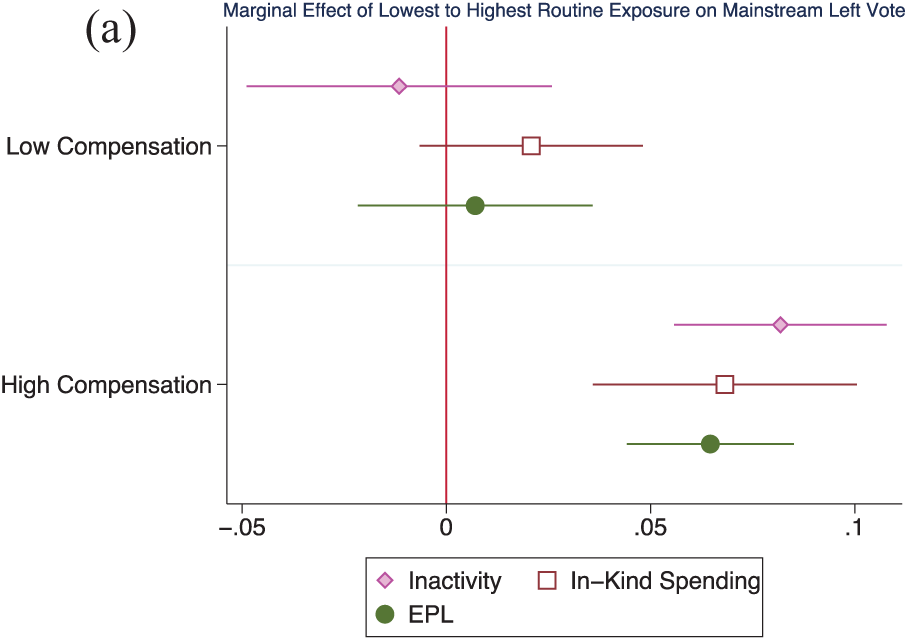
Marginal Effect of Lowest to Highest Routine Exposure on Mainstream Left Vote.
When we turn to right-populist choices, we see little evidence for H2. Higher levels of inactivity (when RTI is at zero) is associated with increased populist choice, with no additional effect on the exposed (column 6). In-kind spending has a negative coefficient, but it is not significant. When we restrict the analysis to places with a right populist present (supplementary Table A2), there is a significant negative effect of spending on populist support among those with no exposure (RTI equal to zero), but it has no reducing effect among the highly exposed. Finally, EPL is positively signed but not significant (column 8). These results suggest, if anything, compensation is associated with more populist voting.
Figure 2b, drawing on a model that excludes observations with no right populists shows these effects. While the sample size is low, limiting our inferences, we see that the marginal effect of RTI on the probability of selecting a populist party is consistently around 1–2% – a non-trivial effect given that an average of 6% of respondents selected populists. However, these effects are similar, or even enhanced, in high-compensation contexts.

Marginal Effect of Lowest to Highest Routine Exposure on Populist Vote.
Table 2 focuses on the fixed effects model. As these models use annual data, and not all the compensation variables are available for 2015, the sample sizes vary. The specifications examining support for right-populists are restricted to country-years with a right-populist contender. Turning to columns 1–4, we can investigate the effects of differences in compensation within countries on mainstream left party choice. Here we see a positive direct effect of inactivity on mainstream left choice, but no interactive effect with exposure (RTI) (column 2). As with the multinomial logit models, there is no direct effect of either in-kind spending or EPL on support for the mainstream left, but both, in relative terms, enhance support the mainstream left among exposed workers (columns 3 and 4). The results of the fixed effects models, for the mainstream left, are substantively similar to those outlined above.
Fixed effects, full sample.

p < 0.05; *p < 0.1.
Columns 5–8 show the results for right-populist parties. Here, inactivity has a relatively strong negative effect on populist support, and it reduces the effect of exposure. This finding suggests that downward changes within countries in levels of inactivity – cut backs – are associated with both increases in overall populist support and increases among those most negatively exposed to automation. The results for in-kind spending are similar to the multinomial logit models discussed above, exposed workers are more supportive in contexts with high in-kind spending. EPL again has little effect.
Both specifications come from a small number of countries and draw on observational data, meaning that they must be interpreted with caution. Collectively, however, they do not provide consistent evidence that compensation has the political effects hypothesized above. In line with H1, there is a positive association between compensation and relative mainstream left support among the highly exposed group across place and time. These results, though, come partly from lower overall support in these contexts from workers with low negative exposure to automation.
Across places, there is little evidence that compensation reduces populism, and may in fact enhance it. The fixed effects models hint that cutbacks in early retirement are associated with more support for populism, but not cuts in either spending or EPL. This evidence then, is unsupportive of the claim that more extensive compensation in the face of past automation substantially moderated populism among exposed workers. 14
Conclusions
In the observational evidence presented here, we see that the compensatory approaches that deeply modified the structures of advanced labor markets appear to have weak or inconsistent effects on how voters responded to new economic pressures – in some cases shoring up support for both the mainstream left and right populists. Do these results suggest that compensation does not matter?
Not necessarily. Social programs very likely have prevented much radicalization among voters in the face of economic shocks (Halikiopoulou and Vlandas, 2016), and pronounced fiscal austerity and direct cuts to social programs may stimulate a backlash. However, it is possible that compensatory policies are less important for how structural economic pressures play out politically in the face of automation than past forms of compensation were in the face of globalization, as affected workers face the risk of losing both income and status.
If voters react to such structural pressures similarly, regardless of the range of compensatory approaches that address their dislocation, then it may point to the limits of such policies alone in reducing dislocation. Instead, we may need to examine the way in which economic pressures matter, and how they are mobilized, looking less at experienced insecurity, and more at how labor markets structure opportunities and choices for voters. Returning to the questions raised in the introduction, this latter interpretation suggests that compensating the “losers” of change may not be enough to prevent the far-reaching political consequences of automation, instead we need to consider policies that make more people “winners” in the new economic environment.
Supplemental Material
Supplementary_AUTOMATION – Supplemental material for Did State Responses to Automation Matter for Voters?
Supplemental material, Supplementary_AUTOMATION for Did State Responses to Automation Matter for Voters? by Jane Gingrich in Research & Politics
Supplemental Material
Supplementary_Tables – Supplemental material for Did State Responses to Automation Matter for Voters?
Supplemental material, Supplementary_Tables for Did State Responses to Automation Matter for Voters? by Jane Gingrich in Research & Politics
Footnotes
Acknowledgements
The author would like to thank Ben Ansell, Bruno Palier, Thomas Kurer and the participants in the Pocotech workshops for feedback on earlier drafts.
Declaration of conflicting interests
The author(s) declared no potential conflicts of interest with respect to the research, authorship, and/or publication of this article.
Funding
The author(s) received no financial support for the research, authorship, and/or publication of this article.
Supplemental materials

Notes
Carnegie Corporation of New York Grant
This publication was made possible (in part) by a grant from the Carnegie Corporation of New York. The statements made and views expressed are solely the responsibility of the author.
References
Supplementary Material
Please find the following supplemental material available below.
For Open Access articles published under a Creative Commons License, all supplemental material carries the same license as the article it is associated with.
For non-Open Access articles published, all supplemental material carries a non-exclusive license, and permission requests for re-use of supplemental material or any part of supplemental material shall be sent directly to the copyright owner as specified in the copyright notice associated with the article.
