




Abstract
Platform work has introduced a new dimension of precarity in the labor market, as platform workers face high labor market risks and have limited access to social protection. The expansion of this employment status raises the question of whether platform workers have distinct social policy preferences from workers with similar socioeconomic backgrounds who are not employed in the platform economy. This paper empirically examines how and under what circumstances the social policy preferences of platform workers differ from those of other workers. We find that platform workers are more likely to demand more compensatory labor market policies than regular workers. Also, they are more likely to demand more social investment-type policies than regular and atypical workers who do not engage in the platform economy. We also find evidence for contextual effects: whereas welfare state generosity is associated with weaker demand from platform workers for compensatory labor market policies, it is associated with higher support for social investment. Our results suggest that the expansion of platform work will fuel demands for welfare expansion, specifically focusing on social investment.
Introduction
Platform-mediated work has grown rapidly in the recent decade, spreading to a broad range of sectors and services with different skill requirements and remuneration patterns—from taxi driving, cleaning, and delivery services to graphic design and software engineering. Platform work is an umbrella term describing a type of work in which a digital interface—a so-called platform—connects labor buyers and sellers, often employing algorithmic management of workers (Vallas and Schor, 2020). These platforms have introduced a new dimension of precarity to the labor market, increasing demands for flexibility and intensifying challenges related to job instability. While atypical employment is not new, platforms have facilitated a complex and widespread adoption of piecework and on-demand labor (Kalleberg and Vallas, 2018). Moreover, the concentration of economic power in the hands of platform companies can create an asymmetric relationship between workers and these companies, making platform workers vulnerable to changes in the platforms’ business goals and strategies (Culpepper and Thelen, 2020). Finally, platform workers are disproportionally exposed to risks of offshoring and automation (Lehdonvirta et al., 2019).
Thus, even though high-skilled crowd workers such as software engineers might face different challenges compared to low-skilled on-demand delivery workers, as platform workers, they are both exposed to demand volatility and face greater income insecurity. The increased exposure to labor market risks is coupled with a lack of coverage via traditional social policy instruments and schemes. As platforms embody a new form of company organization, their workforce tends to exist in a regulatory vacuum between employees and self-employed (Behrendt et al., 2019; Palier in this volume). Workers who depend primarily on platform work are rarely covered by collective bargaining, employment rights protection, or national social insurance systems (Woodcock and Graham, 2020), see Daugareilh et al. (2019) for a comparative legal overview. Previous research has suggested that platform work has accelerated the process of individualization of risks by exempting companies from social responsibility (Kalleberg and Vallas, 2018; Rahman and Thelen, 2019; Thelen, 2019).
The spread of platform work has, in short, potentially created a new type of worker who combines greater exposure to labor market risks with lower levels of social protection through traditional welfare state institutions. This combination of characteristics suggests that platform workers—in spite of the continued heterogeneity of this group—might also differ from regular workers in their social policy preferences, as the latter group of workers is well covered by existing welfare state schemes. Ultimately, however, it is an empirical question to what extent social policy preferences of platform workers are different from those of other workers. Given the large heterogeneity of workers within the broad category of platform work, the platform worker status might be less decisive relative to individual-level factors, in particular the individuals’ skills and educational resources. The purpose of this paper is to answer this open empirical question by employing novel international comparative survey data.
More specifically, our empirical analysis draws on data from the OECD “Risks that Matter” survey. In the 2020 wave, this survey included a module devoted to social risks related to technological change. The strength of these survey data compared to existing alternatives is that it allows for a much more fine-grained measurement of the status of individuals as platform workers, which is crucial, given the complexities of measuring this particular employment status. At the same time, as we will also point out in detail below, the survey data has some limitations which should be addressed in future research. As dependent variables, our study focuses on preferences for compensatory and social investment-type labor market policies. We conduct multilevel models and include cross-level interactions to assess how welfare state generosity moderates those attitudes, adding an important cross-national, comparative perspective.
Our results confirm that the social policy preferences of platform workers are substantially different from those of other workers, controlling for individual-level factors such as educational background, income, and other variables. Our findings show that platform workers are generally more likely to support the expansion of both compensatory as well as social investment-type labor market policies than regular workers. Platform workers also demand more social investment policies than atypical workers who do not participate in the platform economy. The analyses furthermore reveal that context matters in determining platform workers’ social policy preferences: platform workers living in generous welfare states are less likely than those living in residual welfare states to support the expansion of compensation-type labor market policies. However, their support for social investment-type labor market policies is not negatively affected by welfare generosity. These results suggest that the spread of platform employment goes along with greater support for expanding welfare state policies across the board. In particular, the expansion of platform work might intensify demands for a social investment turn in the welfare state.
Background and literature review: platform workers and the welfare state
Commercial work platforms create marketplaces that connect buyers and sellers in a highly flexible manner (Kenney and Zysman, 2016), charging a fee to mediate the relationship between service providers and users while providing the infrastructure for this interaction (Koutsimpogiorgos et al., 2020). By automating and digitalizing this process of exchange, the platforms reduce barriers to market entry and exit, allowing the commercialization of small or complex tasks through (very) short-term forms of employment (Vallas and Schor, 2020). This ephemeral work relationship is a product of the digital revolution in the labor market, which has accelerated already existing processes of flexibilization and precarization (Kalleberg and Vallas, 2018). In this study, we define a platform worker as an individual who sells their labor through these platforms, providing services either online or offline (Vallas and Schor, 2020).
While there is considerable legislative variation across countries and differences in platform practices (Aloisi, 2022; Boeri et al., 2020), in most cases, workers are associated with platforms as self-employed (or “independent contractors”) (Daugareilh et al., 2019; Picot, 2022). This classification assumes workers to have a high degree of independence from the platform company. Research has confirmed that the autonomy to set working hours and the possibility of combining platform work with traditional jobs is a key motivator for workers joining platforms (Lehdonvirta, 2018; Sutherland et al., 2020). However, the presumption of independence between workers and platforms has become highly contested in the literature, as studies have shown that those workers often have limited bargaining power to set their prices and working hours, as these are typically regulated by platform algorithms (Drahokoupil and Vandaele, 2021; Meijerink and Keegan, 2019; Ravenelle, 2017).
Such misclassification of platform workers’ employment status enables platforms to bypass labor laws, exempting them from social contributions and fees that regular employers face (Drahokoupil and Piasna, 2022; Picot, 2022). As a result, platforms have considerable competitive advantages compared to other firms, contributing to their rapid expansion (Rosenblat and Stark, 2016). This also means platform workers have limited access to employment-based social insurance and are not covered by collective labor agreements (Behrendt et al., 2019; Daugareilh et al., 2019; Joyce et al., 2019).
However, this finding should be nuanced in light of the fact that a considerable number of platform workers also engage in a primary occupation in the traditional labor market (Huws et al., 2018). This implies that workers who engage in platform work to complement the income of a regular job are covered by work-related benefits provided by their primary job, which also offers them some income security. Moreover, welfare institutions are also relevant with regard to platform workers’ access to social benefits and services. In a more generous, universalist welfare state, some benefits and services are distributed based on social citizenship, regardless of previous contributions. This means that dependent platform workers are likely to enjoy more social security in universalist, citizenship-based welfare states compared to insurance-based or residual welfare regimes. And finally, there is a large heterogeneity within the group of platform workers, which can include low-skilled services such as food delivery or handyman work, but also high-level skills such as software engineering. Within this large group, individuals differ with regard to access to individual economic resources. Workers with more resources at their disposal (e.g., to bridge periods of low or even (voluntary) unemployment) are likely to be less dependent on the welfare state compared to low-skilled workers.
In the next section, we develop our theoretical expectations on the differences between platform and non-platform workers’ social policy demands and the impact of welfare state contexts on these demands in greater detail.
Theoretical expectations
Differences between platform workers and other groups of workers
We start our theoretical discussion with the question of whether platform workers’ social policy preferences are likely to differ systematically from those of other workers. A large body of literature on comparative political economy has identified a strong and positive association between labor market risk and the demand for social protection (Rehm, 2009, 2016; Rehm et al., 2012; Rueda, 2005, 2007; Schwander and Häusermann, 2013). Previous studies have also shown that besides risk, employment status additionally matters in shaping individuals’ risk perceptions and policy preferences, in particular for those in precarious self-employment (Dekker, 2010; Jansen, 2017, 2019).
Our expectations are built on these studies. Here, as well as in the empirical analysis below, we focus on those platform workers who depend strongly (albeit maybe not solely) on platform work for their monthly income. These platform-dependent workers often do not have access to work-related benefits in contrast to platform workers who use this kind of work to boost their income from regular employment. The latter group is often covered by benefits associated with their regular employment contract; hence, in this case, we would not expect strong preference differences between platform workers and other workers. However, for the narrower group of genuine platform workers, we expect strong differences in preferences. To some extent, the preferences of genuine platform workers should be similar to those in atypical (precarious) employment. Given that atypical workers are often—depending on the country context—still covered by some welfare state benefits and services, we expect the preferences of genuine platform workers to deviate in an even stronger manner from those of typical workers.
Our overarching theoretical expectation is that platform workers, compared to regular workers, demand more support from the welfare state because of their precarious employment position and lack of access to social benefits. A potential counter-argument would be to claim that platform workers voluntarily chose platform work as a more flexible and independent type of project work, which might be associated with a more “individualistic” approach to social insurance and therefore less demand for support from the welfare state. A further potential counter-argument could be that given the large heterogeneity of platform workers in terms of skill levels and income, individual-level factors should be more important in shaping social policy preferences rather than the employment status of platform workers.
Ultimately, it is an empirical question whether differences in preferences between platform and regular workers exist, that is, whether the effect of the joint employment status outweights that of individual-level variables. Furthermore, some traction on the counter-arguments can be gained by analyzing the heterogeneity of preferences within the platform workers by interacting individual-level variables with the platform worker status. The urge to self-insure against social risks rather than relying on the collective insurance of the welfare state should be stronger for individuals with more resources at their disposal, which we will analyze below by exploring the interaction effects between education and platform work status.
The literature on welfare states makes a key distinction between compensatory policies, which address social risks like unemployment after they occur, and social investment-type policies, which aim to enhance skills and human capital (Eichhorst et al., 2022; Garritzmann et al., 2018). Considering platform workers’ limited access to work-related benefits and the insecure nature of their work, we expect platform workers to be more likely to demand better access to and provision of compensatory policies, such as unemployment benefits, as these types of policies are directly related to their precarious employment situation.
With regard to social investment policies, the theoretical expectations are a bit less clear-cut. On the one hand, social investment policies, such as active labor market policies, further training and investments in education, may not immediately affect the employment situation of platform workers as their full benefits are realized only in the long term. On the other hand, platform workers might be especially eager to access these policies, as they are arguably the first group to be impacted by current digital transformations in the labor market (Eichhorst et al., 2022). Therefore, they are more likely to seek training in skills that will enable them to thrive in the knowledge economy and survive in a hypercompetitive work environment (Giazitzoglu, 2014; Meijerink et al., 2020; Ravenelle et al., 2021; Shibata, 2020).
Translated into social policy preferences, this perspective suggests that platform workers are likely to demand more access and better provision of social investment-type labor market policies than regular workers.
As a result, we develop the following hypotheses regarding platform workers' social policy preferences:
Platform workers are more likely than regular workers to demand better access to and expansion of social investment-type labor market policies.
Platform workers are more likely than regular workers to demand better access to and expansion of compensatory labor market policies. As in our theoretical discussion above, individual-level variables, in particular, the educational background of platform workers, might also matter with regard to which particular kinds of social policy they demand. High-skilled platform workers, such as software engineers, and graphic designers, often engage in this activity to gain extra income, and flexibility, build work experience, and acquire new skills (Hoang et al., 2020; Joyce et al., 2019; Ravenelle, 2019; Wood et al., 2019; Woodcock and Graham, 2020). In contrast, low-skilled platform workers, such as those involved in delivery, cleaning, caretaking, data entry, and photo tagging, typically turn to platform work as a last resort to make ends meet (Dunn, 2020; Hoang et al., 2020; Joyce et al., 2019; Ravenelle, 2017; Van Doorn, 2017). This means that low-skilled platform workers experience greater income insecurities while high-skilled platform workers are in a relatively privileged position. In terms of social policy preferences, we therefore expect low-skilled platform workers to particularly demand compensation-type labor market policies, whereas high-skilled platform workers should be interested in social investment-type labor market policies, as skill acquisition is especially important for their labor market success.
High-skilled platform workers are more likely to demand social investment-type labor market policies compared to regular workers.
Low-skilled platform workers are more likely to demand compensatory labor market policies compared to regular workers.
The influence of welfare state contexts
We now turn to the discussion of contextual effects, in particular how differences between generous and residual welfare states might be related to variations in social policy preferences of platform workers. There is a well-established tradition in comparative welfare state research identifying policy feedback effects of existing institutional arrangements on the level of individual attitudes and preferences (for recent overviews, see Béland and Schlager, 2019; Busemeyer et al., 2021; Larsen, 2020). Therefore, we expect to observe similar effects also in our case.
Even though there is still discussion in the literature on the overall direction of policy feedback (Busemeyer et al., 2021), we hypothesize the existence of self-undermining feedback effects in the present case. According to this logic, individual social policy demands are expected to indicate changes away from the status quo, particularly if the status quo is perceived as producing negative side effects, such as inequality or poor economic performance (Weaver, 2010). In line with this thinking, we posit the existence of interaction effects between platform worker status and welfare state context. In other words, it matters in which welfare state someone is a platform worker. In simple terms, our expectation is that platform workers living in residual (less generous) welfare states are more likely to demand compensation and/or social investment from the welfare state than platform workers living in generous universalist welfare states. The reason is that even though platform workers are typically excluded from many employment-related social benefits, universalist-encompassing welfare states provide a range of social services (and partly benefits) as a matter of social citizenship, that is, independent of workers’ status, hence demand for additional social protection from platform workers should be lower in these kinds of welfare state. Furthermore, platform workers in generous welfare states might also prefer being exempted from paying into collective social insurance systems because they could perceive them as onerous and bureaucratic (Ravenelle et al., 2021). Thus, our hypotheses regarding welfare state contexts are as follows:
Platform workers in less generous welfare states are more likely to demand access to and expansion of social investment-type labor market policies than platform workers in more generous welfare states (and vice versa).
Platform workers in less generous welfare states are more likely to demand access to and expansion of compensatory labor market policies than platform workers in more generous welfare states (and vice versa).
Data and methods
Dependent variables
As mentioned above, our data source is the 2020 wave of the OECD “Risks that Matter” survey. This cross-national survey assesses perceptions of social and economic risks and related policy preferences. It was conducted in 25 countries—Austria, Belgium, Canada, Chile, Denmark, Estonia, Finland, France, Germany, Greece, Ireland, Israel, Italy, Korea, Lithuania, Mexico, the Netherlands, Norway, Poland, Portugal, Slovenia, Spain, Switzerland, Turkey, and the United States—with around 25,000 respondents in total aged between 18 and 64 years. The survey is administered by the public opinion and market research firm Respondi, using online sampling with non-probability samples recruited via the Internet and phone. Sampling is based on quotas for gender, age group, education level, income level, and employment status, and respondents receive compensation of around one or two euros per survey (OECD, 2021).
Our central dependent variables are measures of support for social investment-type and compensatory labor market policies. Differing somewhat from typical measures of social policy attitudes, we rely on an indicator that captures an individual’s willingness to pay for access to and the expanded provision of different types of social policies. We use this measure because it captures the aspect of access to a particular social policy, which is of great relevance in the context of our discussion on platform work. Furthermore, it is likely to provide a more robust estimate of individual demand for social policy expansion, as the wording directly mentions the costs in terms of higher taxes. It is important to bear in mind, however, that 2% might be a small contribution compared to what would be necessary to fully include platform workers in the social benefit pool.
The exact wording of the questions is: “Would you be willing to pay an additional 2% of your income in taxes/social contributions to benefit from better provision of and access to employment support (e.g., job-search support, skills training support, better access to funds to start a business)?” “Would you be willing to pay an additional 2% of your income in taxes/social contributions to benefit from better provision of and access to unemployment support (e.g., unemployment benefits)?”
We consider employment support as a social investment-type labor market policy and unemployment support as a compensatory labor market policy and consider both in separate analyses below. We construct binary variables for each of these two policies, where a value of “1” is given if the individual supports better provision of and access to the policy and “0” otherwise. We also cross-validate our findings using more conventional measures of social policy demand/support as they are provided in the survey (see the robustness section below).
Independent variables
This study aims to contrast the social policy preferences of platform workers to regular workers and atypical workers who do not engage in platform work. Individuals who are not primarily workers, such as students and retirees, are excluded from the analysis. A binary variable operationalizes workers’ participation in the platform economy (“1” if the respondent uses platforms to find work at least once a month and “0” otherwise). 1 We adopt once a month as the minimum frequency of engagement in platforms for a worker to be considered a “platform worker,” 2 as more sporadic participation in the platform economy is unlikely to influence individual welfare preferences.
Participation in the platform economy is associated with a variable concerning workers’ labor market status. This variable is binary, coded as “1” if the worker has an atypical job, such as working part-time or in temporary contracts, and “0” if the worker is characterized as having regular employment, which means working full-time in an open-ended contract. As mentioned before, platform workers who are also regular workers are considered regular workers. Therefore, our definition of platform workers focuses on those whose monthly income depends on this work to a large extent but potentially not exclusively. Consequently, our main independent variable has three categories: (1) platform workers, (2) atypical workers who are not platform workers, and (3) workers in a regular work contract.
Unfortunately, our data does not allow for differentiation between platform workers who perform services online and those who perform on-site, which is a notable limitation, as previous studies have shown that these workers differ substantially in terms of social vulnerabilities (Lehdonvirta, 2018; Vallas and Schor, 2020), which could influence their social policy preferences. We can partly mitigate this limitation by using a series of country and individual variables to account for alternative factors influencing workers’ social policy preferences. A binary variable accounts for respondents’ education (“1” for tertiary education or higher education level and “0” otherwise). We measure household income as the individual’s position in the income distribution (given in country-specific deciles). We include a binary variable to control for respondents’ gender (“1” men, “0” otherwise), and we also include a continuous variable of the respondents’ age. Regarding macro-level explanatory variables, we include total welfare expenditure as a percentage of gross domestic product (GDP) and total expenditure in labor market policies, also as a percentage of GDP. The independent variables used in the study and their distribution are available in Table 1A and Figure 1A in the Supplemental Material.
Methods
We run a series of linear multilevel models with country random intercepts and the above-mentioned variables as dependent variables. The core independent variable of interest is the labor market status, categorized as platform, atypical, or regular worker. We include cross-level interactions between this variable and macro-level contextual variables to account for the influence of welfare state contexts on preferences as well as interactions between individual education background and platform worker status. In line with literature recommendations, we add a random slope when using cross-level interactions (Heisig and Schaeffer, 2019). It should be noted that the fieldwork for the OECD “Risks That Matter” 2020 survey was carried out during the COVID-19 pandemic. The exceptionality of this moment is likely to affect platform work in several ways. First, an unprecedented number of jobs disappeared during the economic downturn, creating a mass of unemployed workers ready to take precarious jobs on online platforms. Moreover, many workers started to work from home, allowing some to combine a regular job with platform work. The condition of a global pandemic likely also increased the general perception of insecurity, thus increasing the overall demand for social protection. We believe that the increase in insecurity is not homogeneous among the population and that individuals with precarious jobs are likely to be more affected by the crisis. Thus, it might well be the case that the global crisis accentuated the difference between more protected worker groups and atypical workers, such as platform workers, but given the available survey data, it is not possible to empirically assess this claim directly.
Results
Descriptive statistics
Individual level
Association between labor market status, education, disposable household income, and willingness to pay for better access to and provision of social investment and compensation (including 95% confidence intervals).
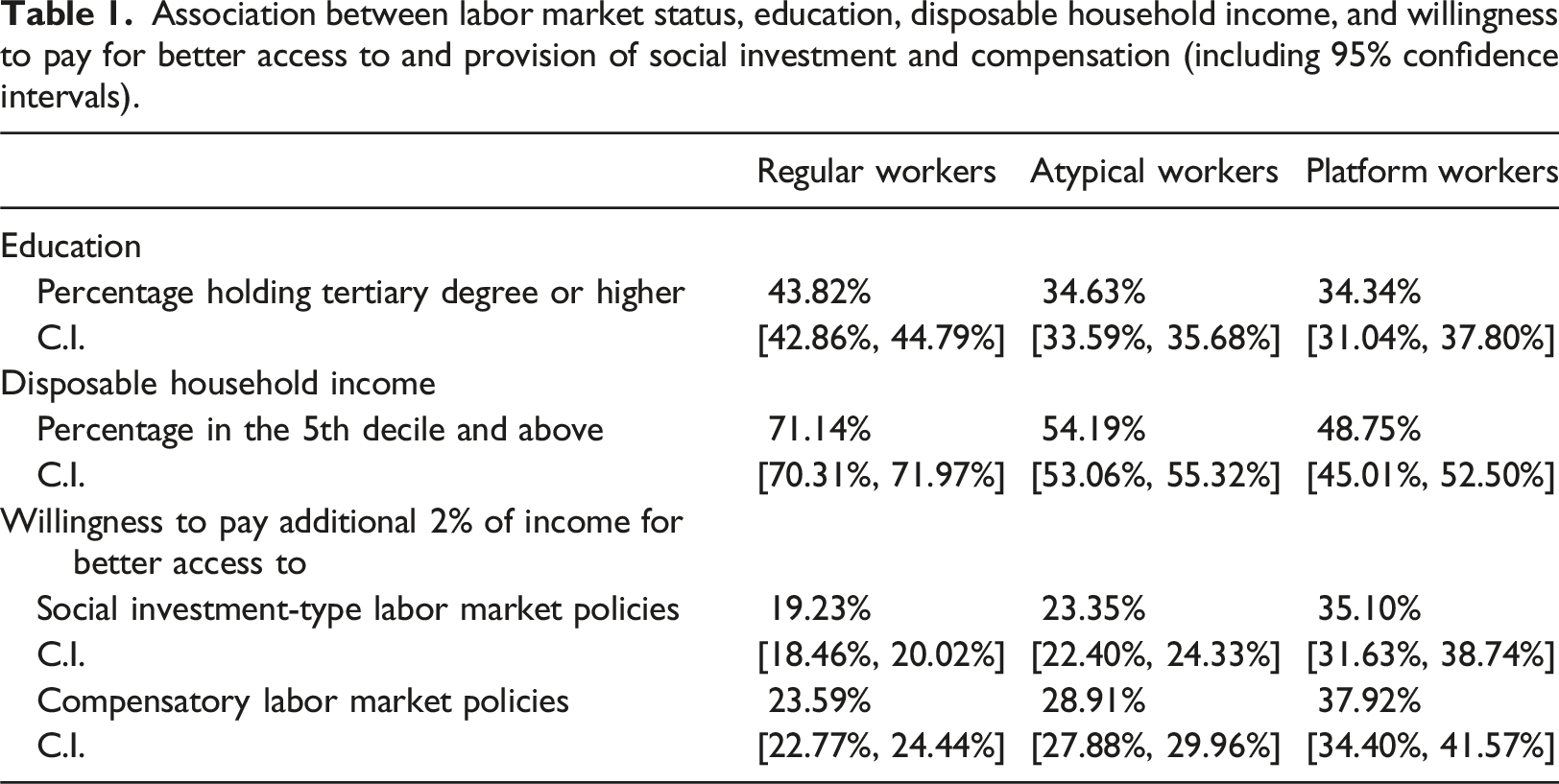
Table 1 also shows the simple bivariate association between our dependent variables and our main independent variable. It reveals that platform workers are more likely than atypical non-platform workers and regular workers to agree to pay an additional 2% of their income in taxes or other contributions to have better access to and provision of compensation and social investment-type labor market policies, providing tentative support for our core hypotheses. Notably, the disparities between social policy preferences of regular workers and platform workers are particularly large regarding both social investment and consumption-type labor market policies.
Country level
Across all countries, workers who use platforms to find work at least once a month and are not employed in a regular job represent 4.11% of our sample. This ratio varies from 11.54% in Spain to 0.86% in Germany (Figure 1). This suggests that only a small fraction of the population in the analyzed countries is a genuine platform worker and is likely to depend on platform income on a monthly basis.
3
Share of workers who participate in the platform economy at least once a month and are not regular workers, by country.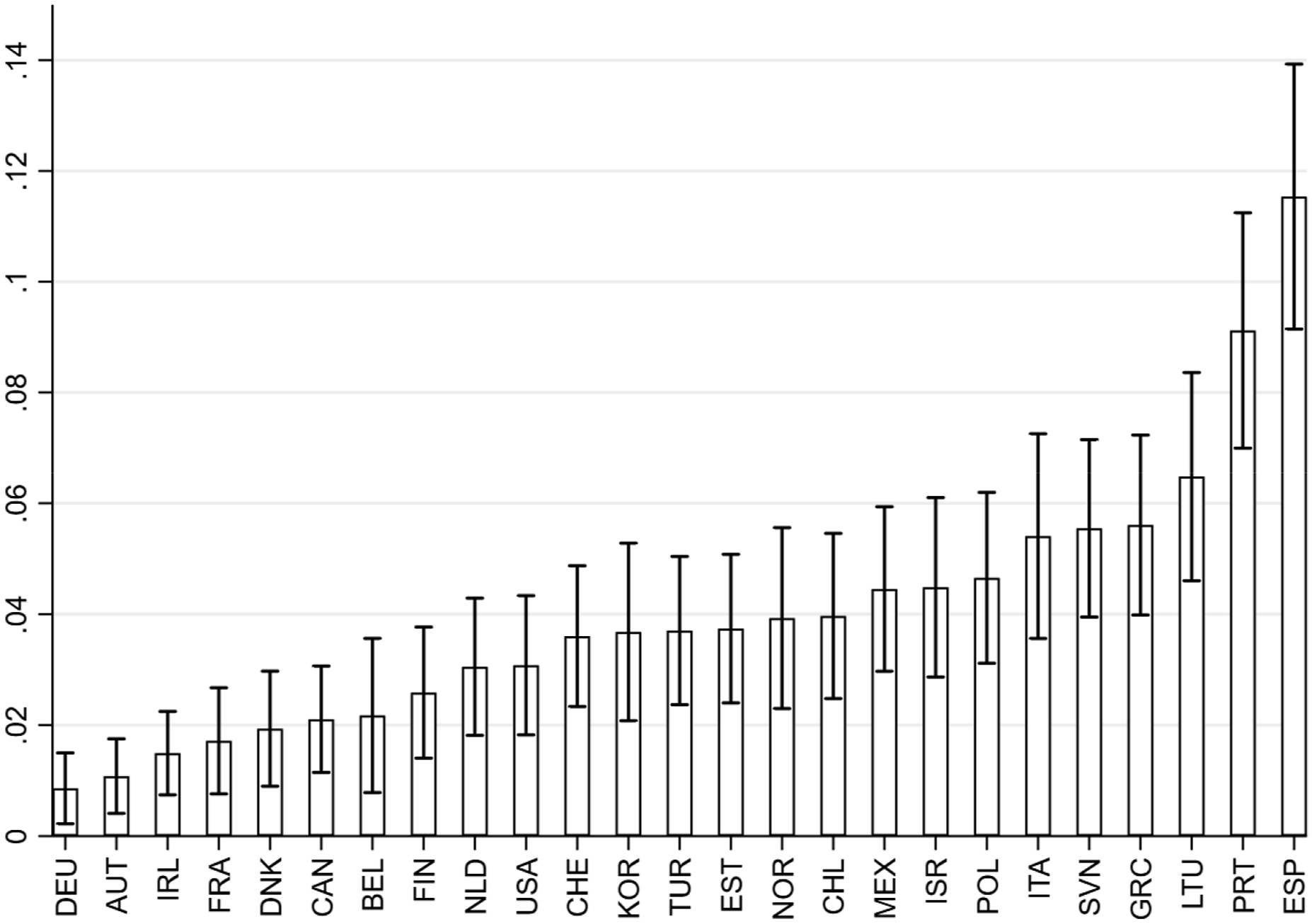
To determine whether this share varies in line with the macro-level variables, Figure 2(a) and (b) shows the association between the percentage of platform workers willing to pay for better provision of and access to social investment-type (on the left-hand side) and compensatory labor market policies on the one hand and the country level of public social expenditure (as a percentage of GDP) on the other. Percentage of platform workers willing to pay an additional 2% in taxes or contributions for better access to and provision of (standard errors in parentheses) (a) social investment-type labor market policies and (b) compensatory labor market policies, by country welfare expenditure as a GDP ratio.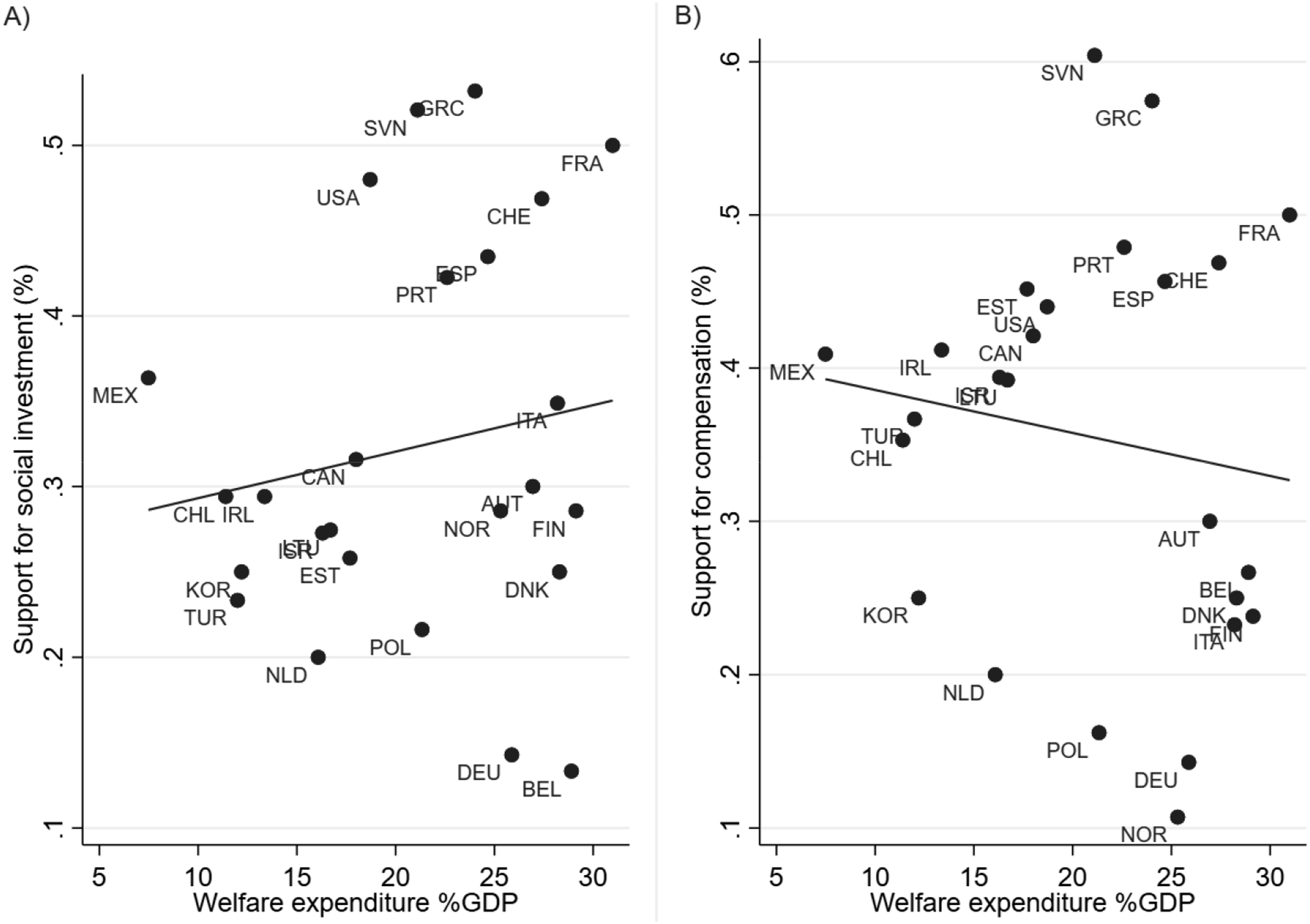
Figure 2(a) reveals a positive relationship between welfare state generosity and platform workers’ support for social investment-type labor market policies, whereas Figure 2(b) shows a negative relationship between welfare state generosity and platform workers’ support for compensatory labor market policy. These associations point toward a self-undermining policy feedback effect, but only in the case of compensatory social policies, partially in line with H4b. This result suggests that despite the fact that platform workers are typically excluded from many employment-related social benefits, in more generous welfare states, some of those benefits are available to them as part of social citizenship. This effect will be examined more closely below.
Multilevel models
To examine differences in social policy preferences between platform workers, atypical workers, and regular workers while controlling for individual characteristics such as education, age, sex, and disposable income, we conducted linear multilevel regressions as explained above.
Figure 3(a) and (b) displays the association between labor market status and the predicted probability of support for compensatory and social investment-type labor market policies, with other variables held constant at their means. The complete regression output is available in Table 2A of the Supplemental Material. The figure shows that platform workers are 13% more willing than regular workers to pay for improved access to social investment policies and 11% more willing to pay for better access and provision of compensatory policies, supporting H1a and H1b. It also indicates that platform workers exhibit stronger support for the expansion of both types of labor market policies compared to atypical workers not engaged in the platform economy. However, this latter result is only statistically significant at the 95% confidence level in the case of social investment-type policies. Predicted probability of the willingness to pay an additional 2% in taxes or contributions for better access to and provision of (a) social investment-type labor market policies and (b) compensatory labor market policies, by labor market status.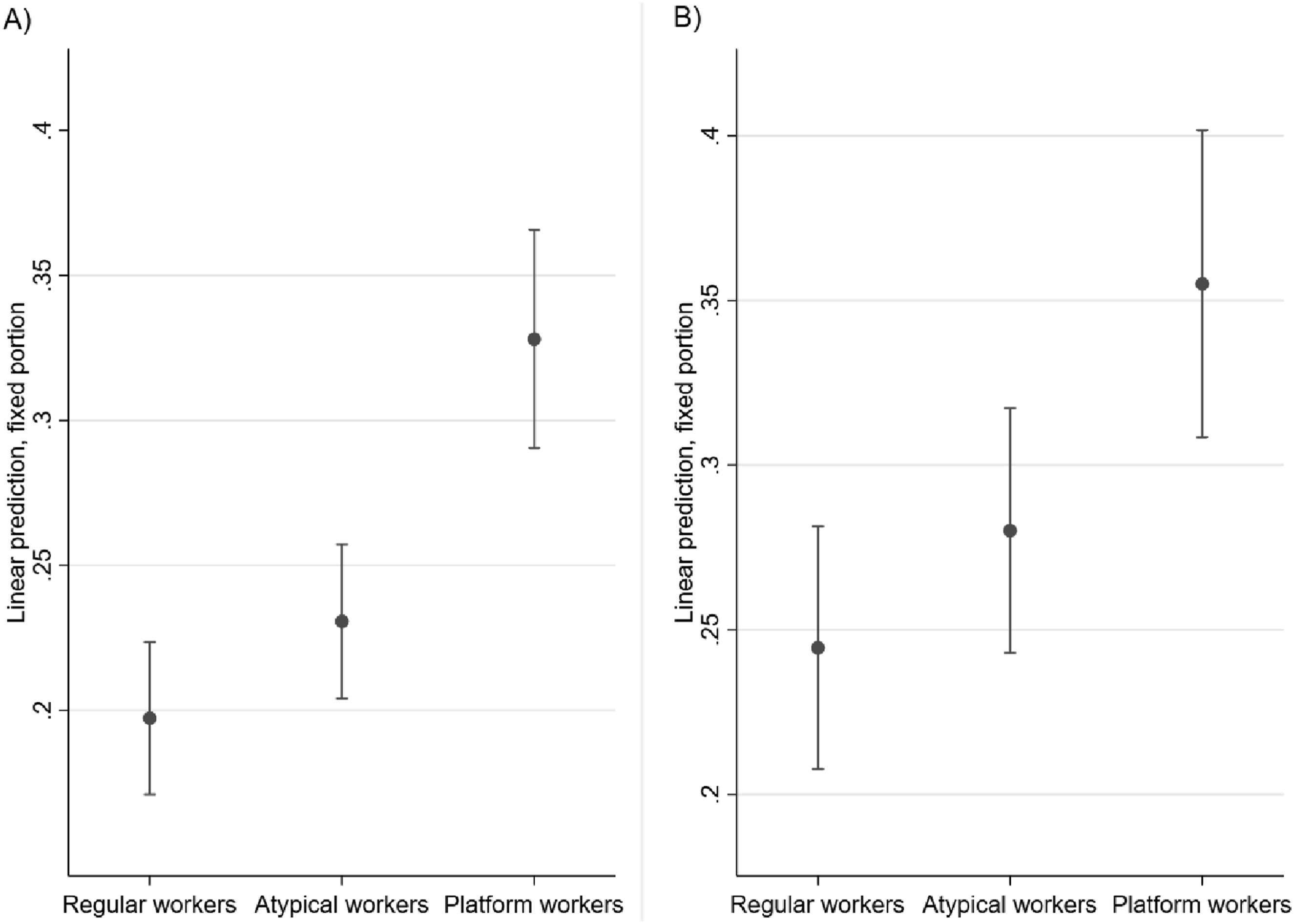
We proceed with our analyses evaluating the role of education in moderating platform workers’ social preferences and the extent to which they differ from other workers, exploring the heterogeneity in terms of individual-level resources within the larger group of platform workers. Figure 4(a) and (b) displays the predicted probability of support for social investment-type and compensatory labor market policies, distinguishing further between platform workers with tertiary education and those without (the complete regression output is available in Table 2A in the Supplemental Material). Predicted probability of the willingness to pay an additional 2% in taxes or contributions for better access to and provision of (a) social investment-type labor market policies and (b) compensatory labor market policies, by labor market status and education.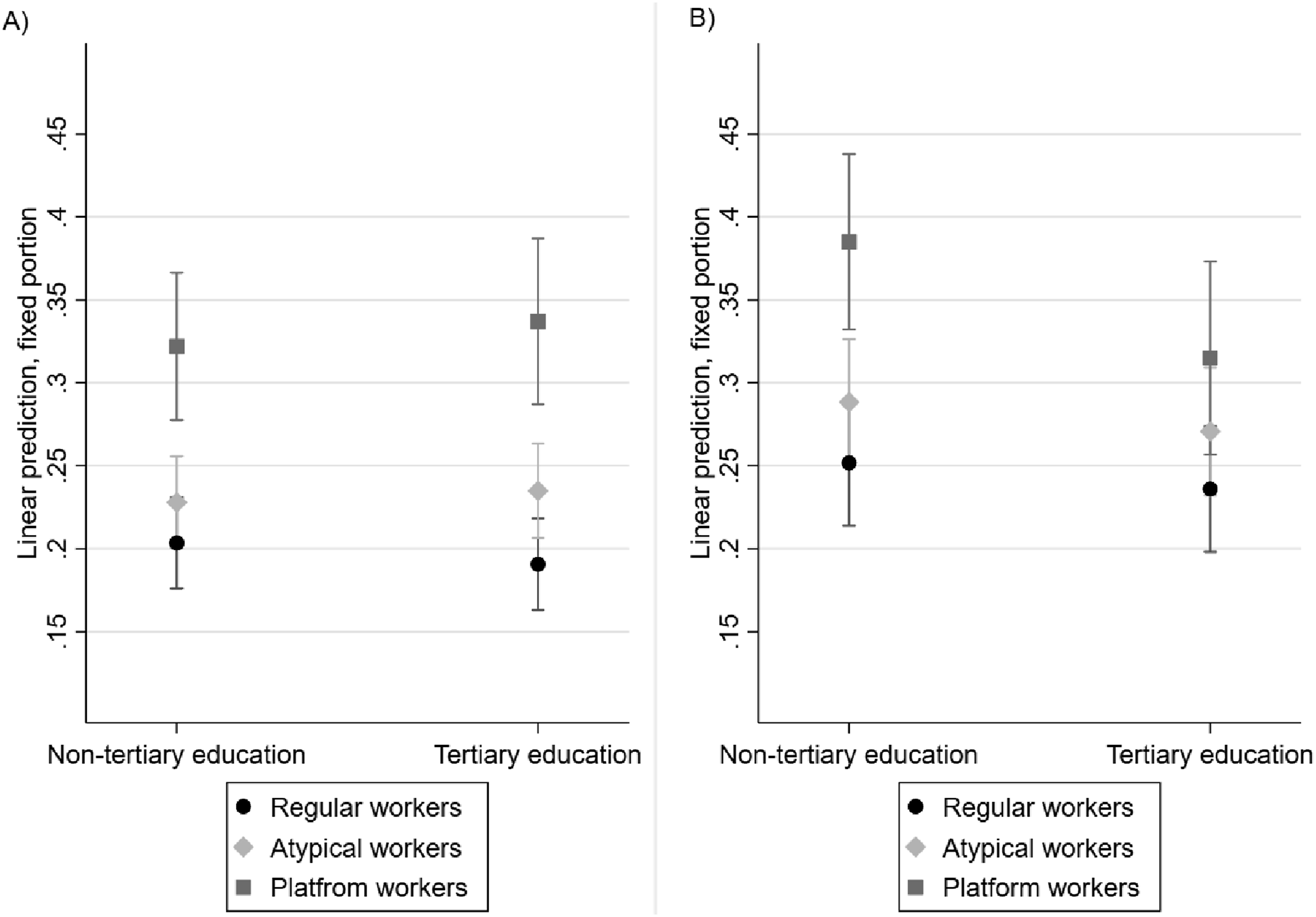
In line with H2a, Figure 4(a) illustrates that both high-skilled and low-skilled platform workers are significantly more inclined to pay for improved access to and provision of social investment-type labor market policies compared to regular and atypical workers with similar skill levels. Consistent with H2b, low-skilled platform workers are more likely to support the expansion of compensatory labor market policies, whereas high-skilled platform workers are no longer distinguishable from regular or other atypical workers in this regard. However, when comparing these effects, the differences between high-skilled and low-skilled platform workers are not statistically significant. In sum, the core insight here is that platform workers—independent of their individual skill level—are more likely to demand social investment-type social policies, whereas the demand for compensatory policies is strongest for low-skilled platform workers, albeit with less empirical support in terms of statistical significance.
We conduct a number of robustness tests of our findings. For one, we replicate our analysis using more conventional measures of social policy, which measures the support of government spending in a given policy area, 4 given the taxes the respondent might have to pay and the benefits they and their family receive. The results, available in Figure 2A of the Supplemental Material, also indicate that platform workers are more likely than non-platform workers to support policy expansions. However, in these alternative analyses, the differences between platform workers’ and non-platform workers’ social policy preferences are not significant, confirming our expectations that platform workers’ limited access to benefits and services are relevant factors in understanding their preferences.
In the next and final step, we study whether welfare state contexts also influence the effect of platform work on social policy preferences. Hence, we turn to interactions between contextual effects and platform workers’ employment status. To test our hypothesis that platform workers in residual welfare states will demand more social investment and compensatory policies than platform workers in generous welfare states, we calculate the marginal effect of welfare expenditure on platform workers’ willingness to make an additional contribution for better provision of social investment-type (Figure 5(a)) and compensatory (Figure 5(b)) labor market policies. Predicted probability of typical workers, atypical non-platform workers, and platform workers’ willingness to pay 2% more of their income for better access to and provision of (a) social investment-type labor market policies and (b) compensatory labor market policies, by levels of total welfare state expenditure as GDP ratio.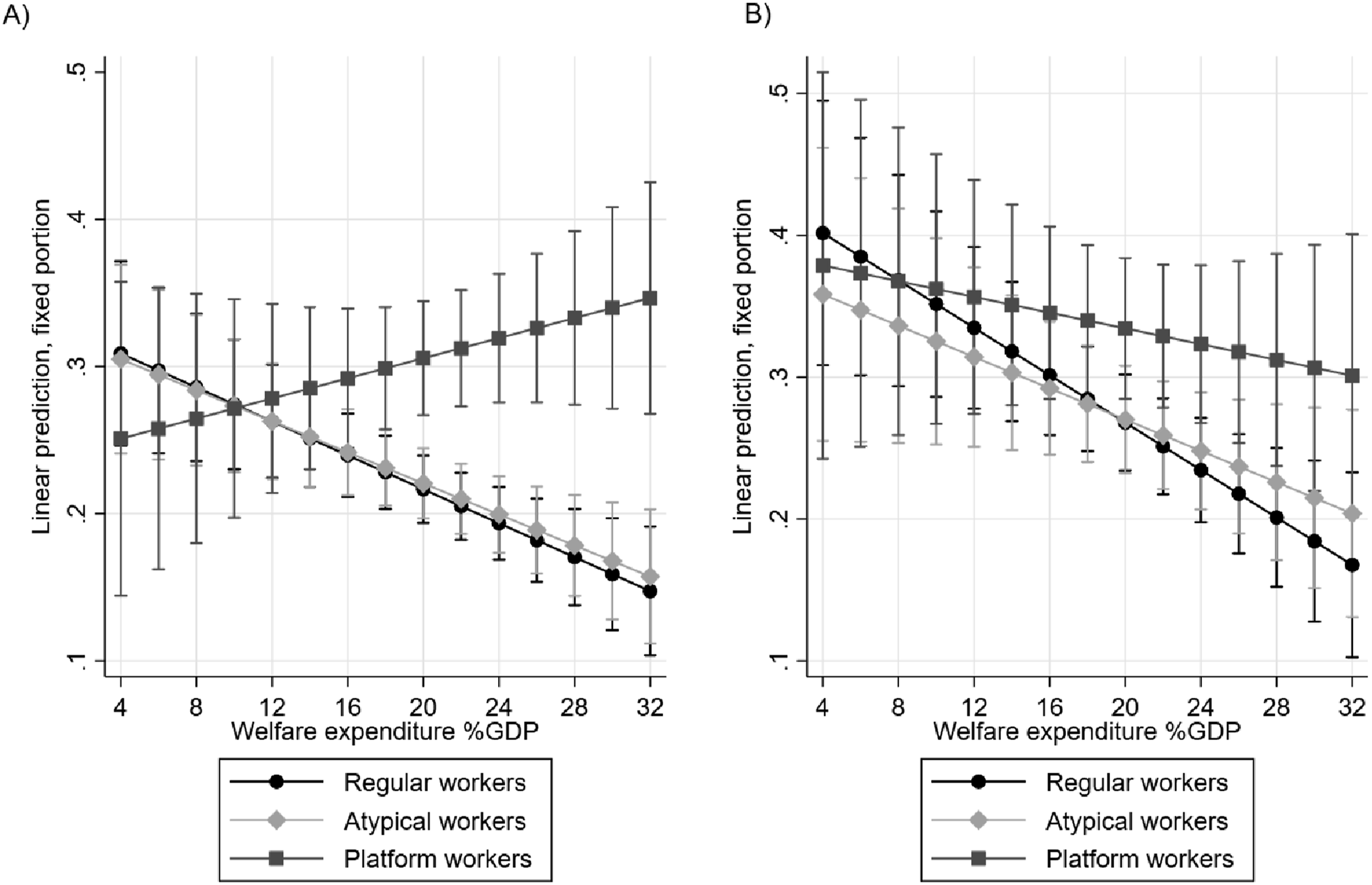
For the case of social investment-type labor market policies, Figure 5(a) shows a distinct attitudinal pattern for platform workers. Contrary to our expectation of self-undermining policy feedback (H3a), higher levels of welfare state expenditure are actually associated with greater support among platform workers for social investment-type labor market policies. This could be potentially explained with positive spill-over effects in the sense that platform workers in generous welfare states have learned to appreciate the benefits of social investment-type policies and therefore demand this kind of policy in order to improve their employment situation in the long term rather than focusing on compensation only in the short term. In line with our expectations, Figure 5(b) shows that higher welfare expenditures are associated with lower support among platform workers for compensatory labor market policies. However, this result is not statistically significant at a 95% confidence level, providing weak support for H3b at best.
We replicate the analysis of Figure 5(a) and (b), this time utilizing labor market policy expenditure as a proxy for welfare generosity. Figure 4A, which can be found in the Supplemental Material, confirms our previous findings, indicating that the generosity of labor market policies is associated with decreased support among platform workers for compensatory labor market policies but not for social investment-type labor market policies. Finally, to verify whether platform workers have different welfare preferences compared to other workers within the same country, we repeated the analysis, incorporating the country averages for platform workers, atypical workers, and regular workers (see Bell et al., 2019). The results of this analysis, presented in Figures 5A, 6A and 7A of the Supplemental Material, show that the observed differences also apply within countries.
Conclusion
The rise of platform labor is transforming work for a growing population of workers. In this article, we argue that the social policy preferences of platform workers are genuinely different from those of regular workers in important aspects. Our empirical analysis, drawing on data from the OECD “Risks that Matter” survey, showed that being a platform worker is associated with a significantly greater demand for social investment and compensation policies compared to regular workers, even if expanded access and provision to these benefits and services would go along with an increase in income taxes. We further explored the potential impact of heterogeneities in the individual educational background of platform workers, finding that such workers demand more social investment-type labor market policies compared to other workers regardless of their educational level. Moreover, platform workers without tertiary education demand more compensation compared to atypical workers with the same level of education. Lastly, our study also revealed a significant degree of cross-country variation, both in terms of the size of the group of platform workers and with regard to how welfare state contexts shape platform workers’ social policy preferences. In particular, in the case of social investment-type labor market policies, our findings indicate that platform workers are more supportive of expansion in more generous welfare states. These results reveal that access to social investment-type labor market policies is central for platform workers, in line with previous studies pointing to the relevance of training for workers who intensively use digital technology (Busemeyer et al., 2022; Busemeyer and Tober, 2023).
Our findings have broader political and policy implications. For one, even though the expansion of the platform economy is often thought to undermine existing welfare states, our analysis suggests that this expansion may also create new welfare state constituencies demanding to be integrated into existing social policy schemes and for those schemes to be expanded. Our analysis also indicates that digital transformations might further fuel demands for a social investment turn in the welfare state. Hence, the risk of the platform economy undermining welfare states stems from the practices of technology companies rather than individual workers turning away from the collective financing and provision of social policy.
The translation of social policy preferences into policymaking is, however, not automatic but depends on the mobilization of platform workers and the articulation of their interests within unions and organizations that promote their political interests. Such mobilization is likely to face more challenges and difficulties in the case of platform workers compared to regular workers in the traditional sectors (where it is also facing challenges). Nevertheless, there are nascent trends of platform workers getting organized in some OECD countries (Tassinari and Maccarrone, 2020) and social partners getting involved in the discussion about regulations of platform workers’ status and activities (Ilsøe, 2017). Moreover, mobilization at national and international levels to prevent the misclassification of platform workers as self-employed (Aloisi, 2022; de Stefano, 2016) may promote the inclusion of these workers in existing social protection schemes. The recent discussion of creating international standards for decent work in the platform economy at the International Labour Organization (ILO) is an important step in this process. 5
Of course, our study has limitations, which could point out avenues for future research. For instance, our survey data does not allow us to distinguish between online and offline platform work, even though this distinction is known to be important in debates about the platform economy. To some extent, the distinction could be related to individuals’ educational background (think, for instance, of a software engineer vs a delivery driver), but clearly, more fine-grained data would be needed here. The same holds with regard to the household composition of platform workers, which our survey data does not take into account. However, it clearly makes a large difference whether platform workers can rely on income from other household members or whether they live in a precarious situation. Finally, as we only have cross-sectional data, we do not know to what extent the duration of the status as a platform worker matters, which could be probed in panel data. Future studies with better data can hopefully address some of these issues.
Supplemental Material
Supplemental Material - Different status, same demands? The social policy preferences of platform workers in OECD countries
Supplemental Material for Different status, same demands? The social policy preferences of platform workers in OECD countries by Juliana Chueri and Marius R Busemeyer in Competition & Change.
Footnotes
Acknowledgments
We would like to thank the participants of the “Socio-Economic Transformations and Social Policy Preferences” panel at the Council of European Studies Conference in Lisbon, in particular, Silja Häusermann and Julian Garritzmann for their guidance in the early stages of this project. Additionally, we are grateful to Jonas Pontusson for his insightful comments on this paper.
Declaration of conflicting interests
The author(s) declared no potential conflicts of interest with respect to the research, authorship, and/or publication of this article.
Funding
The author(s) disclosed receipt of the following financial support for the research, authorship, and/or publication of this article: This paper is part of the research project European welfare states and the Challenge of platform work, financed by the Swiss National Science Foundation, project number: 100017_212407.

Supplemental Material
Supplemental material for this article is available online.
Notes
References
Supplementary Material
Please find the following supplemental material available below.
For Open Access articles published under a Creative Commons License, all supplemental material carries the same license as the article it is associated with.
For non-Open Access articles published, all supplemental material carries a non-exclusive license, and permission requests for re-use of supplemental material or any part of supplemental material shall be sent directly to the copyright owner as specified in the copyright notice associated with the article.
