




Abstract
This paper explores the employment trajectories of workers exposed to technological change. Based on individual-level panel data from the UK, we first confirm that the share of middle-skilled routine workers has declined, while non-routine jobs in both high- and low-skilled occupations have increased, consistent with country-level patterns of job polarization. Next, we zoom in on the actual transition patterns of threatened routine workers. Despite the aggregate decline in routine work, most affected workers manage to remain in the labor market during the time they are in the study: about 64% “survive” in routine work, 24% switch to other (better or worse paying) jobs, almost 10% exit routine work via retirement and only a small minority end up unemployed. Based on this finding, the final part of our analysis studies the economic implications of remaining in a digitalizing occupational environment. We rely on an original approach that specifically captures the impact of information and communication technology at the industry level on labor market outcomes and find evidence for a digital Matthew effect: while outcomes are, on average, positive, it is first and foremost non-routine workers in cognitively demanding jobs that benefit from the penetration of new technologies in the workplace. In the conclusions, we discuss if labor market polarization is a likely source of intensified political conflict.
Introduction
Automation, digitalization and, increasingly, artificial intelligence are profoundly transforming the world of work. Changing job skill demands create substantial uncertainty about workers’ fortunes in the labor markets of the future. In this article, we study the effects of technological change on individual labor market trajectories with worker-level data. From a political science perspective, examining individual trajectories is crucial because they can reveal which groups become better or worse off due to technological change. Whether digitalization is a likely source of political disruption depends on the distributive consequences of structural change and not just on the overall effects on economic growth. Even if workplace automation does not result in net job loss, political backlash is possible if disadvantages are concentrated in some groups. At the same time, an examination of trajectories is crucial to assess if the progressive nature of technological change allows affected individuals enough time to adapt. Workers in occupations susceptible to automation might manage to switch jobs, while those unable to adapt may have the opportunity to exit the labor force non-traumatically through (early) retirement. Such a scenario would protect them from the experience of job displacement and, hence, attenuate the political repercussions of economic transformation. In other words, understanding individual-level labor market trajectories is a fundamental prerequisite to assess whether digitalization is a likely source of the political disruptions we currently observe.
We add to the literature on the social and political consequences of technological change by studying (a) which share of workers susceptible to digitalization are actually forced out of their jobs and (b) where they end up. Furthermore, we ask (c) how digitalization affects objective (income) and subjective (job satisfaction) labor market outcomes and (d) whether adverse economic effects are particularly pronounced among so-called routine workers. An influential study in labor economics (Autor et al., 2003) has suggested that routineness is the primary characteristic that renders jobs susceptible to automation. Routine occupations are mostly middle-skill and middle-wage jobs in both blue-collar (e.g. manufacturing) and white-collar (e.g. administration) sectors.
Our approach goes beyond compositional changes in the employment structure and studies the actual frequency of distinct trajectories out of threatened routine jobs among the active labor force. We report three empirical results. First, the population included in the UK study has undergone clear-cut employment polarization, characterized by a decline in the share of routine jobs relative to non-routine jobs. Second, the aggregate decline of routine jobs does not result in massively increased unemployment rates among (former) routine workers. During the time covered by our study, a majority manage to cling to their jobs until retirement, about a quarter switch into better or worse paying jobs in less threatened non-routine occupations and only a small share actually end up unemployed. In all likelihood, the aggregate decline in routine jobs is driven by fewer new entrants to routine jobs rather than abrupt exit. The relatively large share of “survivors” motivates the third part of our analysis, which focuses on the economic implications of staying in a digitalizing industry. We rely on an original approach building on industry-level data specifically capturing the investment in information and communication technology (ICT). We show that increases in the penetration of ICT at work are, on average, economically beneficial for workers, presumably because technology creates productivity gains. Our main indicator of “economic benefits” is labor income, perhaps the most typical indicator of objective economic well-being, but we also look at subjective measures; that is, individual job satisfaction.
There is an important qualification to the positive economic impact in the overall sample: effects are not constant across the entire population. Middle-skilled routine workers, who are particularly susceptible to automation, benefit less than non-routine cognitive workers. Wage growth is lower and subjective job satisfaction does not increase at all with rising computerization and digitalization. “Survival” in routine jobs thus comes at the cost of economic stagnation. Low-skilled non-routine manual workers fare similarly badly. The results thus highlight strong distributive implications of technological change and provide evidence for a digital Matthew effect that pitches highly skilled and specialized workers in cognitively demanding jobs against the rest. Although technology tends to improve labor market outcomes, on average, the main beneficiaries are workers in non-routine cognitive jobs.
The substantive implications of our results are open to interpretation. On the one hand, we find that digitalization in an industry increases wages across occupations. Workers who stay in non-routine manual jobs and routine jobs become better off in absolute terms (even if not in relative terms) as their industry digitalizes. On the other hand, digitalization has heterogeneous consequences for different types of tasks and, hence, exacerbates existing inequalities in pay and job satisfaction. Given these unequal gains and losses, the positive net effects of technological innovation may not prevent political push-back. Recent research suggests that individuals are very sensitive to relative changes in economic well-being, even if absolute indicators would not necessarily give rise to concern (see Burgoon et al., 2018; Im et al., 2018; Kurer, 2017).
Our contribution to this special issue, using worker-level evidence, attempts to bridge the link between studies of aggregate economic trends and the nascent literature on the political consequences of technological change. Taken together, our results suggest more nuance than a broad-brush story based on previous findings would suggest. Given that we do not find evidence of negative effects (in absolute terms) on individual economic well-being, the question becomes whether the growth in inequality due to technological change is sufficiently significant to motivate political discontent or whether other groups left out of our analysis (such as future labor market entrants or the long-term unemployed) are significant enough to create a political backlash.
Data and operationalization
Individual-level data on occupational transitions and labor market outcomes
We rely on longitudinal data from the British Household Panel Study (BHPS) and the Understanding Society (UKHLS) survey in order to assess individual occupational trajectories, as well as the individual labor market outcomes (wages and job satisfaction) of workers exposed to varying levels of digitalization.
The BHPS is a longitudinal study that has interviewed approximately 10,000 individuals nested in 5000 households drawn from a stratified random sample of the British population yearly from 1991 to 2008. In 2009 the BHPS was transformed into the UKHLS survey, leading to a substantial increase in sample size (for details on survey design, see Buck and McFall, 2011).
Industry-level data on digitalization
We study the impact of new technologies on objective and subjective labor market outcomes based on a novel approach that combines individual-level panel data with data about the prevalence of ICT at the industry level. The main advantage of this approach is that it facilitates the creation of a longitudinal data set, which includes both time-varying indicators of the increasing importance of technology at the workplace as well as time-varying information on individual labor market outcomes.
We use European Union (EU) KLEMS data (Jäger, 2016) to create our measure of digitalization (see also Graetz and Michaels, 2015; Michaels et al., 2014). The EU KLEMS database contains yearly measures of output, input and productivity for 40 industries in a wide range of countries, including the UK. We use the September 2017 release, which covers the period 1997 through 2017. The data are compiled using information from national statistical offices and then harmonized to ensure comparability. Most importantly for our purposes, the EU KLEMS database provides a breakdown of capital into ICT and non-ICT assets (O’Mahony and Timmer, 2009).
Sample
For the descriptive first part of our analysis, we exploit the full potential of the combined BHPS/UKHLS data and include all respondents between 1991 and 2015 with non-missing information on occupation (International Standard Classification of Occupations (ISCO) codes). This sample contains 320,080 observations from 66,267 different individuals. On average, respondents are observed in 4.8 waves. For the second part of the analysis, we excluded respondents surveyed between 1991 and 1996, as the 2017 EU KLEMS release only includes data from 1997 onward. We also lose people who drop out of the labor force because they are no longer associated with an industry. This second sample contains 268,120 observations from 59,793 different individuals (on average, 4.5 waves per individual) with non-missing data on occupation and industry codes.
Employment structure and occupational transitions
To begin, Figure 1 shows the relative shares of routine work and non-routine work over time. In line with previous examinations of aggregate trends in the employment structure in the UK (Goos and Manning, 2007; Goos et al., 2014), we see a clear trend of job polarization. The share of middle-skilled routine jobs steadily declines whereas the share of both kinds of non-routine work, high- and low-skilled, grows over time. 1
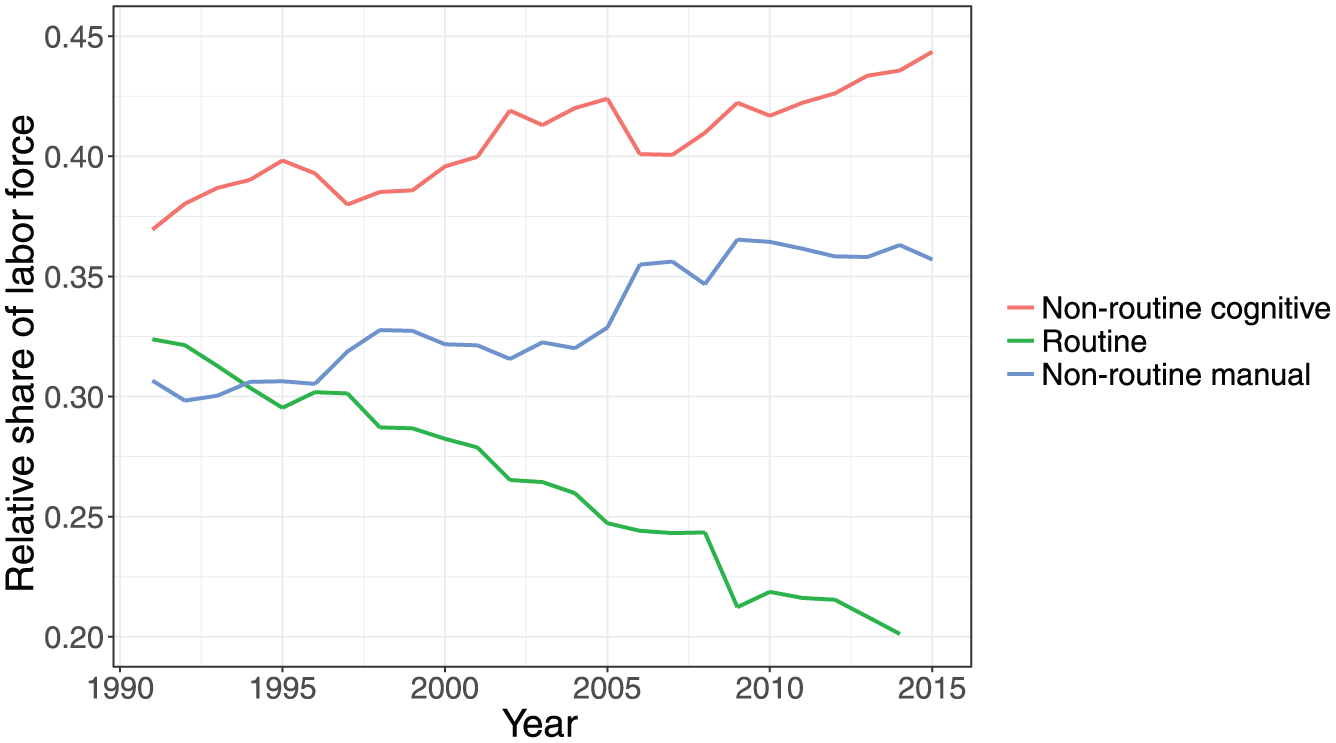
Aggregate trends in the employment structure.
Figure 2 provides additional descriptive information with respect to routine workers, non-routine cognitive workers, and non-routine manual workers. Figure 2(a) displays average monthly income and confirms the characterization of routine workers as being in the middle of the earnings distribution. The rank order of the three task groups regarding income does not change substantially over time, although the wage premium of high-skilled work in cognitively demanding jobs continues to increase over time, which can be read from the growing distance to the two other task groups. The age structure displayed in Figure 2(b) reveals an interesting pattern: the average age among routine workers distinctly increases over time relative to both non-routine groups. This is consistent with lower rates of entry by young labor market entrants into routine jobs (Cortes, 2016) and confirms the relationship between changes in the size of an occupation and shifts in the age distribution of its workforce, which has been documented for the USA (Autor and Dorn, 2009). An implication of this pattern is that the relative share of routine workers remains fairly stable among older respondents while less and less younger respondents enter routine jobs. Put differently, the “decline of the middle” is driven by declining entry rates of younger cohorts to routine occupations (see Supplemental Figure 1).
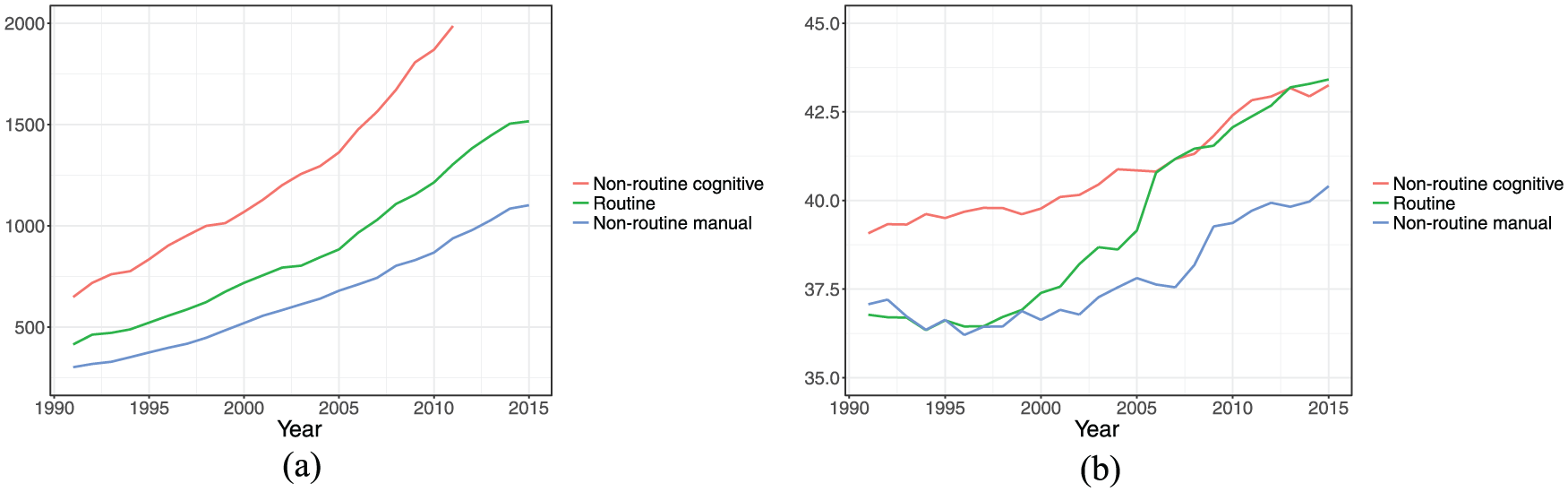
Average income and age structure of occupational groups: (a) monthly income (CPI-corrected, 2010 GBP); (b) age (in years).
Aggregate trends provide a valuable starting point, but researchers studying the political consequences of technological change should have a keen interest in the specific occupational transitions underlying the decline in routine employment. Polarization can be driven by various forces, most importantly increased unemployment rates, increased rates of occupational switching or higher exit rates – for example, into retirement or disability (Cortes, 2016). Such distinct trajectories out of routine work most likely trigger different political reactions. Technology-induced job displacement presumably creates political push-back only if workers cannot find better alternative employment (Caprettini and Voth, 2017) and are not compensated or sheltered by a system of social protection (see also Gingrich, 2018). We would not expect workers who are able to upgrade to better jobs or who exit the labor force through retirement to accumulate strong grievances that result in disruptive political behavior.
Figure 3 makes full use of the longitudinal data and visualizes actual transition patterns between the three occupational groups as well as alternative exit options – that is, unemployment and retirement. The alluvial plot on the left (Figure 3(a)) shows transitions between the first occupation that has been recorded for each respondent and the same respondent’s job situation in the last completed BHPS/UKHLS wave. The plot in Figure 3(b) shows the transition probabilities for sub-samples with varying duration between the first and last observation since the likelihood of transitions obviously increases with the observed time span. By design, the alluvial chart on the left is a weighted average of the varying transition probabilities over time, plotted on the right. The key point here is that occupational transitions happen less often than the aggregate numbers in Figure 1 might suggest. Based on an average time span of 4.8 years, a clear majority (64%) of routine workers “survive” in their routine jobs. About every fourth routine worker switches into non-routine jobs that are less exposed to digitalization, where upgrading into high-skilled cognitive work is slightly more frequent (13%) than downgrading into low-skilled manual jobs (11%). Only 3.4% ended up unemployed. The plot in Figure 3(b) adds interesting nuance to this snapshot. As expected, surviving in routine work becomes less frequent with increasing time spans – that is, with increasing duration between the first and last observation in BHPS/UKHLS – but the lion’s share of this decline is due to “natural” transitions into retirement. All other transition probabilities remain stable after about seven years of observation. It should be noted that the underlying sample sizes decline rapidly with increasing time windows.
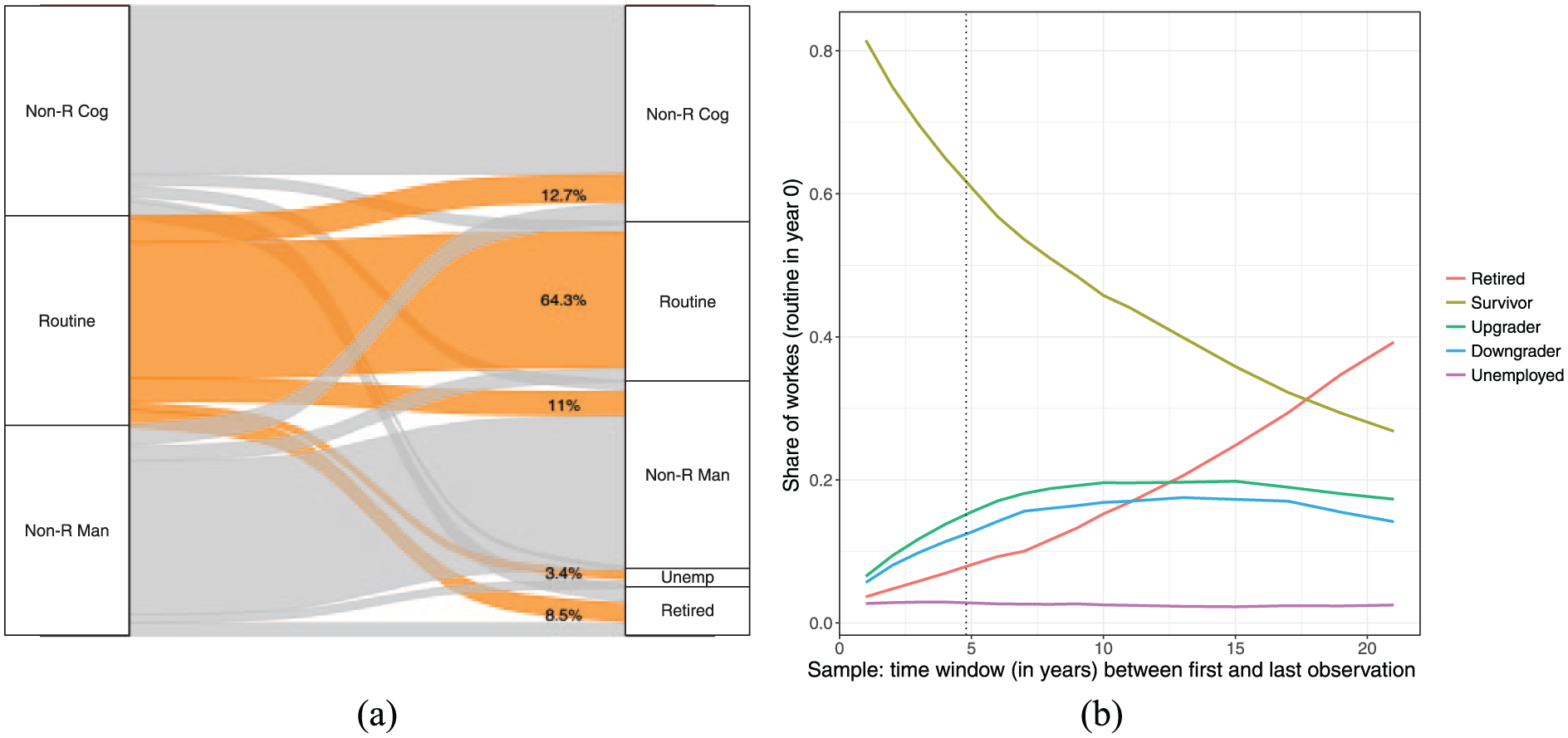
Occupational transition patterns: (a) occupational transitions (first to last observation); (b) occupational transitions by time span between observations.
This pattern of individual-level transitions suggests that the main mechanism behind job polarization is not layoff, displacement or general upgrading but a gradual transformation of the employment structure over time. Rather than being immediately and massively replaced, an interpretation sometimes conveyed in the media, routine work slowly goes extinct. (There are also some transitions into routine work but these are less frequent than into any of the non-routine task groups, see Table 1 for the full transition matrix.)
Transition matrix.

NRC: Non-routine cognitive; R: Routine; NRM: Non-routine manual.
Digitalization and labor market outcomes
In line with the our analysis of individual occupational transitions, overall employment numbers have not decreased in recent years despite the demonstrable impact of new technologies on productivity (Oliner and Sichel, 2000). While automation substitutes for some tasks, it complements others and can thereby increase output, earnings and demand for labor (Acemoglu and Restrepo, 2016; Autor, 2015; Autor and Salomons, 2018). A comprehensive assessment of the political consequences of technological change should, thus, not exclusively focus on the most obvious losers – that is, displaced workers – but rather on those who remain in the labor market. In electoral terms, they represent a more relevant part of the population.
Importantly, a neutral or even positive impact on overall employment should not hide the fact that shrinking job opportunities in the middle present a challenge for many; for example, workers with difficulties adapting to a changing demand for skills or mid-skilled labor market entrants who traditionally entered routine jobs. Digitalization has very specific effects on skill demand (Autor et al., 2003) and, accordingly, might produce politically relevant grievances, even among workers who manage to cling to their jobs. Thus, the last part of our analysis studies heterogeneous labor market outcomes among the active labor force. We ask how digitalization affects wages and job satisfaction and whether these effects vary between different task groups. In line with the literature on skill demand, we would expect non-routine workers, in particular high-skilled ones, to reap a disproportionate share of the economic benefits from digitalization.
Estimation
The breakdown of EU KLEMS data into ICT and non-ICT assets allows for the construction of the following indicator of digitalization

where ICT capital is real fixed capital stock in computing equipment, communications equipment, computer software and databases in industry j and year t, in million GBP at constant 2010 prices, estimated using the perpetual inventory method based on past investment and applying a geometric depreciation rate. We divide ICT capital stock by hours worked (also in millions) to adjust for the size of the industry. As expected, the resulting indicator of ICT capital stock in GBP per hour worked (mean = 2.1; standard deviation = 2.4) increases over time. Descriptive information by year as well as a breakdown of ICT capital stock per industry is provided in Supplemental Table 1 and Figure 4.

ICT capital stock 1997–2015; breakdown by industry.
We use fixed-effects regressions to estimate the effects of digitalization at the industry level on income and subjective job satisfaction. The general model is as follows

where
The term
Results
Our analysis provides clear evidence of unequally distributed benefits. The left panel in Figure 5 displays the results with respect to labor market income. 2 While the earnings of every task group grow with increasing digitalization, thus confirming the textbook expectation of positive overall effects, the main winners clearly are workers in cognitively demanding non-routine jobs. Here, the wage increases due to digitalization are nearly double the size of both routine and low-skilled non-routine jobs. This finding nicely ties in with previous work studying distributive implications of the service-sector transition and rise of the knowledge economy (e.g. Wren, 2013). The size of the effect is substantial: an increase in ICT capital stock of £1 per hour worked (=0.41 standard deviations) is related to a wage increase of almost £60 per month for a high-skilled non-routine worker, which is about 2.5% of the 2017 median gross wage in the UK. 3 Note that the difference between non-routine cognitive workers and the two other task groups is statistically significant (see full regression results in Supplemental Table 2). 4

Marginal effects of digitalization on labor market outcomes, conditional on task group.
The right panel in Figure 5 confirms that the unequal distribution of benefits is reflected in subjective perceptions. Only high-skilled non-routine workers, who benefit most from the complementary effects of new technology, are more satisfied with their jobs in the face of increasing digitalization of their industry. By contrast, objectively positive—even if weaker—effects on wages do not translate into higher satisfaction at the workplaces of routine and non-routine manual workers. However, it should be noted that the impact on subjective economic well-being is weaker than the effects on earnings. The magnitude is substantively small and the differences between groups are much less pronounced (see Supplemental Table 2).
Discussion
This special issue explores the political consequences of technological change and employment polarization. Our contribution focuses on the distributive implications of changes in the labor market. Distributive conflicts are very common causes of political contestation and we demonstrate that the benefits of digitalization, indeed, are not equally shared.
Who are the winners, who are the losers? Our analysis reveals relatively complex distributional implications, which are not always spelled out explicitly in existing work. The tension arises from the fact that the task-based literature in labor economics emphasizes routine workers’ disadvantages even vis-a-vis lower-skilled non-routine manual workers (Autor et al., 2003). This is not entirely in line with the main thrust of our paper, which is that non-routine cognitive workers benefit compared to everybody else; that is, compared to both routine as well as non-routine manual workers. We can reconcile these somewhat contradictory expectations by more explicit reference to the particular outcome of interest. When looking at wages and job satisfaction, the main finding is polarization between high-skilled workers and the rest. By contrast, when looking at employment shares, both non-routine groups are doing better than routine workers. However, our analysis shows that this decline in the aggregate does not necessarily have negative material implications for individual workers. Many routine workers remain in their jobs until retirement. The decreasing share of routine jobs is primarily driven by lower entry rates, not by massive involuntary exit. We would expect this pattern to generalize beyond our single case because, if anything, the flexible labor market of the UK allows for more rather than less job switching and more rather than less frequent unemployment spells.
An important take-away from the relatively large share of survivors in routine work is that a comprehensive analysis of the political consequences of technological change should not exclusively focus on those forced out of the labor market as a result of increasing automation. A significant part of the electorate is confronted with increasing prevalence of new technologies in their current work environment. A relevant question to ask is, thus, how the experience of digitalizing work environment affects the labor market outcomes of those who keep their jobs. If a majority keep their job and everyone who stays benefits to a similar extent from the introduction of digital technology at the workplace, we would not expect strong adverse repercussions in the political arena.
Interestingly, we find that all occupational groups experience income gains as a consequence of digitalization. Yet, the actual magnitude of these material benefits varies strongly between groups. The main beneficiaries are high-skilled workers in cognitively demanding jobs, who are well-equipped to make use of the benefits offered by new technology. The large residual group of middle-skilled routine and low-skilled non-routine workers (about 60% of the labor force in our sample) also experience some wage increases, but these are not substantial enough to be reflected in more positive subjective evaluations of job satisfaction. Hence, the promise of new technology primarily serves those who are already in a privileged labor market position.
Our results are open to interpretation. Automation and digitalization provide opportunities for many and, in general, improve individual labor market outcomes. As a consequence, technological change might not look like a plausible source behind recent political disruptions. However, not all voters have an equal share in this economic boost. Employment polarization clearly results in income polarization with disproportionate wage growth for highly skilled and specialized winners of digitalization. This digital Matthew effect could create grievances notwithstanding positive overall effects of technology in economic terms. The combination of generally increasing well-being and the parallel economic stagnation of politically powerful groups might present a toxic political cocktail. Recent research has shown that a positive economic environment can even reinforce political dissatisfaction among those who do not get their piece of the growing cake: when everybody else is thriving, individual stagnation produces even stronger political reactions (see Aytaç et al., 2018; Rooduijn and Burgoon, 2017). Another contribution to this special issue (Im et al., 2018) provides further evidence in this direction. Indeed, relative deprivation theory (Runciman, 1966) has long established that economic stagnation and unfulfilled expectations are especially frustrating when other parts of society are doing exceptionally well.
Supplemental Material
RAP822142_Supplementary_Material – Supplemental material for Distributional consequences of technological change: Worker-level evidence
Supplemental material, RAP822142_Supplementary_Material for Distributional consequences of technological change: Worker-level evidence by Thomas Kurer and Aina Gallego in Research & Politics
Footnotes
Acknowledgements
We thank Niko Schöll, Bruno Palier, Jane Gingrich, Stefan Thewissen, Ruben Enikolopov, seminar participants at Universitat Pompeu Fabra and Sciences Po, and two anonymous reviewers for their helpful comments and suggestions.
Declaration of conflicting interests
The author(s) declared no potential conflicts of interest with respect to the research, authorship, and/or publication of this article.
Funding
The author(s) disclosed receipt of the following financial support for the research, authorship, and/or publication of this article: This work was supported by the Spanish Ministry of the Economy and Competitiveness (MINECO) under the CSO2016-79569-P, from the BBVA Foundation through the project “Digital technology, ideological polarization and intolerance,” and from the Swiss National Science Foundation (Grant Number 146104).
Supplemental materials

Notes
Carnegie Corporation of New York Grant
This publication was made possible (in part) by a grant from the Carnegie Corporation of New York. The statements made and views expressed are solely the responsibility of the author.
References
Supplementary Material
Please find the following supplemental material available below.
For Open Access articles published under a Creative Commons License, all supplemental material carries the same license as the article it is associated with.
For non-Open Access articles published, all supplemental material carries a non-exclusive license, and permission requests for re-use of supplemental material or any part of supplemental material shall be sent directly to the copyright owner as specified in the copyright notice associated with the article.
