




Abstract
Given that approximately half of Internet users use Facebook to access news, it is no surprise that social media are increasingly seen as a viable source of political information. Despite the fact that the average social media user only clicks on a small fraction of political content available in their News Feed, social media use correlates with political knowledge. From where, then, does this knowledge come? We argue that Facebook’s News Feed itself, with its short article previews, provides enough political information for learning to occur. However, this learning comes with an additional consequence: audiences who only read article previews think they know more than they actually do, especially individuals who are motivated to seek emotions. While we are agnostic to the normative implications of such overconfidence, it is worth noting that similar behaviors are associated with political efficacy, knowledge, and participation.
Introduction
Decades of research shows that exposure to news makes people better informed. Yet these results come from an era when exposure to news meant long-form journalism on television or in newspapers. Today, though, 67% of Americans get their news from social media (Shearer and Gottfriend, 2017). We believe that this has important implications for how people learn about politics. Because most social media users only have a passing engagement with posted news, exposure to political information on social media may simply create the illusion of political learning. In this paper, we consider whether Facebook’s News Feed contributes to political knowledge, and how exposure to small bits of information causes some individuals to believe they know more about issues than they actually do.
To do so, we conducted an experiment where we randomly presented subjects with either a full news article, a Facebook News Feed including a preview of that article, or no information at all, and measured how much knowledge they gained about the highlighted issue, as well as how much knowledge they thought they had gained. We found that Facebook’s News Feed, with its short article previews, provides enough information for learning to occur. This in itself is an important and normatively positive finding: in a relatively new way of acquiring information, Facebook users are learning by merely scrolling through their News Feed. However, this learning comes with an additional consequence: audiences who only read article previews are overly confident in their knowledge, especially individuals who are motivated to experience strong emotions and, thus, tend to form strong opinions. These individuals demonstrating a high “need for affect” (Maio and Esses, 2001) are significantly more likely to overestimate their knowledge when encountering snippets of information in Facebook’s News Feed.
We believe this disparity in perceived knowledge between high- and low-affective dispositions is important. With 68% of Facebook users using the site for news, Facebook has become an important source of political information (Shearer and Gottfried, 2017). However, much of that news exposure is in the form of headlines or previews: an average user only clicks 7% of the political news stories available in her Feed (Bakshy, Messing and Adamic, 2015). In other words, though social media are seen as a wealth of information, most users only have a passing engagement with posted news. This incongruity creates an opportunity for limited or biased information processing where the bite-sized presentation style of news contributes to affective audiences’ overconfidence in their knowledge of the issues.
Political knowledge, need for affect, and overconfidence
Knowledge about politics is essential to a well-functioning democracy. Citizens must have sufficient knowledge about issues, policies, and candidates in order to make informed decisions. It is no surprise, then, that scholars have studied the relationship between political knowledge and democratic discourse (Delli Carpini and Keeter, 1997), voting (Berelson, Lazarsfeld and McPhee, 1954; Lau and Redlawsk, 2006), political efficacy (Galston, 2001; Jung, Kim and Gil de Zúñiga, 2011; Kenski and Stroud, 2006), and policy preferences (Bartels, 1996; Converse, 1964; Gilens, 2001; Luskin, Fishkin and Jowell, 2002).
Overconfidence in knowledge is often situated in the context of the classic motivated reasoning framework. Here, scholars draw an important distinction between being uninformed (recognizing one’s own ignorance) and being misinformed (confidently holding inaccurate beliefs), with overconfidence research focusing on the latter (Kuklinski et al., 2000). We argue that overconfidence stems from people’s directional goals, or their desire to reach a particular conclusion (see Kunda, 1990). Directional goals manifest in two ways. The first is the desire to hold a certain attitude or belief (Abelson, 1986). This type of directional goal is the basis of most models of motivated reasoning in politics, since people possess ideological and partisan preferences that make some beliefs preferable to others. In doing so, people place more weight on information that agrees with their views and reject information with which they disagree (Edwards and Smith, 1996; Lord, Ross and Lepper, 1979; Taber and Lodge, 2006). The second directional goal, accuracy, motivates individuals to consider the quality and quantity of the evidence before them (Petty and Cacioppo, 1986) and display less false confidence in their knowledge, either by holding confident, correct beliefs or being less confident when the correctness of their beliefs is in doubt.
Given these different motivations, we do not expect everyone to be equally overconfident in their knowledge. Though we anticipate that individuals vary in the degree to which they are driven by accuracy goals, we want to stress that for some, the feeling of being accurate satisfies directional goals more easily than actually being accurate. We argue that these individuals are driven, in part, by a high need for affect. People vary in their need for affect, with some individuals seeking out strong emotions (regardless of whether they are positive or negative), some people trying to avoid feeling strong emotions, and everyone in between (Maio and Esses, 2001). Individuals who possess a high need for affect tend to be the most certain in the rightness of their attitudes and are more likely to form firm and strong opinions (Britt et al., 2009). Those scoring high in a need for affect also tend to take the party line on policies, even when it conflicts with their values, as well as apply double standards when evaluating politicians of the opposing party (Arceneaux and Vander Wielen, 2013, 2017). We extend this logic to epistemic overconfidence, as evidence indicates that a high need for affect moderates how individuals process political news (Ryan, Wells and Acree, 2016). Specifically, we expect those who are high in need for affect to form relatively strong opinions based on the limited information gleaned from the Facebook News Feed and, therefore, be more likely to come away with an illusion of confidence in their knowledge relative to those who score lower on need for affect.
Social media provide a relatively new avenue of research in political knowledge and overconfidence. Previous research has shown exposure to the mass media (Chaffee and Kanihan, 1997) and the Internet (Kenski and Stroud, 2006) can lead to significant gains in political knowledge, but social media differ from traditional media in significant ways. For example, social media facilitate inadvertent exposure to news. A user who logs onto Facebook for diversionary purposes may learn something from information encountered incidentally on her News Feed (Bode, 2016; Feezell, 2018; Kim, Hsu and Gil de Zúñiga, 2013; Mitchell et al., 2013; Karnowski et al., 2017; Oeldorf-Hirsch, 2018), thus mitigating the issue of self-selection associated with watching television or reading a newspaper (Arceneaux and Johnson, 2013). In addition to providing content to audiences who may habitually avoid such information, social networking sites also allow users to interact with posted content in a way not possible with television broadcasts or newspaper articles (see Eveland, 2003). This interaction, usually in the form of endorsements or comments, prompts audiences to read content that they may ignore in traditional media contexts (Anspach, 2017; Messing and Westwood, 2012). Inadvertent exposure and social influence combine to create an opportunity to inform audiences on a wide array of new issues. With this in mind, we hypothesize:
H1: Social media audiences learn from Facebook article previews, demonstrating more factual knowledge than those receiving no information.
If article previews in the Facebook News Feed can inform users, it is important to understand the effects of these small increases in knowledge. Because individuals with a high need for affect (henceforth, NFA) are more likely to seek out strong emotions (Maio and Esses, 2001), they tend to form strong attitudes (Arceneaux and Vander Wielen, 2013, 2017) and exhibit certainty in the rightness of those attitudes (Britt et al., 2009). Furthermore, we have a similar prediction when we consider epistemic directional goals. We expect that individuals scoring high in NFA will be more overconfident in their knowledge, particularly when only given limited information, as is often the case in Facebook’s News Feed. When asked to consider gains in knowledge, we expect high-NFA individuals to go with their gut reaction, and to be likely to see themselves as knowledgeable even when they are not. Low-NFA individuals, on the other hand, should appreciate that they have only encountered a brief headline and, thus, should be less likely to form overconfident beliefs.
H2: When reading Facebook article previews, high-NFA individuals exhibit more overconfidence in their knowledge of the highlighted issue than low-NFA individuals.
But how does NFA influence overconfidence in other informational situations? When no information is provided (as in a control group), we do not expect NFA to influence people’s perceptions of their own knowledge. Because individuals have no new knowledge gain to which they can react, there will be no gut reaction. We also expect NFA to have less influence when individuals read full news articles, though for different reasons. Providing more information makes it more difficult to overestimate one’s knowledge, as even people without strong accuracy goals learn the facts in information-rich environments (Kunda, 1990: 482–483). Moreover, people tend to adjust their beliefs in accordance with the available facts when they are “presented in a way that ‘hits them between the eyes’” (Kuklinski et al., 2000: 805). Consequently, we expect the differences in overconfidence between low- and high-NFA individuals to attenuate when people read the entire article connected to a post.
H3: Need for affect does not influence overconfidence when no information is provided.
H4: Need for affect does not influence overconfidence when reading an entire article.
Research design
We deployed a survey experiment through Amazon’s Mechanical Turk platform (MTurk) in order to ascertain whether Facebook’s article previews inform audiences, and whether exposure to such posts leads to overconfidence in political knowledge. Because MTurk samples are recruited and surveyed online, they are especially useful for studying social media phenomena. Research from both political science (Berinsky, Huber and Lenz, 2012) and psychology (Buhrmester, Kwang and Gosling, 2011; Paolacci and Chandler, 2014) validate MTurk as a reliable source of data, featuring more diversity than college or other Internet samples (see Online Appendix for descriptive statistics). Any U.S. adult over the age of 18 was eligible for the study, and respondents were paid US$.50 for their participation.
The survey began by measuring subjects’ basic demographic information, including age, education, race, party identification, gender, and income. Embedded within these demographic questions was an attention-check question, and any subjects who failed the attention check (n = 36) were immediately notified of their failure and removed from the online survey without payment. Following the demographic battery, we then measured the remaining subjects’ (n = 990) cognitive styles, particularly NFA. 1 We adopt Maio and Esses’ (2001) affect battery to measure subjects’ NFA in which subjects indicate how much they agree with each statement using a five-point Likert scale (see Online Appendix). We then conducted a factor analysis on those responses to create an aggregate score for each subject’s NFA.
Following the NFA measure, we then randomly assigned each subject to one of three experimental conditions. The first was the full article condition (Figure 1), in which subjects read an article from The Washington Post that summarized a Pew survey on the safety of genetically modified (GM) foods (n = 320). The second was a faux News Feed condition (Figure 2), in which subjects received a mock News Feed containing four article previews, one of which was of the Pew survey (n = 319). Included in this preview was some (but not all) of the information found in the full article condition. Finally, a control group (n = 351) did not receive any stimuli and proceeded immediately to the next portion of the survey described below.
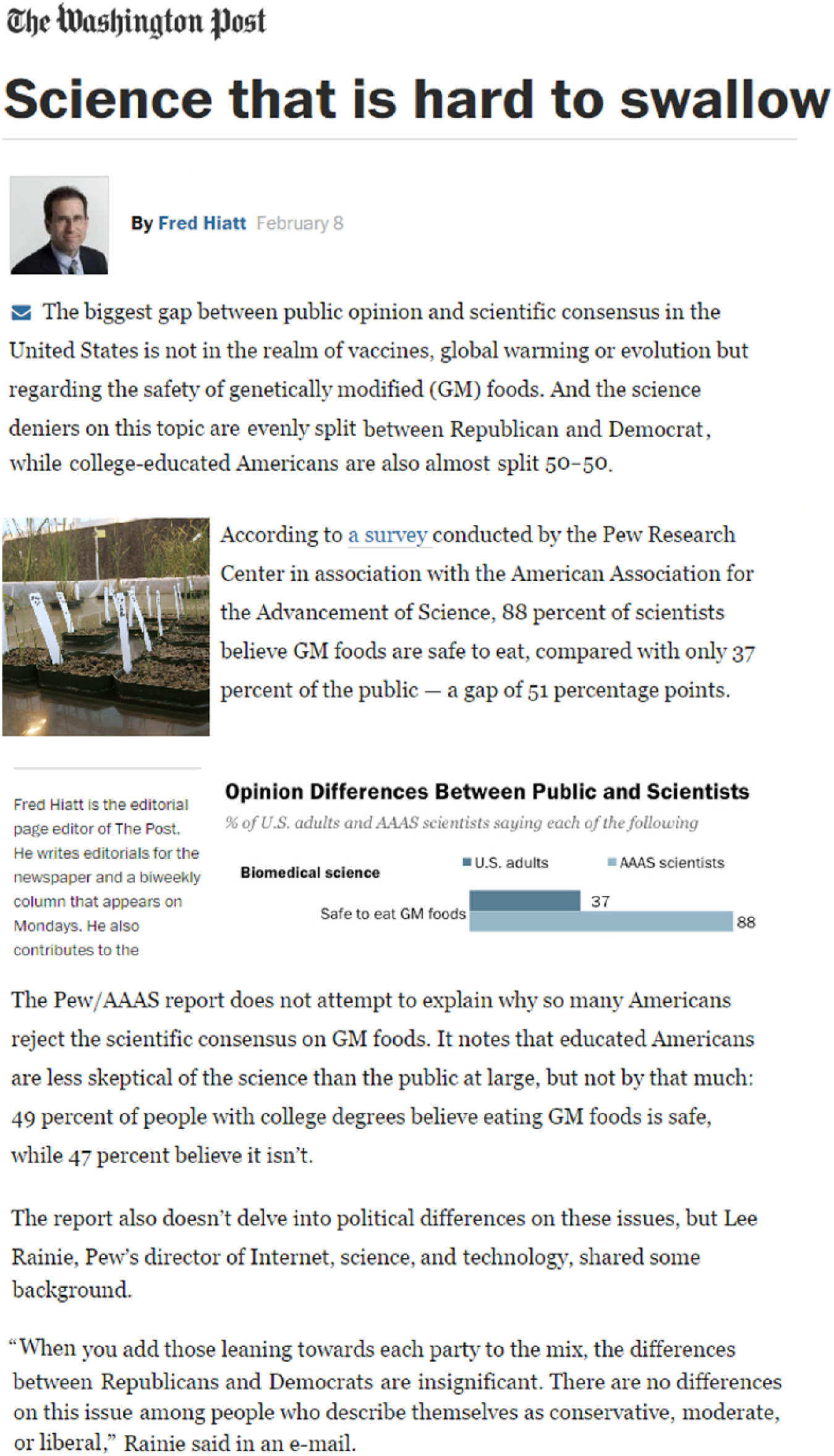
Full article treatment.

GM food article preview used for News Feed treatment.
Our News Feed condition avoided the flaws associated with forced-exposure experimental designs (see Arceneaux and Johnson, 2013), where researchers require subjects to read information they might never encounter in real life. On Facebook, users have little control over the posts that appear in their News Feeds (Bode, 2016), meaning much of the information encountered on the site is done so incidentally (Mitchell et al., 2013). Similarly, our News Feed condition featured a mix of entertainment and informational posts, and drew no particular attention to the GM food post. In this condition, subjects were instructed to select the post they would most likely click if browsing Facebook. This was for informational purposes only, as regardless of choice, subjects did not view the corresponding articles. Of those receiving the News Feed treatment, 92 (28.8%) selected the GM food post, and there were no significant differences in the outcome variables between those who selected the treatment post and those who did not (see Online Appendix).
Following the experimental treatments, we measured subjects’ knowledge of GM foods using six factual questions (see Online Appendix). The answers to five of the six questions could be found in the full article, and three answers could be found in the article’s News Feed preview. To determine each subject’s level of overconfidence, we subtracted the number of correct answers by the number of questions the subject believed they answered correctly, a standard operationalization in overconfidence studies (Moore and Healy, 2008: 502).
Results
Figure 3 shows the differences in correct responses for each of the six GM food questions, based on experimental condition. Whether the answers to these questions were available to the subjects depended on the condition they were assigned to. The first set of bars represents the correct responses to the question of which state requires GM foods to be labeled. The answer to this question was not available in any condition, explaining the lack of any statistical difference between the experimental conditions. The answers to the second and third questions shown in Figure 3 were only featured in the full article condition. Roughly 70% of subjects assigned to this condition answered these questions correctly, as opposed to approximately 30% of the News Feed and control groups. Additionally, it should be noted that for these two questions, the difference in correct response rates for the News Feed and control groups was statistically insignificant.

Correct response rates by experimental conditions.
The third set of questions in Figure 3 allowed us to determine whether, as H1 predicts, article previews in a Facebook News Feed can inform audiences. Answers to this final set of questions were available in both the full article and News Feed conditions. Looking at the response rates to these questions, the full article group answered more questions correctly on average (2.21) than both the News Feed group (1.32; t = 10.9; p < .05) and the control group (1.16; t = 13.5; p < .05). This makes intuitive sense, as subjects were asked to read the entire news article, whereas we drew no special attention to the GM food post in the News Feed. Yet, despite the fact that the GM article preview was only one post among many in the faux News Feed, the News Feed group also answered more of these questions correctly on average than the control group (t = 2.0; p < .05). However, looking at Figure 3, we see that the News Feed group correctly answered only one question significantly more often than the control group. This indicates that though social media audiences do learn from News Feed article previews (thus providing support for H1), the amount of knowledge acquired is modest. Next, we turn to the question of whether audiences realize these informational gains are minimal, or whether they are overconfident in how much they have learned.
Table 1 provides evidence that high-NFA individuals are most likely to exhibit such overconfidence (H2). The first model of Table 1 shows the ordinary least squares (OLS) regression of knowledge of GM foods on NFA, interacted with each treatment, while the second model includes standard control variables. For both models, NFA has no effect on knowledge in any experimental condition. This is important with regard to interpreting subjects’ overconfidence, as any changes in overconfidence attributed to NFA will be due to changes in subjects’ perceptions of their knowledge, not in their actual knowledge. The final columns of Table 1 demonstrate how each of our experimental treatments interact with NFA to influence overconfidence, both with and without control variables. The most striking result of these regressions is how NFA reverses the direction of the article preview’s effect on overconfidence. Among subjects exposed to a limited amount of information, those with a high NFA exhibit significantly more overconfidence than those scoring low on NFA, which indicates clear support for H2. Though a need for affect does not cause individuals to actually learn more about GM foods, it does cause them believe they know more than they actually do. Upon gaining a little bit of knowledge from article previews, high-NFA subjects fail to reflect upon the fact that such previews convey an incomplete picture of the issue at hand. These individuals tend to evaluate their knowledge with their gut reactions, and display a higher level of overconfidence than their less emotive counterparts.
OLS regressions of GM food knowledge and overconfidence.

Note: standard errors in parentheses; significant coefficients (p < .05) presented in bold.
Just as interesting as NFA’s influence on the News Feed’s effect is the fact that NFA did not influence overconfidence in the other experimental conditions. In the control group, low- and high-NFA subjects displayed statistically indistinguishable levels of overconfidence. Without any new facts provided, even low-NFA individuals had trouble assessing their knowledge on an issue. Because of this, they were equally likely to overestimate their knowledge of the GM foods issue as high-NFA individuals in the same condition, providing evidence in support of H3.
Finally, it is important to note that NFA is similarly inconsequential in information-rich environments, such as our full article condition. Given a bevy of undisputed facts, subjects actually learned more, rather than simply feeling they had learned more. With this substantial gain in knowledge of GM foods, both high- and low-NFA subjects could accurately gauge their knowledge on the issue, thus providing support for H4. To provide a fuller picture of NFA’s influence, we calculated the predicted overconfidence scores for the minimum and maximum NFA scores in our data for each experimental condition (Figure 4). Even at the extremes, NFA had no effect on how people evaluated their knowledge in the control and full article conditions: subjects with minimum NFA were equally likely to overestimate their knowledge as those with a maximum NFA, while those scoring at the extremes were equally likely to evaluate their knowledge accurately in the full article condition. It was only in the News Feed condition that NFA predicted divergent outcomes. Though subjects with a minimum NFA were able to accurately gauge their accuracy on the six-item knowledge scale, those with maximum NFA overestimated their knowledge by a whole point. For some, a little bit of knowledge seems to be a dangerous thing.

Minimum and maximum need for affect as predictors of overconfidence.
Conclusion
These findings provide evidence that Facebook’s article previews generate knowledge. However, there is a disparity in the effect of this knowledge, as evidenced by the rates of overconfidence. Those who are driven to seek and feel emotion learn something from the article previews, but are seemingly unaware of the limitations of their acquired knowledge. For these individuals, the positive feelings associated with being accurate are likely to be as important as actually being accurate. However, this NFA only influences overconfidence in a “middle ground” information environment; NFA effects do not exist when no information is provided, nor in an information-heavy context.
The motivated reasoning literature (Kunda, 1990) proposes that individuals vary in the degree to which they are motivated by accuracy goals. Those with a high NFA have strong gut reactions, or intuitions, and are not motivated to interrogate their intuitions, whereas those who are highly reflective are willing to second-guess and, if need be, override their intuitions (Stanovich, 2009; Stanovich and West, 2000). While theories of motivated reasoning have been used previously to predict reactions to partisan information, we have employed it here to predict differences in how subjects react to limited information in Facebook’s article previews. Those who are more driven by emotion allow the positive feelings associated with being right to override the need for actual accuracy, thus coming away from limited exposure to information falsely overconfident in their knowledge of the subject matter.
We see these findings as important for two reasons. First, as Facebook is relied upon more and more as a news source (Shearer and Gottfried, 2017), these findings speak to the potential to gain political knowledge from article previews. Facebook users can learn political information by simply scrolling through their News Feeds, and knowledge (or even the belief in knowledge) is associated with political participation (Galston, 2001), political efficacy (Jung, Kim and Gil de Zúñiga, 2011), and voting correctly (Lau and Redlawsk, 2006).
Secondly, however, concern about the quality of information within these previews persists. In light of the recent “fake news” controversies surrounding the 2016 U.S. presidential election, Allcott and Gentzkow (2017) used a database of 156 fake news articles about either Clinton or Trump and found that those articles were shared nearly 40 million times on Facebook in the three months leading up to the election. Additional research indicates that misinformation is frequently found on social media, and Facebook audiences are easily misled by misinformation attached to article previews (Anspach and Carlson, 2018). We would expect this belief in misinformation to be particularly true if the audience exhibits a high NFA (Arceneaux and Vander Wielen, 2013, 2017). Future research should continue to investigate whether emotion can help us understand the spread and influence of fake news. As Facebook is increasingly relied on as a news source, audiences’ overconfidence could be potentially troublesome, especially if the perceived knowledge gain is based on misinformation.
Supplemental Material
Appendix_(resubmission) – Supplemental material for A little bit of knowledge: Facebook’s News Feed and self-perceptions of knowledge
Supplemental material, Appendix_(resubmission) for A little bit of knowledge: Facebook’s News Feed and self-perceptions of knowledge by Nicolas M. Anspach, Jay T. Jennings and Kevin Arceneaux in Research & Politics
Footnotes
Declaration of conflicting interests
The author(s) declared no potential conflicts of interest with respect to the research, authorship, and/or publication of this article.
Funding
The author(s) received no financial support for the research, authorship, and/or publication of this article.
Supplemental materials
The supplemental files are available at http://journals.sagepub.com/doi/suppl/10.1177/2053168018816189. The replication files are available at 
Notes
Carnegie Corporation of New York Grant
This publication was made possible (in part) by a grant from the Carnegie Corporation of New York. The statements made and views expressed are solely the responsibility of the author.
References
Supplementary Material
Please find the following supplemental material available below.
For Open Access articles published under a Creative Commons License, all supplemental material carries the same license as the article it is associated with.
For non-Open Access articles published, all supplemental material carries a non-exclusive license, and permission requests for re-use of supplemental material or any part of supplemental material shall be sent directly to the copyright owner as specified in the copyright notice associated with the article.
