




Abstract
Research demonstrates the multi-dimensional nature of American identity arguing that the normative content of American identity relates to political ideologies in the United States, but the sense of belonging to the nation does not. This paper replicates that analysis and extends it to the German and British cases. Exploratory structural equation modeling attests to cross-cultural validity of measures of the sense of belonging and norms of uncritical loyalty and engagement for positive change. In the 2010s, we find partisanship and ideology in all three nations explains levels of belonging and the two content dimensions. Interestingly, those identifying with major parties of the left and right in all three countries have a higher sense of belonging and uncritical loyalty than their moderate counterparts. The relationship between partisanship, ideology, and national identity seems to wax and wane over time, presumably because elite political discourse linking party or ideology to identity varies from one political moment to the next.
Introduction
National identity—the sense of one’s belonging to the nation and the extent to which people believe being a member of the nation is important—is a key aspect or core dimension of social identity (Tajfel, 1982; Huddy and Khatib, 2007; Theiss-Morse, 2009). 1 One advantage of the social identity approach is that it organizes research in a more consistent theoretical framework, potentially solving problems of conceptual confusion (Schildkraut, 2014). For example, scholars can consider how citizens’ relationships with their nation overlap with their political views, as Huddy and Khatib (2007) did using multiple samples from the 1990s and early 2000s. They find that Americans’ sense of belonging to their nation is orthogonal to political ideologies and partisanship. Nonetheless, some potentially related attitudes—uncritical loyalty and desire for positive change—appear more politically charged in the American student samples of the early 2000s, with ideological conservatives more supportive of the former and less so for the latter. Thus Huddy and Khatib (2007) find that whereas national identity is not politicized, proscriptive attitudes about how to behave, potentially are. As with any social science analysis, it is worth examining how well these conclusions apply at different periods of time and/or with different populations. In the decade since Huddy and Khatib’s article, polarization has increased, as has the success of populist leaders and parties across western democracies. One common refrain from these political opportunists is “taking our country back,” raising the possibility that national identity has become (more) politicized. In this paper, we revisit these questions about the politicization of national identity and ask whether the political ground underneath the analyses of Huddy and Khatib has shifted to such a degree that we need to update our conclusions about the relationship between national identity and ideology.
In this paper, we follow the path laid out by Huddy and Khatib and draw on social identity theory to argue that national identity might be apolitical in certain contexts, but not in others. Importantly, we view the analyses here as fully compatible with Huddy and Khatib (2007). Their work inspired us to examine these questions at a different point in time and across multiple populations, and the continuity is evident in following their emphasis on the importance of social identity to understanding how citizens feel and think about their nation. Although the results presented here differ in some ways from those presented by Huddy and Khatib, the broader theoretical approach is taken directly from them. We hope the results we present here offer enough richness to deepen our understanding of how political context may be important to consider when thinking about the relationship between ideology/partisanship and national attachment. More generally, we think that the existence of both change and continuity in the structure of attitudes about national identity (and related constructs) is perfectly consistent with the social identity approach. When political elites differ in emphasizing a strong sense of national attachment as a constitutive group norm, so will reported national identity levels at the citizen level.
We measure national identity, uncritical loyalty and the desire for positive changes in national surveys of the United States, United Kingdom, and Germany. Using latent variable modeling we first establish the cross-cultural equivalence of these three constructs, and then test the hypothesis that ideologues and partisans on the left and right alike continue to embrace national identity, while also continuing to differ in proscriptive attitudes about behavior. In all three countries, we find partisanship and ideology to color not only the normative dimensions of uncritical loyalty and the desire for positive change but also the previously apolitical dimension of national identity. We must again emphasize that this is not a corrective of Huddy and Khatib (2007), but an extension. Our survey data come from political contexts that differ markedly from those analyzed in Huddy and Khatib (2007); as such, our findings do not undermine their work, but rather build on it.
National identity, normative content, and political attitudes
Research on citizens’ relationships with their nation produces many concepts and measures (for a recent review, see Schildkraut, 2014), and a comprehensive analysis of them all is infeasible. Instead, we concentrate on the subset of concepts that Huddy and Khatib (2007: 75) advise:
a subjective or internalized sense of belonging to the nation;
the degree to which people exhibit an uncritical loyalty that combines “unquestioning positive evaluation, staunch allegiance, and intolerance of criticism” (Schatz et al., 1999: 153); and
the degree to which citizens are “driven by a desire for positive change” (Schatz et al., 1999: 153; see also Staub, 1997; Rothì et al., 2005).
National identity/attachment
The concept of national identity derives directly from the more general social psychological theory of social identity (Tajfel, 1982; Turner et al., 1987; Hogg and Abrams, 1988), which defines social identity “as an awareness of one’s objective membership in the group and a psychological sense of group attachment” (Huddy and Khatib, 2007: 65). Accordingly, the term “national identity” denotes a sense of attachment, or belonging to the nation.
Are political attitudes—like ideology—related to national attachment? Following the social identity approach, a key to understanding this relationship is that group members internalize constitutive in-group norms, world views, and attitudes (Turner et al., 1987; Hogg and Abrams, 1988; Reicher and Hopkins, 2001). Accordingly, people cognitively represent social groups as category prototypes. These group prototypes not only describe constitutive group attributes but also prescribe how members should think and act. Crucially for us, national attachment might constitute a prototypical characteristic of a given partisan or ideological camp. To learn about the group prototype members, one must look to other, important members. As Hogg and Smith (2007: 98) put it, “the construction and identification of norms is, therefore, a dynamic process in which the social context plays a significant role.” This means that as the dominant elite political discourse linking party or ideology to national identity changes, so will the relationship between partisanship, ideology, and national identity. At one point in time and place, a strong feeling of national attachment might be advocated as a constitutive in-group norm within a party or ideological camp; at another point in time and place it might not. Thus, in line with Huddy and Khatib (2007) we do not believe there is a reflexive or knee-jerk psychological link between national attachment and political views, given that national attachment is (potentially) free of normative content and therefore reconcilable with different political ideologies. However, differences in the degree to which political elites from different camps stress a strong sense of national attachment as a constitutive norm of their group may result in a correlation between political loyalties and national identity levels at the citizen level. 2
Following this theoretical argument, Huddy and Khatib’s findings should be interpreted as a function of collecting data in the United States in the wake of Western triumph over communism, as found in the 1996 General Social Survey (GSS, 1996) and in the national unity following the events of 11 September 2001 (2002 and 2004 New York student samples, collected less than 60 miles from the World Trade Center grounds). Accordingly, citizens with different political orientations did not vary in national attachment because national identity was positively valued on both sides of the ideological aisle in the USA. As the Bush Presidency carried on, however, attitudes toward the nation became not only more salient; Republicans increasingly tried to make love of country a trait durably owned by the conservative/Republican camp (Tesler, 2010). In a speech during the 2008 campaign, Sarah Palin succinctly captured the more polarized politics that would be would characterize the Obama era—fights over what constitutes the “real America” (Davis, 2018). In this more polarized environment, with its debates over immigration, multiculturalism, and the continuing fight against the external threat of international terrorism (Abramowitz and Webster, 2016; Martin and Yurukoglu, 2017), our expectation is that national identity remained a salient feature of US politics, and that the attempts of Republicans and conservatives were at least partially successful in owning the issue. In a comparative context, differences between political parties in the two European countries might be even larger. A large strand of research explores how the political competition in Western European countries is increasingly structured by a conflict over the implications of globalization. Whereas conservative actors stress the continuing importance of national attachments in times of weakening national borders, liberal actors tend to take a European and cosmopolitan point of view (Kriesi et al., 2008; Hooghe and Marks, 2009). Following this research, desirability of a strong national identity might not be consensual in the UK and Germany, but instead constitute a more accepted in-group norm in the conservative (right-wing) than the liberal (left-wing) camp.
Uncritical loyalty and desire for positive change
In our view, Huddy and Khatib (2007) correctly point out that research should contrast national identity with normative dimensions of what it means to be a member of the nation. Again, we follow these authors and take account of two dimensions derived from Schatz et al. (1999), which describe “differences in the manner in which individuals relate to their country” (Schatz et al., 1999: 168). One is the degree to which people exhibit indiscriminate attitudes toward the righteousness of the conduct of this group. Citizens exhibiting such uncritical loyalty combine “unquestioning positive evaluation, staunch allegiance, and intolerance of criticism” (Schatz et al., 1999: 153). A second element of the research on the norms concerning the member-group relationship is the degree to which citizens are “driven by a desire for positive change” (Schatz et al., 1999: 153; see also Staub, 1997; Rothì et al., 2005). These norms are constitutive elements of the “blind” and “constructive patriotism” concepts introduced by Staub and colleagues (Schatz and Staub, 1997; Staub, 1997; Schatz et al., 1999), but since there is conceptual ambiguity (Huddy and Khatib, 2007: 64) and since we do not have all the original items to measure these concepts, we use the more limited concepts of uncritical loyalty and desire for positive change.
How do these dimensions relate to political attitudes? Uncritical loyalty is not devoid of content. Huddy and Khatib (2007: 75) suggest that this dimension should be ideologically highly consequential. Following previous findings, it is straightforward to expect uncritical loyalty to be positively associated with a conservative ideology, identification with conservative parties and higher levels of right-wing authoritarianism (e.g., Schatz et al., 1999; Huddy and Khatib, 2007; Parker, 2010). That is because these ideologies and groups all subscribe to notions of deference to authority and the primacy of binding values over individualizing values (e.g., O’Sullivan, 2013).
As for the desire for positive change, one can argue along the lines of Huddy and Khatib (2007) that this dimension is devoid of content because it does not specify what constitutes positive change. Thus, ideologues and partisans likely disagree about what constitutes positive change, and the level of desire for positive change should be unrelated to political attitudes. Empirical findings support this expectation—Schatz et al. (1999: 167) report that their constructive patriotism measure, which includes questions about the desire for positive change, does not relate to self-identified ideology, party identity, and right-wing authoritarianism (RWA). On the other hand, those who identify with a certain ideology or political party could internalize group norms about engagement for positive change (Huddy and Khatib, 2007: 64). It is difficult to specify the relationship between contemporary ideologies and the desire for positive change, but it seems reasonable to expect that this sentiment is less political than uncritical loyalty.
Empirical analysis
In the current study we analyze how national identity, uncritical loyalty, and desire for positive change correlate with fundamental political attitudes in the early 2010s in the USA, the UK, and Germany. We thus repeat the analysis of Huddy and Khatib (2007) with data for the US public approximately 10–15 years later and also add data for two Western European countries. Extending the analysis to other countries, where “the nation” has a different meaning in political discourse, gives us a broader understanding of the contours of national identity. As discussed above, given the nature of political discourse as a key contextual feature we suspect that there is an association between national identity and political attitudes in the 2010s both in the USA and in the Western European countries. We have not discussed uncritical loyalty and desire for positive change in a comparable manner, partly because we suspect the associations between these dimensions and political attitudes to be less dependent on context (and therefore more dependent on underlying values), but also for space considerations.
We proceed as follows. First, we test if this three-dimensional conceptualization is empirically sound in each country by estimating separate latent variable models for nationally representative samples from each. Second, we assess the cross-cultural invariance in our ordered-categorical measures. Third, we study the association of the three factors with political ideology and partisan preferences.
Methods
The national identity items we analyze come from the second waves of original panel surveys conducted in the USA, the UK, and Germany. YouGov undertook data collection in May 2012 in the USA and the UK and in July 2015 in Germany. To achieve representative samples in these online surveys, selected respondents are matched on demographic factors (gender, age, education, and region), and we weight the final achieved samples to the characteristics of the US, UK, and German adult populations. The effective sample sizes (excluding cases with missing data across all national identity items) are 2330 (USA), 2339 (UK), and 2476 (GER) (Table 1).
Indicators of identity with the nation, uncritical loyalty, and desire for positive change.

UL: uncritical loyalty; DC: desire for positive change; US: United States; UK: United Kingdom; GER: Germany.
We hypothesize that the three latent dimensions generate observed survey responses to three survey questions apiece. 3 The identity items derive from Huddy and Khatib (2007). The items for uncritical loyalty and desire for positive change originate in the work of Schatz et al. (1999), where they are part of item batteries to measure blind and constructive patriotism, respectively. Respondents indicate their disagreement–agreement on a 5-point scale and, in one case (i1), on a 4-point scale. A latent RWA dimension gauges general value predispositions, with one 5-point scale item tapping each of the concepts’ three dimensions (i.e., submission, aggression, and conventionalism; Cronbach’s α = 0.80 (USA), 0.79 (UK)). 4 Furthermore, respondents report their party identity (e.g., “Generally speaking, do you consider yourself as a Republican, a Democrat, an independent, or what?”) and their self-identified ideology using an 11-point scale (1 = left, 11 = right). To account for non-linear effects of ideology, two separate variables indicate the extremity of left- and right-wing ideology, respectively.
To analyze the dimensionality of the indicators, we estimate exploratory structural equation modeling (ESEM) using the software package Mplus (Version 7.3). ESEM is both less restrictive and more transparent than confirmatory factor analysis (CFA), combining the strengths of both exploratory factor analysis and CFA (Marsh et al., 2014; for methodological details, see Online Appendix A2). As a robustness check, we estimate CFA analogous to the ESEM presented here. The CFA model fits are adequate as judged via approximate fit metrics and the substantive results mimic the ESEM results (see Appendices A3 and A4).
We first establish measurement reliability in our three countries, using country-specific ESEM before testing for configural and scalar invariance across countries using multiple group (MG) ESEM (Millsap and Yun-Tein, 2004). 5 Configural invariance requires only that “factor structures are equal across groups: The same configurations of salient and non-salient factor loadings should be found in all groups” (Davidov et al., 2014: 63), but the magnitude of the loadings may differ. In the case of scalar invariance, constraints force factor loadings and indicator thresholds to be equal across groups. Scalar invariance is necessary for making meaningful comparisons of latent variable correlations and means across groups (Stegmueller, 2011: 473; Davidov et al., 2014: 64).
Results
The country-specific ESEM and the unconstrained MGESEM yields a close fit to the data (Table 2). This means that the same factorial structure exists in the USA, the UK, and Germany. The scalar invariant MGESEM also fits the data well, with the close fit indices at appropriate levels, below 0.05 for the case of the RMSEA and above 0.95 for the CFI (Byrne, 2012). As Table 3 shows, all indicators load substantively on their respective factor and there are no large cross-loadings. In sum, these results demonstrate that full scalar invariance holds.
Fit indices of ESEM models with three factors.
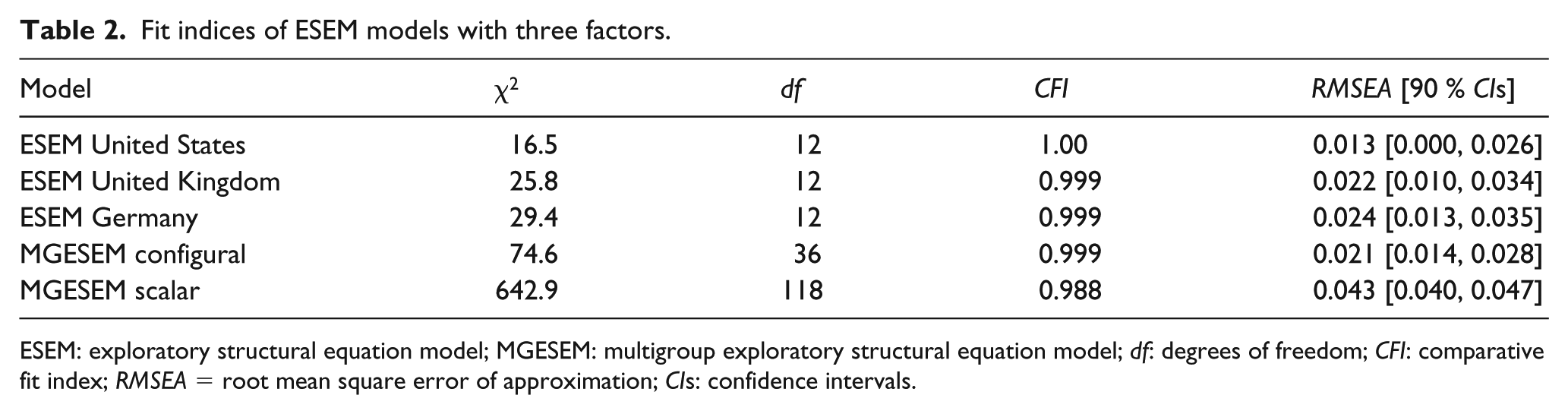
ESEM: exploratory structural equation model; MGESEM: multigroup exploratory structural equation model; df: degrees of freedom; CFI: comparative fit index; RMSEA = root mean square error of approximation; CIs: confidence intervals.
Unstandardized loadings of the scalar invariant model.
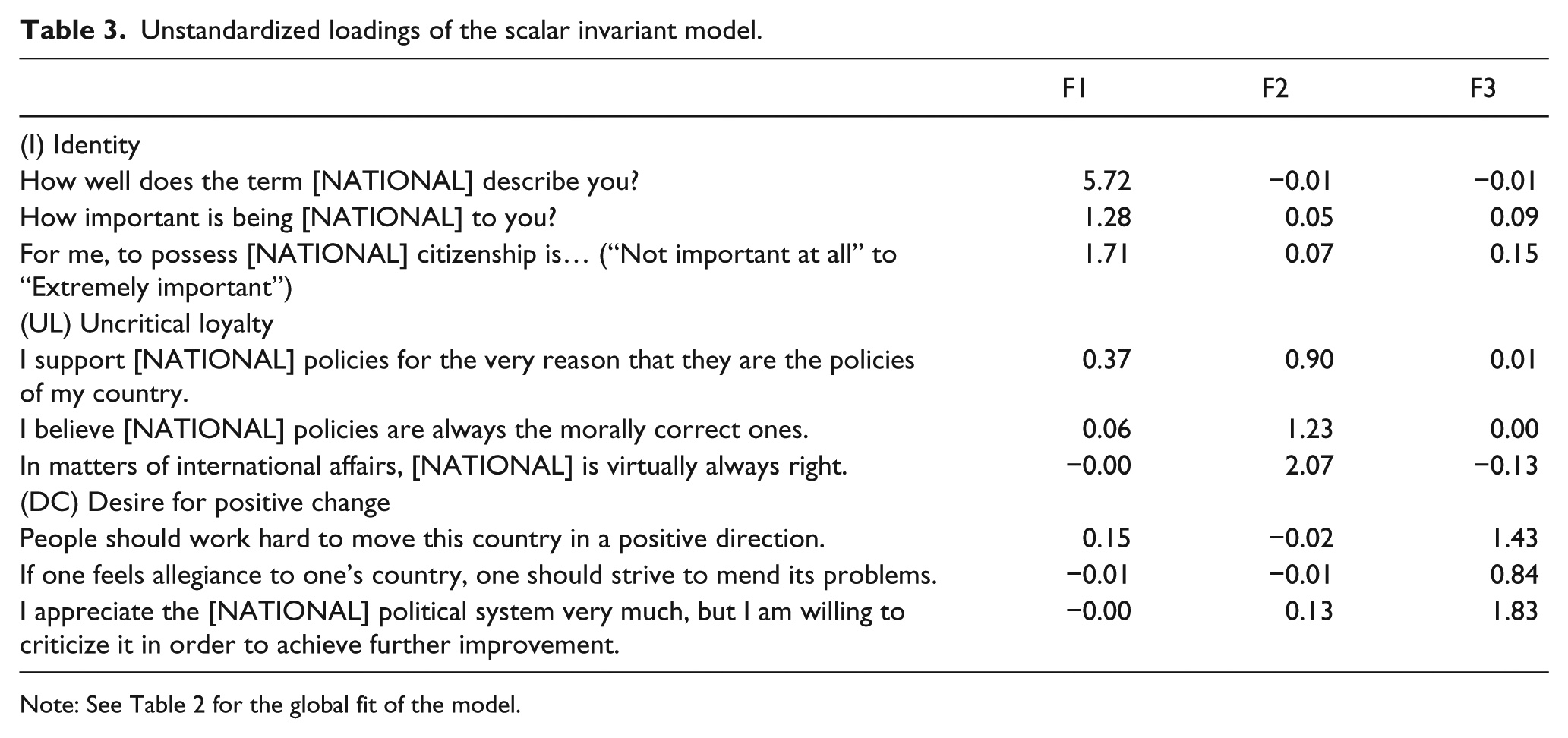
Note: See Table 2 for the global fit of the model.
The regression models (Table 4) show that self-identified ideology and partisan affiliation substantially influence identity with the nation in all three countries. 6 Furthermore, right-wing authoritarianism has a substantial impact in the USA and the UK. These results resemble those for uncritical loyalty. The closer that citizens place themselves on the right endpoint of the ideological continuum, the more identified with and uncritically loyal to the nation they are. Higher values of RWA are positively associated with identity and uncritical loyalty. Finally, affiliates of the conservative parties score higher on these two dimensions than citizens without partisan ties.
Determinants of national identity, uncritical loyalty, and desire for positive change.
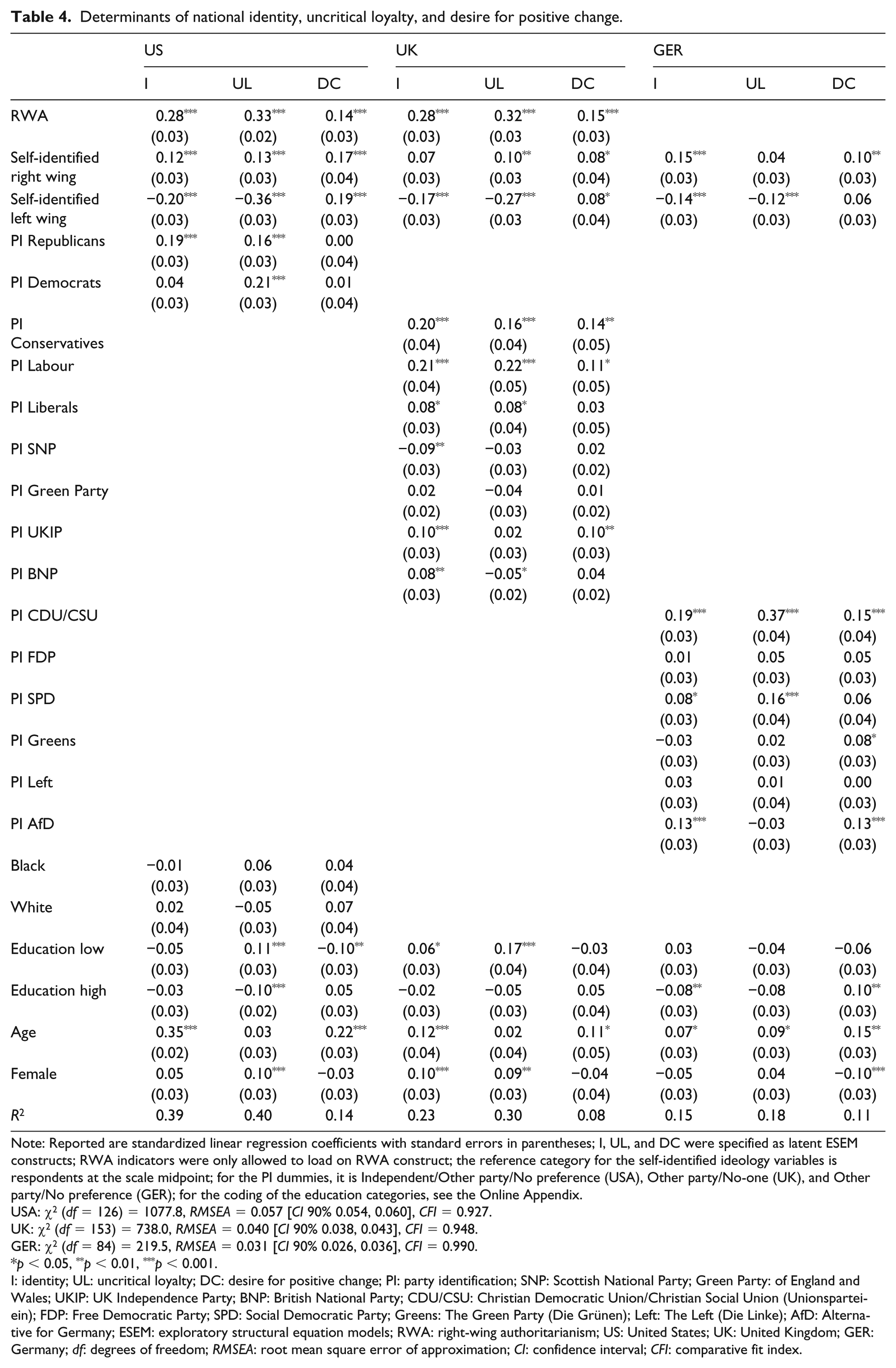
Note: Reported are standardized linear regression coefficients with standard errors in parentheses; I, UL, and DC were specified as latent ESEM constructs; RWA indicators were only allowed to load on RWA construct; the reference category for the self-identified ideology variables is respondents at the scale midpoint; for the PI dummies, it is Independent/Other party/No preference (USA), Other party/No-one (UK), and Other party/No preference (GER); for the coding of the education categories, see the Online Appendix.
USA: χ2 (df = 126) = 1077.8, RMSEA = 0.057 [CI 90% 0.054, 0.060], CFI = 0.927.
UK: χ2 (df = 153) = 738.0, RMSEA = 0.040 [CI 90% 0.038, 0.043], CFI = 0.948.
GER: χ2 (df = 84) = 219.5, RMSEA = 0.031 [CI 90% 0.026, 0.036], CFI = 0.990.
p < 0.05, **p < 0.01, ***p < 0.001.
I: identity; UL: uncritical loyalty; DC: desire for positive change; PI: party identification; SNP: Scottish National Party; Green Party: of England and Wales; UKIP: UK Independence Party; BNP: British National Party; CDU/CSU: Christian Democratic Union/Christian Social Union (Unionsparteiein); FDP: Free Democratic Party; SPD: Social Democratic Party; Greens: The Green Party (Die Grünen); Left: The Left (Die Linke); AfD: Alternative for Germany; ESEM: exploratory structural equation models; RWA: right-wing authoritarianism; US: United States; UK: United Kingdom; GER: Germany; df: degrees of freedom; RMSEA: root mean square error of approximation; CI: confidence interval; CFI: comparative fit index.
Interestingly, a similar pattern exists with regard to affiliates of the dominant left-of-center parties in the UK and Germany, respectively. German and UK citizens who identify with the Social Democratic Party and Labour Party score higher on national identity and uncritical loyalty than citizens without partisan ties do. This might indicate a cleavage between general system supporters and opponents which runs (to some extent) across ideological lines. Our findings from a later period differ from the results of Huddy and Khatib (2007); they show uncritical loyalty to be “politically powerful” and national identity to be “ideologically more neutral” during the 90s and early 2000s. 7
We find the relationship between partisanship and ideology and the desire for positive change to be more muted:
Although it does correlate positively with RWA, the association is substantially weaker than in the cases of identity and uncritical loyalty.
It correlates positively with self-identified right- as well as left-wing ideology.
Desire for positive change does not vary with partisan affiliation in the USA (it does in the UK and Germany).
Discussion
This study addresses the question whether levels of national identity, uncritical loyalty, and a desire for change vary by political beliefs. The work of Huddy and Khatib (2007) with US data dating from the 1990s and early 2000s suggests that identity is “ideologically neutral.” 8 With fresh data from the 2010s, we find national identity to be associated with political attitudes both when we look at data from the same country they analyzed (the USA) and when studying UK and German citizens. Specifically, identification with parties of the right and center-right as well as right-wing ideology in the USA and Germany correlates with higher national identity scores. The opposite relationship holds for left-wing ideologues in the three nations.
To some extent the difference between our findings and Huddy and Khatib’s might be rooted in methodological differences. As noted, we use slightly different items to capture core concepts, including national identity, political ideology, and authoritarianism. However, the differences here are not terribly large. Consequently, we see two possible choices when evaluating Huddy and Khatib:
The first possibility is that their results are extremely fragile to minor changes in question wording or modeling strategy. Given the robustness of their findings (demonstrated in the supplemental material), we do not think this interpretation is convincing.
The second possibility is that their broad theoretical approach is correct, but the specific findings are bound in time and space.
We greatly prefer this second interpretation. The social identity approach stresses that the construction of identities is a dynamic process—accordingly, whether and how political actors might emphasize national identity as integral part of their political group may change over time. Following this line of reasoning, our findings suggest that national identity in the USA became “owned” by the political right. In the UK and Germany, the pattern of right-wing citizens identifying more strongly with the nation than citizens on the left corresponds to the greater significance that conservative ideologies attribute to the nation in these countries (e.g., Lochocki, 2016; Ford and Goodwin, 2017).
Another interesting finding from the multi-variate analyses is that adherents to all the mainstream parties of the left (Labour, Social Democratic Party (GER), Democrats) and right (Conservatives, Christian Democratic Union/Christian Social Union, Republicans) in the three countries show higher levels of uncritical loyalty than do non-partisans. On the one hand, this result could simply signal that more politically engaged citizens buy into the notion that their nation is generally just and a force for good in the world. This account would not be a cause for concern as a certain degree of trust and diffuse support of the national political system aids its survival and basic functioning. On the other hand, recent work shows partisans’ susceptibility to indiscriminately accepting arguments that accord with their predispositions (Taber and Lodge, 2006). Lilliana Mason’s powerful account of partisan division in America should be cause for alarm (Mason, 2018). When representatives of political parties make statements about the national goals or values, can partisans with high levels of uncritical loyalty push back, particularly if statements are false and/or unethical (e.g., Flynn et al., 2017)?
We agree with Huddy and Khatib (2007) and others about the need for situating research on how citizens think and feel about their nation more firmly in the analytical framework of the social identity approach. In this spirit we have drawn on that approach to argue that a high level of national identity—a strong sense of belonging to the nation—may or may not be an in-group norm of political groups. The politicization of national identity may change over time. By implication, to derive expectations about patterns of national identity and political attitudes at a given place and time, we should look at the particular dynamics of the political discourse at that place and time. It is, for example, not at all clear what to expect in terms of the pattern of national identity and partisan views if we were to repeat the analysis with US public opinion data collected during the Trump presidency. Has the further increase in ideological polarization since the Obama period and President Trump’s credo of “Make America Great Again” and “America first!” strengthened the hold of conservatives and Republicans on national identity? Similarly, how have these rhetorical devices affected Democrats’ identities as Americans? Have the widespread debates about alternative visions of American identity—markedly different in content but equal in their feelings for the nation—led back to a more equal distribution of national attachment between the political camps? Moreover, how is the relationship between identity and ideology and/or partisanship changing in the wake of Brexit in the UK and heightened debate over refugees in Germany? Aside from this, future research may aim at more fine-grained measures of potentially relevant contextual features to tease out specific effects. We hope future work will answer these and other questions to better understand the consequences of the over-time and cross-national variation in citizens’ national identity in general and the implications of the (current) politicization of belonging to the nation specifically.
Supplemental Material
Supplementary_file – Supplemental material for How political are national identities? A comparison of the United States, the United Kingdom, and Germany in the 2010s
Supplemental material, Supplementary_file for How political are national identities? A comparison of the United States, the United Kingdom, and Germany in the 2010s by Matthias Mader, Thomas J. Scotto, Jason Reifler, Peter H. Gries, Pierangelo Isernia and Harald Schoen in Research & Politics
Footnotes
Declaration of conflicting interest
The author(s) declared no potential conflicts of interest with respect to the research, authorship, and/or publication of this article.
Funding
The author(s) disclosed receipt of the following financial support for the research, authorship, and/or publication of this article: Data collection was funded by a grant from the Economic and Social Research Council of the United Kingdom (RES-061-25-0405). Original data supporting this research are available from the UK Data Archive (Study Number 851142): 
Supplemental materials
Notes
Carnegie Corporation of New York Grant
This publication was made possible (in part) by a grant from the Carnegie Corporation of New York. The statements made and views expressed are solely the responsibility of the author.
References
Supplementary Material
Please find the following supplemental material available below.
For Open Access articles published under a Creative Commons License, all supplemental material carries the same license as the article it is associated with.
For non-Open Access articles published, all supplemental material carries a non-exclusive license, and permission requests for re-use of supplemental material or any part of supplemental material shall be sent directly to the copyright owner as specified in the copyright notice associated with the article.
