




Abstract
Experimental research on racial attitudes examines how Whites’ stereotypes of Black Americans shape their attitudes about the death penalty, violent crime, and other punitive measures. Marginally discussed in the race-to-crime literature are Blacks’ perceptions of retribution and justice. We fill this void by using an original survey experiment of 900 Black Americans to examine how exposure to intra- and- intergroup violent crime shapes their policy attitudes and emotional reactions to crime. We find that Black Americans are more likely to support increased prison sentences for violent crimes when the perpetrator is White and the victim is Black, and reduced sentences for “Black-on-Black” crime. Our analyses further reveal that Black people express higher levels of anger when the victim is Black and the perpetrator is White; levels of shame and anger also increase in instances of Black-on-Black crime. Given current race relations in the United States, we conclude by speculating about how these emotional reactions might shape one’s willingness to participate in the political arena.
Introduction
Upon returning from a trip to the store on February 26, 2012, a 17-year-old Black male named Trayvon Martin was shot and killed by George Zimmerman, a resident of Sanford, Florida who was participating in a neighborhood watch program. In the Black community, the murder of Trayvon Martin produced widespread anger and discussions of changes to “stand your ground” legislation (Alvarez, 2013). Shortly after George Zimmerman was found not guilty, former President Barack Obama stated (Coates, 2013), I think it’s important to recognize that the African-American community is looking at this issue through a set of experiences and a history that doesn’t go away…the African-American community is also knowledgeable that there is a history of racial disparities in the application of our criminal laws—everything from the death penalty to enforcement of our drug laws. And that ends up having an impact in terms of how people interpret the case.
Many Black Americans believed that racial bias played a role in Zimmerman’s shooting of Martin, and that Zimmerman would have been arrested immediately had he shot a White teenager (Newport, 2012). The rage sparked by this particular murder also led to a common retort among White, and some Black, conservatives, “Where is the outrage in the Black community for Black-on-Black” violence?” (Coates, 2014; Harriot, 2017). This real world scenario begs the following questions: how do Black Americans respond to intra- and intergroup violent crime? Are attitudes about punitiveness dependent upon the race of the victim and perpetrator? Moreover, to what extent do Black Americans’ emotional reactions to intra-and-intergroup violence vary?
Extant literature on racial attitudes, crime, and emotions provide incomplete answers to these questions. Scholars examining attitudes about crime often focus on how White Americans’ racial stereotypes of Black Americans influence their attitudes about violent crime and the death penalty (Gilliam and Iyengar, 2000; Hurwitz and Peffley, 2005). Research on emotions often focuses on the experiences of White Americans, with very few examining the implications of Blacks’ emotional experiences (Harris-Perry, 2013; Simien, 2015; White et al., 2007). To our knowledge, none have quantitatively explored the causal roles of race, emotions, and attitudes about retribution and justice. 1 We contend that Blacks’ emotional reactions to violent crime along with their attitudes about punishment are contingent upon the race of the perpetrator and victim.
Understanding Blacks’ emotional reactions to violent crime
Writers, activists, and abolitionists such as Frederick Douglas, Ida B. Wells, Fannie Lou Hamer, Lorraine Hansberry, Shaun King, the founders of the Black Lives Matter movement, the family members of those victimized, and countless others, have spoken of the ways in which racialized violence works to terrorize, marginalize, and oppress Black Americans. The fear and pain of such violence is often accompanied by anger (Baldwin, 1961; Coates, 2014; Du Bois, 1903, 1914; Francis, 2014; Turner, 1876). We do not envision our work as starting this conversation. Rather, we view our work as joining a long and ongoing conversation that includes a number of vocal participants. Our study attempts to provide quantitative causal evidence to understand the lived emotional experiences and policy implications in the aftermath of such events.
In a paper titled, “The Color of Memory,” Booth (2008) explains, “color causes the injustice of slavery and discrimination and the myriad of social relations associated with them to remain an enduring presence and wound, threatening to make the past and its injustices visible” (691). Arguably, the interplay of history, race, and violence continue to affect the way in which Black Americans perceive and process certain phenomena. During the Jim Crow era, race and racial differences were salient through the use of “separate but equal” laws, societal norms, and acts of race-based violence. Separate but equal policies are now of course unconstitutional; however, Blacks may consider current instances of White-on-Black violence to be a continuation or legacy of historical race-based violence, thus, making race salient once again (Equal Justice Initiative, 2015; Francis, 2014; Nobles, 2008; Peffley and Hurwitz, 2010; Russell-Brown, 2009).
Psychology research surrounding the concept of intergroup threat can help us make sense of how Black people might react to violent crime committed by members of a racial out-group. Riek et al. (2006) define an intergroup threat as one that “occurs when one group’s actions, beliefs, or characteristics challenge the goal attainment or well-being of another group” (336). Existing political science literature focuses on two types of intergroup threats: realistic and symbolic. Realistic threats include threats to physical well-being, and political and economic power (Hutchings et al., 2011), whereas symbolic threats are threats to the in-group’s value system, belief system, or worldview (Kinder and Sears, 1981). Events such as lynchings, the murder of Emmett Till in 1954 (Latson, 2015), or the bombing of 16th Street Baptist Church in 1963, which killed four Black girls, are concrete examples of realistic intergroup threats (Civil Rights Digital Library, 2013). Stephan and Mealy (2011) state that the appraisal of threat can evoke strong negative emotions, including fear, rage, anger, hatred, resentment, frustration, contempt, and insecurity; threats to the group as a whole are more likely to evoke anger (Cottrell and Neuberg, 2005; Stephan et al. 2002; Stephan and Mealy, 2011). 2 Anger is defined as “a belief that we, or our friends, have been unfairly slighted, which causes in us both painful feelings and a desire or impulse for revenge” (Lazarus, 1991). Anger is a negative emotion wherein blame for undesirable behavior and resulting undesirable events is directed at another person or group. Therefore, we hypothesize the following.
When Black Americans are exposed to an intergroup threat, in the form of violent crime, from a member of a racial out-group, Blacks’ feelings of anger should increase (Hypothesis 1).
Although far less is written and known about Blacks’ emotional reactions to intragroup violence, we suspect that shame might be the natural response. Shame is defined as “an all-consuming experience of the self as fundamentally flawed or defective” (Ferguson et al., 2007, 332). Research pertaining to social identity theory finds that “individuals gain a sense of identity from their membership in groups” (Tajfel, 1978; Tajfel and Turner, 1979). Lickel et al. (2007) find that members of stigmatized racial groups experience higher levels of shame when members of their racial in-group engage in behaviors that confirm negative stereotypes of the group. Research demonstrates that crime has been cognitively linked to Black Americans in the minds of White Americans (Gilliam and Iyengar, 2000; Hurwitz and Peffley, 2005). Exposure to instances of intragroup violence (“Black-on-Black” crime) could potentially induce feelings of group shame and embarrassment in response to socially undesirable behavior that seems to confirm prevailing negative stereotypes. As such, we expect the following.
When Black Americans are exposed to an intragroup threat, in the form of violent crime, from a member of their own racial group, Blacks’ feelings of shame should increase (Hypothesis 2).
Scholars have examined the complexity of Blacks’ attitudes toward issues of crime and punishment. Given that Blacks are more likely to live in neighborhoods with higher crime rates, and more likely to report being the victim of crime (Ramirez, 2014), one might expect Black people to express greater support for harsher punishments (mandatory sentences, death penalty, etc.) for those convicted of crimes (Bobo and Johnson, 2004). However, Black Americans are arrested at disproportionate rates (Bobo and Thompson, 2010; Buckler et al., 2009) and view the criminal justice system as discriminatory, unfair, and biased towards Black people (Bobo and Thompson, 2010; Peffley and Hurwitz, 2010; Ramirez, 2014). This can create wariness toward the ability of the criminal justice system to treat Black Americans, particularly those accused of committing a crime, fairly. In general, research shows that Blacks are less supportive of harsher sentencing policies (Bobo and Thompson, 2010), but these preferences are potentially malleable when race is made salient (Bobo and Johnson, 2004). As such, we hypothesize the following.
When Blacks are exposed to an intragroup threat, in the form of violent crime with a Black perpetrator, regardless of the race of the victim, Blacks will become less punitive (Hypothesis 3a).
However, Blacks’ support of punitive measures might be attenuated by the race of the perpetrator and victim. Qualitative writings of Black sociopolitical thought leaders suggest that anger is a natural response of Black people to instances of White-on-Black violence (Du Bois, 1914; Turner, 1876). Anger produces a desire to regain control, remove the obstruction, and if necessary, attack the source of injury (Cottam et al., 2010, 52). In an effort to regain control and remove the obstruction, we might expect the following.
When Blacks are exposed to an intergroup threat, in the form of violent crime with a White perpetrator and a Black victim, Blacks will become more punitive (Hypothesis 3b).
Method
We obtained a sample of approximately 900 self-identified Black respondents from Survey Sampling International in March of 2013 to participate in our online survey experiment. 3 To observe how Black Americans respond to intra- and intergroup threat, respondents were randomly assigned to one of five vignettes that varied the race of the victim and perpetrator in a fictitious article about a murder and subsequent arrest. One group served as the control, receiving a crime bulletin about a murder and arrest without any mention of the race of the perpetrator and victim. The remaining four groups received the same crime bulletin as those in the control, but the crime bulletin in the treatment conditions specified the race of the perpetrator and victim, thus yielding the following conditions: “White-on-Black” crime, “Black-on-Black” crime, “White-on-White” crime, and “Black-on-White” crime. 4
After reading the crime bulletins, respondents completed a questionnaire that gauged emotions and opinions on crime. We adapted our emotions measures from the short-form of the Positive and Negative Affect Schedule (Watson et al., 1988) to reflect experiencing emotions as a member of a group. Specifically, we ask respondents to what extent the news article made them feel angry or ashamed as a member of their racial group. We add a racial group cue to our emotions questions to shift and or specify the lens through which the threat is evaluated. Psychology research on emotions suggests, “social categorization into a group changes emotional experience” (Mackie and Smith, 2017). Indeed, Ray et al. (2008) found that when a group of students was categorized as Americans, respondents viewed Muslims as threatening and had negative emotions toward them. However, when the perceivers were categorized as students, they had more positive emotions towards Muslims. Since we know that groups matter in the political arena, whether racial, religious, partisan, or sexual orientation, the racial group cue should provide us with a more nuanced understanding of the implications of emotional experiences in the political arena (Burge 2014). 5
To gauge attitudes about punishment for violent crimes, we use a dependent variable measure from Peffley and Hurwitz (2002) that asks respondents to rate the extent to which they strongly agree or disagree on a 5-point Likert scale with the following statement: “The best way to deal with violent crimes is to dramatically increase prison terms for people who commit violent crimes.” All of our dependent variables (i.e., the punitiveness measure and our emotions measures) are rescaled from 0 to 1 for comparability.
Our sample of approximately 880 Black Americans is evenly balanced between men and women. Our average respondent has some college education but no degree. The average level of household income ranges from US$30,000 to US$39,000. Respondents range in age from 18 to 78 but the average age of respondents is 36. We checked for balance in the experimental conditions by examining age, education, income, gender, region, ideology, and partisanship. 6
Results
The results for Hypothesis 1 appear in Table 1 and Figure 1. We hypothesized that respondents would increase in anger when exposed to a White-on-Black crime incident and we find moderate support for this hypothesis. Table 1, Model 1 (A - B) demonstrates that when compared to the control, those in the White-on-Black condition increase in anger (p < 0.10). Figure 1 also depicts these findings. Although the comparison between respondents in the control group and those in the White-on-Black crime condition shows that the respondents increase in anger, an important question is to what degree does the race of the perpetrator, as compared to the race of the victim, produce the observed increase in anger? In Table 1, the White-on-Black/Black-on-Black difference of means comparison in Model 2 (B–E) allows us to isolate the effect of the race of the perpetrator. The White-on-Black/White-on-White comparison in Model 3 (B - C) allows us to isolate the effect of the race of victim on anger. However, the results from these analyses to do not reach the traditionally accepted levels of statistical significance.
Differences of means in anger across experimental conditions.

p < 0.10.

Average levels of anger by treatment condition.
An additional finding deserving of further scrutiny is that the level of anger is the highest in the Black-on-Black condition. Why might Black people feel the angriest in the Black-on-Black crime condition? Statistically, members of an in-group are more likely to be victimized by other members of their in-group across racial and ethnic groups, so as some note, Black-on-Black crime is not a “thing” (Harriot, 2017). Indeed, some argue that the frame of Black-on-Black crime is used to either suggest group-wide nonconformity with legal and societal norms, and to derail in-depth discussion of the occurrence and inadequate prosecution of White-on-Black violence (Bouie, 2014; Coates, 2014). Black Americans could potentially increase in anger if in-group violence is thought to contribute to and reinforce this Black-on-Black crime narrative, while simultaneously creating barriers to adequately redress of interracial violence concerns (White-on-Black crime in particular). We cannot necessarily confirm that these factors are driving the anger response we see in Figure 1; additional empirical analysis is needed to add nuance and depth to our current knowledge of Blacks’ emotional reactions to crime.
Another plausible alternative is directly related to the action tendencies of anger. Lazarus (1991) and Banks (2014) argue that the experience of anger involves knowing whom to blame for the offense and believing the person offending could have taken an alternative course of action. One might argue that when Black people witness the murder of other Blacks it makes them angry because members of their racial group are facing a realistic threat and believe that violence could have been avoided. Anecdotally, we know that many individuals in Black communities are outraged over these instances of what many believe are senseless acts of violence and this outrage has led to community protests in cities like New York, Chicago, Pittsburgh and many others (Bouie, 2014; Coates, 2012).
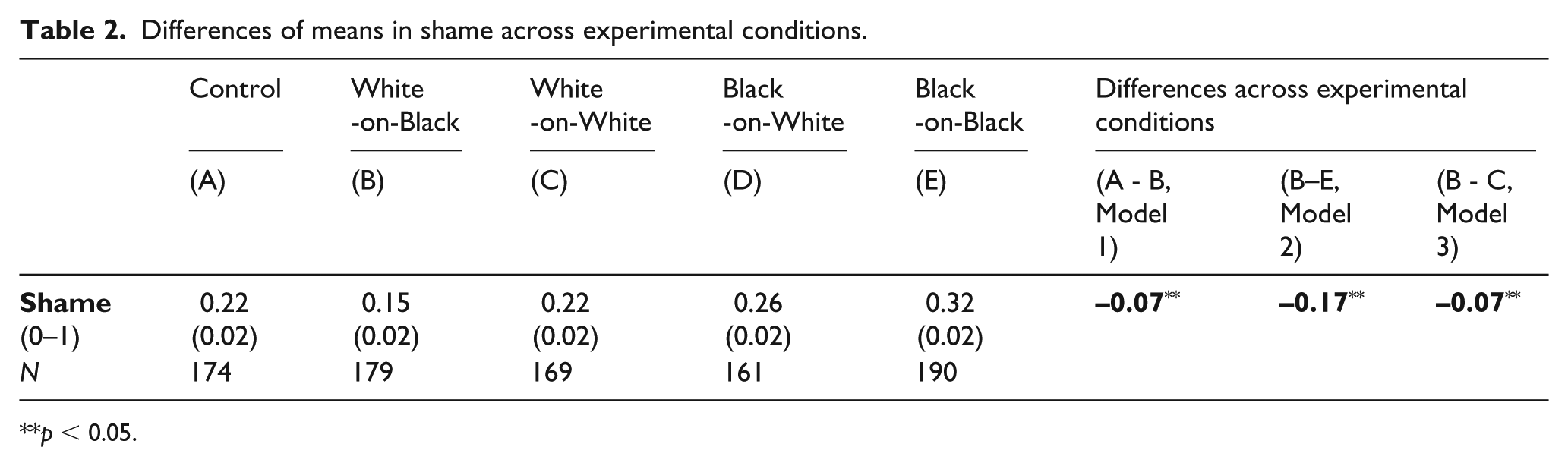
Table 2 and Figure 2 include our findings for Hypothesis 2. We stated that feelings of shame would increase when Black respondents are exposed to crime incidents with Black perpetrators. Table 2 and Figure 2 contain average levels of shame across each treatment group. As hypothesized, reported feelings of shame are highest in the Black perpetrator categories. In the “Differences Across Experimental Conditions” portion of Table 2, the findings in Model 2 (B–E), which compares respondents in the White-on-Black and Black-on-Black conditions, indicate that respondents in the Black-on-Black condition experience substantially higher levels of shame than those in the White-on-Black condition (p < 0.01). When a member of the in-group behaves in a way that fails to conform to expectations of desired social behavior, a shame response could emerge across a variety of contexts. However, for Black Americans, feelings of shame are potentially exacerbated given Blacks’ historically stigmatized status (Cohen, 1999; Du Bois, 1933; Kennedy, 2015) and as noted earlier, the stereotypical linkage between Black people and criminal behavior.
Differences of means in shame across experimental conditions.
p < 0.05.
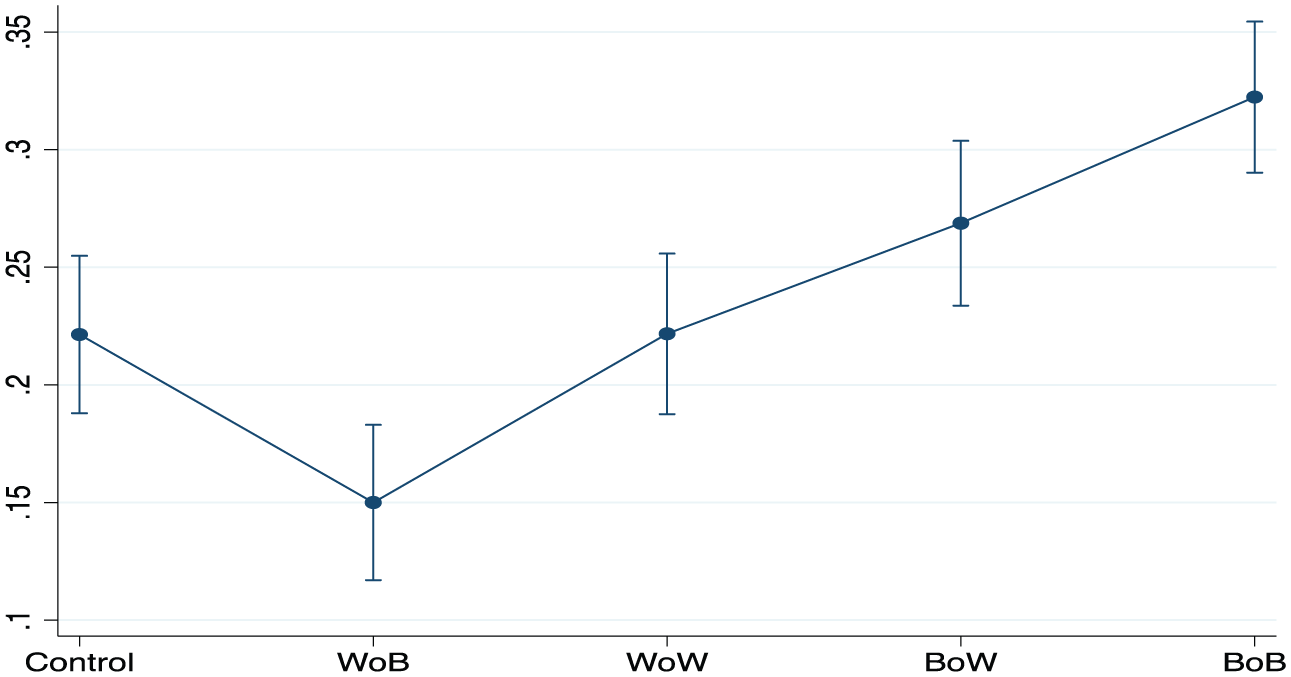
Average levels of shame by treatment condition.
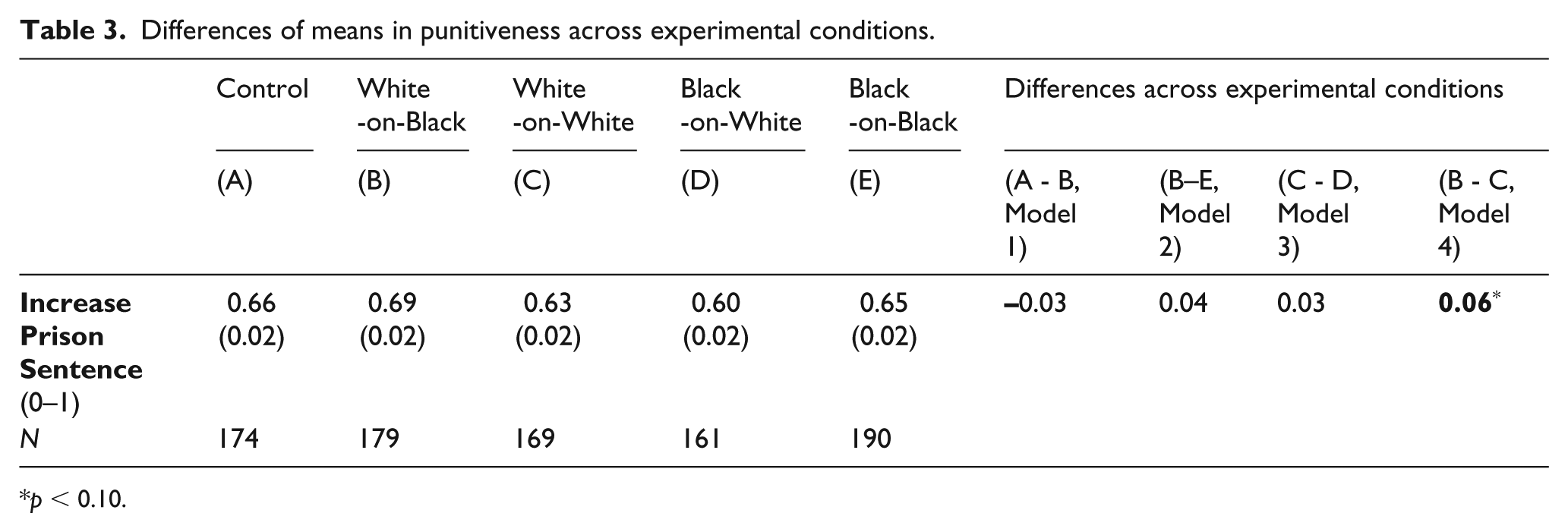
We had somewhat divergent hypotheses for attitudes about punitiveness: if the perpetrator is Black, respondents would express a decreased desire for punishment (H3a); if the victim of a violent crime is Black, and the perpetrator is White, Blacks should express an increased desire for punishment (H3b). Our findings in Table 3 and Figure 3 provide mixed support for these hypotheses. In Table 3, we attempt to isolate the effect of the race of the perpetrator on the respondents’ punishment preferences by comparing the opinions of respondents in the “White-on-Black” condition to those in the “Black-on-Black” crime condition (B–E). The results suggest that respondents are less punitive when exposed to the “Black-on-Black” crime treatment as compared to those exposed to the “White-on-Black” treatment. However, the difference is not statistically significant. We see a similar result when we examine the effect of the race of the perpetrator when the victim is White in Model 3 (C - D). Blacks appear less punitive when perpetrator is Black and the victim is White; however, the difference also lacks statistical significance.
Differences of means in punitiveness across experimental conditions.
p < 0.10.

Average of punitiveness by treatment condition.
But, perhaps it is the race of the victim that matters most. Our findings in Table 3, Model 4 (B - C) show that respondents in the “White-on-Black” crime condition are more punitive than those in the “White-on-White” crime treatment (p < 0.10). That is, as hypothesized, respondents become more punitive when a Black victim is murdered at the hands of a White perpetrator and less punitive when a White victim is murdered at the hands of a White perpetrator. Figure 3 shows that Black respondents are most punitive when the perpetrator in the crime vignette is White and the victim is Black. We believe this finding has important implications for research in sociology surrounding punitiveness. Scholars suggest that in certain instances Blacks are less punitive than Whites (Bobo and Johnson, 2010; Buckler et al., 2009), and our results also illustrate that their willingness to punish depends on the context.
In Table 1 and Figure 1, we saw an increase in anger among those in the White-on-Black crime condition and an even greater spike in anger amongst those in the Black-on-Black crime condition. These findings demonstrate that when Blacks are portrayed as the victim, their anger increases. However, we saw somewhat different responses in the context of punitiveness. Even though Blacks are extremely angry in the Black-on-Black treatment, Table 3 and Figure 3 suggest a decreased desire to punish Black perpetrators. In Figure 4, we explore the relationship among race, anger, and punishment in greater detail. Figure 4 demonstrates that as one’s anger increases, respondents in the White-on-Black condition increase their willingness to support increased prison sentences for those accused of violent crime. However, this is not the case for those in the Black-on-Black condition, as increases in anger are associated with a decrease in punitiveness.

The effects of anger on punitiveness by treatment condition.
Potential explanations are understandably complex and multi-faceted. As noted previously, the decreased desire to punish could reflect suspicion of the criminal justice system toward accused Blacks, suspicion that was noted by W.E.B. Du Bois over a century ago. In addition, the decreased willingness to punish, despite increased anger, could reflect an underlying sentiment that intragroup violence, particularly in the context of Black Americans, emerges as a symptom of broader racial oppression and injustice and its effects (poverty, joblessness, inadequate education access). Intragroup violence among oppressed groups, thus, is an indictment of the broader institutional and political system and the optimal response is not necessarily punishment of individual perpetrators but rather restorative justice for the marginalized group and a removal of discriminatory policies and values.
Conclusion
Our goal in this paper is to examine how exposure to crime affects emotions and public opinion among Black Americans. The findings from our survey experiment suggest that feelings of anger and shame feature prominently in Blacks’ emotional reactions to instances of intra- and- intergroup crime, and further, that reactions to crime and subsequent retribution are contingent upon the race of the victim and perpetrator. As hypothesized, respondents in our experiment report higher feelings of anger after exposure to a news story regarding intergroup violence. Our findings also indicate that respondents are most willing to support harsher punishment for violent crimes when the perpetrator is White.
The interplay of emotions and public opinion potentially has important implications regarding how those exposed to crime (particularly a crime involving a member of one’s racial/ethnic group) interact and mobilize within the political sphere. Anger in politics can play a vital role, motivating some people to participate in ways they might ordinarily not (Valentino et al., 2011). In addition to expressions of anger and frustration, there have been numerous recent examples of mobilization among Black Americans in the aftermath of intergroup crime involving civilian and non-civilian perpetrators (CBS News, 2014). Specifically, in the aftermath of highly publicized intergroup crime, such as the Trayvon Martin murder, a key component of the protest and group mobilization is not only a call for widespread reform of the criminal justice system, but also a call for adequate punishment of the specific perpetrator (Luscombe and Siddique, 2013).
The responses to Black-on-Black crime are more varied. The finding of increased feelings of shame seems to reflect negative group feelings toward undesirable behavior from in-group members. Interestingly, exposure to Black-on-Black crime is met with very high levels of anger from Black Americans (respondents actually exhibit the highest levels of anger in this treatment condition). However, this anger is also accompanied by a decreased preference for punitive sentences. This decrease in support for harsher punishments for Black perpetrators, even when the victim is Black, potentially reflects concerns over systematic biases in the American criminal justice system that disproportionally affect Blacks, particularly in regard to sentencing (Buckler et al., 2009, Ramirez, 2014). The way in which the juxtaposition of increased anger and decreased desire for punishment potentially affects engagement with the public sphere is less clear. In contrast to an increased desire for longer criminal sentences in the aftermath of intergroup crime, one could envision greater calls from in-group members for solutions such as antipoverty programs or greater educational opportunities aimed at reducing the occurrence of intragroup crime (Ramirez, 2014).
Unfortunately, in today’s society, the occurrence of crime and violence are common. When these instances involve intergroup conflict, such as in the Trayvon Martin example, responses from certain racial in-group members seem particularly acute and vocalized. Our study attempts to provide quantitative causal evidence to understand the lived emotional experiences and policy implications in the aftermath of such events. Understanding the factors involved with intra- and- intergroup conflict can potentially help facilitate societal dialogue beyond the halls of academia after the occurrence of these types of conflicts.
Supplemental Material
2018-04-22_Online_Appendix – Supplemental material for Race, crime, and emotions
Supplemental material, 2018-04-22_Online_Appendix for Race, crime, and emotions by Camille D. Burge and Gbemende Johnson in Research & Politics
Footnotes
Declaration of conflicting interest
The author(s) declared no potential conflicts of interest with respect to the research, authorship, and/or publication of this article.
Funding
The author(s) received no financial support for the research, authorship, and/or publication of this article.
Supplemental materials

Notes
Carnegie Corporation of New York Grant
This publication was made possible (in part) by a grant from the Carnegie Corporation of New York. The statements made and views expressed are solely the responsibility of the author.
References
Supplementary Material
Please find the following supplemental material available below.
For Open Access articles published under a Creative Commons License, all supplemental material carries the same license as the article it is associated with.
For non-Open Access articles published, all supplemental material carries a non-exclusive license, and permission requests for re-use of supplemental material or any part of supplemental material shall be sent directly to the copyright owner as specified in the copyright notice associated with the article.
