




Abstract
In this article, we examine the effects of individual anxiety after the 2016 Orlando, Florida, mass shooting, which killed 49 people and wounded 58 others. Similar to prior research on the influence of anxiety, after the Orlando shooting anxious citizens supported policies and institutions perceived as protective and capable of minimizing future risks. In addition, anxiety counteracted ideology. Anxious citizens largely abandoned ideological processing, which resulted in a sharp reduction of differences between liberals and conservatives on essential beliefs and preferences associated with mass shootings. However, the degree of ideological abandonment turned on the alignment of ideology and anxiety. When anxiety about the Orlando shooting encouraged support for policies inconsistent with ideological preferences, the influence of ideology on subsequent preferences diminished notably. Conversely, when anxiety prompted support for policies consistent with ideological preferences, anxiety reinforced those preferences. The identification of ideological abandonment after Orlando, and the asymmetric influence of anxiety on political attitudes across ideology, are important contributions to theories of emotion and for research on tragic events.
On 12 June 2016, a lone gunman killed 49 people and wounded 58 others in an attack on a gay nightclub in Orlando, Florida. During the shooting, the gunman made a 9-1-1 call pledging allegiance to the leader of the Islamic State of Iraq and the Levant (ISIL). He reportedly fired over 110 rounds of ammunition using at least two semi-automatic weapons. Officials characterized the shooting as an act of terrorism. The Orlando shooting was the deadliest modern US mass shooting until October 2017.
Though extraordinary, Orlando is sadly another tragedy in a seemingly endless string of mass shootings (Berkowitz et al., 2018). Given the scale of death and heartbreak that mass shootings engender, it is remarkable that so little is known about the public’s reaction to them. The prevailing wisdom seems to be that such tragedies do not catalyze policy change (Azari, 2017). Rather, shocking episodes of extreme gun violence are met by an entrenched and polarized public that is unable to muster consistent demands for government action.
We demonstrate that mass shootings do in fact move the public, rousing widespread anxiety. Anxiety research suggests mass shootings, much like other tragedies, should affect people in two identifiable ways. First, people made anxious by shootings will seek protection from the perceived threats and unpredictability (Albertson and Gadarian 2015). Anxious citizens support policies, leaders and institutions viewed as protective and intended to minimize future risks (Huddy et al., 2005).
Second, anxiety shifts citizens’ reliance on habitual information processing to open cognition that is responsive to the unexpected and threatening events (Huddy et al., 2007; Marcus et al., 2000). To presume the public is not sensitive to shootings, or that ideological preferences become intensified thereafter (Jang, 2018), is to neglect the role of anxiety. Among those made anxious by Orlando, ideological thinking should decline considerably. We therefore expect a sharp reduction in differences between liberals and conservatives on essential beliefs and preferences associated with mass shootings; notably attributions of blame for the Orlando shootings, gun-law preferences, support for government and presidential approval.
However, the extant literature does not address a lingering question. Does anxiety-induced shifts in beliefs and preferences away from habitual responses affect both liberals and conservatives? We hypothesize that abandonment of ideological thinking turns on the alignment of ideology and anxiety. For example, after tragedies like Orlando, ideology and anxiety should be aligned for liberals—that is, both belief and emotion encourage greater restrictions on gun ownership and gun blame for violence. In other words, here, we expect liberals will not experience conflict: high anxiety about the Orlando shooting will reinforce liberals’ pre-existing preferences. However, among conservatives anxiety and ideology point in opposite directions. Conservatives will experience conflict between ideological preferences about guns and high anxiety induced by the shooting. Therefore, we expect anxiety to exhibit a powerful effect among conservatives, with anxiety loosening the grip of ideology on relevant attitudes.
In summary, shocking violence leads anxious people to adapt situation-specific beliefs and preferences consistent with threatening events (Atkeson and Maestas, 2012). Anxiety leads liberals to stay the course on gun control and blaming guns while anxious conservatives temper their ideological positions on guns. In general, when ideology and anxiety are orthogonal – as is the case for conservatives in the aforementioned example – we anticipate a decline in ideological thinking. When ideology and anxiety are aligned, the effect of ideology on preferences remains the same. Consequently, anxiety after a mass shooting can create conditions where people with different ideological predispositions move much closer together in their policy preferences and blame attributions, and thereby create an opportunity for policy change.
Theoretical development
The targets of mass shootings are extraordinarily diverse: the lives of young children, high school and college students, employees, church parishioners and concert enthusiasts’ end without warning. Yet, to our knowledge, no research examines public emotions after mass shootings. Nor does it appear that much research directly tests whether mass shootings influence support for gun regulation. There is significant polling data that links support for gun control and mass shootings, but the analyses are descriptive and aggregate in nature (Parker et al., 2017). A notable exception is Newman and Hartman’s (2017) recent study. They show that proximity to a mass shooting makes the threat of gun violence more salient, which in turn boosts public support for gun control.
Yet extensive media attention to extraordinary tragedies can powerfully connect people to events, overcoming the obstacle of geographical distance and bringing about broadly-felt emotions. For example, Huddy et al. (2005) reported widespread anxiety after 9/11. Almost half of the sample felt anxious, or worried at least sometimes, approximately one-third felt scared or frightened sometimes or very often, and a majority were concerned about another attack.
Concerns about how distant events might indirectly influence the public can also produce widespread anxiety. Atkeson and Maestas’s (2012) analyses of Katrina showed a large portion of the public were concerned that hurricanes would negatively impact the nation’s economy. Nearly 75% were somewhat or very concerned about that possibility. Finally in Anxious Politics, Albertson and Gadarian (2015) demonstrated significant anxieties arising in the context of dramatic events and related exposure. However, we find little comparable scholarly attention to emotions after mass shootings. 1
Anxiety
Marcus et al.’s (2000) theory of Affective Intelligence offers a valuable framework to consider the role of emotions after mass shootings. The theory posits two affective subsystems of the brain that have important and discrete ties to an impressive variety of attitudes and behaviors. Here we focus on the surveillance system, which is primarily responsible for identifying threatening situations that produce anxiety.
Anxiety develops as people confront an unusual or novel threat. Once the surveillance system detects unexpected or threatening stimuli, it evokes anxiety, interrupting on-going information processing and shifting attention toward the threat. The shift encourages attention and learning, motivating people to seek additional information.
Tragedies prompt the surveillance system. For example, those anxious after the 9/11 attacks watched more television than the less anxious (Huddy et al., 2005). In addition, anxiety about the Iraq War increased the number of self-reported thoughts about the war and the likelihood of conversing with others about it (Huddy et al., 2007). Valentino et al. (2008) experimentally induced anxiety and showed that it produced greater interest in and attention to presidential campaigns. Further Gadarian and Albertson (2014) reported that anxiety about immigration increased information searches, improved recall of information and the anxious were also attracted to threatening information.
The motive to search and learn arises as anxiety inhibits people’s reliance on habitual information processing. Prior habits are abandoned for “reasoned and informed consideration of the alternatives” (Marcus et al., 2000: 62). Unanticipated, abrupt and traumatizing events thus disturb habitual cognitive patterns, inducing anxiety and causing people to reconsider standard ways of thinking, increasing attention to their environments and engaging in learning processes. People relatively undisturbed by tragedy should therefore exhibit the usual directional processing, where common ideological differences characterize beliefs and preferences. Among the anxious, a marked deterioration of ideological thinking is expected.
In addition, we argue that such deterioration will not be uniform across ideological categories. For example, evidence suggests anxiety does not always lead to more reasoned and informed judgments but to overestimation of risk and risk-avoidant beliefs and behaviors (Huddy et al., 2007). This indicates habitual processing may persist after anxiety takes hold. Similarly, Atkeson and Maestas (2012) argued that anxiety does not simply trigger a switch from habitual- to accuracy-based reasoning. Rather, shocking events direct attention to media and learning about threatening situations. The associated anxiety makes people more receptive to the information they seek. Such information could fit well with existing ideological preferences. Thus while anxiety produced an information search, it could result in the strengthening of ideological thinking.
It is therefore plausible that in some instances anxiety reinforces ideological preferences and in others anxiety produces ideological moderation. The key is to identify the effects of anxiety and determine whether those are consistent with those produced by ideology. The literature suggests anxiety increases support for policies and institutions perceived as protective and capable of minimizing future risks (Huddy et al., 2005). Support for government and gun-control policies are typically considered protective and a liberal position. The effects of liberals’ anxiety and ideology in this example are therefore aligned. For conservatives, however, anxiety encourages support for institutions and policies that are generally opposed to their ideological beliefs. Since conservatives’ anxiety and ideology are in conflict, high anxiety should then loosen the grip of ideology on conservatives’ essential beliefs and preferences associated with mass shootings.
Hypothesis
When prominent mass shootings happen, some people develop anxiety about the senseless violence, the victims and what the violence may mean for their own lives. They are vigilant and begin to search for answers. Among the anxious, the effort to reduce further risks is expected to produce support for relevant causes, policies, leaders, and institutions.
In addition, anxiety about mass shootings should modulate the effects of ideology.
Finally, when an ideological group supports a policy preference or causal belief, and anxiety also portends support, we anticipate modest, if any, effect of emotion (ideological thinking remains). However, if an ideological group supports a policy or attribution, yet anxiety signifies opposition, the effects of anxiety should be extensive (ideology thinking modulates).
Data and method
We employed Clear Voice Research (CVR) to conduct a national survey of US adults, starting just 6 days after the Orlando tragedy – 18 June 2016. We fielded the survey promptly after the shooting to capitalize on the anticipated emotional responses (see Supplemental Appendix for survey details).
We presented respondents with three questions designed to measure anxiety about the Orlando shootings. Anxiety is typically measured by self-reported feelings (Albertson and Gadarian, 2015; Atkeson and Maestas, 2012; Huddy and Feldman, 2011; Huddy et al., 2007; Mackuen et al., 2007; Erisen, 2018). Respondents were asked: “Thinking about the mass shooting in Orlando, Florida how does this shooting make you feel on a scale from 1 to 5 with 1 indicating not at all (anxious, frightened, worried) and 5 indicating the highest level of (anxious, frightened, worried)”. About 25% reported a significant level of anxiousness, a similar percentage were frightened by events and nearly 40% reported being very worried. The three items share substantial covariance. The Cronbach’s alpha was α = 0.89. We combined the three items into an additive index of anxiety. 2
Blame attributions
We assessed the degree of blame respondents’ attributed to three causes widely reported after Orlando: gun availability, terrorism and mental illness. We asked: “On a scale from 1 to 10 with 1 being none at all and 10 being a lot of blame, how much blame for this shooting would you place on gun availability?; on terrorism?; on mental illness?” Terrorism generated a mean blame score of 6.74, mental illness 7.14 and gun availability 6.11. Conservatives reported the highest average level of blame for terrorism (8.1), nearly 2.5 points greater than liberals’ assessment (5.8). Liberals strongly blamed guns (8.2) while conservatives scarcely did (3.9). Both groups blamed mental illness (liberals 7.5, conservatives 6.5).
Independent variables
For ideology we employed the conventional seven-point scale. 3 As noted, anxiety is an index of three related measures coded low to high. We also included several exogenous influences likely to affect blame attributions and anxiety. Based on previous research, women in response to terror attacks reported greater anxiety than men (Huddy et al., 2002; Huddy et al., 2005). Blacks reported higher levels of perceived threat (Huddy et al., 2005) and anxiety after 9/11 (Huddy et al., 2002). More education reduced anxiety about terrorism, as did higher income (Huddy et al., 2005; Skitka et al., 2004). Additionally, after the 9/11 attacks, younger people felt more anxious and threatened than older people (Huddy et al., 2005).
Another necessary control is gun ownership. Gun owners are substantially less likely to attribute mass shootings to gun availability (Joslyn and Haider-Markel, 2017). We also know that those closely following the news of an event are more likely to be exposed to the predominant frames about the causes and consequences of the event (Atkeson and Maestas, 2012: 41). As such, we included a measure of a respondent’s reported attention to news about the Orlando shootings.
Results
Table 1 provides OLS main effects model estimates and then includes an interaction term. For the interaction models, we followed Marcus et al. (2000) and MacKuen et al. (2014) and divided the sample by those reporting very little anxiety (one standard deviation below the mean) and those highly anxious (one deviation above the mean). This partition aptly captures respondents’ experiencing either low or high anxiety and thus corresponds well with theoretical constructs. 4 Also, independent variables were recoded to a 0 to 1 range for comparability.
The impact of ideology and anxiety on blame attributions about the Orlando shooting.

OLS estimates: variables are rescaled from 0–1 for comparison. Standard errors in parenthesis.
p<0.01;
p<0.05.
Degree of blame attribution questions: “On a scale from 1 to 10 with 1 being none at all and 10 being a lot of blame, how much blame for this shooting would you place on …?” The decrease in n from main effects to interaction model is due to division of the anxiety index into high and low categories, deleting middle responses. Ideology ^ con indicates ideology with higher scores being more conservative. IdeoXAnxiety indicates an interaction term for Ideology multiplied by Anxiety
Notice first the consistent effect of ideology across the three main effects models. Comparing estimates across and within models, no other variable equals ideology’s power to predict blame levels. It is robust for guns and terrorism yet comparatively modest for mental illness. Second, across the blame categories, anxiety is a reliable determinant. The effect is strong, positive and highlights the direct emotional influence of Orlando. Third, the interaction term is significant for blaming guns and terrorism, the two most ideologically driven blame categories.
Figure 1 depicts the interaction terms for the blame gun and terrorism models. The vertical axis shows degree of blame attributed to guns and terrorism and the horizontal axis represents respondents’ ideology from very liberal to very conservative. Observe the estimated slopes for anxious respondents are relatively flat and modest compared to the less anxious. Anxiety clearly decreases differences between liberals and conservatives. Consider the “blame guns” graph. Anxious liberals assigned blame to guns a mere 1.8 points greater than anxious conservatives (liberals 8.3 to conservatives 6.5). The same gap between less anxious liberals and conservatives is nearly twice that size at 3.4 points. In blaming terrorism, the divide between anxious liberals and conservatives shrinks still further. Anxious conservatives were less than a point higher in blaming terrorism than anxious liberals (conservative 7.6 to liberals 6.9). The divide is nearly 3.0 points among the less anxious. This is strong evidence to support hypotheses 2.

The effects of ideology and anxiety on blaming guns and terrorism for the Orlando shooting.
Figure 1 also shows that anxiety split conservatives on guns and separated liberals on terrorism. In fact, the blame guns chart demonstrates that anxious conservatives were more similar to liberals than to less anxious conservatives. Likewise, the terrorism chart indicates anxious liberals were nearly the same as conservatives in blaming terrorism, and distinctly different from non-anxious liberals.
Last, Figure 1 supports hypothesis 3. The influence of anxiety among liberals’ blaming guns is muted; that is liberals blame guns for the shooting, and high anxiety merely supports that belief. The ideological tendency among conservatives is to not blame guns. Anxiety works against that tendency, moving conservatives to consider causes typically ignored. Greater gun blame among anxious conservatives is the result. Just the opposite pattern is evident among anxious liberals in the terrorism chart. Regardless of ideological category, when anxiety encourages support for blame attributions that are inconsistent with habitual ideological attributions, the grip of ideology on attributions weakens.
Gun laws and beliefs about government
We also asked respondents their preferences on access to gun ownership: “How strongly would you favor or oppose new laws that would restrict access to gun ownership?” Fifty-six percent favored or strongly favored new laws to restrict gun ownership. Respondents were queried about government and the efficacy of government action in preventing mass shootings. “Which of the following statements comes closer to your overall view: ‘Government and society can take action that will be effective in preventing shootings like Orlando’ [45%] or ‘shootings like the one in Orlando will happen again regardless of what action is taken by government [55%]’.”
Table 2 presents logistic regression models. As expected, conservatives did not support gun regulations and were significantly less likely than liberals to believe government action would prevent mass shootings. In addition, anxiety increased the probability of favoring new laws to restrict gun ownership and enhanced the likelihood of believing in government action. The main effects of anxiety are impressive, raising the likelihood of favoring restrictive gun laws from 0.40 among the least anxious to nearly 0.70 among the most anxious respondents.
The impact of ideology and anxiety on support of gun regulations and belief that government action can prevent shootings.

Logistic regression estimates. Standard errors in parenthesis.
p<.01;
p<.10.
Question wording: “How strongly would you favor or oppose new laws that would restrict access to gun ownership? 1=strongly favor, favor; 0 = oppose, strongly oppose.”
“Government and society can take action that will be effective in preventing shootings like Orlando or shootings like Orlando will happen again regardless of what action is taken by government?”
The decrease in n from main effects to interaction model is due to division of the anxiety index into high and low categories, deleting middle responses. IdeoXAnxiety indicates an interaction term for Ideology multiplied by Anxiety.
Anxiety also moderated the effect of ideology. Both interaction terms are significant and substantively important. Figure 2 shows that less anxious respondents travelled the well-worn ideological path on guns and beliefs about government. The chances of less anxious liberals favoring gun restrictions is very high (0.87) and predictably very low for less anxious conservatives (0.08). Among anxious respondents, ideology did not affect beliefs about government. The proximate horizontal line across the ideological scale denotes very little to no division between anxious liberals and conservatives on beliefs about government effectiveness in preventing mass shootings. In addition, anxious conservatives appear remarkably open to new gun laws. The likelihood that anxious conservatives favored such laws increased to nearly 0.50. This change is noteworthy and brings liberals and conservatives much closer together on their gun-law preferences. A similar pattern emerged for beliefs about government capacity to prevent mass shootings. Anxious conservatives were approximately 0.20 more likely to believe government can prevent mass shootings than less anxious conservatives.
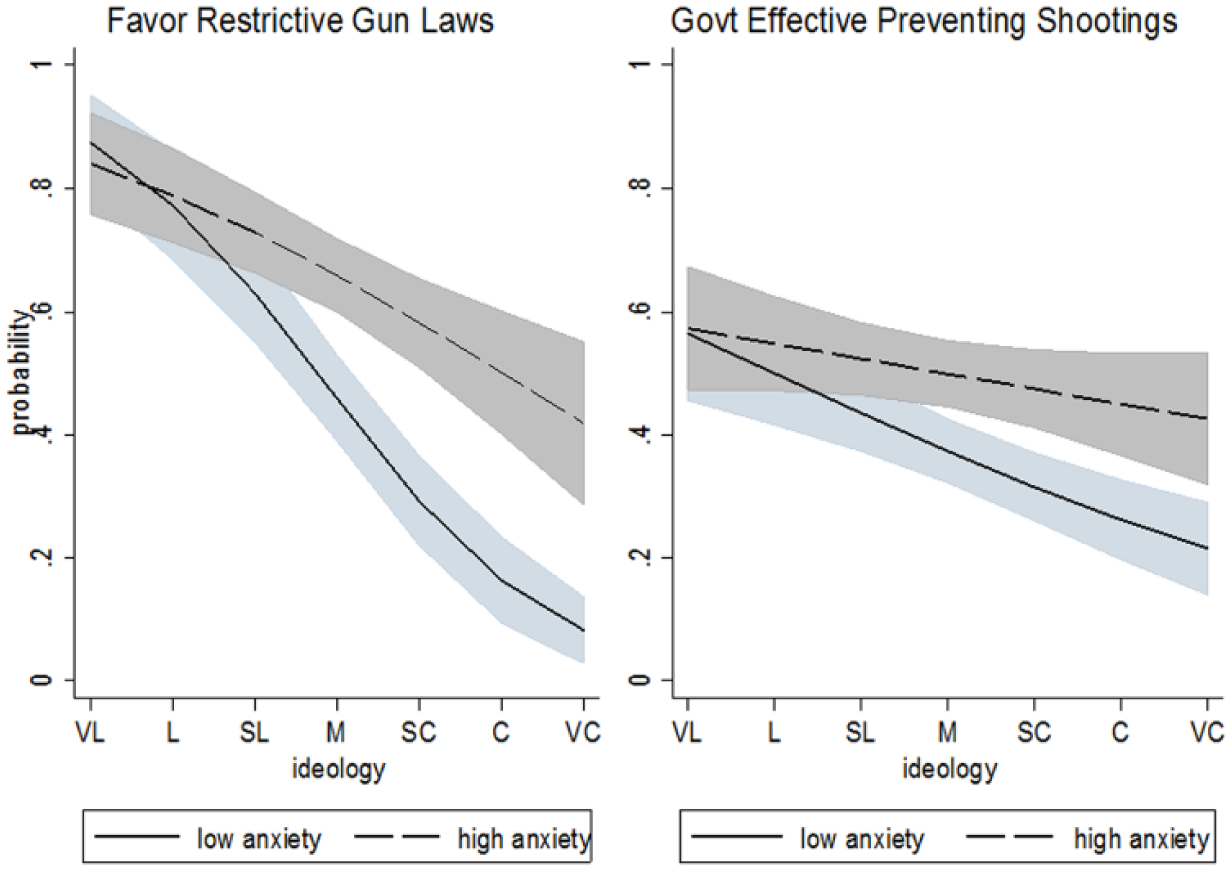
The effects of ideology and anxiety on support for restrictive gun laws and beliefs government can prevent shootings.
Confidence in government and Presidential approval
Following the questions on the Orlando shootings, respondents were asked to consider their confidence in government: “How much confidence do you have in the federal government? None at all, not very much, a fair amount, a great deal.” We combined responses into two categories, 1 - great deal and fair amount (35%); 0 - none and not very much. Respondents also reported Presidential approval. Predictably, both measures produced sharp ideological division (see Table 3). However, greater anxiety triggered support for government and approval of the perceived leader of government. In addition, anxiety–ideology interactions are significant and Figure 3 confirms the expected patterns.
The impact of ideology and anxiety on confidence in government and approval of the President.

Logistic regression estimates. Standard errors in parenthesis.
p<.01;
p<.10.
Question wording: “How much confidence do you have in the federal government? None at all, not very much (0), a fair amount, a great deal (1).”
“Do you approve or disapprove of the way Barak Obama is handling his job as President?”
The decrease in n from main effects to interaction model is due to division of the anxiety index into high and low categories, deleting middle responses. IdeoXAnxiety indicates an interaction term for Ideology multiplied by Anxiety.

The effects of ideology and anxiety on confidence in government and the job approval of President Obama.
The powerful effects of ideology are in fact tempered by anxiety. This is especially evident for confidence in government. Across the ideological spectrum, differences in respondents’ confidence in government vanished among those anxious about Orlando. This result parallels previous findings and perhaps best illustrates the strength of the emotional-based mechanism triggered after Orlando. Anxiety effectively cancelled long-standing ideological divisions about government (H2). And anxiety did so primarily by inducing conservatives to reconsider government (H3). The probability that less anxious conservatives expressed confidence in government was typically slight (0.10). That same probability among anxious conservatives increased nearly fourfold (0.38), roughly equivalent to liberals.
Conclusion
A primary result of higher individual anxiety about Orlando was a marked decline in ideological division on the perceived causes of shootings, support for new restrictive gun laws, increased confidence in government and higher presidential approval. Our analyses show that a mass shooting produced an emotionally-based mechanism that created less division in the public about the sources of violence and potential solutions.
The findings point to two conclusions. First, with respect to empirical inquiry, mass shootings merit greater scholarly attention. Shootings draw widespread media coverage, involve virtually all socio-political groups, occur without warning and are geographically dispersed. The public reacts predictably, with a significant portion feeling anxious about them. Across seven attitudinal contexts, a significant and strong main effect of anxiety appeared. Anxiety intensified blame on guns, terrorism and mental illness, boosted support for restrictive laws on gun ownership, enhanced beliefs that government could prevent shootings, increased confidence in government and raised Presidential approval. These results are consistent with the notion that anxiety increases support for government institutions as well as polices that might mitigate potential risk.
Future work should consider perceptions of threat (Huddy et al., 2005), the distinct effects of other emotions (Huddy, Feldman and Cassese, 2007), and possible connections to gun policy, institutional support, and approval of political leaders. Although mass shootings are now fairly common, variation in the number of people involved, the types of victims, and the settings likely arouse different emotions and evoke distinct blame attributions.
Second, we showed anxiety consistently inhibited people’s dependence on ideological thinking. An anxious public weighs information it may have otherwise ignored. Strong ideological differences receded and in some instances nearly disappeared. Consider that on issues such as gun regulation, government effectiveness and perceived causes of mass shootings, anxiety substantially moderated entrenched ideological divisions. The effects were reliable, robust and consistent with the emotion and politics literature.
Finally, when the effects of anxiety and ideology were at odds, each inspiring different policy preferences and blame attributions, the grip of ideology diminished. Notable departures from habitual beliefs and attitudes resulted. Yet when anxiety and ideology encouraged the same attitudes and attributions, routine ideological thinking continued. Anxiety and ideology can thus reinforce one another or work against the other. It is in those latter instances, where ideology and anxiety clash, ideological thinking modulates and the opportunity for policy change may grow.
Supplemental Material
Supplemental_Appendix_revised2 – Supplemental material for The direct and moderating effects of mass shooting anxiety on political and policy attitudes
Supplemental material, Supplemental_Appendix_revised2 for The direct and moderating effects of mass shooting anxiety on political and policy attitudes by Mark R. Joslyn and Donald P. Haider-Markel in Research & Politics
Footnotes
Declaration of Conflicting Interest
The author(s) declared no potential conflicts of interest with respect to the research, authorship, and/or publication of this article.
Funding
The author(s) disclosed receipt of the following financial support for the research, authorship, and/or publication of this article: This research was partially funded with support from the University of Kansas, College of Liberal Arts, research fund.

Supplemental material
Notes
Carnegie Corporation of New York Grant
This publication was made possible (in part) by a grant from the Carnegie Corporation of New York. The statements made and views expressed are solely the responsibility of the author.
References
Supplementary Material
Please find the following supplemental material available below.
For Open Access articles published under a Creative Commons License, all supplemental material carries the same license as the article it is associated with.
For non-Open Access articles published, all supplemental material carries a non-exclusive license, and permission requests for re-use of supplemental material or any part of supplemental material shall be sent directly to the copyright owner as specified in the copyright notice associated with the article.
