




Abstract
Even though violent attacks resulting in civilian fatalities can be seen as constituting failure on the part of the incumbent party to provide security to citizens, governments are not always punished electorally. Rather, at times, they appear to gain votes following terrorist attacks. Here we argue that political parties that can take advantage of their local presence to frame and communicate their narrative in response to terrorism, can better manage to avoid blame and even to emerge victorious in times of violent conflict. The AKP in Turkey is one such important example. Our statistical analyses of municipality-level aggregate election results show that the party not only maintained national incumbency, but even strengthened its predominance in the political system in the face of growing security threats. In municipalities where AKP controlled the local government and hence municipal resources, the party did not lose votes following terrorist attacks. This finding remains even when we consider past voting, regional variations, competitive districts, and ethnicity. Our argument that incumbents can avoid punishment through their capacity to reach out to voters at the local level is also supported by individual-level survey data and the comparison with neighboring municipalities. As such, we highlight how local government control can be consequential for national politics, including periods when security dominates the national agenda.
Introduction
Between June and November 2015, Turkey experienced 305 violent attacks that caused 398 fatalities, and in these five months, the incumbent AK Party (AKP) increased its vote share from 40.9% to 49.5%. From one election to the other, the share of voters who named terrorism and security as the most crucial problem in Turkey rose from 9% in May to 47% by September, while 55% also thought that AKP was the party that could effectively solve this problem (Carkoglu & Aytac, 2015; Aytac & Carkoglu, 2019). Yet, even in such an atmosphere, some constituencies behaved differently: 61% of the locations where terror attacks took place, voted for a different party than AKP.
Terrorism is an important source of debate in elections throughout the world. Yet, it is not particularly clear why the incumbent party gains votes in one terror location and loses votes in another area affected by terror (Barratt, Gartner & Segura, 2004; Berrebi & Klor, 2006; Montalvo, 2011). We are left with the related puzzle of why terrorism results in electoral defeat for incumbents in some countries (Peru 1990, Spain 2004) but not others (Israel 2019). One leaves the literature expecting the public to be harsher on incumbent political parties facing increasing amounts of terrorist attacks during continuous single-party rule, especially when credible alternative right-wing parties exist (Gassebner et al., 2008; Chowanietz, 2011; Kibris, 2011; Berrebi & Klor, 2008; Getmansky & Zeitzoff, 2014).
Here we analyze Turkey during the AKP period where the explanations listed above would lead us to expect AKP to suffer electorally due to growing terrorism. By 2015, AKP had been ruling the country as a single party for 13 years. Terrorist attacks increased during its tenure and its reliance on different approaches to the Kurdish question, including negotiations, resulted in accusations of flipflopping. Yet, AKP expanded its electoral support during this period, especially in the elections where terrorism rose to prominence. How could AKP avoid being blamed and instead even emerge with net gains in some locations that were directly affected by violent attacks?
In our explanation we build upon past research that suggests control of the narrative as an important factor for electoral accountability (Carlin, Love & Martínez-Gallardo, 2015; Criado, 2017). What is unclear from earlier studies is how national governments can control the narrative on terrorism to their satisfaction. We are underscoring the role of local actors and highlighting the interplay of the local and national governments. One factor that affects voters’ perception of how effectively the government is dealing with a security threat is local communication carried out by local actors. Local government, in turn, is another relevant factor that expands opportunities for this communication. When a co-partisan controls the municipality, municipality resources can be used and there is no conflicting narrative emerging from the mayor and her team. Therefore, ruling political parties, that is, national incumbents, can capitalize on co-partisan local governments’ post-terror efforts (Eriksson, 2016). Our hypothesis, as such, expects a mitigating role of local government control in electoral accountability: the incumbent party loses votes following terrorist events in opposition-controlled municipalities, but does not suffer electoral punishment when the local government is controlled by a co-partisan.
We statistically analyze Turkish elections at the municipality level and public opinion surveys. We attempt to understand how the national vote is affected by terrorism as well as these local dynamics, and our findings show the mitigating effect of co-partisan local government. When the local government is controlled by the opposition, AKP loses votes in municipalities that experienced terrorist attacks. Yet, as we expected, attacks do not affect the AKP vote when a co-partisan is the mayor. To explore further the mechanism behind our argument, we turn to individual-level analysis. One implication of our argument for individual voters is that they should evaluate the national incumbent more favorably when the local communication is more effective. Indeed, we find that local government control also conditions voters’ evaluation of AKP’s ability to solve the problem of terrorism. These results are then further supported and developed through additional statistical analyses, such as of neighboring municipalities.
In this manner, we contribute to discussions on the terror–elections nexus by addressing a puzzle emerging from the literature on the uneven effects of terror on national election results and underlining the role of an understudied entity – local politics and municipality. We also contribute to the literature on electoral accountability. Specifically, looking at the effect of decentralization on electoral accountability, the focus of the earlier literature has been on clarity of responsibility – how sharing of responsibilities across levels of government can blur responsibility (Anderson, 2000). Yet, on the issue of terrorism, this explanation is unsatisfactory for some countries, such as Turkey, where local governments have no direct role in security provision. When voters do not assign any responsibility to local governments, opposition control of municipalities should not hinder electoral accountability. We show that even in such cases, local government control matters and it has an effect in the opposite direction. Rather than opposition control, it is co-partisan control at the local level that hurts accountability for the lack of security. We suggest incumbent parties’ communication and linkages at the local level as the mechanism. Through local actors, resources, and the effective communication with voters that these channels provide, incumbent political parties seem to convince their constituency that terrorism happens (possibly due to external factors), but they are the ones most capable of solving this problem, especially when compared to the opposition (Alonso, 2013).
Next, we review the literature on voters and terrorism and outline our argument on the role of co-partisans in local government. We then discuss the background context in relation to the Turkish case. We go on to present our methodology and our own statistical analysis.
Incumbency, elections, and terrorism
People care about security underperformance (Bochsler & Hanni, 2019) and regard terrorism as a vital issue that affects their standards of living and life satisfaction (Singer, 2011; Enders & Sandler, 2011; Sexton, Wellhausen & Findley, 2019; Weinberg, Eubank & Francis, 2008). Terrorism, thus, affects politics and elections (Berrebi & Klor, 2006; Montalvo, 2011; Robbins, Hunter & Murray, 2013; Holmes & Gutiérrez de Piñeres, 2012; Kibris, 2011; Aksoy, Carter & Wright, 2015; Park & Bali, 2017). Political violence raises fundamental questions about the performance of governments including those in authoritarian or hybrid regimes where legitimacy is based on providing order and service. This creates a challenging situation for the democratic and non-democratic incumbents facing terrorism (Healy & Malhota, 2010; Eriksson, 2016; San-Akca, 2014) and raises a puzzle as to why there is not more engagement with the question of why some incumbents are electorally abandoned while others are espoused.
The relevant literature approaches the question of the incumbent’s fate under mainly two pillars of research: the ideology of the incumbent party, and clarity of responsibility. The ideology of incumbent parties has received considerable attention. Williams, Koch & Smith (2013; Wheatley et al., 2020) suggest that left-wing governments are less likely to survive following terrorist attacks. Political psychology literature highlights the advantage of right-wing parties in times of threats, as people espouse more authoritarian political values (Onraet, van Hiel & Cornelis, 2013) and the fear of terror and loss predicts political conservatism (Jost et al., 2007). Nonetheless, others question the usefulness of ideological explanations and deem it overly simplistic (Whitten & Williams, 2011). Incumbent ideology fails to explain both why increasing levels of conservativeness and authoritarianism do not always materialize into votes (for example, as in the 2004 Spanish general elections following the Madrid attacks) (Echebarria-Echabe & Fernández-Guede, 2006), and why voters would choose the incumbent right-wing party over other right-wing parties.
Most of the evidence pointing towards the incumbent’s ideology emerge from the Israeli electorate (but see Kibris, 2011). These studies suggest that, while left-wing incumbent parties are at a disadvantage, right-wing parties receive more votes following terrorism due to a shift of voter preferences between parties (Berrebi & Klor, 2006; Grossman, Manekin & Miodownik, 2015; Getmansky & Zeitzoff, 2014). However, even in the Israeli context, a turn to the right following terrorism is non-linear (Gould & Klor, 2010) and not universal, as right-wing parties lose votes after non-local terror fatalities (Berrebi & Klor, 2008). Moreover, analyses reveal that right-wing incumbents do not enjoy a universal advantage (Bali, 2007; Weintraub, Vargas & Flores, 2015; Holmes & Gutiérrez de Piñeres, 2012). Additionally, some survey analyses highlight the change in voter turnout, rather than voter preference change, as the primary explanation (Balcells & Torrats-Espinosa, 2018). Explanations for this contradiction (Chenoweth, 2013), based on transnational and domestic terrorism, lack unanimous support (de la Calle & Sánchez-Cuenca, 2009). Overall, if the issue was solely about voting for the right when confronted with terrorism, we would expect to see neither the left, at times, gaining votes, nor a turn away from the right in post-terror locations.
Clarity of responsibility emerges as another factor in the electoral accountability literature. Previous literature on economic voting shows that governments are particularly held accountable if the incumbent is cohesive, for example single-party government (Powell & Whitten, 1993; Hobolt, Tilley & Banducci, 2013). Complex institutional structures, such as coalition and federalism, blur the lines of responsibility, making it difficult for voters to punish unsuccessful governments (Anderson, 2000; Hellwig & Samuels, 2008). However, in the context of security, unified governments seem to be in a relatively better condition when challenged with terrorist attacks, rather than being punished for these attacks. Studies based on public opinion surveys attribute this to the ability of executives to control the narrative on security responses (Carlin, Love & Martínez-Gallardo, 2015; Faucher & Boussaguet, 2018).
In this article, we extend this explanation by analyzing another institutional factor: local governments. In the next section, we discuss in more detail the way local political dynamics and local government control affect how incumbent parties can more effectively communicate with voters in conveying their anti-terrorism measures and their related narrative and, as such, shape how voters perceive incumbent performance on security.
Co-partisans at the local government
Local communication with voters takes place through canvassing during the electoral campaign period by relying upon ‘grassroot gladiators’ (Putnam, 2000: 37) (i.e. activists) to convince citizens to turn out, or to change their vote choice (Frankel & Hillygus, 2017) and through everyday contact between elections, what we call here ‘informal campaign efforts’. More directly, post-terror activities are carried out locally, partly due to the mayor’s re-election concerns – her success perhaps being tied to how well they handle the post-terror attack challenges in the locality. Although political parties, especially large ones such as national incumbent parties, have local presence throughout the country, control of the local government is still crucial for post-terror communication because of the availability of additional material and non-material resources from the municipality. For example, the local activists of the national incumbent party can meet with terror-affected shopkeepers, 1 but without local municipality control, such ground activities will be more limited. It is difficult to imagine Guiliani, the mayor of New York, fostering his post-9/11 terror identity (and then supporting George Bush in his re-election bid) without the city machinery and activists (he utilized much of his staff and political operation to calm individuals following the terror attacks) (Mitchell, 1994). In other words, controlling the local government is beneficial for national incumbent political parties in post-terror locations, where voters can potentially blame the government (Eriksson, 2016).
Local strategies
Here, we outline a list of potential strategies through which local government control opens up opportunities for effective communication and response in post-terror locations.
First, through the expanded opportunities for mobilizing party activists. These partisan activists can be employed directly in the local government payroll (Kemahlıoğlu, 2012) or companies that receive contracts can return the favor by hiring activists (Ark-Yıldırım, 2017), thus contributing to the expansion of parties’ local networks. Following terrorist attacks, such activists can thus act as a sounding board, as a bidirectional flow of communication (Thacher, 2005); this can allay public anxieties (Robbins, Hunter & Murray, 2013; Hunter, Bennett & Robbins, 2016), which ‘can further increase the sense of a community’s political efficacy and the perception that the government cares’ (Canetti et al., 2013: 268), and help the incumbent to alter the saliency of the issue (Aytac & Carkoglu, 2019).
Second, through the distributive programs of local governments, such as compensation packages. For example, following the 2006 bombings, the mayor of Moscow signed off on a monetary compensation package for the families of terror victims, 2 and after the 2017 London Bridge attacks the mayor of London announced a fund to help businesses affected by terror attacks. 3
Third, through providing access to knowledge such as who will pay for terror-related expenses and thus meeting the demands of the locals to navigate and circumvent bureaucracy (Jong & Dückers, 2019). As was voiced by the mayor of Christchurch following the 2017 attacks: ‘The agencies have joined forces so none of those affected ever faces a wrong door. Whoever they approach can help, even if the agency they first make contact with isn’t the right place, they will find a solution and ensure help is provided.’ 4
Fourth, through brokering access to general state assistance (Barozet & Espinoza, 2019; Urhan, 2018). For example, Ark-Yıldırım (2017: 481–482) gives an account of how women request home visits by local female party activists to establish their eligibility for a social welfare program of the municipality. 5 Arguably, this creates an environment conducive to conversations on the government’s policies, including concrete security measures (Canel & Sanders, 2010) as well as the government’s terrorism message.
Fifth, through local government events. These municipality events also expand opportunities for direct contact with voters, where their party loyalty can be strengthened. During such events, the national incumbent party can produce a ‘rally around the flag’ effect (Carlin, Love & Martínez-Gallardo, 2015; Ramos & Sanz, 2020; Aytac & Carkoglu, 2019).
Sixth, through organizing local events directly in response to the attacks. They can hold commemorative events following attacks and honor the memories of the victims. Collective mourning, perhaps through a mass funeral or remembrance days, with local mayors serving as ‘mourner-in-chief’ (Jong, 2017: 1033), helps to give individuals a feeling that something has been accomplished. Funerals, in particular, turn into political events where local and national politicians attend (Kibris, 2011). In some cases, this can even mean the acquisition of land from the city for the purposes of building a cemetery, such as in Quebec City following the 2017 mosque shootings. 6
Seventh, through opening up new areas of linkages with civil society organizations and social community
Overview of the theoretical argument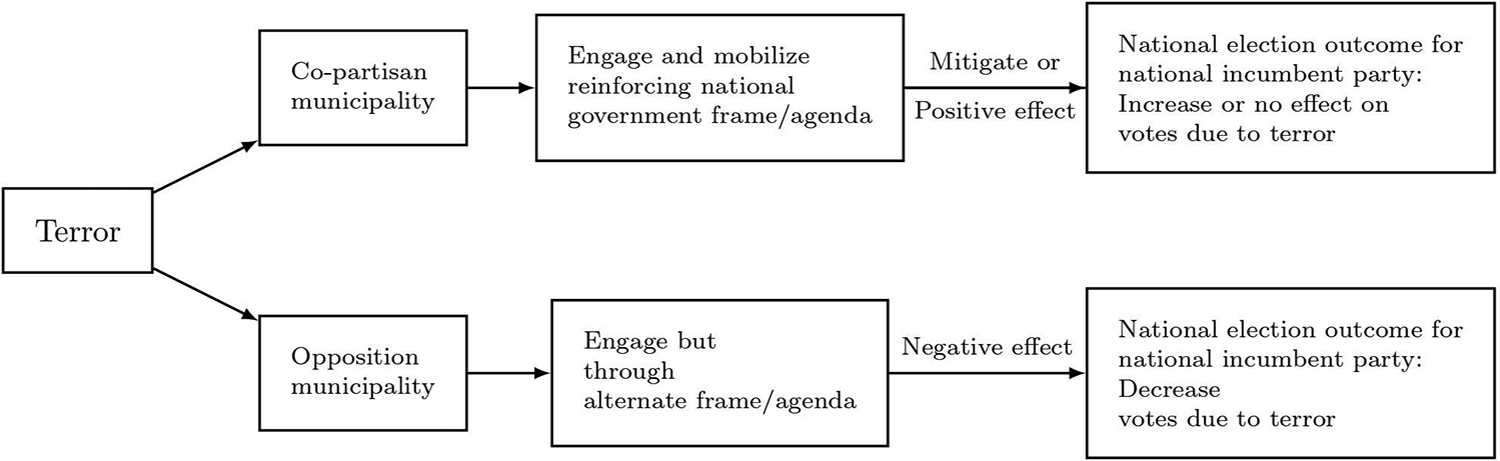
Eighth, through having the ear of the media. Contact with the media is identified by many former mayors as constituting a significant part of their post-terror activities. 8 National incumbents, through their access to national media and state apparatus, actively engage in framing the terrorist attack with varying success (Oates, 2006). Local governments also engage in political communication with local, national, and even international media (Nacos, Bloch-Elkon & Shapiro, 2011) 9 and can amplify the government’s message or not, resulting in potentially more critical and negative coverage (Hallin, 1986).
In sum, our suggested mechanisms all highlight the interplay between the local and national levels. The local government’s success with voters will likely be influenced by the national government’s framing and post-terror response. A successful national campaign is bolstered by a strong presence at the local level. Local government serves as a mediatory in telling the story of terrorist attacks. By directly responding to the needs of the locality, the party also gets the opportunity to substantiate its narrative. As illustrated in Figure 1, local politics shape how the public evaluates the party’s relative performance. Therefore, for the national government, having a co-partisan at the local level can help to offset the supposed cost of terrorism.
Terrorism, elections, and the local response in Turkey
Three types of terrorist groups have been prevalent in Turkey: ethnic-based, religious, and leftist. The first type accounts for most of the domestic terrorist attacks given that most attacks are attributed to Partiya Karkerên Kurdistanê (PKK), which came onto the scene in 1984 in the aftermath of the 1980 coup, and now is deemed ‘the deadliest homegrown group in the OECD in the last few years’ (Institute for Economics & Peace, 2016: 46). While all parts of the country have been affected (Alptekin, 2021; Kibris, 2021), the number of incidents and fatalities has varied and the Kurdish populated areas were particularly hit. In the most conflict-affected parts, that is, the east and southeast, besides the Kurdish-leaning party, the national incumbent party also controls municipalities due to differences among (Kurdish) voters (Sarigil & Karakoc, 2016). Therefore, we also examine below how particularly PKK attacks affect the AKP vote.
Radical religious groups have been involved in some of the more spectacular terror attacks, such as the coordinated attacks in Istanbul in 2003 or Ankara in 2015. While far from their heyday in the 1970s, radical left organizations also committed attacks involving fatalities in this era. During PKK ceasefires and the ‘peace process’ between 2013 and 2015, these other entities kept terrorism on the public agenda.
Terrorism in Turkey has affected democracy (Gurses, Celik & Balta, 2020). In public opinion surveys, over almost all elections in the recent period, terrorism has remained a primary societal concern of the Turkish electorate, ranked as the first or second most important problem of the country by a large share of the electorate (21% in 2007, 13% in 2011, 9% in June 2015, 47% in September 2015) (Carkoglu & Aytac, 2015). Unsurprisingly, research has also shown that terrorism has electoral consequences. For example, Kibris (2011) reports that voters reacted to the PKK’s killings of soldiers by blaming the government and demonstrates that security force funerals in a province decreased the incumbent vote in the 1991 and 1995 elections. This finding makes AKP’s general election victories even more puzzling.
We turn to presenting vignettes involving terrorism from southeastern, southern, and western Turkey during this era to discuss in more detail the local dynamics. The importance of local politics and resources for the incumbent AKP and the opposition parties have been documented (Esen & Gumuscu, 2021; Watts, 2010). Comparing different cases of terrorist attacks and local electoral results in Turkey is illustrative of the mediating role of local government in the case of electoral accountability for these attacks. We first provide examples from opposition-controlled municipalities.
AKP’s vote share in the general elections plummeted in Diyarbakır following a major terror attack in 2015. The Kurdish-leaning party controlling the municipality, HDP, was highly critical of the national government and this resulted in a 4.4% gain in votes for HDP. 10 Clearly, this case cannot be considered independent of the ongoing Kurdish conflict in Turkey where HDP, with its appeal to some of the Kurdish population, is naturally expected to shape how voters perceive the security situation (Sarigil, 2018). Watts (2010) highlights the importance of local activists for HDP and fits our argument that any party controlling the local municipal resources increases their capacity to communicate with voters. When it is a party of the opposition, the narrative hurts the AKP and contributes to the negative electoral consequences of security threats perceived by the voters.
Iskenderun municipality (Hatay province) had lost AKP votes between 2007 and 2011, and in 2010 – when a rocket attack during the relief of the sentry at a naval base resulted in the death of six seamen – the local mayor was from the leading national opposition party, CHP. Two days later, a huge anti-terror march was held in Iskenderun with over 10,000 people in attendance resulting in extensive local and national media coverage. 11 The CHP mayor was the main speaker, and his speech came with a distinct CHP flavor, including references to imperialism and the Turkish War of Independence. Not only did AKP’s local leader not attend, but the police created a security barrier around the AKP local party headquarters. 12 Iskenderun is not an isolated case: a cursory examination reveals over two dozen cases from all corners of Turkey where the national incumbent party went from coming first in the general elections to trailing in ensuing elections, in terror locations where the opposition controlled the municipality.
Conversely, an example of a mediating positive effect is seen following the attacks of 2008 in Güngören (a conservative, working-class residential neighborhood in Istanbul), which resulted in 17 civilian deaths and more than 150 injured. These attacks could have generated voter anger, as Güngören was not a location associated with crime, let alone terrorism, and due to its location in Istanbul, the attacks received considerable media attention. However, AKP increased its vote share in the 2011 general elections, receiving 55.6% of the vote share, compared to 50.9% in the 2007 general elections. Though not the only factor, the AKP-controlled municipality actively rallied around the national incumbent (AKP) and prevented the alternate right-wing party from gaining. The Güngören municipality acted fast in responding to the attacks, initially through crisis response coordination, providing emergency care and psychosocial support (Şavus & Tomas, 2010), and assisting shop owners and civilians. The mayor was the point-person for the media and publicly reappraised the post-terror efforts by saying: ‘We made the citizens feel that the state was with them. […] We enlightened the public about the event’, and assistance was extended to those affected by the attack. 13
Municipal control and terror attacks
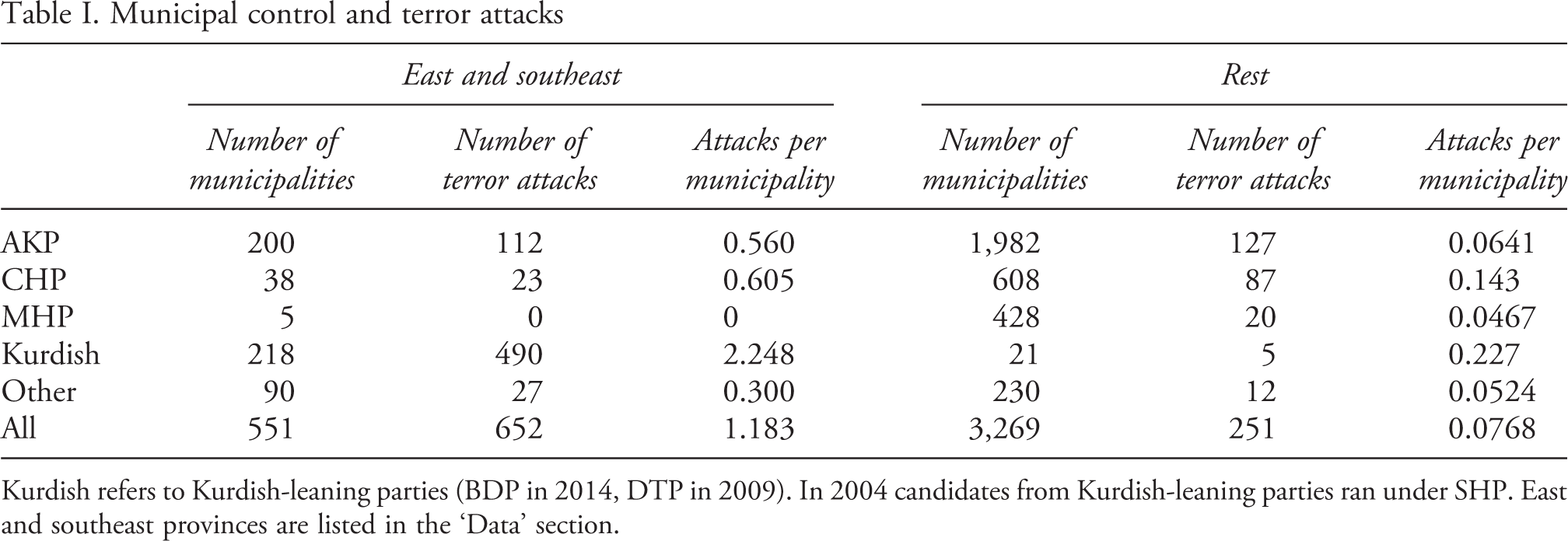
Kurdish refers to Kurdish-leaning parties (BDP in 2014, DTP in 2009). In 2004 candidates from Kurdish-leaning parties ran under SHP. East and southeast provinces are listed in the ‘Data’ section.
The reasons for the AKP’s success in Güngören cannot be attributed to financial investment 16 but to the ground presence of local organizations. All of these responses by the local AKP mayor helped to communicate the image of a caring party taking action at the local level. 17 A similar image is fostered via the media in other locations, such as Siirt in eastern Turkey, for example. A local AKP women’s branch activist is quoted by a local news source saying that they ‘visit daily each terror victim at their houses’, where they share the money and food collected, and ‘let them [local citizens] know that all of the resources of the state are mobilized for them [local citizens]’. 18
Similarly, it was local party activists at Güngören – through their contacts with affected individuals from the 2008 bombing – who were able to identify deficient areas of the civilian terror martyrs (sivil terör sehitleri) national program (with ensuing alterations in the national program) that resulted in immediate family members of the deceased victim receiving a salary. 19
These vignettes also represent the geographical variation in the Turkish party system and electoral cleavages (Ozen & Kalkan, 2017). Table I demonstrates that while AKP held about half of the district municipalities at the time of the four general elections we examine, its main competitor differs across the regions. In the more conflict-ridden, Kurdish populated east and southeast, there is a two-party system between a Kurdish-leaning party (with different names due to party closures and mergers) and the AKP. In the rest of the country, the party system is more fragmented, with CHP and MHP posing the main challenge.
Regardless of the identity of the main opposition party, when important local actors are from the AKP in a post-attack area, they directly communicate the party’s narrative with their constituency, emphasize the national party frame, and help substantiate it with their direct actions in the locality. Given the strong central government in the Turkish unitary state, local governments are limited in the way they can respond and have no role in security provision (Yilmaz & Guner, 2013). Still, the party’s local presence, buttressed by municipal resources, leads to more effective engagement with voters. Thus, we expect a co-partisan-controlled local government to help the national incumbent party to avoid blame. We next share the statistical analyses to explore this premise.
Analyzing aggregate election results
Data
As we argue that the terror incidents’ effect on the incumbent party’s performance at the subsequent general elections is moderated by local government control, our unit of analysis is the municipality-election period. Measuring the impact of an assault on vote rates assumes that people identify with the location of the attack, and we think the municipality level is small enough to capture this effect. On average, the 970 municipalities 20 of Turkey had an average of 81,176 people in 2015; if large cities were omitted (Ankara, Istanbul, and Izmir), the remaining 876 municipalities had an average population of 62,379 people. We provide a map of terrorist attacks in the Online appendix (A1).
In our primary analyses, the dependent variable is the vote share of the national incumbent party in the municipality in the legislative elections. We rely upon ordinary least squares regression (OLS) and estimate robust standard errors. We concentrate on AKP’s single party rule during four distinct election periods. Because the notion that a single party government could avoid blame is the starting point of our puzzle, we do not study Turkey in the 1990s, where there were unstable coalition governments that would obfuscate responsibility. We analyze the elections during the AKP rule under pooled models (and share separate analyses for each election period in the Online appendix). These election periods are November 2015 (June–November 2015); June 2015 (June 2011–June 2015); June 2011 (July 2007–June 2011); and July 2007 (November 2002–July 2007). Tables and figures, where appropriate, for all the following estimations listed below are available in the Online appendix (A1–A45), if they are not included in the main text.
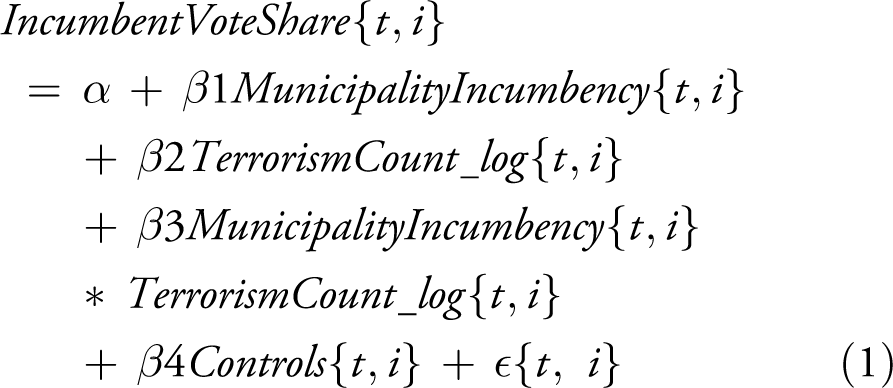
For each municipality, we created a count variable for all terror attacks since the last legislative elections. The measures of terror attacks are highly right-skewed; therefore, we normalize the terror counts using log+1 transformation to minimize the outliers’ effect. Thus, we are estimating the following equation:
We rely upon Global Terrorism Database (START, 2022) and two PKK-related terrorism datasets (Kibris, 2021; Alptekin, 2021). According to the GTD database a terrorist attack is ‘the threatened or actual use of illegal force and violence by a nonstate actor to attain a political, economic, religious, or social goal through fear, coercion, or intimidation’ (START, 2022: 11). This must meet two of the following three criteria: the act should not fall under humanitarian international law; the act must have a political, economic, religious or social goal; and the action must not be limited to the immediate victims. Extensive research in newspapers resulted in additional data for eight provinces and 480 districts missing information among the GTD Turkey cases (see Online appendix).
Our key variable is an interaction of terrorism with the municipality incumbency dummy. Municipality incumbency takes 1 when the mayor of the district municipality is from the national incumbent party (AKP), and 0 otherwise. GTD data for the four periods between four legislative elections that we analyze are as follows: there were 124 terror attacks between 2002 and 2007. The ensuing 2007–11 period witnessed 86 attacks. The four years between 2011 and June 2015 saw the number of terror attacks increase to 388. Finally, in the five months between June 2015 and November 2015 elections, 305 attacks are counted.
We rely upon multiple count measures of violence: all attacks, fatal attacks, civilian attacks, and PKK attacks. Our primary objective of using multiple measures from different datasets is to reach ‘more reliable conclusions’ (Chenoweth, 2013: 374). Deadly attacks can attract more attention. While all types of attacks (Robbins, Hunter & Murray, 2013) can result in mobilization of municipalities, we expect civilian attacks (Nacos, Bloch-Elkon & Shapiro, 2011) to create an even greater need and opportunity for local government involvement, such as house visits where the framing is conditioned by whether the municipality is a co-partisan of the national incumbent or not.
The incumbent party’s vote-share in the previous legislative election (lagged dependent variable) controls for the base level of support in the municipality for the party. Other controls include the size of the municipality measured by the number of registered voters (log-transformed to normalize outliers). There is no average income data by the municipality and, following past research (Marschall, Aydogan & Bulut, 2016), we turn to illiteracy information (the number of illiterate people as a proportion of the total number of registered voters within the municipality) to capture the level of development. Our dependent variable (incumbent vote share) and all of the aforementioned data are acquired from the Turkish Statistical Institute (TUIK, 2019). We also rely upon night-time lights as an additional control variable that gauges the municipality’s economic status. These data acquired from outer space help us develop a standard index for smaller or underdeveloped regions, as past studies suggest that the night-time lights can be used to understand the economic development of locations (Weidmann & Schutte, 2016). We recreated shapefiles of Turkey for the years 2015, 2011, and 2007, using the official gazette to readjust the changing district and province status and borders, and
Effect of terror and municipal partisanship on the incumbent’s vote rate in national elections. Figure 2b. Effect of terror when municipality belongs to the opposition party and when the municipality belongs to the incumbent party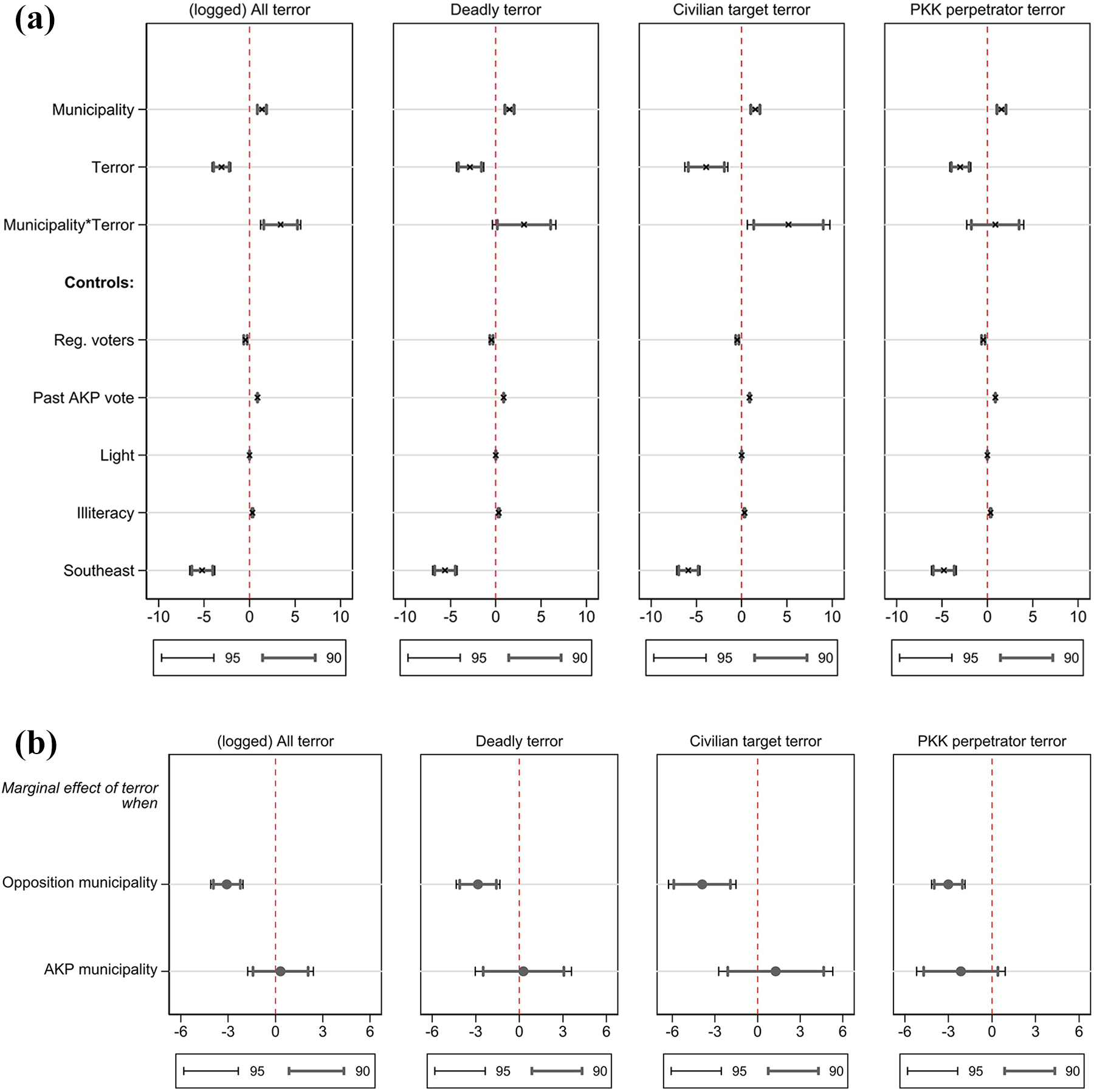
Results
As can be seen in Figure 2, regardless of the terror type variable (GTD-based all terror, deadly terror, civilian target terror, or Kibris’s PKK terror), higher number of terror incidents result in lower vote rates for the national incumbent in opposition-controlled areas (Online appendix, A6). Moreover, municipalities where the local incumbency is the same as the national incumbent are, in general, associated with higher vote rates compared to municipalities that are not governed by the national incumbent party when these locations are not hit with attacks. Particularly important for us is the interaction term of the municipality incumbency and terror attacks. Our expectations appear supported as there is no backlash against the national incumbent in terror locations where the local incumbent is from the same party as the national incumbent. Interpretations of interaction terms cannot be conducted in isolation: if a municipality does not belong to AKP, for each unit of logged terror increase, we find a 3.09% decrease of incumbent vote share in upcoming national elections (SE: 0.52); the results for Models 2, 3, and 4 are similar with –2.84 (SE: 0.77), –3.90 (SE: 1.21), and –3.004 (SE: 0.59) respectively. Figure 2 shows that having a co-partisan at the local municipality when terror strikes mitigates this negative effect. When the municipality belongs to AKP, marginal effects of each terror variable, that is, all incidents of terror, fatal terror, civilian target terror, and PKK attacks, are as follows for each model: 0.32 (SE: 1.06; p-value: 0.76), 0.28 (SE: 1.69; p-value: 0.87), 1.28 (SE: 2.05; p-value: 0.53), and –2.14 (SE: 1.55; p-value: 0.17). Thus, as we expected, if the municipality belongs to AKP, the party does not suffer electorally following terrorist attacks, which underscores our argument that the dynamics of having a co-partisan at a terror location are distinctly different. This finding remains the same when we include province dummies. Attacks on civilians have a bigger magnitude, as expected. Marginal effects for the pooled model, as well as for each election separately, are available in the Online appendix (see A7–A9) and in each election co-partisans were an asset for the national incumbent. This is the case regardless of whether there is a relative downturn or upturn in terror intensity.
Overall, while terrorism makes the incumbent party lose votes in locations where it does not control the municipality, in locations where it controls the municipality, this is not the case. This is despite the fact that we are controlling for past incumbent vote share, which explains the current incumbent vote share with about 50%. Regarding development, only illiteracy consistently has a positive and statistically significant effect, suggesting a nuanced relationship on how development influences incumbent vote.
Given the amount of violence in the east and southeast, we control for the Kurdish-dominated municipalities through the southeast proxy in our estimations. Although AKP is the main competitor of the Kurdish-leaning party in the region, AKP’s average vote share is relatively lower than in the rest of the country, controlling for other factors such as illiteracy. We furthermore estimated separate models only with southeast provinces and discarded the rest of the country and, again, we find that the negative effect of terror activities on the incumbent vote share is moderated by the municipality control (A10–A12). Our results are also robust to the inclusion of the share of Kurdish population in the district based on Livny’s (n.d.) data (A13) and different southeast categorizations.
We next disaggregate the opposition-run municipalities according to the partisanship of the mayor. Since we expect the main challenger party to be different in the southeast and the non-southeast, we analyzed them separately. According to Figure 3, following attacks, the AKP loses votes in the CHP and Kurdish-leaning party-run municipalities respectively in the non-southeast and southeast (A14). When we analyze the elections separately (A15–A16), attacks decrease AKP’s vote in the MHP municipalities in June 2015. Yet, regardless of region and the main challenger party, AKP-controlled municipalities mitigate the negative effect of the attacks. These results are in line with past work that demonstrates considerable variation among Kurds (Sarigil & Karakoc, 2016) as their response to the attacks seems to be conditioned by the party controlling the municipality.
Robustness checks
We conduct robustness tests, the details of which are shared in the Online appendix. All of the following additional examinations support our central finding that the incumbent party’s vote loss is mitigated by co-partisan local government control.
We analyzed the same models from Figure 2 with the alternate PKK-only dataset (A17–A18) (Alptekin, 2021) and found similar results. It also allows for the examination of the effect of attacks within residential areas. The findings on residential areas reinforce what we see in our other analyses: unlike in opposition-controlled municipalities, AKP national vote is not affected in terror-struck residential areas which are controlled by its co-partisans.
Alternatively, we include fixed effects for the districts to account for possible historical and sociopolitical factors that might have an impact. We again find a difference between opposition and AKP-controlled municipalities (A19–A20). We then checked for historical conflict in a municipality by controlling for violence before 2002 (A21–A22). Moreover, since religious identity is an important component of voting behavior in Turkey, we also control for the religiosity and denominational composition (share of Alevi population) of the municipality (Livny, n.d.). Our main findings do not change (A23).
AKP typically holds the local incumbency in its strongholds. Our expectation is that as AKP will have a stronger local presence in these strongholds, it will effectively engage with the voters after an attack, but the constituency is also expected to be more receptive to the AKP’s message in these strongholds. To see if the local incumbency effect can also be observed in non-stronghold districts, we restricted the sample to places where the electoral margin is less than 25%
Marginal effect of terror in different municipalities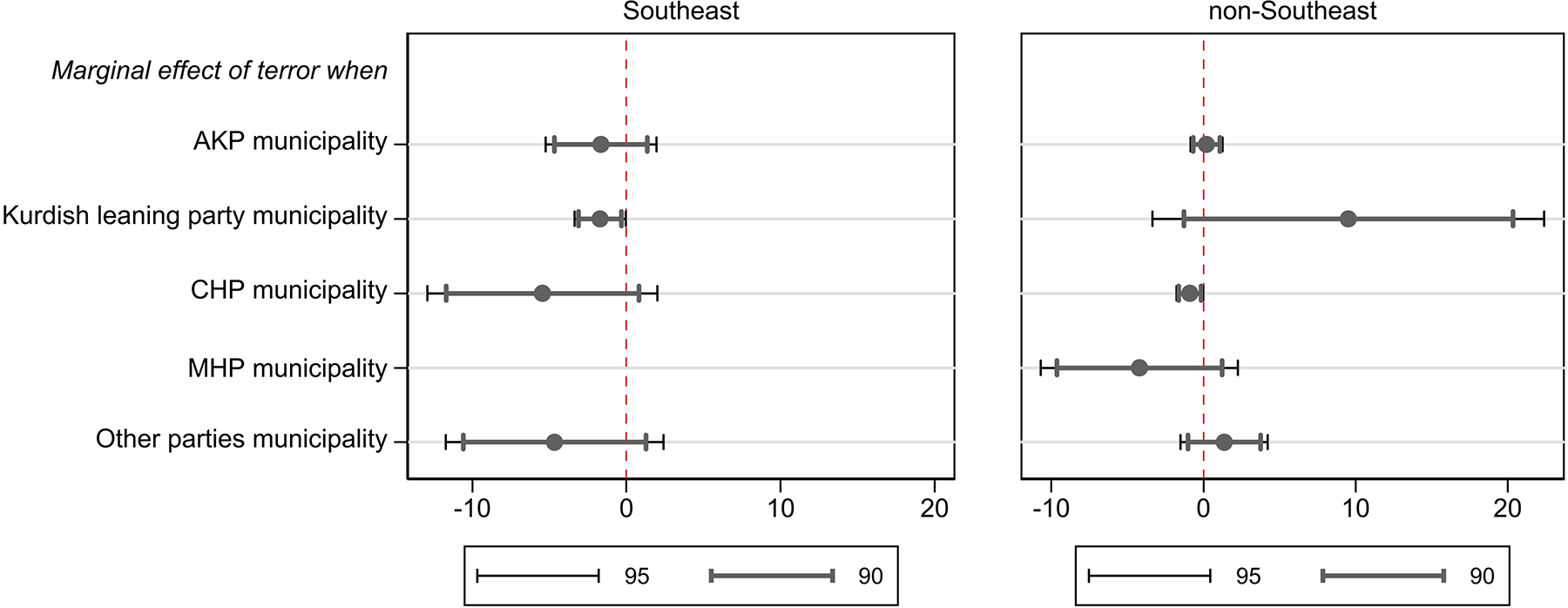
We also control for district electoral competitiveness (A29–A30). Since Turkey has a multiparty system, the lagged vote share of AKP does not always capture how close the AKP was to winning a district. When we also include electoral margin (absolute value of the difference between AKP and its closest competitor’s vote in previous elections), our main results do not change.
Relying upon binary measures instead of continuous variables suggests, again, that the incumbent can avoid blame in general elections with the help of local co-partisans. This finding overlaps well with the Güngören example of a co-partisan municipality’s effective single terror attack response translating to general election results. With a binary measure for fatal terror (A31–A32), too, a terror attack at an opposition-held municipality statistically significantly decreases the AKP vote. 21
We also considered the 2018 general elections. This election differed from previous elections due to the AKP having the MHP, primary right-wing alternative, as an electoral coalition partner and replacement of HDP mayors with appointed trustees (‘kayyum’). Nonetheless, our main hypothesis held when we included 2018 elections and kayyums (A33–A34) but this election needs more theoretical attention.
Regarding endogeneity concerns, we examined whether AKP municipalities were particularly targeted and did not find it to be the case (descriptive statistics tables are in the Online appendix; see A3–A5). Municipalities controlled by Kurdish-leaning parties received more attacks in the southeast (Table I). Additional analyses confirmed that our results were not an artifact of these attacks (see A35). Lastly, we provide an analysis of natural disasters in Turkey. This analysis should increase confidence as it is hard to argue that natural disasters target some parties disproportionately. Regardless of which disaster dataset or how we approach the disaster variable, we see that they have a negative effect on national incumbent vote share, whereas the municipality incumbency mitigates the negative results of the disaster (A36–A37). 22
Exploring the mechanisms further
Thus far, our testing has relied on aggregate level correlational data on elections and terrorist attacks. We next analyze additional data to see if other empirical implications of our argument are supported. We check below whether local elections indeed give incentives to local actors to work for the party after an attack, whether election outcomes are different in neighboring municipalities where this incentive would be different, and whether voters indeed respond to such potentially more effective engagement at the local level.
Local elections
The main premise our argument is that local co-partisans of the national incumbent party work effectively in terror-times and help the party avoid vote losses. We first directly test the effect of terrorist attacks on local elections (A38–A39). We find that AKP’s vote share in local elections is
Whether AKP is the party that can solve the terrorism problem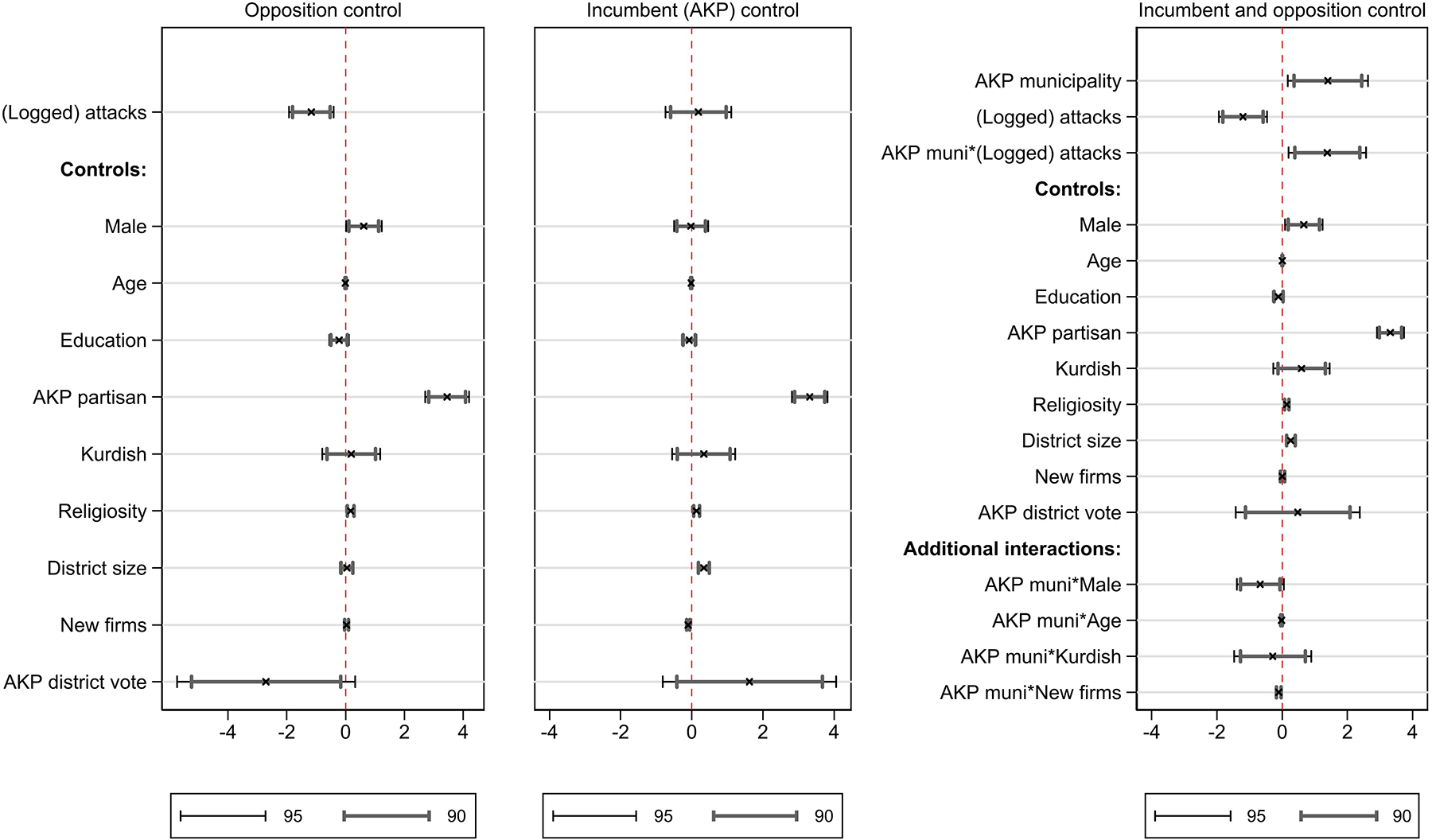
Neighboring municipalities
We then look at the effect of violent attacks in adjacent municipalities. Once the terror attack occurs in municipality i, we would expect the local party machinery at municipality i to take steps to address the consequences of terrorism by mobilizing services, workers, and activists. If an attack occurs in a neighboring municipality, mobilization by local actors will be relatively less since the terror attack did not take place within their own borders. Therefore, the mitigating effect of the local government would be weaker for attacks occurring in adjacent districts and our expectation is that the incumbent vote will suffer from these attacks in neighboring municipalities. We observe (A40–A41) that terrorism in neighbor municipality i is negatively associated with the incumbent vote rate in municipality j regardless of whether the municipality is controlled by the opposition or, importantly, the incumbent. The fact that co-partisans in neighboring municipalities are losing votes increases our confidence in our central point that local party mobilization in terror-locations is of particular importance at such pivotal moments.
Individual-level analysis
Finally, we explore the implications of our argument for individual-level attitudes and behavior. If, as we argue, incumbent political parties can more effectively convince citizens that they are doing a good job in providing security, with the help of their co-partisans at the local level, voters should be evaluating incumbents more positively in districts controlled by the AKP. We use individual-level survey data from 2015 to test whether voters’ evaluation of AKP following a terrorist attack differed if they lived in a municipality controlled by the AKP, versus an opposition party.
In our analysis we use data from the post-election survey (Aytac & Carkoglu, 2019) of November elections and focus on 1,235 respondents who named terrorism as the most important problem. We take advantage of the question that asks which party would solve this problem. The dependent variable takes on the value of 1 if the respondent named AKP, and 0 otherwise. We estimate logit models. Our main independent variable is the (logged) number of terrorist attacks in the respondent’s municipality. We control for the following individual-level factors: AKP partisanship, gender, age, education, religiosity, and ethnic identity (Kurdish speaking or not). We add two district-level controls – (logged) number of voters in the district, AKP’s June 2015 vote share – and a provincial-level indicator of economic performance – the number of new firms that were registered in 2015.
In the first two models of Figure 4 (see A42), we conduct separate models for opposition (Model 1) and AKP-controlled municipalities (Model 2). Then, in Model 3, we analyze the differential effect of AKP municipalities through interaction with the dummy variable that takes on the value of 1 for AKP mayors and 0 otherwise. In Models 1 and 3, we find that the probability of naming AKP as the party that would solve the problem of terrorism decreases with terrorist attacks if the respondent lives in a municipality controlled by an opposition party, but this effect is nullified when the respondent’s mayor is from the AKP (Models 2 and 3). The marginal effect graph is in the Online appendix (A43). As we expected, after a terrorist attack AKP’s local presence seems to convince voters that AKP is still the party to solve this problem.
Conclusion
An incumbent party needs to convince the voters that it is the right party for the job. As we show above, local governments can play an important role in this regard. Our results broadly show that local government control helps to alleviate the electoral costs of terrorism for the national incumbent. Our argument based around the interaction of the local with the national was supported both by national aggregate election results and by additional analyses exploring our mechanism. These results for incumbent parties are particularly interesting for the case of Turkey, as well as in the broader context. Since our research focuses on electoral accountability for voters’ security concerns, we empirically analyzed how the incumbent’s votes are affected by terrorist attacks. Another side of the issue is where the dissatisfied voters go when they decide to punish the incumbent. One interesting finding is that AKP lost votes due to attacks in CHP-controlled municipalities in 2011, but instead lost votes in MHP-controlled municipalities in June 2015 elections. This suggests that more attention is needed to study whether who switches votes due to security concerns depends on the contextual factors in each election, such as the intensity of the conflict and other salient issues dominating the campaign.
Our findings also highlight the importance of the local electoral dynamics concerning the Kurdish question in Turkey. Although our focus is on the electoral accountability mechanisms around security-related issues in general, in Turkey the topic is closely intertwined with the Kurdish conflict. Our analysis here shows that even in a highly centralized state like Turkey, local government control has implications for the national incumbent party’s electoral performance in the country’s most conflict-ridden region. This raises questions on the role of electoral concerns behind the post-2015 removal of elected mayors from office mainly in conflict regions. While we examined appointed trustees in the 2018 elections, further studies are needed to understand how trustees engage with the voters and the local party organization.
In many unitary countries like Turkey, local governments do not have their own police forces, and are not involved directly in counterterrorism measures. Therefore, voters are not likely to hold local governments responsible for failing to respond effectively against terrorism. Responsibility-sharing across different levels of government is not expected to weaken electoral sanctioning for losses in security through the clarity of responsibility mechanism. Analyzing electoral accountability in the area of security, therefore, allowed us to examine the indirect effect of municipal incumbency on electoral accountability in national elections. Our argument and finding on the mitigating effect of local government, therefore, also contribute to the electoral accountability literature by showing that even in centralized policymaking contexts, local governments matter because they affect the incumbents’ capacity to reach and respond to the voters.
Footnotes
Replication data

Acknowledgements
Earlier versions of the paper were presented at the Koç University Approaches to Contemporary Voting Behavior in Turkey workshop, Juan March permanent seminar, ESPA annual meeting, and the FLACSO-ISA joint conference. We thank the three anonymous reviewers and the editor, as well as the conference, seminar, and workshop participants for their valuable feedback. We are thankful to Selim Erdem Aytaç and Ali Çarkoğlu for sharing their data. Özge Kemahlıoğlu thanks Berk Öztürk for his research assistance.
Funding
The research has received funding from the European Union’s Seventh Framework Programme (FP7/2007-2013) under Grant Agreement no. 256527.