




Abstract
Labor market competition is a leading explanation for defensive attitudes towards immigration but empirical support for this hypothesis is widely debated. This paper re-evaluates its explanatory power by investigating the relationship between labor market retirement and attitudes towards immigration in 14 European countries. The empirical results, based on an instrumental variable strategy to deal with potential endogeneity, find that although retirement is an important change in a person’s labor market participation, it does not generally shift opinions. As a plausible explanation for this, I use a cross-national survey experiment to demonstrate that individuals who are retired retain socio-tropic orientations towards immigration, which, I argue, likely override their ego-tropic orientations. The combined evidence indicates that the labor market competition hypothesis may not be suitable as a comprehensive explanation for public opinion about immigration.
Introduction
The notion that native attitudes towards immigration are motivated by competition with immigrants in the labor market is a longstanding and persistent hypothesis. The labor market competition hypothesis argues that individuals who compete with immigrants in the labor market are more against immigration than individuals who do not (Citrin et al., 1997; Espenshade and Hempstead, 1996; Harell et al., 2012; Lancee and Pardos-Prado, 2013; Lancee and Sarrasin, 2015; Mayda, 2006; Scheve and Slaughter, 2001).
Recently, the labor market competition hypothesis has come under considerable scrutiny. In a widely cited review essay, it was described as “something of a zombie theory” (Hainmueller and Hopkins, 2014: 241). Several prominent studies have failed to find evidence to support the hypothesis (Bansak et al., 2016; Hainmueller and Hiscox, 2010; Hainmueller et al., 2015), casting doubt on its explanatory power. These studies have looked at the impact of varying the characteristics of the immigrants themselves on a native’s immigration preferences (Hainmueller and Hiscox, 2010; Hainmueller et al., 2015; Lee et al., 2017; Malhotra et al., 2013). While understanding the relative importance and influence of immigrant attributes is an important line of inquiry, these experimental studies do little to explain how changes in a native’s labor market participation affects a person’s opinions about immigration.
Still, the labor market competition hypothesis continues to be a prominent explanation for attitudes towards immigration as cross-sectional evidence continues to show that attitudes towards immigration depend on a person’s skill level (Gerber et al., 2017; Polavieja, 2016), industry (Dancygier and Donnelly, 2013), and occupation (Kunovich, 2016). However, this empirical evidence has been less than conclusive since there are substantial methodological challenges to disentangling the unobservable characteristics which determine a person’s labor market participation and employment status (such as their values, beliefs, cognitive ability, or socialization) which are likely to also influence their opinions about immigration. Researchers have struggled to find exogenous variation in individuals’ labor market circumstances, which would be needed to assert such causal claims.
I aim to address this gap by evaluating the labor market competition hypothesis in a cross-national setting, using an empirical strategy which allows us to test the relationship between labor market participation and opinions about immigration. To do so, I investigate the impact of retirement from the labor market. Retirement represents a sharp change in a person’s labor market status and is an important event in the life course but I do not know of any existing studies which examine the effect of retiring on attitudes towards immigration. In the existing empirical literature, a person’s retirement status is typically not included as a routine control variable. It has, however, occasionally been used as a control variable, often as a category of employment status (e.g., Fetzer 2000; Markaki and Longhi, 2013; Sides and Citrin, 2007). Instead, in this study, I use quasi-experimental methods, exploiting cross-country variation in early and full retirement ages as an instrument for a person’s retirement status. I then use a survey experiment to assess the ego-tropic versus socio-tropic mechanisms underlying a potential retirement effect.
Data and methods
Data and sample
For this study, I use data from Round 7 (2014) of the European Social Survey (ESS), a cross-national micro-attitudinal dataset which includes a special module on immigration. The sample consists of 14 Western European countries. These are: Austria; Belgium; Denmark; Finland; France; Germany; Ireland; Netherlands; Portugal; Spain; Sweden; the United Kingdom; Norway; and Switzerland. The sample is selected by strict random probability methods and respondents are interviewed face-to-face.
While the ESS is a nationally representative sample of the adult population in each country, I further restrict the sample for the purposes of the analysis. 1 After applying list-wise deletion, I restrict the sample to individuals who are between 50 and 69 years of age. Individuals who have never worked or have not worked after the age of 50 have also been dropped from the analysis. Furthermore, I limit the sample to men to avoid cohort differences in the labor market participation of women. What remains is a sample of 3616 of near-retirement and post-retirement aged men in 14 different country settings.
Independent variable
The main explanatory variable is whether a person is retired or not. I code this as a dummy variable whereby men who report that their main activity in the last seven days as “retired” are given a value of 1 and men who are still in work are given a value of 0. As an alternative, I have also checked that the results shown here are consistent by measuring retirement as whether or not state pensions are the individuals’ primary form of income. However, I prefer to use the former measure since retired workers may have private or occupational pensions as their primary form of income—using state pensions as a measure of retirement would introduce unnecessary error.
Dependent variables
I focus on three measures which capture a person’s attitudes about the economic impact of immigration: 2
The impact of immigration on the economy: “Would you say it is generally bad or good for [country]’s economy that people come to live here from other countries?” Respondents are asked to answer on a scale from 0 (bad for the economy) to 10 (good for the economy).
The impact of immigration on jobs: “Would you say that people who come to live here generally take jobs away from workers in [country], or generally help to create new jobs?” Respondents answer on a scale from 0 (take jobs away) to 10 (create new jobs).
The impact of immigration on taxes and services: “Most people who come to live here work and pay taxes. They also use health and welfare services. On balance, do you think people who come here take out more than they put in or put in more than they take out?” Respondents are asked to answer on a scale from 0 (generally take out more) to 10 (generally put in more).
Instruments
Individuals self-select into retirement at various ages for reasons which are endogenous to their values, beliefs, and opinions. Yet, state institutions provide age-based incentives for individuals to exit the workforce by replacing their earnings with pensions. I use early and full statutory retirement ages in each country in 2014 provided by the Organisation for Economic Co-operation and Development (OECD) (2015) as instrumental variables (IVs) to correct for this endogeneity (see Table 1). The earliest age at which an individual is eligible for retirement is 50 and the latest age is 66, which allows for considerable variation. These ages are highly significant in predicting individuals’ actual retirement behavior, and for these reasons this instrument has been adopted in other fields of research such as health economics (Angelini et al., 2009; Coe and Zamarro, 2011).
Eligibility for public retirement benefits, 2014.
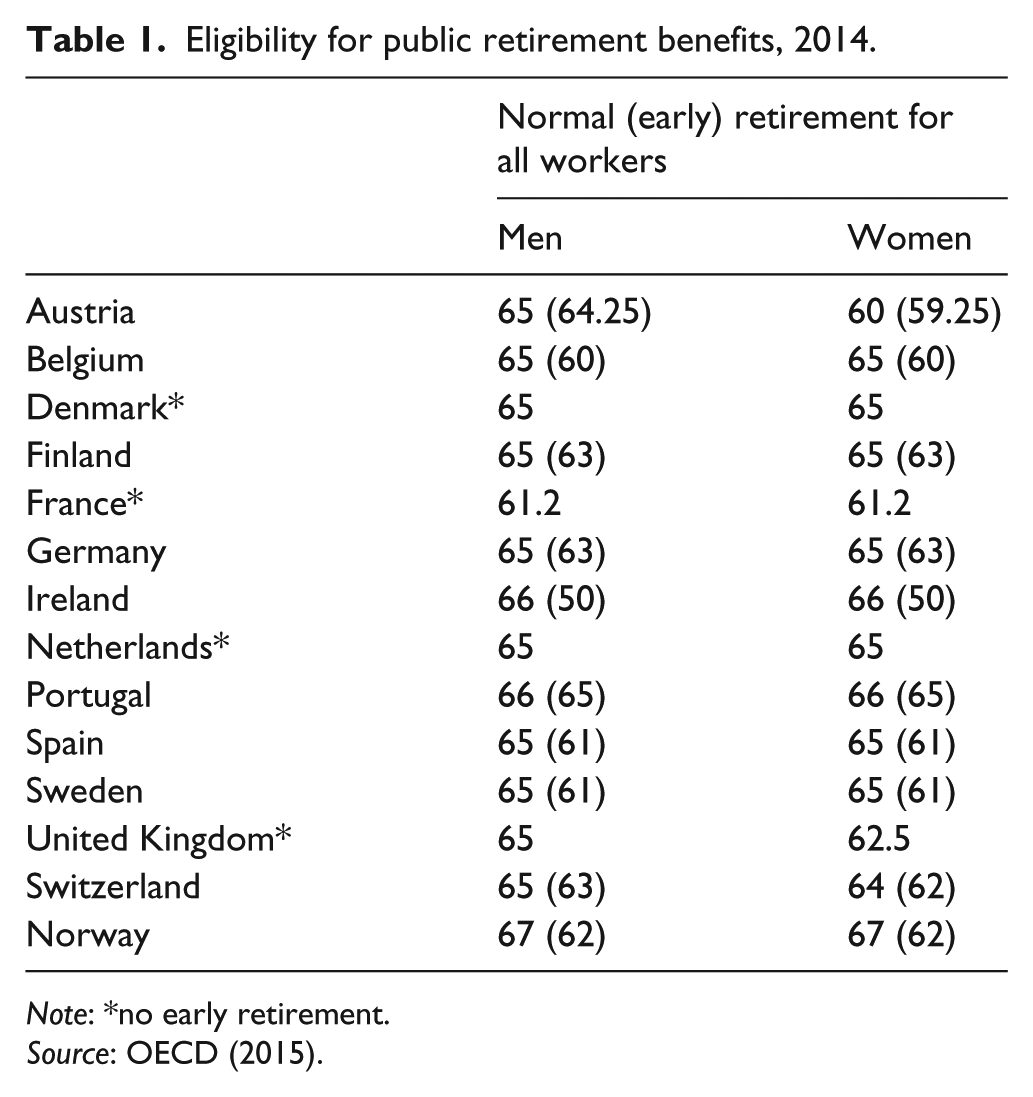
Note: *no early retirement.
Source: OECD (2015).
For statutory retirement ages to be a suitable instrument, they should induce change in attitudes towards immigration due to a change in retirement behavior but should otherwise be independent from attitudes towards immigration. There is no compelling reason to believe that these retirement ages are otherwise related to attitudes towards immigration. For instance, it would be hard to imagine that there might be a non-linear break in attitudes towards immigration for men aged 65 in Germany and aged 67 in Norway. Figure 1 confirms that there is no systematic discontinuity in attitudes towards immigration around the full pension retirement age in each of the countries in the sample.
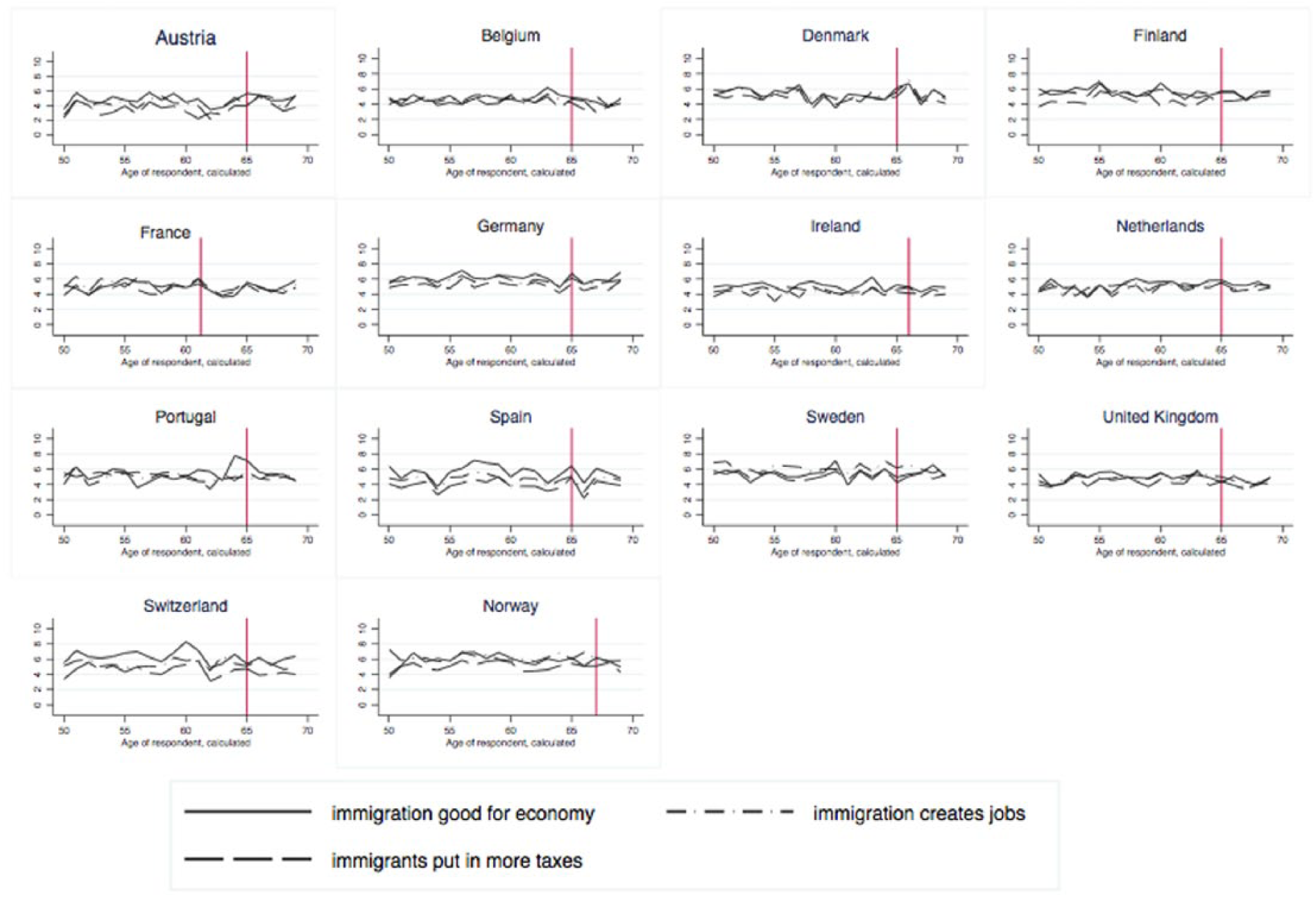
Mean attitudes towards immigration, discontinuity around full retirement age by country.
Control variables
I also include a series of control variables for the person’s age and age-squared, the number of years spent in education, income decile, and left–right political orientation. Dummy variables are also included to control for whether or not the person was born abroad, lives in a small town or rural area, is married or has ever had children. A series of dummy variables are also included for International Standard Classification of Occupations skill levels and the country.
Results
Instrument validity
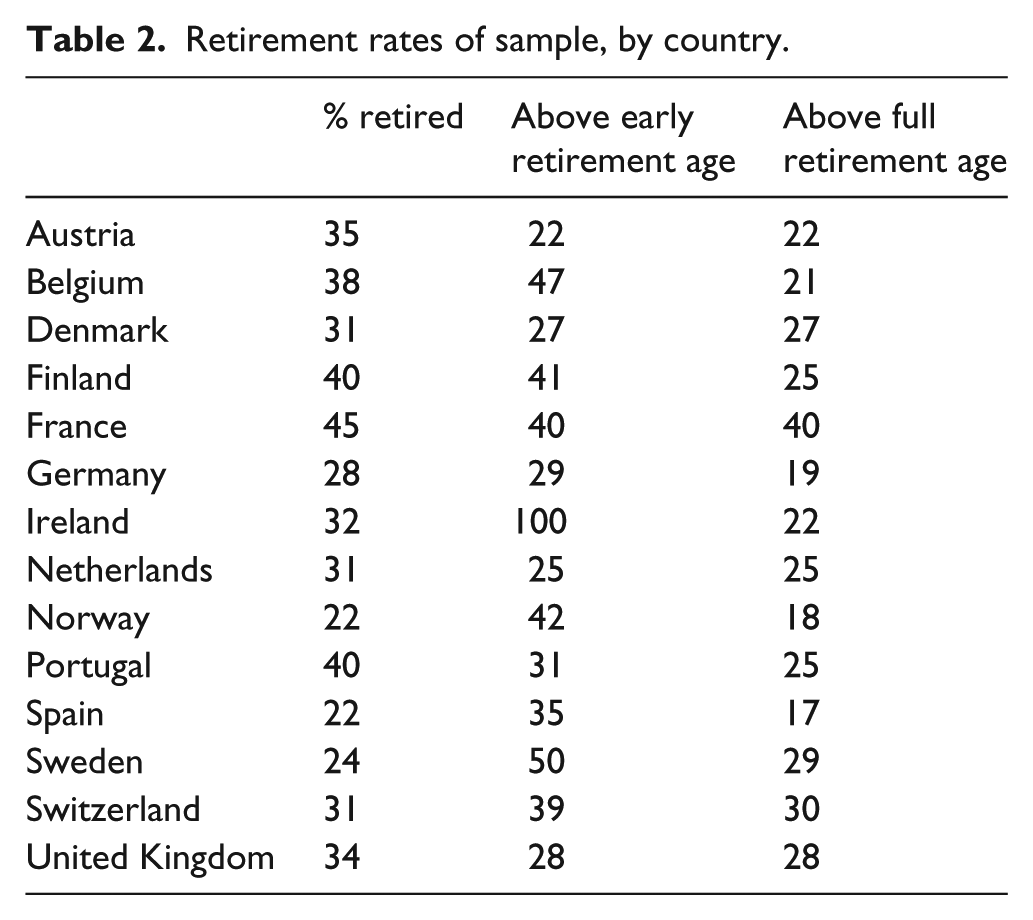
In order for the instruments to be valid, the ages of eligibility for public pension schemes must predict retirement behavior. In other words, early retirement and full retirement statutory ages should predict a person’s propensity to retire. The retirement rates of those who are above early retirement and full retirement ages for each country can be found in Table 2.
Retirement rates of sample, by country.
The results of the first stage regression are shown in Table 3. The results show that early retirement and full retirement ages are significant predictors of retirement behavior in this sample of men aged 50 to 69. This means that being above the early retirement age increases the probability of being retired by approximately 0.14 points on a scale of 0 to 1, on average. Being over the full retirement age, on the other hand, increases the probability of being retired by an average of approximately 0.19 points on a scale of 0 to 1. This effect is consistent with evidence from the literature showing that the age of eligibility for pension has a moderate impact on retirement behavior (for a discussion see Atalay and Barett, 2015). The coefficient of the F-tests is also above the threshold of 10 which is typically considered a strong instrument. 3 The coefficients for the other variables are as expected.
First stage results.

Note: includes country and occupational dummy variables;
p < 0.05; **p < 0.01; ***p <0.001. Standard errors are robust.
The effect of retirement on opinion towards immigration
Table 4 reports the ordinary least squares (OLS) and IV estimations for each of the three attitudes about impact of immigration on the economy, jobs, and taxes and services. The IV estimates are in line with the OLS estimates. The IV models estimate that the average effects of being retired on this subset of the population are: (a) decreases the perception that immigration is beneficial to the economy by 0.60 on a scale of 0 to 10 with 95% confidence interval (CI) that this estimate is between -1.85 and 0.65; (b) decreases the perception that immigration creates jobs by 0.35 on a scale of 0 to 10 (95% CI between -1.58 and 0.88); and (c) decreases the perception that immigrants contribute more taxes than services received by -0.35 on a scale of 0 to 10 (95% CI is between -1.60 and 0.90). None of the coefficients achieve statistical significance, consistently showing that retiring from the labor market does not have a significant impact on a person’s opinion about immigration. This finding is consistent across all three measures for attitudes towards immigration. 4 There is no evidence that when a person retires from the labor market, opinions towards immigration become less defensive.
Ordinary least squares (OLS) and instrumental variable (IV) results.
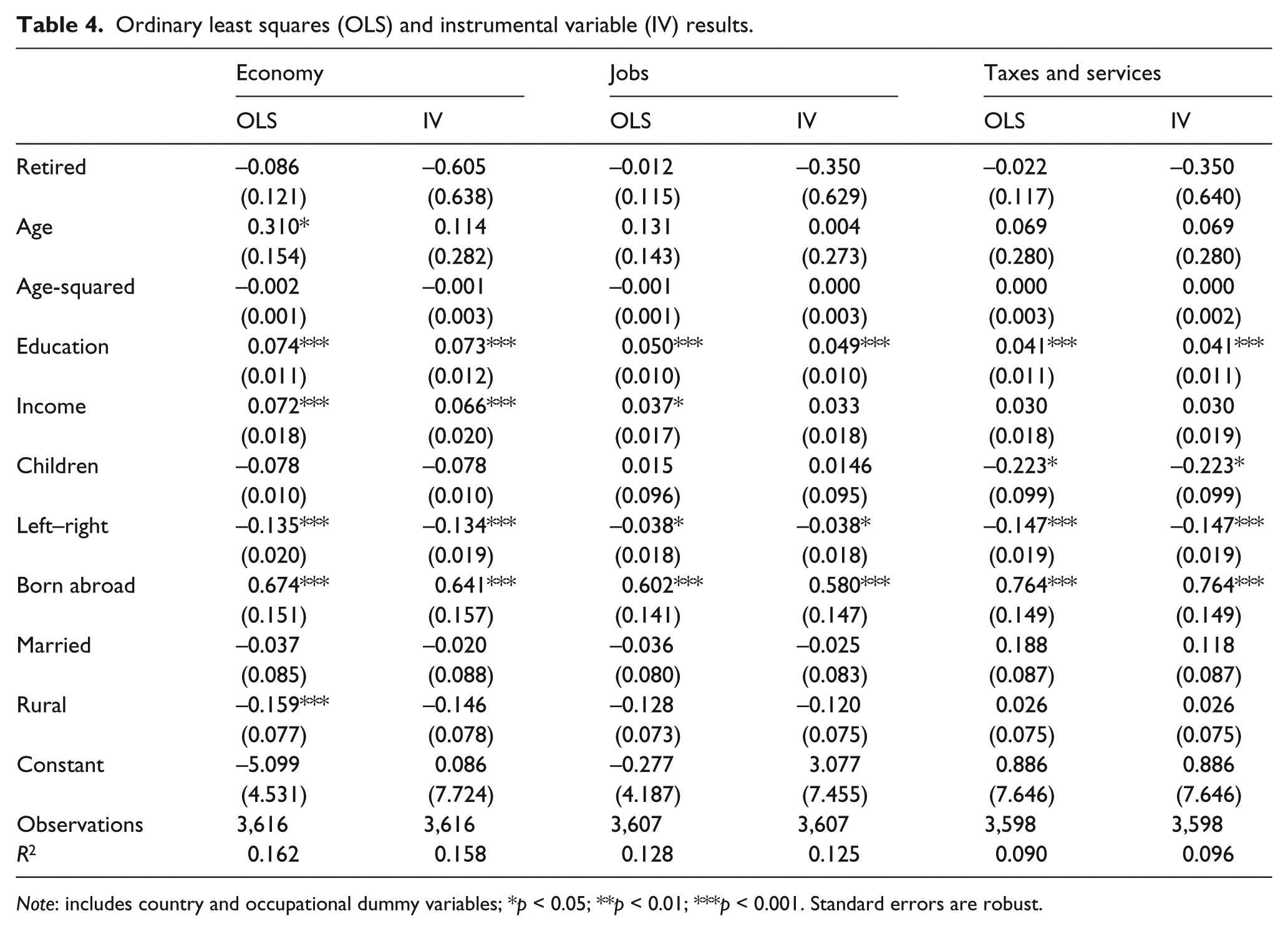
Note: includes country and occupational dummy variables; *p < 0.05; **p < 0.01; ***p < 0.001. Standard errors are robust.
To address concerns that results from this year are not generalizable to other time periods, I have also conducted a similar analysis using Round 3 of the ESS (2006) and the results remain the same. 5 Similarly, I do not find evidence that the results are affected by a single country: they also hold when replicating the model 14 times, each time dropping a country from the sample. 6
Survey experiment
In the second empirical part, I use a survey experiment to investigate whether or not the lack of a “retirement effect” is due to individuals’ socio-tropic motivations, meaning their perception of what is in the best interest of society. The objective is to understand why a person’s retirement does not affect a person’s attitudes towards immigration even if this person no longer competes with immigrants in the labor market. This will allow me to investigate whether the lack of retirement effect is, in fact, due to an individual’s propensity to conceive of immigration in terms of the national interest rather than their own personal interests.
For this, I use a between-subjects survey experiment which was embedded in Round 7 of the ESS (2014). The experiment was conducted on a sub-sample of approximately half of the individuals (n = 1995) from the sample of 3616 individuals used in the previous analysis. Respondents were allocated randomly to two different groups each of which are asked a survey question which varied the economic status of the immigrants and then asked them to give their immigration policy preferences in a split ballot design. 7 The two poles of the economic status hierarchy are used: professionals; and unskilled workers. The selection of the immigrant origin countries is different for each country in which the ESS is administered and is based on its most important country of origin outside Europe. 8 For respondents within the same country, the two questions differ only in that they describe immigrants as either professionals or unskilled laborers.
Control Version: To what extent do you think [country] should allow
Treatment Version: To what extent do you think [country] should allow
Answer options (both versions): (a) allow many to come and live here; (b) allow some, (c) allow few; (d) allow none; and (e) don’t know. For the purposes of this analysis, don’t know responses are coded as missing.
Figure 2 shows the distribution of retiree responses across the treatment and control groups. Amongst retirees, men in the control group more frequently respond that they would allow many or some immigrants to come and live in their country than men in the treatment group, who are more likely to prefer the country to allow only few immigrants to enter or to restrict admission altogether.

Support for immigration restrictions by treatment group amongst retired individuals.
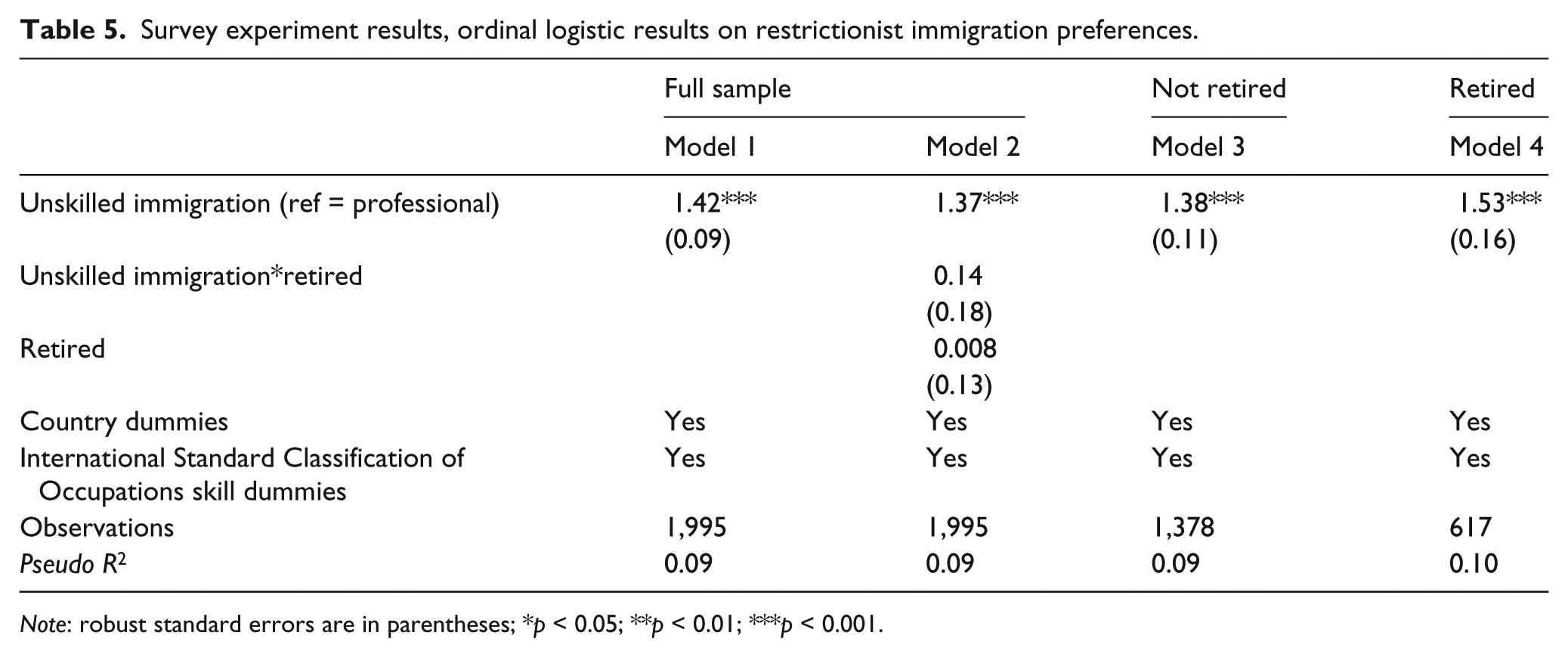
To statistically test the impact of the treatment, I estimate ordered logistic regressions predicting individual immigration policy preferences. I use these models to analyze the results because the dependent variable is ordered and not continuous. Beginning with the full sample, I estimate six versions of the model, presented in Table 5, which are estimated with robust standard errors. The first two models (1 and 2) estimate the impact of the treatment on the full sample of men aged 50–69. The next model (3) estimates the impact for the restricted sample of non-retired men. The last model (4) estimates the impact for a restricted sample of retired men.
Survey experiment results, ordinal logistic results on restrictionist immigration preferences.
Note: robust standard errors are in parentheses; *p < 0.05; **p < 0.01; ***p < 0.001.
All the models in Table 5 show that respondents exposed to the unskilled immigration treatment reported more restrictive immigration preferences. Importantly, the effect is significant – and larger – amongst the sample of retired individuals. Exposure to the unskilled question frame results in a 1.53 unit increase amongst retired men while it results in a 1.38 unit increase amongst workers in log odds of preferring more restrictive immigration preferences. Regardless of whether or not a person is retired, skilled immigration is more preferable than unskilled immigration. 9 Still, there is no evidence that a person being retired conditions the effect of the unskilled treatment: the coefficient for the interaction term in Model 2 is not significant.
The results of the survey experiment demonstrate that the absence of retirement effect in the previous analysis cannot be attributed to the notion that people simply do not update their preferences in old age. I show quite the contrary, that within this sample of older individuals, people update their preferences even based on the subtle changes in the wording of survey questions. Taken together, these results are at odds with an ego-tropic understanding of immigration opinions. If individual labor market competition is the primary motivation for attitudes towards immigration, we would not expect retired individuals to respond to the unskilled question frame. Yet instead, I find similar effects across the two samples: in both cases highly skilled professional immigrants are preferred to unskilled laborers. These results are consistent with a socio-tropic understanding of immigration opinions instead of an ego-tropic one.
Limitations
Some might argue that while retirement may not abruptly change a person’s opinion, it might instead occur gradually over time as workers gain experience and seniority in the labor market and their competition with immigrants lessens. Older people tend to be further along in their career life-cycle, have a longer job tenure and occupy a more secure labor market position than younger people (Kalleberg and Lincoln, 1988), and are less exposed to direct labor market competition with immigrants, which tend to be younger (Pedersen et al., 2008). While this counter-argument cannot be ruled out completely, the results in this study show only limited evidence that concerns about immigration diminish with age. Older individuals are less concerned about the impact of immigration on the economy in general, but their age does not affect their opinions about immigration regarding jobs, taxes, or services, all else considered.
This study is also limited by the fact that it only observes the absence of a local effect of men at a certain age. It is important to remember that amongst men aged 55 to 64 in advanced economies, retirement is the primary reason for labor market exit. However, younger men tend to exit the labor market for different reasons, for instance because a job of limited duration has ended or because they were dismissed or made redundant (OECD 2015 Pensions at a Glance). Women also tend to leave paid work for other reasons such as disability or going into care. The results shown here to do not allow us to rule out that these different motivations for labor market exit might have an impact on opinions about immigration even if retirement does not.
Conclusion
The objective of this study has been to empirically test the labor market competition hypothesis by analyzing to what extent a person’s attitudes towards immigration change as they retire from the labor market and to explain why this is so. I find that retirement does not affect opinions about immigration, which is important evidence against the labor market competition hypothesis. The results from the cross-national survey experiment challenge the ego-tropic understanding of immigration attitudes and joins the scholarly work which stresses the importance of socio-tropic interests (Hainmueller and Hiscox, 2010; Malhotra et al., 2013). Instead, I find that retired individuals are more likely to have restrictive policy preferences when immigration is framed as unskilled, just as workers do. A plausible reason for this is that opinions about immigration are socio-tropically oriented, whereby individuals conceive of the costs and benefits of immigration to the national economy rather than their own narrow self-interest.
Future research should explore the economic contextual factors which may make labor market changes such as retirement more crucial to public opinion. This present research has explored the general effect of retirement on attitudes towards immigration, but this does not exclude the existence of conditional effects. For instance, it may be that retiring from the labor market could have an effect on individual opinions in a political context undergoing austerity measures and pension cuts. Looking ahead, it would be fruitful to explore whether contextual economic conditions influence the salience of individual material interests.
Supplemental Material
Online_appedix_RR1 – Supplemental material for Revisiting the labor market competition hypothesis in a comparative perspective: Does retirement affect opinion about immigration?
Supplemental material, Online_appedix_RR1 for Revisiting the labor market competition hypothesis in a comparative perspective: Does retirement affect opinion about immigration? by Anne-Marie Jeannet in Research & Politics
Footnotes
Acknowledgements
Thanks to Dominik Hangartner and Catherine deVries for conversations and comments on previous versions of this article, which was presented at the 2017 annual meeting of the European Political Science Association in Milan, Italy.
Declaration of Conflicting Interest
The author(s) declared no potential conflicts of interest with respect to the research, authorship, and/or publication of this article.
Funding
The author(s) disclosed receipt of the following financial support for the research, authorship, and/or publication of this article: This research has been funded by the Swiss National Science Foundation (grant agreement: P2SKP1_164950).
Supplementary materials
The supplementary files are available at http://journals.sagepub.com/doi/suppl/10.1177/2053168018784503The replication files are available at https://dataverse.harvard.edu/dataset.xhtml?persistentId=doi%3A10.7910%2FDVN%2FMKP7IQ&version=DRAFT
Notes
Carnegie Corporation of New York Grant
This publication was made possible (in part) by a grant from the Carnegie Corporation of New York. The statements made and views expressed are solely the responsibility of the author.
References
Supplementary Material
Please find the following supplemental material available below.
For Open Access articles published under a Creative Commons License, all supplemental material carries the same license as the article it is associated with.
For non-Open Access articles published, all supplemental material carries a non-exclusive license, and permission requests for re-use of supplemental material or any part of supplemental material shall be sent directly to the copyright owner as specified in the copyright notice associated with the article.
