




Abstract
Twenty-five years after Entman (1993) argued that the framing paradigm was fractured, debates about the value of framing as a theoretical concept are still ongoing. In particular, discussions focus on the use of: (a) equivalence frames (i.e., frames with logical equivalence such as gain and loss frames) versus emphasis frames (i.e., frames that emphasize different dimensions of an issue); and (b) generic frames (frames that are applicable to multiple issues) versus issue-specific frames (frames that are applicable to one issue only). We conducted a systematic review on the use of these frame types in 21st-century political-framing experiments (N = 372) to establish whether and how scholars’ positions in these debates have changed across disciplines and over time. Results demonstrate that emphasis frames are more popular than equivalence frames, and that a slight majority of frames are issue-specific rather than generic. Moreover, frame preferences differ across disciplines and have hardly changed over time. This study thus shows that debates about what types of frames should be studied have had little influence on scholars’ frame choices across disciplines in previous research on political framing.
Framing is one of the major theories in research on political communication (Cacciatore et al., 2016). The most popular definition of framing is provided by Entman (1993), who argues that framing involves the selection and salience of information. Scholarly work on framing is spread across several disciplines within the social sciences and humanities (D’Angelo, 2012; Matthes, 2012), making framing research strikingly diverse and dynamic.
The abundance of approaches has, however, also resulted in widespread debates about the value of political framing as a theoretical concept (e.g., Cacciatore et al., 2016; Krippendorff, 2017). Twenty-five years after Entman (1993) argued that the paradigm of framing research was fractured, discussions about what types of frames should be studied are still ongoing. These discussions typically center around two debates: (a) the equivalence versus emphasis framing debate; and (b) the generic versus issue-specific framing debate.
In this study, we review 21st-century literature on political framing from various disciplines to establish whether and how scholars’ positions in these debates have changed across disciplines and over time. In particular, we focus on the use of equivalence versus emphasis frames and generic versus issue-specific frames in previous research on political framing. By identifying the presence of these frame types across disciplines and over time, the present state of both debates is evaluated.
Equivalence versus emphasis frames
The equivalence versus emphasis framing debate is about whether competing frames should contain different conceptual content (or not). Equivalence frames present different but logically equivalent information, promoting the same considerations for issues under discussion (Cacciatore et al., 2016). For instance, a new crime policy may keep 80% of drug offenders OFF the streets (“gain frame”) or 20% of drug offenders ON the streets (“loss frame”; Kahneman and Tversky, 1984). Both frames invite individuals to evaluate the policy based on the degree to which it may influence crime rates. By contrast, emphasis frames promote different considerations (Cacciatore et al., 2016). For example, during elections, the “substantive frame” focuses on candidates’ issue positions, while the “procedural frame” only emphasizes their performance in the polls (Entman, 2004).
Emphasis frames have been contested in the framing literature because findings demonstrating framing effects cannot always be exclusively attributed to framing. Instead, opponents of emphasis frames argue that effects of emphasis framing have been confounded with media effects models such as priming and agenda setting (Cacciatore et al., 2016; Scheufele and Iyengar, 2012), generally caused by conceptual and terminological confusions (Scheufele and Tewksbury, 2007). Also, potential effects may actually be attributed to presenting different arguments rather than emphasizing different dimensions of an issue (Leeper and Slothuus, 2015). Nevertheless, proponents of emphasis frames show that they are also highly useful to understand how individuals weigh the often conflicting considerations that media and political actors provide (Nelson et al., 1997). Under this perspective, examining emphasis frames may thus be essential to understand how individuals use different frames to form their own opinions.
Generic versus issue-specific frames
A similar debate concerns the specificity of frames (Borah, 2011; de Vreese, 2005; Hertog and McLeod, 2001). Whereas generic frames can be identified regardless of the topic, issue-specific frames are subject to thematic restraints (de Vreese, 2005). For instance, while the generic “human-interest frame” is abstract and therefore applicable to a wide range of issues, the issue-specific “climate-change frame” is more concrete and generally only applicable to political discourse about the accumulation of CO2 in our planet’s atmosphere.
Issue-specific frames are often considered problematic because they can reduce the ability to compare and generalize framing findings over time and across topics (Borah, 2011; Hertog and McLeod, 2001). Because the outcomes of studies using issue-specific frames are often too context sensitive, some scholars have proposed to shift attention to generic frames (Borah, 2011; Hertog and McLeod, 2001). Examining issue-specific frames can, however, yield a more profound understanding of framing in relation to specific contexts compared to generic frames (de Vreese, 2005). Hence, studying issue-specific frames may be necessary to understand how frames help individuals organize the world around them.
The current study aims to determine whether and how scholars across disciplines have held different positions in these two debates over time. This study provides a systematic overview of the extent to which previous political-framing research has converged in terms of employing frames that present logically equivalent information (or not) and frames that are generically applicable to issues (or not). Such an overview is needed to appreciate the state of the equivalence versus emphasis framing and generic versus issue-specific framing debates today. First, we explore the present state of affairs of scholars’ frame preferences for all disciplines combined by asking:
RQ1: What are the proportions of: (a) equivalence versus emphasis frames; and (b) generic frames versus issue-specific frames in 21st-century political-framing research?
Most of the discussions regarding the value of framing as a theoretical concept were motivated by Entman’s (1993) fractured-paradigm statement. He argued that framing was a “scattered conceptualization” (1993: 51) because the concept seemed to be differentially defined and studied across disciplines. Frame preferences were seen as largely dependent on the specific lines of research in the different disciplines. The disciplinary status of studies could thus be an important factor to take into account when examining scholars’ current positions in the two framing debates. Hence, the second research question posits:
RQ2: How does the proportion of: (a) equivalence frames; and (b) generic frames in political-framing research differ between disciplines?
In addition, we ask whether this distribution of frame types across disciplines has changed over time. The current literature seems to mostly advocate using equivalence frames (e.g., Cacciatore et al., 2016; Scheufele and Iyengar, 2012) and generic frames (e.g., Borah, 2011; Hertog and McLeod, 2001). Scholars can, however, have different reasons for using particular types of frames. While using equivalence frames and generic frames may promote the comparability and generalizability of framing findings (Borah, 2011; Cacciatore et al., 2016; Hertog and McLeod, 2001; Scheufele and Iyengar, 2012), using emphasis frames and issue-specific frames may promote a better understanding of the role that framing plays in the construction of our complex political reality (e.g., Nelson et al., 1997). It therefore remains unclear whether previous political-framing research has increasingly abandoned studying emphasis frames and issue-specific frames. For this reason, the third research question is:
RQ3: How have frame preferences across disciplines changed over time?
Method
Inclusion procedure
A systematic review was conducted to investigate which types of frames have been employed in 21st-century political-framing experiments across disciplines. The unit of analysis was experimental studies on political framing published from 2000–2016. In addition to journal articles and books, we included studies from conference papers and doctoral dissertations, as recommended by Cumming (2014). This enabled us to limit the influence of publication bias on the outcomes of this systematic review and to draw conclusions about the general population of studies. The time period was selected to provide 21st-century evidence for how frame preferences have evolved across disciplines and over time. We focused on experiments, because this widely used method is characterized by a high level of researcher control, thereby exposing scholars’ frame preferences.
The systematic review comprised five steps. 1 First, we identified relevant publications through database searching (see Appendix A for search string) in 19 electronic databases related to the social sciences and humanities (see Appendix B). After removing duplicates (step 2), we manually screened each publication against the selection criteria (step 3). Publications were coded as preliminarily relevant when they: (a) studied framing of (b) one or more political topics through (c) experimental methods using (d) native-speaking, healthy adults as participants. It was important to exclude studies that, for instance, explicitly focused on patients or children to be able to generalize the outcomes of this study to traditional political-framing research that typically focuses on the average voter. After carefully reading the method sections of these publications to determine definite relevance (step 4), we compressed the unit of analysis to individual studies (step 5) because publications could contain more than one relevant experiment.
Coding procedure
The variable equivalence versus emphasis framing was coded based on how the authors of the original studies defined the frames that were employed in their experiment(s). Frames were coded as equivalence frames, when the original study explained how the different frames that were used had the same logical content. Otherwise, frames were coded as emphasis frames. Control frames were excluded from the analysis because they could neither be coded as equivalence frames or emphasis frames. We conducted a reliability assessment in which a sample of frames (N = 100) was coded by two independent coders. This yielded “almost perfect” agreement (Cohen’s κ = 0.82; Landis and Koch, 1977).
The variable of issue-specific versus generic frames was coded based on which frames had been generally described as generic in the framing literature. When frames with different names were similar in terms of relating to particular concepts, they were likewise coded as generic (see Appendix C for details). The remaining frames were coded as issue-specific. Reliability assessment of the same sample of frames (N = 100) produced “substantial” intercoder agreement (Cohen’s κ = 0.79; Landis and Koch, 1977).
The variable of academic discipline was coded in the majority of studies by searching for the subject categories of each journal in the Journal Citation Reports from ISI Web of Science. 2 The categories were merged when possible, resulting in the discipline categories of political science (including public administration and international relations), communication, psychology (including educational research), and other. The other category contained all other disciplines (e.g., anthropology, economics, environmental science, health science, sociology), each of which individually had too few relevant studies for quantitative comparison. For studies published in journals that were not listed in the Journal Citation Reports, and studies published in books, doctoral dissertations, and conference papers, we determined the discipline categories by means of the websites of the journals, publishers, conferences, and departments in which the dissertations were defended.
Most studies were published in an outlet that belonged to one discipline category only (e.g., Acta Politica only belongs to political science). Some studies, however, were published in outlets belonging to two or more discipline categories (e.g., Political Psychology belongs to political science and psychology). These studies were categorized under all of these disciplines. Because a single experiment could belong to multiple disciplines, statistical analyses were conducted per discipline classification.
Results
We retrieved 372 relevant experiments on political framing from 284 publications published between 2000–2016 (for the references, see Appendix D; and for a full overview of the frames coded per study, see Appendix E). These 284 publications comprised 244 journal articles (with 319 studies), 4 books (with 4 studies), 10 doctoral dissertations (with 22 studies) and 26 conference papers (with 27 studies). A majority of 85.8% of studies were thus published in a journal. Of the remaining studies, 1.1% were published in a book, 5.9% in a doctoral dissertation, and 7.3% in a conference paper. With regard to the disciplinary status of the studies, 80.9% were classified as belonging to only one discipline and 19.1% as belonging to two or more disciplines. In total, 33.1% of the studies were published in a political-science outlet, 35.2% in a communication outlet, 25.0% in a psychology outlet, and 26.6% in an outlet from a different discipline. Table 1 shows that the distribution of studies over the types of publication outlets was fairly equal between disciplines.
Distribution of studies over publication outlets and disciplines.

Some studies are counted in >1 discipline, because they are published in an outlet that belongs to several disciplines such as the journals Political Psychology (political science and psychology) and Political Communication (political science and communication).
First, RQ1 asked about the presence of the four types of frames in 21st-century political-framing experiments across disciplines. The total number of frames employed in all studies was 998. Most experiments employed two frames (n = 223, 59.9%), three frames (n = 56, 15.1%) or four frames (n = 61, 16.4%). Few studies employed more than four frames (n = 25, 6.8%) or compared only one frame to a control condition (n = 7, 1.9%).
Equivalence frames made up only 8.1% of all frames used in the studies (e.g., “superior ingroup frame”, “inferior outgroup frame”; Chow et al., 2008). No less than 91.9% of the frames were emphasis frames (e.g., “victimization frame”, “multicultural frame”; Bos et al., 2016). The relation between generic and issue-specific frames was less skewed with an average of 49.3% of the frames being generic (e.g., “politcy frame”, “game frame”; Pingree et al., 2012), and 50.7% being issue-specific (e.g., “public aid frame”, “strict work frame”; Shen and Edwards, 2005). In sum, emphasis frames were found to be more popular than equivalence frames, and a slight majority of frames were issue-specific rather than generic.
RQ2(a) investigated how the degree of equivalence framing differed between disciplines. Per study, we calculated a proportion of equivalence frames by dividing the number of equivalence frames by the total number of equivalence and emphasis frames. Because Student’s t-test can be biased when sample sizes and variances are unequal between groups (Delacre et al., 2017), we used the more conservative Welch’s t-test to test whether frame preferences differ between disciplines. The analysis showed that the degree of equivalence framing was significantly higher for studies published in psychology outlets (M = 0.17, SD = 0.37) than those published in non-psychology outlets (M = 0.07, SD = 0.24; see Table 2). According to the effect size classifications of Cohen (1988), this difference can be classified as a small effect. 3 Yet, studies published in other-discipline outlets were significantly less likely to employ equivalence frames (M = 0.04, SD = 0.20) than studies published in the communication outlets, political-science outlets, and psychology outlets combined (M = 0.11, SD = 0.31). This effect can also be considered small (Cohen, 1998). The other two comparisons were non-significant. The results thus reveal small differences between disciplines in whether scholars prefer to use equivalence or emphasis frames.
Proportions of equivalence and generic frames per discipline.
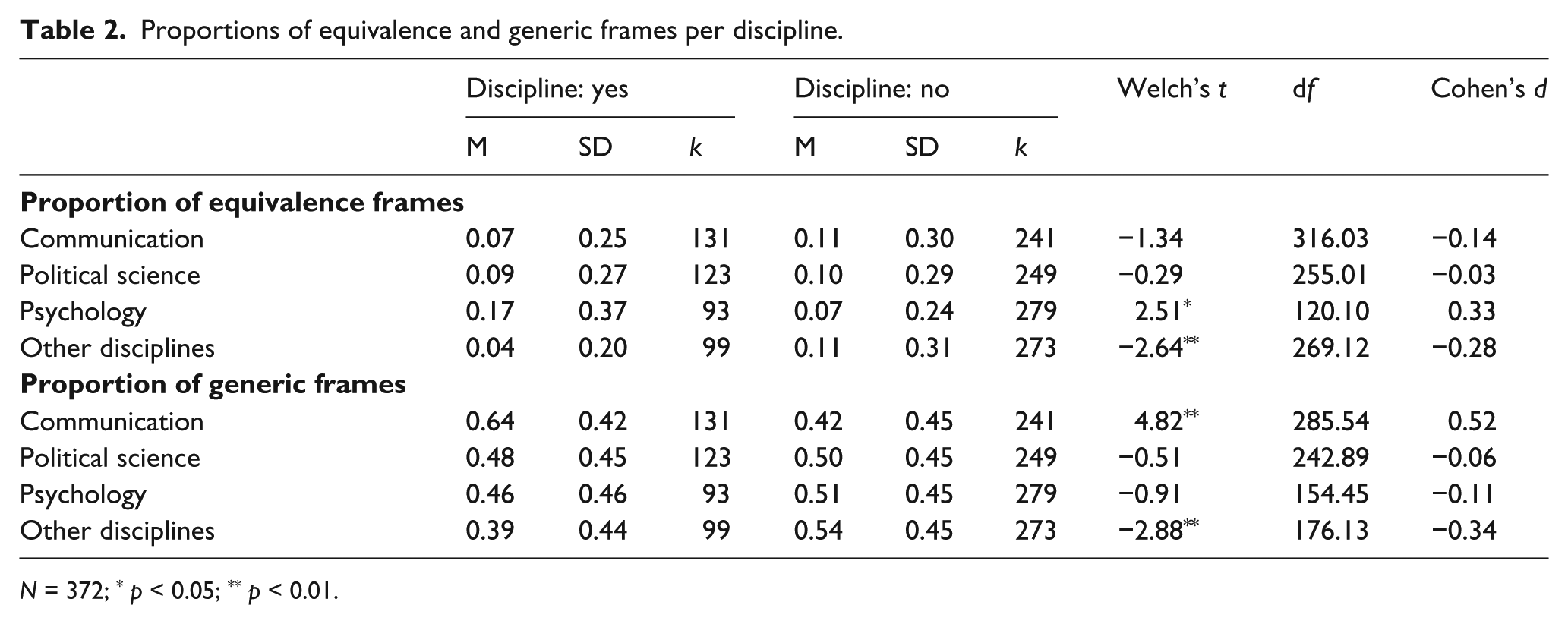
N = 372; * p < 0.05; ** p < 0.01.
RQ2(b) addressed how the degree of generic framing differed between disciplines. Per study, we calculated a proportion of generic frames by dividing the number of generic frames by the total number of generic and issue-specific frames. Welch’s t-tests demonstrated that the degree of generic framing was significantly higher for studies published in communication (M = 0.64, SD = 0.42) compared to non-communication outlets (M = 0.42, SD = 0.45). This difference constitutes a medium effect (Cohen, 1988). In contrast, the degree of generic framing was significantly lower for studies published in outlets from other-discipline outlet (M = 0.39, SD = 0.44) compared to studies published in the communication outlets, political-science outlets, and psychology outlets combined (M = 0.54, SD = 0.45). This effect can be classified as small (Cohen, 1988). The other two comparisons were non-significant. The results show small to medium differences between disciplines with regard to the popularity of generic versus issue-specific frames.
Finally, RQ3 dealt with changes in frame preferences across disciplines over time. Regression analyses showed that publication year explained a significant amount of variance in equivalence-frame use, R2 = 0.02, F(1, 370) = 8.73, p < 0.01. Equivalence-frame use seemed to have decreased over the years (B = −0.01, SE = 0.00, t(370) = −2.96, p < 0.01). This decrease was, however, considerably small. Furthermore, publication year did not significantly explain any variance in generic-frame use, R2 = 0.00, F(1, 370) = 1.31, p = 0.25. When zooming in on the discipline categories (see Table 3), we found that the proportion of equivalence frames has decreased over time in psychology and other-discipline studies. We found no significant relations between time and the proportion of generic frames. These results thus suggest that the degree to which scholars employ equivalence versus emphasis frames and generic versus issue-specific frames in political-framing experiments has hardly changed.
Relation between publication year and frame preferences per discipline.

N = 372; * p < 0.05; ** p < 0.01.
Discussion and conclusions
This systematic review reveals the distribution of frame preferences across disciplines and over time in 21st-century political-framing experiments. The findings substantiate two tendencies in framing research, criticized by some scholars: (a) a dominance of emphasis frames over equivalence frames (e.g., Cacciatore et al., 2016; Scheufele and Iyengar, 2012); and (b) a dominance of issue-specific frames over generic frames (e.g., Borah, 2011; Hertog and McLeod, 2001). Results show that approximately one out of ten frames were equivalence frames and a slight majority of frames were issue-specific frames (RQ1).
Comparing frame preferences between disciplines showed that studies from psychology outlets differed from all studies in the relatively high number of equivalence frames that were studied (RQ2). Furthermore, studies from communication outlets differed from all others studies in the relatively high amount of generic frames that were employed. Third, studies from outlets that belong to disciplines other than political science, communication, or psychology differed from these studies in the relatively high amount of emphasis frames and issue-specific frames that were used. Studies published in political-science outlets seemed to represent the average study in previous political-framing research in terms of the presence of the different frame types.
These findings seem to contradict some of the expectations raised in the framing literature regarding the distribution of frame preferences over disciplines. For instance, equivalence framing originates from ground-breaking work by psychologists Kahneman and Tversky (1984). Because of this tradition, psychology studies are often expected to use more equivalence framing than studies from other disciplines (e.g., Scheufele and Iyengar, 2012). Although our analysis shows that psychology studies are almost twice as likely to involve equivalence framing, still only one-fifth of psychology experiments actually involved equivalence framing. Similarly, the dominance of issue-specific framing seems to have been most often criticized in the communication literature (e.g., Borah, 2011). Yet, we show that communication studies are most likely to involve generic framing compared to studies from other disciplines.
Examining frame preferences over time showed that frame preferences within disciplines have hardly changed since the turn of the century (RQ3). A small decrease was found in the overall degree of equivalence framing due to a small decrease in the use of equivalence frames in studies from psychology and other disciplines. In contrast, no differences in the degree of generic framing were found over time.
These findings seem to contradict the amount of attention that scholars have paid to discuss how framing research is increasingly characterized by emphasis frames and issue-specific frames (e.g., Borah, 2011; Cacciatore et al., 2016; Hertog and McLeod, 2001; Scheufele and Iyengar, 2012). The observation that framing scholars have a tendency to use many emphasis frames and issue-specific frames is correct. This study shows, however, that the degree of equivalence framing and generic framing in political-framing research has not shifted since the turn of the century.
Some limitations of the current study can be noted. First, we did not investigate the impact of each individual study in terms of the number of citations. Trends in frame preferences could be different for the most influential (most cited) studies. Unfortunately, many studies were too recently published to determine impact. Future research could take the number of citations of studies into account. Second, we only focused on political framing in experiments because this method is characterized by the most researcher control. Future research could consider examining other methods such as content analysis.
Overall, this study shows that debates about the “true” nature of frames have had little influence on scholars’ frame choices across disciplines in previous research on political framing. We found meaningful and time-consistent differences in approaches to political framing between disciplines. Despite the fact that studies using emphasis frames (e.g., Borah, 2011; Hertog and McLeod, 2001) and issue-specific frames (e.g., Cacciatore et al., 2016; Scheufele and Iyengar, 2012) have received considerable criticism, equivalence frames and generic frames have not received increasing research attention. Instead, frame preferences appear to be discipline-specific and considerably stable.
Supplemental Material
Appendix_A – Supplemental material for Political framing across disciplines: Evidence from 21st-century experiments
Supplemental material, Appendix_A for Prices for Political framing across disciplines: Evidence from 21st-century experiments by Britta C. Brugman and Christian Burgers in Research & Politics
Supplemental Material
Appendix_B – Supplemental material for Political framing across disciplines: Evidence from 21st-century experiments
Supplemental material, Appendix_B for Prices for Political framing across disciplines: Evidence from 21st-century experiments by Britta C. Brugman and Christian Burgers in Research & Politics
Supplemental Material
Appendix_C – Supplemental material for Political framing across disciplines: Evidence from 21st-century experiments
Supplemental material, Appendix_C for Prices for Political framing across disciplines: Evidence from 21st-century experiments by Britta C. Brugman and Christian Burgers in Research & Politics
Supplemental Material
Appendix_D – Supplemental material for Political framing across disciplines: Evidence from 21st-century experiments
Supplemental material, Appendix_D for Prices for Political framing across disciplines: Evidence from 21st-century experiments by Britta C. Brugman and Christian Burgers in Research & Politics
Supplemental Material
Appendix_E – Supplemental material for Political framing across disciplines: Evidence from 21st-century experiments
Supplemental material, Appendix_E for Prices for Political framing across disciplines: Evidence from 21st-century experiments by Britta C. Brugman and Christian Burgers in Research & Politics
Footnotes
Declaration of conflicting interests
The author(s) declared no potential conflicts of interest with respect to the research, authorship, and/or publication of this article.
Funding
Supplementary material
The supplementary files are available at http://journals.sagepub.com/doi/suppl/10.1177/2053168018783370. The replication files are available at: 
Notes
Carnegie Corporation of New York Grant
This publication was made possible (in part) by a grant from the Carnegie Corporation of New York. The statements made and views expressed are solely the responsibility of the author.
References
Supplementary Material
Please find the following supplemental material available below.
For Open Access articles published under a Creative Commons License, all supplemental material carries the same license as the article it is associated with.
For non-Open Access articles published, all supplemental material carries a non-exclusive license, and permission requests for re-use of supplemental material or any part of supplemental material shall be sent directly to the copyright owner as specified in the copyright notice associated with the article.
