




Abstract
What are the consequences of police brutality in fighting against the Catalan secessionist movement? While Spanish authorities resorted to violence with the hope that forceful action would deter further support for separatism, recent studies of repression argue that state violence tends to backfire. I test these two plausible arguments in the context of non-lethal police brutality to prevent an illegal self-determination referendum. For this, I combine data of the local distribution of police violence during the referendum and the official results of the subsequent regional elections. Because police forces were not deployed randomly, I employ a difference-in-differences estimation with matching to evaluate the electoral consequences of violence. The results show no clear evidence that police brutality affected support for separatism or electoral mobilization in the areas that it was deployed. The lack of a clear effect sets an agenda for future research in the investigation of the conditions under which state violence affects dissenting movements.
Introduction
States face a strategic choice when tackling secessionist movements: (a) make policy concessions, such as granting further powers to regional authorities or holding a self-determination referendum; or (b) resort to repression to ensure the unity of political entities. Many countries take the latter approach with the expectation that repressive action would deter further support for secessionist movements (Walter, 2006).
Important questions on the consequences of such forceful action remain in the literature. How does state violence affect secessionist movements? Are secessionists who experience repression more likely to acquiesce to the state and demobilize in order to avoid further violence (deterrence effect), or do they become even more mobilized and radicalized against the state (backfire effect)? These questions have important implications for understanding and assessing the effectiveness of violent state repression as a political tool to maintain a country’s territorial integrity, as well as for conflict resolution in general.
I empirically contribute to this debate by evaluating the consequences of police brutality after the rogue 2017 Catalan referendum in Spain. While the central authorities presumably hoped that forceful action could deter further support for separatism, the pro-independence parties and many observers have expected that an overreaction of this type could backfire and increase support for separatism. I use evidence from the deployment of central security forces in Catalonia to prevent an illegal self-determination referendum from occurring on 1 October 2017. I combine village-level data on the presence of Spanish forces with the results of the regional elections. A causal effect of state violence is estimated by employing a standard difference-in-difference matching estimate (DIDM) technique, which simultaneously removes permanent confounders while capturing transitory shocks by matching on pre-treatment covariates.
Findings show that pro-independence and turnout rates of those who lived in localities that were directly exposed to state violence were not systematically greater compared to those that were not. The lack of a systematic effect is consistent across all model specifications, namely the ordinary least squares, the matching estimator, the DID estimator and the DID-matching estimator; and for both outcomes of interest turnout and support for pro-independence parties. I conclude that there is no clear evidence that state violence affects the electoral support for secessionist movements and electoral mobilization. Finally, I discuss some explanations for these null effects and conclude that the lack of clear evidence should set an agenda for future research on the conditions under which state violence is effective at reducing the support for secessionist movements.
Theory and context
Spain resorted to widespread police repression in the region of Catalonia to prevent an illegal self-determination referendum from occurring on 1 October 2017. 1 Even though the vote had been previously banned by Spanish authorities, the Catalan regional government, in collaboration with pro-independence grassroots movements, opened the polling stations, obtained an official electoral registry of voters, and provided the necessary electoral materials to carry out a vote.
As the polling stations officially opened, Spanish security forces began moving into some of them to prevent people from casting their ballots. Riot squads pushed their way through crowds of would-be voters to access the interior of some polling stations using batons, rubber bullets, and tear gas canisters. At the end of the day, nearly 900 people were reported injured by the Catalan Health Department (CatSalut, 2017). Of the 2305 polling stations across the 947 municipalities in Catalonia, the Spanish security forces visited about 100 polling stations in 57 towns. Just a few weeks after that, the Spanish government activated a constitutional provision to dismiss the members of the regional government, enforce direct rule over the region, and call for new regional elections, which took place on 21 December 2017.
The expected consequences of police brutality after the rogue Catalan referendum are far from obvious. Plausible arguments can be made either way about the effectiveness of state violence against secessionists. On the one hand, states seem to repressively respond to either actual or potential dissent with the expectation that repressive action would protect the status quo through deterrence. The use of violence may intend to persuade dissenters that their anti-state activities are futile and, thus, increase the costs associated with their mobilization (Tilly, 1978). In fact, some scholars have found evidence for the effectiveness of state violence in dampening protests in movements against authoritarian regimes (Olzak et al., 2003) or insurgency amidst a civil war (Lyall, 2009).
On the other hand, pro-independence parties and many observers have expected that an overreaction could backfire and increase support for separatism. In this regard, most recent studies on the effects of severe repression in civil war, terrorism, and social movements converge on the notion that indiscriminate violence backfires. After violent episodes, mobilization may rebound due to anger toward government actions (Hess and Martin, 2006; Sutton et al., 2014).
In the context of lethal political violence, exposure to violence has been associated with greater social and political participation (Barceló, n.d.; Blattman, 2009; Gilligan et al., 2014). Extreme forms of violence also lead to a shift in people’s preferences against the punisher in such a way that people reject the perpetrators’ political identities (Balcells, 2012), take more hostile attitudes against the perpetrator, be it a central government or a foreign country (Dell and Querubin, 2018; Lupu and Peisakhin, 2017; Rozenas et al., 2017), and embrace more hawkish preferences against terrorists after attacks (Berrebi and Klor, 2008; Getmansky and Zeitzoff, 2014). At the same time, war-related violence may also influence parties’ organizational structures (Costalli and Ruggeri, 2015). Notwithstanding these, non-lethal forms of police repression in the form of injuries amongst protesters in an advanced democratic country like Spain might not have the same effects as the type of violence that characterizes wars, terrorism, and authoritarian state repression.
Such boomerang effects, however, could be especially likely because of two key features of nonviolent self-determination movements. First, the nonviolent nature of the dissenting movement might increase a collective perception of government abuse and, thus, enhance feelings of anger, individually, among the victims of such repression and their acquaintances and, collectively, in areas that were more strongly exposed to such violence. Second, self-determination movements such as the Catalan are built around strong national identities, which provide the basis for their mobilization. As we know from extant literature, group identities are socially constructed (Chandra, 2012), and malleable by external events (Eifert et al., 2010; Fearon and Laitin, 2000). Thus, the local experience of state repression itself might make identity attachments more salient, sharpen group boundaries and, thus, ignite further separatism.
The two plausible arguments yield the following hypotheses for empirical investigation.
Backfire effects:
H1: State violence against nonviolent secessionist movements backfires;
H1A: State violence leads to greater support for pro-independence parties;
H1B: State violence leads to greater electoral mobilization.
Deterrence effects:
H2: State violence against nonviolent secessionist movements deters;
H2A: State violence leads to lower support for pro-independence parties;
H2B: State violence leads to lower electoral mobilization.
Methods and data
This section discusses some relevant characteristics of the dataset; the measurement of the dependent, independent, and control variables; and an empirical strategy for the identification of a causal effect.
Measures
I have built an original dataset with the 947 Catalan municipalities as the units of analysis. The dataset includes information about whether the municipality was directly affected by state violence on 1 October 2017, and the intensity of such violence. Specific information about the geographic distribution of violence is drawn from media sources such as El Punt Avui and El Temps, 2 and an important effort made by Altesa Amils (2017), who collected information about any police violence that occurred in each municipality.
For the purpose of the analyses, I create a state violence dummy that takes the value of 1 if riot squads of one of the two Spanish security forces, Policía Nacional or Guardia Civil, moved into at least one polling station in the municipality with the attempt to seize electoral material. The detailed accounts of the violent episodes in these journalistic and academic reports allow me to code the intensity of violence in each municipality. Online Appendix A shows that 57 municipalities, or 6.02%, were affected by state violence. Of these, the use of force by means of batons, rubber bullets, and/or tear gas canisters was required in 38 municipalities (4.01% of the total). Police intervention took place through non-violent means in 19 municipalities (2.01% of the total). 3 I do not, however, differentiate municipalities as a function of the intensity of violence used in each municipality as this is likely to be endogenous to the resistance of the crowds, which could bias the results. 4 Finally, Figure 1 maps the locations of the municipalities affected by state violence from the Spanish security forces. The map shows that they are scattered throughout the territory but clustered around the four capital provinces, precisely the location of the Spanish police major headquarters.

Map of state violence in Catalonia. Note: The map shows the areas of the Catalan region that suffered from violence by the Spanish police on 1 October 2017. Yellow circles show the location of the province capitals where the major Spanish police headquarters are located.
Additionally, I include measures in the dataset that capture the support for independence and electoral mobilization. First, I operationalize the support for independence as the voting percentages for pro-independence parties—namely, Junts pel Sí and CUP-Crida Constituent in 2015 and Junts per Catalunya, Esquerra Republicana de Catalunya, and CUP-Crida Constituent in 2017—in the regional elections.
Second, I use the electoral turnout in Catalan regional elections as a measure of political mobilization. On average, municipalities had a mean of 81.78% turnout rate in 2015 and 84.67% in 2017. Generally speaking, we can see that the average turnout rate for these elections has been high and that the 2017 regional elections marked a historic record in turnout. 5
Estimation strategy
I estimate the causal effect of direct exposure to state violence by using a difference-in-differences (DID) matching design (Abadie, 2005) to eliminate selection bias and to estimate the average treatment effect on the treated (ATT). DID-matching combines a non-parametric matching procedure with first-differencing with respect to a pre-treatment period. Specifically, matching allows me to eliminate selection bias due to observed covariates by comparing municipalities that were affected by state violence to similar, yet unaffected, municipalities. First-differencing eliminates selection bias due to time-invariant unobservable factors. The validity of the DID-matching relies on some assumptions, which are tested for their plausibility and discussed in online Appendix B. 6
For the implementation of the DID-matching, I first match municipalities affected by state violence with other municipalities based on the following observed covariates: support for pro-independence parties in 2015 (in the turnout models) or turnout in 2015 (in the support for pro-independence models), driving distance to the province capital, the log of the number of eligible voters in 2015, and the province of the municipality. All covariates are matched based on the coarsened exact matching using the automatic binning algorithm (Iacus et al., 2012). 7 Province capitals are discarded from the matching procedure as they cannot be credibly matched with any other municipality within the same province. 8 Due to lack of common support, 19 affected villages cannot be matched with unaffected villages. In total, 34 treated and 119 control units remain in the sample.
Finally, I estimate the causal effect using the DID estimator in the matched dataset. The outcome Yi denotes the percentage of voters for pro-independence parties—or the turnout rate—in municipality i is modeled by

where the coefficient α refers to the constant term, β denotes treatment group specific effect, which accounts for average permanent differences between treatment and control municipalities, γ captures the period effects or time trends common to treated and control units, and δ denotes the true causal effect of state violence. Finally, λ captures remaining imbalances in the matching procedure of time-varying pre-treatment covariates, and ε indicates a random, unobserved error term that contains all determinants of Yi that are omitted in the model.
Results
In this section, I show the major results of the empirical analysis and their robustness across several empirical checks.
The effect of state violence on pro-independence parties
Table 1, Model 1 shows that the municipalities that were affected by state violence had, on average, lower support for pro-independence parties compared to unaffected municipalities. This difference of only 0.09 percentage points is small in magnitude, however, and not statistically significant. Model 2 also includes several covariates that could be associated with state violence and with the increase in support for secessionist parties between 2015 and 2017 such as turnout in 2015, population size or the number of eligible voters in the municipality in 2015, distance to province capitals and province fixed effects. The conclusion of no-significant effects remains unchanged after including these covariates.
The effect of state violence on the support for pro-independence parties.
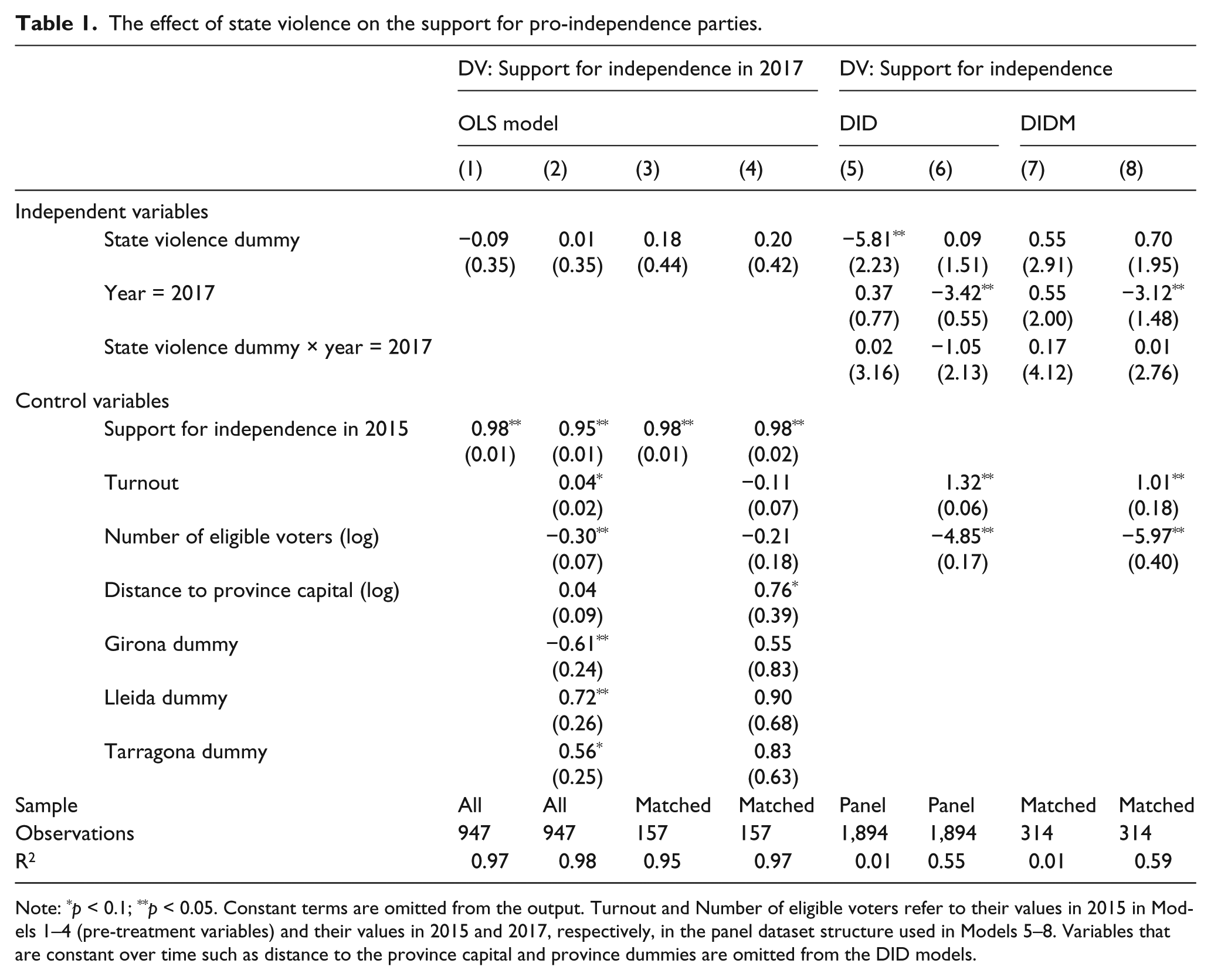
Note: *p < 0.1; **p < 0.05. Constant terms are omitted from the output. Turnout and Number of eligible voters refer to their values in 2015 in Models 1–4 (pre-treatment variables) and their values in 2015 and 2017, respectively, in the panel dataset structure used in Models 5–8. Variables that are constant over time such as distance to the province capital and province dummies are omitted from the DID models.
All municipalities in the sample are used to estimate the results in Models 1 and 2. I acknowledge, however, that this might be problematic given that there are some municipalities that were affected by state violence that are systematically different from unaffected municipalities. Hence, Models 3 and 4 report the results via coarsened exact matching to ensure that I am only comparing municipalities that are similar across covariates. Yet, their effects remain small in magnitude and not statistically significant.
Models 5 and 6 in Table 1 report the DID estimates. For these models, the interaction term of the treatment and the time dummy yield the treatment effect of state violence on the support for pro-independence parties. Model 5 is consistent with prior models as it reports a small and non-significant coefficient. Once I account for time-varying covariates such as turnout and the number of voters in Model 6, the estimate becomes larger and negative but still unreliable and not distinguishable from a null effect. Finally, Models 7 and 8 show that the DID-matching specifications estimate an effect that is smaller than 1 percentage point and indistinguishable from a null result. Figure 2(a) and (b) plot the voteshare of pro-independence parties in 2015 and 2017 based on the full and matched samples, respectively, which illustrate a lack of different variation in support for pro-independence parties between affected and unaffected villages.

Variation in outcomes between affected and unaffected municipalities (2015–2017). (a) Change in the support for pro-independence parties between 2015 and 2017 across affected and unaffected municipalities. Full sample. (b) Change in the support for pro-independence parties between 2015 and 2017 across affected and unaffected municipalities. Matched sample. (c) Change in turnout between 2015 and 2017 across affected and unaffected municipalities. Full sample. (d) Change in turnout between 2015 and 2017 across affected and unaffected municipalities. Matched sample.
The effect of state violence on electoral mobilization
Table 2, Models 1 and 4, report the ordinary least squares models with the full and the matched sample for the effect of state violence on electoral turnout with and without controls. The size of the effects only vary from −0.12 to 0.28, and none of the coefficients are statistically significant.
The effect of state violence on electoral mobilization.

Note: *p < 0.1; **p < 0.05. Constant terms are omitted from the output models. Support for pro-independence parties and Number of eligible voters refer to their values in 2015 in Models 1–4 (pre-treatment variables) and their values in 2015 and 2017, respectively, in the panel dataset structure used in Models 5–8. Variables that are constant over time such as distance to the province capital and province dummies are omitted from the DID models.
Models 5 and 6 report DID estimates of 0.81 percentage points. They suggest that municipalities that were affected by state violence seem to have turned out slightly more in the subsequent elections, although none of these estimates are statistically significant. The DID-matching estimator yields coefficients that are smaller in magnitude, 0.18 and 0.16, and they remain statistically indistinguishable from a null result. Figure 2(c) and (d) plot the turnout rates in 2015 and 2017 based on the full and matched samples, respectively. They illustrate a suggestive positive relationship, but also a lack of a clear relationship between the presence of state violence and variation in the turnout rate due to the unreliability of the estimates in those models that are best for causal identification.
Further analysis and robustness checks
As a robustness check to the results, I consider alternative matching algorithms and coding decisions of state repression. On the one hand, I estimate the effects through the nearest neighboring algorithm, optimal matching, and subclass matching with four strata. The results obtained with these methods lead me to the same conclusion for both outcomes of interest (see online Appendix G for further details). On the other hand, I check the robustness of the findings across alternative coding of state repression (see online Appendix F for further details). The results remain unaltered.
As an additional check, I consider the relevance of ceiling effects (see online Appendix H). One may reason that the lack of clear evidence arises because both outcomes already reached high levels before the illegal referendum took place. To check the plausibility of this explanation, I split the sample into two groups of villages, those above and those below the median value of the pre-treatment outcome. Then, I re-estimate the models for each group. If ceiling effects play a significant role, we should expect positive effects to be significantly greater for those villages below the median compared to those above the median.
I find that: (a) treatment effects are similar in both groups in the models about the support for pro-independence parties, which suggests that ceiling effects are unlikely to impact the main finding; and, (b) treatment effects are marginally greater for those villages below the median compared to those above the median in the turnout models, although these differences are not statistically significant. This indicates that ceiling effects could attenuate the effect of violence on turnout, although this attenuation bias is unlikely to be large.
Finally, I acknowledge that observations tend to manifest themselves as clusters or concentrations of similar values at the local scale. Therefore, one could argue that spatial autocorrelation might bias my main estimates if observations are not independent. (See, for instance, Barceló (2014) and Rodon and Guinjoan (2018) for research suggesting the importance of the spatial dimension in Catalonia.) I consider the relevance of the spatial autocorrelation and, when necessary, adjust for it in online Appendix I. The major results and conclusions from the analyses remain unaltered.
Conclusions
How does state violence affect nonviolent secessionist movements? While governments often resort to violence with the expectation that violent action would deter support for secessionism, most studies support the thesis that repression backfires. The compilation of a novel dataset that captures local-level voting behavior immediately after an episode of widespread state violence in Catalonia (Spain) empirically contributes to this debate. The results show no clear evidence that police brutality influenced separatism or electoral mobilization in the areas that it was deployed.
These null findings seem to be at odds with current theories about the consequences of state-directed violence. We should note, however, that this paper evaluates the effect of violence in a context that is quite distinct from previous work. In the past, scholars tended to analyze the impact of severe forms of violence such as foreign and civil wars, and terrorism or state repression under authoritarian regimes. The case of Catalonia contrasts with prior evidence because: (a) political violence was non-lethal, as only injuries to protesters were reported; (b) security forces were directed by Spain, an advanced democratic country; and (c) violence was not indiscriminate but targeted dissenters. Nevertheless, the null findings reported here do raise new questions about the scope conditions under which violence affects political behavior.
Future investigations should examine whether the impact of state repression depends on its severity as non-lethal repression might simply not have the same effects as lethal political violence. The consequences of violence might also depend on whether the regime is democratic or authoritarian. Additionally, the lack of a clear effect may perhaps be because the effect depends on the nature of violence, whether indiscriminate or targeted against the dissenters. In addition to these, the lack of evidence for an effect does not necessarily mean that such an effect does not exist. Hence, the consideration of a wider range of cases and the identification of the mechanisms at work are some of the next steps to understand more about the scope conditions of the relationship between political violence and political behavior.
Supplemental Material
Appendix_(3) – Supplemental material for Batons and ballots: The effectiveness of state violence in fighting against Catalan separatism
Supplemental material, Appendix_(3) for Batons and ballots: The effectiveness of state violence in fighting against Catalan separatism by Joan Barceló in Research & Politics
Footnotes
Acknowledgements
I would like to thank Raymond Duch, James L. Gibson, Taishi Muraoka, and Guillermo Rosas for their helpful comments on earlier version of this paper.
Declaration of conflicting interests
The author(s) declared no potential conflicts of interest with respect to the research, authorship, and/or publication of this article.
Funding
The author(s) received no financial support for the research, authorship, and/or publication of this article.
Supplementary material
The supplementary files are available at http://journals.sagepub.com/doi/suppl/10.1177/2053168018781747. The replication files are available at  .
.
Notes
Carnegie Corporation of New York Grant
This publication was made possible (in part) by a grant from Carnegie Corporation of New York. The statements made and views expressed are solely the responsibility of the author.
References
Supplementary Material
Please find the following supplemental material available below.
For Open Access articles published under a Creative Commons License, all supplemental material carries the same license as the article it is associated with.
For non-Open Access articles published, all supplemental material carries a non-exclusive license, and permission requests for re-use of supplemental material or any part of supplemental material shall be sent directly to the copyright owner as specified in the copyright notice associated with the article.
