




Abstract
Leeds et al. (2000) report that military alliance commitments are honored in war around 75% of the time. We update and extend data on alliance reliability from 1816 to 2003. Our analysis reveals a lower compliance rate overall: 50%. We find a sharp disparity in alliance reliability before and after World War II. States honored their alliance commitments 66% of the time prior to 1945 but the compliance rate drops to 22% from 1945 to 2003. Moreover, the rates of fulfillment for defense pacts (41%) and nonaggression pacts (37%) are dramatically lower than offensive alliances (74%) and neutrality agreements (78%). These findings carry implications for the role of military alliances in world politics and highlight the need for more research to explain the differences that emerge before and after World War II.
An influential study by Leeds, Long, and Mitchell (2000, hereafter “
Our analysis reaffirms
Alliance reliability in war: Data and procedures
Scholars have discussed the honoring of alliance promises at least since the time of Thucydides (431 BCE). Systematic research on this topic began to take off after scholars compiled comprehensive data on military alliances and war through the Correlates of War project. Early studies were not sanguine about the reliability of alliances in war: Sabrosky (1980) finds that alliances are honored less than 30% of the time, while Siverson and King (1980: 2) conclude that just 23.1% of the opportunities to fulfill an alliance commitment resulted in countries joining their allies in war. One limitation of these studies, however, is that they do not consider the specific requirements of each alliance (i.e., the casus foederis). This research therefore misclassifies alliance fulfillment: some treaties are considered to be violated (or upheld) even though countries did not renege on (or honor) any particular promise.
Leeds et al. (2002) address this issue by developing the ATOP dataset, which identifies specific alliance provisions to more accurately assess when states are (and are not) obligated to act.
To address this issue, we create a dataset of alliance treaty fulfillment for the period from 1816 to 2003, following the procedures described in
The unit of observation in our dataset is the “alliance performance opportunity.” Because some wars trigger multiple alliance commitments, the same conflict may appear in the dataset more than once. The dataset accounts for four types of alliances: defense pacts, offensive alliances, neutrality agreements, and nonaggression pacts. We started by identifying all active alliance commitments made by participants in 70 interstate wars during our period of study. Next, we determined whether each treaty’s casus foederis was met in a given war. The analysis ultimately includes only those cases where the particular requirements of the treaty were met, excluding cases that are not relevant for assessing alliance reliability. We identified a total of 576 “alliance performance opportunities” from 1816 to 2003. The casus foederis was invoked in 146 of these cases, compared to 110 with
For all “alliance performance opportunities” in which the casus foederis was invoked, we determined whether the commitment was upheld. Like
Findings
We found that alliance treaties were fulfilled in war from 1816 to 2003 at a rate of 50% (see Figure 1).
3
This figure is about 25 percentage points lower than the alliance reliability rate reported by

Updated data on alliance treaty fulfillment.
There is interesting variation in the rate of compliance based on treaty type. 4 Offensive alliances and neutrality agreements are fulfilled at high rates − 73.81 and 77.78%, respectively. Defense pacts, by contrast, are upheld just 41.18% of the time. Nonaggression pacts are honored at the lowest rate (36.73%). The type of alliance commitment is therefore important for understanding promise fulfillment. This may be partially because defense pacts and nonaggression pacts are more likely to generate time inconsistency problems. These alliances may be more likely to be invoked years after they are signed, increasing the likelihood that the circumstances that led to forming the agreement have changed. 5 On the other hand, offensive treaties and neutrality pacts seem to be forged shortly before a war begins, after allies have already decided to fight together (or to remain neutral).
The disparity in alliance treaty fulfillment before and after World War II is also striking (see Figure 2). From 1816 to 1944, we find that alliance treaties were upheld 66.30% of the time. This figure is similar to the rate of 74.5% in
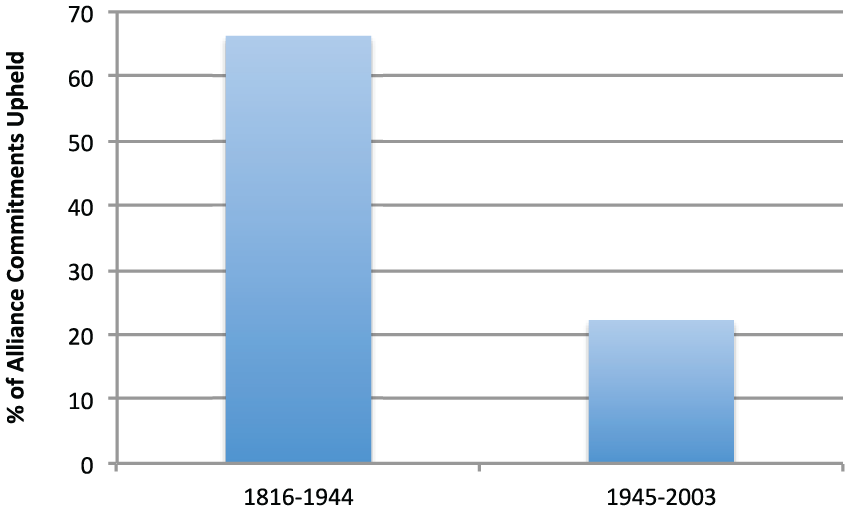
Comparing alliance treaty fulfillment in two eras.
Table 1 lists the opportunities to fulfill alliance commitments from 1945 to 2003. This information offers some possible explanations for the sharp decrease in promise fulfillment after World War II. One thing that stands out is that offense pacts and neutrality agreements, which are honored at higher rates than defense pacts and nonaggression pacts, are less common in the modern era. Only 20% of alliance performance opportunities from 1945 to 2003 included offensive or neutrality-based commitments, compared with more than 70% from 1816 to 1944. Changes in the types of alliance commitments that are invoked in war over time might partially account for the puzzling trend that we identify. Yet we still see sizable variation in compliance within the same commitment type in the two eras. Defense pacts, for instance, were honored 61.02% of the time from 1816 to 1944 and only 13.95% of the time post-World War II. What else, then, could explain the changing patterns over time?
Alliance performance opportunities, 1945–2003.
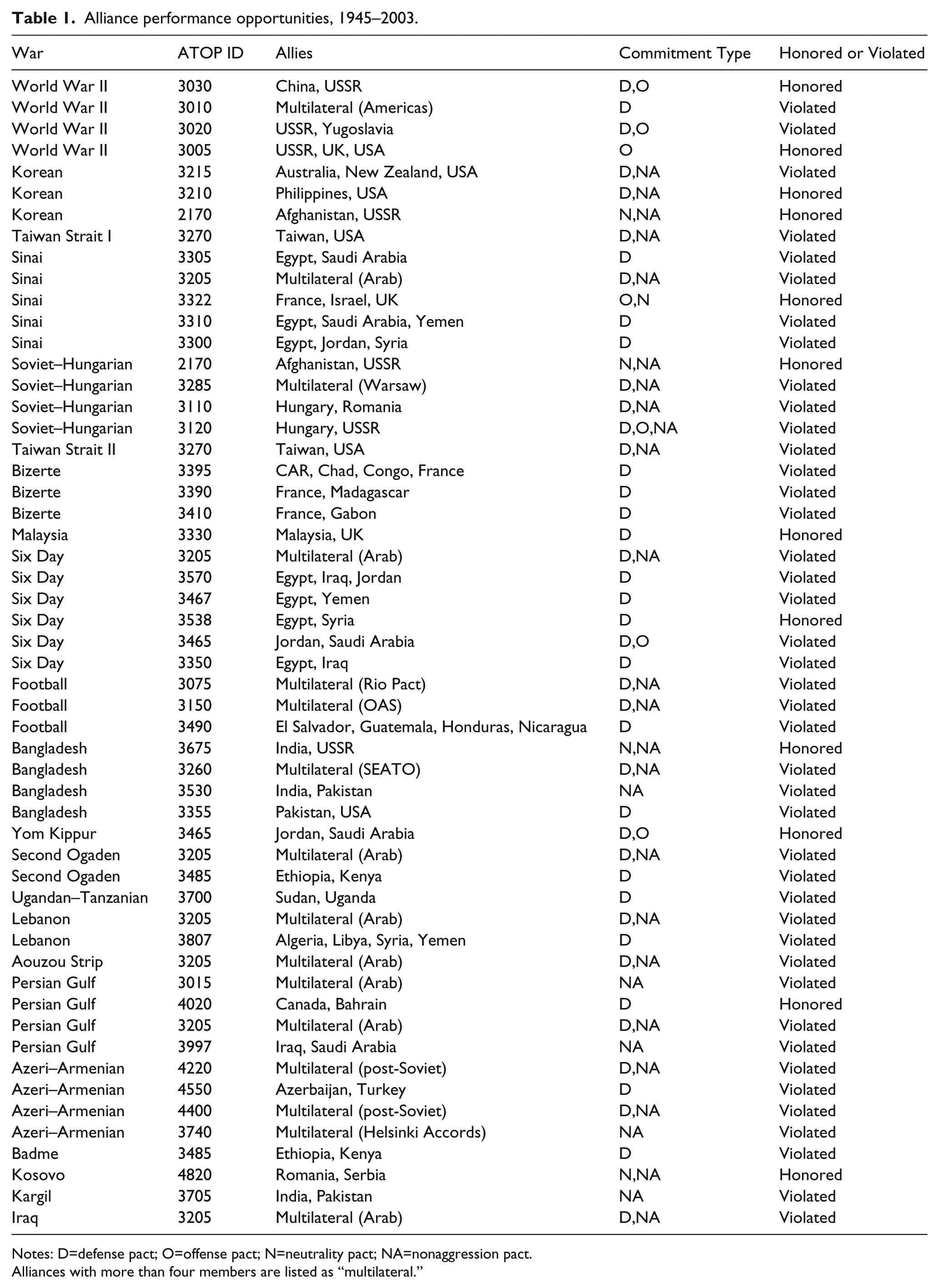
Notes: D=defense pact; O=offense pact; N=neutrality pact; NA=nonaggression pact.
Alliances with more than four members are listed as “multilateral.”
The invention of nuclear weapons offers one potential answer. In the post-World War II era, the world’s most powerful states possessed nuclear arsenals. Given the destructive power of these weapons, alliance commitments from nuclear powers – especially defense pacts – have rarely been challenged in war (Fuhrmann and Sechser, 2014). As a result, major powers appear just a few times in Table 1 and relatively weak states account for a sizable percentage of all “alliance performance opportunities” from 1945 to 2003. This is relevant because state power may affect alliance treaty fulfillment. Countries should be most likely to intervene in war when their participation might change the outcome (Morrow, 1994; Smith, 1995). Relatively weak states, according to this line of thinking, are less likely to fulfill their alliance promises because they lack the material capacity to sway a conflict’s outcome. 7 Israel probably would have prevailed in the Six Day War, for instance, even if Saudi Arabia had joined its allies in the fight. From Riyadh’s perspective, this may have made it easier to largely remain on the sidelines. This is, however, merely a preliminary conjecture.
Conclusion
This study presented an updated assessment of the reliability of military alliances. Our analysis, which extended earlier work to include the post-World War II era and utilized updated war data, yields three main conclusions. First, the overall rate of alliance fulfillment in war is lower than previously reported. Second, defense pacts and nonaggression pacts are honored much less frequently than neutrality agreements and offensive alliances. Third, there is a large disparity in the rate of alliance fulfillment before and after World War II. This offers a lesson for researchers that extends beyond the realm of alliance politics: trends that apply in one period may not extend to other eras. It is important to consider whether relationships of interest vary over time – particularly when there are structural shocks, like World War II.
What implications does the lower compliance rate carry for our understanding of alliance treaty reliability? Our analysis does not imply that military alliances are ineffective, nor does it challenge the evidence that defense pacts promote peace through extended deterrence (Leeds, 2003b; Johnson and Leeds, 2011; Fuhrmann and Sechser, 2014). The most effective threat is one that never has to be implemented (Schelling, 1966). NATO does not appear in our dataset, for example, precisely because potential adversaries perceive it as effective. However, when alliance commitments are invoked in war, allies uphold their promises less often than the conventional wisdom suggests. This implies that leaders are less restrained by treaty commitments than prior research would expect, a conclusion that carries implications for our understanding of international institutions (for a review of relevant literature, see Simmons, 2010).
Our analysis opens up avenues for future research. Scholars could use our updated dataset to revisit enduring debates about alliance politics, such as whether democracies make more (or less) reliable allies (c.f., Gartzke and Gleditsch, 2004; Leeds, 2003a). The disparity in compliance rates over time also represents a puzzle worthy of examination in scholarship. Something may have changed after 1944 that fundamentally altered the nature of alliance politics. We have speculated about the sources of this variation, but further analysis is necessary in order to achieve more definitive answers. The disparity in compliance across commitment types is worthy of further investigation in scholarship as well. Dedicated studies on why offense pacts are so much more reliable than defense pacts would be especially welcome. More generally, future research might consider the implications of our findings for extended deterrence, war-fighting, and the efficacy of international institutions.
Supplemental Material
Appendices2018-0223_(1) – Supplemental material for Reassessing the fulfillment of alliance commitments in war
Supplemental material, Appendices2018-0223_(1) for Reassessing the fulfillment of alliance commitments in war by Molly Berkemeier and Matthew Fuhrmann in Research & Politics
Footnotes
Acknowledgements
The authors’ names are listed alphabetically. The authors are indebted to Ashley Leeds for detailed and constructive feedback on this project. The authors also thank Jeffrey Arnold, Rosella Cappella, Scott Cook, Bryan Early, Erik Gartzke, Kristian Gleditsch, Florian Hollenbach, Jeffrey Kaplow, Michael Koch, Quan Li, Sara Mitchell, Mitchell Radtke, Dan Reiter, Ahmer Tarar, participants in a research workshop at the University at Albany – SUNY, and audience members in conference presentations at the annual meetings of the American Peace Science Association, the Peace Science Society (International), and the International Studies Association for helpful comments on earlier versions of this paper.
Declaration of Conflicting Interests
The author(s) declared no potential conflicts of interest with respect to the research, authorship, and/or publication of this article.
Funding
The author(s) received no financial support for the research, authorship, and/or publication of this article.
Supplementary material

Notes
Carnegie Corporation of New York Grant
This publication was made possible (in part) by a grant from the Carnegie Corporation of New York. The statements made and views expressed are solely the responsibility of the author.
References
Supplementary Material
Please find the following supplemental material available below.
For Open Access articles published under a Creative Commons License, all supplemental material carries the same license as the article it is associated with.
For non-Open Access articles published, all supplemental material carries a non-exclusive license, and permission requests for re-use of supplemental material or any part of supplemental material shall be sent directly to the copyright owner as specified in the copyright notice associated with the article.
