




Abstract
Compulsory voting is known to produce a relatively weak match between voters’ ballot choices and their preferences. We theorize that this link, in part, exists because compelled voters are relatively unlikely to seek out political information during an election campaign, even after differences in political sophistication across compelled and voluntary voters are taken into account. To test our expectations, we use a simulation of an Australian election, through which we track participants’ information searches. Our findings show that those who do not turn out voluntarily under Australia’s compulsory voting law tend to spend less time seeking out political information, and they engage with less information. While differences in political sophistication between those who feel compelled to vote and those who do not account for a portion of this pattern, feeling compelled also has an independent effect on information seeking. This suggests that the negative relationship between compulsory voting and the “quality” of votes is partly due to the fact that those who are compelled to turn out expend less effort when deciding how to cast their ballots.
Introduction
Compulsory voting, which is used in some form by close to 30 countries, is provocatively linked to low-“quality” 1 votes (e.g., Dassonneville et al., 2017; Hooghe and Stiers, 2017; Selb and Lachat, 2009; Singh, 2016a). Such low-quality votes are thought to come about because mandatory voting brings to the voting booth individuals with low levels of political sophistication, who tend not to cast well-reasoned ballots. Do these compelled voters fail to cast well-reasoned ballots strictly due to their relative lack of political sophistication, or do these choices reflect a lack of meaningful engagement?
We engage with these questions, theorizing that the link between compulsory voting and low-quality vote choices is mechanized by both voter sophistication levels and decision-making processes. We expect that those who feel compelled to vote expend systematically less effort when formulating their vote choices, as compared to those who turn out voluntarily, even after we take into account political sophistication.
We test our expectations with an election simulation, in which we track the behavior of a representative sample of about 2000 Australians. Our findings show that those who report being compelled by Australia’s mandatory voting law tend to spend less time seeking out political information, and they engage with fewer pieces of information. While differences in political sophistication among compelled and non-compelled voters account for a portion of this pattern, feeling compelled also has an independent effect on the character of voters’ information searches. Finally, using an experimental manipulation reported in the supplementary material, we find no evidence that the availability of a simple heuristic, polling information, moderates the relationship between voter compulsion and information seeking.
Background
Political sophistication and its correlates are less likely to induce electoral abstention where turnout is mandatory (e.g., Dassonneville et al., 2017; Gallego, 2015; Hoffman et al., 2017; Hooghe and Pelleriaux, 1998; Irwin, 1974; Singh, 2015). Ironing out sophistication-based cleavages in turnout can accentuate these same disparities in the voting population. This is consequential because those without substantial knowledge about politics are least able to use political information in a way that allows them to cast meaningful ballots (Zaller, 1992), and unsophisticated voters are less likely to select the party that best matches their preferences (Lau et al., 2008). Such patterns suggest that low-quality vote choices will be relatively common where turnout is mandatory, a pattern found in many extant studies (e.g., Dassonneville et al., Hooghe and Miller, 2017; Hooghe and Stiers, 2017; Selb and Lachat, 2009; Singh, 2016a).
Theory and hypotheses
We seek to understand how compulsory voting weakens the match between voters’ choices and their preferences. For us, much of this link is due to differences in the decision-making processes of voluntary and compelled voters. Any such differences should matter for the quality of vote choices, as individuals who expend little effort arriving at their decisions are less likely to cast votes that are well-matched with their preferences (Lau and Redlawsk, 1997; Singh and Roy, 2014).
When individuals are forced into a behavior, their motivation for engagement lessens (Deci, 1975), and coercion and punishment are linked to defiance, lower levels of cognitive engagement, and less interest in one’s tasks (e.g., Sherman, 1993; Tyler, 2006). Forced voting, in particular, has been found to magnify and entrench resentment of the democratic system (Henn and Oldfield, 2016; Singh, 2016b). The fact that compulsory voting increases invalid voting (e.g., Katz and Levin, forthcoming; Power and Garand, 2007; Singh, 2017) reinforces the notion that those who are compelled to participate in elections are less motivated to formulate a meaningful vote. This leads to our first hypothesis:
Hypothesis 1: Relative to voluntary voters, those who feel compelled to vote are less likely to seek out political information.
Individuals who vote because of external coercion are more likely to be politically unsophisticated (Dassonneville et al., 2017; Gallego, 2015; Hoffman et al., 2017; Hooghe and Pelleriaux, 1998; Irwin, 1974; Singh, 2015), and politically unsophisticated individuals are less likely to engage with politically relevant information (Lau and Redlawsk, 2006). This suggests that at least part of compulsory voting’s effect on information seeking is driven by political sophistication.
However, compulsory voting’s production of defiance toward, and resentment of, the democratic system likely lessens political information seeking in the voting population independent of sophistication. That is, those who are negatively oriented toward the democratic system, even if politically sophisticated, are unlikely to engage with campaign information. Moreover, compulsory voting brings to the voting booth individuals who prefer fringe, outsider, or anti-system parties or candidates (Bélanger, 2004; Carreras, 2012; Jensen and Spoon, 2011). While supporters of such non-mainstream options are not necessarily less politically sophisticated, they will have little desire to learn about the competitors to their preferred parties or candidates. Thus, while one’s level of political sophistication likely drives some of the hypothesized negative link between voter compulsion and information seeking, voter compulsion should also have an effect independent of sophistication. This leads to our second hypothesis:
Hypothesis 2: The effects of feeling compelled to vote on information seeking are partially driven by political sophistication.
The election simulation
To test our hypotheses, we simulated an Australian federal election in April of 2016. 2 Participants were presented with links to information on the actual issue positions of Australia’s four main political parties (as conveyed on official websites). They were able to access party platforms and positions with respect to five policy domains by clicking on the links. Unbeknownst to the participants, we recorded the amount of time they spent gathering information and each link they accessed. This allows us to create two separate measures of information seeking: the amount of time spent seeking information; and the number of information links accessed. Figure 1 provides a screen capture of the election simulation, and Figure 2 illustrates the distributions of the two measures of information seeking, which are used below as our dependent variables.

A screen capture of the election simulation.

The distributions of the dependent variables.
To populate our studies, we hired Survey Sampling International, a private international firm that specializes in online sampling. Random sampling was performed within strata for age, education, gender, and household income to help ensure the sample was reflective of the population in accordance with these characteristics. 2220 Australian participants completed the simulation. We obtained approval from the Research Ethics Board of Wilfrid Laurier University in Ontario, Canada, before beginning our study, and all participants gave informed consent before proceeding to our simulation.
Measuring feelings of compulsion and political sophistication
Our primary independent variable is feelings of compulsion to vote. All eligible voters are legally required to vote in Australia, 3 which means that we cannot compare voters subject to compulsory and voluntary rules. However, we are able to gain leverage on the extent to which one feels compelled to vote with a well-established counterfactual approach. To determine the extent to which an individual turns out to vote against his or her own volition, we asked two questions as part of a survey that preceded the election simulation. The first asked: “In federal elections, are you certain to vote, likely, unlikely, or certain not to vote?” The second asked: “If voting were no longer mandatory in Australia, would you be certain to vote, likely, unlikely, or certain not to vote in the next federal election?”
As a first step, we retain only the participants who reported being likely or certain to vote under Australia’s compulsory voting law. We then classify those who would also certainly vote under voluntary voting as “Voluntary Voters,” those who would likely vote as “Slightly Compelled Voters,” those who would be unlikely to vote as “Moderately Compelled Voters,” and those who would certainly not vote under voluntary voting as “Strongly Compelled Voters.” 4
A host of extant studies of compulsory voting use this type of counterfactual approach (e.g., Bélanger, 2004; Hellwig and McAllister, 2016; Hooghe and Pelleriaux, 1998; Hooghe and Stiers, 2017; Hooghe et al., 2011; Mackerras and McAllister, 1999; Selb and Lachat, 2009), and Selb and Lachat (2009, 577–578) provide a clear discussion of its strengths. They also note, however, that the counterfactual approach may suffer from the effects of social desirability bias. Those who are willing to take part in an election study may also be hesitant to express a preference for abstention (Jackman, 1999). This would suggest that our counterfactual measurement strategy understates any differences between “voluntary” and “compelled” voters. Such social desirability effects would make it harder for us to find support for our hypotheses.
We measured political sophistication in the pre-simulation survey. Scholars often consider individuals to be politically sophisticated if they both have political knowledge and are willing to put that knowledge to use (see Fiske et al., 1983; Neuman, 1986). In line with this, we take sophistication to consist not only of existing political knowledge, but also of political interest. We gauged political interest using scores on a self-reported 0–10 scale, 5 and we measured political knowledge as the number of correct answers in a series of four trivia-type questions. 6 To create our sophistication measure, we standardized both measures to zero mean and unit variance and summed them.
Results
Our first hypothesis puts forth that voters who feel compelled to the polls are less likely to seek out political information than voluntary voters. To test this, we regress our two dependent variables, the number of minutes spent gathering information and the number of information links accessed, on voter compulsion. In the model with the number of minutes spent as the dependent variable, we use linear regression, 7 and we use negative binomial regression in the model in which the number of information links accessed is the dependent variable. 8 We use dummy variables for each category of voter compulsion as covariates, and we exclude “Voluntary Voters” as the reference category. Data on each of our variables were available for 1917 participants.
The top panels of Figures 3 and 4 illustrate the results of the regressions, which provide support for our first hypothesis. In each graph, it is clear that feeling compelled decreases political information seeking. For example, the results shown in the top panel of Figure 3 show that “Slightly Compelled Voters” are expected to spend about 18 fewer seconds gathering information than those who turn out voluntarily, “Moderately Compelled Voters” spend an average of about 26 fewer seconds gathering information, and “Strongly Compelled Voters” spend about 45 fewer seconds gathering information, on average. The results shown in the top panel of Figure 4 depict a very similar pattern with regard to the expected number of information links accessed. “Slightly Compelled Voters” are expected to click on about 0.57 fewer links than those who turn out voluntarily, “Moderately Compelled Voters” click an average of about 1.05 fewer links, and “Strongly Compelled Voters” click about 1.70 fewer links, on average. Both plots demonstrate that the effect of compulsion on information acquisition is progressively larger among those who feel more compelled by the mandatory voting law, a pattern that is unlikely to come about purely due to chance. 9
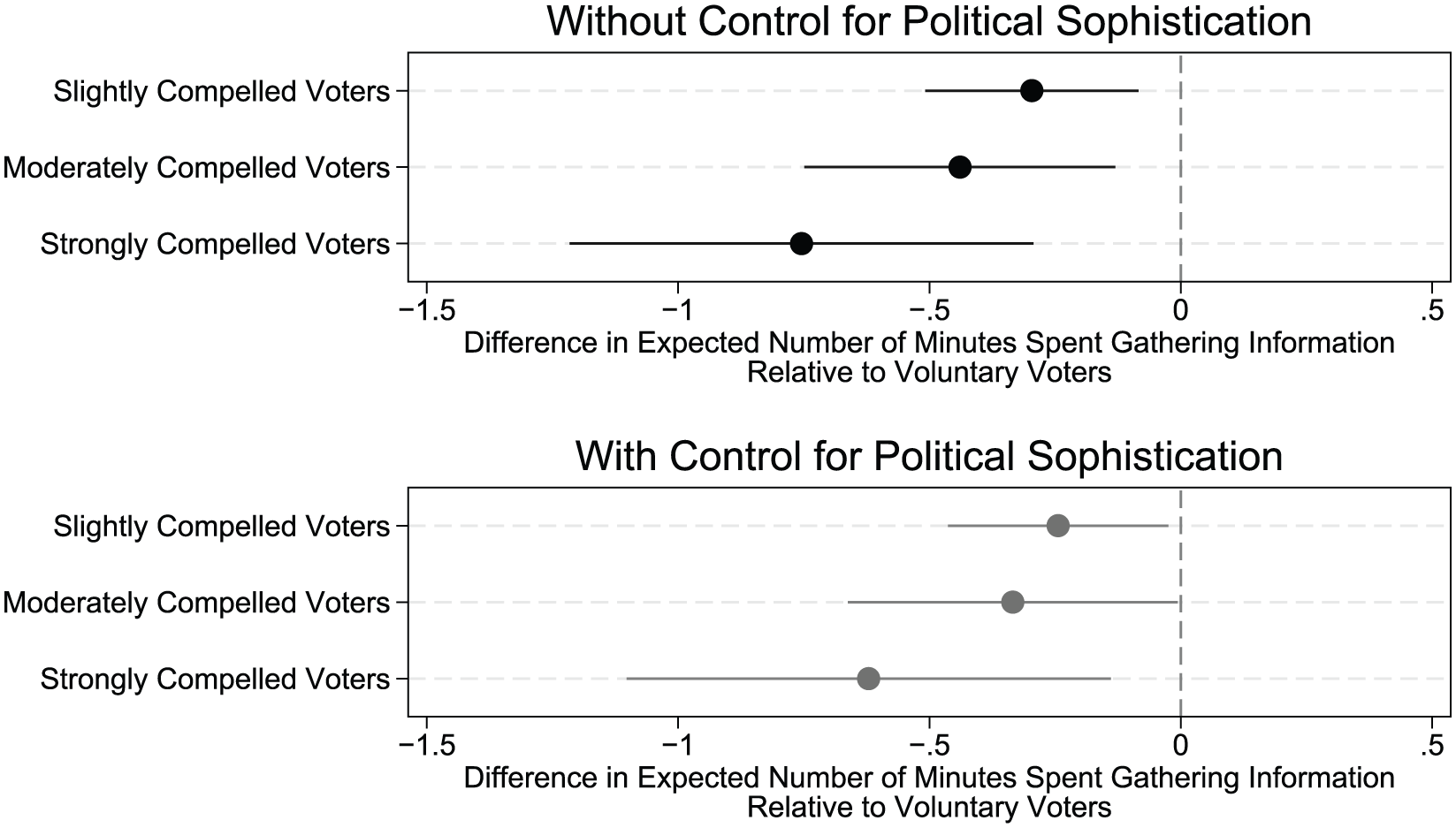
Time spent gathering political information and voter compulsion.
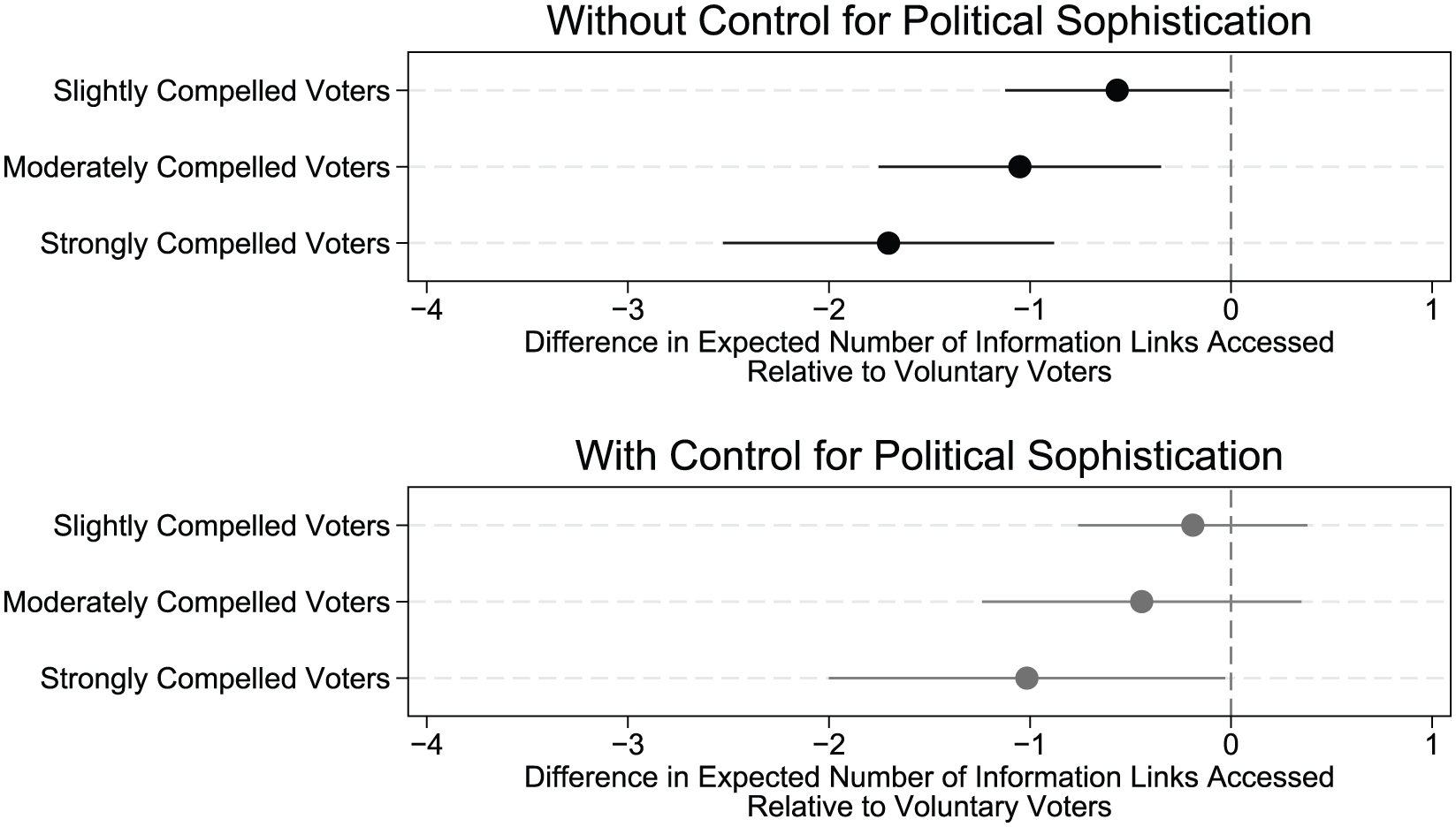
The amount of political information gathered and voter compulsion.
Our second hypothesis puts forth that, while voter compulsion has an independent effect on information seeking, political sophistication drives only part of this link. There is a straightforward empirical implication of this expectation: adding a control for political sophistication to models predicting information seeking as a function of voter compulsion should decrease the magnitude of the coefficients on the covariates that capture feelings of compulsion. To test this, we re-estimate the models depicted in the top panels of Figures 3 and 4, with our measure of political sophistication added to the right-hand side of the regression equations.
Results are depicted in the bottom panels of Figures 3 and 4. Starting with Figure 3, it is apparent that the effect of each category of compulsion on the expected number of minutes a participant spent gathering information is smaller once political sophistication is taken into account. However, each effect is still statistically different from zero, which indicates that voter compulsion also has an effect independent of sophistication. The pattern in Figure 4, in which the dependent variable is the number of information links accessed, is similar. The effect of each category of compulsion on the expected number of links accessed by a participant attenuates once political sophistication is accounted for. In fact, the effects of being “Slightly Compelled” and “Moderately Compelled,” relative to voting voluntarily, are not distinguishable from zero with sophistication taken into account. However, “Strongly Compelled Voters” are still expected to access fewer links than those who turned out by their own volition, even once we account for political sophistication. These patterns provide support for Hypothesis 2.
We posit above that the link from feeling compelled to information seeking is only partially driven by political sophistication because, while compulsory voting increases participation among the less politically sophisticated, it also induces defiance and resentment of the democratic system, and it brings to the voting booth individuals who prefer fringe, outsider, or anti-system parties or candidates. We find empirical support for these proposed mechanisms in tests detailed in Appendix A in the supplementary material.
We also account for the possibility that the estimated effects of the categories of compulsion depicted in the bottom panels of Figures 3 and 4 may not be completely washed of political sophistication; while we argue that there are factors associated with being compelled that decrease information acquisition independent of sophistication, these may in fact themselves be due to a lack of political sophistication. To estimate the unique effects of feelings of compulsion with this possibility taken into account, we use inverse probability weighting to simulate a scenario in which individuals are randomly “treated” with compelled voting. Results, shown in Appendix B, are similar to those depicted in the bottom panels of Figures 3 and 4, which bolsters our argument that a portion of compulsion’s effect on information seeking is unrelated to political sophistication.
Finally, we explore the role of heuristics in the relationship between feelings of compulsion and information seeking. Within our simulation, we conducted an experiment in which we randomly treated participants with the availability of polling information. We found no evidence that access to polling results conditions the size of the differences in information acquisition between voters who feel compelled and those who do not. The effects of voter compulsion on both types of information seeking were not consistently larger in magnitude for treated individuals, and they were never statistically different from the effects calculated among those in the control group. We elaborate on our experimental design and consider potential reasons for these non-findings in Appendix C.
Conclusion
Our findings bring to light a mechanism driving the commonly uncovered link between compulsory voting and votes that are poorly representative of preferences (e.g., Dassonneville et al., 2017; Hooghe and Stiers, 2017; Selb and Lachat, 2009; Singh, 2016a): individuals who only turn out because of external coercion spend less time and effort formulating their choices. This link exists in part because voters who feel compelled are less sophisticated politically, but feelings of compulsion also independently diminish the information search.
To be sure, as we study the effects of compulsory voting within a single country that uses compulsory voting, we have not shown that information levels are generally lower in countries where turning out is mandatory. A number of studies report evidence of a positive link between compulsory voting and political knowledge in the population (e.g., Sheppard, 2015; Shineman, forthcoming), others suggest that this relationship is stronger in, or exclusive to, certain subgroups (e.g., Carreras, 2016; Córdova and Rangel, 2017), and still more find little or no evidence of any such link (e.g., de Leon and Rizzi, 2014, 2016; León, 2017; Loewen et al., 2008). While our findings show that those who feel cajoled into voting in a compulsory system are less likely to seek out information than those who participate voluntarily, they do not necessarily indicate that voters in compulsory systems are less politically informed than their counterparts in voluntary systems. The scholarly debate over this potential link persists.
Footnotes
Acknowledgements
The authors thank Patrick Fournier and Jae-Jae Spoon for helpful comments and Rachel Weiss and Neil Williams for research assistance.
Correction (June 2025):
Declaration of conflicting interest
The author(s) declared no potential conflicts of interest with respect to the research, authorship, and/or publication of this article.
Funding
The author(s) disclosed receipt of the following financial support for the research, authorship, and/or publication of this article: This research was supported with funds from The Social Sciences and Humanities Research Council of Canada.
Supplementary material
The supplementary files are available at http://journals.sagepub.com/doi/suppl/10.1177/2053168017751993. The replication files are available at:  .
.
Notes
Carnegie Corporation of New York Grant
This publication was made possible (in part) by a grant from Carnegie Corporation of New York. The statements made and views expressed are solely the responsibility of the authors.
References
Supplementary Material
Please find the following supplemental material available below.
For Open Access articles published under a Creative Commons License, all supplemental material carries the same license as the article it is associated with.
For non-Open Access articles published, all supplemental material carries a non-exclusive license, and permission requests for re-use of supplemental material or any part of supplemental material shall be sent directly to the copyright owner as specified in the copyright notice associated with the article.
