




Abstract
The literature largely assumes that a candidate’s religious affiliation sends signals about his or her ideological leanings and policy preferences. We contend that prior works have not sufficiently accounted for the effects of the party label. Using an original experimental design that manipulates both religion and party, we show that the effects of a religious cue are more limited than previously implied. Though Evangelical and Catholic cues do impact impressions of a candidate’s stance on abortion, the partisan cue dominates perceptions of overall ideology. These findings further demonstrate the power of the party brand and are more consistent with research arguing for the non-policy value of the religion heuristic.
Introduction
“I’m a Christian and a Democrat, that’s all.”
From John F Kennedy’s Catholicism to Mitt Romney’s Mormonism, the religion of candidates for major office often becomes the focus of campaigns. Works exploring how religious labels affect citizens’ perceptions generally agree that they send strong cues about the ideologies and issue stances of candidates (Berinsky and Mendelberg, 2005; Bolce and De Maio, 1999; Fastnow et al., 1999; Jacobsmeier, 2013; Layman, 1997; McDermott, 2007, 2009). Missing from this previous research, however, is an explicit exploration of how these religious cues interact with another major heuristic used by citizens: candidate partisanship. We argue that by not fully accounting for the simultaneous effects of both religious and partisan cues, it is likely that these previous works have overstated the influence of the former. 1 Using an original experimental design, we show that religious cues have limited effects. Evangelical and Catholic cues send signals about a candidate’s position on abortion, but when looking at overall ideology, religious cues do little to either differentiate candidates within parties or to bridge the gap between candidates across parties. Thus, our results question earlier assertions about the inferences drawn from religious labels. We offer more evidence for the argument that the religion of a candidate is important, not because it serves as an ideological dog-whistle, but because it is a signal of non-policy characteristics (Campbell et al., 2011; Clifford and Gaskins, 2016).
Rethinking the effects of religious labels
We contend that the extant literature has failed to provide a complete, realistic picture of the effects of religious labels. Though McDermott (2009) finds that the Evangelical label shifts perceptions of a candidate’s ideology by about 1-unit on an 11-point scale, the experimental treatments do not explicitly note the partisanship of the candidates. While subjects did utilize the religious cue in the absence of other information, it remains quite possible that there would be little to no change in candidate perception had those subjects also been provided the partisan cue. McDermott’s exploration of Sam Brownback’s (R-KS) conversion to Catholicism does suggest that religion exerts an additional effect. However, it is likely that conversion to a different religion elicits different effects than a more stable religious identity. 2 In addition, there are no data on the percentage of voters who were actually aware of the switch, meaning that “it is only an assumption that it is Brownback’s religion that changed voters’ attitudes toward him” (McDermott, 2007: 967).
In contrast to McDermott’s (2007, 2009) work, Jacobsmeier’s (2013) more complete observational analyses find little to no effects of any religious labels. These largely null findings are supported by Berinsky and Mendelberg’s experimental exploration of how the Jewish label signals liberalism. They find that the effect of the Jewish label “exists only when ideology cues are more ambiguous and disappears when these cues are more clear and salient” (Berinsky and Mendelberg, 2005: 856). But while manipulating candidate ideology, this last study also omitted candidate partisanship.
And notably, none of the above-cited works explicitly test for the interaction between partisan and religious cues. That is, how do citizens process the two when they send conflicting signals? Campbell et al. (2011) find that the Evangelical cue seemingly neutralizes the Democratic cue. Yet this study focuses on candidate preference, not ideological or issue inferences. Moreover, their experimental treatments test for the combined effects of religion and party in the presence of a third cue: a distinctly ideological issue profile. In total, there is a need for further examination of the inferences drawn when both religious and partisan cues are provided.
When confronted with both pieces of information, we expect citizens to only use religious cues sparingly. More specifically, we expect religion to impact perceptions of a candidate’s position on abortion, but to have little to no effect on perceptions of a candidate’s ideology. When citizens are asked to make specific inferences about social issues, we expect that there may be religious effects akin to those suggested by previous works. In these instances, the association of religion with issues like abortion and homosexual rights should increase the impact of a candidate’s religious affiliation (Adkins et al., 2013). But when inferring the overall ideology of candidates, we expect that partisanship will dominate. A number of previous studies demonstrate that: (1) individuals rely on the party label even in the presence of other, potentially conflicting information (e.g. Hayes 2011; Huddy and Capelos, 2002; Michelson, 2005; Milita et al., 2017; Rahn et al., 1990; Riggle et al., 1992); and (2) individuals often do not perceive differences in the ideological placements of politicians from the same party (Simas, 2016; Snyder and Ting, 2002; Woon and Pope, 2008). 3 Thus, when making these broader evaluations, we expect that there will be little to no influence from the religious cue.
Experimental design
Through funding from Time-Sharing Experiments in the Social Sciences, 4 we obtained data from a nationally representative sample of 1,008 individuals. 5 Subjects took part in a between-subject post-test-only multiple treatment group survey experiment administered in August 2008 as part of an ongoing internet panel administered by GfK (formerly Knowledge Networks). 6 Respondents were unaware that they were participating in an experiment and instead believed themselves to be completing a survey on actual political candidates. A pre-stimulus questionnaire assessed partisanship, political ideology, and religious affiliation and orthodoxy. All subjects then received a short candidate biography of a hypothetical House candidate. Doing so allows us to vary the candidate on both partisanship (Democrat or Republican) and religious affiliation (Evangelical Christian, Jewish, Catholic, or no affiliation). 7 This created eight treatment groups to which subjects were randomly assigned. While partisanship and religion varied among treatment groups, all other details of the biography were held constant. 8 This allows us to make comparisons both within and between parties and religions. After reading the candidate biography, respondents were asked to place the candidate on a 4-point scale gauging opinions on abortion and the 7-point liberal/conservative scale. Subjects then proceeded to other survey tasks and were debriefed upon completion.
Results
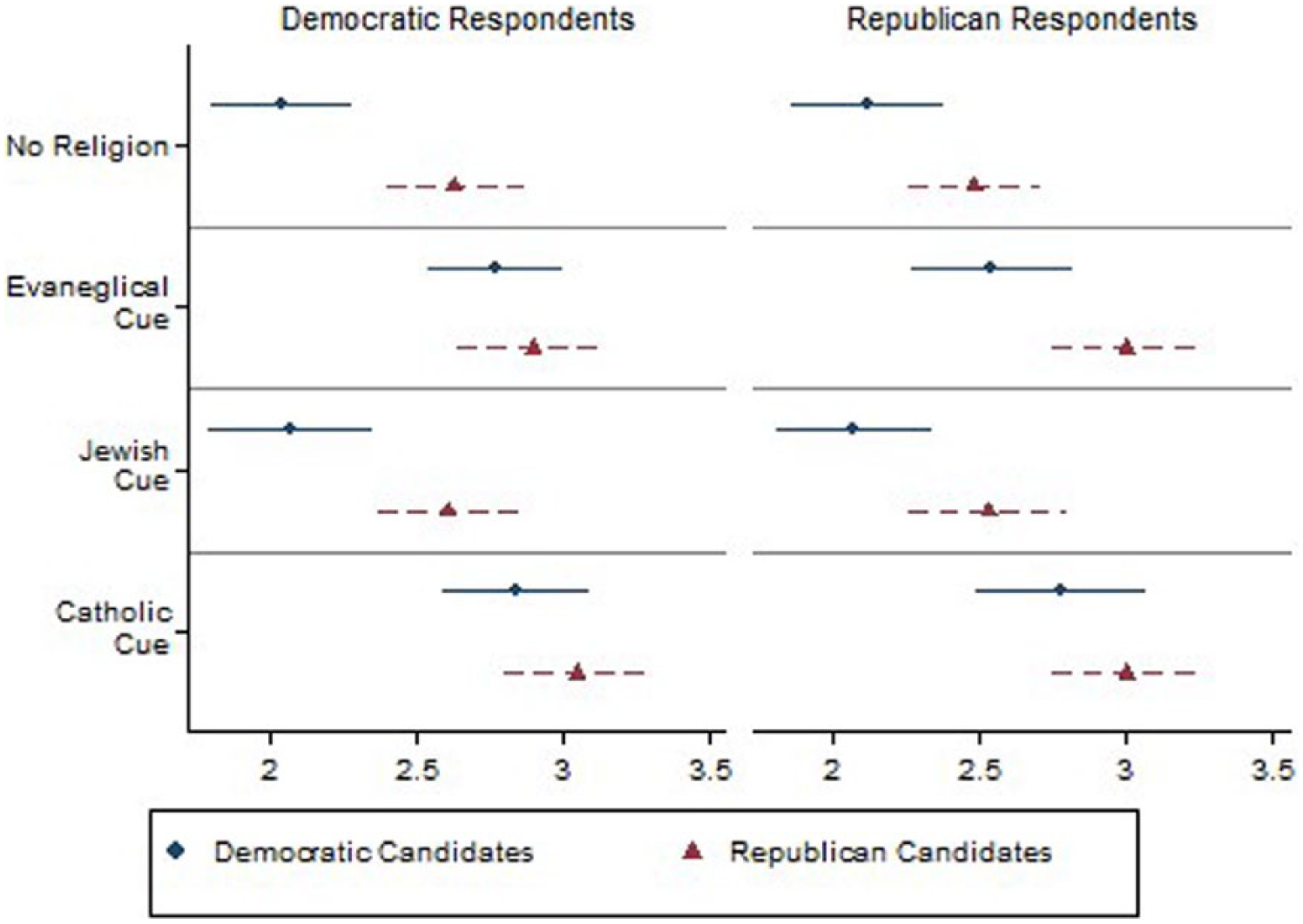
Because prior findings suggest a partisan asymmetry (Campbell et al., 2011), we present and analyze Democratic and Republican subjects separately. Figures 1 and 2 plot the means of the candidate placements. 9
Mean perceptions of the candidate’s stance on abortion.

Mean perceptions of the candidate’s ideology.
We begin with a discussion of the abortion placements. The topmost plots in Figure 1 are the mean perceptions of subjects in the control groups. Democratic candidates are clearly perceived to be more liberal than Republican candidates (
Yet, this pattern does not appear to hold when looking at perceptions of the candidate’s overall ideology. Among Democratic subjects, the Evangelical treatment does lead to significant conservative shifts for both the Democratic and Republican candidates (
Among Republican subjects, the party cue dominates and there are no significant effects of the religious cues. None of the religious cues distinguish the ideologies of candidates from the same party. The religious cues also do not mitigate the differences between candidates from opposite parties. Democratic candidates are perceived as significantly more liberal than Republican candidates, regardless of religious affiliation. The Democratic candidate means are all more liberal than the moderate point (4), while the Republican candidate means are all more conservative. In total, it seems that unless considering the rare case of an Evangelical Democrat, religion offers little additional information about the ideology of partisan candidates. 10
Discussion
Utilizing an experimental design that explicitly tests the effects of both religious and partisan cues, we show that while a candidate’s religious affiliation may signal positions on specific issues, it is rarely a proxy for his more general ideology. These results not only inform our understanding of the role of candidates’ religion, but also highlight the importance of including partisanship in experimental treatments. By including partisanship, we find more limited religious effects and uncover partisan heterogeneity that would not be apparent had we employed nonpartisan treatments.
Yet this is not to say that citizens do not draw inferences from religious labels. Our finding that citizens cannot distinguish between Democratic and Republican Catholics on the issue of abortion is striking given the highly partisan nature of the political environment. Moreover, we contend that our work is consistent with research suggesting that religious cues may prime beliefs that are not related to ideology, but are still useful for making judgments of political candidates. For example, Brady and Sniderman (1985) suggest that religious cues may make candidates appear more likable, while Clifford and Gaskins (2016) find that religious cues are related to trust. The effectiveness of religious cues may also be heterogeneous among specific groups and behavioral tendencies. Future work should further probe the partisan asymmetries uncovered here and delve into the potential for difference due to such factors as religious orthodoxy (Layman, 1997), political activity (Malka et al., 2012), race (McDaniel and Ellison, 2008; McLaughlin and Thompson, 2016), and fundamentalist cultural preferences (Jelen, 1993). Further, while our theory and subsequent results address the influence of religious cues in partisan elections, these results do not account for the many non-partisan elections that take place annually at various levels of government. Particularly in primaries, when voters know that all candidates are from the same party, religious cues may play a larger role in informing perceptions. Thus, our major conclusion is not that a candidate’s religion is inconsequential, but rather that it plays a much more nuanced role than earlier works imply. Religious cues may inform some individuals about certain policies or characteristics, but ultimately, their link to ideology is neither as direct nor powerful as previous works have asserted.
Footnotes
Acknowledgements
We would like to thank Cheryl Boudreau, Cindy Kam, and Scott Clifford for their help in the development of this research. We also appreciate the feedback received from the editor and two anonymous reviewers.
Declaration of Conflicting Interest
The authors declare that there is no conflict of interest.
Funding
The data in this article were obtained through Time-Sharing Experiments in the Social Sciences, which was funded by the National Science Foundation Grant 0094964, Jeremy Freese and Penny Visser, Principal Investigators.

Notes
Carnegie Corporation of New York Grant
This publication was made possible (in part) by a grant from Carnegie Corporation of New York. The statements made and views expressed are solely the responsibility of the author.
References
Supplementary Material
Please find the following supplemental material available below.
For Open Access articles published under a Creative Commons License, all supplemental material carries the same license as the article it is associated with.
For non-Open Access articles published, all supplemental material carries a non-exclusive license, and permission requests for re-use of supplemental material or any part of supplemental material shall be sent directly to the copyright owner as specified in the copyright notice associated with the article.
