



Abstract
As a presidential candidate, Donald J. Trump argued that he could compel Mexico to pay for a border wall by threatening to restrict the flow of remittances sent by Mexicans living in the United States. The proposal was largely dismissed by the press and the political establishment. American officials, however, have used threats to restrict remittances as leverage before. Some experts believe, in fact, that a threat from three House Republicans to restrict remittance flows to El Salvador changed the outcome of El Salvador’s 2004 presidential election in favor of the pro-trade, US-friendly candidate favored by the Bush administration. The objectives of this article are to demonstrate that Trump’s proposal to use remittances as leverage has precedent and to use survey data to attempt to evaluate the claim that a threat to restrict remittances influenced the outcome of the 2004 Salvadoran presidential election. Statistical tests suggest that remittance recipients were indeed more likely to vote for the Bush administration’s preferred candidate in the 2004 election; however, it does not appear that remittance recipients changed the outcome, nor is it clear from the available data whether the remittances threat or some other factor caused remittance recipients to vote differently than non-recipients.
Introduction
In the race for the 2016 Republican presidential nomination, Donald J. Trump stated repeatedly on the campaign trail that as president he would build a wall along the border with Mexico and find a way to make the Mexican government pay for it. The notion that Trump could make Mexico pay for a border wall sounded like little more than a catchy campaign slogan until April 5, 2016 when the candidate released a memo outlining a plan (Woodward and Costa, 2016). At the center of Trump’s plan were the relatively small sums of money that immigrants save from their paychecks and send to family members and friends in their home countries. Mexico is a leading recipient of this money, known as remittances, due to the large population of Mexicans living and working in the United States. In fact, in 2016, remittances to Mexico totaled at least $27 billion (Harrup, 2017).
In the April 2016 memo, Trump argued that he could compel Mexico to pay for the wall by proposing a new rule that requires money transfer companies like Western Union to refuse to serve people who are in the United States illegally. About half of the Mexican immigrant population in the United States is in the country illegally (Brown and Patten, 2014), so such a rule could potentially cause a reduction in the flow of remittances to Mexico. Trump predicted that the Mexican government would protest this proposal because remittances are such an important source of income to so many Mexican families. Trump said he would then tell Mexico that he would drop the proposal to restrict remittances if Mexico pays for the wall. Presumably the Mexican government would yield to Trump’s demands for payment in an effort to avoid losing this critical economic resource.
Trump’s proposal was largely dismissed by the press and the political establishment. President Obama called the plan “half-baked,” and many pundits argued that it would be impossible to pull off (Boston Globe, 2016; Woodward and Costa, 2016). Pursuing foreign policy objectives by threatening to restrict remittances, however, has been done before. Some observers believe, in fact, that a threat from three House Republicans to restrict the flow of remittances to El Salvador influenced the outcome of El Salvador’s 2004 presidential election in favor of the pro-trade, US-friendly candidate favored by the Bush administration (Perla, 2014; Portillo, 2010; Rubin, 2004).
The objectives of this article are to demonstrate that Trump’s proposal to use remittances as leverage in America’s relations with other countries has precedent and to use survey data to attempt to evaluate the claim that a threat to restrict remittances influenced the outcome of the 2004 Salvadoran presidential election. Understanding the impact of threats to restrict remittances is important because millions of households in developing countries depend on money from relatives abroad to manage economic shocks and buy basic goods and services such as food, healthcare, medicine, clothing, shelter, and education (Elezaj et al., 2012; Orozco, 2013; Ramocan, 2011; Ratha et al., 2011). Remittances, in fact, are a leading source of foreign exchange for many developing countries and the volume of remittances flowing to the developing world is at least three times greater than the volume of development aid contributed to poor nations by wealthy nations (OECD, 2015; World Bank, 2015). For all their benefits, however, remittances leave poor households vulnerable to changing political and economic conditions in the countries where migrants settle and work. Remittances to some developing countries dropped, for instance, during the global financial crisis as economic conditions deteriorated in the countries their citizens migrate to most. Another possible area of vulnerability is the political climate in migrant-destination countries. A hardening in public attitudes toward immigrants can lead to more restrictive immigration policies, which means fewer people abroad to remit. This article furthermore shows how diplomatic relations and foreign policy priorities can affect the perceived security and stability of remittance flows.
Remittances and the 2004 Salvadoran presidential election
El Salvador’s 2004 presidential election pitted two civil war-era rivals against each other in what would be the first competitive presidential election in El Salvador’s post-civil war history. It also signaled the rise of El Salvador’s leftist party, the Farabundo Martí National Liberation Front (FMLN). The FMLN was founded in the early 1980s as a coalition of leftist resistance groups, all of which sought to overthrow the Salvadoran dictatorship and install a leftist government, as the Sandinistas had in Nicaragua. After a 1981 overthrow attempt failed, the FMLN spent a decade at war with the regime. When a peace settlement was reached between the FMLN and the Salvadoran government in 1992, the FMLN became a formal political party (Allison, 2006).
During the 1990s and 2000s, the FMLN made incremental gains against its chief rival, the Nationalist Republican Alliance (ARENA). ARENA pursued an unabashedly neoliberal economic policy agenda after winning the presidency in 1989. The party’s reforms involved painful austerity measures, privatization of state-owned companies, and efforts to establish a free trade agreement with the United States. Poverty and inequality increased under ARENA, and the liberalization of the economy was followed by the displacement of millions of Salvadoran workers, many of whom emigrated to the United States. Remittances more than doubled during the 1990s to become El Salvador’s leading source of foreign exchange. As economic dissatisfaction in El Salvador increased, the FMLN sought to distinguish itself as the populist alternative to ARENA. The FMLN called for a renegotiation of a pending free trade deal with the United States, more agency in El Salvador’s relationship with the United States, and more state intervention in the economy to promote equality and reduce poverty. Although the FMLN lost the 1994 presidential election to ARENA, it managed to capture a quarter of the seats in the National Assembly. In 1999, the FMLN again failed to win the presidency, but gained a slight plurality in the National Assembly after the legislative elections of 2000. The 2004 presidential election was expected to be close (Allison, 2006).
The Bush administration feared an FMLN victory in 2004 because its candidate, former guerrilla leader Schafik Handal, openly opposed the idea of a Central American Free Trade Agreement – an agreement Bush hoped to sign that summer. In late 2003 and early 2004, Bush sent several envoys, including his brother, Florida Governor Jeb Bush, to El Salvador to meet with ARENA leaders. Some saw the administration’s photo opportunities with ARENA party members as taking sides in the Salvadoran presidential campaign and as a way to bolster ARENA’s standing in the eyes of Salvadoran voters (Perla, 2014; Portillo, 2010; Rubin, 2004). Furthermore, as the election neared, Salvadoran newspapers reported comments from Otto Reich, one of Bush’s special envoys, that an FMLN victory would result in a “radical change” in US–Salvadoran relations (Perla 2014; El Diario de Hoy, 2004a).
What at first sounded like an observation turned into a threat on March 17, 2004 – four days before the presidential election – when US Representatives Dana Rohrabacher (R-CA),. Dan Burton (R-IN), and Tom Tancredo (R-CO) declared on the floor of the House of Representatives that an FMLN victory “could mean a radical change in United States policy as it pertains to the essentially free flow of remittances from Salvadorans living in the United States to El Salvador” (Burton, 2004; Rohrabacher, 2004; Tancredo, 2004). Comparing the FMLN to a terrorist organization, Tancredo argued that if Handal were to win the presidency, “it may be necessary for the United States authorities to examine closely and possibly apply special controls to the flow of $2 billion in remittances from the United States to El Salvador.” This, as Tancredo put it, would be “to the detriment of many people living in El Salvador” (Tancredo, 2004).
Salvadoran voters got this message the next morning when El Diario de Hoy – a widely circulated national newspaper and open critic of the FMLN – reported that an “influential legislator” in the United States had proposed to restrict remittances if the FMLN wins (Cruz Rojas, 2004). Then on March 19, 2004, two days before the election, El Diaro de Hoy ran another article reporting threats from Burton and Rohrabacher to deport hundreds of thousands of Salvadorans in the event of an FMLN victory. The article also repeated Tancredo’s threat to restrict remittances and mentioned that the US restricts the flow of remittances to Cuba (El Diario de Hoy, 2004b). On March 20, the day before the election, El Diario de Hoy ran an editorial entitled “Remittances from the US are in grave danger” (El Diario de Hoy, 2004c). The piece repeated Tancredo’s threat to restrict remittances and encouraged Salvadorans to think of their families when they voted.
That day’s paper also included an article with the headline “Executive Concerned about the Future of Remittances” (El Diario de Hoy, 2004d). The article stitches together statements from ARENA officials reacting to Tancredo, Rohrabacher, and Burton’s threats to cut off remittances and deport Salvadorans in the event of an FMLN victory. René León, for instance, El Salvador’s Ambassador to the United States and member of the ARENA party, stressed that the threats were “not an invention” of the ARENA government, but a “real commitment” from Washington. Jorge Nieto, the Minister of Labor, expressed concern about how El Salvador would adjust if the US were to deport hundreds of thousands of Salvadorans after the election.
A provocative TV ad funded by ARENA supporter Rafael Menjívar López put a human face on the threats. In the ad, a white-haired man sits in a rocking chair in his home. His wife opens a letter sent from their son who is living in the United States. In the letter, the son tells his mother to save the money he is sending her because it could all be a thing of the past because Schafik Handal “hates Americans.” Her husband comes over to the table where she is now reading the letter, tears in her eyes. He hugs his wife as she sets the letter down on the table. The ad ends with two cards that say, “Don’t let them take your remittances because of Schafik” and “Reject the FMLN” (Trovar Peel and Escobar Castillo, 2009).
Did the threats impact the election?
Tony Saca, the ARENA party’s candidate, won the election on March 21 with 57 percent of the vote to FMLN candidate Shafik Handal’s 35 percent. Did Burton, Rohrabacher, and Tancredo’s threats cause remittance recipients to vote in larger numbers for the ARENA party? Remittance recipients made up about 23 percent of the Salvadoran electorate at the time, so in theory, it is possible that they could have tipped the election to ARENA, or at least contributed to a more convincing victory.
I explore this question with survey data that the Latin American Public Opinion Project (LAPOP) collected from a national sample of adults in El Salvador three weeks after the election (n = 1589). 1 Because we do not have longitudinal data, it is not possible to measure whether an actual shift in public opinion occurred in the wake of the threats; however, using self-reports of voting behavior we can, despite the well-documented limitations of these data, get a sense of whether respondents who said they receive remittances from a family member in the United States were more likely than non-recipients to vote for ARENA over the FMLN. Our working hypothesis is that because remittance recipients were being told that they would lose their remittances in the event of an FMLN victory that they would have come out in larger numbers for the ARENA candidate if they were truly worried that there was some substance to Burton, Rohrabacher, and Tancredo’s threats.
Table 1 presents results from a multinomial logit model that controls for the respondent’s age, education level, gender, income level, assessment of his or her personal economic situation (pocketbook assessment), self-placement on a left–right scale, and feeling that his or her community is affected by gangs (a major political and public safety issue in El Salvador). The independent variable of interest is a dichotomous variable that identifies respondents who said they receive remittances from a family member abroad. These results suggest that, according to self-reports, remittance recipients were more likely to vote for ARENA over the FMLN (p < 0.10). How big was this effect? Were remittance recipients critical in tipping the balance in ARENA’s favor? To get a sense of the substantive effect of the remittances variable, I used probabilities derived from the model to simulate 1000 mock elections using the procedure described in King et al. (2000). Each dot in Figure 1 represents the outcome of a mock election. A dot closer to any of the three vertices (ARENA, FMLN, or Other) signals that that party won the mock election. A dot close to the center of the triangle would represent a toss-up. A dot on or near any of the dotted lines would signal a close contest between two parties.
Vote choice model, 2004 El Salvador presidential election (multinomial logit).
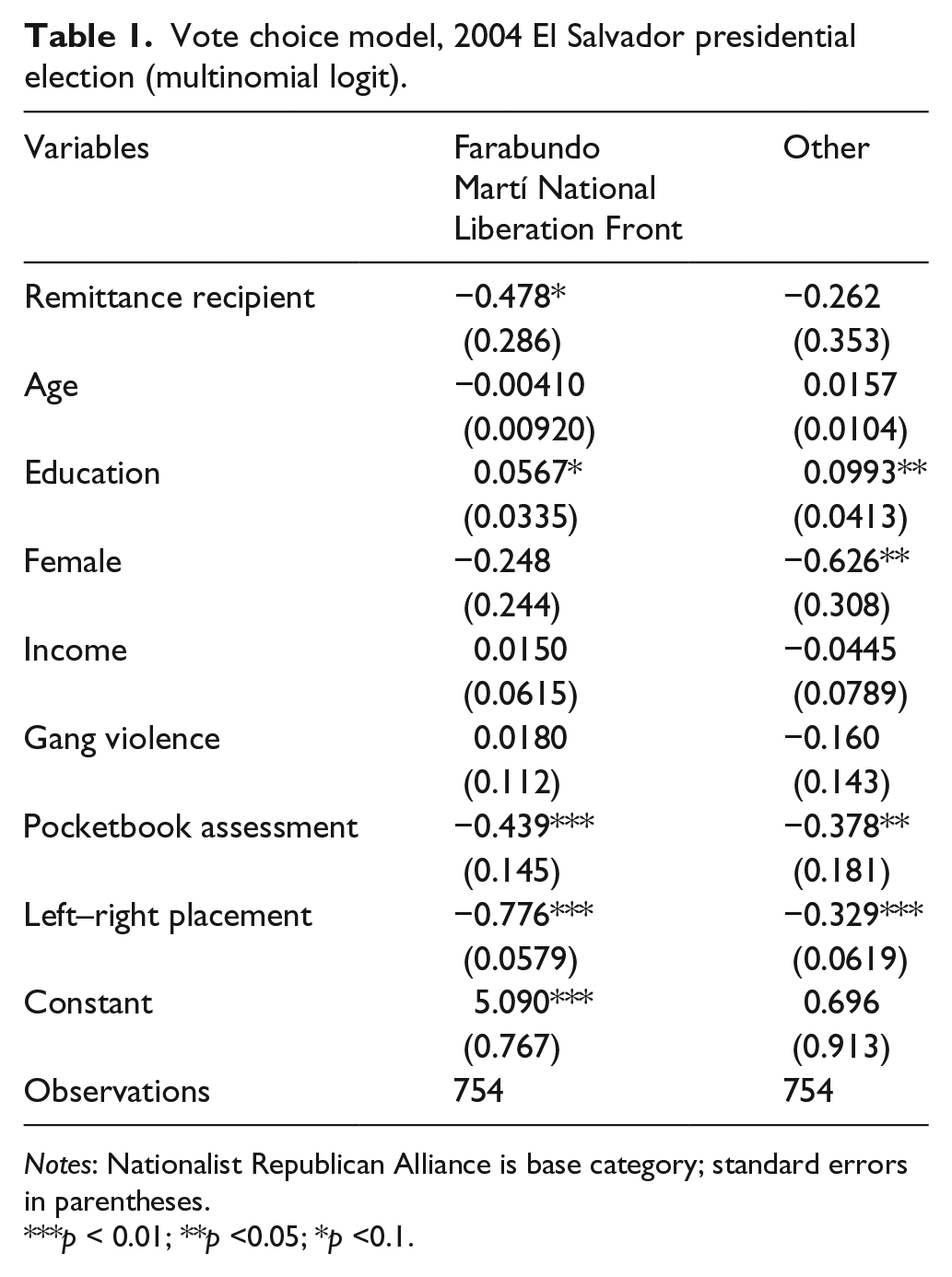
Notes: Nationalist Republican Alliance is base category; standard errors in parentheses.
p < 0.01; **p <0.05; *p <0.1.

Simulated election outcomes based on estimates in Table 1; 2004 El Salvador presidential election.
In panel (a) on the left, we see that the distribution of outcomes is squarely in the ARENA party’s “win-zone” even when the remittances variable is set to zero. According to this simulation, in other words, ARENA easily won all 1000 mock elections even when no voters were remittance recipients. This suggests that the threat to restrict remittances to El Salvador most likely does not explain the FMLN’s loss. ARENA won by a large margin and, it appears, would have likely been victorious either way. Looking at panel (b), however, we see some evidence that remittance recipients were more likely overall to say they voted for ARENA over the FMLN. In this simulation, the remittances variable has been set to one, meaning all voters in the mock elections receive remittances. In panel (b), we can see that more dots are closer to the ARENA vertex than in panel (a), indicating that ARENA won more decisively.
An important question is whether remittance recipients’ slight preference for the ARENA candidate was driven by fear that an FMLN victory would cause the United States to restrict remittances. A convincing test of the threat’s effect on voting behavior is not possible due to the absence of longitudinal data on voters’ preferences before and after the threat was made. Furthermore, to my best knowledge, no public opinion surveys in El Salvador collected data on remittances prior to LAPOP’s 2004 wave. The next best alternative, then, is to examine questions from the 2004 LAPOP survey that asked about voting behavior in the 2003 mayoral and legislative elections to explore whether there is any evidence of a shift in remittance recipients’ political preferences between the 2003 and 2004 elections. Table 2 presents binomial logit estimates based on these data. Models 1 and 2 indicate that remittance recipients were not more likely than non-recipients to support ARENA in the 2003 elections. This suggests that remittance recipients did not have an inherent attachment to ARENA that drove their support for its candidate in 2004, keeping alive the possibility that the threat played a role in 2004. Models 3 and 4, on the other hand, cast some doubt on the hypothesis that the threat caused remittance recipients to shift support away from the FMLN and to ARENA. The outcome variables in Models 3 and 4 were coded as 1 if a respondent voted for the FMLN in 2003 and ARENA in 2004. The results show that in both the mayoral and legislative votes, remittance recipients were no more likely than non-recipients to make the switch from the FMLN to ARENA.
Comparisons to vote choice in 2003 elections (binomial logit).

Note: standard errors in parentheses. ***p < 0.01; **p < 0.05; *p < 0.1.
What else could explain remittance recipients’ apparent preference for ARENA in 2004? Prior studies of public opinion and voting behavior in Latin America have found that remittance recipients tend to favor right-of-center incumbents due to a preference for lower taxes (Doyle, 2015) and the relative absence of economic grievances that may motivate one to vote for a populist challenger like Handal (Germano, 2013). It could have been the case, in other words, that remittance recipients in El Salvador would have preferred ARENA even if Tancredo had not threatened to cut off remittances. Table 3 shows some support for the economic voting argument and no evidence that remittance receiving-voters agreed more with ARENA on policy issues like taxes and trade. Model 1 indicates that remittance recipients were more likely to make positive pocketbook assessments, which suggests that their preference for the ARENA presidential candidate could have been motivated by relatively more positive assessments of ARENA’s performance while in office.
Determinants of pocketbook assessments and attitudes on taxation, the effects of trade, and trade agreements with the United States (ordered probit).

Note: standard errors in parentheses. ***p < 0.01; **p < 0.05; *p < 0.1.
Discussion and conclusion
Let us entertain the prospect that remittance recipients’ preference for the ARENA candidate was at least partially influenced by Burton, Rohrabacher, and Tancredo’s threats to restrict remittance flows. What mechanisms were at work to create this effect? It is clear from the narrative above that it was not simply the fact that Tancredo made the threat, but also that actors in El Salvador, such as members of the ruling party, the press, and the pro-business elite, mobilized and worked diligently to publicize the threat and give it credibility. Domestic actors, in other words, spread rumors and sowed fear, and this fear may have caused some remittance recipients to reason that voting for ARENA was the safer choice. The specifics would surely be different in Mexico, but rumors and fear about what Trump might do to remittances could be stoked not only by the media and Trump himself via his large social media presence, but also by actors and organizations in Mexico that would benefit financially if Mexican immigrants sent money by means other than the major banks and money transfer companies. Drug cartels, for example, already launder billions of dollars from the US back to Mexico and have much to gain from capturing a slice of the lucrative US–Mexico remittance market. These criminal organizations are well positioned to do this since they already do business throughout Mexico and the United States.
Whether anxiety over remittances would be enough to change public opinion and cause the Mexican government to make concessions to the Trump administration remains to be seen. Reports indicate, however, that remittances to Mexico increased after Trump’s November 2016 victory – presumably a reflection of immigrants’ anxiety over the April 2016 threat to restrict flows – and that Mexican immigrants in the US and remittance recipients in Mexico are contemplating alternative ways of sending money home in the event that Trump moves to restrict, seize, or tax remittances (Catan and Cota, 2016; Harrup, 2017; O’Boyle, 2017; The Economist, 2017).
The larger lesson from the 2004 Salvadoran election is that because remittances are such an important resource to millions of families in developing countries, they leave developing countries exposed to shifting political climates in developed countries where their citizens work. The governments of developing countries benefit immensely from remittances to the extent that they reduce economic grievances (Germano, 2013; Regan and Frank, 2014) and help fund development (Adida and Girod, 2011; Iskander, 2010). For these reasons, remittances may be able to be used as leverage in interactions between states akin to economic sanctions.
Footnotes
Acknowledgements
The author thanks Clint Wallace, Reid Mitenbuler, Kirk Semple, and two anonymous reviewers for helpful comments on earlier drafts of this article.
Declaration of conflicting interest
The author declares that there is no conflict of interest.
Funding
This research received no specific grant from any funding agency in the public, commercial, or not-for-profit sectors.

Notes
Carnegie Corporation of New York Grant
This publication was made possible (in part) by a grant from Carnegie Corporation of New York. The statements made and views expressed are solely the responsibility of the author.
References
Supplementary Material
Please find the following supplemental material available below.
For Open Access articles published under a Creative Commons License, all supplemental material carries the same license as the article it is associated with.
For non-Open Access articles published, all supplemental material carries a non-exclusive license, and permission requests for re-use of supplemental material or any part of supplemental material shall be sent directly to the copyright owner as specified in the copyright notice associated with the article.
