




Abstract
Remittances are the dominant factor in the contemporary economy of El Salvador, which is enjoying a new comparative advantage in the international economic system—the export of cheap labor to the Global North and particularly the United States. The Salvadoran economy is part of a transnational economic space, but this space is perverse: Although the poor are nominally receiving more money, remittances cause them to be caught in a vicious cycle of economic instability. At the same time, the elites are able to access remittances indirectly by becoming a Keynesian oligarchy—an oligarchy that extracts wealth by controlling the demand structure of the economy instead of production. Remittances represent bread and butter for the poor and a vehicle for transnationalization for the rich, and this leads to a new stasis of elite rule: remittances provoke the rescaling of social conflicts in favor of elites. Transnationalism in this regard must be interpreted as an elite strategy for suppressing the bargaining power of the subaltern class. In this transnational remittances economy, opportunities for the subaltern class and migrants to participate directly in reshaping this economic space are limited or nonexistent. As a consequence, they must rely on translocal moral economies linking migrants with their families at home, where they are still able to impose some control. Meanwhile, elites foster transnationalism by dismantling these very modes of control. In this sense, remittances are the silver bullet for facilitating neoliberalism in the Global South. In El Salvador, they produce ultrastability for the oligarchy and chaos for the poor.
Las remesas son el factor dominante en la economía contemporánea de El Salvador, que goza de una nueva ventaja comparativa en el sistema económico internacional en la exportación de mano de obra barata al Norte Global y particularmente a los Estados Unidos. La economía salvadoreña es parte de un espacio económico transnacional, pero este espacio es perverso: aunque los pobres reciben nominalmente más dinero, las remesas hacen que se encuentren atrapados en un círculo vicioso de inestabilidad económica. Al mismo tiempo, las élites pueden acceder a las remesas indirectamente al convertirse en una oligarquía keynesiana— una oligarquía que extrae riqueza controlando la estructura de la demanda de la economía en lugar de la producción. Las remesas representan el pan de cada día para los pobres y un vehículo para la transnacionalización de los ricos, y esto lleva a una nueva estasis del gobierno de la élites: las remesas provocan la reescalada de los conflictos sociales a favor de las élites. El transnacionalismo a este respecto debe interpretarse como una estrategia de élites para suprimir el poder de negociación de la clase subalterna. En esta economía transnacional de remesas, las oportunidades para que la clase subalterna y los migrantes participen directamente en la remodelación de este espacio económico son limitadas o inexistentes. Como consecuencia, deben contar con las economías morales translocales que vinculan a los migrantes con sus familias en El Salvador, donde aún es posible imponer cierto control. Mientras tanto, las élites fomentan el transnacionalismo desmantelando estos mismos modos de control. En este sentido, las remesas son la bala de plata para facilitar el neoliberalismo en el Sur Global. En El Salvador, producen ultra estabilidad para la oligarquía y caos para los pobres.
Remittances are a dominant factor in the contemporary economy of El Salvador. Not only is the country economically dependent on its diaspora but its entire economy is growing into the U.S. economy. When the Salvadoran central bank published its annual statistics on remittances transfers in late January 2017, no one wondered at its new figures. Expatriate Salvadorans had sent more than US$4.5 billion during fiscal year 2016 (BCR, 2017). In absolute terms, remittances peaked in 2009 with the onset of the world financial crises but soon recovered and now continue to increase. In line with this increase, remittances additionally compensate for a continuously growing balance-of-payments deficit. According to a recent statistical survey by the Ministry of Economics, more than 20 percent of the population received remittances in 2014 (DIGESTYC, 2015). The average remittance-receiving household obtained more than US$180 per month, representing 46 percent of average household spending and around 33 percent of average household income. The majority of remittance-receiving households are not classified as poor, but many are vulnerable to falling back into poverty if remittances cease. Many Salvadorans therefore depend on expatriate money to cover their daily expenses. El Salvador enjoys a new comparative advantage in the international economic system—the export of cheap labor to the Global North and particularly the United States. One-fourth of its population lives abroad, and remittances are the single largest item of foreign exchange earnings. A recent study estimates that the Salvadoran diaspora in the United States produces more than three times the gross domestic product of El Salvador (Hinojosa-Ojeda, 2016: 12), and many Salvadoran migrants in the United States send a considerable part of their income back home. In short, El Salvador has gone transnational (Robinson, 2003; Roniger, 2011; Coutin, 2007).
This article approaches the transnational remittances economy from the Salvadoran perspective. Notwithstanding that this transnational economy is heavily influenced by processes within the United States such as migration policies and economic interests, the Salvadoran economy is part of a transnational economic space that includes both domestic and diasporic economic activities. Massive and still increasing remittances circulating between the United States and El Salvador have given rise to an entirely new economic situation. Compared with the economic models dominating much of the twentieth century, today’s transnational remittances economy does not rely on state interventions by the Salvadoran government, bi- or multilateral trade agreements, or other ways of managing economies.
The flow of remittances leads to a vicious cycle of instability for the poor, despite their nominally receiving more money. It inhabits a still poorly understood micro-macro divide, and this is particularly important because remittances mitigate poverty but at the same time produce new social insecurities. The increasing importance of remittances parallels the ongoing self-modernization of the ruling class. While the Salvadoran oligarchy historically developed by controlling production, factions of that elite have been transformed into what I call a “Keynesian” oligarchy—an oligarchy that increasingly specializes in extracting rent and power by controlling consumption and indirectly making use of and benefiting from remittances. 1 These two processes are leading to the rescaling of the struggle between the ruling class and subaltern groups and ultimately to a profound stasis of elite rule in El Salvador. Social conflicts today are shifting to conflicts within the subaltern class rather than between it and the ruling elite (Warnecke-Berger, 2018). The management of the transnational remittances economy releases social pressure from elite activity, creating opportunities for elites to use this transnational economic space as a vehicle for constructing structural alternatives and increasing their room for maneuver. In contrast, an increasing number of Salvadorans must rely on the financial support of family members living and working in the United States.
Remittances and Transnational Spaces
The presence of such a quantity of remittances touches on the classics of political-economy-inspired development theory—the discovery of the existence of an available surplus paralleled by the marginalization of a large share of the population (see, from a dependency perspective, e.g., Nun, 1969, and, from a modernization-theoretical perspective, e.g., Lewis, 1954). What has changed since this theoretical discovery, however, is that the available surplus does not necessarily accrue to the rich; very often the poor are today “empowered” to administer remittances on their own.
Remittances began to enjoy significant academic attention with the last round of globalization and its increasing importance as a global financial flow, particularly in economics and political economy approaches to development. However, the consequences of the transnational dimension have barely entered the theoretical toolkit of either literature. Advocates of dependency (e.g., Binford, 2003) and modernization (e.g., Kapur, 2004) approaches continue to oppose each other. While the former argues that remittances lead to new dependencies, the latter focuses on the benefits of remittances for receiving societies. Both mainly focus on the national scale and therefore are unable to integrate the transnational moment. The same critique applies to the concurrent abundant contributions in economics. After two decades of intensive analysis of the impact of remittances, a certain “remittances fatigue” (Carling, 2014: 219) has materialized. Although remittances enjoyed unprecedented attention over this period, the literature only rarely noticed their qualitative depth in penetrating and their capacity to transform economic spaces in the societies of today’s Global South. How the flow of remittances qualitatively shapes established economic spaces, particularly those of developing societies, remains to be understood.
At the same time, the spatial turn touches on these issues and fills the gap with regard to the way spaces evolve and adapt. Some researchers argue that globalization, understood as an interplay of flows and controls, causes de- as well as reterritorialization (Brenner, 1999). Existing boundaries limiting economic, political, and cultural flows are increasingly challenged. This loss of space, however, is paralleled by newly arising boundaries and the establishment of consolidated spatialities. Both the establishment and the dissolution of boundaries and capacities for control lead to the rescaling of political power. During the recent wave of neoliberal adjustments, economies have experienced a scale shift toward the transnational, the regional, or the local (Swyngedouw, 2004). From this perspective, national sovereignty has been challenged by the deterritorializing tendencies of global flows. Its dissolution in turn has led to reterritorialization that is not exclusively located on the nation-state scale. Thus, the establishment of new spatialities necessarily accompanies the loss of space.
The empirical discussion of these concepts has produced rich insights into the multiple social relations that people establish and maintain in different places at the same time, thereby crossing national borders and possibly redefining the scope of transnationalism as an object of research. However, one of the main aspects of this discussion is that the role of the economy and class dynamics are largely excluded from analysis (see for the same criticism, e.g., Collyer and King, 2015: 187). Thus, taking the political economy of space and the rescaling of social conflicts into account, the very dynamics of the Salvadoran transnational remittances economy come to the fore.
Economic Spaces of Remittances
Remittances undermine established patterns of territorialized flows of political power and economic commodities, since traditional forms of control no longer function. While remittances remain a stable flow of money on the macro level even in times of crisis, they withdraw from the usual and institutionalized forms of control and management of economic flows that have been constructed to control commodities or capital. Remittances tend to lead to the Dutch disease, whereby exchange rates appreciate with inflowing migration dollars and finally make exports of commodities more expensive (Acosta, Lartey, and Mandelman, 2009; Lartey, 2008). On the micro level, in contrast, they produce relative autonomy from local economic conditions, particularly for remittance-receiving households, since remittances tend to flow anticyclically and augment net consumption. In other words, remittances arise from local conditions and experiences and therefore need to respond to localized forms of control.
From a purely institutional perspective on economic spaces, the remittance economy remains an ad-hoc network. This network is composed of different actors and their strategies and the places with which these actors are engaged. However, a clear-cut or unified institutional setting has so far failed to evolve. While institutions capable of channeling and capturing remittances are growing, these institutions remain isolated from each other rather than generating spillover effects or mutual benefits (for an overview, see, e.g., Haas, 2012).
Remittances are a clear signifier of “transnationalism from below” (Smith and Guarnizo, 1998) and the very expression of “transnational living” (Guarnizo, 2003). “Remitting as a way of life” (Lopez, 2015: 10) and the cultural production of landscapes of remittances create a self-identifying representational space built out of ideas, practices, and artifacts and therefore form part of a basic dimension of social space (Lefebvre, 1991 [1974]). As a translocal relationship, remittances connect particular places from which migrants send money with particular places in which families receive this money (Brickell and Datta, 2011). Initially, this relationship arises from migration flows—people leaving their home families and communities and migrating to the Global North in search of better living conditions. However, migrants do not simply emigrate and immigrate, leave their culture behind, and assimilate to new cultural contexts. On the contrary, they maintain social relationships with their home families, as the rich discussion on transnationalism in migration studies shows (for an overview, see Levitt and Jaworsky, 2007).
In spatial terms, and as a translocal relationship, remittances topographically link the place of production, including value generation, and the place of the wage bill “here” with the places of consumption and remittances-spending “there.” Because of this translocality, remittances transcend the boundaries of formerly “national” economies. Only at this point do remittances become transnational. However, remittances are not detached from these boundaries, since the appropriation of remittances “takes place” at particular places and in specific spaces where actors, organizations, and institutions other than the remittance-sender and the receivers themselves claim to control economic surplus.
In this regard, the dominant perspective on remittances as an aggregate flow leads to the reification (termed Verdinglichung [Marx, 1972 (1894): 887]) of remittances and the “fetishization” of the remittances space (Smith, 1984: 28–31; Belina, 2013: 29–36), since their particular social relations are obscured. By focusing almost exclusively on remittances as a global flow and thus on their macrodynamics, this reification has helped to construct remittances as a development tool (Bakker, 2015). Circumventing this challenge, I argue that the historically specific social embeddedness of remittances uncovers the social relations of power that are interwoven with the appearance, control, and use of remittances. This calls for challenging the exclusive focus on remittances as a macroflow and for focusing on the dynamics of spaces in the Global South where remittances are an important source of income for maintaining livelihoods and where the effects of these remittances unfold.
The Role of Remittances in the Salvadoran Economy
El Salvador has always been dependent on exports to external markets. During much of the nineteenth century, coffee was the sole engine of the economy and gave rise to a handful of rich families that formed a power nucleus widely described as a classic form of oligarchy (Suter, 1996). When coffee prices began to fall in the mid-1950s, sugar and cotton complemented coffee and maintained the net surplus (Bulmer-Thomas, 1987; Dunkerley, 1988). The struggle over access to and the distribution of economic surplus, which was produced within certain politically invented but certainly fixed boundaries, intensified in the following decades. In the late 1970s and during the civil war (1980–1992), one of the central objectives of the emerging revolutionary left was to redistribute the fruits of the still national economy (Dunkerley, 1982). Moreover, even right-wing modernizers and their economic imaginaries envisioned channeling the economic surplus, which was termed “national wealth,” created by national entrepreneurs within the political territory (Lindo-Fuentes and Ching, 2012).
In the middle of the civil war, however, Salvadorans began migrating to escape the disturbances and the bloodshed (Montes, 1988; Funkhouser, 1992). By then, remittances had increasingly replaced “national wealth” and therefore place-bound surplus production within the political territory. At the same time, the cause of migration changed from political to economic (Funkhouser, 1997). Today the appropriation and future “production” of remittances is the most important engine of the Salvadoran economy and gives rise to an entire new circuit of social reproduction. This circuit consists in the “national” production of labor, its decentralized export via migration, and the subsequent appropriation of remittances, which are used to maintain the necessary level of social reproduction (Gammage, 2006). Strictly speaking, El Salvador bears the cost of reproduction of labor, while value is generated in the United States and only partly flows back in the form of remittances.
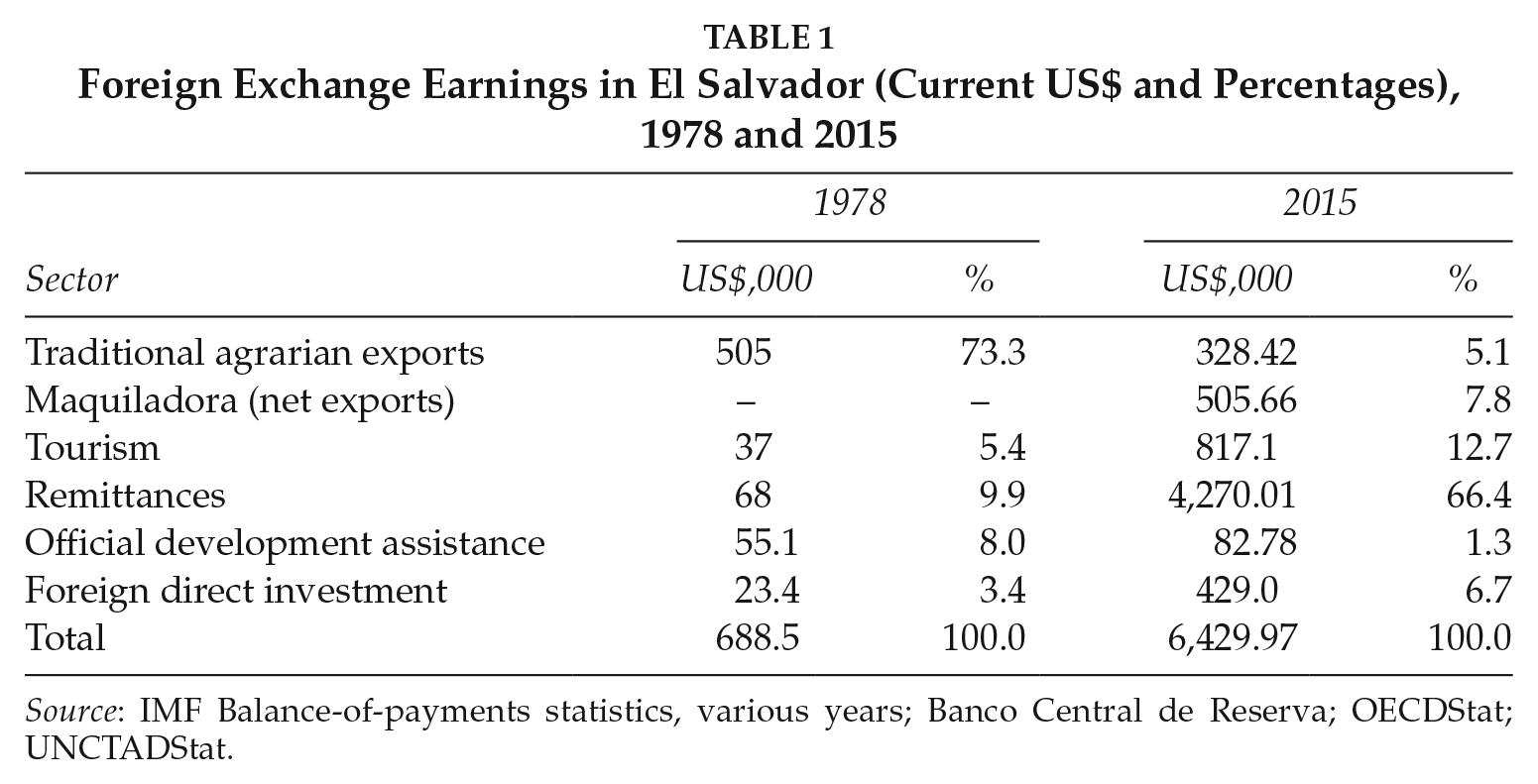
By the end of the twentieth century El Salvador had experienced a sharp shift in its role in the international division of labor (Table 1). While traditional agrarian exports historically served as the engine of uneven growth in El Salvador and led to the mono-agrarian export model for development, this product group had almost entirely lost relevance. In 1978 traditional agrarian exports accounted for more than 60 percent of foreign exchange earnings. This number slumped to 5 percent in 2015. Simultaneously, remittances grew from around 10 percent to more than 66 percent. Today, maquila production dominates industry, and tourism has increased considerably in the past decade. Remittances are the number-one source of foreign exchange earnings, followed by maquila production, exports, and tourism (Rosa, 2008). El Salvador has consequently shifted its development model. Once dependent on commodity exports, today it is dependent on the export of labor and the inflow of remittances. The Salvadoran economy literally depends on remittances for survival.
Foreign Exchange Earnings in El Salvador (Current US$ and Percentages), 1978 and 2015
Source: IMF Balance-of-payments statistics, various years; Banco Central de Reserva; OECDStat; UNCTADStat.
The increasing political relevance of remittances reflects this shift, but it remains ambivalent. In the past decade, for instance, El Salvador developed a highly competitive remittances-transfer sector through which formal remittances channels considerably increased. In 2000 migrants sent up to 30 percent of remittances through informal channels. By 2014, almost 95 percent of remittances flowed through the formal banking system (BCR, 2017; Palacios and Hurtado de García, 2011). Although the Salvadoran government maintains an active part in the negotiations for a transnational migration regime in certain policy areas (e.g., Plan Puebla Panama, the Mérida Initiative), high-ranking government officials (Francisco Lazo, former Salvadoran vice minister of economy, interview, San Salvador, September 2, 2016) say that a comprehensive political strategy for channeling remittances has always been absent. The government still struggles to establish formal links to its diaspora and mainly provides migration assistance. Although a highly vibrant diaspora network in the United States has developed since the 1980s (Menjívar, 2000), these hometown associations are isolated from each other and distant from the Salvadoran government and its dependencies in the United States (Baker-Cristales, 2004a).
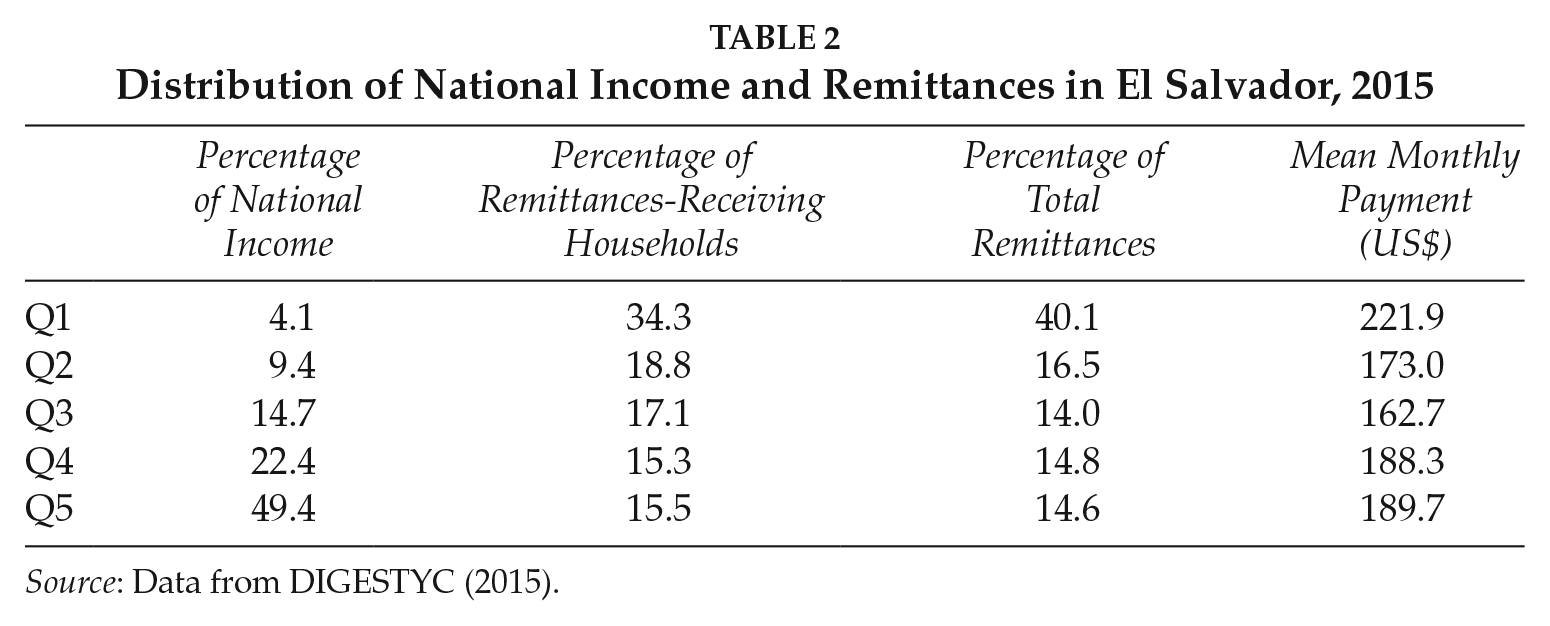
However, it is not the quantity of remittances and its institutional setting that matter but the social fabric and the class configuration behind them. A first step toward uncovering this configuration (Table 2) shows that while the poorest 20 percent of the population (quintile 1) received 4.1 percent of the national income in 2015, this quintile received more than 40 percent of total remittances. In contrast, the richest 20 percent of the population earned 49.4 percent of the national income but captured only 14.6 percent of total remittances. Remittance-receiving households came mainly from the lower income strata (quintiles 1 and 2) and received on average more money from abroad. The actual distribution of remittances thus compensates for the unequal distribution of national income.
Distribution of National Income and Remittances in El Salvador, 2015
Source: Data from DIGESTYC (2015).
The pro-poor distribution of total remittances is a first result, but it is superficial because it is disconnected from access to and appropriation of remittances. Uncovering the social relations of remittances requires analysis of the strategies of social reproduction of the poor as well as the rich. Even though the flow of total remittances is increasing and the poor are gaining disproportionately from remittances, remittances create a vicious cycle of instability for their “beneficiaries.” The oligarchy, in contrast, although receiving less in total remittances than the poor, is receiving remittances indirectly. The vicious cycle of instability of the poor gives rise to opportunities for the rich to benefit from remittances by concentrating on the structure of aggregate domestic demand.
Remittances and the Vicious Cycle of Economic Instability
Uncovering the microdynamics of remittances, I show in the following that remittances lead to a vicious cycle of instability for the poor. I unfold this argument in three steps. First, remittances are primarily used for consumption of subsistence goods. Since the propensity to consume of the poor is higher than that of the rich, remittances stimulate aggregate demand. However, consumption favors the informal economy and leads to changes in relative prices in this sector. Second, this situation becomes precarious because remittance inflows are unpredictable and volatile at the micro level. Changes in the frequency of remittance transactions then produce a vicious cycle of economic instability. Third, the dependence on remittances of many households to cover daily expenses has a perverse side effect: Given the rigid and unequal economic structure, remittance-receiving households react to increasing remittances not only by increasing consumption but by reducing labor supply (Acosta, 2007). From the perspective of receiving households, remittances become a dominant form of income and work time supplements them. The only lever at the poor’s disposal is daily work time. Increases in remittances are likely to lead to decreasing labor output. Taken together with the increasing unpredictability of remittances, this vicious cycle of instability is amplified and eventually infects nonreceiving households.
Remittances directly contribute to a higher level of consumption of receiving households. Household surveys reveal that the distribution of remittances permits households to maintain their daily expenditures. Between 85 and 90 percent of remittances are spent for covering daily expenses (my calculation from DIGESTYC, 2015; Keller and Rouse, 2016). At the same time, an inflow of migrant money reduces the labor supply of receiving households but increases both their net consumption and their entrepreneurial activities in the informal sector (Acosta, 2007). Thus, products for daily expenses are either imported, as in the case of food (Ripton, 2006), or produced and processed in the informal sector, and the very articulation of the Salvadoran informal sector stipulates the politico-economic effects of remittances.
El Salvador has the largest informal economy on the continent (Portes and Hoffman, 2003: 52). The immense central market in the city center of San Salvador is only one indicator of its size. Even though El Salvador has been experiencing decreasing rates of poverty since 1992, underemployment is on the rise and is compensated for only by increasing remittances. In monetary terms, absolute poverty decreased from 19.8 percent in 1995 to 3.25 percent in 2013. During the same period, relative poverty decreased from 38.9 percent to 11.5 percent (World Development Indicators). However, official statistics still show that at least 31 percent of the total workforce is underemployed (DIGESTYC, 2015: 35).
The informal sector is constantly growing and nowadays absorbs between 49 and 59 percent of the labor force, depending on the measure. 2 This economic branch is far from homogeneous; in El Salvador it has at least three subsectors (Andrade-Eekhoff and González, 2003: 26). A first subsector, widely described as a capitalist sector following profit maximization and market competition, represents 1.7 percent of the informal labor force. A second subsector of almost 6 percent of the labor force consists of small enterprises that tend to invest on a regular basis and exist a little above the subsistence level. The final and largest sector, amounting to 91 percent of the informal labor force, is infrasubsistence, which means that workers earn less than the cost of their survival. This latter subsector, which for the most part obtains less than the minimum wage (López, 2005: 142), has increased considerably in recent decades (Bivens and Gammage, 2005: 14–15).
Given the distribution of remittances among receiving households, increasing remittances lead to both an increase in the demand for final consumption goods, which are mainly produced in the informal sector (DIGESTYC, 2015: 241), and an increase in imports. However, demand generated from remittances is fragile. Even though remittances are stable in macroeconomic terms, enormous fluctuations are the rule on the micro level. The frequency of remittances is highly volatile, with a tendency toward sending smaller amounts at ever shorter intervals. This process is crucial. The proportion of remitters living in the United States who send their amounts on a monthly basis has decreased considerably, from 59 percent in 2012 to less than 50 percent in 2014. During this same period, remitters who send amounts every two weeks increased from 15 percent to 27 percent. While the macroflow of remittances experienced continuous growth (excluding the financial crisis year of 2009), remittance transactions increased disproportionally faster and the amount per transaction decreased. 3 For remittance-receivers, this translates into a shorter planning horizon for their economic activities. Households that receive remittances on a monthly basis are able to project and plan their additional income-generating activities within this time period. Households that receive remittances at shorter intervals, in contrast, are forced to readjust their livelihood strategies to these intervals. Economic behavior and livelihood strategies depend not just on the amount of migrant money available but on the certainty of future remittance incomes. The increasing frequency of remittance transactions thus leads to resource unpredictability, particularly for the poor who depend on future remittances.
I have argued elsewhere (Warnecke-Berger, 2017b) that this unpredictability is deeply inscribed in translocal moral economies in which both migrants and their families at home negotiate remittances and which are characterized by social conflicts and informational asymmetries. Although both migrants and families at home are actively engaged in maintaining these moral economies, remittances tend to produce a vicious cycle of social instability. While remaining stable on the macro level, they lead to resource unpredictability and social instability on the micro level. The volatile nature of remittances on the micro level expands throughout the entire economy and immediately (and directly) affects the labor output of the household.
Since there are entry barriers to the subsectors of the informal sector, 4 remittance-receiving households react to changes in remittance inflows with increasing work time in the infrasubsistence informal subsector in times of decreasing remittances and reductions of work time when remittance flows recover. When I asked a young woman who was selling garlic all day in the central market of San Salvador how much she earned, she said about US$1.50 per day. This did not cover daily expenses, she explained, but her husband sent remittances from the United States and she only had to work for a small extra income to cover the additional costs of the household. Asked what she would do if she received more money from abroad, she answered that she would stay at home to take care of her children. People are forced to balance fluctuations in their personal remittance inflows by increasing labor supply or by permanently supplementing remittances. Under these conditions, and even though remittances are used to set up employment opportunities in the informal economy, 5 the microvolatility of remittances is reinforced and multiplied.
The vicious cycle of instability also affects nonreceiving households. Although remittance-receiving households may not work in the informal economy, they do buy goods from this sector and therefore contribute to changes in it. As I have argued above, remittances flow largely into demand for consumption goods that are mainly produced in the informal sector. Increasing remittances thus tends to bloat the informal sector. Even though there are decreasing direct microeconomic links between receiving and nonreceiving households in general (Taylor, Zabin, and Eckhoff, 1999: 112), nonreceiving households are affected by remittances because consumption other than imports is biased toward nontradable goods (DIGESTYC, 2015: 241). Generally, the degree of capacity utilization of microenterprises in the infrasubsistence sector is high, and the more advanced sectors have both bottlenecks and entry barriers (Chaudhuri, Yabuuchi, and Mukhopadhyay, 2006; Schaefer, 2002). This means that the informal sector does not react flexibly to new demand impulses. Under these conditions, fluctuations of remittances translated into demand turnovers for consumption goods lead to price increases of nontradable goods. Since in El Salvador nontradable goods are almost exclusively produced in the infrasubsistence informal subsector, the microvolatility of remittances is further multiplied, with price pressures toward the nontradable sector.
On the macro level, this amounts to the Dutch disease—the appreciation of exchange rates and, related to this, a worsening position in the international division of labor. There is empirical evidence that prices in the nontradable sector have been increasing at an above-average rate (Cabrera Melgar, 2005). Domestically, the purchasing power of the dollar has diminished and prices of nontradable goods have risen (Schmitt and Stanley, 2001; Towers and Borzutzky, 2004). Under these economic conditions, and although remittances mitigate poverty and help the poor to escape from local economic conditions in the first place, they provoke resource unpredictability and ultimately contribute to enormous social instability for the large mass of the population. This process is paralleled by the continuing self-modernization of the Salvadoran elite.
The Modernization of Oligarchic Rule
The traditional power groups of Salvadoran society—the well-known 14 families that have formed a historical power bloc and controlled the economy and the society from the nineteenth century to the present—have increasingly withdrawn from control of economic production. By abandoning production sectors such as agrarian exports, the oligarchy has managed to adapt to a changing economic environment. It became a Keynesian oligarchy by focusing on the demand structure of the economy. By failing to establish an economic framework in which El Salvador could equitably develop, it became susceptible to external economic shocks, and it promoted transnational diversification to secure itself against those shocks. Domestically, however, it no longer openly and directly engaged in major political processes such as presidential elections. It did not need to control the political sphere, increasingly drawing its power from consumption and the transnational remittance economy.
The reason for all this lies in its capacity for self-modernization (see Paige, 1997: 338–362; Zinecker, 2004). The production-controlling oligarchy was transformed into a demand-oriented and demand-controlling Keynesian oligarchy in four major steps. The first, up to the end of the 1970s, was the emergence of a modern wing, adding coffee merchandisers, exporters, and financiers to the existing coffee producers (Suter, 1996). The second began with the preparations for the structural adjustment policies of the early 1980s. By the end of that decade the modernized faction led by then-President Alfredo Cristiani finally gained government power over the conservative coffee producer faction led by Roberto D’Aubuisson (Zinecker, 2004: 31–39) and implemented those policies (Robinson, 2003: 91). Through the privatization of state-owned companies, it was able to fulfill the conditionalities imposed by the International Monetary Fund and take advantage of them to expand into banking, assembly production, wholesale trade, and services (Albiac, 2007: 165–166). It was able to purchase the country’s four largest banks—the Banco Cuscatlán, the Banco Agrícola Comercial, the Banco del Comercio, and the Banco Salvadoreño— of the formerly nationalized banking sector (Arias Peñate, 2010: 34; Bull, 2013: 276). Once it owned banks, it began to invest in new economic sectors such as the maquila, finance, and nontraditional agrarian exports (Paniagua Serrano, 2002; Segovia, 2006).
The third step began at the end of the 1990s and lasted until 2007. At this point the oligarchy’s primary strategy was to expand on a regional level and thus initiate transnationalization. Its main vehicle was finance. Between 1997 and 2004 almost 85 percent of official intraregional investment in Central America came from El Salvador (Schneider, 2012: 118). Newly regionalized financial institutions coordinated the expansion into emerging regional sectors such as commerce, nontraditional export agriculture, maquila, tourism, and services. The revival of the Central American Common Market in the face of the Central American Integration System played a key role. The dollarization of the Salvadoran economy in 2001 and the signing of the free-trade agreement among the Central American countries, the United States, and the Dominican Republic in 2004 accompanied it. 6 These three measures generated a situation in which the Salvadoran oligarchy was transnationalized. Instead of focusing on finance as a basic pillar, the oligarchy used finance as a vehicle to expand into sectors on a regional scale, thereby gradually abandoning its traditional base of economic power, the production of agrarian exports. Orozco (2000: 43) reports that by 1998 almost a third of total remittances were sent through the Banco Cuscatlán. However, the oligarchy did not remain in finance to approach remittances directly. Instead, a fourth and perhaps even more artful and perfidious step was initiated.
This step was achieving access to remittances indirectly. By the end of 2007, all the major banks controlled by the oligarchy had been sold to multinationals. In 2005 Scotiabank acquired the Banco de Comercio de El Salvador from Sol Millet and Freund for US$176 million. In 2006 the Grupo Banistmo bought the Banco Salvadoreño, which was owned by the Simáns, and sold it to HSBC later that year for US$1.77 billion. UBCI, the Central American holding company of the Grupo Cuscatlán, which was dominated by Cristiani, was sold to Citigroup in December 2006 for US$1.51 billion, while the Banco Agrícola, owned by the Kriete and Baldocchi Dueñas families, was sold to Bancolombia in 2007 for US$879 million (Bull, 2013: 280). Finally, these families used the profits from selling off these financial institutions to invest in and build up trade and trading companies, an expanding tourism sector, the leisure sector, the construction sector, and the production and trade of nontraditional agrarian exports. This juncture marks the end of the diversification strategy. By selling the vehicle, the oligarchy had arrived at its destination, the indirect appropriation of remittances. The coffee elite was transformed into a Keynesian oligarchy. Today the Salvadoran oligarchy controls almost all of the region’s major hotel franchises, its commercial sector (with shopping malls throughout Central America), and its cinemas and theaters, the largest construction companies and computer companies, and the production and trade of its remaining primary but nontraditional products (Bull, Castellacci, and Kasahara, 2014; Robles Rivera, 2010). When remittances are spent in El Salvador and even in Central America today, they are spent in branches directly owned by segments of the oligarchy or in the informal economy, which must buy inputs (raw materials, intermediate products, and precursors) and use channels (intra- and interregional trade) that the oligarchy controls.
By focusing on these new and emerging economic sectors, the oligarchy has finally achieved access to remittances indirectly by focusing on the demand structure of remittance- receiving households. More and more, the oligarchy has withdrawn from domestic surplus production and thus from the production of national wealth and eventually from the overt and direct exploitation of society. Its primary task today is no longer monopolizing the production structure of the economy but focusing on consumption.
The Rescaling of Social Conflicts
The social instability of remittances for the poor and the self-modernization of the ruling class have reconfigured social conflicts both among elites and among the poor. The crux, however, is not only the rescaling of these conflicts (see Brenner, 2004; Swyngedouw, 2004) but their particular setting. By rescaling of social conflicts I mean a change in scale in which political class interests are articulated on the basis of alternative economic processes. Within the remittance economy, the means of subsistence of families at home depends on moral economies including their respective migrants. Their livelihoods depend not on economic conditions set and maintained by the oligarchy but on the integration of migrants into foreign labor markets. These moral economies are translocal, connecting particular places on the local scale. In contrast to these localizations of political power, the ruling class has discovered transnational means of appropriating wealth by focusing on demand from both migrants and families at home. It has become parasitic on the macroflow of remittances without necessarily interfering in the microeconomics of remittances appropriation or controlling the particular places from which and to which remittances are sent. While the ruling class has transnationalized its scope by withdrawing from the purely domestic sphere of production, subaltern groups are forced to localize their political means.
Thus, post–civil-war economic restructuring and the rise of remittances did not overcome the social bifurcation that developed during the past century in El Salvador. On the contrary, remittances helped to reproduce this vertical relationship between the oligarchy and its subordinated classes. However, it did so in a perverse way: While the oligarchy benefited from focusing indirectly on remittances and accessing the demand structure, subaltern groups were thrown back on their own resources and dependent on further migration to maintain their well-being. Consequently, the oligarchy did not appear as an addressee for political claims expressed by subaltern groups. It managed to avoid threats of violence (which were indeed present during the civil war) and abstained from directly controlling the lower strata through open repression. As a result, it tended to gain greater autonomy from the rest of society. It was not only the traditional alliance between the oligarchy and the military that was affected by this trend. 7 By withdrawing from domestic production, the oligarchy avoided being held accountable for the miserable situation of the masses and “ensured its economic domination regardless of who controls the state” (Garni and Weyher, 2013: 62). Remittances in this context became self-reinforcing, since maintaining them called for incentivizing migration (Cáceres, 2006: 602). In contrast to the situation in the troubled civil-war period of the 1970s and 1980s, large-scale state-led repression is no longer necessary to undermine subaltern political unrest. In a sense, the oligarchy succeeded both in depoliticizing social conflicts and in shifting their content to the subaltern class.
For the lower strata, remittances challenge the traditional place-based working life in the agricultural sector, manufacturing, and the informal sector. They secure a higher living standard without regular work but at the same time create a vicious cycle of instability and social fragmentation. They atomize society in that they are appropriated on an individual (or at least a family) basis and therefore contribute to the “depoliticization of everyday life” (Baker-Cristales, 2004b: 31) and generate a class situation that is “fragmented and diffuse” (Garni and Weyher, 2013: 74). Not least, the high levels of “horizontal violence” (Warnecke-Berger, 2017a) indicate that social conflicts that erupt into violence are mainly situated within the subaltern class and do not threaten elite rule. This twofold process enables the ruling class to withdraw from society, since it creates an escape valve for social pressure.
Thus remittances are bread and butter for the poor and a vehicle for transnationalization for the rich. In the formation of a transnational economic space that is based on remittance transfers, essential opportunities for the subaltern class and migrants to participate directly in reshaping this economic space are limited or even eliminated. As a result, the subaltern class needs to rely on economic opportunities inscribed in translocal moral economies and articulated in particular places where it is still able to impose control. Instead, elites foster the project of transnationalism by dismantling these very modes of control.
A New Stasis? The Making of a Transnational Economic Space
In contrast to theories of transnationalism that highlight the agency of transmigrants in forming a new transnational social field (Coutin, 2007; Glick Schiller and Faist, 2010; Landolt, 2001; Smith and Guarnizo, 1998) and even eventually pressuring national governments for policy change, transnationalism in El Salvador developed by decree of the oligarchy. In this regard it must be interpreted as an elite strategy for suppressing the bargaining power of the subaltern class. In contrast to classic accounts of shifting power relations in the region that stress the role of international organizations such as the International Monetary Fund or the World Bank in pressuring national governments to transnationalize (Robinson, 2003), I highlight the agency of both the Salvadoran ruling class and the subaltern groups.
El Salvador plays a contradictory role in the contemporary world system. Even though the economic basis of social reproduction has been translocalized in recent decades, the power configuration has remained stable, even since the victory of the former revolutionary left in the past two presidential elections. In this regard, the transnational remittance economy transcends the economic boundaries imposed by state entities. At the same time, counterintuitively, it reproduces these very boundaries by maintaining the institutional setting of the economy. This amounts to a new stasis, since remittances provoke the rescaling of the economic space and the elimination of the agency of the lower strata from negotiations surrounding the content of that scaling. In this sense, remittances are the silver bullet for facilitating neoliberalism in the Global South. They produce ultrastability for the oligarchy and chaos for the poor. With this contradiction between transnationalism and the cementing of a domestic institutional setting, the Salvadoran economy is increasingly transcending its historical boundaries and becoming part of a transnational economy. I have approached remittances in this article as a part of the transnational economy from a specific angle, analyzing in-depth the way they spur social transformations and the stasis of elite rule in countries of the Global South.
From a topographic perspective, remittances are a form of economic surplus that is created not at home but abroad. Traditional “national” economic institutions such as the tax regime, the foreign exchange regime, and the control of money are no longer capable of regulating or controlling remittance flows. Far from being anomic, in the case of El Salvador remittances have produced a new economic space, one that maintains control with methods that are inscribed in different spatial ensembles. Remittances are place-bound: their control and appropriation are part of intrafamily communications within a translocal moral economy between migrants and their families at home (Warnecke-Berger, 2017b). Migrants and their families thus actively participate in reproducing the transnational economic space by maintaining translocal relationships charged with moral obligations, shame, and emotion (Carling, 2014). However, their modes of control remain localized in particular places—the place from which migrants send money and the one to which they send money. Once economic agents such as the oligarchy recognize the macrostability and the microvolatility of remittances, they can control remittances indirectly. Such indirect control consists in maintaining “national” institutions through demand management, which is in stark contrast to the exclusive control of production that characterized the old economy.
Footnotes
Notes
Hannes Warnecke-Berger is a senior researcher in the Departement of International and Intersocietal Relations at the University of Kassel, Germany. He thanks the Latin American Perspectives reviewers for their very helpful suggestions.