




Abstract
On August 9, 1974, Richard M. Nixon formally resigned the presidency; however, folklore hints Nixon informally quit fulfilling his duties well before then. As Watergate became less “a third rate burglary” than “high crimes and misdemeanors,” rumors of President Nixon’s wallowing, wandering, drinking, and mumbling swirled. Yet evidence for such assertions has been thin, and prevailing scholarship offers compelling reasons to believe Nixon’s institutional protocols overrode his individual proclivities. This study offers a new, systematic look at Nixon’s presidency by coding his public events and private interactions with top government officials during every day of his presidency. Contrary to our expectations, the results corroborate the rumors: Richard Nixon effectively quit being president well before he resigned the presidency. In fact, it turns out there was a defining moment when Nixon disengaged from his administration: on December 6, 1973, the day Gerald Ford was confirmed as Vice President.
Keywords
Whereas an early scholarly generation theorized that each president’s fate hinged on his personal character and political acumen (Barber, 1972; Burns, 1965; Corwin, 1957; Rossiter, 1956), today’s researchers tend to deemphasize what Fred Greenstein (2004) called “the presidential difference.” This transformation reflects numerous studies showing institutional rules, historical context, and partisan allegiances mute presidents’ discretion and impact—with citizens (e.g. Canes-Wrone, 2005; Edwards, 2003; Wood, 2009), reporters (e.g. Kumar, 2007), lawmakers (Bond and Fleisher, 1990; Lee, 2009), not to mention the political system writ large (e.g. Edwards, 2009; Jones, 1994; Skowronek, 1993). In the scholarly parlance, then, “presidency-centered” theories of presidential behavior have largely supplanted “president-centered” ones.
One lingering question, however, is whether presidents’ personal preferences matter more inside the West Wing. For internal operations are not only a domain where presidents’ discretion is relatively broad, but it is also one where systematic evidence is relatively thin.
On one hand, there is good reason to believe the institutional presidency disciplines individual presidents. Careful research has shown consistency in the White House’s internal organization, at least since Richard Nixon ran things (Ponder, 2000; Rudalevige, 2002; Walcott and Hult, 1995, 2005). It was Richard Nixon who insisted issues and advisors reach the president per a rigid protocol, following a clear chain-of-command, led by the president, managed by a Chief of Staff, channeled through a cadre of advisors, and informed by a vast array of domain-specific experts (see especially Nathan, 1975; Reeves, 2002; Walcott and Hult, 1995, 2005). Charles Walcott and Karen Hult (2005) thus conclude Mr Nixon forged “the standard model” for organizing the modern presidency—a “model” that has endured year-to-year, president-to-president—which buttresses William Howell and Terry Moe’s recent appraisal: “All presidents share basically the same wiring, and they can be counted upon to behave in the same basic ways” (2016, xvi).
On the other hand, organization is not operation, and the latter is the place where presidents’ individual preferences should matter most. President Nixon’s case, in fact, exemplifies the point; there have long been rumors that Nixon’s “system” was not as robust as it seemed. Tantalizing tales of Nixon’s wallowing, wandering, drinking, and mumbling during Watergate hint that the scandal not only broke “the man,” but also “the model” he created. By August 1973, columnist Stewart Alsop worried the President was “on the naked edge of a nervous breakdown” (1973); Hunter S. Thompson reported Mr Nixon was “crazy with rage and booze and suicidal despair” (1976). This narrative gained notoriety when Woodward and Bernstein’s Final Days (1974) depicted a distraught Nixon roving the White House, whispering to his predecessors’ portraits, and it gained credibility when Alexander Haig, Nixon’s final Chief of Staff, acknowledged that he had had White House physicians hide the President’s pills for fear he might kill himself (Chicago Tribune, 1995). David Gergen, a speechwriter in Nixon’s White House, stated the implication: “There was a time during the Watergate crisis when President Nixon was nearly incapacitated” (CNN, 2010).
This study offers a new, systematic look into President Nixon’s work habits throughout his presidency—inauguration to resignation. Specifically, after coding archival records that detail President Nixon’s public events and behind-the-scenes contacts from January 20, 1969 to August 9, 1974, we consider which thesis—“presidency-centered” or “president-centered”—best captures Nixon’s work habits. To our surprise, the results corroborate the rumors: Richard Nixon abandoned his model and, in fact, effectively quit doing the job well before he resigned the presidency. In particular, we discover there was a specific day when Nixon effectively disengaged from his administration: December 6, 1973, the day Gerald Ford was sworn in as Vice President.
Measuring the president’s work
Because demands on the president’s time vastly outpace its supply, “face time” with the president is among the capital’s most precious resources. This was especially true during Richard Nixon’s years. “Paradoxically,” Henry Kissinger wrote, “Nixon’s abhorrence of face-to-face meetings enabled his administration to deal with one of the most important challenges of modern government: to husband the President’s time—his most precious commodity—so as to give him the opportunity for reflection” (2000: 74).
As Kissinger’s reflections indicate, Nixon’s personal contacts with government officials constitute a particularly good indicator of his work habits (as opposed to, say, his social calendar). Fortunately, the Presidential Daily Diary includes a comprehensive log of those interactions. Here is the Richard Nixon Presidential Library & Museum’s holding description: The Daily Diary of files represents a consolidated record of the President’s activities. The Daily Diary chronicles the activities of the President, from the time he left the private residence until he retired for the day, including personal and private meetings, events, social and speaking engagements, trips, telephone calls, meals, routine tasks, and recreational pursuits. For any given meeting, telephone call, or event, the Daily Diary usually lists the time, location, persons involved (or a reference to an appendix listing individuals present), and type of event.
1
To extract the relevant details from these extraordinary records, we first distributed the Nixon Library’s Daily Diaries collection among a large team of undergraduate students, with each getting a random selection. 2 The RA assigned a particular day would then scour the corresponding Diary to tally the President’s 5-plus-minute contacts—face-to-face or by phone—with the following top government officials: Chief of Staff; National Security Advisor; White House Counsel; White House Press Secretary; Treasury Secretary; Defense Secretary; Secretary of State; Speaker of the House; House Minority Leader; Senate Majority Leader; Senate Minority Leader. The result, then, was original data indicating Richard Nixon’s five-plus-minute contacts with 11 key government officials during each day of his presidency.
First term consistency
For an opening glimpse into Nixon’s work habits, Figure 1 shows the President’s quarterly contacts with the key officials noted above. By way of interpretation, it is useful to distinguish various time intervals, starting with Nixon’s first term, before Watergate became “Watergate.”

President Nixon’s total contacts with key officials, by quarter.
The initial finding is an important one: Nixon was scarcely “alone in the White House” during his first term. The eleven leading officials studied here (collectively) averaged more than 65 personal contacts per week with President Nixon throughout his first four years in office. And while closer inspection shows his contacts varied official-to-official and day-to-day, the overall consistency throughout the President’s first 16 quarters is remarkable: Richard Nixon’s inaugural term was characterized by frequent, consistent personal contact with a myriad of top government officials—from the White House, the Cabinet, and, to a lesser degree, Capitol Hill. 3 Such patterns corroborate the presidency-centered thesis that Nixon’s “model” structured his deliberation and decision-making—at least for his first four years.
Second term denouement
If frequency and consistency hallmarked Nixon’s first-term interactions with key officials, things clearly changed thereafter: the President’s personal contacts plummeted during his (truncated) second term. Focusing on the same 11 key government officers, we find Nixon’s personal interactions fell from 65 contacts per week during his first four years to 40 contacts per week in 1973, then to fewer than 10 contacts per week into 1974. Put differently, during his final eight months in the White House, the President’s weekly meetings with top officials were just 15% as frequent as they had been throughout his first term. 4
To interrogate these results in greater detail, let us home in on President Nixon’s closest advisors during the critical period—starting with the Watergate break-in and ending with the President’s resignation. Figure 2 displays President Nixon’s five-plus-minute contacts, either face-to-face or over-the-phone, with his Chief of Staff (H.R. Haldeman until April 30, 1973 and Alexander Haig thereafter), National Security Advisor (Henry Kissinger, who also became Secretary of State on September 22, 1973), and Press Secretary (Ron Ziegler) for each week after the Watergate break-in. We include these officials partly because they occupy important posts, but also because Nixon cites them as his closest advisors even in his darkest days (Nixon, 1978: 1078). We overlay the figure with a timeline of Watergate’s significant moments.

President Nixon’s weekly contact with top officials during Watergate.
Several patterns stand out. First, despite the Watergate burglars’ arrest, indictment, and conviction (June 1972 to April 1973), we find Nixon’s interactions with Haldeman, Kissinger, and Ziegler held steady into the spring of 1973. This continuity persisted even as the trial’s presiding judge, John Sirica, openly (and effectively) pressured the Watergate defendants to disclose their ties to the Nixon campaign and/or administration. Indeed, Figure 2 reveals no evidence that the burgeoning crisis had much of an impact on President Nixon’s work habits vis-à-vis his closest advisors at first.
Second, Nixon’s steady work habits held through the summer and fall of 1973. This persistence is striking when one considers just how perilous 1973 was for Nixon: in April, White House counsel John Dean began cooperating with federal officials; in May, Dean gave nationally-televised testimony before the Senate Watergate Committee; in July, Alexander Butterfield revealed Nixon had a secret recording system; in October, reporters decried Nixon’s firing of the special prosecutor over Justice Department officials’ objections (the so-called “Saturday Night Massacre”); in November, White House attorneys informed Judge Sirica that an 18½-minute section of a subpoenaed tape had been inexplicably erased. And yet, battered by these devastating developments (and dismal poll numbers), President Nixon nonetheless continued to meet consistently with his Chief of Staff, National Security Advisor, and Press Secretary.
One year into his second term, then, President Nixon’s core internal deliberations had largely proven impervious to Watergate revelations. Though less voluminous than during his first term, Nixon’s second-term contacts with key government officials remained frequent and consistent. Even when H. R. Haldeman (and John Erlichman) resigned—a loss Nixon compared to “cutting off my arms”—the President transitioned seamlessly to working with his new Chief of Staff, Al Haig. Returning to Figure 2 demonstrates how President Nixon’s meetings with his Chief of Staff continued unabated after Haldeman’s tenure ended and Haig’s began (before and after timeline point 4).
A breaking point
However, after a year of relative consistency, Richard Nixon’s personal contact with key officials dropped off, starkly and suddenly, starting in December 1973. Alexander Haig’s example is illustrative. Here are Nixon and Haig’s average weekly contacts during the summer and fall of 1973: 27 (June); 21 (July); 18 (August); 24 (September); 32 (October); 26 (November). Then comes December, when contacts between Nixon and Haig fall to just five contacts per week. They never rebounded. In fact, Richard Nixon averaged just two contacts per week with his Chief of Staff through his presidency’s final eight months. The same pattern held for Kissinger and Ziegler.
Drilling deeper, and to our surprise, we detected a specific day on which Richard Nixon effectively disengaged from his administration: December 6, 1973, the day Gerald Ford was sworn in as Vice President. 5 Figure 3 displays President Nixon’s total weekly contacts with the aforementioned 11 key officials before and after Jerry Ford’s confirmation. In the 12 weeks before that date, Nixon averaged 8 (standard deviation = 5) contacts per day with top officials; in the 12 weeks after that date, he averaged 1 (standard deviation = 1). 6 This does not mean it was Ford’s ascension per se that devastated Nixon; rather, we suspect Ford’s confirmation was merely the last straw—the point when Nixon realized his hopes for surviving Watergate were dashed.
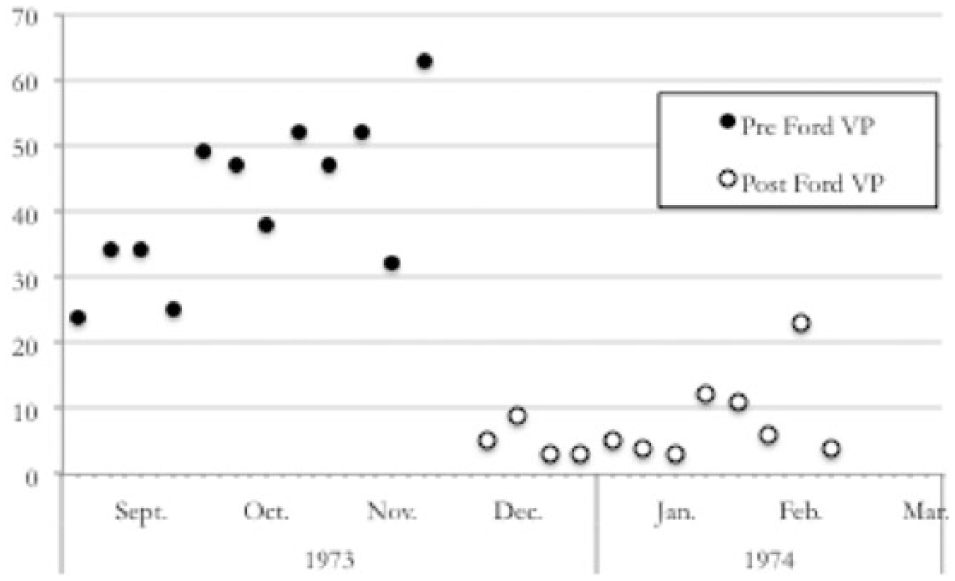
President Nixon’s total weekly contacts with key officials pre/post Gerald Ford Vice Presidency.
While Nixon’s memoirs only briefly address Gerald Ford’s confirmation, details from Nixon’s closest advisors help explain why this was such a blow to Nixon. In the spring of 1973, President Nixon still believed he could and would avoid impeachment and retain power. To help ensure as much, Nixon decided Gerald Ford would make an acceptable Vice President not only because lawmakers would confirm him, but also because he believed those same lawmakers would be reticent to give Ford the presidency. According to Henry Kissinger, Nixon felt Ford’s “selection would dampen desires to impeach him because the Congress would not want to run the risk of placing a supposedly inexperienced man in charge of foreign affairs” (Kissinger, 1979: 514). Similarly, H. R. Haldeman said Nixon presumed House members, knowing Ford as well as they did, would never impeach Nixon and make Ford President (Ambrose,1991: 238). According to one aide, the President had been even more blunt: Charles Colson reported that Nixon described Ford as an “insurance policy” against impeachment (Hersh, 1983: 58).
It thus appears, as historian Stephen Ambrose elucidates, that “[Nixon] did not select Ford in order to make it easier for the Democrats to impeach him. Nor did he expect to be impeached, or forced to resign.” (1991: 238) However, “Nixon made a misjudgment” (1991: 238). The reality was that Gerald Ford’s ascension sealed Richard Nixon’s demise, as the next day’s New York Times’ front-page story indicated: “But the drama of the day was heightened by the realization of those present that with Mr Ford installed as Vice President, sentiment for impeachment of Mr Nixon—or pressure on him to resign—would intensify” (Hunter, 1973). Clearly, Nixon felt that “pressure.”
Maintaining impressions
One question left open is whether Nixon sought to maintain a good public face. That is, did the President depict a steady outward appearance, or did his public schedule match his private one—declining before collapsing altogether? To compare President Nixon’s “on stage” work habits to his “behind-the-scenes” ones, we drew on Gerhard Peters and John T. Woolley’s invaluable American Presidency Project (2016), which consolidates “The Public Papers of the Presidents” by date and document type. Pulling from this database, we tallied all of President Nixon’s public events during each day of his presidency. 7
Figure 4 plots President Nixon’s public events by quarter. Across this timespan, President Nixon averaged a public event every other day, although the distribution of such activities was highly variable. Most days included no public events; on October 28, 1970, Nixon issued eight separate public statements, his maximum. Nixon’s public activities were more frequent during his first two years in office (five events per week in 1969, four in 1970) before settling at an average of two or three events per week for the years that followed.

President Nixon’s total public events, by quarter.
The differences between Nixon’s private and public activities are clear. Whereas Nixon’s private contacts with top officials declined in the second term and then fell off a cliff starting in December 1973, his public schedule remained relatively consistent during his final year in office. Even his last quarter’s public schedule was busier than it appears because the count gets cut short by his resignation. In fact, Nixon’s average number of public events per day was greater in his last quarter (1974, quarter 3) than it had been one year earlier (1973, quarter 3).
This pattern holds throughout the Watergate crisis. Figure 5 displays President Nixon’s public events by week, starting with the break-in and ending with his resignation. Even at this greater resolution, we see President Nixon’s public activities continued largely uninterrupted as Watergate drew closer and more dire (the correlation between weeks in office and public events during his second term is .07). 8 Just looking at his public activities, then, one would find little evidence of Nixon’s diminished workload. 9 Indeed, we find President Nixon’s “on stage” activities proved far more durable than his “behind-the-scenes” meetings.

President Nixon’s weekly public events during Watergate.
Discussion
As political scientists have eschewed “president-centered” theories for “presidency-centered” ones, Richard Nixon’s experience presents an intriguing case. While Mr Nixon’s personality was once cited as integral to understanding his presidency, recent research emphasizes Nixon’s role in forging the institutional presidency. That President Nixon embodied this intrinsic tension—“man” versus “model”—inspired us to test whether Nixon’s work routines were as robust as his model or as brittle as its creator.
To that end, we drew on an extraordinary archival resource—the Presidential Daily Diary—to discover that Nixon’s “system” did seem to discipline his deliberations through his first term, and even into his second. However, we also found strong evidence that Nixon “the man” ultimately discarded his “model,” operating more or less in isolation during his last eight months in office. Perhaps most striking of all was how abruptly this change occurred, upending White House deliberations in a single moment: the day Gerald Ford was sworn in as Vice President.
A follow-up investigation of President Nixon’s public activities—his public addresses, remarks, and news conferences—evidenced no comparable decline. Even as his work behind-the-scenes fell to one-seventh of the level it had been during his first term, President Nixon continued to hold public events, even into the waning days of his besieged presidency. We thus find Richard Nixon maintained the façade of working long after he quit doing the work itself.
More valuable than clarifying the historical record on Richard Nixon, his model, or his legacy are the broader implications for understanding the modern presidency. The first is a greater awareness concerns presidency research and evidence. To date, most empirical data on presidents’ influence draw from their work outside the White House—their relations with the citizens, reporters, lawmakers, judges, and beyond—rather than on the chief executives’ activities inside the West Wing. There are many reasons for this external focus—not the least of which is presidents purposefully conceal their inner-workings—and much has been learned about the nature of presidential influence with others, especially its limits. Nonetheless, Nixon’s experience reminds us that the place where “president-centered” factors are likely to matter most is the very place the scholarly literature and empirical record is thinnest: presidents’ work behind-the-scenes, inside the White House.
That leads to a second noteworthy lesson emerging from this study: “presidency-centered” models of presidential behavior presume presidents are purposeful, if not fully rational. “Rationality” is a reasonable assumption in most cases, and it has helped presidency scholars identify the (considerable) constraints on presidents’ discretion and influence. But as much as we have developed insightful theories to help understand what happens when presidents reach for the ceiling, it is important to recall just how little we know about what happens when they fall to the floor—because they can, as Nixon did.
Footnotes
Acknowledgements
This study benefited greatly from several colleagues’ generosity. First and foremost, I am grateful to the scores of UC Irvine students who helped collect these data. Second, I want to thank John Woolley and Gerhard Peters for the extraordinary work they put into the American Presidency Project, which provides their fellow scholars an invaluable public good. Third, I greatly appreciate Martin Wattenberg and John Pitney for their thoughtful feedback and encouragement of this study. Finally, the editor and anonymous referees prodded me to improve this study and its presentation in several ways. I truly appreciate their efforts on my behalf.
Declaration of conflicting interest
The authors declare that there is no conflict of interest.
Funding
This research received no specific grant from any funding agency in the public, commercial, or not-for-profit sectors.
Supplementary material
The appendix is available at: http://journals.sagepub.com/doi/suppl/10.1177/2053168017704800. The Codebook and Data are available at: 
Carnegie Corporation of New York Grant
This publication was made possible (in part) by a grant from Carnegie Corporation of New York. The statements made and views expressed are solely the responsibility of the author.