




Abstract
Does an increase in naval power increase the likelihood of interstate disputes? While volumes have been written on the importance of naval power, we are left with little more than intuition and anecdotal evidence to provide potential answers to this question. Endogeneity issues in particular make it difficult to untangle the links between developing naval power and interstate conflict. Here I present a new instrument for naval power. Utilizing a new dataset of naval power and employing an instrumental variable analysis, I present one of the first large cross-national studies showing a significant link between naval power and a specific type of interstate conflict - non-contiguous disputes. The findings have implications for the future actions of states whose naval strength is growing.
Introduction
A source of concern for observers of international politics involves the rising tensions in the Asian Seas combined with the massive military build-ups occurring, particularly naval power. China has launched their first aircraft carrier and is currently developing their first domestically produced carrier. Japan has launched their first carrier-class warships since World War II (Izumo). Naval build-ups, long-standing disputes, and a new willingness to protect oversea interests are all key ingredients for military conflict. Does an increase in naval power increase the likelihood of interstate disputes?
Answering the above question is of great importance to conflict scholars. Yet exploring the links between naval power and conflict is fraught with empirical difficulties. If a state expects non-contiguous conflict in the future they are likely to increase their stock of military hardware. As such, concerns about endogeneity make it difficult to separate the influence of a state’s beliefs about future conflict from the independent influence of military capabilities on the likelihood of militarized disputes.
As such, the contribution of this article is the creation of a new instrument for naval power: the length of a state’s coastline and their urban population. With this instrument, I conduct the first large cross-national test of the influence of naval power on long-distance disputes. This article is a timely contribution to the conflict literature as analysts watching Southeast Asia, and beyond, wonder what the influence of the naval build-ups will have on conflict. Using an instrument for naval power to address endogeneity concerns, the results of the article suggest an increase in the number of non-contiguous disputes on the horizon.
Naval power and long-distance disputes
Today’s navies draw strategic inspiration from classical naval theorists – namely Mahan and Corbett. In many ways the US Navy operates with the principles of both theorists. The supremacy of the post-Cold War US Navy allowed the US to expand beyond focusing on controlling the world’s sea lanes (a Mahan principle), to focusing on using naval might to project power inland (a Corbett principle) (Till, 2013). Meanwhile, in China their, “String of Pearls” strategy operates on Mahanian principles by creating friendly relations and outposts in countries such as Bangladesh and Pakistan to create alternative shipping routes to ensure the free-flow of oil (Holmes and Yoshihara, 2008: 378). Additionally, China’s anti-access/area-denial strategy to deny the US access to key waters surrounding China is a principle of Corbett.
The implication from Mahan and Corbett is that naval power allows states to reach out and influence other states. This highlights an understudied concept in quantitative studies of conflict – distance. A large number of studies control for distance rather than discussing its theoretical influence. There are exceptions, of course (Boulding, 1962; Bueno de Mesquita, 1981). The links between naval power and long-distance disputes are clear. Naval power allows a state to begin influencing the actions of other states while also helping to protect them from similar influence. This is significant because naval power allows states to overcome the stopping power of water (Boulding, 1962; Bueno de Mesquita, 1981). States with naval power that engage with non-contiguous foes now have the ability to militarily punish intransigence. Hence, I hypothesize that:
Hypothesis 1 (H1): As the naval power of a state increases, it is more likely to initiate a non-contiguous militarized dispute.
Instrumenting naval power
A major concern with attempting to model the influence of naval power on conflict is endogeneity. States expecting future conflicts build powerful navies. In other words, states build large navies in the anticipation of gaining power and influence within the international system. This means that any measure of naval power included in an empirical model is likely to be an endogenous regressor.
Endogenous regressors violate one of the basic assumptions of regression analysis – that the error term and regressors are uncorrelated. Violating this assumption results in biased estimates of the regression coefficients. Here, any estimates of naval power’s influence on non-contiguous conflict would be combined with the indirect influence of a state’s expectation of non-contiguous conflict as captured by the error term. This makes it difficult to establish the independent influence of naval power on the likelihood of non-contiguous conflict.
One solution to the problem is to instrument the suspected endogenous regressor. With an instrument we can model the endogenous regressor with variables correlated with the endogenous regressor, but not correlated with our potentially omitted variable (Angrist and Pischke, 2009: 117). The predictions calculated from the endogenous regressor model can be used to model non-contiguous conflict. The instrument variable allows us to indirectly model the influence of naval power on the likelihood of non-contiguous conflict.
The primary challenge for modeling an endogenous regressor is finding suitable instruments. Instruments must be correlated with naval power but not correlated with the expectation of future conflict – known as the exclusion restriction. While we can test the correlation between an instrument and naval power, we are left to theorize about the lack of correlation between the instrument and non-contiguous conflict.
For this study, two instruments are used for naval power. The first is a measure of the length of a given state’s coastline. Indeed, Mahan (2004: 29) notes that a solid coastline is a crucial component of developing naval power. States without a coastline are in little need of a navy. Hence, Coastline is a measure of a state’s coastline in kilometers. The data is taken from the World Vector Shoreline data from the World Resources Institute (2000). 1 The correlation between Coastline and Tonnage is 0.36.
The second instrument uses data from the Correlates of War National Material Capabilities project. Urban Proportion is a measure of the proportion of urban population of a state’s total population. Agricultural societies are less likely to have a need for a navy to interact with other states for trade or other purposes. As a larger proportion of a state’s population becomes urbanized, the potential need for naval capabilities grows. Therefore, I would expect there to be a correlation between the proportion of a state’s urbanized population and naval strength. While there is a positive correlation between Urban Proportion and Tonnage, it is a more moderate 0.12.
The question remains regarding the correlation between the instruments and the expectation of non-contiguous conflict. While we cannot test this relationship we can speculate about their potential relationship. For Urban Proportion, the argument is fairly straightforward. Within the conflict literature there does not appear to be a link between a state becoming more urbanized and increasing their likelihood of interstate conflict. While there may be a link with urbanization and the likelihood of civil conflict, the link with interstate conflict appears tenuous.
Regarding a state’s coastline, while it might serve as a necessary component for developing a navy, it is not a necessary or sufficient condition for future conflict. Indeed, numerous states have developed navies for only domestic protection. As an example, throughout the 1800s the US Navy focused on domestic protection and was unwilling to produce a navy capable of competing with the European navies. The US finally made the decision in 1890 to create a significant peace time naval force (Symonds, 2016: 60). Therefore, using the length of a state’s coastline as an instrument variable likely satisfies the exclusion restriction.
Other potential instruments are likely to be correlated with a state’s expectation of noncontiguous conflict. For instance, in order for a state to seek colonial possessions, they will need a sufficient naval force. A proxy for economic development, such as gross domestic product is likely to suffer similar problems. While not all developed states build top rate navies, economic development will be strongly correlated with state’s engaging in non-contiguous disputes. Additionally, Markowitz and Fariss (2013) show that there is a link between economic development and a state’s ability to fight at greater distances. So, this potential measure would also be correlated with a state’s expectation of non-contiguous conflict.
As such, the primary empirical model used in this study is an instrument variable probit model. The instruments Coastline and Urban Proportion serve as the excluded regressors in the first stage model.
Research design
The unit of analysis for this study is the state-year. Temporally, the analysis spans 1885–2000. 2 Spatially, all non-landlocked states are included.
Dependent variable
The dependent variable is the initiation of a non-contiguous militarized dispute (MID). A MID is defined as an event “in which the threat, display or use of military force short of war by one member state is explicitly directed toward the government, official representatives, official forces, property, or territory of another state” (Jones et al., 1996: 168).
To create a non-contiguous measure of MIDs, I use the MID location (MIDLOC) data set (Braithwaite, 2010). The MIDLOC provides the location of where the actual MIDs took place. 3 As such, Non-contiguous MID equals 1 when there was at least a non-contiguous threat of force and zero otherwise.
Independent variables
Two variables capture naval power. First, Tonnage captures the total tonnage of a state’s fighting naval forces. Here, a state’s total tonnage is divided by ten thousand in order to make the resulting regression coefficients more readable. Taken from Crisher and Souva (2014), Tonnage is a measure of ocean going combat vessels. As an alternative measure, Major Ships equals the number of battleships (pre-WWII) or aircraft carriers (post-WWII) a state possesses in a given year.
I also include a number of typical control variables. Polity measures a state’s polity score (Marshall and Jaggers, 2009). An increase in a state’s polity score reflects a regime becoming more democratic. The variable Trade represents a state’s total trade divided by their gross domestic product. The data for this measure is taken from Oneal and Russett (2005). Alliance Portfolio is a measure of foreign policy preference similarity. For the analysis, Alliance Portfolio measures a state’s satisfaction with the status quo as the similarity of a state’s alliance portfolio with the alliance portfolio of the leading state in the system. Lastly, I include a lagged measure of non-contiguous MID initiation.
Empirical analysis
Table 1 shows the results from the instrumental variable models. Model 1 shows that for all states from 1885 to 2000 increasing naval tonnage is having a positive and statistically significant influence on the likelihood of a non-contiguous MID. Additionally, the table also reports the Wald test for exogeneity. Rejecting this test is evidence of an endogenous regressor. The results of the Wald test indeed show evidence of an endogenous regressor and support the use of an instrument model.
Instrument variable models: 1885–2000.

p ⩽ 5%, **p ⩽ 1%, and ***p ⩽ 0.1% for two-tailed tests with robust errors.
Predicted probabilities give a better sense of the substantive significance of these findings. Using results from Model 1, predicted probabilities were calculated for increasing a state’s navy from 30,000 tons to 390,000 tons (roughly from the 50th to 90th percentile). Shown in Figure 1, an increase in tonnage across the x-axis (an unlikely increase) increases the likelihood of a non-contiguous MID by about 3 percentage points. A more modest increase from 30,000 tons to 90,000 represents just over a 0.5 percentage point increase in the likelihood of a non-contiguous MID. While seemingly trivial, when dealing with rare events even a half percentage point increase is substantively significant.

Predicted probability of a non-contiguous MID as tonnage increases, 1885–2000.
The results from Model 1 may be driven by the major naval powers. To address this, models were ran selecting on major and minor naval powers. Model 2 selects on major naval powers while Model 3 selects on minor naval powers. 4 The results for both models shows additional support for H1. Among major naval powers increasing tonnage has a positive and statistically significant increase in the likelihood of non-contiguous initiation. Similarly, even among minor naval powers, increasing tonnage has a positive and statistically significant influence on non-contiguous conflict.
Figure 2 shows the predicted probability of a non-contiguous MID as a state’s number of major ships increases from zero to five. Launching a single major ship results in the likelihood of a non-contiguous MIDs increasing from roughly 6% to 9%. Additionally, increasing a state’s number of major ships from zero to two increases the likelihood of a non-contiguous MID from 6% to 14%. Again, when dealing with rare events, these increases are substantively large and significant. Readers should keep in mind that China has confirmed they are working on the domestic production of a second carrier. It is believed that with a second carrier the Chinese navy will become more assertive. 5 The results of Model 4 suggest that this is a well-founded expectation.

Predicted probability of a non-contiguous MID as major ships increases, 1885–2000.
One interesting finding in Table 1 is the error term correlation between the two stages of the model. If a state develops naval might with the expectation of future non-contiguous conflict, we would expect the error term correlation to be positive. The negative correlation from the models contradicts this and suggests that the unobservable factors influencing naval production are actually decreasing the likelihood of long-distance disputes. A likely explanation for this finding is that states with larger navies have an easier time bargaining with other states. As such, while these states will have more success with coercive diplomacy (Schelling, 1966), they are still more likely to engage in long distance disputes when adversaries become intransigent.
Instrument diagnostics
A potential concern for any model using an instrument is the presence of a weak instrument. Weak instruments can bias any findings found in Table 1. Unfortunately, post-estimation tests are limited for this particular model. But, diagnostics are available when running the model with a continuous dependent variable. In other words, by treating Model 1 as a linear probability model, we can access instrument diagnostics. 6
Looking at Table 2, Model 5 shows the results of running the base model as a linear probability model. The primary results hold, but we are mainly concerned with the first stage diagnostics. In particular, the weak identification test checks the joint correlation between the excluded instruments and the endogenous regressor. The test is from Stock and Yogo (2005) with a null hypothesis that the instrument is weak and gives critical values for various levels of distortion researchers are willing to tolerate. Here, the F statistic (69.4) far exceeds any of the critical values of the Stock and Yogo test. Additionally, results from the under identification test (meaning the first stage equation is properly identified) and the over-identification test give additional support that the proposed instrument is a valid proxy for naval power. Similar results are found when using Major Ships as the endogenous regressor.
Instrument diagnostics models.
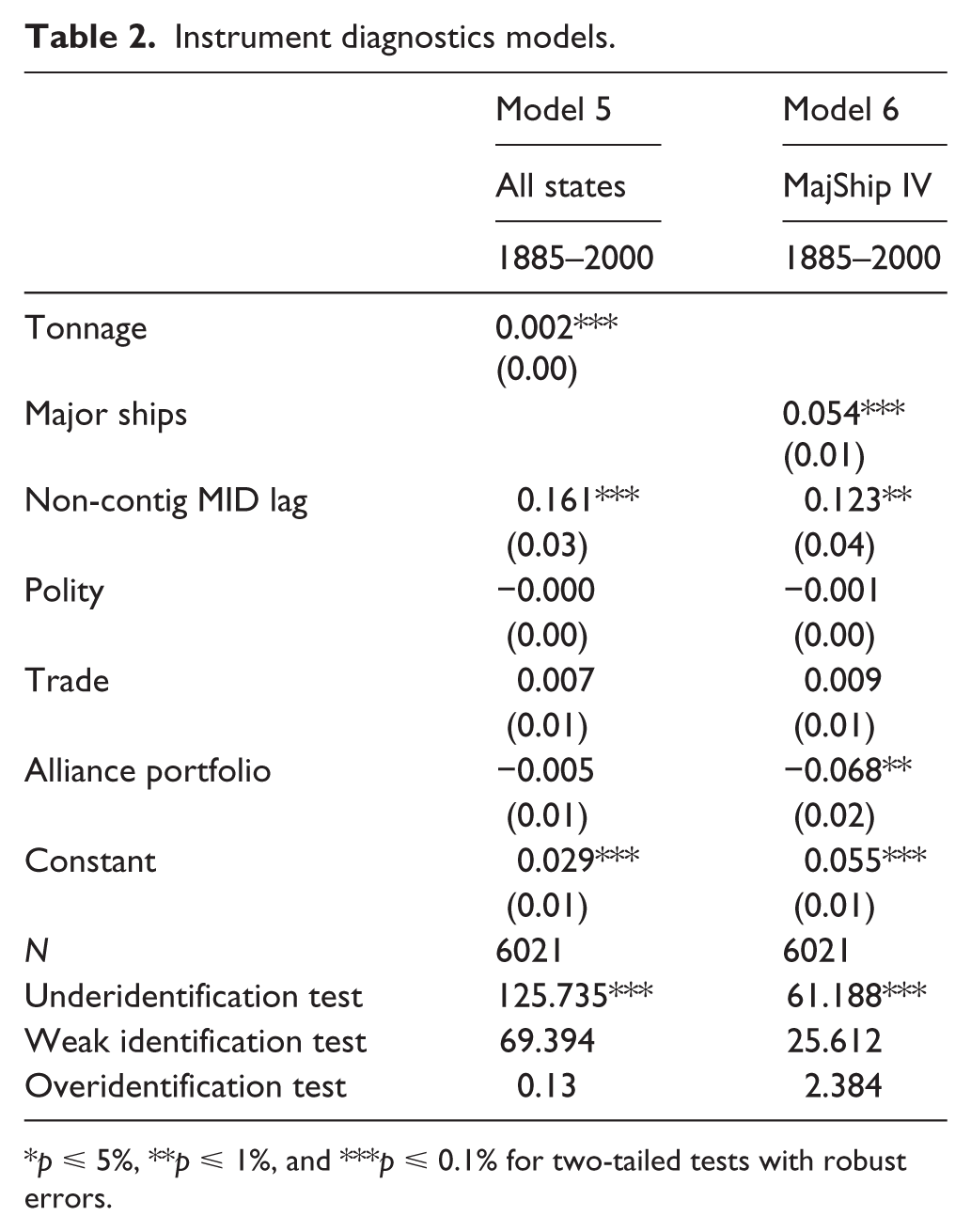
p ⩽ 5%, **p ⩽ 1%, and ***p ⩽ 0.1% for two-tailed tests with robust errors.
Discussion and conclusions
What implications do these findings have for a state like China? While China had a large navy prior to their acquisition of the ex-Soviet carrier Varyag they lacked a major power projection capability. The results from the analysis show that increasing a state’s naval capabilities has a positive influence on the likelihood of non-contiguous disputes. We would expect that as China’s interests abroad expand, they will put their newfound capabilities to use.
In sum, states with significant naval power can influence the decisions of others and deter others from attempting to do the same. A major impediment to understanding the precise link between naval power and non-contiguous conflict are concerns about endogeneity. States may develop naval power precisely because they expect non-contiguous conflicts to occur in the future. By instrumenting naval power, I have shown that increasing the size of one’s navy increases the opportunities for non-contiguous conflict and naval powers take advantage of these opportunities.
Going forward, the findings presented here suggest that as the world continues in this period of naval development, some states may look to use their expanding capabilities against non-contiguous opponents. While the development of capital ships may serve as the clearest signal of intent to engage abroad, the findings do suggest the possibility of even minor naval powers putting their warships to use. Therefore, while the world maintains their focus on the upheavals and numerous conflicts in the Middle East, they should keep a weather eye on the naval developments occurring in South-East Asia.
Footnotes
Acknowledgements
I would like to thank Mark Souva, Rob Carroll, Will Moore, and Sean Ehrlich for their helpful suggestions. Additionally, I am grateful to the editors and reviewers at Research & Politics for providing valuable feedback and suggestions for this project.
Declaration of conflicting interest
The author declares that there are no conflicts of interest.
Funding
This research received no specific grant from any funding agency in the public, commercial, or not-for-profit sectors.

Notes
Carnegie Corporation of New York Grant
This publication was made possible (in part) by a grant from Carnegie Corporation of New York. The statements made and views expressed are solely the responsibility of the author.