




Abstract
This study argues that the effect of third-party trade on dyadic conflicts is conditional on the naval power of both the potential conflict initiator and its target state. This conditional effect occurs mainly because naval power allows trade-integrated initiators to reduce their trade dependence on a given trade partner and its allies more easily. At the same time, the target’s naval power increases the costs that conflict inflict on the initiator’s trade. As maritime trade accounts for about 80 percent of world trade volume, naval capability has an important effect on combatant states’ ability to substitute trading partners during a conflict and to mitigate trade-related costs, thereby affecting the relationship between third-party trade and conflict. The findings of our statistical analyses support our theoretical expectation that the pacifying effect of third-party trade diminishes as the initiator’s naval power increases, yet increases as the naval power of the potential target increases.
Introduction
Over 80 percent of world merchandise trade volume and about 70 percent of global trade value is conducted by sea (UNCTAD 2018). Yet, the literature paid little attention to naval power’s influence on the trade-conflict nexus. In this study we argue that the naval power of dyad states influences the extent to which third-party trade affects the likelihood of conflict between the dyad. This follows mainly because combatants’ naval capabilities are key in determining their ability to substitute trade during conflict and to mitigate trade-related costs. Therefore, a rise in states’ naval power counteracts the deterrent power of trade integration, which has been emphasized in the recent literature focusing on third-party trade’s role in mitigating conflict.
Building on the logic of opportunity costs, many studies argue that, similarly to bilateral trade, third-party trade and other aspects of global economic integration have a pacifying effect on conflict. 1 Integrating into the world economy reduces the probability of conflict because it heightens countries’ concerns regarding its potential loss of trade with third parties and consequent loss of income caused by armed conflict (Gartzke and Li 2003a; Russett and Oneal 2001). Critics, however, argue that as states become more integrated within the world economy, it is easier for them to find alternatives for trade with adversaries that they may lose. High levels of trade openness and the multilateral nature of the globalized trade system reduce the income losses caused by taking belligerent measures against an individual trade partner (Schneider 2014), consequently increasing the likelihood of dyadic conflict (Martin, Mayer, and Thoenig 2008).
Yet others argue that tension between the substitution effect and conflict’s potential obstruction to third-party trade makes the opportunity costs explanation ambiguous (Kinne 2014). Many studies have therefore highlighted other channels through which third-party trade discourages conflict. A growing number of studies have employed social network analysis, demonstrating that the probability of conflict is lower among dyads that have many trading partners in common and that are connected through trade networks (Dorussen and Ward 2010; Kinne 2012; Lupu and Tragg 2013; Maoz 2009). An additional explanation for the pacifying effect of trade integration is that economic openness enables states in crisis to send “costly signals” and express their resolve to use force, without resorting to the use of force (Gartzke and Li 2003b; Gartzke, Li, and Boehamer 2001). 2
Most of the studies that associate more third-party trade, trade links, or integration in the global trade system, with a lower likelihood of armed conflict, implicitly or explicitly assume that dyadic conflicts hamper trade with at least some third parties. Nonetheless, the potential damage that conflicts might cause to third-party trade is not uniformly distributed across states (Gowa and Hicks 2017, 655). Recent literature has therefore highlighted the need to identify variables that affect the degree to which combatants can reduce trade-related costs of conflict and substitute a portion of their pre-conflict trade (Kleinberg, Robinson, and French 2012; Gartzke and Westerwinter 2016; Gowa and Hicks 2017).
None of the aforementioned studies, however, accounts for the fact that most of world trade is conducted by sea, and therefore naval capabilities may have an important impact on the distribution of trade-related costs across states, and consequently, on the likelihood of conflict. In this paper we argue that naval power influences the magnitude of both the obstruction and the substitution effects. On the one hand, significant naval power reduces states’ concerns regarding the conflict’s potential damage to its third-party trade, because naval power can be employed to secure the flow of maritime trade and alleviate global market concerns regarding potential disruptions maritime traffic by enemies. Naval power also reduces shipment insurance costs, which tend to rise during a conflict and increase trading costs. At the same time, strong naval capabilities facilitate a smoother wartime substitution process, allowing states to divert their pre-conflict trade to alternative markets. Consequently, strong naval capabilities of a given state decrease the pacifying effect associated with the rise in its third-party trade and increase the aggravating aspects attributed to its third-party trade. Conversely, a state’s third-party trade is more likely to serve as a constraint when its potential enemy has strong naval capabilities that can inflict substantial costs upon its trade and limit its ability to use the sea to re-route its trade.
This study contributes to the literature by examining the argument that, when all else is equal, the effect of third-party trade on dyadic conflict is conditional on the naval power of both the potential conflict initiator and the potential target state. The findings of our statistical analyses support our theoretical expectation that third-party trade may reduce conflict, and that this pacifying effect diminishes as the initiator’s naval power increases, and intensifies as the naval power of its potential target increases. While our core theoretical explanation for this conditional effect rests on the logic of opportunity costs, we argue that naval power is also highly relevant to other explanations in the literature on trade and conflict. Specifically, we demonstrate naval power’s relevance to studies that highlight the aggravating aspects of third-party trade stemming from its role in altering the dyadic balance of capabilities (Aydin 2008; Peterson 2011).
Since trade and naval power have always been highly interrelated, our results have important implications for the ongoing debate on the trade-conflict nexus. Historically, global trade integration and the need to secure new trade routes have motivated countries to strengthen their naval power (Glaser and Rahman 2016). According to our results, a trade-motivated rise in naval power may counter the pacifying power of global trade.
We proceed as follows: First, we briefly review studies that focus on the obstruction and the substitution effects when exploring the link between third-party trade and conflict, highlighting the lack of attention to the influence of naval power on both effects. Then, we outline the causal mechanisms linking naval power to the conditional relationship between third-party trade and conflict. We then describe our research design and test two hypotheses using directed dyadic data spanning the period from 1950 to 2010. We conclude with a discussion of the contribution of our findings to the literature on trade-party trade and conflict.
Naval Power and Trade-Related Costs of Conflict
As noted, exposure to high levels of third-party trade might have two opposite effects on the opportunity costs of conflict, and consequently on a state’s propensity to use force. While conflict’s potential damage to trade relations with third parties may constrain states that are highly integrated in global trade, extensive third-party trade allows states to divert trade from their potential rivals more easily and therefore also has an aggravating effect on conflict. Nonetheless, it would be naive to assume that these two opposite effects equally influence the costs of war, and consequently, the probability of conflict, for any given dyad of states. Thus, exploration of the factors that might influence the magnitude of the damage that conflict inflicts on third-party trade and the ability of trade-integrated states to find substitutions is warranted.
A number of recent studies demonstrated that the substitution process is not determined solely by the volume of third-party trade, but also by state’s membership in trade agreements and institutions (Peterson 2015; Sadeh and Feldman 2020) and by strategic interests (Haim 2016; Feldman and Sadeh 2018; Gowa and Hicks 2017). Kleinberg, Robinson, and French (2012) argue that even states that are extensively involved in third-party trade will find it very difficult to divert trade if their extra-dyadic trade is distributed among few trade partners. Gartzke and Westerwinter (2016) find that dyadic trade interdependence may be less pacifying when states have numerous trading parties, because trade diversion is easier. Nonetheless, even highly integrated economies would find it difficult to divert trade and find substitute markets if they cannot secure their trade routes.
The argument that third-party trade increases conflict opportunity costs rests on the assumption that dyadic conflict will disrupt trade between combating states and third parties. Most of the few studies that empirically examine this assumption found that conflict indeed reduces trade volumes with third parties uninvolved in the conflict (Feldman and Sadeh 2018; Glick and Taylor 2010; Hegre, Oneal, and Russett 2010; Long 2008). The negative externalities that conflict generates for third-party trade may be the result of several processes, many of which are related to the maritime domain. In addition to direct loss of capital, combatant states might face a reduction in the demand for investments, production capabilities, and consumption. Conflict may also impair third-party trade by raising the cost of private economic agents engaging in trade with combatant states. Maritime insurance rates are arguably one of the most important means through which conflict impacts third-party trade. Many studies demonstrate that transportation costs have a profound disruptive influence on trade even during peace, and in many cases shipping costs may be even more trade inhibiting than customs (Limão and Venables 2001; Clark, Dollar, and Micco 2004). Ships passing through conflict zones are traditionally subject to higher insurance rates. Since military measures might restrict merchant ships’ access to ports, cause transportation delays, and pose physical risks for merchant vessels and their employees; This trade-inhibiting effect tends to soar when tensions in conflict zones escalates. The probability that these scenarios will occur increases transportation costs and therefore reduces the profits of exporters and importers who are forced to pay for more expensive insurance and freight (Long 2008, 87).
Conflict generates substantial negative externalities through disruption of maritime traffic. Some recent examples include higher insurance rates for Ukrainian imports, after Russia harassed merchant ships heading there (Higgins 2018); a 10-20 percent rise in freight rates of ships operating in the Persian Gulf following Iranians attacks on oil tankers in May 2019 (Batrawy 2019); and a rise in insurance rates of merchant vessels headed to Yemen during the civil war that began in 2015 (Sharp 2018). In protracted conflicts, rates can fluctuate sharply, varying with frequency and the success of attacks on ports and shipping assets, as seen in the 1980-1988 Iran-Iraq War (Navias and Hooton 1996).
A potential combatant’s concerns for such negative externalities on third-party trade will be lower when it possesses significant naval capabilities. States with high naval capabilities can better protect their trade routes and secure merchant vessels shipping from and to its ports, thereby curbing the rise in insurance rates on shipments. For example, after Iran seized a British-flagged vessel in 2019, the British government declared that the Royal Navy would accompany British-flagged vessels through the Strait of Hormuz. According to a 2019 expert memo published by German insurance giant Allianz, this decision was expected to “positively impact pricing [of insurance] for ship owners” (Allianz 2019). By reducing the potential physical threats to merchant vessels, naval power softens the direct drop in trade volumes with third parties that combatants incur in the event of conflict. Although shipping companies and private ships owners have operated in warzones, exploiting political tensions to charge higher shipping rates (Beckley 2017, 92), their number is small, and the typical outcome is that fewer ships enter frontline zones as a conflict poses more concrete and direct physical risks (Grubb 2007, 84).
Naval power not only reduces disruption to third-party trade, it can help to increase trade with some third parties that constitute substitutes for export markets and important sources. Countries that have the resources to employ naval convoys or whose allies are willing and able to protect their merchant ships can more easily avert physical dangers by modifying shipping routes. Gowa and Hicks (2017) demonstrated that the naval convoys of merchant ships helped Britain to retain some of its trade during the First World War and to dramatically increase trade with neutrals states that were substitutes for Britain’s pre-war trading partners. The possibility that the US will escort Taiwan’s merchant ships is commonly mentioned in the studies evaluating the effectiveness of China’s potential blockades on Taiwan (Beckley 2017, 93).
Naval Power and the Conditional Relationship between Third-party Trade and Conflict
As explained above, combatants’ ability to both substitute trade and mitigate some trade-related costs is affected by their naval capabilities. Thus, naval power influences the magnitude of both the aggravating and the pacifying effects associated with third-party trade. Potential trade-integrated belligerents will find it easier to both allay concerns of worldwide economic agents and divert trade when they possess a significant degree of naval power. Since the naval power of the potential conflict initiator (State A in a directed dyad) mitigates some trade-related costs of conflict, it reduces the pacifying effect attributed to third-party trade. State A will be less deterred by potential trade-related costs of conflict if it has good reason to believe that the conflict will not disrupt third-party trade flows or cause a rise in shipping insurance and freight rates. Furthermore, as naval power increases, a state’s ability to substitute pre-conflict trade with adversaries and their allies exacerbates the aggravating aspects attributed to third-party trade. Conversely, the target’s naval power (State B in a directed dyad) might increase State A’s conflict trade-related costs and diminish its ability to re-route its trade, thus increasing the pacifying effect attributed to State A’s third-party trade.
Admittedly, while over 80 percent of world merchandise trade volume is conducted by sea, a massive amount of trade crosses through land borders. Thus, in many cases, the ability to substitute pre-war trade is also highly dependent on a state’s ability to secure its land transport. For example, in 2017, around 80% of Ukraine imports from the EU and 30% of its exports to the EU (one of the largest market to which Ukraine diverted some of its pre-conflict trade with Russia) were shipped by road transport (Emerson and Movchan 2018, 167). Nonetheless, in addition to the recovery of Ukraine’s cross-border trade with the EU, much of its 2017 recovery in total trade is related to the increase in maritime trade with several trade partners (Emerson and Movchan 2018, 48). To be sure, states whose trade is largely conducted through their land borders might be less sensitive to immediate trade-related costs stemming from rise of maritime insurance or disruptions to maritime traffic. Nonetheless, even in such cases, naval capabilities are relevant in determining the extent to which these states can divert their pre-conflict trade, because their ability to find alternative markets is very limited if they cannot use the sea to re-route their trade. In fact, the ability to turn to the sea to establish new trade routes might be especially relevant for potential conflicts between neighboring countries involved in significant cross-border trade across land borders. For example, goods crossing through the land border between Saudi Arabia and Qatar were the primary source of Qatar’s consumer products, before a Saudi-led coalition of four Arab countries imposed a land, maritime, and air blockade on Qatar in 2017. To bypass the blockade and to secure food supplies, Qatar quickly established three new sea trade routes (Neubauer 2017).
Importantly, a combatant’s ability to secure its maritime trade might also be influenced by its alliance networks. As previously mentioned, while the literature that evaluates the effectiveness of China’s potential blockades on Taiwan refers to both states’ naval capabilities, it also highlights the naval capabilities of the US and China’s neighbors in East Asia (Beckley 2017). 3 Recent rising tensions in the Gulf echo the US’s ability to secure tankers shipping through the Strait of Hormuz, through which around 20% of the world’s oil passes. These examples, along with analyses of other notable international tension zones where the US and other global powers have a clear commitment and strong interest to secure maritime traffic, indicate that states’ should also account for the naval power of their adversaries and their adversaries’ allies when assessing potential trade-related cost of conflict. Nonetheless, it is most likely that such cases are the exception, and that in most potential crises, states have good reasons to assume that their allies will be reluctant to actively deploy naval power to secure their trade. As Beckley (2015) illustrates, national interest considerations, rather than alliance obligations, have motivated most of the cases in which US has militarily intervened to support its allies. Policymakers in the US (and in other strong states with alliance obligations) do not necessary consider an ally’s trade to be a clear national interest. In contrast to the age of imperialism and the pre-World War II economic system of trade blocs system that strongly reflected the conflicts of interest among the great powers in the multipolar system (Gowa and Hicks 2013), not every political act that disrupts their allies’ ability to trade produces direct geopolitical externalities for the great powers.
Even when states made explicit commitments to defend their formal or de facto allies’ maritime trade, they were reluctant to deploy their naval power. The US did not deploy naval forces to lift the 1967 Egyptian blockade on Israel’s southern port, despite earlier assurances to do so (Barak 2007, 665). Even when the US had a clear interest, it acted cautiously. Though it defined the flow of oil from the Persian Gulf region as a vital interest, it began defending shipping there only seven years into the Iran-Iraq War, three years after attacks on tankers began, and did so with a reluctant Congress (O’Rourke 1988). In most cases, both the commitment and interests of US—and other great powers—to secure freedom of navigation and allies’ maritime trade can be expected to be significantly more limited than in the above cases. Thus, whereas allies’ naval power is a factor that must be accounted for, in the post-1945 era, we can expect the naval power of the state, rather than its allies, to condition the relationships between third-party trade and conflict.
In summary, both State A and world economic agents engaged with it may be less concerned by conflict externalities if State A has meaningful sea power. Therefore, all else being equal, trade-related costs and their associated constraining effect are reduced when states have significant naval capabilities. Thus, our first hypothesis is:
The potential conflict initiator must also consider its adversary’s ability to use its naval power to impair the conflict initiator’s trade. State A’s own naval power enables it to take active measures to alleviate economic agents’ concerns or to re-route trade, but potential increases in insurance and freight rates and the ability to secure maritime trade are also related to State B’s naval capabilities. Britain’s strong navy enables it to accompany British-flagged vessels through the Strait of Hormuz and to moderate the rise in insurance rates, yet insurance firms’ concerns would have probably been even lower if Iran had less naval power. Goods are transferred on large, expansive ships, which creates opportunities for weaker parties to inflict costs upon their powerful foe’s third-party trade. Even very small actors can be effective: In response to Houthi attacks on Saudi tankers in the Red Sea in 2018, Riyadh halted oil shipments through Bab al-Mandab Strait for two months (Dudley 2018). Riyadh’s ability to ship oil through alternative routes, allowed it to avert much of the damage to its oil exports. Note, however, that had the Houthis been able to block alternate routes, Saudi’s economic dependence on oil export would probably have had a constraining effect on this conflict.
Naval inferiority limits a state’s ability to initiate an effective commercial blockade, an action typically employed by large navies. In most cases, State A’s naval superiority implies that State B lacks the ability to paralyze State A’s maritime trade for a long period, yet it does not imply that State B cannot incur costs to both its military and merchant fleet,
4
and that such costs potentially increase as State B’s naval power increases. All else being equal, State A’s concern about trade-related costs of conflict increases with State B’s naval power, and thus we expect State A’s third-party trade to have a constraining effect on conflict when State B possesses greater naval capabilities.
5
Accordingly, our second hypothesis is:
Alternative Mechanisms for the Conditional Effects of Naval Power
While the causal mechanism of our theory rests on opportunity cost logic, it may also be relevant to other explanations in the literature. Since high naval power reduces concerns regarding trade-related costs, it may undermine the pacifying effect highlighted by the signaling literature: State A will find it more difficult to signal its resolve to take action that potentially jeopardizes its trade with State B and its allies, if State B recognizes that State A can easily compensate for such lost trade by shifting trade to alternative trade parties. Furthermore, the initiator’s naval power increases its ability to find alternative markets, and thereby diminishes third parties’ ability to credibly signal their disapproval of the conflict through trade-related action.
Most importantly, since our theory sets in its center an important element of states’ ability to project physical force, it speaks directly to studies highlighting multilateral trade’s role in transforming relative dyadic capabilities (Aydin 2008; Peterson 2011) and creating tension between states that export similar goods (Chatagnier and Kavakli 2017). 6 Peterson (2011) claims that capabilities that states gain through extensive third-party trade alter dyadic balances of power, and consequently might increase a state’s tendency to initiate conflict, especially against states perceived as potential threats. Military campaigns funded by economic growth that was generated by State A’s rising third-party trade may be more likely to coerce State B if State A has a strong navy. Thus, State A’s naval power increases such aggravating aspects associated with third-party trade. Conversely, taking advantage of trade gains in order to challenge the dyadic status quo will be less appealing when the adversary has a strong navy.
In this respect, there may be no fundamental difference between naval power and other military capabilities. However, the specific relevance of naval power to such a potential “commitment problem” stems from its influence on the costs of war. The potential role of third-party trade in altering the balance of power does not imply that states should not take into account the damage that conflict might cause. 7 It is therefore highly likely that by influencing the cost of conflict, naval power is uniquely relevant to models that highlight third-party trade effects on shifts in dyadic capabilities.
Contrary to our main model, focusing on third-party trade’s role in altering the balance of capabilities also calls for an examination of how naval power conditions the relationship between State B’s third-party trade and State A’s conflict initiation. State A’s concerns of a future shift in the balance of power in State B’s favor, as a result of State B’s third-party trade, will be stronger if State B already possesses a significant degree of naval power. At the same time, such naval capabilities might deter State A from initiating a conflict against State B. Given these two possible opposite effects, we do not present a specific hypothesis regarding this conditional effect, though in one set of our models below, we explore how naval power also conditions the impact of State B’s third-party trade on conflict initiation.
Research Design
We test our hypotheses using a directed dyadic dataset that covers annual trade and naval data from 1950 to 2010. We excluded pre-1950 years because we believe that our causal mechanism is less relevant for the age of imperialism and the pre-WWII system of trade blocs. Although naval power played an important role in affecting freight rates and facilitating the processes of substitution well before World War I, and during both the World Wars (Findly and O’Rourke 2007), it is more reasonable to assume that great powers’ naval capabilities, rather than dyads’ naval capabilities, played the primary role in affecting conflict initiation. 8
Our dependent variable is MID initiation, which takes the value of 1 in each observation if State A takes the first militarized action against State B in a new MID that caused at least one battle death, and 0 otherwise (Palmer et al. 2015). We restrict the test to MIDs that involved casualties in order to exclude minor disputes with limited potential to impede third-party trade. This operationalization of MID initiation is imperfect because the state that performs the first militarized act is not necessarily the revisionist actor who bears responsibility for the conflict (Reiter, Stam, and Horowitz 2016). However, this variable allows us to test our hypotheses because states that choose to perform the first hostile act must account for the potential economic costs of escalation of the conflict. Nevertheless, given that the determination of the conflict initiator is controversial, in the online appendix we present models in which we code an alternative dependent variable using the International Conflict Behavior dataset (ICB) (Brecher and Wilkenfeld 2000). This dependent variable receives the value of 1 in each crisis in which State A used violence against State B. There are many crises coded in ICB in which one actor choses to employ violence while its adversary refrains from doing so. Thus, rather than explore crisis initiation, the variable used in the appendix allows us to examine how naval power conditions the way third-party trade affects the decision to use violence and escalate a conflict.
Our series of estimations relies on binary logit models with robust standard errors clustered by directed dyads. We correct for duration dependence by including variables for peace years since last fatal MID, from which we generated a cubic spline with three interior knots (Beck, Katz, and Tucker 1998). To mitigate simultaneity bias, the dependent variable, the peace years, and the cubic spline are coded for the year t+1, which has the same effect as using the values of all explanatory variables lagged by one year.
Our primary explanatory variables should capture the degree to which the impact of State A’s exposure to third-party trade is conditional on the naval power of both states in the dyad. We achieve this by interacting variables that measure State A’s third-party trade integration with variables that measure the naval power of both State A and State B. In order to account for the influence of naval capabilities of the dyad’s allies, we also interact the proxies for State A’s third-party trade integration with both the log of the sum of State A’s allies’ naval power and State B’s allies’ naval power.
For naval power data, we use Crisher and Souva’s (2014) dataset, which measures the sum total of tonnage for each active ship in the fighting naval forces of the seventy three states, based on ship displacement. This does not constitute a perfect measure of a navy’s performance in naval combat, as the aggregate total tonnage refers to quantity not quality (Crisher and Souva 2014). Nonetheless, tonnage and ship capabilities are usually strongly correlated (Markowitz and Fariss 2018, 86). In one set of models, we use the natural log of total tonnage. The correlation between this variable and the log of Correlates of War Composite Indicators of National Capabilities (CINC), which is an index commonly used to measure military capabilities, is 0.71. This high but far from perfect correlation indicates that total tonnage captures a specific militarily capability and allows us to include both variables in the same regressions in several sets of models, as explained in the results. To reduce potential selection bias stemming from the exclusion of states not included in Crisher and Souva’s dataset, and to make our results comparable to the standard models in the literature, our second set of models employed on the dataset includes most states in the system. We code a second proxy assuming that states not reported in the dataset do not have meaningful naval power. Accordingly, the variable takes the natural log of states’ tonnage reported in Crisher and Souva dataset and the value of 0 for states that are not included in dataset or are reported as missing values. 9 The correlation between this variable and CINC (log) is 0.67. 10
We use three alternative proxies of State A’s exposure to third-party trade. The first, A’s third-party trade, is the natural log of State A’s total trade, less dyadic trade flow. This proxy was used to consider how trade can transform to power and increase adversaries’ fear (Peterson 2011). Yet, when controlling for GDP and other variables detailed below, a state’s total trade flow is a straightforward proxy for global trade integration (Peterson and Lassi 2017). The second, A’s third-party trade dependence, is a variant of the commonly used proxy for multilateral trade dependence or trade openness. It is operationalized as the natural log of the initiator’s third-party trade divided by its GDP. All trade data are taken from Correlates of War (COW) trade data 4.0 (Barbieri and Keshk 2016). Finally, we used the natural log of the KOF index of economic globalization (Dreher 2006), which is the weighted average of two sub-indices that measure states’ actual economic flows and their restrictions to trade and capital. Although the KOF index does not allow us to disaggregate dyadic economic interactions from third-party interactions, it captures a state’s general exposure to the global economy. In addition to trade, the KOF index includes data on FDI and portfolio investment, and thus allows us to explore whether naval power conditions the pacifying effects attributed to other aspects of economic globalization. 11
In addition to these primary independent variables, the baseline model includes a series of variables commonly used in research on the relationship between trade and conflict. State A’s trade dependence on State B is the sum of State A’s bilateral exports, plus imports with State B, divided by State A’s GDP. 12 This variable is important since it allows us to distinguish between third-party trade and the effect of dyadic trade on conflict. Democracy is the lower of State A and State B’s Polity IV scores (Marshall, Gurr, and Jaggers 2014). We also include the log of State A’s GDP per capita in current USD (Gleditsch 2002) to control for initiator’s level of economic development. Distance is the natural log of distance between State A and State B’s capital cities, taken from EUGene. Contiguity is an ordinal variable that measures whether two state are contiguous, as classified by COW Direct Contiguity Data, 1816-2016, version 3.2 (Stinnett et al. 2002). Alliance is a dummy variable that equals 1 if State A and State B share a defence treaty or entente (Gibler 2009).
Given that one of our primary independent variables is naval power, it is critical to control for other aspects of national capabilities in order to capture the specific effect of military maritime strength. Accordingly, we include State A’s GDP (logged) in current USD to control for the size effect of the initiator’s economy (Gleditsch 2002). Capability Ratio (log) is the natural log of the initiator’s CINC score divided by the sum of the initiator’s and target’s CINC. 13 Finally, we include System Size to control for the number of states in the international system that can potentially serve as alternative markets.
Results
Table 1 presents the results of the regressions of our two sets of models, the models that are restricted to the seventy three states reported in Crisher and Souva’s dataset and models that include most states in the international system. Models 1 and 2 examine the conditional effect of third-party trade, while Models 3 and 4 refer to third-party trade dependence, and Models 5 and 6 refer to the KOF index. The coefficients for third-party integration proxies are negative and statistically significant in Models 3 and 5, and negative but insignificant in all the other models. Recall, however, that since our specification includes interactions, these coefficients have limited power in explaining how exposure to third-party trade affects conflict, because they refer to a specific case where the naval power of dyad and their allies equal zero.
In line with our first hypothesis, the coefficients of the interactions between A’s naval and the proxies for third-party trade integration are positive and statistically significant in all six models. Furthermore, Model 6 is the only model in which the coefficient of the interaction term between one of our proxies for third-party trade exposure and State A’s allies’ is positive and significant. This is compatible with our expectation that, in most cases, states’ own naval power, rather than the naval power of their allies, reduces the pacifying effect of third-party trade. 14
Hypothesis 2 is supported in Models 1 and 2, as the coefficient of A’s third-party trade × B’s naval is negative and statistically significant. In contrast, whereas the coefficients of the interactions A’s third-party dependence × B’s naval in Models 3 and 4, and A’s KOF × B’s naval in Model 6 return the expected signs, they are far from statistical significance.
Since our hypotheses were tested in logit models with interactions variables, it is very difficult to draw direct inferences based on the results in Table 1. We therefore present a more careful analysis of the marginal effect of third-party trade on conflict for varying levels of naval power. As we want to make the illustrations of our results comparable to those presented in other studies in the literature, our plots are based on the models that refer to the most states in international system. The upper plots in Figure 1 illustrate the marginal effect of each of our third-party trade integration proxies (from Models 2, 4, and 6) conditional on the value of A’s naval power. The lower plots illustrate the marginal effect of each of the three proxies conditional on the value of B’s naval power. All the three upper plots provide further strong support for Hypothesis 1. The upper-left-hand plot shows that A’s third-party trade has a negative and significant marginal effect on MID initiation at low levels of A’s naval power, yet this tendency for third-party trade to reduce conflict diminishes and becomes statistically insignificant at higher levels of State A’s naval power. The same pattern is illustrated in the upper-middle-hand plot, which refers to third-party trade dependence. The upper-right-hand plot shows that there is a positive but non-significant association between economic globalization and MID initiations at low levels of A’s naval power, but this aggravating effect of economic globalization becomes statistically significant when State A’s naval power increases. The lower-left-hand plot shows that third-party trade has no significant effect on MID initiation at low levels of B’s naval power, yet in line with Hypothesis 2, the marginal effect of third-party trade becomes negative and statistically significant at high levels of State B’s naval power. The two remaining lower plots illustrate that the effect of third-party trade dependence and KOF is not conditional on B’s naval power, in contrast to our expectation. These results might stem from the fact that in contrast to states’ own naval power that can actively be used to secure trade and to allay the concerns of global economic agents during various stages of a crisis, states cannot use their adversaries’ naval power to influence economic agents’ decisions.
Third-Party Trade Integration, Naval Power, and Conflict: Baseline Models.
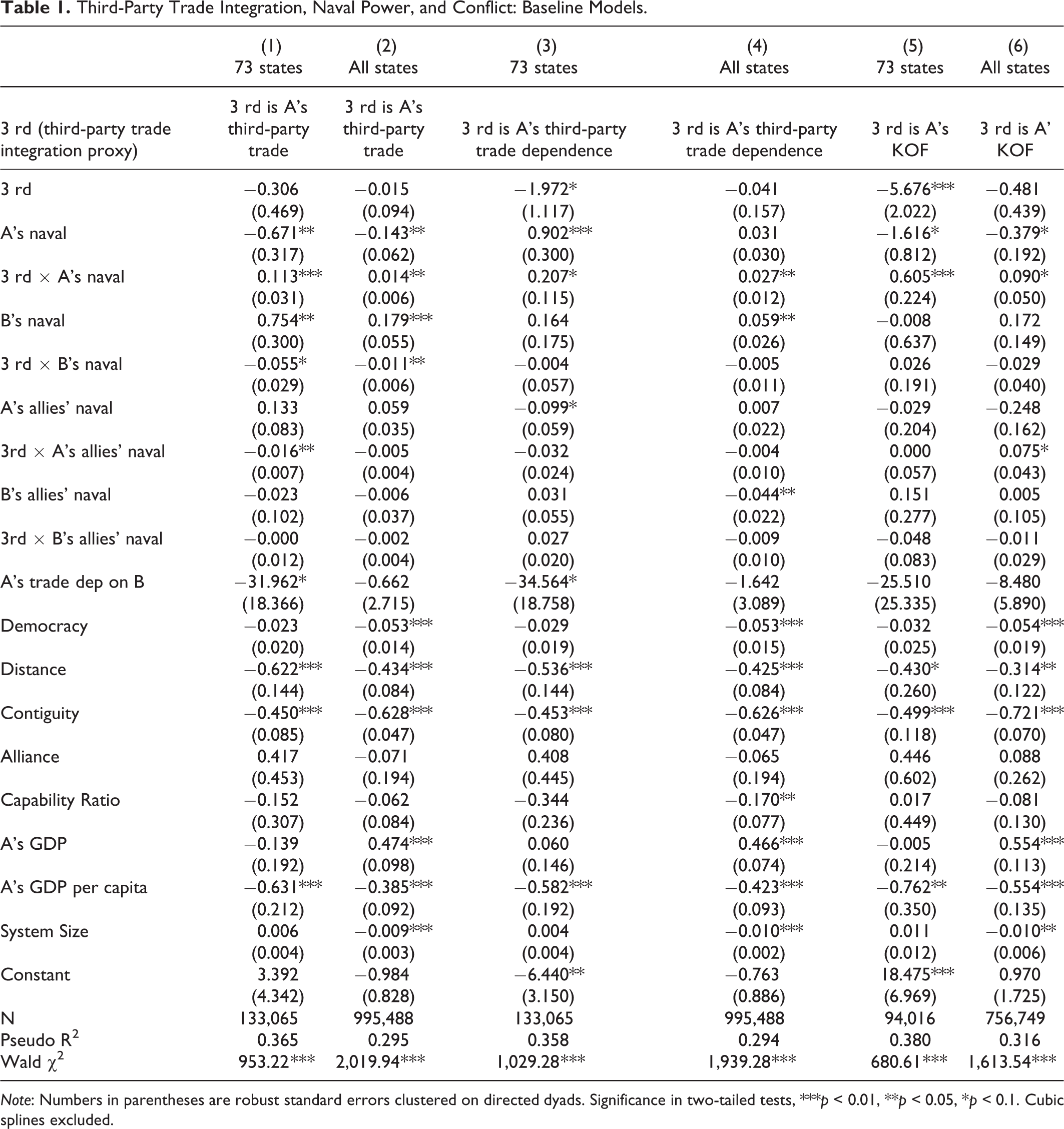
Note: Numbers in parentheses are robust standard errors clustered on directed dyads. Significance in two-tailed tests, ***p < 0.01, **p < 0.05, *p < 0.1. Cubic splines excluded.
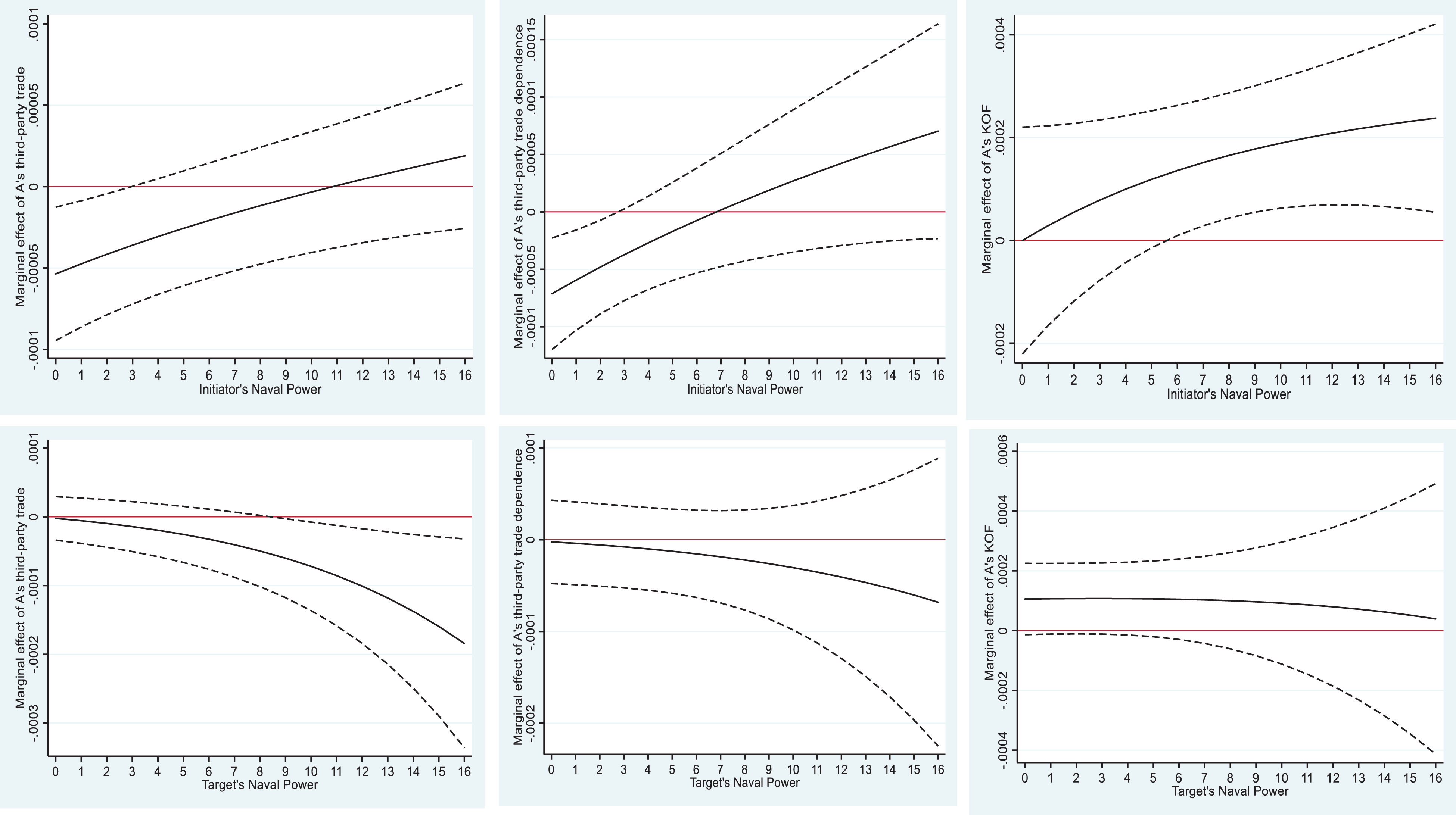
Marginal effects conditional on different levels of State A’s and State B’s naval power. 90% confidence intervals. Initiator’s Naval Power = ln (A’s total tonnage). Target’s Naval Power = ln (B’s total tonnage).
Robustness Check
We subjected our results to robustness tests. First, in the online appendix, we implement an instrumental variable strategy to address potential endogeneity concerns that arise from the relation between naval power and MID initiation (Crisher 2017). Second, because naval power is correlated with other aspects of power, it might be argued that our results express how states’ capabilities in general, rather than their naval power, condition the influence of third-party trade on conflict. Thus, in order to further support our argument that naval power has a specific influence on the relation between third-party trade and conflict, in Table 2 we present estimates from models including a three-way interaction between (1) A’s third-party trade proxies, (2) A’s naval, and (3) A’s CINC score (log). We also include the interaction of A’s trade integration proxies and B’s naval power × B’s CINC score. Since these models address both naval power and CINC, we added Naval Ratio (log) to the regressions, which is similar to the operationalization of Capability Ratio (log), which is quotient of the initiator’s naval power divided by the sum of the initiator’s and target’s naval power.
We find that in all models, excluding Model 10, the interaction terms between A’s proxies for third-party trade integration and A’s naval, as well as the three-way interaction between A’s proxies for third-party trade integration, A’s naval, and A’s CINC, are positive and statistically significant. These results again suggest that third-party trade integration becomes less pacifying (or more aggravating) as initiator’s naval power increases, but this effect is stronger when A’s CINC score is higher. Figure 2 illustrates the marginal effect of third-party trade conditional on the value of A’s naval power from Model 8, when holding A’s CINC scores at three different levels: one standard deviation above the mean, at its mean, and at one standard deviation below the mean. As shown in the left-hand plot, at high CINC scores, third-party trade has a pacifying effect at low levels of A’s naval power, which diminishes and loses it statistical significance as A’s naval power increases. The middle plot shows that, in line with our argument, naval power conditions third-party trade effects even when states do not have a high CINC score. While the marginal effect of third-party trade is negative and quite constant across different naval power levels, it loses statistical significance when naval power exceeds 5. Nonetheless, as demonstrated in the right-hand plot, this conational effect does not hold when A’s CINC score is low.
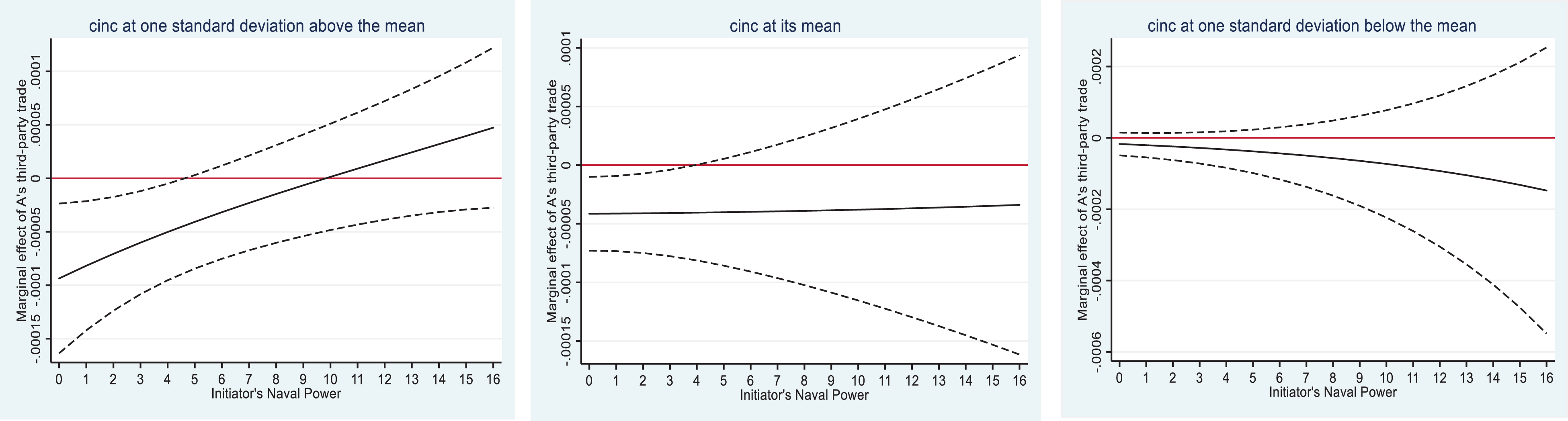
Marginal effect conditional on different levels of State A’s naval power (from Model 8). 90% confidence intervals. Initiator’s Naval Power = ln (A’s total tonnage).
The negative and significant coefficients of the interaction terms between A’s trade integration proxies and A’s CINC in Models 9 and 11, also support the argument about the specific conditional influence of naval power. These results suggest that when A’s naval power equals 0, higher capabilities might increase the pacifying of effect of third-party trade, but this effect diminishes as A’s naval power increases. 15 Turning to Hypothesis 2, in contrast to our expectations and to the result in Models 1 and 2, the interactions between A’s third-party trade and B’s naval are insignificant.
Third-Party Trade Integration, Naval Power, and Conflict: 3-way Interaction.
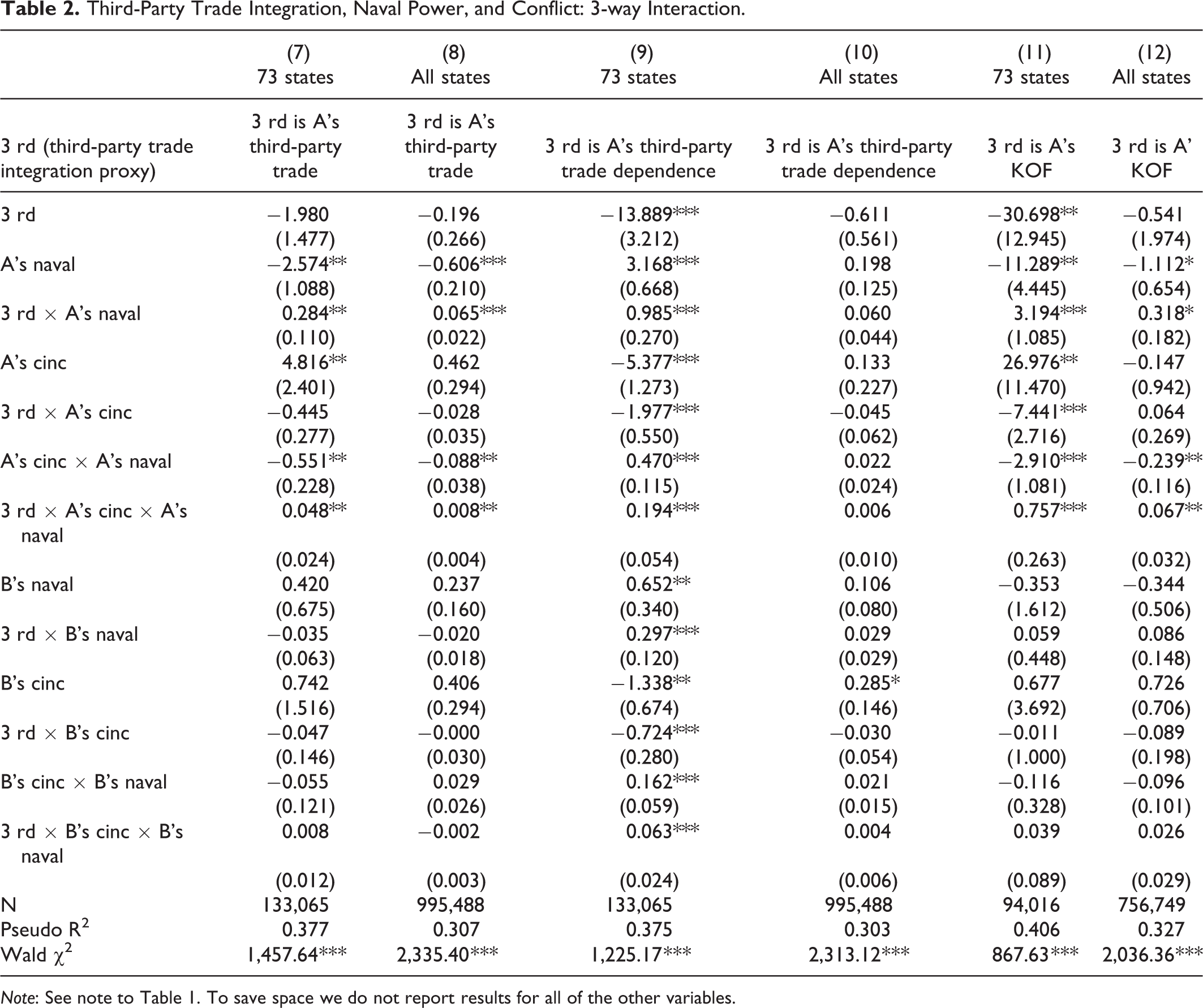
Note: See note to Table 1. To save space we do not report results for all of the other variables.
Finally, Table 3 reports the results of regression models that explore the possibility that naval power’s conditional effect stems from its influence on the state’s considerations to initiate conflict in response to shifts in their or their potential rivals’ third-party trade. Accordingly, these models include the third-party trade of both State A and State B, and State B’s GDP and GDP per capita. Following Peterson (2011), we further control for trade interdependence with an interaction of each party’s dyadic trade dependence, and similarly control for democracy by interacting each party’s degree of democracy. We begin in Model 13 by interacting A’s and B’s third-party trade with both A’s and B’s naval power. Consistent with our two hypotheses, A’s third-party trade × A’s naval is positive and significant, and A’s third-party trade × B’s naval is negative and significant. It is difficult to infer whether this conditionally stems only from naval power’s effect on states’ trade-related cost/benefit calculus or from naval power’s influence on A’s ability to coerce B and disrupt its trade, and thus on State A’s willingness to initiate conflict. In contrast, since A’s trade-related costs are not affected by B’s third-party trade, we are more likely to conclude that the interaction terms between it and naval power are directly related to A’s concerns regarding B’s third-party role in altering the dyadic balance of capabilities. The positive and significant interaction term for B’s third-party trade × B’s naval suggests that such concerns are aggravated when State B is a strong naval rival. Figure 3 plots the marginal effects for A’s and B’s third-party trade, each conditional on A’s and B’s naval power. The upper-left-hand plot in Figure 3 illustrates that the marginal effect of A’s third-party trade becomes positive and significant as A’s naval power rises. The upper-right-hand plot illustrates that A’s third-party trade becomes negative and significant as B’s naval power rises, in line with Hypothesis 2. The lower-right-hand plot demonstrates that B’s naval power amplifies the positive association between State B’s third-party trade and State A’s tendency to initiate a MID against State B.
Third-Party Trade, Naval Power, and Conflict. With B’s Third-party Trade.
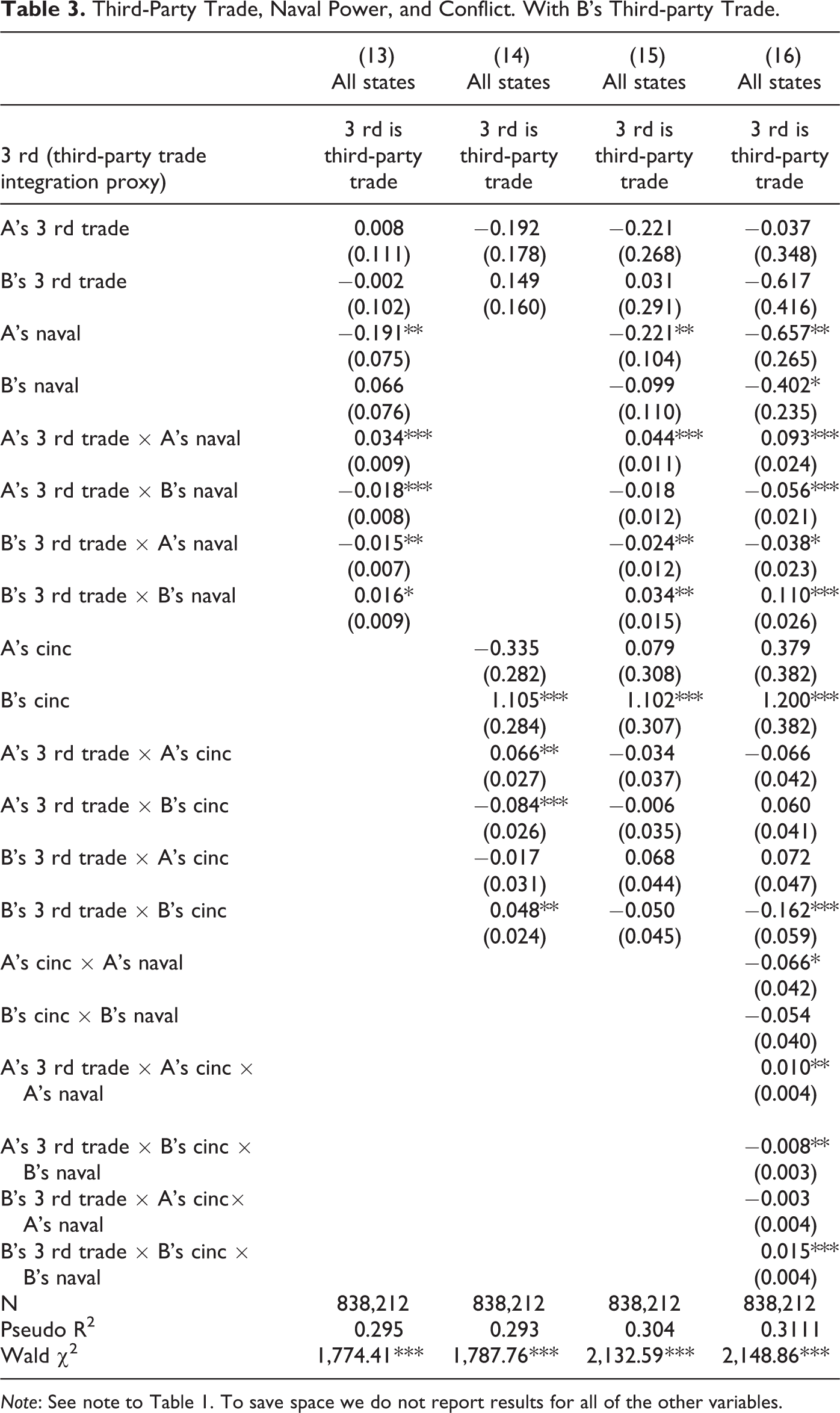
Note: See note to Table 1. To save space we do not report results for all of the other variables.
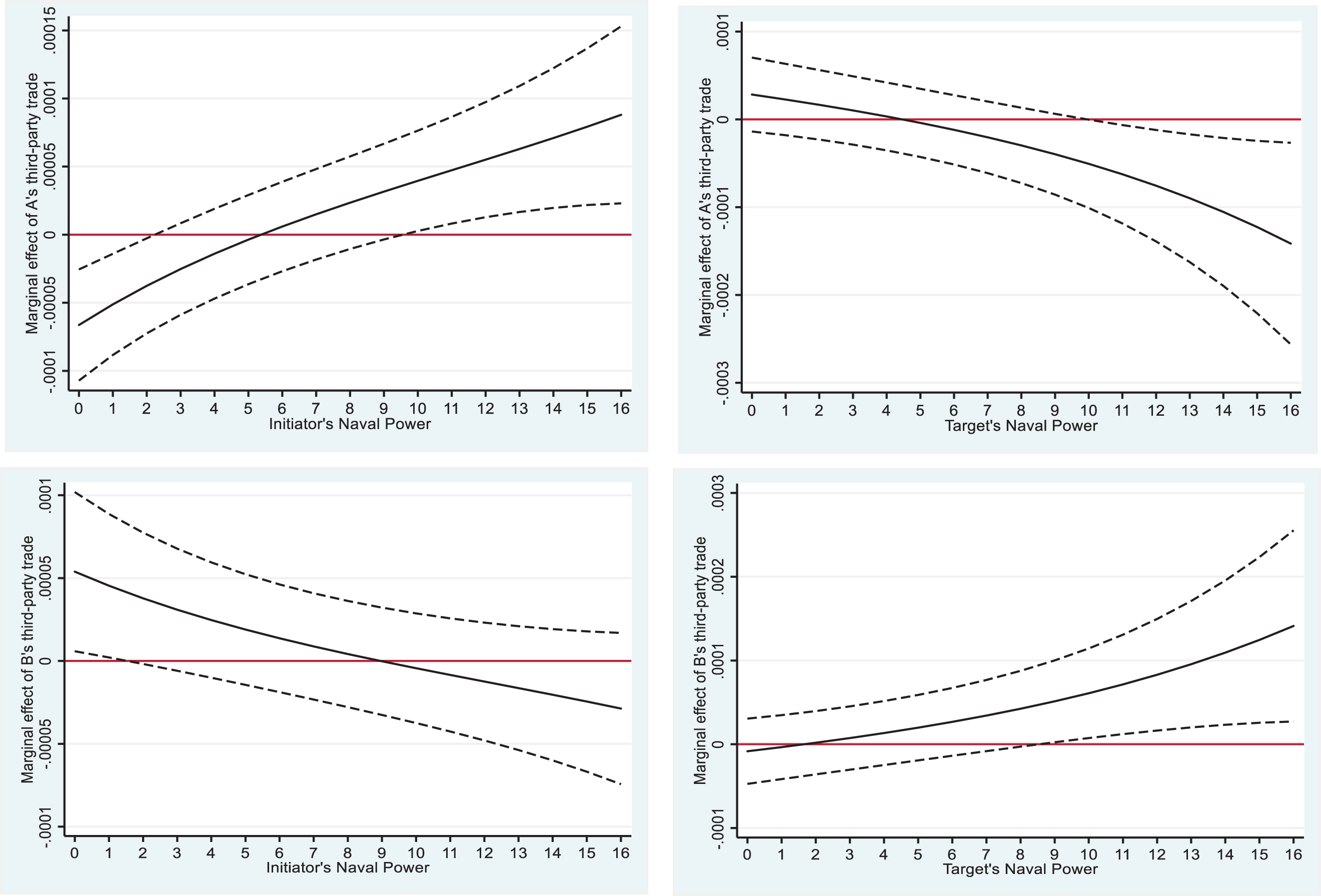
Marginal effects conditional on different levels of State A’s and State B’s naval power (from Model 13). 90% confidence intervals. Initiator’s Naval Power = ln (A’s total tonnage). Target’s Naval Power = ln (B’s total tonnage).
To test whether these results reflect a unique effect of naval power, we employ additional tests. First, in Model 14 we replace naval power variables with A’s and B’s CINC scores. Similarly to their corresponding variables in Model 13, A’s third-party trade × A’s CINC is positive and significant, and A’s third-party trade × B’s CINC is negative and significant. In contrast, the interaction between B’s third-party trade and A’s CINC score is insignificant, suggesting again that naval power—rather power in general— might have a unique influence on the commitment problem generated by third-party trade. Model 15 includes both naval power and the two-way interactions with third-party trade and CINC scores and their interaction term with third-party trade. Similarly to Model 13, even when controlling for the interaction term between third-party trade and CINC, A’s third-party trade × A’s Naval is positive and significant. We also find that there is a negative and significant interaction term for B’s third-party trade × A’s Naval power, suggesting that states with large navies are less concerned about the rise in other states’ trade. Again, the positive and significant coefficient for B’s third-party trade × B’s naval power suggests that, from the perspective of A, the rise in State B’s third-party trade generates greater concern when State B has significant naval capabilities. The same pattern is shown in Model 16, which includes a three-way interaction between third-party trade, naval power, and CINC. Notably, beyond our specific interest in naval power, the results highlight the need for further research that explores how other specifications of specific military capabilities might condition the aggravating aspects attributed to third-party trade.
Conclusion
This study is the first, to our knowledge, that explores the influence of naval power on how third-party trade affects conflict. We argue that, since more than 80 percent of world merchandise trade in volume is carried by sea, naval power is an important factor in determining a potential combating state’s ability to mitigate its trade-related costs of conflict and to divert trade with the enemy and its allies to alternative markets. Therefore, the deterrent power of global trade integration, and consequently the role of third-party trade in reducing conflict, is conditional on the naval power of both the potential conflict initiator and the target state. Moreover, naval power is also relevant to other mechanisms in the study of trade and conflict.
Highlighting several paths through which a potential initiator’s naval power can mitigate the damage that conflict causes to its third-party trade, we hypothesized that the pacifying effect of a state’s global trade integration diminishes as its naval power increases. Conversely, a target state’s naval power might increase the damage that conflict causes to the initiator’s third-party trade. We thus hypothesized that as the target’s naval power increases, the potential initiator’s degree of trade integration is more likely to serve as a constraining factor.
Our study shows the significance of naval power when exploring the channels through which states’ global integration influences their propensity to initiate conflict. We find consistent and robust support for the argument that the effect of the initiator’s exposure to global trade on conflict is conditional on its naval power. High volumes of third-party trade, third-party trade dependence, and other dimensions of economic globalization can all reduce a state’s propensity to initiate conflict. These moderating effects diminish with the initiator’s naval tonnage. In other models, we find that when the initiator possesses high levels of naval power, higher third-party trade levels and exposure to economic globalization are associated with a higher likelihood of conflict initiation. We interpret these results as support for our argument that while high naval capabilities reduce a state’s concerns about direct disruption to its third-party trade, such capabilities increase the substitution effect of economic globalization, which is highlighted by the critics of the “globalization brings peace” thesis. An additional explanation is that naval power increases states’ willingness to take advantage of their third-party trade gains to change the dyadic status quo.
Empirical support is weaker for our proposition that a target state’s naval power increases the pacifying effect of the initiator’s economic integration. Our baseline models indicate that third-party trade flow has a pacifying effect that becomes statistically significant and stronger at high levels of the target’s naval power. The models that include both the initiator’s and the target’s third-party trade also provide support for Hypothesis 2, as they indicate that the initiator’s third-party trade is aggravating only when the target has limited naval capabilities. Nonetheless, the interaction terms between our remaining two variables for trade integration and target’s naval power are insignificant. It is possible that this stems from the fact that, in contrast to their own naval power, states cannot actively use their adversaries’ naval power to influence economic agents at various stages of an international crisis.
Our findings have important implications for the research on third-party trade and conflict. History shows that integration into the world economy has motivated many states to increase their naval power. Our results demonstrate that an increase in naval power reduces the deterring effect of trade integration, and may also increase other aggravating aspects associated with multilateral trade.
We analyzed the role of maritime factors in the relationship between global economic integration and conflict. Admittedly, combatants’ ability to find substitution markets is also related to the size of their merchant fleets. Therefore, further research might explore how a state’s commercial fleet influences the relationship between trade and conflict. Future research might also empirically examine the causal mechanism of our theory, namely that naval power increases a state’s ability to divert trade and reduce the damage that conflict causes to its third-party trade. Gaining a better understanding of how maritime factors affect the trade-conflict relationship is of particular importance given the rise of China as leading global economic actor and naval power.
Supplemental Material
Supplemental Material, sj-pdf-1-jcr-10.1177_0022002720958180 - Naval Power and Effects of Third-Party Trade on Conflict
Supplemental Material, sj-pdf-1-jcr-10.1177_0022002720958180 for Naval Power and Effects of Third-Party Trade on Conflict by Nizan Feldman, Ehud Eiran and Aviad Rubin in Journal of Conflict Resolution
Supplemental Material
Supplemental Material, sj-zip-1-jcr-10.1177_0022002720958180 - Naval Power and Effects of Third-Party Trade on Conflict
Supplemental Material, sj-zip-1-jcr-10.1177_0022002720958180 for Naval Power and Effects of Third-Party Trade on Conflict by Nizan Feldman, Ehud Eiran and Aviad Rubin in Journal of Conflict Resolution
Footnotes
Acknowledgments
We wish to thank the editors, three anonymous reviewers, and numerous colleagues for helpful feedback. Nizan Feldman conveys his gratitude to Maritime Policy and Strategy Research Center for its support.
Declaration of Conflicting Interests
The author(s) declared no potential conflicts of interest with respect to the research, authorship, and/or publication of this article.
Funding
The author(s) received no financial support for the research, authorship, and/or publication of this article.

Supplemental Material
Supplemental material for this article is available online.
Notes
References
Supplementary Material
Please find the following supplemental material available below.
For Open Access articles published under a Creative Commons License, all supplemental material carries the same license as the article it is associated with.
For non-Open Access articles published, all supplemental material carries a non-exclusive license, and permission requests for re-use of supplemental material or any part of supplemental material shall be sent directly to the copyright owner as specified in the copyright notice associated with the article.
