




Abstract
During the 2016 presidential election campaign in the United States, scholars argued that authoritarian visions of the family are associated with support for Donald Trump, a candidate also noted to exhibit authoritarian or illiberal tendencies. Though it is plausible that “authoritarian” citizens (defined by parenting attitudes) vote for “authoritarian” candidates (defined by disrespect for democratic institutions), past research provides relatively little guide regarding this relationship. One reason is that few US candidates announce overtly authoritarian views. Latin America, by contrast, has had many such candidates. We take advantage of this variation using the 2012 AmericasBarometer, which applied a battery of authoritarian parenting attitudes. We first describe mass authoritarianism across Latin America, showing it is associated with many social attitudes. We then examine authoritarians’ voting behavior, distinguishing between support for “mano dura” (“strong arm”) candidates, who are usually rightists, and for candidates threatening violations of general civil liberties, who are often leftists in Latin America. We find that authoritarians tend to vote for right-wing authoritarian candidates, while authoritarianism boosts support for candidates threatening civil liberty violations only among citizens identifying on the ideological right. Education is the most consistent determinant reducing support for both leftist and rightist authoritarian candidates.
Academic observers of the 2016 US presidential election noted that Republican nominee and eventual winner Donald Trump enjoyed outsize support among voters with authoritarian views of the family (Federico et al., 2016; Lakoff, 2016; Taub, 2016; but see Enders and Smallpage, 2016; Rahn and Oliver, 2016). Academics and journalists also described candidate behaviors suggesting indifference toward certain norms of liberal, presidential democracy (Dahl, 1971), including tolerance of dissent, press freedom, and judicial independence (Farhi, 2016; Lind, 2016; Liptak, 2016). An apparent implication is that these phenomena are linked: that “authoritarian” citizens—those believing the home should be structured in a top-down fashion with the father as the ultimate authority—support candidates promising to take charge of the national hierarchy, at the expense of liberal democratic norms. Yet, because few presidential candidates have displayed significant illiberal tendencies in recent US elections, there is little historical evidence regarding whether authoritarian parenting attitudes lead US citizens to support candidates with strongman leadership styles.
Latin America, in contrast, is a region rich with examples of strongmen engaging in democratic politics. In some countries (e.g. Honduras, Mexico, Peru), rightist candidates have promoted “mano dura” or hardline crime policies calling for an explicit tradeoff between citizens’ liberties and national security. Leftist leaders in Bolivia, Ecuador, and Venezuela have limited press freedoms and civil liberties, and sought to reduce institutional checks on executive power. This wide range of authoritarian leaders presents an ideal environment for assessing the effects of authoritarian parenting attitudes.
We conceptualize “authoritarianism” differently for citizens and candidates. At the mass level, “authoritarianism” is a psychological trait emphasizing submission to authority and group norms, and involving aggression toward nonconformists (Feldman, 2003; Stenner, 2005). 1 Scholars have measured the trait using several batteries, including the “F-scale” (or “fascism” scale), which fell out of favor due to high acquiescence bias and low reliability (see Altemeyer, 1981), and the more reliable “right wing authoritarianism” (RWA) measure. Because RWA conflates moral conservatism with aggression to outsiders and preference for authority (Duckitt et al., 2010; Feldman, 2003; Hetherington and Weiler, 2009), recent studies use a battery on child-rearing preferences to capture “adherence to authority” independent of conservatism (Stenner 2005). We assess mass-level authoritarianism using a measure of authoritarian parenting attitudes.
At the elite level, we define authoritarianism not as a preference for familial hierarchy, but rather as an attitude of disregard toward liberal democratic protections of citizens’ rights. We gauge candidates’ levels of authoritarianism through public statements and behavior. Linking both conceptualizations is the core idea that the relevant social entity—the family or the state—should have a single, unrestrained leader who is owed obedience.
Are mass- and elite-level authoritarianism connected? RWA is correlated with opposition to civil rights and liberties and support for governmental abuses of power (Duckitt et al., 2010; Stellmacher and Petzel, 2005). Both authoritarian parenting attitudes and RWA are associated with support for populists and rightists (Billiet and de Witte, 1995; Duckitt et al., 2010; Mayer and Perrineau, 1992; McCann, 2009; Tibon and Blumberg, 1999). However, scholars have not linked authoritarian parenting attitudes to support for candidates promoting authoritarian policies. In light of scholarly explanations of the 2016 US presidential election, this question has become increasingly salient. Evidence from Latin America can illuminate whether or not authoritarian voters actually support authoritarian candidates.
In Latin America, support for authoritarian leaders has been explained using standard determinants of presidential support such as economic performance (Kutiyski and Krouwel, 2014) and access to political information (Geddes and Zaller, 1989). In contrast to scholars of US political behavior, Latin Americanists have generally conceptualized mass-level authoritarianism not based on parenting attitudes, but rather as what we call “institutional authoritarianism”: disrespect for democracy in the abstract, or for particular institutions such as the judiciary. Individuals who are ambivalent toward democratic institutions are more receptive to illegal electoral tactics such as vote buying (Carlin and Moseley, 2015) and more supportive of authoritarian leaders (Canache, 2002; Kutiyski and Krouwel, 2014). However, mass-level institutional authoritarianism is different from authoritarian parenting; these dispositions might even be negatively correlated. Because democratic institutions—or at least, free elections—constitute the status quo in Latin America, citizens who respect authority might feel compelled to voice respect for democracy and for particular institutions. At the elite level, however, there is evidence of a positive association—Latin American legislators expressing hostility to those outside the social order are more amenable toward non-democratic government alternatives (Stevens et al., 2006).
Since authoritarian parenting measures have not been widely used in Latin America, we first validate our scale. In our main analysis, we ask whether authoritarianism predicts support for authoritarian presidential candidates in past or hypothetical elections, while accounting for ideology. We find that authoritarian citizens tend to vote for right-wing authoritarian candidates. Authoritarianism does boost support for leftist authoritarian candidates, who typically threaten civil liberty violations, but only among citizens on the political right; among centrist and leftist voters, authoritarianism is not correlated with support for leftist authoritarian leaders. The most consistent determinant of voting for authoritarian leaders is not attitudinal; education reduces support for authoritarian candidates on both the right and left.
Authoritarianism in Latin America: Levels and convergent validity
We begin by examining authoritarian parenting attitudes across Latin America utilizing a three-question battery administered to half of AmericasBarometer 2012 respondents. 2 Respondents were asked: “[T]alking about the qualities that children ought to have, I am going to mention various characteristics and I would like you to tell me which one is the most important for a child.” Paired response options included, “Independence” or “Respect for adults”; “Obedience” or “Autonomy (self-sufficiency, taking care of oneself)”; and “Creativity” or “Discipline.” Responses of “Independence,” “Autonomy,” and “Crea-tivity” each received values of 0, while “Respect for adults,” “Obedience,” and “Discipline” received values of 1. Volunteered responses that “both” were important were scored 0.5. Authoritarian parenting attitudes (abbreviated to authoritarianism) is the mean of the three scores, and ranges from 0 to 1.
Figure 1 presents mean levels of authoritarianism in the 18 Latin American countries, plus the United States and Canada for reference. Scores were rescaled for just this analysis from 0 to 100. Authoritarianism is lowest in the two Anglo-North American countries, where means are close to the midpoint. Chile and Argentina have the lowest means in Latin America, around 66. At the top end, mean authoritarianism is close to 90 on the 0 to 100 scale in El Salvador and the Dominican Republic.

Authoritarian parenting attitudes in Latin America, Canada, and the United States.
As a first step in investigating the battery’s validity, we assess non-response and scale reliability (see the Supplementary Information). High non-response would suggest that respondents had difficulty understanding the questions or that their responses had failed to match the pre-coded categories. However, on average across the region, non-response on each of the three items is about 1%. Ecuador has the highest non-response rates, at 2.7, 4.0, and 4.1%, respectively. Cronbach’s alpha calculations are more concerning. Reliability coefficients are low in all countries, and extremely low in some. This will reduce the magnitude of measured effects, biasing against finding statistically significant results.
Do Latin Americans’ responses validly represent a construct developed initially in the United States? Pérez and Hetherington (2014) show the battery does not predict the political views of US African Americans. They argue that while members of the racially dominant group implicitly view the polity through a family metaphor, racially subordinate citizens do not. It is worth investigating, then, whether authoritarian parenting and political attitudes are associated among Latin Americans.
Figure 2 presents partial correlation coefficients between the authoritarian parenting battery and other behavioral and attitudinal measures across the Latin American countries in our sample, controlling for country fixed effects (see the Supplementary Information for question text). If this battery lacks convergent validity, we cannot expect responses to predict voting behavior. Two general findings stand out. First, the battery is indeed associated with theoretically relevant personal attributes, including political tolerance and support for media censorship. Second, the correlations are low, despite their statistical significance. We also note a more specific finding: in Latin America, support for social welfare is positively associated with authoritarianism. While this runs opposite to common wisdom in US politics, new research indicates that personality’s effect on economic attitudes is variable and contingent on political context (e.g., Johnston et al., forthcoming; Malka et al., 2014).

Convergent validation: association of authoritarian parenting attitudes with other opinion and behavior measures.
Figure 2 also reports the battery’s association with two measures of institutional authoritarianism: support for democracy in the abstract, and support for the political system. Low support for democracy and low support for existing democratic institutions would correspond to high institutional authoritarianism—that is, rejection of democratic institutions. Confirming the discussion above, authoritarian parenting is not positively associated with institutional authoritarianism. It is uncorrelated with support for democracy, while it has a small positive correlation with support for the political system.
Do authoritarians support authoritarians?
We turn to the question of whether Latin Americans with authoritarian parenting attitudes tend to favor candidates exhibiting authoritarian tendencies. The analysis is limited to presidential systems, where authoritarian executives are most common and powerful. We examine both self-reported retrospective vote in the most recent election and prospective vote “if the election were this week.” 3 We coded candidate authoritarianism using English- and Spanish-language journalistic accounts of the elections prior to and following 2012 AmericasBarometer data collection, located via Google News and Lexis Nexis searches (see Supplementary Materials). We searched for evidence of prospective or prior infringement on civil liberties such as the freedom of the press. We tracked ties to non-democratic regimes or coups—for example, Peruvian candidate Keiko Fujimori’s link to her father’s electoral authoritarian regime in the 1990s, or her opponent Ollanta Humala’s coup attempt. We also coded support for hardline (mano dura) crime enforcement policies threatening civil liberties violations; for instance, militarization of the civilian police, or incarceration of suspects on the basis of physical characteristics such as tattoos.
We coded leaders’ left-wing or right-wing orientation based on the self-reported ideological position of supporters with high levels of political knowledge, adjusting for country-level skew in the ideological spectrum. Politicians whose most knowledgeable supporters placed themselves to the right of the average citizen were coded as “right-wing”; those to the left as “left-wing.” Most candidates promoting hardline policies were rightists, but candidates potentially infringing civil liberties tended to be leftists. At the time the poll was conducted, most left-wing authoritarian candidates were incumbents, while the rightists tended to be in the opposition.
Table 1 assesses the association between authoritarian parenting attitudes and prior vote for authoritarians. 4 The first, third, and fifth columns present simple logistic regression models controlling only for demographics and country fixed effects. The second, fourth, and sixth columns add other public opinion variables measuring ideology and (low) institutional authoritarianism: an indicator for self-identification as rightist (i.e. as 8–10 on the 1–10 ideology scale); support for democracy in the abstract; and support for the current political system. To aid comparison of coefficients, all variables are standardized on a 0–1 scale. The first major finding is that authoritarian parenting attitudes are associated with support for authoritarian leaders—but only right-wing leaders. Education decreases voting for both left-wing and right-wing authoritarians. This finding is consistent across model specifications. Indeed, the predicted probability of having voted for any authoritarian in the previous election drops from .45 for those without schooling to .35 for those with higher education, suggesting this variable is key to understanding support for authoritarian candidacies. Supporters of left-wing authoritarians are also less wealthy and of darker skin tone, on average.
Determinants of voting for left-wing and right-wing authoritarian candidates.

Estimates represent logistic regression coefficients. Country fixed effects not shown. Standard errors in parentheses. Coefficients are significant at *p<.05.
The second analysis for each dependent variable includes attitudinal controls. Coefficients for authoritarian parenting attitudes remain essentially unchanged. Not surprisingly, self-identified rightists are more likely to vote for right-wing authoritarians, and less likely to vote for left-wing ones. More interestingly, support for democracy in the abstract is positively associated with voting for authoritarians. The variable is statistically significant in models excluding system support, but becomes statistically insignificant in the full model (see the Supplementary Information). Most strikingly, support for the existing political order is strongly correlated with a left-wing authoritarian vote. 5 This may be due to reverse-causality: all six left-wing authoritarians analyzed won their respective elections and became forceful presidents evincing little tolerance for the opposition. In majoritarian systems, there are large gaps between winners and losers in the perceived legitimacy of the political system (Anderson and Guillory, 1997; Anderson et al., 2005, Carlin and Singer, 2011). 6 Given the majoritarian nature of these presidential terms, one might expect polarization in system support. Nonetheless, it is striking that even among supporters of right-wing authoritarian candidates, all but one of whom lost, support for democracy and the political system are positively, though not significantly, associated with voting for authoritarians.
Does the impact of authoritarianism vary by respondent ideology? Authoritarians tend to self-identify with the political right, yet the translation from underlying dispositions to ideology is far from perfect. Rightists can be non-authoritarian, and authoritarians can identify as centrists or leftists. We suspect, however, that non-authoritarian and authoritarian rightists behave differently, with non-authoritarian rightists more strongly opposing left-wing authoritarian leaders. Figure 3 shows the predicted probability of supporting left-wing and right-wing authoritarian candidates, by personal authoritarianism and ideological identification (see the Supplementary Information for full models, and results incorporating an indicator for leftists). We find a statistically significant interaction between authoritarianism and rightism in predicting support for left-wing authoritarians. While rightism consistently reduces voting for left-wing authoritarians, the size of the gap varies across the range of authoritarianism. In other words, authoritarian rightists are willing to put aside their ideological convictions and to support a leader with an authoritarian style, even though the leader is of the left.
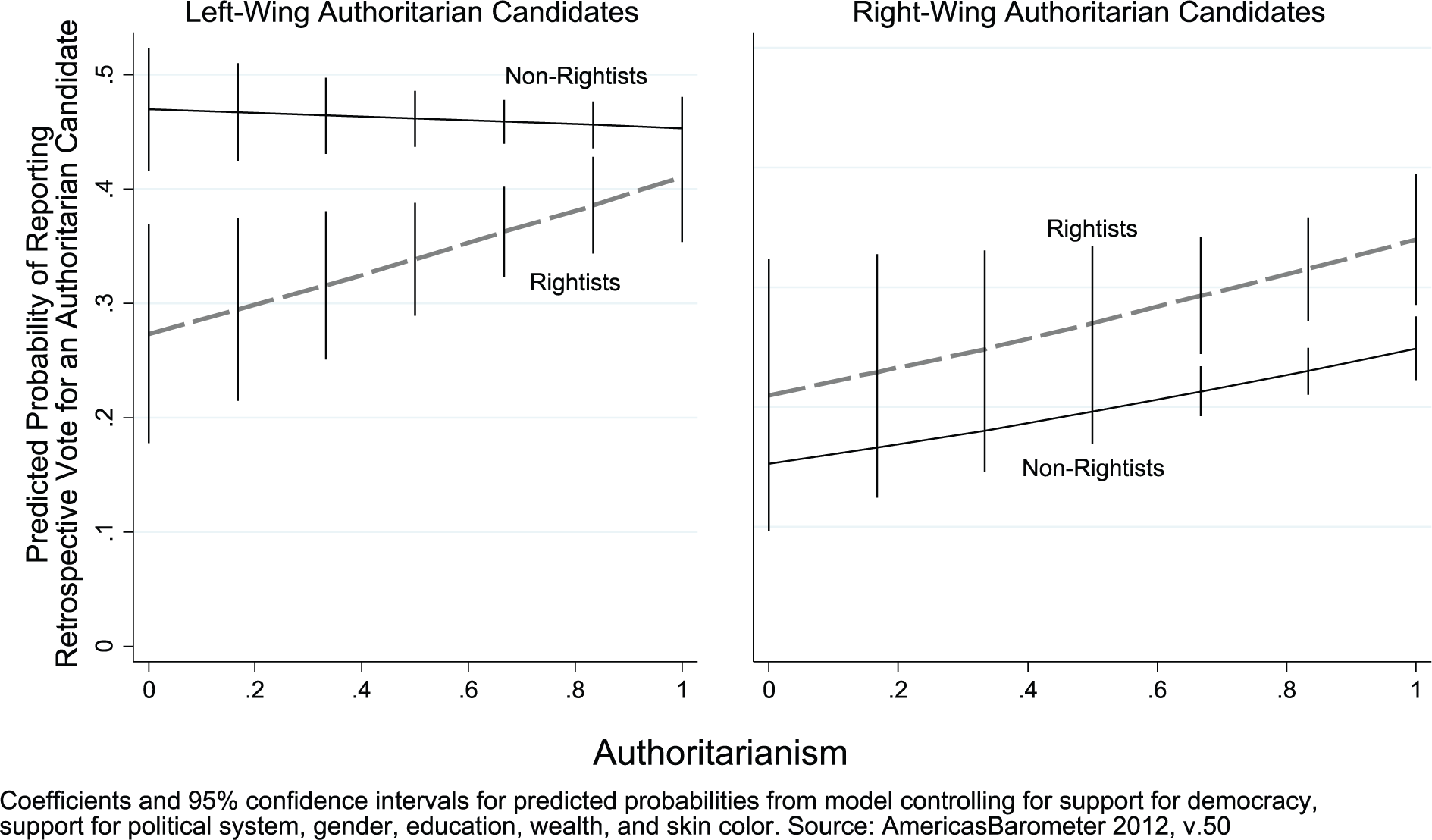
Authoritarianism and rightism as determinants of support for authoritarian candidates.
Finally, we examine prospective support for authoritarian candidates, utilizing a question asking what respondents would do “if the next election were held this week”: vote for the incumbent party or candidate, vote for the opposition, abstain, or vote blank/null. We focus on voting for/against incumbents. Opposition support is hard to interpret, since in many countries it was unclear which opposition candidates would run, and most elections had multiple opposition candidates. We expect authoritarian voters to support authoritarian incumbents, reflecting their preferences for order and the status quo. 7 Contrary to expectations, however, in the Supplementary Information, we show that authoritarianism is not significantly associated with supporting incumbent authoritarians over their opponents. This might be due to the fact that the authoritarian incumbents in this study were all leftists; recall that authoritarianism is not significantly associated with voting for leftist authoritarians in the previous analysis.
In countries without authoritarian candidates, authoritarians may support rightists. In the United States, for instance, authoritarian parenting attitudes are correlated with Republicanism (Duckitt et al., 2010) though few Republican candidates take overtly anti-democratic stances. Figure 4 presents coefficients for the authoritarian parenting battery from multinomial logistic regression models run in every country. 8 The baseline category within each country is support for the incumbent. Authoritarian parenting attitudes are not significantly associated with prospective vote in most countries. In the few cases where the coefficient of the parenting battery is statistically significant, there are no obvious authoritarian candidates in the previous or following elections. In Uruguay, for instance, neither then-incumbent President José Mujica nor any conservative opposition party could reasonably be termed authoritarian. The same goes for then-incumbent Laura Chinchilla and the center-left opposition in Costa Rica. In these cases, authoritarianism is associated with rightism, suggesting the political right’s appeal to those with authoritarian parenting attitudes is independent of candidate stances vis-à-vis the institutional democratic order.
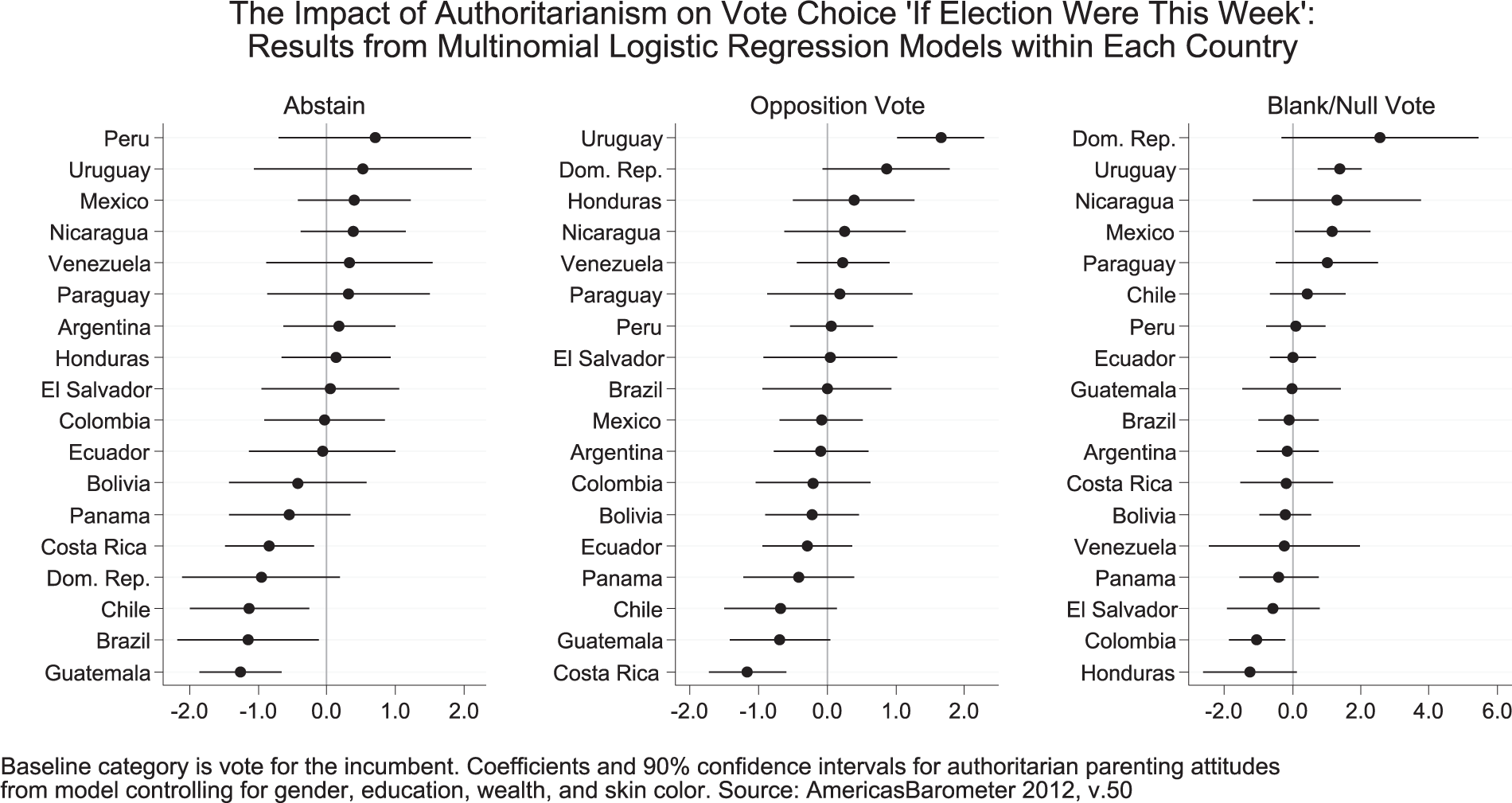
Association of authoritarian parenting attitudes with prospective vote choice within each country.
Discussion and conclusion
To answer the question posed in the title, based on observing 18 Latin American countries: Yes, authoritarians—defined by parenting attitudes—do tend to vote for authoritarian candidates—defined by disregard for civil liberties and democratic checks and balances. The link is strongest when right-wing authoritarians run for office, but parenting attitudes also predict rightist voters’ support for left-wing authoritarian candidates. We believe this is because authoritarians gravitate to rightist ideology, which is more consistent with hierarchical values, while only non-authoritarian rightists—oftentimes economic liberals—strongly oppose left-wing authoritarians. Authoritarian rightists may be willing to sacrifice their ideological positions in exchange for authoritarian leadership, even if those leaders are on the left. In the prospective vote choice analysis, however, we obtain an unexpected result: parenting attitudes are associated with support for rightist incumbents and opposition to leftists, but not with support for authoritarians, in particular. We cannot determine why authoritarianism is unassociated with voting for leftist authoritarian incumbents in the present paper, though a few explanations might be possible. Perhaps citizens with authoritarian dispositions are attracted to the leadership style of leftist authoritarians, yet oppose them on ideological grounds, leading to an apparent null effect. Alternatively, perhaps the result is simply due to problems in measuring prospective vote choice.
Together, the analyses indicate that—at least in Latin America—those with authoritarian parenting attitudes are more strongly attracted to rightists in general than to potentially authoritarian candidates. If these results extend to the US case, they suggest that the parenting battery’s association with Republicanism—and with support for Donald Trump—might result more from conservative ideology than from any particular authoritarian stances on civil rights or checks on the executive. Still, when leftist authoritarian leaders hold power for extended periods of time (e.g. contemporary Venezuela, or the former Soviet Bloc), authoritarian citizens might eventually identify as leftists (de Regt et al., 2011).
For students of Latin America, the results imply that democratic legitimacy does not form a bulwark against electoral authoritarianism. Support for authoritarian candidates is not a product of negative attitudes toward democracy or existing political institutions. Instead, citizens who support democracy and the current system may be more likely to choose authoritarians, though the direction of causality remains for future study.
What, then, leads citizens to elect authoritarians? Proponents of liberal democracy should note the consistent role of education. Why does education buffer citizens against authoritarian claims on the left and right? Perhaps the effect relates to norms conveyed in public classrooms, or perhaps to some incidental social advantage. In either case, it appears the “schools of democracy” may, in fact, be schools.
Footnotes
Acknowledgements
Thanks to David Campbell, Rodrigo Castro Cornejo, Geoff Layman, Christina Wolbrecht, and Liz Zechmeister for very helpful feedback as we developed the project. We thank the Latin American Public Opinion Project (LAPOP) and its major supporters (the United States Agency for International Development, the Inter-American Development Bank, and Vanderbilt University) for making the data available.
Correction (June 2026):
Declaration of conflicting interest
The authors declare that there is no conflict of interest.
Funding
This research received no specific grant from any funding agency in the public, commercial, or not-for-profit sectors.
Supplementary material
The supplementary files are available at http://journals.sagepub.com/doi/suppl/10.1177/2053168016684066. The replication files can be found at 
Notes
Carnegie Corporation of New York Grant
This publication was made possible (in part) by a grant from Carnegie Corporation of New York. The statements made and views expressed are solely the responsibility of the authors.
References
Supplementary Material
Please find the following supplemental material available below.
For Open Access articles published under a Creative Commons License, all supplemental material carries the same license as the article it is associated with.
For non-Open Access articles published, all supplemental material carries a non-exclusive license, and permission requests for re-use of supplemental material or any part of supplemental material shall be sent directly to the copyright owner as specified in the copyright notice associated with the article.
