



Abstract
The recent rise of xenophobic attacks against refugees in Germany has sparked both political and scholarly debates on the drivers, dynamics, and consequences of right-wing violence. Thus far, a lack of systematic data collection and data processing has inhibited quantitative analysis to help explain this current social phenomenon. This paper presents a georeferenced event dataset on anti-refugee violence and social unrest in Germany in 2014 and 2015 that is based on information collected by two civil society organizations, the Amadeu Antonio Foundation and PRO ASYL, who publicize their data in an online chronicle. We webscraped this information to create a scientifically usable dataset that includes information on 1 645 events of four different types of right-wing violence and social unrest: xenophobic demonstrations, assault, arson attacks, and miscellaneous attacks against refugee housing (such as swastika graffiti). After discussing how the dataset was constructed, we offer a descriptive analysis of patterns of right-wing violence and unrest in Germany in 2014 and 2015. This article concludes by outlining preliminary ideas on how the dataset can be used in future research of various disciplines in the social sciences.
Introduction
In the face of violent responses to the recent surge in refugee numbers within Europe and particularly in Germany, debates about the prosecution of right-wing extremist violence have resurfaced among politicians and civil society. Currently, however, official police statistics often do not identify whether or not certain crimes are politically motivated (Human Rights Watch, 2011), making it hard to track changes and trends. Thankfully, however, a joint project by the Amadeu Antonio Foundation and the weekly magazine Stern named Mut gegen rechte Gewalt (courage against right-wing violence) has been documenting anti-refugee violence and social unrest in Germany since the beginning of 2014. The project Mut gegen rechte Gewalt (hereafter MGRG) comprises an online chronicle publicizing all instances of right-wing extremist violence directed specifically at refugees. All information for the chronicle is collected by the Amadeu Antonio Foundation in collaboration with PRO ASYL, a human rights organization (see below for details). The Amadeu Antonio Foundation has been operating a similar project documenting anti-Semitic incidents since 2002 and thus already possesses experience in collecting and aggregating public information on right-wing extremist criminal activity. Due to the significant increase in incidents since the beginning of 2014 (e.g. the year 2015 has seen a fivefold increase in attacks on refugee shelters (Bundesministerium des Innern, 2016)), the foundation employs one person entirely dedicated to maintaining and updating the chronicle. 1
While the listed instances of anti-refugee violence in the chronicle are a highly valuable source of information, they do not lend themselves readily to statistical analyses and further scientific examination. This paper therefore presents a georeferenced event dataset based on the chronicle in order to provide a scientifically usable source of information on anti-refugee violence and social unrest in Germany (hereafter ARVIG). Currently, the dataset identifies a total 1645 events from the years 2014 and 2015, belonging to one or more of the following categories: demonstrations, assault, arson attacks, and miscellaneous attacks against refugee housing. Regular updates of the dataset are planned, provided that MGRG keeps publishing the information.
The paper proceeds in four parts. We first provide some background information on the refugee crisis and reflect on previous research on right-wing violence in Western Europe. Secondly, we outline the process of webscraping the data collected by the Amadeu Antonio Foundation and PRO ASYL, and discuss the categorization of different types of right-wing violence. Thirdly, we present the variables included in the dataset and discuss some initial descriptive statistics of the patterns of anti-refugee violence and social unrest in Germany. We conclude the paper by outlining several potential uses of the dataset in future research.
Background
In 2015, an ever increasing number of refugees made their journey to the European Union (EU) to seek asylum in one of the EU’s member states. According to the United Nations High Commissioner for Refugees (UNHCR), as of early 2016, a majority of asylum applicants in Europe were Syrian citizens fleeing military advances by both their government as well as the Islamic State (48 per cent of arrivals), closely followed by refugees from Afghanistan (21 per cent), where a withdrawal of foreign troops has led to a resurgence of Taliban control (UNHCR, 2016). Most refugees have sought asylum in Germany and Sweden; the German government’s reaction towards incoming refugees, in particular, has sparked international attention. By the end of summer 2015, when other EU member states began closing their borders, Chancellor Angela Merkel publicly pledged that Germany would offer temporary residence to all incoming refugees. Her government also suspended applying the EU’s Dublin III Regulation, a 2013 EU law that determines the member state responsible for examining asylum applications. In addition to this “open-arms policy” (Hockenos, 2015) of the German Chancellor, television footage of cheering citizens welcoming refugees at the Munich train station stood out in comparison to the increasingly restrictive policies towards refugees across the EU.
Not everyone welcomed refugees to Germany, however. The Christlich-Soziale Union (Christian Social Union, CSU) – the Bavaria-based sister party to Merkel’s Christlich-Demokratische Union (Christian Democratic Union, CDU) and a partner in the national coalition government – soon openly challenged Merkel’s decisions, an act previously unthinkable in German consensus politics. Simultaneously, the new right-wing party Alternative für Deutschland (Alternative for Germany, AfD) started to attract an increasing number of voters in polls. 2 In addition to these political reactions, xenophobic violence directed against refugees and their supporters was on the rise throughout 2015 (Deutsche Welle, 2015). This violence reached a tragic climax in October 2015, when Cologne city official Henriette Reker was stabbed in the neck over her position towards refugees during an electoral campaign event.
Anti-refugee violence and social unrest is not new to post-Cold War Germany, and a number of scholarly analyses have shed light on this phenomenon in the past. To name a few prominent examples, Koopmans and Olzak (2004) study the causal links between public discourse and xenophobic violence in Germany, analyzing over 11 000 public statements in the period from 1990 to 1999 (cf. also Koopmans, 1996). Their findings suggest that media attention to right-wing violence affects both the precise targets of such attacks as well as these attacks’ temporal and spatial distribution (cf. a similar analysis on xenophobic violence in the Netherlands by Braun, 2011). Krell et al. (1996) also investigate the links between rising numbers of asylum seekers in Germany during the early 1990s and anti-refugee violence, presenting both a typology of the perpetrators as well as studying the explanatory power of various theories to account for the rising number of attacks. Willems similarly focuses on the perpetrators of right-wing violence in Germany by analyzing police data on their biographical and socio-demographic characteristics (Willems, 1995a) as well as public opinion polls, arguing inter alia that anti-refugee activist groups are far too heterogeneous “to be sweepingly labeled as racists” (Willems, 1995b). These studies tie into a broader literature on how immigration links to the rise of right-wing extremism and xenophobia in the Western world, that has in the past particularly been driven by studies modeling the emergence of extreme right-wing populist parties and voting behavior (e.g. Betz, 1993; Rydgren, 2005; Arzheimer and Carter, 2006; Lubbers et al., 2002; Green-Pedersen and Odmalm, 2008) as well as of anti-immigration movements (e.g. Fetzer, 2000; Brown, 2013).
The recent spread of anti-refugee sentiments in German politics and society has already sparked academic interest, but investigations have thus far overwhelmingly concentrated on explaining the rise of the right-wing anti-immigration movement Pegida (Patriotische Europäer gegen die Islamisierung des Abendlandes, or Patriotic Europeans against the Islamization of the Occident) that flourished in late 2014 (e.g. Dostal, 2015; Vorländer et al., 2016). A lack of systematic data collection and data processing of the recent anti-refugee events in Germany has thus far inhibited a thorough quantitative investigation of this phenomenon, its patterns, dynamics, drivers, and consequences.
Creating the dataset
In order to create the ARVIG dataset, we webscraped information in the MGRG online chronicle, that provides a list of instances of anti-refugee violence and social unrest since 2014. We currently include all available entries between 01.01.2014 and 31.12.2015 in the dataset. The chronicle provided by the MGRG project is itself based on information collected by two civil society organizations. The first is the Amadeu Antonio Foundation that was named after Angolan citizen Amadeu Antonio Kiowa, who was one of the first victims of right-wing violence in reunified Germany when he was beaten to death by extremist youths in 1990. The foundation was started in 1998 with the explicit goal of strengthening German civil society activism against right-wing extremism, racism, and anti-Semitism (Amadeu Antonio Stiftung, 2016a). The second organization is PRO ASYL, founded in 1986, shortly after significant restrictions were introduced to the German asylum law that resulted in greater difficulties for people persecuted in their home countries to secure lasting protection in Germany (Förderverein PRO ASYL e.v., 2016). Both the Amadeu Antonio Foundation and PRO ASYL belong to the largest and most respected pro-immigration advocacy organizations and work closely with international human rights organizations, which increases our confidence in the quality and transparency of their data collection.
Categories of right-wing violence
The chronicle provided by the MGRG project documents four different types of attacks and unrest against refugees and refugee housing in Germany: demonstrations, assault, arson attacks, and miscellaneous attacks against refugee housing. The collection is based on a variety of sources, including public reporting in newspaper articles, press releases by the German police, and parliamentary interpellations, as well as publicly accessible reports by local and regional organizations offering advice and consultation for victims of right-wing violence (Amadeu Antonio Stiftung, 2016b).
The first types of violence and social unrest reported by MGRG are events of anti-refugee demonstrations, such as the rallies staged by Pegida since December 2014. The causes and dynamics of xenophobic protests have in the past been thoroughly studied by researchers interested in social movement theory (see e.g. Della Porta, 2000; von Holdt and Alexander, 2012), and our data thus provides the opportunity to test existing theories on a new case. To give one example of the demonstrations included in the MGRG chronicle, on 14 March 2015, 180 people protested against the construction of a new refugee shelter in the city of Flöha in Saxony. The demonstration was registered by Pegida-spokesperson Steffen Musolt and at least one man was reported shouting “Sieg Heil!” (Freie Presse, 2015).
The second type of violence reported by the MGRG project concerns physical assaults and bodily injuries. For instance, on 12 January 2015, a Libyan asylum seeker was badly injured in Dresden. He had been asked for cigarettes by “men wearing bomber jackets,” and after he did not understand the question, one of the men reportedly poured hot liquid over his face, shoulders, and arms, making it necessary for him to seek medical treatment (Morgenpost, 2015). It should be noted that while right-wing violence can target many groups – including religious minorities or the LGBT community – the chronicle only records information on assault if the victim has a refugee status. This also means that assault on, for instance, left-wing and pro-refugee protesters, volunteers helping incoming refugees, or journalists covering xenophobic rallies, are not recorded.
The third and fourth categories of anti-refugee violence included in the MGRG chronicle represent arson attacks against refugee housing, as well as miscellaneous attacks against such shelters. For instance, on 23 March 2015, a group of unknown attackers was reported trying to set fire to a school in Berlin-Kreuzberg that houses refugees (Berlin Online, 2015). Miscellaneous attacks against refugee housing comprise instances of rocks thrown at shelters or xenophobic graffiti. For example, on 8 January 2015, unknown attackers painted swastikas on the walls of a house in Hausberge/Porta Westfalica (North Rhine-Westphalia) that was supposed to be turned into a refugee shelter (Mindener Tageblatt, 2015).
In addition to these four distinct categories, some of the reported events include mixed forms of anti-refugee attacks, such as demonstrations in the course of which refugee shelters were attacked: On 6 March 2015, an anti-asylum demonstration of 1500 people in Freital (Saxony) not only attacked police officers and journalists with pyrotechnics, but some demonstrators also forced their way into a refugee shelter and reportedly vandalized the building (Tagesspiegel, 2015). A small number of events in the dataset are not categorized as they do not belong to any of the four basic event types. Examples include the distribution of xenophobic leaflets or public banners with right-wing extremist slogans. Table 1 summarizes the frequencies of all observed event types as reported by the MGRG project. Figure 1 offers a geographic overview of all recorded events. For a more concise presentation, multi-category events have been split and counted once in each of their respective categories.
Frequencies of event categories.


Geographic overview of events by category. Administrative areas: © GeoBasis-DE / BKG 2016.
One advantage of the chronicle published by the Amadeu Antonio Foundation and PRO ASYL is that by including events from this broad set of categories, the chronicle, as well as the dataset, covers a wider range of anti-refugee violence than some previous studies on the topic do. For instance, studying right-wing violence against asylum seekers in the Netherlands, Braun (2011) relies on data on the timing and location of events provided by the Anne Frank Stichting, which defines right-wing violence as “[purposive] infliction of material or physical damage to targets, chosen because of their different cultural, national, ethnic, racial or religious background” (cited in Braun, 2011). In MGRG’s categorization, Braun’s conceptualization of anti-refugee violence would thus only cover the “assault” category. We prefer the broad conceptualization of anti-refugee violence and social unrest offered by the MGRG chronicle for two reasons. First, a broad conceptualization that also includes demonstrations and attacks against property allows researchers not only to distinguish between different types of xenophobic attacks, but also to study degrees of severity. In that regard, the dataset can be used to help answer research questions that deal with the escalation of xenophobic extremism over time. Second, the broad conceptualization also relates more closely to other recent event data collections on global instances of violence and social unrest, such as the Social Conflict Analysis Database (SCAD) that covers protests, riots, strikes, inter-communal conflict, and government violence against civilians in Africa and Central America (Salehyan et al., 2012).
It is important to highlight one limitation of the chronicle and consequently of the dataset, namely the underreporting of demonstrations and assaults. First, the chronicle points out that because anti-refugee demonstrations and rallies have been on the rise in recent years, it is impossible to collect information on every single one of them. Thus, demonstrations are likely to be under-reported. MGRG however notes that under-reporting has become a problem mostly since January 2016, at which point the Amadeu Antonio Foundation and PRO ASYL have limited themselves to reporting demonstrations that specifically disregarded German law. This includes illegal demonstrations not registered with the authorities beforehand, demonstrations that included assaults against journalists or police, or situations in which demonstrators were reported using hate speech (Volksverhetzung) (Amadeu Antonio Stiftung, 2016b). Second, MGRG points out that the actual number of assaults – irrespective of the victim’s status – is likely to be much higher than is reported in the chronicle (Amadeu Antonio Stiftung, 2016b). This is, however, a problem faced by many criminal statistics (Myers, 1980).
Webscraping and geocoding
To construct the ARVIG dataset, we primarily relied on webscraping the information available in the MGRG chronicle. This is possible for all events from January 1, 2015 onwards as they are neatly separated in the HTML code of the MGRG website, and we used the rvest package in the software environment R that was designed to harvest data from HTML web pages (Wickham, 2015). For the 2014 events, webscraping proved insufficient, because the entries on the MGRG website are not as neatly structured in the HTML code. Hence, we manually copied the 2014 events, cleaned the data and merged it with the 2015 events.
Next, we extracted the information on the location and the respective federal state from the dataset and used the Google Maps API to geocode the location. It proved necessary to take both location and federal state, in order to avoid confusion between two locations with the same name, but which are in different federal states such as Friedberg (Hesse) and Friedberg (Bavaria). Each event is thereby mapped to a longitude and latitude with municipality-level precision. This enables us to place each event on a high resolution map of Germany that includes geospatial information on all 11 306 German municipalities (Gemeinden) and determine the corresponding official 12-digit Community Identitification Number (Regionalschlüssel). 3
The ARVIG dataset is made available as an R data package as well as a .csv-file and can be found along with installation instructions at https://github.com/davben/arvig. All technical details of the webscraping, data cleaning, and geocoding can be reconstructed and replicated using the code provided in the R data package.
Variables and patterns
The ARVIG dataset contains 10 variables that characterize each recorded event. First, we provide the exact date at which an event of interest occurred. Currently, all dates lie between January 1, 2014 and December 31, 2015. Events were recorded on 563 of the 730 days covered by the dataset (cf. the frequency distribution in figure 2). The date for which the highest number of events was recorded is August 29, 2015, with a staggering count of 17 anti-refugee events, including six demonstrations, ten miscellaneous attacks against refugee shelters, as well as one instance of assault occurring in Halle (Saale), where a refugee from Guinea-Bissau was insulted, beaten and kicked by six to eight individuals.

Histogram of events per day.
Next our dataset specifies the location and federal state of events as reported by MGRG (in German writing, thus including umlauts). All federal states of Germany have seen right-wing violence and social unrest in 2014 and 2015, but with strong variation in the number of events. By far the highest level of anti-refugee violence and unrest was recorded in Saxony, with 394 events in the 24 months under analysis, followed by North Rhine–Westphalia (231 events) and Berlin (210 events). The traditionally left-wing governed Bremen (where all State Premiers since 1945 have belonged to the Social Democratic Party), on the other hand, saw only two events in the past two years: two arson attacks, on September 26 and October 26, 2015. If we control for number of state inhabitants, the densely populated North Rhine-Westphalia drops out of the top three and is replaced by Mecklenburg–Vorpommern – a federal state that has a history of xenophobic violence against asylum seekers, for instance when between August 22 and 24, 1992, several hundred violent protesters in the Lichtenhagen district of Rostock threw stones and petrol bombs at a refugee shelter and were applauded by an even larger crowd of bystanders. Figure 3 depicts the number of events per 100 000 inhabitants for all federal states and shows a clear divide between West and East Germany in the number of events directed against refugees.

Events per 100 000 inhabitants by state and category. Federal states of the former German Democratic Republic are marked with an asterisk.
Figure 4 depicts this relationship at the district level. This map again highlights the high number of anti-refugee events taking place in East Germany, with a particularly high count in the district of Saxon Switzerland–East Ore Mountains (Sächsische Schweiz–Osterzgebirge). This district had a total of 67 instances of anti-refugee violence, including 10 assault, 5 cases of arson, and 21 miscellaneous attacks in 2014 and 2015. These statistics were despite the fact that the district is relatively sparsely populated; its population of 245 954 inhabitants is smaller than cities such as Mannheim, Karlsruhe, or Bonn.
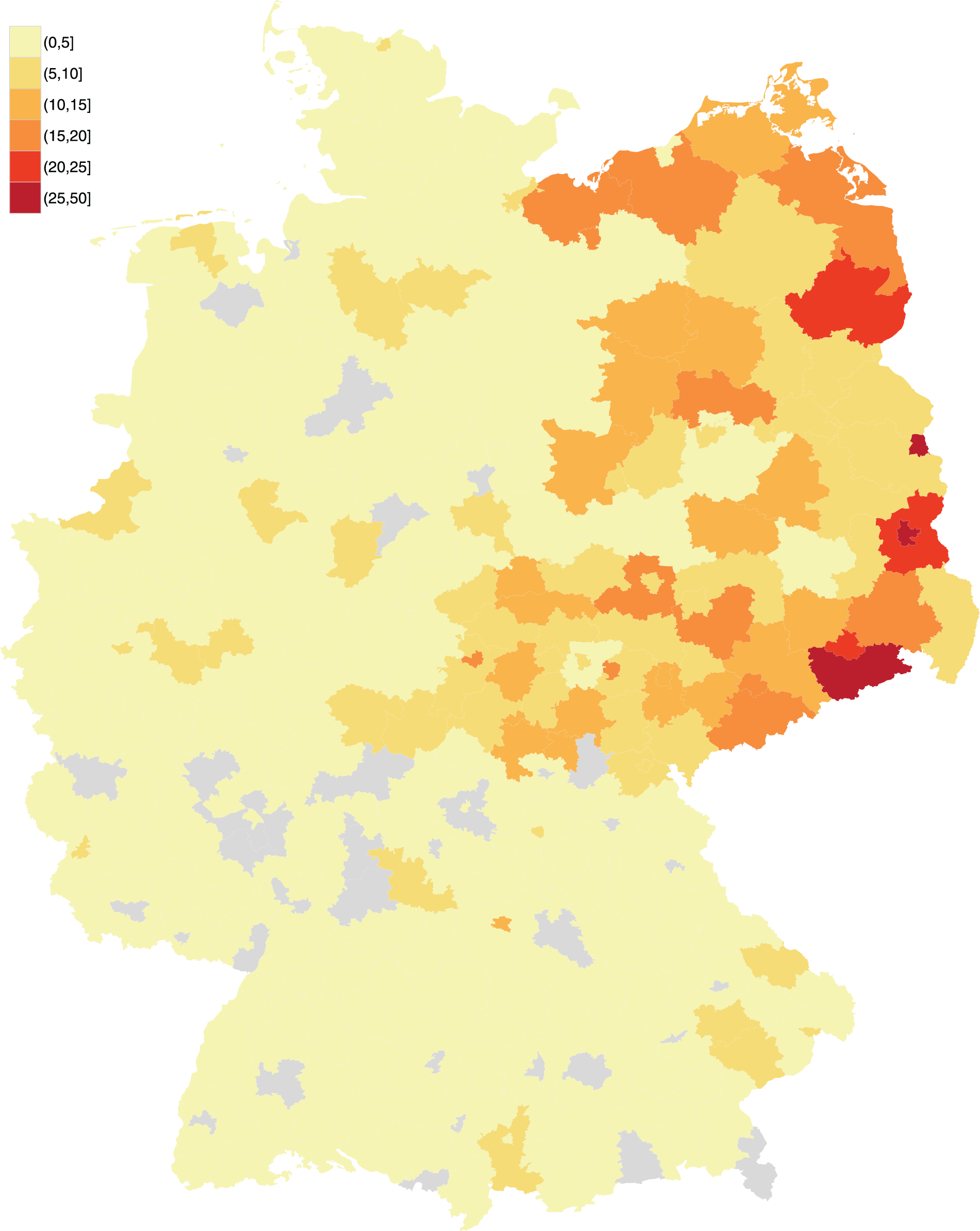
Events per 100 000 inhabitants by district (districts with zero events are grey). Administrative areas: © GeoBasis-DE / BKG 2016.
In order to facilitate disaggregated analyses of the data, the ARVIG dataset also contains the 12-digit Community Identification Number of the respective municipality in which each event has occured. This standardized identifier is taken from official statistics and thus makes it easy to merge highly disaggregated data from other sources with the ARVIG dataset. The data show that 640 individual municipalities within Germany experienced right-wing extremist violence and social unrest against refugees in 2014 and 2015. Berlin has seen the largest number of events (215), 40% of which were demonstrations and 44% were miscellaneous attacks. For more detailed spatial analyses we also provide longitude and latitude of the respective event location.
The dataset also contains the event category provided by MGRG both in German and in English. This enables us to observe an interesting variation as to when events occurred when we analyse each type of event separately: For Figure 5 we again split up multi-category events and added them once to each of their respective categories. We can observe that in terms of their distribution over weekdays, assault, arson and miscellaneous attacks behave quite similarly: They are relatively evenly distributed over all seven days of the week, with minor spikes on the weekends (more prominent for assault and miscellaneous attacks on Saturdays). Demonstrations, on the other hand, show a very strong spike on Saturdays. This could indicate that while demonstrations are planned and organized – they must by law be registered with the police beforehand – the other three types of anti-refugee violence and unrest occur more spontaneously. This distribution is at least to some extent suprising because past research has found that acts of right-wing violence in Germany occur disproportionately on weekend nights (Braun and Koopmans, 2010), a finding that is usually linked to alcohol consumption of young men. Braun (2011) has found that weekend nights – and summer periods – are strong predictors for an increased hazard of xenophobic violence in the Netherlands also, and (as we have mentioned above) he does not even include demonstrations in his categorization of anti-refugee violence, which seems to be the main driver of weekend occurrences in our dataset.

Events by weekdays and category.
Finally, a description of the event (in German) as as well as the source of this description, such as a link to a news website are provided. To illustrate this set of variables, Table 2 provides a sample record from the dataset.
Sample event from the ARVIG dataset.

Conclusion: Using the dataset
The ARVIG dataset complements existing research on the determinants and effects of anti-refugee attacks in Germany and Western Europe with new and systematic data. The event-based coding as well as the supplementary information on event locations make the data useful for a variety of analyses, both event-based or aggregated to German administrative units such as the municipalities (Gemeinden) or districts (Kreise). In that regard, the data presented here offer a starting point to analyze the recent rise in anti-refugee violence from different disciplinary backgrounds, including, but not limited to, criminology, sociology, political science, or economics.
For instance, and as we have outlined in the introduction to this article, a number of studies have reflected upon the determinants of anti-refugee violence in the 1990s; (youth) unemployment, the success of right-wing political parties, and media discourses have each been identified as strong predictors of violent outbursts. It would be interesting to examine if the recent rise in anti-refugee attacks confirms these theories, or whether different predictors have stronger explanatory power.
Kuechler (1994) has for instance argued that in the early 1990s an analysis of survey data indicated “strikingly similar patterns of hostility towards foreigners” between citizens in East and West Germany. Yet our data show a clear divide of anti-refugee violence and unrest between East and West Germany. What factors explain this variation? And what effects does this variation in anti-refugee violence have on other variables, such as patterns of social cohesion within German municipalities, or patterns of integration of asylum seekers? Since we include the Community ID (Regionalschlüssel) in our dataset, researchers have the opportunity to merge ARVIG easily with all official German statistical data in order to explore any underlying relationships.
As an example, our descriptive and preliminary analysis of patterns in anti-refugee violence in Germany in 2014 and 2015 has already pointed to a surprising finding, namely that besides the occurrence of demonstrations, other types of anti-refugee violence are spread evenly across weekdays. As this goes directly against previous findings on the issue, more research on why this is the case would be advantageous. Can we detect, for instance, similar developments for other types of crime?
Events that have gained significant media attention have shaped public and political discourse. Previous research (Koopmans and Olzak, 2004) has established the impact of public discourse on the outbreak of violence. Our event-based data enable researchers to confirm or falsify these findings by identifying key events that may or may not have triggered violence. Is anti-refugee violence, for instance, a direct reaction to fears of terrorist violence in Europe? Does it increase after terrorist attacks (and the subsequent media reports), or are these events unrelated?
Finally, the dataset is also valuable to scholars conducting qualitative or mixed-methods research on the causes and consequences of anti-refugee violence. ARVIG enables scholars to carry out systematic case selection, if, for example, they are trying to compare municipalities with high levels of anti-refugee violence and unrest with municipalities with low levels of such violence.
Footnotes
Declaration of conflicting interests
None declared.
Funding
This research received no specific grant from any funding agency in the public, commercial, or not-for-profit sectors.
Notes
Supplementary material
Data and R code for replicating all figures and tables in this paper are available at http://dx.doi.org/10.7910/DVN/I2CZQY. The ARVIG dataset is made available as an R data package as well as a .csv-file and can be found along with installation instructions at  .
.
Carnegie Corporation of New York Grant
This publication was made possible (in part) by a grant from Carnegie Corporation of New York. The statements made and views expressed are solely the responsibility of the author.