




Abstract
Protests at national party conventions are an important setting in which political parties and social movements challenge one another. This article examines the motivations of participants in these events. Drawing upon data from surveys of protesters outside the 2008 national party conventions, it focuses on how partisan and independent political identifications correspond with the reasons that individuals give for protesting. The results demonstrate that there are some conditions under which independents place a greater focus on issues than do partisans and under which partisans place a greater focus on presidential candidates than do independents. However, there are also conditions under which independents are inclined to work alongside partisans, such as trying to stop the election of a threatening candidate and in championing an issue outside their opposing party’s convention. The article argues that micro-level partisan identifications are thus likely to affect the broader structure of party coalitions. These considerations promise to become increasingly relevant as social movements – such as the Tea Party, Occupy Wall Street, and Black Lives Matter – launch new campaigns against or within established parties.
Keywords
Protests at national party conventions have long been a part of the political landscape in the United States. For example, on June 8, 1908, Samuel Gompers, President of the American Federation of Labor, led a march for labor rights outside the Republican National Convention (RNC) in Chicago (Staff, 1908). Over the years, conventions have seen protests for woman suffrage, civil rights, farm subsidies, peace in Vietnam and Iraq, the right to life and the right to choose, tighter financial regulations on banks, and many other issues. Activists travel to conventions to express their viewpoints because these gatherings symbolize the parties as institutions in a way that no other events do (Edelman, 1964: 95). Activists are often motivated to mobilize outside conventions because it is a relatively easy way to seize media coverage for their causes (Sobieraj, 2011). Convention protests have been especially contentious in the 2000s, which have seen frequent clashes between protesters and police, as well as mass arrests (Hermes, 2015).
Despite the regular appearance of convention protests during the presidential election cycle, relatively little is known about why individuals participate in this type of activism. Are they there to help or hurt a candidate? To promote an issue? To express themselves? To see friends? Or some mixture of all of these? What factors shape these motivations? This lacuna is unfortunate because protest organizers are among the policy demanders that work to shape party coalitions (Bawn et al., 2012). Through these protests, parties and movements meet in the streets outside the conventions in a tangible way. A sizeable body of research has emerged on how leaders in parties and movements influence one another (see, e.g., Clemens, 1997; Frymer, 1999; Schlozman, 2015). Yet, how parties and movements affect, and are affected by, rank-and-file activists remains less-explored territory (but see Heaney and Rojas, 2007, 2015; Layman et al., 2010; Skocpol and Williamson, 2012).
In examining this topic, Fabio Rojas and I (Heaney and Rojas, 2007, 2015) theorize that political parties and social movements sometimes come together in a social space that we call “the party in the street.” This space provides an opportunity for activists to pressure a party to pursue a movement’s issues and, reciprocally, to pressure the movement to support a party’s candidates. We argue that partisan identification draws activists into politics when it serves the party’s interests, but also pushes activists out of politics when their involvement no longer serves the party’s goals. Thus, we see a trade-off between party and movement activism – which is largely to the advantage of parties – at least during periods of high partisan polarization. However, this empirical analysis is limited by the fact that it focuses on issue involvement without considering the actions that activists may try to help or hurt candidates directly.
Samara Klar and Yanna Krupnikov (2016) also examine how partisan identification affects political participation, though they stress the consequences of the decision by an increasing number of citizens to identify as independents, who avoid making public commitments to one of the major parties. They argue that even though independents may tend to vote as if they are loyal partisans, their embarrassment with the parties and with contemporary politics may motivate them to refrain from disclosing their partisan leanings. In particular, independents tend to avoid the kind of interpersonal activism that promotes the flow of partisan ideas through social networks, such as talking to friends about politics and displaying partisan bumper stickers, yard signs, and buttons. This avoidance of partisan engagement on the part of independents is an impediment to the parties’ efforts to win elections and govern.
In contrast to Heaney and Rojas’s (2007, 2015) claim that parties gain from the participation of independents when they are allied with partisans, Klar and Krupnikov emphasize that parties lose when independent identifiers do not participate in politics. Yet, Klar and Krupnikov do not examine what happens when independents do participate in partisan politics. How is their participation different from that of party identifiers? Moreover, their empirical analysis focuses on actions that independents may or may not take to help candidates, but does not consider the potentially powerful actions that independents may take to hurt candidates.
In this article, I argue that combining the Heaney–Rojas and Klar–Krupnikov perspectives on partisan and independent identifications provides significant insights into the competing motivations of protesters outside the national party conventions. It considers that activists may act to help or hurt a candidate, or speak out on an issue, within the same analysis. I argue that partisan identification – or its absence – affects the mixed conditions under which activists seek to be a resource to parties or movements.
The article proceeds, first, by discussing the role of partisan identification and independence in individuals’ participation in activism. Second, it outlines the research design based on a survey of demonstrators outside the 2008 national party conventions. Third, it presents descriptive survey results. Fourth, it reports estimates of probit models for protest motivation. It concludes by considering how political parties and social movements relate to one another at the grassroots level.
Partisans, independents, and activism
Political activism is a widely prevalent form of political participation, though it receives substantially less attention than does voting behavior. Activism reflects individuals’ involvement in politics that takes place informally, such as by participating in demonstrations, writing about issues online, organizing citizens’ groups, and writing letters to elected officials. Using data from a longitudinal study of activism from 1965 to 1997, Catherine Corrigall-Brown (2012) reports that approximately two-thirds of Americans engage in some form of political activism over their lifetimes. Schlozman et al. (2012) argue that this activism redirects the attention of politicians away from the preferences of the median voter and toward the causes championed by activists.
I argue that partisan identification – or the lack thereof – is closely linked with the ways that individuals make sense of their participation in political activism. People that identify closely with a political party may turn to party politics to understand and explain their involvement in activism. They are more likely to be attracted to the competitive aspects of elections that are integral to party politics (Schattschneider, 1960).
People who describe themselves as independents are likely to have different types of concerns about politics than do partisans. As Klar and Krupnikov (2016) point out, independents may be put off by the conflictual aspects of politics to a degree that self-identified partisans may not be. However, they may also reject partisan identities because they are cross-pressured on issues with which they strongly identify (Magleby and Nelson, 2012). Social identities related to these issues, then, may help to motivate protest participation (Polletta and Jasper, 2001). Convention protests usually have a strong issue orientation that is likely to amplify these motivations. As a result, the independents who protest at conventions may not be in the “middle of the road” between the Democratic and Republican parties. Rather, they may identify as independents because there is at least one issue on which they do not think that the parties are extreme enough.
Building on these arguments, it is possible to state a series of hypotheses related to partisan identification, independence, and the motivation of individuals for participating in activism outside conventions. First, partisans at convention protests are likely to want to help the presidential candidate of their party, especially if they are attending the convention at which that candidate is nominated. Thus:
H1: Partisans are more likely than independents to be motivated by the desire to help a candidate if they are protesting at their more-proximate party’s convention.
Second, it is possible that activists protest to hurt the chances of the candidate from the other party. They are more likely to see the opportunity to do so if they are attending the convention of the opposing party. Thus:
H2: Partisans are more likely than independents to be motivated by the desire to hurt a candidate if they are protesting at their more-distant party’s convention.
Third, partisans and independents are likely to be differently motivated by issues. Because their energy is drawn into the competitive aspects of partisan politics, partisans are less likely to articulate their motivations explicitly in issue terms. In contrast, independents are more likely to see issues as closer to their political identities. These propensities underlie the trade-off between party and movement activism. Thus:
H3: Partisans are less motivated to protest by issue considerations than are independents.
Underlying these hypotheses is the more general hypothesis that independents are differently motivated than partisans in attending protests. Independents generally eschew working to affect the chances of candidates and instead concentrate on their issue concerns. Thus:
H4: Partisans and independents are differently motivated to protest in that partisans place a greater emphasis on candidates and independents place a greater emphasis on issues.
Convention protest surveys
This study is based on surveys conducted of protesters outside the 2008 RNC in St Paul, Minnesota and 2008 Democratic National Convention (DNC) in Denver, Colorado. The attitudes of the participants in the protests were assessed using a five-page, pencil-and-paper survey. 1 The questions queried individuals’ motivations for participating in the protest, partisan identification, ideology, emotional engagement in politics, social networks with other protesters, where they live, sex/gender, race/ethnicity, age, level of education, and annual income, as well as other attitudinal and demographic questions.
Surveys were collected at all protests using the “anchor sampling” method developed by Heaney and Rojas (2007, 2014, 2015) as an adaptation of exit-poll sampling. The survey team began by distributing itself throughout the major regions of the crowd. Surveyors were instructed to look into the crowd and select a person to serve as an “anchor” for their counting process. This anchor could be anyone they preferred, though the anchor would not be surveyed on the understanding that s/he might be selected with bias. From the anchor, surveyors counted five persons to the right, and then issued a survey invitation; again, counted five to the right, then issued a survey invitation, continuing until three individuals had accepted the survey. Once three surveys were completed, the surveyor selected a new anchor and repeated the procedures. Non-responses were recorded for the purpose of tabulating response rates. Research shows that if these surveys are conducted with attention to ensuring random selection and account for biases in non-response, then they can generate samples that are a good representation of the individuals attending the protest (Walgrave and Verhulst, 2011).
Who are convention protesters?
The survey yielded 412 respondents from the DNC, with a response rate of 65 percent, and 990 respondents from the RNC, with a response rate of 77 percent. All of the analysis reported here is weighted according to differences in response rates and accounts for different variances in the two strata of the survey (i.e. the DNC and the RNC).
The partisan breakdown of protest participants is provided in Figure 1. The distribution has a strong, overall skew toward non-Republicans. Republicans and people who lean Republican made up about 6 percent of protesters at the RNC and 11 percent of protesters at the DNC. Among other participants, there was a greater percentage of independents at the DNC and a greater percentage of Democrats at the RNC. Roughly 36 percent of protesters at the RNC were independents, as were 44 percent of respondents at the DNC. Democrats and Democratic leaners made up 45 percent of protesters at the DNC and 57 percent at the RNC.
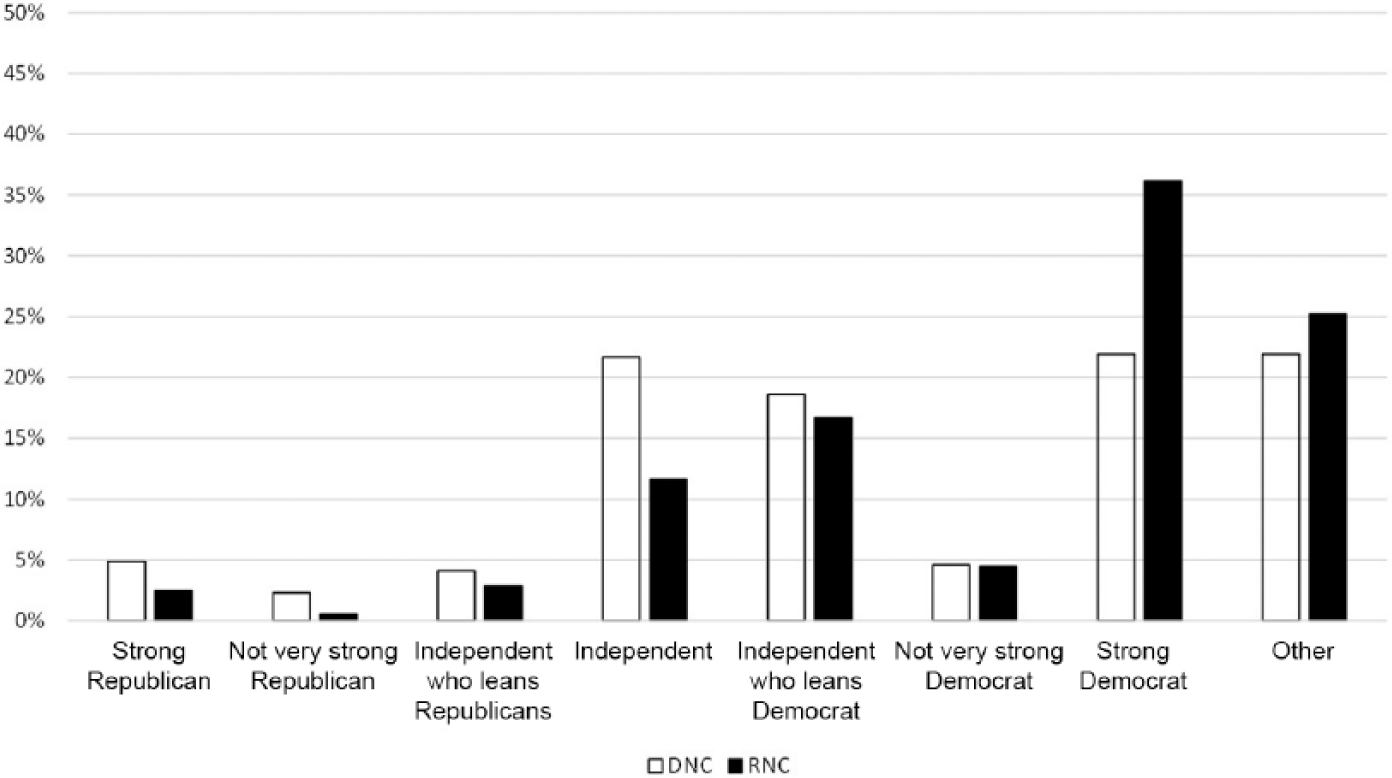
Partisan identification of protesters by convention.
Respondents were asked “Which are the most important reasons that you decided to come to this convention?” They were shown a list of 12 options (plus “other”) and asked to circle up to three of them. This article focuses on three of these options: (1) “To help a candidate win this year’s presidential election”; (2) “To help prevent a candidate from winning this year’s presidential election”; and (3) “To express my view on a particular issue or issues.” Respondents who indicated that they were motivated by issues were also asked to “Please specify the top issues.”
Selected motivations are reported by convention in Figure 2. 2 Respondents were more likely to seek to help a candidate at the DNC (14%) than at the RNC (10%) and more likely to seek to hurt the chances of a candidate at the RNC (18%) than at the DNC (7%). However, issues provided a more powerful source of inspiration for these respondents. 3 Approximately 32 percent of DNC protesters and 44 percent of RNC protesters were motivated by issues. 4 War and peace was the issue most commonly mentioned, with 27 percent of respondents volunteering this motivation. There was a significant fall-off after war/peace, with 6 percent concerned about the economy, 5 percent mentioning health, 4 percent calling for group rights, 3 percent pointing to problems with the environment, and all other issues falling below this threshold.

Selected motivations of protesters by convention.
Models of protest motivation
This article estimates three probit regression models of protest motivation: one for helping a candidate, one for hurting the chances of a candidate, and one for issue motivation. Complete-case imputation (Little, 1988) was used to replace the values of missing data, which is an appropriate method given the low percentage of missing data (King et al., 2001).
Each equation includes the same independent variables. The first focus variable is More-Proximate Party Convention. This variable takes the value of 1 if a Strong Democrat, Not Very Strong Democrat, or Independent Who Leans Democrat is protesting the DNC; or, if a Strong Republican, Not Very Strong Republican, or Independent Who Leans Republican is protesting the RNC; 0 otherwise. The second focus variable is More-Distant Party Convention. This variable takes the value of 1 if a Strong Democrat, Not Very Strong Democrat, or Independent Who Leans Democrat is protesting the RNC; or, if a Strong Republican, Not Very Strong Republican, or Independent Who Leans Republican is protesting the DNC; 0 otherwise. The implicit excluded category is independent, which combines both middle-independent category and the other-independent category.
The remaining variables are included for the purpose of statistical control. Ideology is measured on a 9-point ordinal scale from left to right, with “To the ‘right’ of strong conservative” receiving a score of 9 and “To the ‘left’ of strong liberal” receiving a score of 1. Enthusiasm about Politics and Anxiety about Politics are included in order to account for positive and negative emotional engagement with the political process. They are measured on a 5-point ordinal scale, with people reporting enthusiasm and anxiety “Almost Always” receiving a 5 and people who “Never” experience enthusiasm and anxiety receiving a 1. Social Networks at Protest accounts for the possibility that people that perceive that they are well connected at the protest may be motivated differently than people that perceive that they are poorly connected at the protest. Live in State of Convention controls for the possibility that local people are differently motivated than those that travel a considerable difference to protest the convention. Sex/Gender takes the value of 1 for women and 0 for men. Race/Ethnicity takes the value of 1 for whites and 0 for nonwhites. Age is measured in years. Education is measured on a 6-point ordinal scale, with “Graduate or professional degree” receiving a score of 6 and “Less than high school diploma” receiving a score of 1. Income is measured in thousands of dollars for 2007.
Probit results are reported in Table 1. The estimates in equation (1) are consistent with H1. They show that when partisans are protesting at their more-proximate party convention, they are more likely than independents to do so for the purpose of helping a candidate for president. Additionally, consistent with H4, the results show that partisans protesting at their more-distant party’s convention are also more likely than independents to want to help a candidate for president. That is, they may see their protest of the opposing party directly in terms of being helpful to their home party. On this point, independents are clearly different from partisans: they are very unlikely to protest with the intention of helping a candidate. Only about 6 percent of independents reported doing so.
Probit models of protest motivation.

SD: standard deviation; SE: standard error.
p ⩽ 0.05.
p ⩽ 0.01.
p ⩽ 0.001.
The estimates in equation (2) are consistent with H2. They show that when partisans are protesting at their more-distant party’s convention, they are more likely than independents to work to hurt the chances of a candidate. However, the results are not entirely consistent with H4. The estimates reveal that independents are significantly more likely than partisans attending their more-proximate party’s convention to protest with the intention to hurt the chances of a candidate. Thus, rather than being strictly less interested in candidate politics than are partisans, independents occupy a middle ground. About 10 percent of independents were motivated to stop a candidate, which was more than the 4 percent of partisans at their more-proximate convention and less than the 25 percent of partisans at their most-distant convention.
The estimates in equation (3) support H3. They demonstrate that partisans at their more-proximate party convention are less likely than independents to protest because of issue concerns. However, again, the results are not entirely consistent with H4. There is no statistically significant difference in the degree to which they are motivated by issues between independents and partisans when they are attending their more-distant party’s convention. About 40 percent of independents and 46 percent of partisans at their more-distant convention came out due to issues. In contrast, only 28 percent of partisans at their more-proximate convention mentioned issues as one of their reasons.
The effects of the control variables exhibited variation across the equations. Anxiety about politics had significant, positive correlations across all three equations, though enthusiasm about politics only significantly contributes to helping a candidate. Women were more likely than men to be motivated by issue politics and to hurt the chances of a candidate, but were no different from men in wanting to help a candidate. Older respondents were more likely than younger respondents to be motivated by issues, but age was not associated with differences in motivations about affecting candidates’ chances. Ideology, Social Networks at Protest, Live in State of Convention, Race/Ethnicity, Education, and Income were not significantly related to the dependent variables in any of the equations.
Given that the largest group of issue-focused protesters were concerned with issues of war and peace, I considered what would happen if this group was removed from the analysis. The results of this alternative specification are presented in Table 2. The pattern of direction and significance (or lack thereof) matches the main analysis for five of six coefficients that were the focus of the hypothesis tests. From these results, we can conclude that if issues of war and peace moved off the agenda (which, for example, was largely the case during the 2016 convention protests), the effects of partisan and independent identities would likely remain very similar.
Probit models of protest motivation – no antiwar protesters.
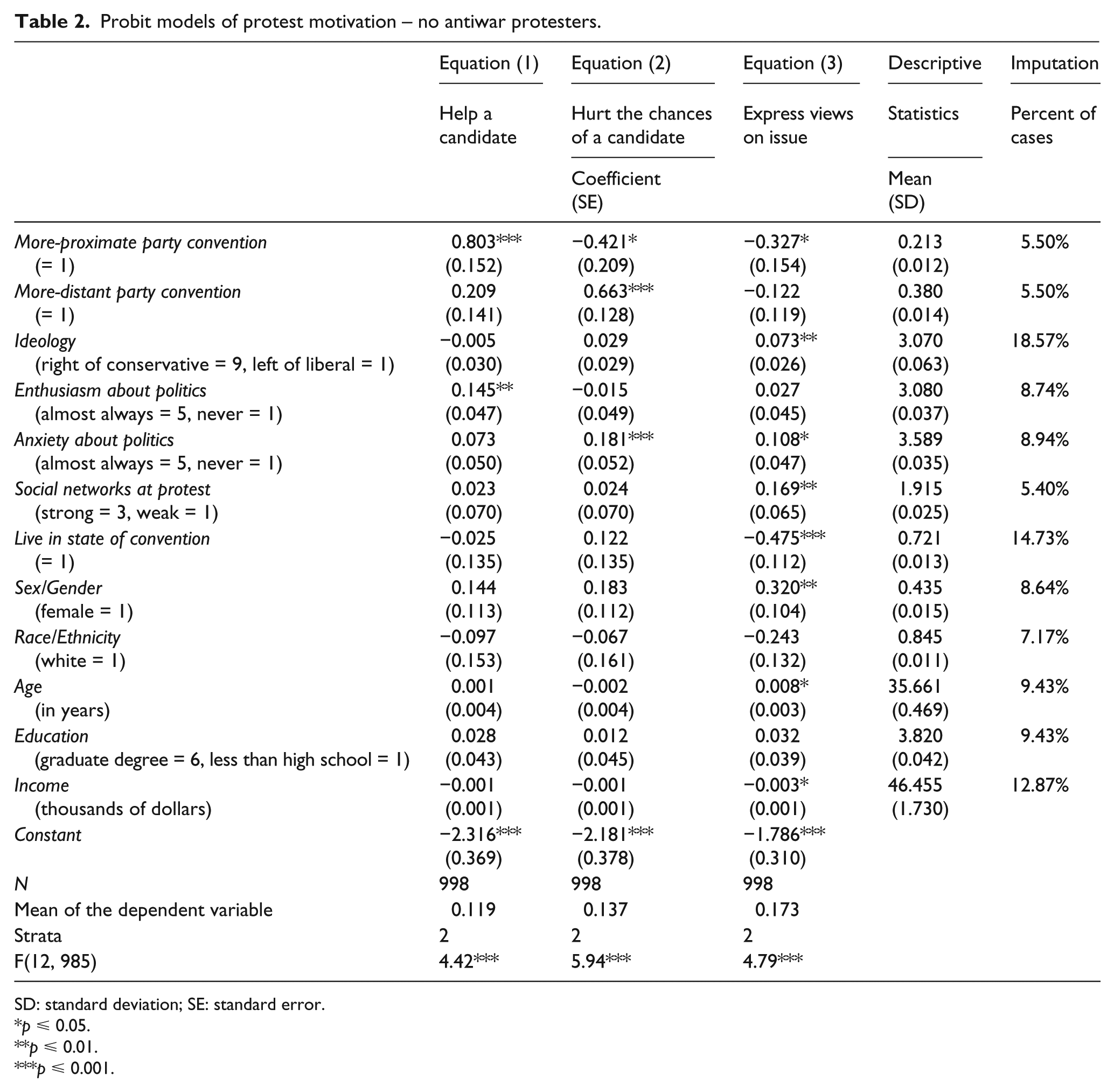
SD: standard deviation; SE: standard error.
p ⩽ 0.05.
p ⩽ 0.01.
p ⩽ 0.001.
Conclusion
The results of this study exhibit consistencies and inconsistencies with the extant literature. Consistent with Klar and Krupnikov (2016), the results show that independents are much less likely than partisans to work to help a candidate. Likewise, consistent with Heaney and Rojas (2015), the results demonstrate a trade-off between issues and party activism, as protesting at one’s own party convention is associated with candidate, rather than issue, motivations. However, in contrast to the argument of Klar and Krupnikov, the results reveal that independents are more prone than some partisans to protest with the intention of stopping a candidate. One possible explanation, suggested by prospect theory (Kahneman and Tversky, 1979), is that independents are more likely to join the partisan fray if they see the need to stop a loss (i.e. the election of a bad candidate), than to achieve a gain (i.e. the election of their preferred candidate). Thus, it may be presumptuous to count independents completely out of partisan politics. In contrast to Heaney and Rojas, the results indicate there is not necessarily a trade-off between party and issue activism when partisans are protesting their most-distant party’s convention, where partisans are often fighting for issues right beside independents.
It is a mistake to see independents as having abandoned electoral politics; though, under certain conditions, they do exhibit less concern than do partisans. Yet it must also be considered that a growing share of independents in the population represents an opportunity for movements. If movements can mobilize people based on issue identities – rather than partisan identities – then they may better withstand the vicissitudes of partisan politics. Advocates truly committed to issues may be more likely to push back against parties, even when their more-preferred party is in office, thus sowing the seeds for increased relevance by movements in American politics.
Looking to the future, both the Democratic and Republican parties in the United States are facing increased contention from social movements – such as the Tea Party, Occupy Wall Street, and Black Lives Matter – some of which is likely to manifest itself through convention protests. Politically oriented scholars would be well-advised to be attentive to these dynamics in order to understand how organized (and disorganized!) groups may be disruptive to party coalitions.
Supplemental Material
Supplementary_material – Supplemental material for Unconventional protests: Partisans and independents outside the Republican and Democratic national conventions
Supplemental material, Supplementary_material for Unconventional protests: Partisans and independents outside the Republican and Democratic national conventions by Michael T. Heaney in Research & Politics
Supplemental Material
Unconventional_Protests_Replication_Materials – Supplemental material for Unconventional protests: Partisans and independents outside the Republican and Democratic national conventions
Supplemental material, Unconventional_Protests_Replication_Materials for Unconventional protests: Partisans and independents outside the Republican and Democratic national conventions by Michael T. Heaney in Research & Politics
Footnotes
Acknowledgements
Data for this paper were collected as a joint effort with Dara Strolovitch, Joanne Miller, and Seth Masket. The author appreciates the generosity of his collaborators in allowing the use of the data for this project. An earlier version of this article was presented at the William and Flora Hewlett Foundation Conference on “Parties, Polarization and Policy Demanders”, University of Maryland, College Park, 9–10 June 2016. For helpful comments, thanks are owed to Stephanie Evans, Stephen Garcia, Ethan Kaplan, Ken Kollman, Michael Martinez, Lilliana Mason, Rob Mickey, Nurlan Orujlu, Zoe Van Dyke, and Winnie Wang.
Correction (March 2025):

Declaration of conflicting interests
None declared.
Funding
This work was supported by the National Science Foundation, Small Grants for Exploratory Research (grant numbers 0842474 and 0842371) and the Center for Urban and Regional Affairs at the University of Minnesota.
Supplementary material
Notes
Carnegie Corporation of New York Grant
The open access article processing charge (APC) for this article was waived due to a grant awarded to Research & Politics from Carnegie Corporation of New York under its “Bridging the Gap” initiative. The statements made and views expressed are solely the responsibility of the author.
References
Supplementary Material
Please find the following supplemental material available below.
For Open Access articles published under a Creative Commons License, all supplemental material carries the same license as the article it is associated with.
For non-Open Access articles published, all supplemental material carries a non-exclusive license, and permission requests for re-use of supplemental material or any part of supplemental material shall be sent directly to the copyright owner as specified in the copyright notice associated with the article.
