



Abstract
Research on policy responsiveness to public opinion highlights differences owing to political institutions—both electoral and governmental. Electoral institutions that produce coalition governments tend to reduce responsiveness in between elections. Government institutions that divide powers horizontally, by contrast, appear to increase that responsiveness. These findings point to the role of institutional “friction” in shaping what governments do, though the two sources appear to produce different effects—one harmful and the other helpful. This paper explores this apparent contradiction. We revisit and clarify theoretical assumptions and outline alternative models of the effects of friction. Extending previous tests, now in 18 countries, we find clearer evidence supporting that earlier research and more firmly establish friction as the mechanism, particularly as regards the influence of electoral systems. The two institutional sources of friction appear to influence responsiveness in different ways, which has implications for politics and policy that we consider in the concluding section.
Keywords
A growing body of research examines how institutional arrangements affect policy representation. Early work on the subject considered the “congruence” between positions of the public and the government immediately after elections, beginning with Powell’s (2000) classic study. 1 More recent research examines “responsiveness” of governments as public preferences change, some of which concentrates on actual policy decisions (e.g., Ezrow, Fenzl, and Hellwig 2023; Soroka and Wlezien 2010). 2 The latter may help account for what governments do in between elections, which matters because preferences can change; indeed, responsiveness may be necessary for effective congruence during those periods.
Political institutions may influence responsiveness in various ways. To begin with, consider that they can introduce “friction” into the policymaking process, working to constrain policy change (Jones and Baumgartner 2005; Jones et al., 2009; Tsebelis 2002). This can inhibit responsive policymaking even when governments are in ideological alignment with the public by making it harder to act. Consider that parties in a coalition government might have difficulty undertaking policies because the agreements that brought them together are constraining of action thereafter. But, it also may be that friction actually boosts responsiveness, for instance, in systems offering checks and balances, which some research finds to be more responsive than those with little to no horizontal friction (Wlezien and Soroka 2012). The idea is that independent executive and legislative institutions may produce greater responsiveness because of the “error correction” that the process allows, for example, in the United States, the President responds but may over- or under-shoot, and Congress adjusts policy accordingly.
To understand why at least some forms of friction can be beneficial, it is necessary to recognize that governments do not mechanically enact policy perfectly in line with public preferences. Policy is produced by officials within government acting on imperfect incentives and information, and their sense of what the public wants can be warped partly due to their own preferences and biases, but also because officials can misperceive public opinion even when they are trying to represent it. When some policymakers try to enact policy that is unresponsive to the public’s wishes, the friction introduced by dividing power has the potential to increase responsiveness by moderating policy change. Being able to change policy easily is not always representationally advantageous; indeed, it may lead to misrepresentation. Checks and balances thus can be beneficial. This does not mean that more friction always is better, however, or that all types of friction are equally beneficial.
Investigating these possibilities requires taking a closer look at the sources of friction arising from electoral systems and government institutions. We begin by reviewing existing work, noting its implications for the relationship between friction and policy responsiveness. We show that current scholarship leads to contradictory expectations, where in some cases friction-enhancing arrangements are thought to harm responsiveness and in other cases to help it. We then search for a resolution to this puzzle by revisiting theoretical expectations and extending empirical tests.
Using data on aggregate public preferences and budget outputs across 18 countries at up to five points in time, we assess the conditioning effects of institutional features on the responsiveness of policy to public opinion. The approach we employ allows us to consider how variation in institutional friction—across countries and time for coalitional fragmentation and across countries for executive dominance—influences responsiveness to public preferences. This follows previous research by Soroka and Wlezien introduced above, and also that by Coman (2015) and Ferland (2020) on electoral systems, which differs from other work (e.g., Rasmussen, Reher, and Toshkov 2019; Toshkov, Mäder, and Rasmussen 2020) that focuses on variation in adoption across issues at particular points in time. Although our data do not allow a fully dynamic analysis—because the public opinion time series are limited—they make it possible to examine how variation in institutional settings influence the impact of changing preferences on what governments produce. This is important, we think, as it permits us to take a step forward empirically and contribute to scholarly understanding of institutions and policy responsiveness, even as it only takes us so far.
The results are largely consistent with existing findings about whether certain institutional arrangements improve or worsen responsiveness, but they add to our understanding of how these institutions matter. We confirm previous research showing that proportional (PR) electoral systems are less responsive than majoritarian ones, but also uncover seemingly strong evidence that the mechanism of government coalitional friction primarily explains these differences. We also confirm previous research showing that systems with dominant executives tend to be less responsive than those with more balance. Thus, the different—electoral and governmental—institutional sources of friction appear to influence the policy process differently. These findings have implications for our understanding of government performance but also for both public evaluations of institutions and election outcomes, which we contemplate in the concluding section together with possible directions for future research.
Friction and the Policymaking Process
One of the most important ways institutions shape the actions of government is through policymaking friction (Jones, Sulkin, and Larsen 2003). This perspective is echoed in research on “veto players,” where institutions that increase the number of actors with power over policy are understood to be more friction laden (Tsebelis 2002). Friction affects the ease with which governments can change policy and, as a result, leads to less productive governments (Tsebelis 1999) with more “punctuated” policy outputs (Jones and Baumgartner 2005; Jones et al., 2009). Scholars have begun to incorporate friction into models designed to predict other outcomes of the policymaking process like the degree of inequality (Enns et al., 2014; Stepan and Linz 2011). Here, friction serves to weaken responsiveness to problems, with impacts on real world outcomes.
Given this line of thinking, it would be easy to suspect that friction-enhancing arrangements necessarily worsen responsiveness to public opinion. Consider the following statement from Caughey and Warshaw’s (excellent) book on policy change in the American states: “Due to the piecemeal and incremental nature of policy change, it often takes years or even decades for the force of public opinion to filter through the political process” (2022, 4). If the policymaking process were less piecemeal or less incremental, responsiveness seemingly would improve. That said, as we have already suggested, there also is reason to think that institutional friction might be beneficial to policy responsiveness. Perhaps some friction is a good thing.
To our knowledge, no existing research offers a generalized explanation of how friction affects this responsiveness. While different strands of research on the effects of various institutions on responsiveness speak to the issue, as we shortly show, these perspectives are disconnected from one another and often lead to divergent expectations. One possible reason for this is that friction does not have a uniform effect on responsiveness, a claim that we develop and test. Although various institutional factors can influence the level of friction experienced in government, we focus primarily on those that have received the most attention in existing comparative research on responsiveness—electoral systems and the horizontal division of powers.
How Institutions Affect Responsiveness
“Responsiveness” has been used in different ways by scholars of representative democracy. Some use the word to refer to a positive correlation between public preferences and policy across space, as distinct from congruence between the two (Achen 1978; Lax and Philips 2012; also see Pitkin 1967; Wlezien 2017). 3 In other work, it takes on a dynamic element, involving policy changing in response to changes in public opinion, that is, “shocks” to those preferences (Caughey and Warshaw 2022; Erikson, Mackuen, and Stimson 2002; Soroka and Wlezien 2010).
The latter strand of research may seem to better capture true responsiveness, as policymakers effectively react to the public, but note that we can observe such evidence without actual responsiveness to public opinion. First, there may be indirect representation owing to elections, whereby the public selects a group of (more) like-minded officials who in turn change policy in accordance with what the public wants; here, policy responds even as policymakers do not. Second, there may be coincidental representation, where the public and elected officials both respond independently to the same forces; here, observed responsiveness is spurious. These alternatives are difficult to explicitly (and fully) test, so scholars in practice are assessing “statistical” responsiveness, which some recognize (see, e.g., Wlezien 2004; Soroka and Wlezien 2010).
Although research on responsiveness emerged in the US context, a burgeoning literature now compares opinion-policy dynamics across countries, examining the effects of different institutional characteristics. These studies typically focus on electoral systems (see Coman 2015; Ferland 2020; McGann, Dellepiane-Avellaneda, and Bartle 2023; Soroka and Wlezien 2015; Toshkov, Mäder, and Rasmussen 2020; Wlezien and Soroka 2015) but there is some work on government institutions (Ezrow, Fenzl, and Hellwig 2023; Soroka and Wlezien 2010), and on both (Wlezien and Soroka 2012). When the different strands of research are taken together, however, a contradiction emerges. The theoretical expectations and empirical results of research on electoral systems contrast with (most of) that on government institutions with respect to the effects of friction. Although various mechanisms could explain the differences, existing accounts tend to highlight the role of friction, if only implicitly.
Electoral Systems and the Hindrance of Friction
Scholars have long been concerned with how electoral systems affect representation. Lijphart (1984) provides one popular interpretation, suggesting that PR improves representation insofar as it allows for the expression of a greater number of viewpoints. Majoritarian systems—those with simple plurality rules—tend to produce a two-party system (or something close to it) and single-party governments and, therefore, necessarily do worse at capturing the range of political ideologies held by the public. As the number of parties goes up, therefore, so too should a government’s ability to represent the public.
Powell’s (2000) influential research also pointed in this direction, but with a more explicit logic. He argued that PR systems better represent the median voter since government formation will tend to require coalitions of parties, bringing the (weighted) average of positions closer to the median voter by comparison with majoritarian systems, where parties tend to be set off to the left and right. Importantly, later research challenged Powell’s initial findings, showing little difference between systems (see Blais and Bodet 2006; Dalton, Farrell, and McAllister 2011; Golder and Stramski 2010), possibly owing to party polarization (Powell 2013).
By contrast with scholarship on positions, a growing body of work has turned to assessing what governments do, specifically, their policy decisions both after and between elections. Here, scholars have hypothesized and found a contrasting pattern, where PR systems exhibit weaker responsiveness to changes in public preferences, which worsens with the greater number of parties (Coman 2015; Ferland 2020; Soroka and Wlezien 2015; Wlezien and Soroka 2012). Figure 1 illustrates the relationship in a basic linear way, for expository purposes. The idea is that, while PR allows for more parties to flourish and may encourage more centrist governments after elections, it dampens those governments' ability (and/or willingness) to respond to changing public opinion in between elections. Hypothetical relationship between proportionality and responsiveness.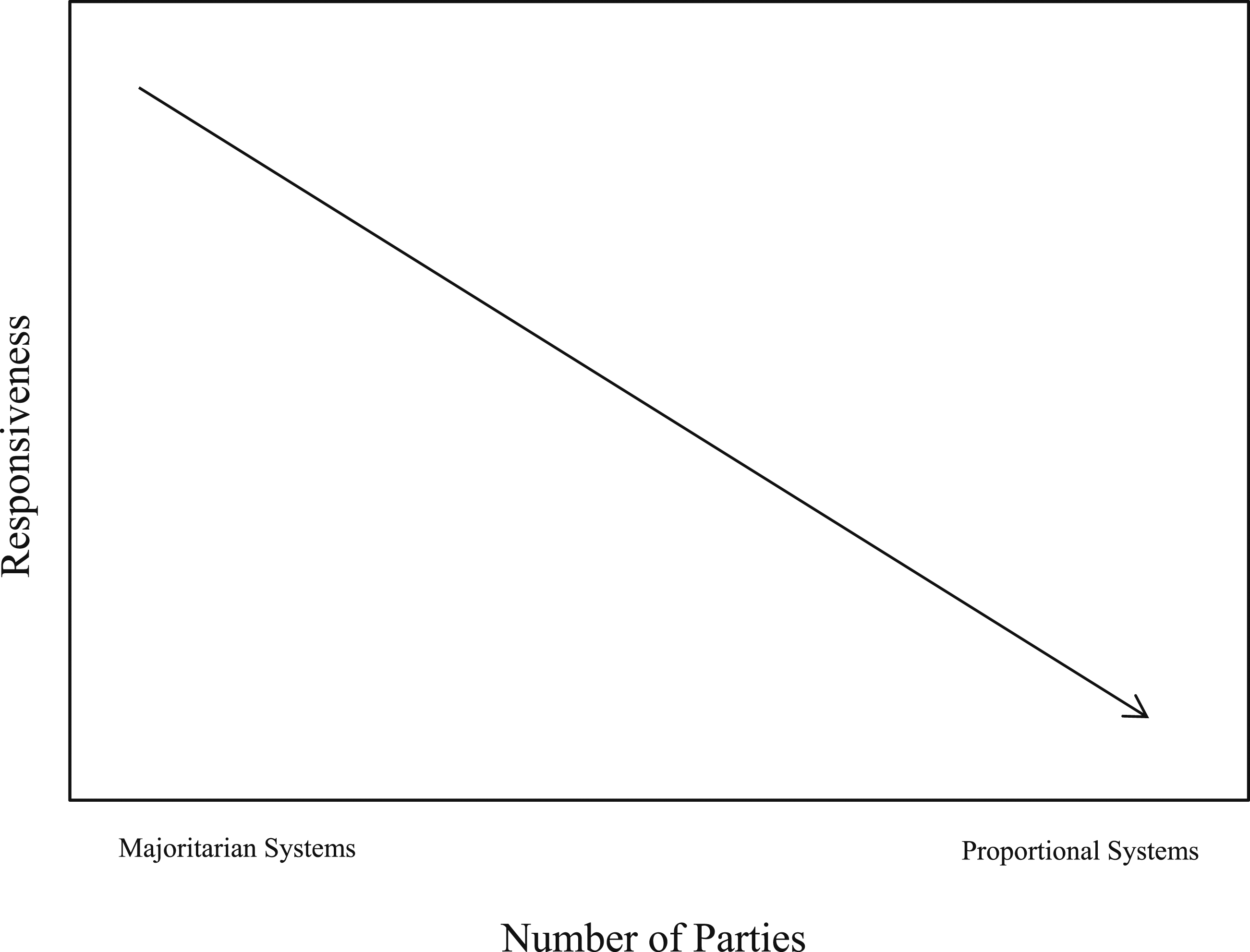
While there are at least two explanations for the pattern on display in Figure 1, it has been suggested that the primary culprit is the added friction in multiparty governments produced by PR (Soroka and Wlezien 2015). When opinion shifts occur, coalitions are saddled with the difficulty of coordinating a response between parties. The difficulty only increases as the number of parties in government goes up. Cabinets can attempt to resolve some of the coordination costs associated with multiparty governance by forming coalition agreements (Bergman et al., 2023; Klüver, Bäck, and Krauss 2023; Müller and Strøm 2008). But, even with lengthy and detailed coalition agreements in place, cabinet governments will experience more friction than single-party governments because the compromises included in these agreements serve to bind the hands of policymakers acting later (Peterson and De Ridder 1986).
The effect of electoral systems on policy responsiveness thus really amounts to a story about friction within government. Majoritarian systems that produce single-party governments experience no inter-party friction, while PR systems, at least those that seriously fragment parties, do experience such friction, increasingly it seems as the number of parties increase. This is not to say that there is not intra-party friction in governments in either majoritarian or PR systems, but that inter-party effects are—or at least may be—of special importance.
Although this explanation has intuitive appeal, so far evidence for it has only been suggestive. The variable that is traditionally used to demonstrate the relationship on display in Figure 1 is the effective number of parliamentary parties, which we would expect to correlate with cabinet friction but not directly capture it. More direct attempts to measure cabinet fragmentation have offered inconsistent evidence (Coman 2015; Ferland 2020; Soroka and Wlezien 2015). Toshkov, Mäder, and Rasmussen’s (2020) recent study of responsiveness among parliamentary democracies actually found no evidence that increasing the number of parties within a government leads to declining responsiveness. 4
Government Institutions and the Benefits of Friction
There is also work, albeit less, on government institutions. Here, research argues and finds that increases in executive-legislative balance improve policy responsiveness, as illustrated in Figure 2. In other words, the greater the horizontal balance of powers in a country, the more responsive government is to changes in public preferences. The first word on this subject comes from Soroka and Wlezien (2010), who show that politicians adjust spending in response to changes in public preferences, that is, as part of the “thermostatic” relationship between opinion and policy, and that responsiveness is greater in the United States (US) than in either the United Kingdom (UK) or Canada. They suggest that this difference may be explained by the greater amount of executive-legislative balance in Madisonian systems compared to parliamentary ones, bearing in mind that the level of balance varies within presidential and parliamentary systems. It is slim evidence, however, and so it is important that they expanded the analysis to include 17 countries and found that executive-dominated systems are (slightly) less responsive on average than those with more balance (Wlezien and Soroka 2012). Hypothetical relationship between executive-legislative balance and responsiveness.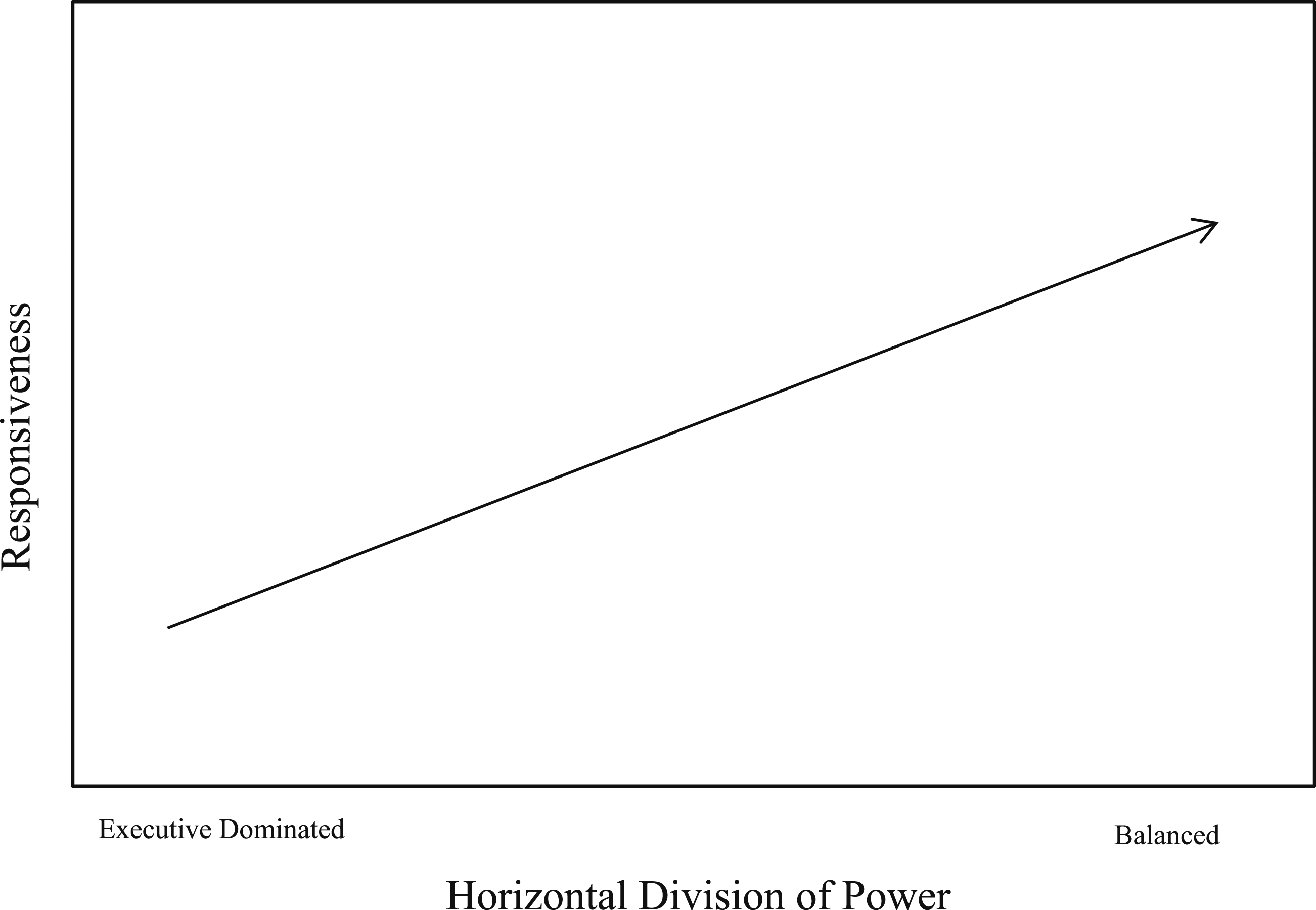
Why would increases in executive-legislative balance improve responsiveness? Soroka and Wlezien (2010) theorize that balance results in a policy process that can “error correct” due to the checks the two branches can place on each other. Presidents may attempt to enact policy but cannot do so without the legislature, and much the same is true for Congress. This prevents either institution from enacting extreme policy positions, improving the probability that policy change is in alignment with public opinion. Indeed, it may be that such error correction occurs even when both actors want to represent public preferences. Wlezien (1996) found evidence of such a process in the US, where Congress has altered responsive presidential proposals for defense spending to make them more responsive to public opinion. It also may be that presidents effectively anticipate congressional action (Kiewiet and McCubbins 1991).
In contrast to Madisonian presidential systems, many, though not all, parliamentary systems are characterized by legislative-executive imbalance, where cabinets effectively dominate the legislature and few moderating checks exist (see, e.g., Bagehot 1867; Jennings 1959; also see Cox 1987; Laver and Shepsle 1996). As a result, “when there are differences between what the cabinet and parliament want, the latter cannot as effectively impose its own contrary will,” leaving little room for error correction (Wlezien and Soroka 2012). In short, the added friction produced by separate institutions sharing power, requiring interbranch coordination, may serve to bolster policy responsiveness. As such, Madisonian presidential systems are thought to populate the right side of Figure 2 while parliamentary systems featuring imbalance are expected to occupy the left side. Strong presidential systems that reflect such imbalance should likewise display inferior responsiveness.
What is most important to us is that juxtaposing scholarship on electoral systems and government institutions presents a puzzle. That is, research indicates that friction is both beneficial and detrimental, weakening responsiveness as the number of parties increases but strengthening it as government policymaking responsibility is divided. Even more puzzling, as discussed above, the theoretical explanations for the two phenomena implicate friction but in opposite directions. The added difficulty of coordination in multiparty coalition governments is thought to hinder responsiveness because it prohibits action. Conversely, the need for inter-institutional coordination in Madisonian systems is thought to improve responsiveness because it requires compromise between veto players. If the research on electoral systems is correct, why don’t the challenges of coordination plague systems with divided governing institutions? If the research on governing institutions is correct, why don’t additional parties produce greater responsiveness? To proceed towards answering these questions, let us begin by revisiting theoretical expectations.
Theories of Friction and Responsiveness
How should institutional friction affect the probability that governments enact responsive policy? Some scholars and other observers might suppose that friction would hurt responsiveness, as it places limitations on policymakers' ability to react to changes, including in public preferences (Jones and Baumgartner 2005; Jones et al., 2009; Tsebelis 2002). From the problem-solving perspective, for example, we expect more catastrophes where friction is high, as it limits policymakers' ability to respond to emerging problems (Fagan 2023). While there is strong intuition for this expectation, it assumes that policymakers want to follow public preferences and that they have good information about those preferences.
But suppose policymakers do not care about public preferences and instead pursue policies based solely on their own preferences. Responsiveness in this case would not be impossible, just coincidental. On some issues policymakers may happen to have the same preferences as the public. As such, institutional arrangements that bolster the likelihood of coincidental responsiveness will perform better. And it is possible to predict which types of arrangements might do just this because we, as researchers, know something about the preferences of publics and elites, namely, the preferences of the former tend to be more moderate than those of the latter (Bafumi and Herron 2010; Fowler et al., 2023; but see Broockman 2016; Ahler and Broockman 2018). At the very least we would expect mean citizen preferences to be positioned between the preferences of parties, which may be off to the left and right. As such, institutions that balance the opposing positions of political elites against each other will tend to increase representation through promoting moderation. Note that this perspective is essentially the same as Powell’s (2000) argument about how PR systems tend to produce more congruent governments. Importantly, it also applies to dynamic representation and responsiveness.
A similar conclusion is reached when considering a scenario where policymakers have some incentive to represent public opinion, but an imprecise sense of what that opinion is. Here, we again would see the potential benefits of friction. Where there is limited friction and lots of policy discretion, a misguided view of public preferences is not likely to be corrected. But through the addition of checks, opposing politicians are in a position to challenge, and effectively correct, representational errors. Friction, in other words, may make the policy process more deliberate. If policymakers have a desire to represent the public, increases in friction may produce increases in responsiveness.
There thus are good reasons to think that friction can improve responsiveness to preferences. Yet, that does not mean friction should always prove beneficial. To respond to changes in preferences, policymakers must be able to undertake change, and friction imposes constraints on whether they can do so. We are then left with two opposing expectations—one where friction hinders responsiveness and one where it helps it. How can these perspectives be reconciled? Two potential answers present themselves.
First, it may be that a friction “sweet spot” exists. The ability to change policy should be a necessary but insufficient condition for policy responsiveness. Any institutional arrangement that possesses so much friction that it makes policy change (nearly) impossible will perform poorly from a responsiveness standpoint. However, this does not mean that the absence of friction will maximize that responsiveness; indeed, adding some amount of friction could be beneficial. The argument here relates to other work finding satisfactory middle-grounds, namely, Singh and Carlin’s (2015) research showing that citizens' perceptions of democracy are most favorable when presidents have neither too much nor too little power. Perhaps this is because policy is more responsive in these scenarios.
Second, it may be that different forms of friction simply function differently. Conceivably, not every manifestation of friction will promote consensus-seeking and deliberation. For instance, balanced, independent actors may be especially likely to correct representational errors because different parts of government can act and react to one another. Multiparty coalition governments do not possess that advantage. Perhaps more important, changes in policy are limited by potentially conflicting interests of coalition partners, making it difficult to reach the agreement necessary to respond to changing public opinion (see Calvo, Hellwig, and Chang 2013).
To summarize, there are reasons to think friction may both help and hinder responsiveness, and we propose two ways of reconciling these perspectives. In the first, friction has a curvilinear relationship with responsiveness. Here, friction may help, but only up to a point, afterward it produces significantly worse effects. In the second view, some versions of friction are “good” and others “bad.” Some types of friction results in a process prone to produce responsive policy while other types do not. We can test these two possibilities.
Data and Methods
To assess responsiveness, we adopt a dynamic model of policy representation, following the work of Soroka and Wlezien (Soroka and Wlezien 2010; Wlezien 1996 2004). There, policy change at time t (∆P
t
) is a function of lagged relative preferences at the previous point in time (R
t-1
) as well as other factors, most notably, the partisan control of government (G
t-1
), but also economic and fiscal constraints (O
t-1
). This is represented in the following equation:

The following equation is used to examine the influence of electoral systems on responsiveness across countries

Although the equation (2) and the foregoing discussion focus on electoral systems, the influence of government institutions can be assessed in the same manner, indeed, in the same equation. The effects of different institutions can be estimated separately to be sure, but since we expect both electoral and government institutions to matter independently, we cannot obtain valid estimates of the effect of one without taking into account, that is, controlling for, the effect of the other. This accords with the previous research (Soroka and Wlezien 2015; Wlezien and Soroka 2012), which we follow in the analyses reported in the main text, though we also report results of estimating the institutional effects separately in the appendices.
Our measure of policy (P) is based on government spending. Importantly, in contrast to work that examines governing party positions or perceived ideological placements, examining spending allows us to assess the effect of public preferences on actual policy outputs in the periods in between elections. For this, we rely on data from OECDStat “Table 11. Government expenditure by function,” and focus on total government expenditure across all domains. This follows the previous research on which we build and is based in part on the limitations of measured public preferences, as we discuss momentarily. Perhaps more important is that governments in different countries define spending functions (and subfunctions) differently and inconsistently over time (see, e.g., Soroka, Wlezien, and McLean 2006). Expenditures initially were recorded in national currency units (NCUs) at current prices and were converted to constant NCUs using average consumer prices (2000 = 100) available from the International Monetary Fund's (IMF) World Economic Outlook Database. These data still present a particular difficulty in time-series cross-sectional models, since NCUs differ considerably in both level (and value) and variance. To address the issue, we use a percentage change measure of spending, which also comports with the measures of opinion that capture preferences for spending change, following the previous research and equations (1) and (2).
To measure relative preferences, R in the above equations, we rely on data from five waves of the International Social Survey Program (ISPP) “Role of Government I-V Cumulative file.”
5
This combines results from five years in which the survey has included a battery of questions on government policies, namely, 1985, 1990, 1996, 2006, and 2016. We use a single measure of relative preferences based on a question about government spending in general: Here are some things the government might do for the economy. Please show which actions you are in favour of and which you are against: Cuts in government spending (strongly in favour, in favour, neither in favour nor against, against, strongly against).
As it taps opinions about spending, the item provides a clearer indication of public support for policy than other indicators, like left-right self-placements (also see Wlezien 2017). The ISPP also asks about spending in particular domains but, as we have discussed, the measurement of spending in particular domains differ across countries (and over time), which complicates analysis at that level. 6 That said, our analysis can only provide a general assessment of the conditioning effects of electoral systems and government institutions, as the responses register very broad budgetary preferences. 7 We produce a net support for spending measure by taking the (weighted) average of responses, where responses are scored strongly in favor (−100), in favor (−50), neither in favor nor against (0), against (+50), strongly against (+100). The measure ranges in theory from −100, meaning that all respondents strongly favor spending cuts, to +100, meaning that all respondents oppose spending cuts. 8 Lastly, per the equations, we estimate the effects of relative preferences on policy using a 1-year lag on preferences as we are interested in whether governments respond to preferences over the short term. 9
We follow other studies in using various measures of the number of parties to assess the influence of electoral systems (E). To begin, we employ the effective number of electoral and legislative parties (ENEP and ENPP) variables that are commonly used, relying on Bormann and Golder’s (2022) dataset. These account for the size of parties based on their vote share and seat share, respectively. To measure coalitional friction more directly, we include data that measures the number of parties in government, both the raw and “effective” number weighted by government party seat share. These measures are based on data from the Database of Political Institutions 2020, available from the World Bank. 10 If it is the case that coalitional friction is the mechanism that reduces the responsiveness of certain proportional systems, then we would expect the measures of parties in government (ENGP) to outperform the measures based on the number of parties in the legislature (ENPP) and especially the number of parties in the electorate (ENEP), which we directly assess.
To measure executive-legislative balance, we rely on Lijphart’s (1999; 2012 ) index of executive dominance. The index captures the converse of the horizontal division of power, and thus, we expect it to have a negative relationship with responsiveness if past results hold. This measure is not perfect, however. Consider that placing parliamentary and presidential systems on the same scale requires imagination. Lijphart bases the index on average cabinet duration for parliamentary systems and a subjective criterion for presidential systems. But although it is difficult to precisely interpret variation across values of the index, it does tap tendencies that are meaningful for us, and there are precedents for using it in previous research. There are several other measures that should in theory capture executive-legislative division, such as V-Dem’s legislative constraint on the executive index or Polity’s constraints on the executive score, but these are not ideal for our purposes either because they are not centrally about the division of policymaking responsibility or else display little variation across the advanced democracies of primary interest here.
Unless otherwise specified, we use the 2012 version of the index. The 2012 index is constructed on the same basis as the 1999 index but departs in certain ways—particularly, in the placement of the US. To better ensure the reliability of our findings, all tests presented below are repeated in the Appendix first excluding the US and then using the 1999 index. The results presented there are substantively and statistically similar to those in the body of the paper.
Lastly, per equation (2), there are other (O) independent variables in the models, including fiscal constraints. For these, we rely on measures of GDP and government debt from OECDStat. Specifically, we use the percent change in inflation-adjusted values, which provides direct compatibility with our dependent variable.
With these measures, we are able to assess policy responsiveness across 18 different countries at up to five different points in time between 1985 and 2016. 11 Although we would hope to incorporate an even larger number of both cross-sectional and time-serial cases into our analysis, this nonetheless represents an increase in the numbers of countries and cases compared to past comparative assessments of policy responsiveness. The statistical analysis follows the logic reflected in equation (2) above, which is a time series cross-sectional regression; given that some of our variables are constant over time within countries, we estimate a random effects model using maximum likelihood. 12
Results
Policy Responsiveness Moderated by Political Institutions.
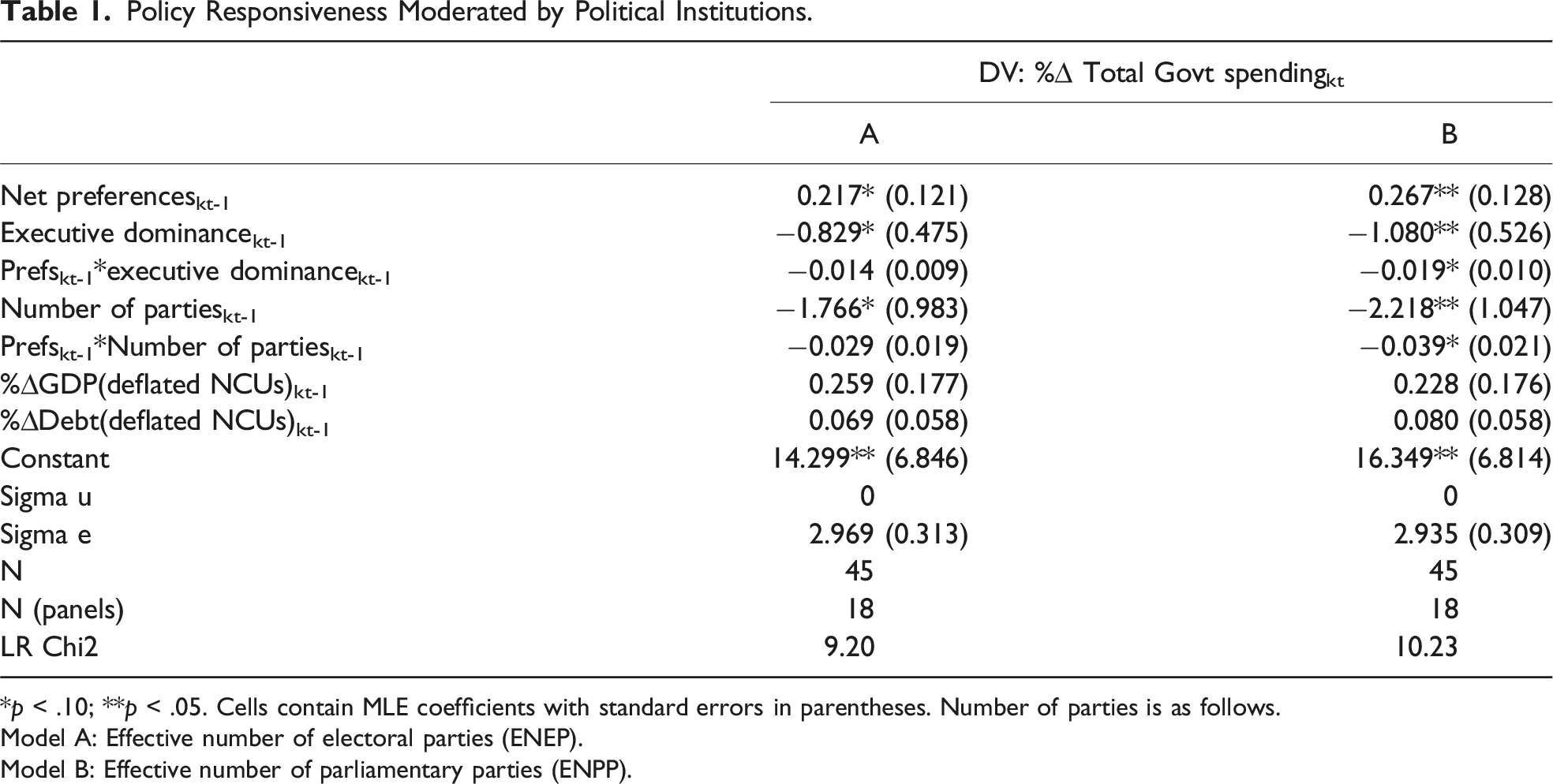
*p < .10; **p < .05. Cells contain MLE coefficients with standard errors in parentheses. Number of parties is as follows.
Model A: Effective number of electoral parties (ENEP).
Model B: Effective number of parliamentary parties (ENPP).
In the table, we see that both measures of proportionality produce the expected negative coefficient when interacted with preferences, implying that more parties weaken responsiveness, though the coefficient is larger (in absolute terms) and more reliable (p = .07) using the ENPP measure. This is as we expect, as the number of parliamentary parties should matter more than the number of electoral parties for government responsiveness, even as the two measures are highly correlated (Pearson’s r = .92). In Table 1, we also can see that the coefficients for executive dominance are negative, and fairly reliable (p = .06) in column B, including the ENPP measure. This implies that increases in executive dominance weaken responsiveness, which is what we expect as well. These results suggest that increases in the number of parties and executive dominance not only do not enhance responsiveness to public preferences, and actually may weaken it.
Alternative Models Based on the Number of Parties in Government.
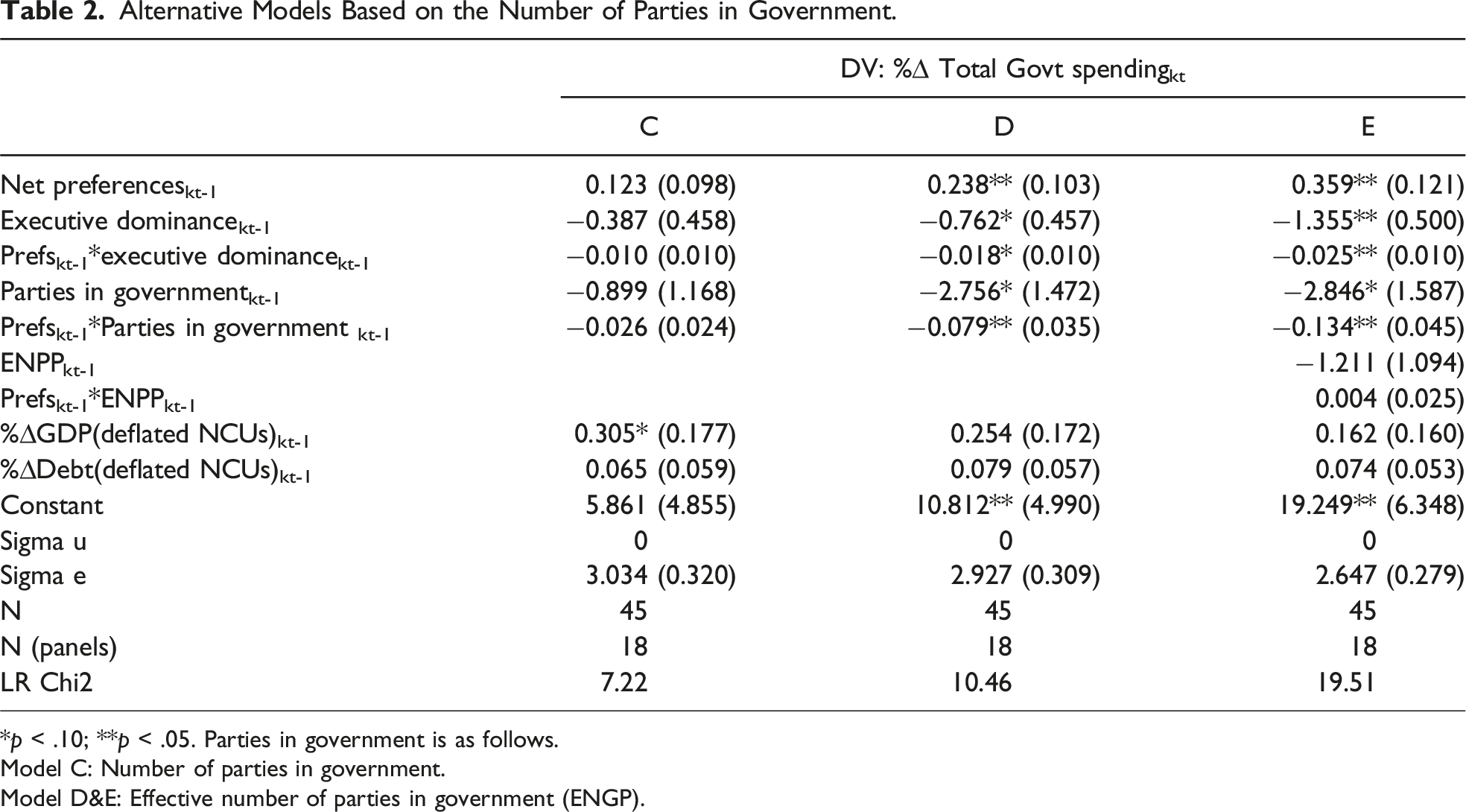
*p < .10; **p < .05. Parties in government is as follows.
Model C: Number of parties in government.
Model D&E: Effective number of parties in government (ENGP).
As column C shows, the first of these measures performs poorly, suggesting that parties' shares of seats (and influence) are of real consequence. This is underscored by the results in column D, which indicate that ENGP moderates policy responsiveness. The associated interactive coefficient is negative and significant (p = .03), and the effect size is much larger and more reliable than that for ENPP in Table 1. Column E adds ENPP to the equation, the results of which show that the negative effect of the number of parties on responsiveness is entirely driven by the variation in ENGP. These results, therefore, align with the finding of Toshkov, Mäder, and Rasmussen (2020) that the absolute number of parties within a government does not appear to moderate responsiveness. Yet, it also finds that the effective number of parties in government does matter for that responsiveness. 14
Results in columns D continue to reveal significant effects of executive dominance on policy responsiveness, although the effects are less reliable (p = .06) and also more modest than those associated with parties. This can be seen in Figure 3, which depicts the separate effects of ENGP and executive dominance on responsiveness.
15
Specifically, it shows the estimated responsiveness of governments with different values of the variables, spanning the range of +/− 2 standard deviations from the mean. Here, a standardized increase in ENGP has nearly twice the effect on responsiveness than a comparable increase in executive dominance. While neither executive dominance nor coalitional friction is beneficial based on this analysis, the results suggest that the latter is particularly harmful.
16
The estimated effects of ENGP and executive dominance on responsiveness.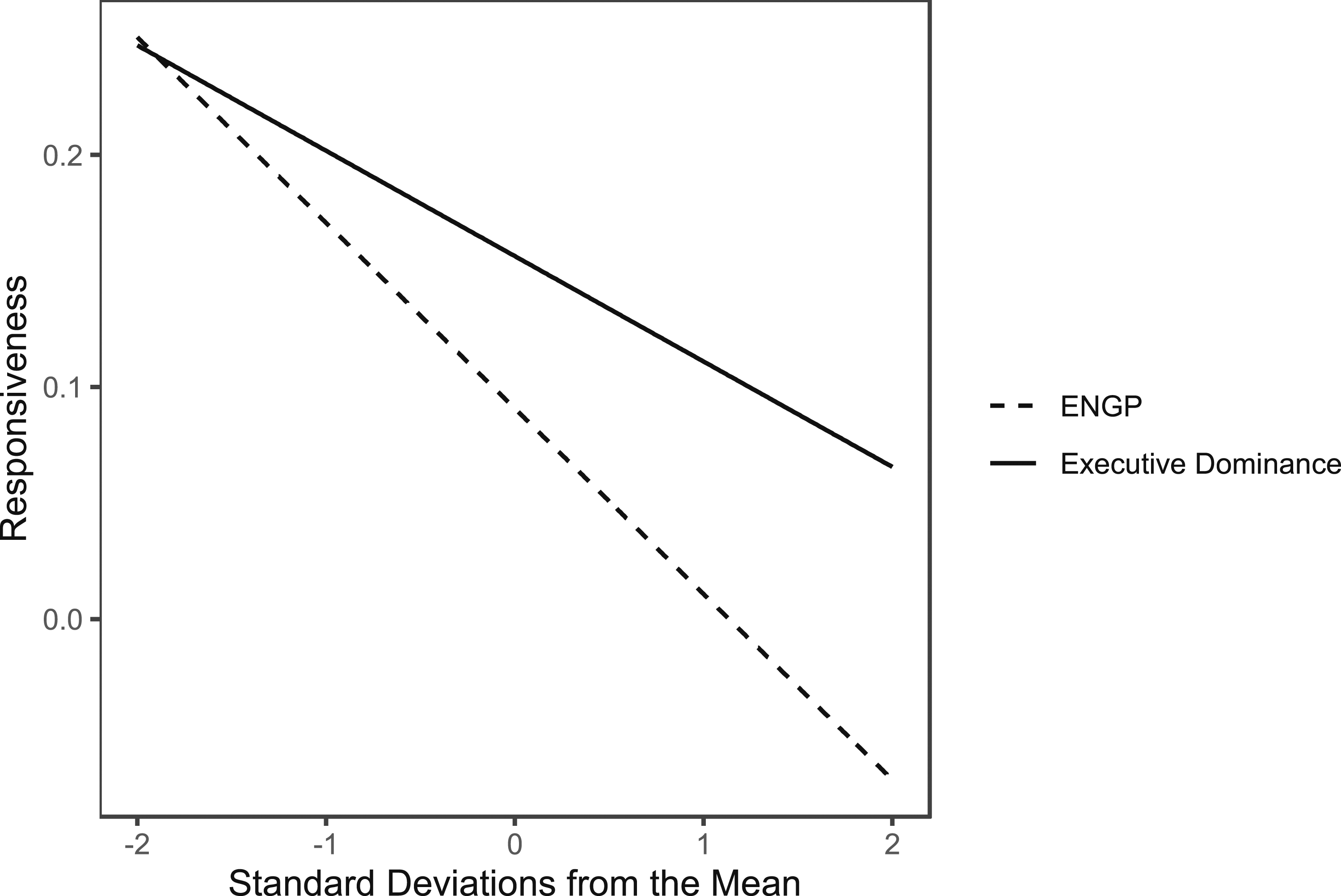
Given the explanations provided in previous research, both relationships depicted in Figure 3 can be understood in terms of institutional friction. Increasing the number of parties in government makes reaching consensus difficult and thus makes policy change in response to evolving public preferences less likely. On the other hand, increasing the balance of power between the executive and legislature allows branches to check each other, and thus makes responsiveness more likely. The results thus confirm our motivating puzzle: the seemingly contrasting effects of institutional friction. We now turn to a more careful analysis of what may be driving these results.
Examining the Role of Friction
We have proposed two ways of explaining how friction affects responsiveness. It may be that different forms of friction just matter differently for policymaking. Alternatively, it may be that a sweet spot exists, where some friction is better than both the absence of friction and lots of it, the (curvilinear) effects of which may be concealed by the analyses in Tables 1 and 2. Adjudicating between these possibilities requires a more flexible approach, as the locations of any friction sweet spots must be uncovered empirically since we do not have strong theoretical priors.
Do Increases in the Number of Parties in Government Always Harm Responsiveness?
Using our measure of the effective number of parties in government, we can try to identify the quantity that best promotes responsiveness. To do this, we construct a measure that is the absolute value of the difference between a country’s ENGP and alternative “neutral” points. Beginning at the mean ENGP across all countries, we then shift the neutral point up and down to assess whether and how this matters for responsiveness. We are interested in the coefficient for the interaction of absolute ENGP values and preferences across the different neutral points. If any increase in the number of parties in governments harms responsiveness, then the coefficient would be negatively-signed and smallest at the left-most point on the scale. This would tell us that responsiveness declines as the number of parties in government increases, since greater ENGP values are furthest from the neutral point when the latter is at the left-most point on the scale. If, however, there is a friction sweet spot, then the coefficient would be smallest at some point closer to the middle of the scale, creating a “U” shape. Figure 4 plots the estimated interactive coefficients along with 95% confidence intervals across a range of neutral points. Coefficient for ENGP*Preferences using different neutral points.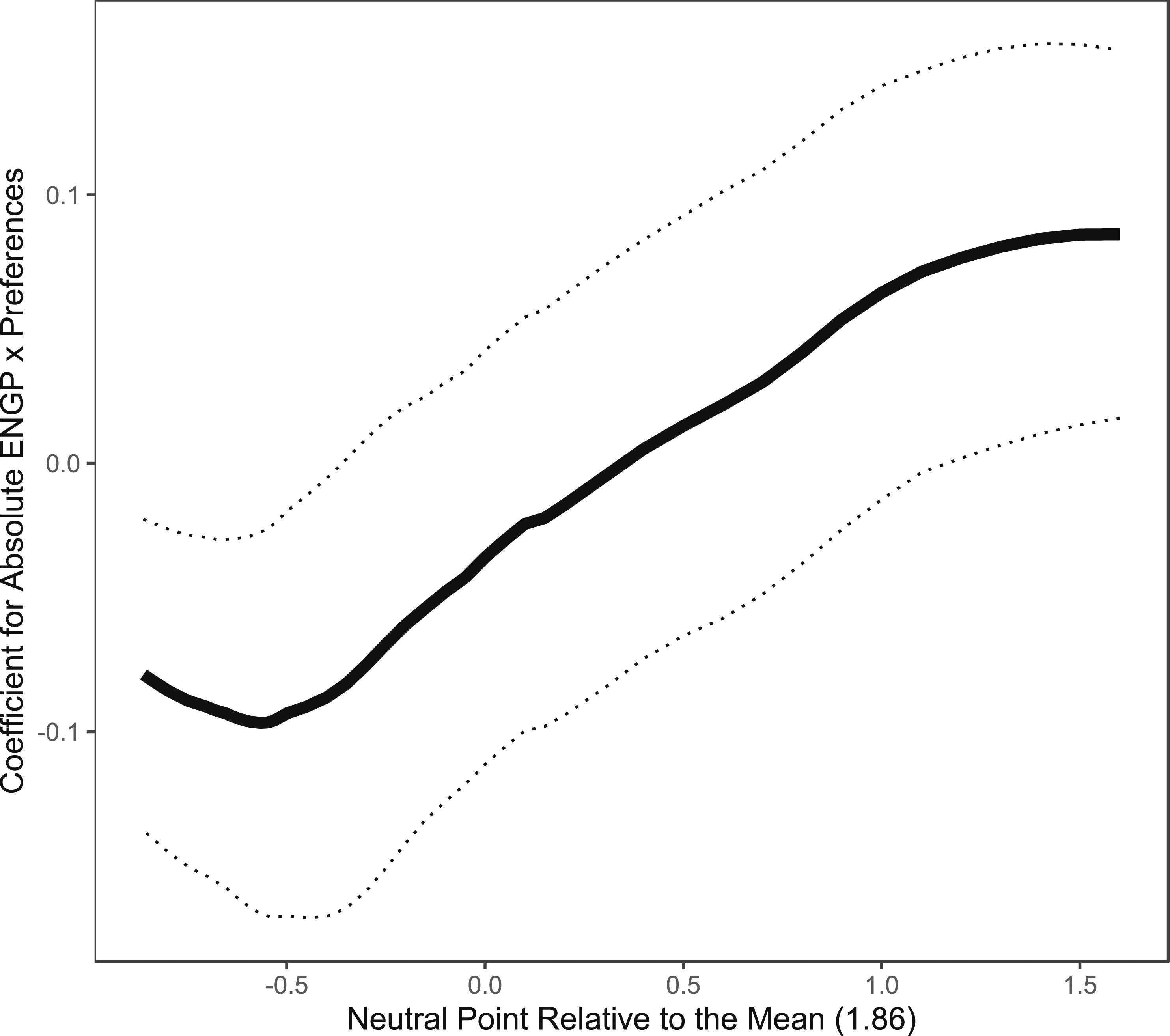
According to Figure 4, estimated responsiveness is greatest near where there is one party in government, even if not exactly at this point. The point on the scale with the lowest coefficient is 0.56 points below the mean ENGP value of 1.86. As can be seen in the figure, however, it is difficult to statistically distinguish performance when the number of parties in government is between 1 and 1.5 or so. What we can say is that governments with those characteristics appear more responsive than those with two parties and even more so than those with three. Indeed, when the neutral point reaches about 2.3, the coefficients turn positive, meaning that governments with small numbers of parties, where there are large absolute differences between the ENGP and the neutral point, are comparatively more responsive. The coefficient continues to increase before leveling off when the ENGP is greater than 3, further underscoring the responsiveness of governments with smaller numbers of parties.
To return to the original question, increases in the number of parties in government may not always harm responsiveness, but this is the case only at the very low end of the scale. A coalition composed of a major and minor party does not seem to include so much friction that responsiveness is harmed. Anything more than this, however, is disadvantageous. Coalitions of two equally-sized parties or more than two parties seem to be imbued with too much friction to be effectively responsive to changing public preferences.
Do Increases in Executive Dominance Always Harm Responsiveness?
Identifying the ideal point of responsiveness using Lijphart’s Index of executive dominance can be done in much the same fashion. Figure 5 presents the coefficient (and confidence intervals) for the interaction between the absolute difference between the country’s score on the index and various neutral points. The pattern demonstrates that executive dominance does dampen government responsiveness to public preferences, as the coefficients increase the more we center our measure on those systems. At the same time, increases in executive power do not always harm responsiveness, as the variation across the lower half of the distribution indicates. Placing the neutral point anywhere from the minimum value on the index to its mean yields essentially identical, negatively-signed coefficients. This clearly changes when placing the neutral point value anywhere above the mean, however. Sloping upwards rapidly, at a value of about 5.5 the coefficient becomes positive, increasing until it is set to a value around 6.5, after which it levels off and actually declines a little, though not significantly. Coefficient Executive Dominance*Preferences using different neutral points.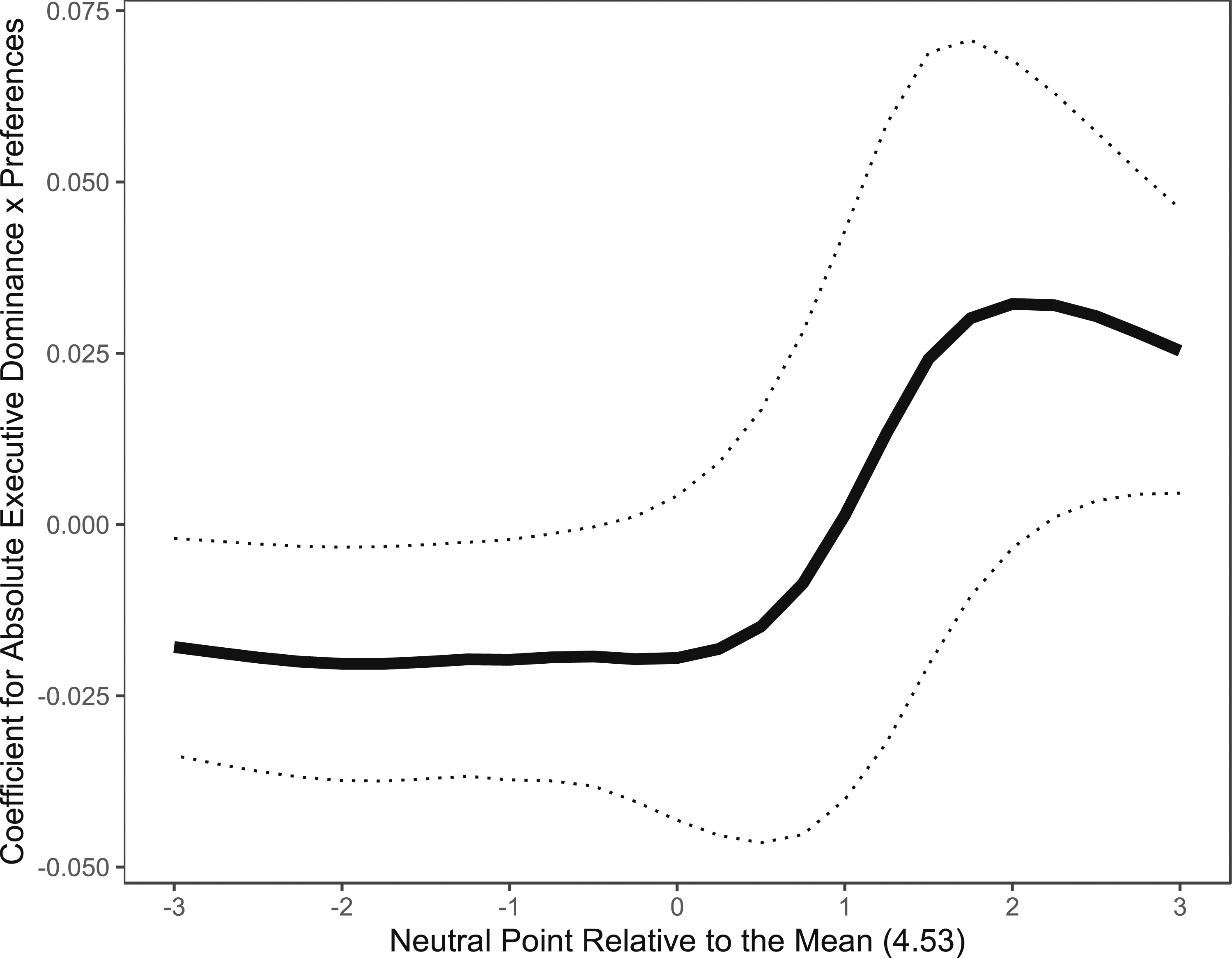
These results indicate that executive-legislative balance out performs executive dominance, as existing tests have indicated. But we modify this conclusion by noting that shifting power away from the legislature towards the executive may not always be ill-advised. There seems to be little difference between systems with a little balance, in the middle of the distribution (and figure), versus a lot, on the left side of the distribution. However, and importantly, performance really declines after the balance of power begins to tip in the executive’s favor. Anything like extreme executive dominance functions quite poorly. 17
We incorporate the insights from Figures 4 and 5 into a single test presented in Appendix Table C1, where we use modified institutional variables. This offers only a slight improvement compared to the simpler equation using the base ENGP and executive dominance values, at least as indicated by model fit. Although the effects of the number of parties in government and executive dominance on responsiveness are not perfectly linear, viewing the relationships in linear terms uncovers the underlying truth.
Thus, our analyses indicate that the two forms of institutional friction matter differently for policy responsiveness to public preferences. For the number of parties in government, the ideal seems to be near the most frictionless scenario, where one party (or thereabouts) governs. For the horizontal division of powers, moderate friction associated with balance works best, though there is not a specific ideal point, that is, what is most important for responsiveness is that the executive is not too dominant. Put simply, friction comes in different forms, and these can produce different effects.
Discussion
Policy outputs are structured in part by the amount of friction within institutions. This is well known (Jones and Baumgartner 2005; Jones et al., 2009; Tsebelis 2002). Less appreciated is how it conditions policy responsiveness to shocks in public preferences. This partly reflects the fact that the two literatures—on policy change and policy responsiveness—have evolved somewhat separately, and existing research on responsiveness has not treated friction as of central importance. While friction has been reflected in theories explaining the mechanism behind the effects of both electoral and government institutions on responsiveness, these explanations are incomplete and seemingly contradictory. This article attempts to redress that imbalance. We describe what existing research has to say, often implicitly, about the role of friction, reexamine the theoretical assumptions behind these perspectives, and employ empirical analysis to probe and better understand the effects of friction on responsiveness.
We find that friction is a necessary component to understanding the role of institutions. It is why the effective number of parties in government better predicts responsiveness than the effective number of parties in the legislature and the electorate, as the former provides a more direct measure of coalitional friction. Furthermore, we go beyond existing understandings to see whether increases in the number of parties in government—and also executive dominance—are always harmful. Our findings reveal a complicated story that, nevertheless, can be simply summarized.
Different sources of friction do not have a uniform effect. Although they all make policy change more difficult by increasing coordination costs, not all types of friction adversely influence responsiveness. On the one hand, dividing power horizontally seems to be more beneficial than concentrating it in the hands of the executive. This is consistent with research showing greater policy punctuations in executive dominanted governments (Breuing and Koski 2006) and authoritarian systems (Baumgartner et al. 2017). On the other hand, combining multiple parties in a coalition appears worse than single-party governments or small coalitions. What explains these differences? We suggest that the sequence may matter. When there is a process where one actor initiates action and another reacts, error correction can and often does ensue. 18 But when multiple actors are forced to come to an agreement at the outset, this complicates and dampens effective responsiveness. To be clear, we do not directly test this possibility, though our hope is that future research will, together with other explanations.
In general, the findings are consistent with most previous work on the moderating effects of political institutions for dynamic responsiveness, particularly as regards electoral systems (Coman 2015; Ferland 2020; Soroka and Wlezien 2015; Wlezien and Soroka 2012). They contrast with research that assesses responsiveness to preferences in different policy areas at particular points in time, which finds no consistent evidence of institutional effects (e.g., Rasmussen, Reher, and Toshkov 2019; Toshkov, Mäder, and Rasmussen 2020). This may be partly due to the way in which responsiveness is conceptualized and assessed, the institutional measures used, and/or the policy domain(s) under study. We analyze the responsiveness of short-term changes in government budgets to public preferences about spending using a variety of institutional measures, but the effects may be different over longer stretches of time, for different policy issues, and measures of institutional variables. As such, we encourage and look forward to future research that broadens the scope of our analysis.
Future research may also seek to test other sources of friction not considered here, such as bicameralism, super-majority thresholds, and intra-party fragmentation. Ezrow, Fenzl, and Hellwig (2023) already have made a move in this direction by studying the effect of bicameralism and find that dividing power within a legislature hinders responsiveness much like dividing power within a coalition. Another potential avenue to explore is the interaction between different sources of friction. For instance, are the effects of cabinet fragmentation and executive dominance additive? Or might executive dominance condition the potential harm produced by the number of parties in government, insofar as executive discretion reduces their importance? 19
Finally, there is reason to think that polarization affects how institutions respond to preferences. For research on congruence, increasing polarization has altered initial expectations regarding how electoral systems shape representation (Blais and Bodet 2006; Powell 2013), but to this point research on responsiveness has largely ignored its potential role. One might suspect polarization to weaken dynamic responsiveness in all systems. That said, given our argument and evidence, we would expect the effect to be most pronounced in PR systems, particularly where polarization impacts the actual governments. While governments under such conditions might better reflect the average voter in the wake of elections, we suspect that they are less able to respond to opinion changes in between elections. By contrast, strong horizontal division of powers might improve responsiveness even with polarization (also see Mayhew 2005). Whether this is generally true, however, remains to be seen. 20
There thus are numerous avenues of research to explore how political institutions affect policy responsiveness to public preferences. The implications of this work are important both for scholars and practitioners hoping to reform or democratize institutions. One lesson is that enhancing the “representativeness” of a system in terms of having a broader spectrum of parties in government may simultaneously impede policy responsiveness. This highlights the trade-offs of proposals urging the United States to adopt certain versions of PR that are likely to fragment parties (Tomasky, Meserve, and d’Amora 2023; but see Carey and Pocasangre 2024) Moreover, although we are wary of drawing very strong lessons from our results, they do point to the dangers of extremity, as too much of both executive dominance and coalitional fragmentation appear to produce adverse effects.
Policy responsiveness is only one measure of how well governments represent public preferences. Majoritarian congruence—the match between preferences and policy—after elections (and in between) also is important (see, e.g., Achen 1978; Powell 2000; Lax and Philips 2012). And policy representation after or in between elections is not all that matters, as voters may also care about the descriptive composition of government (Mansbridge 1999; Pitkin 1967) and/or features of the political process that are separate from their preferences for substantive outcomes (Hibbing and Theiss-Morse 2001). We still do have interests in policy responsiveness, of course, and in seeing whether political institutions influence this relationship. Our results indicate that they do.
Supplemental Material
Supplemental Material - Institutional Friction and Policy Responsiveness: The Puzzle of Coalitional Fragmentation and Executive-Legislative Balance
Supplemental Material for Institutional Friction and Policy Responsiveness: The Puzzle of Coalitional Fragmentation and Executive-Legislative Balance by Jack Maedgen and Christopher Wlezien in Political Research Quarterly
Supplemental Material
Supplemental Material - Institutional Friction and Policy Responsiveness: The Puzzle of Coalitional Fragmentation and Executive-Legislative Balance
Supplemental Material for Institutional Friction and Policy Responsiveness: The Puzzle of Coalitional Fragmentation and Executive-Legislative Balance by Jack Maedgen and Christopher Wlezien in Political Research Quarterly
Footnotes
Author’s Note
An earlier version of this article was presented at the 2024 Meeting of Midwest Political Science Association, Chicago. For helpful comments, we thank Ian Budge, Royce Carroll, Derek Epp, Lawrence Ezrow, Timothy Hellwig, Erik Herron, Bryan Jones, and Anna Weissman, as well the reviewers and editors of PRQ.
Declaration of Conflicting Interests
The author(s) declared no potential conflicts of interest with respect to the research, authorship, and/or publication of this article.
Funding
The author(s) received no financial support for the research, authorship, and/or publication of this article.

Data Availability Statement
Replication archive: https://doi.org/10.7910/DVN/DMCKHL.
Supplemental Material
Supplemental material for this article is available online.
Notes
References
Supplementary Material
Please find the following supplemental material available below.
For Open Access articles published under a Creative Commons License, all supplemental material carries the same license as the article it is associated with.
For non-Open Access articles published, all supplemental material carries a non-exclusive license, and permission requests for re-use of supplemental material or any part of supplemental material shall be sent directly to the copyright owner as specified in the copyright notice associated with the article.
