




Abstract
One of the most provocative recent findings in our understanding of political behavior is the link between physiological responses to environmental stimuli and political attitudes and behavior. This line of research holds much promise in explaining some of the foundational evolutionary origins of basic political orientations. Much of this recent research focused specifically on skin conductance response to threatening and disgusting stimuli, however, is based on analyses of a data collection sample of approximately 200 study participants drawn from the same community at a single point in time. Herein we attempt to reproduce many of the basic findings of recent research on skin conductance response and political behavior using data collected from a novel and unique dataset in a different context. In brief, we fail to reproduce many of the basic findings from this incipient line of research which suggests that the link between skin conductance and political behavior may be more contingent than previously assumed.
Introduction
A novel field of research has recently emerged among political behavioralists. This research agenda has focused on the relationship between physiological responses and political issue preferences and partisanship. A seminal work in the field thus far is Oxley et al. (2008), which demonstrates that those with higher physiological sensitivity to threatening stimuli generally tend to support more conservative political policies and vice versa. It suggests that those with a higher threat sensitivity support conservative policies that seek to “protect” the status quo from threats. Several other studies (e.g. Balzer and Jacobs, 2011; Dodd et al., 2012; Gruszczynski et al., 2013; Smith et al., 2011; Wagner et al., 2014) have been largely successful in demonstrating additional evidence in support of this phenomenon, specifically that a variety of political attitudes and behaviors seem to be clearly associated with physiological response patterns. This research implies strong evidence for the evolutionary origins of human political behavior (see e.g. Hatemi and McDermott, 2011).
Despite these compelling findings, much of the recent research focused specifically on the relationship between political behavior and skin conductance response to threatening and disgusting stimuli is based on analyses of a data collection sample of approximately 200 study participants described first by Oxley et al. (2008). The objective of this analysis, then, is to attempt to reproduce 1 the findings of some of these early studies, specifically in regards to skin conductance response to threatening and disgusting stimuli, using a novel and unique dataset produced in a different context. To briefly preview the findings, we are unable to reproduce many of the findings of previous research on the link between skin conductance response and political attitudes in our novel context. This suggests that the previous research linking skin conductance and political behavior may be more contingent than previously assumed, specifically that it may be contingent upon subject age and its effect on the stability of political attitudes.
Physiological responses and political behavior
Recent studies of the link between physiological responses and political behavior have investigated a variety of different biological mechanisms. Many researchers have investigated the role of emotional response and cognitive processing (see e.g. Lodge and Taber, 2005; Mutz and Reeves, 2005; Redlawsk et al., 2010). Others have used MRI and EEG brain imaging to measure differences between self-identified liberals and conservatives in the way they process information—especially what regions of the brain react when facing a risky decision or which areas have increased gray matter data (Amodio et al., 2007; Giuseffi, 2012; Kanai et al., 2011; Schreiber et al., 2013). Others have measured response valences and found that conservatives were quicker to respond to negative images and biased toward negative outcomes and situations (Carraro et al., 2011; Hibbing et al., 2014; Shook and Fazio, 2009). Dodd et al. (2011) measured gaze cuing effects and found that liberals were more influenced by gaze cues and argued that conservatives value personal autonomy more so than liberals and therefore are less likely to be responsive to gaze cues. Vigil (2010) measured facial expressions in college students and discovered that Republican sympathizers were more likely to interpret faces as signaling threatening expressions or dominant emotions and political affiliation was independently related to perceptions of threatening facial expressions, whereas the demographic variables were not significantly related (see also Vigil and Strenth, 2014). More recently, Adams et al. (2014) found that exposure to a repugnant odor (which activates the disgust response) moved subjects to be more likely to oppose socially liberal political policies, including gay marriage. (For a more comprehensive treatment of the literature on physiological response and political behavior, see Hatemi and McDermott, 2011; Hibbing et al., 2013; Tuschman, 2013.)
Other researchers have focused specifically on physiological threat response, as measured most often by skin conductance (sweat response), which is the focus of the current study. The first major examination of the link specifically between skin conductance levels (SCL) and political attitudes is Oxley et al. (2008). In this study, 46 participants were shown a series of threatening images and their change in SCL and mean blink amplitude (intensity of blink response) were measured to indicate levels of physiological threat arousal on the part of participants. According to the authors, those who exhibited lower physical sensitivities to threatening images were “more likely to support foreign aid, liberal immigration policies, pacifism, and gun control” (Oxley et al., 2008: 1667). In contrast, those who exhibited higher reactions to the same stimuli were “more likely to favor defense spending, capital punishment, patriotism, and the Iraq War” (Oxley et al., 2008: 1667), policies that were interpreted by the authors as preferences for policies that protect the status quo from threats.
While research on the relationship between physiological response and political and social attitudes are growing, as far as we were able to determine as of the writing of this report there have been only six additional published studies in peer-reviewed outlets that specifically investigate the link between physiological response as measured by SCL and political attitudes.
Smith et al. (2011) and Balzer and Jacobs (2011), for example, both used SCL change to measure disgust sensitivity and determine its relationship to policy preferences. Smith, et al. (2011) determined that gay marriage was the only issue significantly related to SCL change in response to disgusting stimuli. Similarly, Balzer and Jacobs (2011) determined that disgust sensitivity (both self-reported and physiological) easily separated supporters and opponents of gay marriage.
In another study, Dodd et al. (2012) measured changes in both SCL and attentiveness to the visual stimuli being presented. They successfully reproduced Oxley et al.’s (2008) finding that links SCL response to threatening images with conservative political orientations. They also find that compared with individuals on the political left, those on the right pay more attention to aversive stimuli and exhibit greater physiological responsiveness to said stimuli.
Renshon et al. (2014) attempted to establish a connection between anxiety emotions and attitudes toward immigration. They found that emotions incidental to the decision process can have significant effects on immigration attitudes, and that these are mediated by levels of SCL response to anxiety-inducing stimuli. In other words, physiological responses are important because they can affect the relationship between emotions and political attitudes.
Others have broadened both the independent and dependent variables. Gruszczynski et al. (2013) broadened the dependent variable to political behavior and found that, on average, those individuals that were more physiologically responsive to both threatening and disgusting images were also more likely to participate in politics, as measured by a multi-item “participation scale.” Wagner et al. (2014) examined SLC response not to threatening/non-threatening images but instead to images of President Obama and found that the SCL response to Obama’s image predicts intensity of opinions toward both Obama and health care reform.
Current objectives
As can be seen, the weight of the evidence thus far has established a clear relationship between higher skin conductance response sensitivity and conservative political attitudes. In that light, it is important to note that the seven studies described in the previous section which have established the evidence for the relationship between SCL response patterns and political attitudes (Balzer and Jacobs, 2011; Dodd et al., 2012; Gruszczynski et al., 2013; Oxley et al., 2008; Renshon et al., 2014; Smith et al., 2011; Wagner et al., 2014) examined only three distinct data samples. When it comes to studies examining SCL threat and disgust response specifically, each analyzed data collected from the same single original sample of individuals recruited from the Lincoln, Nebraska area in the summer of 2007, although different studies feature analyses of different subgroups drawn from the original recruitment sample of approximately 200 individuals (Oxley et al., 2008: SOM page 2). (See Table 1 in the Supplementary Online Materials [SOM] for details on the various samples for these seven studies.)
To bolster their generalizability, it is important that these findings for SCL threat and disgust response be reproduced in a variety of contexts from diverse samples. Thus far the evidence for the link between SCL threat response and political orientations is based on a single data collection sample. Thus, our current objective is to determine whether or not these same patterns exist by attempting to reproduce the same results in a different context using a unique dataset collected from a novel sample. We focus specifically on studies examining SCL threat, non-threat, and disgust response (Dodd et al., 2012; Oxley et al., 2008; Smith et al., 2011).
In order to evaluate the generalizability of these previous findings, we conducted a skin conductance and threat stimuli procedure modeled after those used by previous researchers in this field (Balzer and Jacobs, 2011; Dodd et al., 2012; Gruszczynski et al., 2013; Oxley et al., 2008; Smith et al., 2011), but varying slightly the images and question wording in the procedure as well as the sample, which consisted of 69 students recruited from both general education (43%) and upper-level political science courses (57%) at Centre College, a selective liberal arts institution in the central south region of the United States. Of the undergraduate-aged sample, 57% were female and 43% male, 55% self-identified Democrats or leaners, 38% Republicans or leaners, 7% pure Independents, 50% liberals, 26% moderates, and 24% conservative. Further, 89% of subjects reported having strong opinions toward at least one political issue, with a mean of 8.22 on a 0–10 scale of intensity of opinion toward that issue (more details available in the SOM materials).
It is important to note that this procedure does not represent a pure “replication” of the previous studies but rather an attempt to “reproduce” the same findings in a novel context with slightly varying conditions in order to determine the extent of their generalizability (see note 1; full details of the procedure are available in the SOM). This is important given how influential this body of research has become in recent years.
Reproduction of Oxley et al. (2008)
We begin with a reproduction of Oxley et al.’s (2008) findings related to SCL change and political attitudes. (A full description of the reproduction procedure is included in the SOM.) First, we note that similar to Oxley et al. (2008), subjects in our sample responded with higher mean levels of SCL change to threatening images than non-threatening images (0.00163 logged Hz and -0.00013 logged Hz, respectively), although this effect is smaller than that reported by Oxley et al. (2008). (Compare mean values of 0.004 and -0.0025 to the Oxley et al. 2008 sample, as reported in Oxley et al. 2008 SOM, page 4.) This is important because it shows that subjects were indeed responding differently to threatening vs. non-threatening stimuli in terms of physiological SCL threat response, and in the expected direction (see Figure 1).

Mean skin conductance level change to threatening and non-threatening stimuli, comparison of Oxley et al. (2008) and current study.
Next, we conduct difference of means t-tests to reproduce the analyses regarding the relationship between change in SCL in response to threatening/non-threatening images and support for protective policies. In terms of SCL response to threatening images, we find that, contrary to Oxley et al. (2008), those with high levels of support for protective policies actually have lower average levels of change in SCL levels (-0.0007 logged Hz) compared to those with low levels of support (0.0055 logged Hz). We also find that this difference fails to achieve statistical significance (t=1.046; p=0.300). In terms of non-threatening visual stimuli, we also find no significant difference in non-threatening SCL levels between these two groups (t=−1.5004; p=0.139).
Next, we reproduce Tables 1 and 2 of Oxley et al. (2008) that regress support for protective policies on threatening and non-threatening SCL responses. 2 Table 1 shows the results of the model predicting support for protective policies (0–5 additive index scale) using SCL change in response to threatening images as the key independent variable with gender (female=1; male=0) and family income (9-point ordinal variable) as controls.
Threatening SCL and support for protective policies.

p ⩽ 0.05, ** p ⩽ 0.01, *** p ⩽ 0.001; dependent variable: support for protective policies support scale, higher=more protective/conservative.
Non-threatening SCL and support for protective policies.

p ⩽ 0.05, ** p ⩽ 0.01, *** p ⩽ 0.001; dependent variable: support for protective policies support scale, higher=more protective/conservative.
Whereas the coefficient for threatening image SCL change in Oxley et al. (2008) achieved statistical significance (p<0.05), ours did not (p=0.180). Next, Table 2 reproduces Oxley et al. (2008) Table 2. This is identical to the model displayed previously in Table 2 except that the key independent variable of interest is SCL change in response to non-threatening stimuli.
Here we observe that, in line with Oxley et al. (2008), the coefficient for SCL change in response to non-threatening images fails to achieve statistical significance in predicting support for protective policies.
In sum, we fail to reproduce Oxley et al.’s (2008) key findings related to the relationship between SCL change in response to threatening visual stimuli and support for protective policies in our novel context. We are, however, able to reproduce the finding that SCL changes in response to non-threatening visual stimuli have no significant relationship with support for protective policies.
Reproduction of Smith et al. (2011)
Smith et al. (2011) take a slightly different approach in analyzing the relationship between physiological response patterns and political attitudes. In contrast to Oxley et al. (2008), who analyze responses to threatening visual stimuli, Smith et al. (2011) focus on physiological responses to disgusting stimuli. Specifically, they measure SCL change (and heart rate change) in response to images of a “horribly emaciated but alive body, human excrement floating in a toilet, a bloody wound, and an open sore with maggots in it” (Smith et al., 2011). They argue that the disgust response is important to understand as separate from the threat response because of its unique interaction with sociopolitical attitudes and behavior, particular through the predictions of “moral foundations theory” (Haidt, 2012; Haidt and Hersh, 2001). Smith et al.’s (2011) sample is drawn from the same original 2007 Nebraska sample of 200 individuals, but is a different subset than that analyzed by Oxley et al. (2008).
First, we observe that similar to Smith et al. (2011), subjects in our study responded with increased SCL to disgusting stimuli (mean 0.00273 logged Hz). Next, we attempt to reproduce Smith et al.’s (2011) first finding that SCL responses to disgusting images predict self-report political ideology. (A full description of the reproduction procedure is included in the SOM.) We estimate an OLS model with ideology as the dependent variable and SCL disgust response and gender as independent variables and the results are displayed in Table 3. While the coefficient is in the right direction (conservative = higher SCL response), the coefficient in Table 3 fails to achieve significance (p=0.195).
Disgust SCL and political ideology.

p ⩽ 0.05, ** p ⩽ 0.01, *** p ⩽ 0.001; dependent variable: 7-point self-report ideology, conservative = higher values.
Next, we attempt to reproduce the finding that the SCL disgust response predicts attitudes toward gay marriage. We again estimate an OLS model identical to that found in Table 3 except substituting gay marriage attitudes for ideology as the dependent variable; the results are displayed in Table 4. Again, the SCL disgust response fails to significantly predict attitudes toward gay marriage (p=0.498) and the coefficient, while insignificant, is in the wrong direction (higher SCL response associated with more liberal gay marriage attitudes).
Disgust SCL and gay marriage preferences.
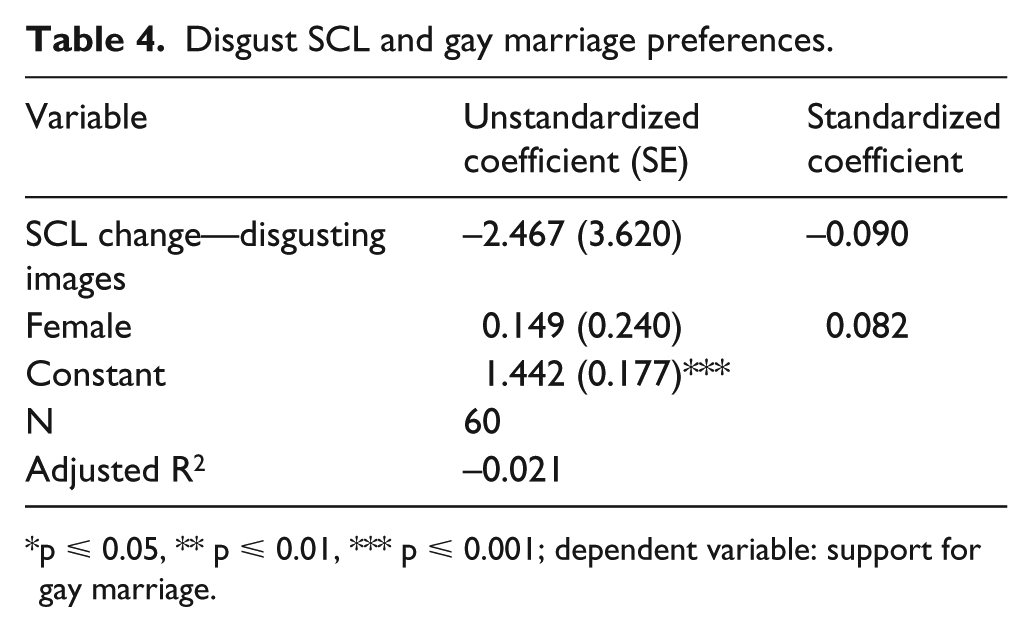
p ⩽ 0.05, ** p ⩽ 0.01, *** p ⩽ 0.001; dependent variable: support for gay marriage.
Reproduction of Dodd et al. (2012)
Among other things, Dodd et al. (2012) focus on SCL levels in response to threatening and non-threatening images (identical images and subject pool as described in Oxley et al. 2008) and analyzed the relationship between SCL change in response to these images and “political orientation”—a scale index variable formed by combining self-report partisanship, ideology, preferences on 28 political policies, and responses to 15 “social principles” index (Dodd et al., 2012: 642).
First, we examine Dodd, et al.’s (2012) finding regarding differences in SCL levels between those on the right and left side of the “political orientation” scale. (A full description of the reproduction procedure is included in the SOM.) We find no statistically significant difference between those with left and right orientations in SCL responses to threatening (“aversive”) images (t=−1.256; p=0.214, N=56), nor do we find any significant difference in SCL responses to non-threatening (“appetitive”) images (t=-0.032; p=0.974, N=56). A MANOVA analysis reveals a similar non-significant result (F=0.78; p=0.465).
Second, we attempt to reproduce the OLS analysis using threatening SCL responses to predict political orientation levels. The model is found in Table 5 and, again, the coefficient for SCL change to threatening images fails to achieve significance (p=0.637).
Threatening SCL and political orientations scale.

p ⩽ 0.05, ** p ⩽ 0.01, *** p ⩽ 0.001; dependent variable: “political orientation” scale variable.
In sum, we are unable to reproduce the key findings of Dodd et al. (2012) that changes in SCL levels in response to threatening (“aversive”) images is meaningfully related to broad political orientations.
Discussion and conclusion
This analysis was able to reproduce some findings in our novel context while unable to reproduce several others. (Table 2 of the SOM summarizes each specific finding from the literature and its reproduction result.) Specifically, we successfully reproduced findings related to SCL response in the face of threatening, non-threatening, and disgusting stimuli, as well as the non-relationship between SCL response to non-threatening images and political behavior. In contrast, we were unable to reproduce the arguably more critical findings related to physiological responses to threatening images. In our particular sample at least, there appears to be very little discernible relationship between responses to threatening or disgusting visual stimuli and attitudes such as ideology and political preferences. How should we interpret these findings given the evidence presented in previous research demonstrating a clearer relationship between SCL and political attitudes?
The most obvious (although not exclusive 3 ) possibility is that the differences between our findings and others is due to the fact that the subjects in our analysis are college students while previous studies have analyzed a more representative sample of adults in the population who have more diversity in terms of age, income, and levels of education. Previous research has shown that young adults are less crystalized in their political attitudes and show more variability than older adults (Sears, 1986) and all of our sample were likely in their late teens or early twenties with a heavier skew toward liberal ideological views. This may therefore suggest an interactive relationship: the link between physiological response (specifically SCL threat response) and political attitudes may depend to some extent on subject age and its effect on the stability of political attitudes. That being said, Renshon et al. (2014) found significant effects of SCL anxiety (but not threat) response on political attitudes using a sample composed of young adult males. Also, there is evidence that student samples are not wholly unrepresentative of the wider population when it comes to social science attitudes and behavior (Druckman and Kam, 2011).
Therefore, we conclude that more research is warranted to further investigate the relationship specifically between SCL threat and disgust response mechanisms and political attitudes, as well as the extent to which these relationships are contingent upon factors such as political interest, age, etc. Specifically, we call for additional reproductions of this data collection procedure in a variety of contexts to determine the extent of generalizability and ubiquity of physiological-political relationships.
Footnotes
Acknowledgements
The authors are indebted to Sparsha Thout, Carolynn Hallquist, Ethan Midkaff, and Benjamin Yeager, former undergraduate research assistants at Centre College, for their invaluable assistance with data collection, extraction, and coding.
Declaration of conflicting interest
The authors declare that there is no conflict of interest.
Funding
This project was supported in part by the John Marshall Harlan Research Fund at Centre College.
