




Abstract
Previous research has argued that while elections motivate parties to respond to public sentiment, global economic ties reduce this responsiveness by redirecting elites from their electorates and toward market actors. In this study, we extend this work to examine the influence of globalization on party responsiveness across different forms of production-welfare regimes. Coordinated market economies (CMEs) accommodate economic interdependence by striking corporatist bargains between political elites, trade union representatives, and organized business. Although these consensual relations facilitate economic stability, they also insulate policymakers from voters. Analyses that pair public opinion and party positions across 18 advanced capitalist democracies from 1977 to 2009 show that while CMEs permit political elites a wide room to maneuver under economic globalization, political parties competing in these organized market economies do not respond to public opinion. This is the case regardless of level of exposure to world markets. In CMEs, party position-taking is uninfluenced by external factors (economic globalization) and domestic factors (public opinion) alike. By examining the consequences for party behavior, our results raise questions about the virtues of coordinated market capitalism for the health of representative democracy.
Differences across advanced capitalist market economies are well-known. 1 Economies employing neo-corporatist models of interest group intermediation produce different outcomes with respect to growth, equality, and stability from those associated with more liberal varieties of market capitalism. Variation in the timing and scale of historic bargains between landed interests, labor, and business are commonly referenced as instrumental in shaping the structure of social protections and the scope of the welfare state. Recognition of the variety of formal and informal institutions characterizing different capitalist economies is critical for making sense of policy outcomes, particularly with respect to the variety of policy responses to systematic challenges confronting advanced industrial economies.
In recent years, however, political economists have provided fresh classifications. New directions in the study of advanced capitalism include work on institutional change (e.g., Streeck and Thelen, 2005), the role of firm-level strategies and the connection between welfare and production regimes (e.g., Hall and Soskice, 2001), welfare protections, and party constituencies (Rueda, 2007), and the relationship between the welfare state and electoral politics (e.g., Beramendi et al., 2015). These new directions are united in directing inquiry away from macro-structural factors and toward the dynamic and reciprocal connections between politics and markets. In recent years, research on the political economy of advanced capitalism has (re)discovered electoral politics. The welfare state, Iversen (2005) argues, is not “politics against markets” but “politics with markets.” By focusing on structural factors or, alternatively, on the interests of particular groups in isolation, scholars fail to consider how political economy and electoral politics interact.
We take inspiration from one of these new directions: the relationship between the welfare state and electoral politics. Specifically, we provide the first examination of the relationship between varieties of market capitalism and political party responsiveness. We bridge two separate bodies of scholarship: the political economy of the welfare state and the study of parties, elections, and voters. Building on previous work, we examine how globalization affects party responsiveness to public opinion in different welfare-production regimes (Ezrow and Hellwig, 2014; also Adams et al., 2009; Haupt, 2010, Ward et al., 2011). We argue that the welfare-production regimes highlighted in the Varieties of Capitalism (VoC) framework matter for party behavior. In coordinated market economies (CMEs), interlocking ties between business, labor, and skills acquisition systems insulate policymakers from voters. This in turn reduces elite incentives to respond to public opinion.
Party elites, market elites, and responsiveness under different welfare-production regimes
We begin with the relationship between party behavior and the electorate’s wishes. Research on political parties commonly takes the preference of the median voter, which is the starting point for democratic representation (McDonald and Budge, 2005; Powell, 2000). If we start with a framework that parties may be motivated by votes, office, or policy, each of these three motivations suggest that there are incentives for parties to react to changes in the preferences of the median voter. Analyses of party strategies in Western Europe regularly find parties to be vote-maximizing and center-oriented (Ezrow, 2010). Where vote-seeking is not the central motivation, it nevertheless remains hard to avoid as an efficient strategy for office- and policy-seeking parties. In addition, even if a political party is policy-seeking, its electoral strength provides leverage to pull the governing coalition’s policy in its preferred direction. While researchers have specified conditions under which parties react to alternative factors such as rival parties (Adams and Somer-Topcu, 2009), subconstituencies in the electorate (Adams and Ezrow, 2009), or the organization of the party itself (Schumacher et al., 2013; see also Lehrer, 2012), the median voter remains a privileged standard for theories of democracy, and an underlying empirical connection between political parties and the median voter persists (Ezrow, 2010; McDonald and Budge, 2005). 2
But how does the broader political-economic environment affect this basic story of responsive political parties? Focusing on political parties with experience heading up governments, Ezrow and Hellwig (2014) identify economic globalization as an important macro-level context accounting for differences in party responsiveness. They show that economic interdependence redirects party elites from their electorates and toward market actors, leading to weaker responsiveness to the mean voter. So while elections motivate parties to respond to shifts in the mean voter position, economic interdependence distracts political elites from their electorates toward market actors, adding uncertainty to the political landscape. For the politician, currying favor with markets does not aid but instead tempers party incentives to respond to shifting public preferences.
In the present study we ask whether these market elites are likely to influence party responsiveness to public opinion (in highly integrated economies) when their interests have already been incorporated into the policymaking institutions. It is widely known that different political economies are governed by different sets of rules (Katzenstein, 1985). While earlier research emphasized macro-institutions, work in the VoC tradition emphasizes how comparative advantages in the organization of firms and skills acquisition sustain differences in policy regimes. According to these arguments, an advantage possessed by CMEs is that close networks linking actors across firms, unions, and the state provides the capacity to overcome collective action problems and enact mutually beneficial policies, even in highly open economies, and even in times of economic stress. Uncoordinated market economies lack such complementarities. 3 In these cases, government involvement tends, by necessity, to take the shape of broad policy instruments aimed at smoothing out the business cycle.
We argue that differences in the relationship among finance, business, and labor matters for the position-taking behavior of political parties. For many policy issues traditionally under the aegis of “left” and “right,” the highly institutionalized forms of bargaining among capital, labor, and the state produces an economic system in CMEs that is consensual and relatively self-governing. Highly developed forms of corporate governance are essential to ensure access to credit and to foster the development of industry-specific skills (Hall and Soskice, 2001). A key implication for our purposes pertains to the implications of CMEs for party behavior. To the extent that policy decisions in these neo-corporatist systems are “pre-parliamentary,” parties face fewer incentives to act to address their constituencies’ concerns with respect to economic production and exchange. Such is not the case in liberal market economies (LMEs). In these economies, labor markets are deregulated, companies interact in competitive rather than cooperative ways, and finance is provided through capital markets. Decisions about how markets work, therefore, are less likely to be addressed by market actors directly and more likely to be grounds for policy debate amongst parties. Differences in policy responses made by governments to the financial crisis of 2007–2008 serve as a case in point. In the USA, a quintessential liberal market economy, the policy response came in the form of fiscal stimulus—a stimulus comprised mainly of general tax cuts aimed at stabilizing business and consumer demand. In contrast, the response in Germany, a solid CME, was much more tepid as social protections served as automatic stabilizers, designed to activate during times of stress.
In our previous work, we showed that globalization constrains parties’ inter-election responses to the median voter. The reason for this is that globalization means parties must extend their attention beyond voters toward an expanded number of actors and a less certain policy environment. Here we reason that the dense networks characterizing CMEs—networks that render parties and governments but are part of a broader nexus—exerts an additional constraint. Routinized exchanges mean that the parameters of policy action are more rigid. In turn, constraints on party responses to public sentiment should be constrained relatively less by globalization in these democracies. The institutionalized relationships between the major policy making actors that exist in CMEs but are absent in LMEs serves to buffer the former set of political economies from effects of external influences on domestic politics, party politics included.
In summary, in CMEs, tight links between employers and workers privilege insular forms of bargaining over mean-voter responsiveness as a guide to policy. With respect to party behavior, this observation generates a pair of predictions. Firstly, there is less room for influence of external market actors to interfere in party politics. That is, the responsiveness of political parties to the preferences of the median voter in CMEs will be affected less by levels of economic globalization than in uncoordinated ones. Secondly, the nature of market coordination means that parties competing in CMEs will be less responsive to public opinion, regardless of the nature of global economic ties.
Of course, ours is not the first study to observe a relationship between globalization and the varieties of capitalism. After all, the neo-corporatist model of economic development associated with coordinated markets has been identified as an effective strategy for the developing comparative advantages in world markets (Katzenstein, 1985). Globalization may well “reinforce the link between economic growth and welfare state expansion” (Pontusson, 2005). Drawing a connection between varieties of capitalism and social spending, Jensen (2011) argues that in CMEs, globalization heightens employer reliance on the state to invest in specific skills; hence, in these market economies we observe a positive association between openness and spending. Our study, however, is the first to extend lessons from the political economy of advanced capitalism to the analysis of party responsiveness to the mean voter.
Model, data, and measures
We evaluate these claims by estimating a series of models examining the determinants of party behavior. If parties respond to the preferences of the mean (or median) voter, then they should adjust their positions on the issues as a function of shifting voter preferences. Levels of globalization, however, should condition this relationship. Our basic specification is
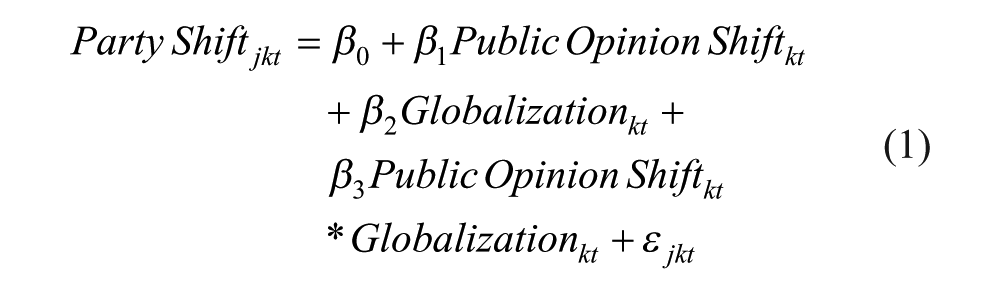
where
To capture important temporal changes in party position, we employ a panel of elections from 18 countries ranging from 1977 to 2009, as provided by the Comparative Manifesto Project (CMP). The dependent variable, Party Shiftjkt, is then measured as the change in party j’s position from election t–1 to t. Data on mean voter preferences come from a public opinion survey item that asks respondents to place themselves on a scale from 1 (left) to 10 (right). 4 Data for most of the cases are from the Eurobarometer surveys, supplemented with national election studies data. Details on the countries, elections, and parties included in the analysis are provided in Table A1 of the Supplementary Information (SI) file. For economic globalization we use the KOF Economic Globalization Index (Dreher, 2006). Half of the index is comprised by flows (trade, investment, and income payments to foreigners) and the other half in terms of restrictions on movement (import barriers, tariffs, and capital account restrictions). 5 We rescale the measure from 0–100 to 0–1 to facilitate model interpretation.
We control for the performance of the domestic economy by including a measure of the shift in the annual per-capita growth rate from election t–1 to t.
6
Finally, the longitudinal nature of these data also allows us to consider the role of parties’ past behavior on their current policy shifts. Inclusion of
Analysis and results
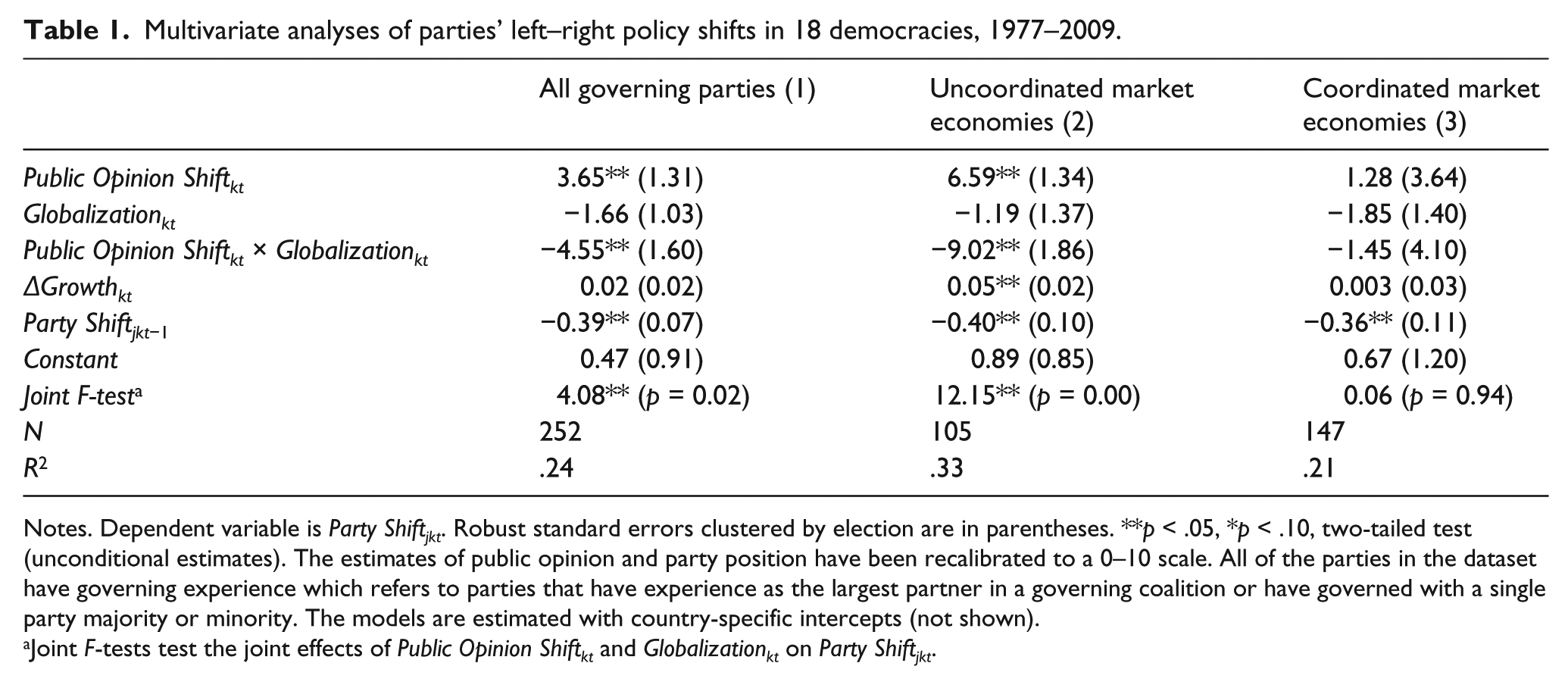
Table 1 reports estimate from a series of models using OLS regression with country-fixed effects, and we estimate heteroskedastic robust standard errors clustered by election period.
Multivariate analyses of parties’ left–right policy shifts in 18 democracies, 1977–2009.
Notes. Dependent variable is Party Shiftjkt. Robust standard errors clustered by election are in parentheses. **p < .05, *p < .10, two-tailed test (unconditional estimates). The estimates of public opinion and party position have been recalibrated to a 0–10 scale. All of the parties in the dataset have governing experience which refers to parties that have experience as the largest partner in a governing coalition or have governed with a single party majority or minority. The models are estimated with country-specific intercepts (not shown).
Joint F-tests test the joint effects of Public Opinion Shiftkt and Globalizationkt on Party Shiftjkt.
Model 1 replicates the central findings from Ezrow and Hellwig (2014: 821). The positive coefficient attached to Public Opinion Shiftkt implies that parties shift their left–right positions in reaction to changes in the mean voter’s position. This expected effect, however, is conditioned by economic globalization, as the negative sign on the interaction term indicates. Using Model 1 estimates, Figure 1(a) displays the marginal effects of public opinion shifts on party shift across the sample range of values for economic globalization. The negative slope indicates that as globalization increases, the estimate of party responsiveness to the mean voter position decreases. The coefficient on Public Opinion Shift kt attains statistical significance when Globalizationkt is below 0.70 on the 0–1 rescaled index. In the remainder of cases—those more exposed to world markets and employing more liberal policies—our model estimates that changes in public opinion, as represented by the mean voter, have no statistically significant influence on party shifts.
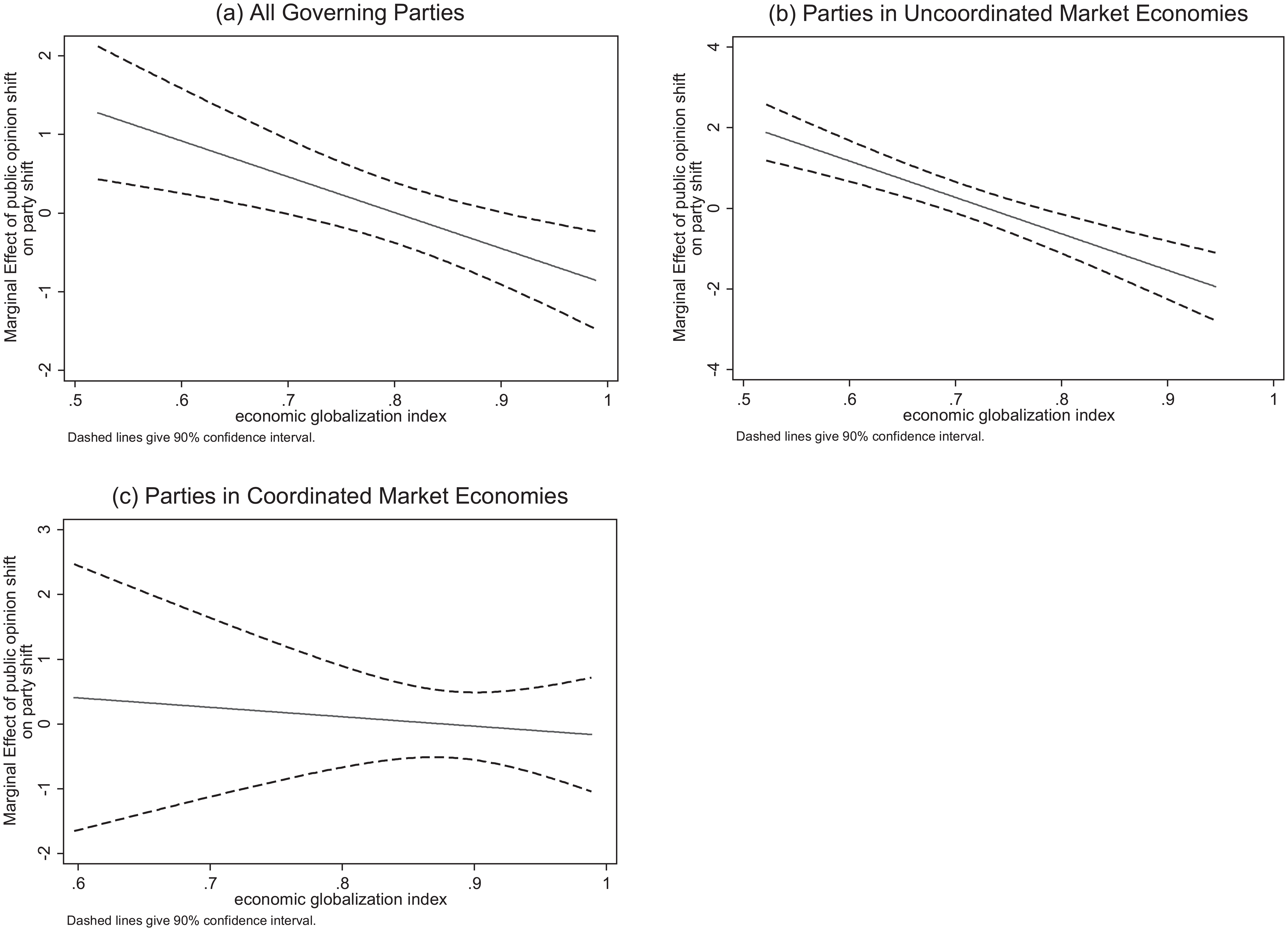
Effect of public opinion shift on party shift conditional on economic globalization.
We next consider varieties of capitalism. CMEs provide the capacity to overcome collective action problems and enact mutually beneficial policies, even in highly open economies. However, in uncoordinated market economies such complementarities are lacking, and government involvement may take the shape of broad policy instruments aimed at tempering the business cycle. Given the tightly linked relationships among actors, the parameters of policy action might be more rigid and, thus, globalization may have less of a constraining influence on party position-taking in these democracies.
We examine this claim that party elites are less constrained by globalization in CMEs by stratifying the sample, in Table 1 Models 2 and 3, based on the organization of the domestic economy. 8 Looking across the models, we again see in Model 2 for Uncoordinated Market Economies that the coefficient on the public opinion shift–globalization interaction is negative and precisely estimated. In fact, the parties’ responsiveness to public opinion in these market economies is much more strongly conditioned than the full sample estimates, as indicated by the size of the coefficient on the interaction term, which is roughly twice the coefficient for the complete sample (−9.02 for uncoordinated market economies, compared to −4.55 for the complete sample). 9
Figure 1(b) uses the Table 1 Model 2 estimates for uncoordinated market economies to chart the marginal effects of public opinion shifts on party shifts across the sample range of values for economic globalization. The sharp negative slope indicates that the estimates of party responsiveness decrease dramatically in globalized contexts.
Model 3 in Table 1 reports estimates for CMEs. Similar to Models 1 and 2, the estimate on the interaction term is negative, but it is now close to zero and insignificant. Consistent with our first prediction, this indicates that globalization does not condition party responsiveness as it does in uncoordinated market economies. Figure 1(c) further depicts this finding. The near flat line suggests that parties are no more responsive to public opinion in closed economies than in open ones. This supports our second prediction: parties in CMEs are less responsive to public opinion, regardless of globalization. 10
Sensitivity analysis
We performed additional analyses to examine the robustness of these results. Firstly, to examine whether findings rest on our classification of political economies, we perform the analyses stratifying the sample according to interest group organization based on the classification of Siaroff (1999) on the basis that interest group organization contributes greatly to the behavior of contemporary capitalisms. The results, which we report in the SI file, show that parties in neo-corporatist countries behave similarly to the CMEs. Secondly, we consider whether the heterogeneity we observe based on degree of market coordination may instead be attributable to the county’s electoral rules. Parties in countries with proportional rules, for instance, may have less incentive to respond to the mean voter (cf. Ezrow, 2011), and indeed a reanalysis of our data separating cases using Gallagher’s (1991) disproportionality index finds that globalization’s conditioning effect on mean voter responsiveness is limited to parties in more disproportional systems (Table A3). Collinearities between electoral rules and types of capitalism make it difficult to disentangle these two forces. However, we can glean some insight by omitting historical partners on the mainstream center-left or (Social Democratic Parties) or center-right (Christian Democratic and Conservative parties). There is a small subset of governing parties in CMEs that are not historically integrated into the process and hence should not be so affected. Table A4 in the SI file presents estimates from modeling these mainly center, agrarian, and liberal “non-corporatist” parties in CMEs. Results suggest that this set of parties is responsive to public globalization and public opinion. 11
We also probe robustness of our findings with respect to alternative conceptions of the dependent variable. We re-estimated our statistical models using shifts on a narrower set of economic considerations (Hellwig, 2012). Results for these models are consistent with those in Table 1. In addition, we re-estimated Table 1 models using the log-odds transformations of the CMP codes as advocated by Lowe et al. (2011). To address uncertainty in CMP estimates, we estimate model parameters for only those cases of statistically significant party shifts. 12 Results of these robustness checks, displayed in the SI file, do not change from those reported above.
Conclusion
The findings reported in this study demonstrate that the organization of market economies matters for party politics, and in ways not previously acknowledged. In particular, CMEs have institutionalized bargaining between political elites, business executives, and trade union representatives. This institutionalized bargaining has two implications: firstly, while globalization may alter party incentives, these pressures will be mitigated when there are strong associations that exist between the organization of firms, unions, systems of skill acquisition, and the state. Institutionalized politics in CMEs weakens the effect of globalization in driving a wedge between party behavior and public opinion.
The second major implication of institutionalized bargaining is that it equally implies that political parties will not systematically respond to public opinion in CMEs. Figure 1(c) demonstrates that this is the case under any level of globalization. This result should push students of the political economy of the welfare state to further examine the implications of market organization for how representative democracies work. While the argument and application here has been informed by the varieties of capitalism, insights from recent work on administrative capacity and the protective versus productive logic of the welfare state could also provide fertile ground for further inquiry. With respect to VoC, however, the highly organized nature of capitalism in CMEs has several virtues with respect to labor protections, skills acquisition, and consensus relations among firms. Our research, however, suggests that when it comes to party incentives to respond to public opinion, CMEs fall short.
Footnotes
Acknowledgements
We thank Simone Dietrich for bringing to our attention the comparison between Germany and the United States that we use in the article.
Declaration of conflicting interest
The authors declare that there is no conflict of interest.
Funding
This research received no specific grant from any funding agency in the public, commercial or not-for-profit sectors.
