




Abstract
The Democratic and Republican parties have polarized since the 1960s. Does the American public believe that the parties have grown “too extreme?” I leverage data from 18 national surveys to explain perceptions of party extremity as well as text-analysis of open-ended survey responses from an additional national survey to examine what the public associates with the concept of extremity. Three key results emerged. First, a growing proportion of Americans believe that both parties are too extreme, but this belief remains in the decided minority. Second, ideology and partisanship interact to shape beliefs about extremity. Moderates are more likely to believe that both parties are too extreme, but this is conditional on the presence of partisan motivations to say that only one party is too extreme. Finally, the public has a multifaceted conceptualization of extremity that is frequently tied to perceived procedural failures with only the highly knowledgeable reliably connecting perceived extremity to programmatic considerations. These results suggest that elite partisans have little reason to moderate their views given that most Americans do not perceive them to be too extreme, partisan considerations gain them ideological leeway, and many fail to connect extremity with the parties’ ideological reputations.
Political parties are crucial to democratic politics because they structure and simplify political choices for an inattentive electorate (Schattschneider 1942; Sniderman 2000). 1 However, there is a growing worry in research on US politics about whether the choices offered by the Democratic and Republican parties are too extreme for the public. This worry manifests most clearly in research showing that elite partisans have polarized while the public has remained broadly moderate (Ansolabehere et al. 2001; Fiorina and Abrams 2009; Hill and Tausanovitch 2015; Lelkes 2016). Bafumi and Herron (2010, 524) put matters in stark terms: “members of Congress are too extreme for their constituencies.”
Does the American public agree that the parties have grown “too extreme?” The evidence on this matter is indirect and inconclusive. Research comparing the preferences of the public with those of their elected officials can indicate the potential existence of a disconnect but not whether the public disapproves of elite extremity. Indeed, it may be the case that the mass public is not overly concerned with elite polarization insofar as polarized elites nevertheless represent the public’s idiosyncratic policy views (Ahler and Broockman 2018). Alternatively, some studies investigate how the public places the parties on ideological and policy scales with this work typically showing an increase in perceived polarization (Ahler 2014; Lelkes 2016; Levendusky and Malhotra 2016; Westfall et al. 2015). However, this too elides the question. Ideological placements are not entirely driven by ideological considerations and can be substantially influenced by perceptual biases (Bauer et al. 2017; Conover and Feldman 1981; Hare et al. 2015; Simonovits 2017). Placement items are also indirect evidence on this matter because they do not assess whether respondents find any given placement problematic. It thus remains unclear whether elite polarization has coincided with a growing concern among the public about elite extremity.
Polarized parties combined with a broadly centrist public imply that many Americans will view both parties as too extreme. I argue that this is unlikely to be the case for two reasons. First, partisanship should condition the role of ideology in judgments of party extremity. Existing work on representational disconnects largely rests on a spatial logic which implies that moderates will be disturbed by a party system where they are caught between two diverging parties (but see: Ahler and Broockman 2018). I argue that partisanship will depress some of this concern and instead lead many moderates to believe that only one of the parties is too extreme. Second, the American mass public is typically portrayed as being “innocent of ideology” with many basing their party evaluations on non-ideological considerations such as beliefs about policymaking procedures and partisan traits (Converse 1964; Hibbing and Theiss-Morse 2002; Kinder and Kalmoe 2017; Klar and Krupnikov 2016; Miller, Wlezien, and Hildreth 1991; Rothschild et al. 2019). Many Americans may consider a party too extreme based on these alternative considerations, which do not neatly track with growing elite polarization.
Prior research has not taken the perspective of the public itself by asking them whether the parties are “too extreme.” I address this limitation in two complimentary ways. I first leverage data from 18 national surveys conducted between 2000 and 2018 wherein respondents indicated whether they believed the parties to be “too extreme.” I find that a growing share of Americans says that both parties are too extreme, but that this response remains the decided minority with just as many saying neither party is too extreme and nearly four times as many saying that only one party is too extreme. As expected, ideological moderates are more likely than extremists to say that both parties are too extreme, but conditionally so based on partisanship. Second, I go one step further and investigate what the public associates with the concept of party extremity via text-analysis of open-ended survey responses using a national non-probability survey I fielded in April 2019. While programmatic concerns were the most frequently used when discussing party extremity, they were only used by approximately a third of respondents who said that a given party was “too extreme.” Descriptions of party extremity were instead multifaceted in nature and frequently tied to the perceived procedural failures of the parties, that is, to their inability to compromise and self-interested motivations. These results are important because they suggest that elite partisans have little reason to moderate their views given that most Americans do not perceive them to be too extreme and partisan considerations gain them further ideological leeway.
Are the Parties Too Extreme?
One natural starting point for considering mass perceptions of party extremity is the spatial logic that underlies much of the literature on party polarization and representation. The central assumption of this perspective is that the public evaluates parties based on perceived ideological proximity (Downs 1957). A plausible expectation from this perspective is a growing share of Americans perceiving both the Democratic and Republican parties to be too extreme given the generally moderate ideological identifications and preferences of the public and the parties’ diverging ideological positions (Bafumi and Herron 2010; Fiorina and Abrams 2009; Hill and Tausanovitch 2015; Lelkes 2016). If this type of spatial logic is in operation, then we would expect that ideological moderates, that is, those caught between the diverging parties, will be the ones becoming more likely to say that both parties are too extreme. Individuals with more extreme ideological leanings, on the other hand, should be more likely to indicate that only one party is too extreme, and increasingly so over time, as polarization entails one of the parties becoming comparatively closer and the other further away.
The proportion of Americans saying that both parties are too extreme should increase over time, all else equal Ideological moderates will be more likely than extremists to say that both parties are too extreme, while extremists will be more likely to say that one party is too extreme, all else equal
While the foregoing spatial logic provides a plausible basis for understanding mass perceptions of party extremity, I argue that it must be supplemented by considering the role of partisan identification. Most Americans, including most ideological moderates, identify with a political party (Lewis-Beck et al. 2008). While identification is not unrelated to ideological considerations (Chen and Goren 2016; Highton and Kam 2011), identification by itself has an important effect on political behavior (and, indeed, may even drive ideology; Barber and Pope 2019; Lenz 2012). In particular, partisan identities act as a “perceptual screen,” wherein information is selectively engaged with in order to accentuate the perceived differences between the in- and out-group (Campbell et al. 1960; Druckman et al. 2013; Leeper and Slothuus 2014; Tajfel 1978). An underlying motivation behind such processes is the drive to perceive the in-group as superior to the out-group, which can be accomplished by ascribing positive values and traits to the former and/or negative ones to the latter with this motivation particularly salient in an ever more clearly “sorted” and affectively polarized party system (Iyengar et al. 2012; Mason and Wronski 2018). It is plausible that ideological extremity is perceived as a negative trait and hence one that partisans will be motivated to ascribe to the out-party. Ideological extremists tend to do worse at the ballot box (Hall 2015). Partisans, meanwhile, tend to view their in-partisan Senators as more ideologically heterogeneous, and out-partisan Senators more homogenous, than they really are (Dancey and Sheagley 2018; Simas 2018). Ultimately, this type of partisan-expressive logic implies a different pattern of extremity perceptions compared to the spatial logic discussed earlier. In particular, partisan identification should increase the probability of saying one party is too extreme for ideological moderates as the identity-based drive to positively differentiate one’s in-party from one’s out-party should pull many moderates away from seeing both sides as too extreme.
Partisan identification is positively associated with the probability of saying one party is too extreme and negatively with saying both parties are too extreme, all else equal Partisan identification is positively (negatively) associated with saying one party is too extreme (both are) among ideological moderates, all else equal
What Does It Mean to be “Extreme?”
What exactly do ordinary people have in mind when they say that a political party is too extreme? The spatial theory discussed above implies that programmatic considerations, that is, beliefs about what the party stands for, lay at the heart of extremity judgments. However, there is reason to doubt whether this will be the only, or even the dominant, consideration that comes to mind. Most Americans do not possess refined understandings of ideological labels (Converse 1964; Kinder and Kalmoe 2017). Many instead ground their beliefs about party behavior in non-programmatic considerations such as beliefs about the social group reputations of the parties, salient political figures such as the President, perceptions of the traits common to party members, or procedural failures such as a surfeit of conflict and gridlock (Ahler and Sood 2018; Converse 1964; Hibbing and Theiss-Morse 2002; Miller et al. 1986; Robison and Moskowitz 2019; Rothschild et al. 2019). Ultimately, I make no formal claims about the relative salience of these considerations and instead pose this research question: Research Question: Which considerations come to mind when people say that a political party is too extreme?
I do advance an expectation concerning who is likely to use programmatic considerations when thinking about party extremity. I expect that the probability of referring to the programmatic reputation of the party will increase alongside political knowledge. The warrant for this claim is the general finding that individuals with higher levels of political knowledge possess more coherent ideological beliefs systems and are better able to connect their ideological predispositions to political evaluations (Converse 1964; Freeder et al. 2019; Lupton et al. 2015).
Political Knowledge will be positively associated with the use of programmatic considerations in discussions of party extremity, all else equal
Data
One way to assess perceptions of party extremity is to consider how the public places the parties on an ideological scale. However, these placements have serious limitations as discussed earlier. I thus turn to two similarly worded and previously unexamined measures asked on national surveys between 2000 and 2018 that directly focus on party extremity. Nine CNN-sponsored surveys asked respondents the following question between the years 2000 and 2013: “Overall, would you describe the views and policies of the [Democratic Party/Republican Party] as too extreme, or as generally mainstream?” Nine Pew-sponsored surveys, meanwhile, asked respondents this similarly worded question on surveys conducted between 2013 and 2018: “Do you think the [Democratic/Republican Party] is too extreme or not?” Table OA1 in the Supplementary Materials provides topline statistics for these items across the 18 surveys.
One question that might emerge concerns the different wording and response options of the two surveys, especially as CNN surveys are primarily in the first, and Pew surveys primarily in the second, half of the time series. The worry here would be that the change in response options is what is driving any over-time trend in responses. However, this does not appear to matter. In two instances, the survey firms fielded surveys in the same year. The absolute value of the average distance between the survey estimates is four percentage points or roughly what we might expect based on random sampling error. In the individual level analyses below, I control for survey sponsor to additionally address this possibility, but the existing evidence suggests the change in format does not materially affect responses.
Examining the foregoing items as a measure of perceived party extremity has a few advantages. First, they directly assess perceptions of party extremity rather than attempting to infer it from other properties. Second, they have been asked over nearly two decades during a period of rising elite polarization, enabling insight into how these perceptions may have responded to a changing party system. Finally, responses stem from national probability-based representative surveys (median N = 1502), which facilitates generalizing to the mass public. These surveys do have one important drawback: their thin set of political variables as potentially important control variables such as political knowledge or perceptions of party ideology are not assessed.
I supplement the CNN and Pew surveys with one of my own. I recruited respondents from Lucid Fulcrum Exchange’s national online panel in April 2019 and asked them the same question posed by Pew (n = 1219; Coppock and McClellan 2019). Respondents also answered questions tapping into their perceived level of ideological proximity to the parties, operational ideology, and political knowledge. 2 In addition, I asked respondents who indicated that a given party was too extreme an open-ended follow-up question wherein they could “tell us what ideas came to mind as you were answering that question” (Zaller and Feldman 1992). 3 I elaborate on the coding of this data below. The chief advantage of this survey is its depth. At the same time, this survey is cross-sectional in nature (as are the Pew/CNN surveys above), which means we cannot establish that partisanship or ideology causes extremity perceptions rather than vice versa; we return to this point in the conclusion. In addition, the Lucid survey is based on a non-probability sample of the American public. While the sample was drawn with quotas on education and race to better approximate the underlying US population, and Table OA2 shows that sample characteristics closely align with those of recent ANES surveys, we must nevertheless be cautious when generalizing from this survey to the broader population.
Tracking and Predicting Perceptions of Party Extremity
Over-Time Trends
I begin by exploring the American public’s beliefs about party extremity and how they have changed over time. Figure 1 plots the proportion of Americans falling into one of three categories in the Pew/CNN surveys: (1) those that said neither party is too extreme; (2) those that said only one party is too extreme; and (3) those that said both parties are too extreme.
4
I argued in Hypothesis 1 that a growing share of Americans should fall into this third category based on a spatial logic. Figure 1 shows this indeed happened with an approximate tripling of this response between the first survey conducted in 2000 (0.05 [95% CI: 0.03, 0.06]) and the final one in 2018 (0.15 [0.13, 0.17]). However, Figure 1 shows that this remained the minority position even in the highly polarized year of 2018 with a greater share of Americans saying that neither party is too extreme (0.25 [0.23, 0.28]) and nearly four times as many saying that only one is too extreme (0.59 [0.56, 0.62]). Figure 1 further shows that the number of Americans falling into this latter group has also increased over time (2000: 0.49 [0.45, 0.52]; 2018: 0.59 [0.56, 0.62]). Figure 1 thus provides reason to be cautious in indicating that Americans are wholly upset with elite polarization; they may be disturbed by one party, but not by the party system. Over-time perceptions of party system extremity.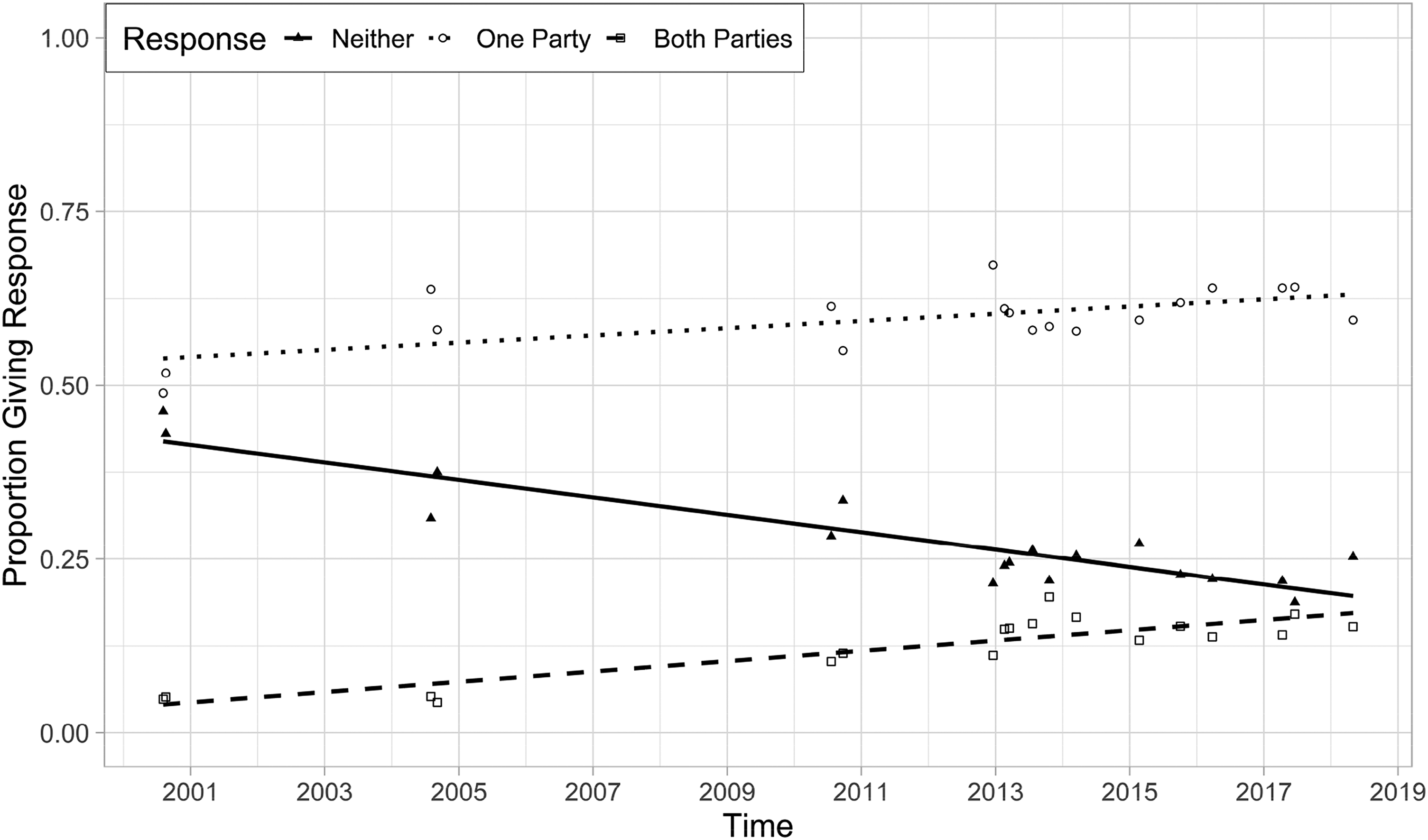
In Hypothesis 2, I argued that it should be ideological moderates that will react to growing elite polarization with the belief that both parties are too extreme, whereas ideological extremists will characterize only one party as too extreme. Figure 2 considers the interaction between time and ideology in shaping these perceptions via two sub-plots. Plot A provides the proportion of respondents providing each response by respondent ideology (moderate, liberal/conservative, or very liberal/conservative). Plot B, meanwhile, provides the average marginal effect of survey year on giving each response by respondent ideology. These latter results stem from a multi-level multinomial logit model that includes respondent ideology, survey year, and their interaction as predictor variables (see Table OA3). The patterns seen in Figure 2 are consistent with Hypothesis 2. While both moderates and those that said they were very liberal/conservative were less likely to indicate that neither party is too extreme as time went on, it is the former who become significantly more likely to say that both parties are too extreme while the latter become more likely to say that only one party fits this description. However, Figure 2 also reiterates a key point from Figure 1: the minority status of the perception that both parties are too extreme. Even though moderates were more likely to fall into this category as time went on, for instance, they still remained about as likely to say that neither party was too extreme and far more likely to say that one party was too extreme. In Hypotheses 3–4, I argued that partisanship might help account for this possibility, a claim I turn to next. Ideology and extremity perceptions over time.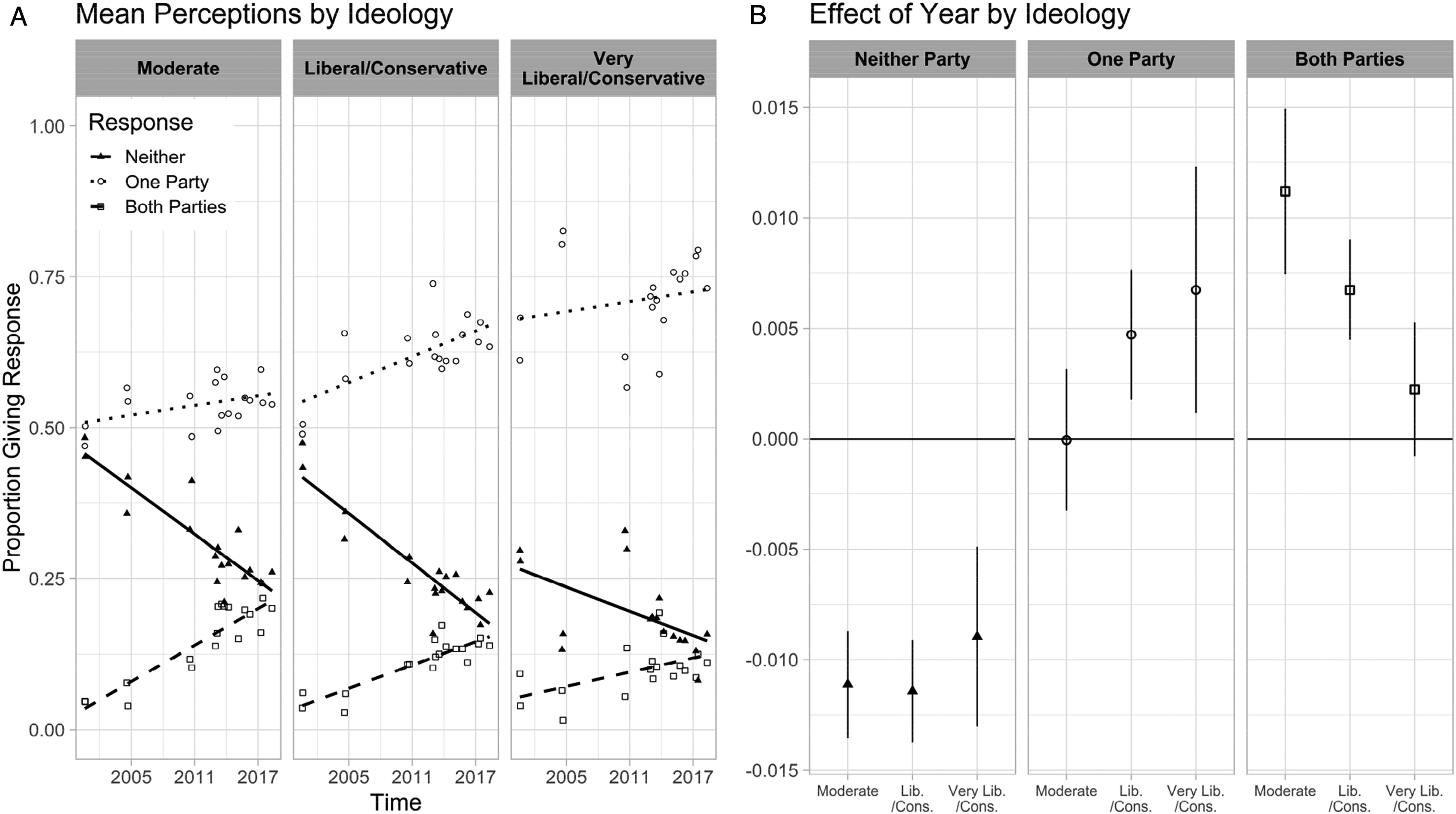
The Ideological and Partisan Correlates of Extremity Perceptions
A growing share of the US public believes that both parties are too extreme. However, this perception remains a minority one even among ideological moderates. One potential explanation for this pattern is that partisanship depresses the perception that both parties are too extreme including among moderates. I begin to test this claim with two sets of multinomial logit models in which membership in the three extremity categories is predicted based on respondent ideology and partisanship (sans interaction). This enables me to further test Hypothesis 2 (ideological moderates will be more likely to indicate that both parties are too extreme than extremists) as well as Hypothesis 3 (the probability of saying that one party is too extreme increases alongside partisan identity strength). 5
The first model is a multi-level multinomial logit using the Pew/CNN data. Party system extremity is predicted using the respondent’s ideological extremity (1 = moderate, 2 = liberal/conservative, and 3 = very liberal/conservative), their partisan identification (1 = pure Independent, 2 = leaning partisan, and 3 = partisan), demographics, and two survey level variables (year and sponsor). The second model uses the Lucid data and likewise predicts perceived system extremity with partisan identity strength and ideology as well as controls for demographics, political knowledge, and “opinionation” (the proportion of issue attitude and leader approval items the respondent gave a non-DK response to on the survey) to further control for respondent political attentiveness and confidence (Atkeson and Rapoport 2003). Details on the coding of all variables can be found in Online Appendix A.
A chief advantage of the Lucid survey concerns the measurement of partisanship and ideology. In the former case, I follow recent work by measuring party identity strength by averaging across multiple items: a folded PID extremity scale and questions concerning the subjective importance of the identity and how well it describes the respondent (Huddy et al. 2015). This variable ranges from 1 (pure Independent) to 4 (strongest partisan). In the latter case, I use three measures of ideology. First, subjective ideological extremity is a folded version of the respondent’s ideological identification (1 = moderate; 4 = very liberal/conservative). Second, I utilize a measure tied to the respondent’s operational ideology given concerns that subjective placements do not neatly align with policy preferences (Ellis and Stimson 2012; Treier and Hillygus 2009). I asked respondents five policy items earlier on the survey, which I combined into an index ranging from −5 (wholly consistent liberal responses) to +5 (wholly consistent conservative responses). I then folded the scale such that higher values indicate a more consistent operational ideology. This measure does not measure ideological moderation and extremity per se (Broockman 2016), but does capture important information about the ideological nature of the respondent’s belief system. Finally, I include a measure tapping into what Leighley and Nagler (2013) term “perceived policy distance” (PPD) to capture relative perceived proximity to the parties. Respondents placed themselves and the two parties on the same ideological scale earlier in the survey. PPD is the absolute difference of two absolute distance measures: ||Self – Democratic Party| - |Self – Republican Party||. A score of 0 indicates the respondent perceives both parties to be equally distant from them with higher values meaning that one party is perceived to be relatively more ideologically proximate. This measure perhaps best captures the underlying spatial logic at the heart of Hypothesis 2. The inclusion of multiple ideology-related variables provides a richer test of Hypothesis 2 than the Pew/CNN data allows given that data source only focuses on symbolic ideology.
Figure 3 summarizes these two models by plotting the average predicted probability of a respondent falling into each of the three extremity categories by their partisanship and ideology (Hanmer and Kalkan 2013). Tables OA4 and OA5 provide the full model results. Per Hypotheses 2 and 3, I expect that higher values on the four foregoing measures will be associated with a greater probability of saying that one party is too extreme and, concomitantly, a lower probability of saying that both parties are too extreme. Partisan and ideological correlates of party system extremity.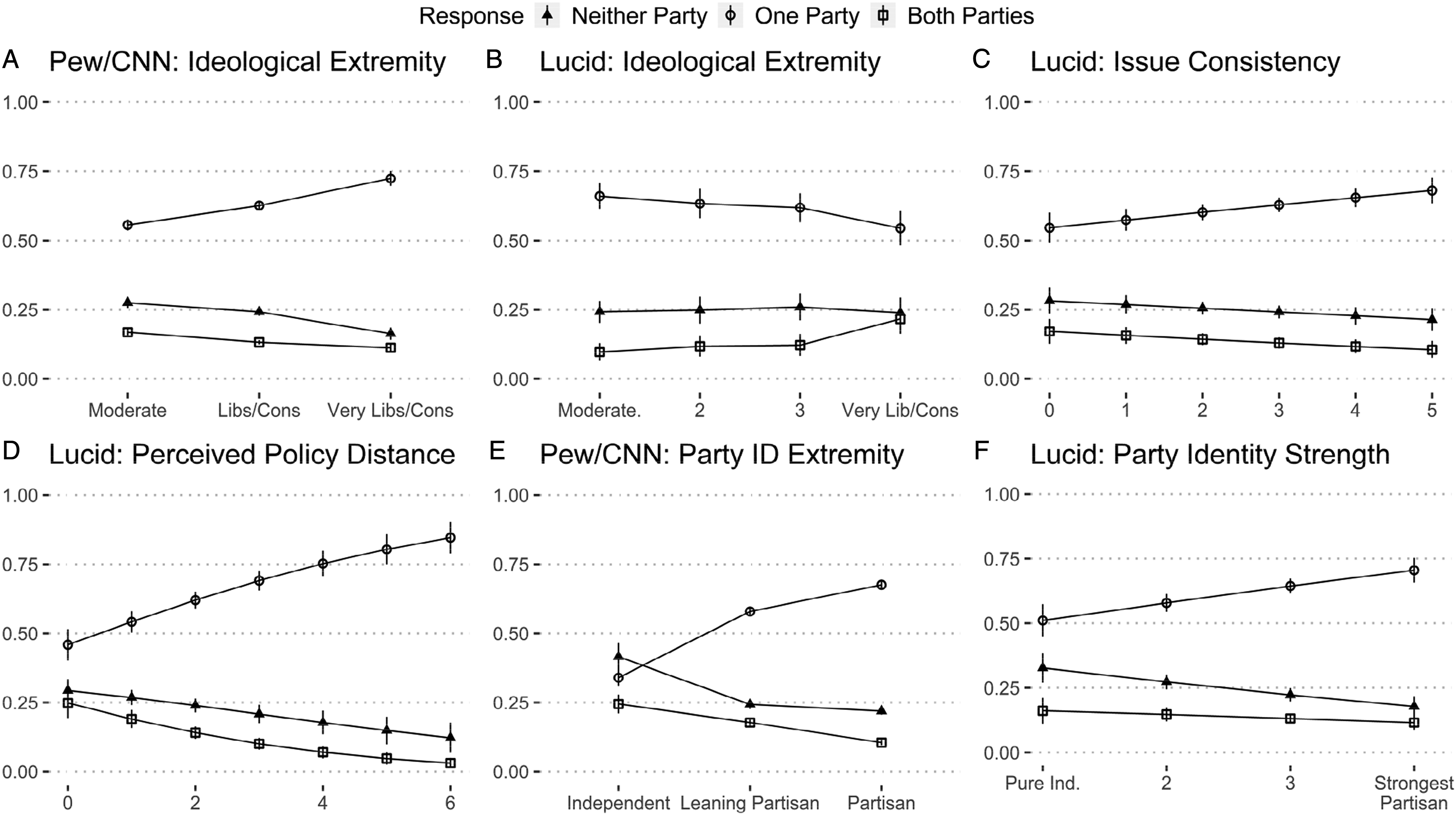
There are two things to note about Figure 3. First, the influence of these variables is much as I expected, with the main exception of symbolic ideology on the Lucid survey. 6 Ideological extremists, respondents with more consistent operational identities, those that perceive one party to be more proximate than the other, and stronger partisans are all substantially more likely to say that one party is too extreme and concomitantly less likely to say that either neither party or both parties are too extreme. The substantive effects of perceived policy distance and partisan identification are particularly notable in size with the probability of saying one party is too extreme being approximately 40 percentage points greater at the maximum of PPD than its minimum and likewise 20 (Lucid) to 34 percentage points (Pew/CNN) greater for partisan identity strength. 7
Second, while ideological moderates and those with weaker to non-existent partisan identities are more likely to say that both parties are too extreme than individuals at the other end of these scales, this nevertheless remains the minority view for these respondents. Indeed, the predicted probability of giving this response is always lower than the probabilities of saying that neither or only one party is too extreme. Ideological considerations clearly matter but are perhaps not as cleanly translated into extremity perceptions as one might presuppose.
My attention thus far has largely been on people who say that either one party or both parties are too extreme. However, these analyses and Figure 3 provide some further insight into those respondents who say that neither party is too extreme. Per above, Figure 3 shows a decreasing probability of falling into this category as the respondent’s ideology and partisan identity become more extreme or stronger. Education and political knowledge, meanwhile, also matter with the probability of falling into this category being higher among those with lower educational attainment or knowledge (see Tables OA4-5). These patterns imply that the perception that neither party is too extreme is driven both by partisan and ideological considerations as well as a lack of attention to political affairs. A disengaged public is thus likely an additional reason why concerns about party extremity remain a minority position.
The Interaction between Partisanship and Ideology
Finally, I turn to Hypothesis 4, where I argued that partisanship should interact with ideology such that ideological moderates would be less likely to indicate that both parties were too extreme, and more likely to say that one party was too extreme as their partisanship increased in strength. I refit the foregoing multinomial logit models to test this claim by including an interaction between partisan extremity and ideology. I do this three times, one for each ideology variable, for the Lucid sample.
Figure 4 provides an overview of these results by plotting the predicted probability of each response by ideology variable (x-axis) with separate lines/markers for (strong) partisans and pure Independents.
8
Perhaps the key comparisons in Figure 4 involve partisans and independents at the minimum of the three ideological variables. If partisan identification does not exert an influence over and above ideology, then these two markers should coincide. However, this is not the case. Strong partisans are substantially more likely to say that one party is too extreme than are pure Independents in each comparison. Indeed, strong partisans at the minimum of the ideology variables tend to have similar probabilities of saying that only one party is too extreme than do independents at the upper end of the ideology variable. Individuals at the other end of the ideological variables, meanwhile, tend to indicate that one party is too extreme with a convergence between partisans and non-partisans in the Lucid analyses. Figure 4 is not fully consistent with our argument, however. While partisanship does lead moderates to think that only one party is too extreme, it does not consistently undermine the (unlikely) perception that both parties are. Instead, partisanship appears to shift moderates away from saying that neither party is too extreme instead. Partisan considerations matter over and above ideological ones.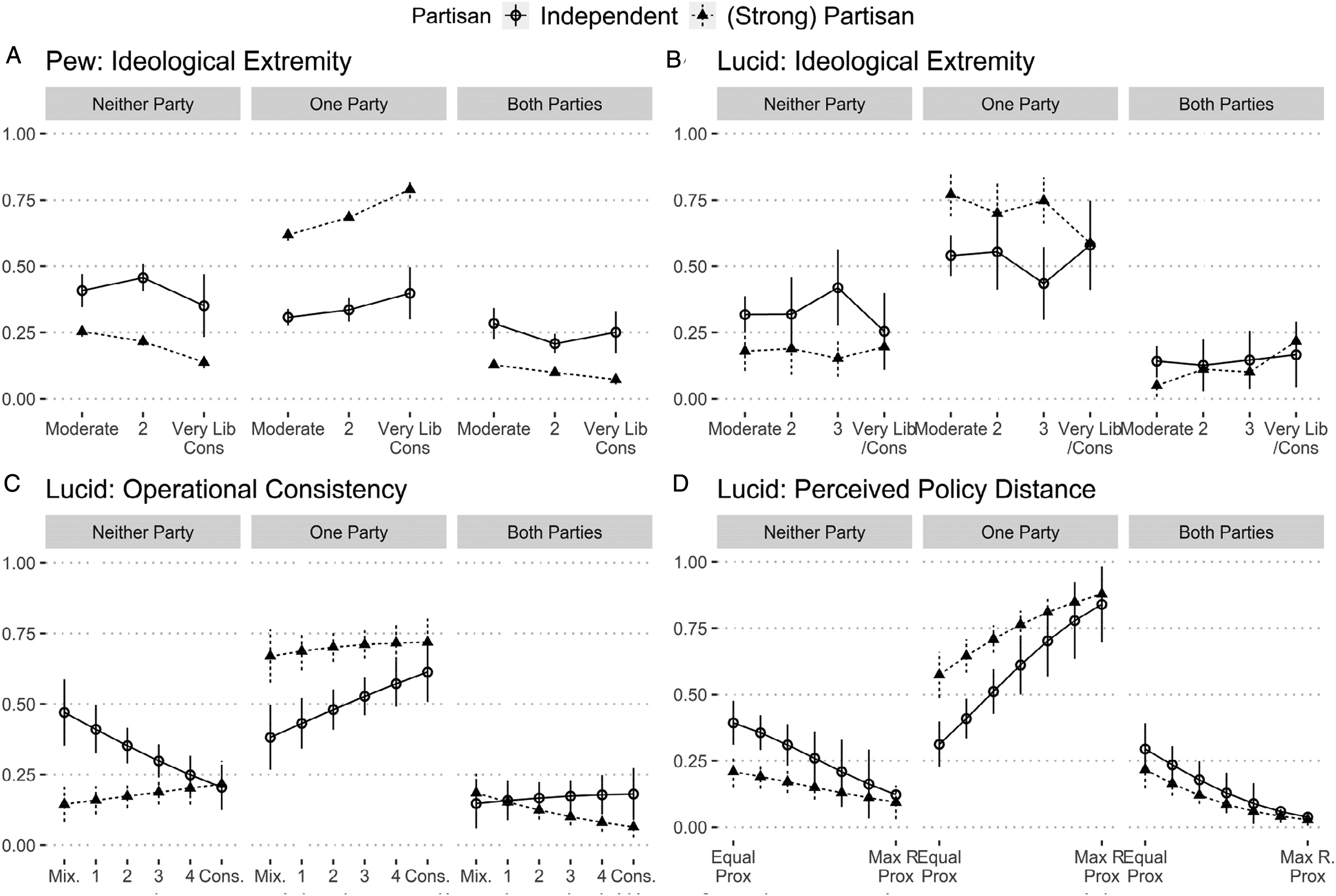
Discussion
Elite polarization combined with a “moderate” public suggests the possibility of growing discord with the US party system. However, while Figure 1 shows that this indeed is occurring to some extent, it also shows that most Americans do not believe that the party system is too extreme. Why might this be the case? One possibility is that partisanship acts as a brake on these perceptions such that one justifies the growing extremity of one’s side (or alternatively rejects its occurrence). The evidence in Figures 1, 2, 3, and 4 is consistent with this claim. Ideological extremists have reacted to growing polarization by becoming more convinced that one party is too extreme. Ideological moderates, on the other hand, have become a bit more likely to say that both parties are too extreme, but this trend is undercut by partisan allegiances as even moderates who think that both parties are equally distant from them are more likely than not to think that only one party is too extreme. Partisan loyalties may thus give partisan elites room to continue diverging without the public thinking the party system is growing out of whack ideologically.
An additional possibility is that extremity perceptions are perhaps less connected with programmatic considerations than we might otherwise think. While I have shown, for instance, that ideology measures based on people’s subjective ideological identification can predict beliefs about party extremity, such measures do not simply project programmatic concerns (Conover and Feldman 1981; Hare et al. 2015). Moreover, respondents to the Lucid survey who perceived both parties to be equally distant from themselves were about as likely to say that neither party was too extreme than both were, and more likely to say that only one party is too extreme than either of these responses. Other considerations beyond ideology may be shaping extremity perceptions. I turn now to probing what people mean by “extremity” to gain further purchase on these over-time trends.
The Many Meanings of Party Extremity
Respondents who indicated that a given party was too extreme on the Lucid survey were asked an open-ended follow-up question in which they were given a chance to record the considerations salient to them while answering. The amount written regarding the two parties was similar (mean words per response: 16.3 [Republican Party]; 16.9 [Democratic Party]). Not everybody, however, offered a “substantive” response. I coded each item for whether the response was “not substantive” (e.g., empty answers, explicit don’t know responses, or random text), “quasi-substantive” (e.g., responses that communicate something that is unclear such as “not sure what they make things difficult”), and “substantive” responses which fall into one of the categories discussed below. A similar split emerged for both parties with approximately 26% in the first category (Republicans: 26.6%; Democrats: 26.1%), 10% in the second category (Republicans: 9.4%; Democrats: 9.8%), and 64% (Republicans: 63.9%; Democrats: 64.1%) in the final category. This implies an important point: not everybody who says a party is extreme will have a well worked out idea of what that means.
Figure 5 provides descriptive statistics regarding what people wrote as a prelude to a deeper investigation. Plot A graphs the most common words by the target party. Plot B, meanwhile, provides a comparison of which words were more common in Democratic Party than Republican Party discussions (grey bars, top bars in Plot B) and which were more common in Republican Party than Democratic Party discussions (black bars, bottom bars in Plot B).
9
Most common words in open-ended responses.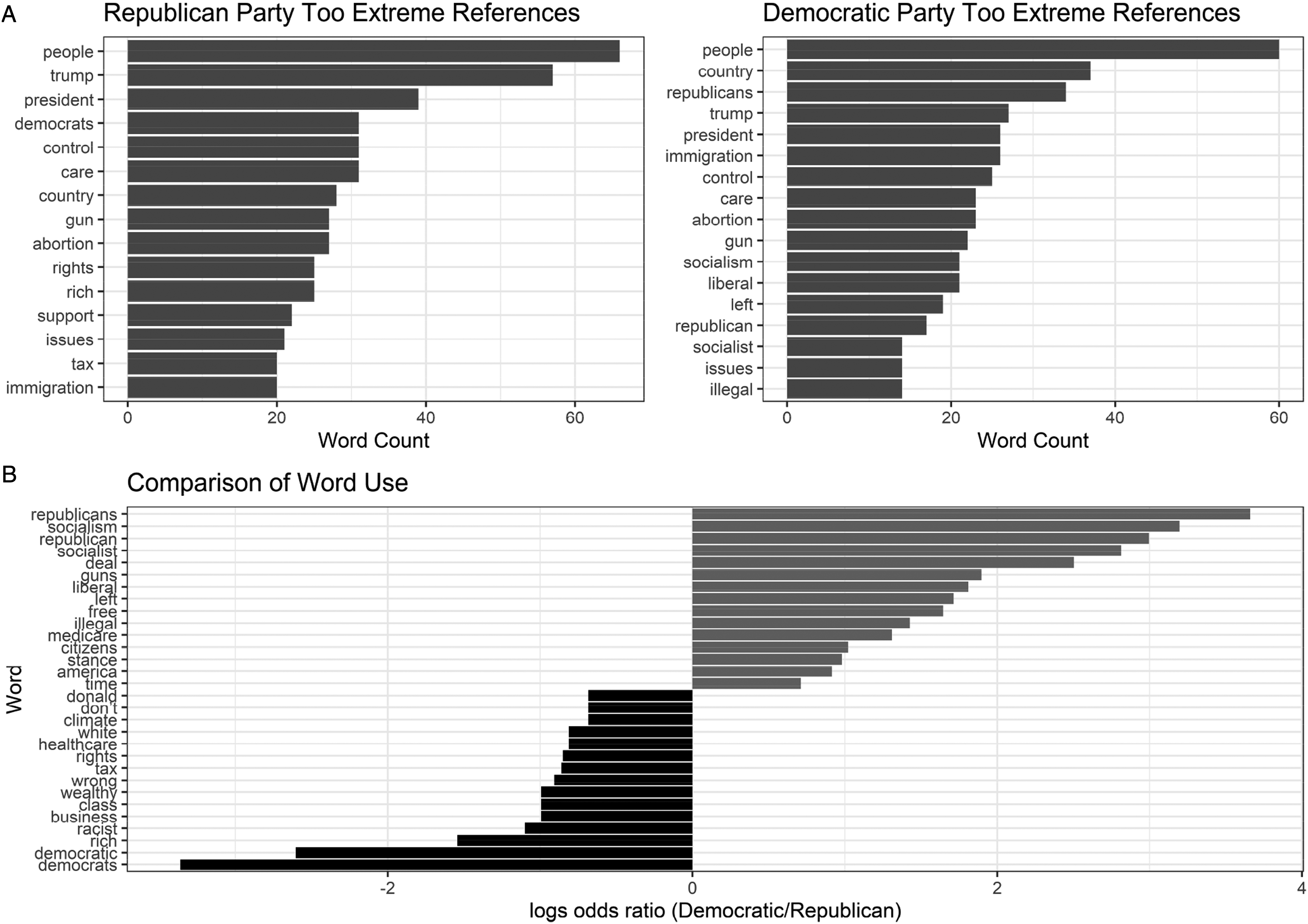
There are three things to heed in Plot A. First, there is some conceptual overlap between the parties with the top words relating to “people” (e.g., the American people or the people), the President, and the other party. Second, issue mentions are also highly salient with a particular focus on guns, abortion, and immigration. 10 Finally, references to ideological symbols (“liberal,” “left,” and “socialism”) are fairly common in discussions of the Democratic Party, but absent from the list of top words for the Republican Party. As Plot B further shows, references to social groups (rich and wealthy in particular) were more prominent in discussions of the Republican Party, while labels like socialism were more prominent in discussion of the Democratic Party. This last pattern may arise for a number of reasons I cannot examine with this data, including the different valence of the terms “liberal,” “conservative,” and “socialist” in American politics (Ellis and Stimson 2012) or potential differences in how Republicans and Democrats conceptualize politics (Grossmann and Hopkins 2015; Lelkes and Sniderman 2014). 11
Content Categories with Examples.
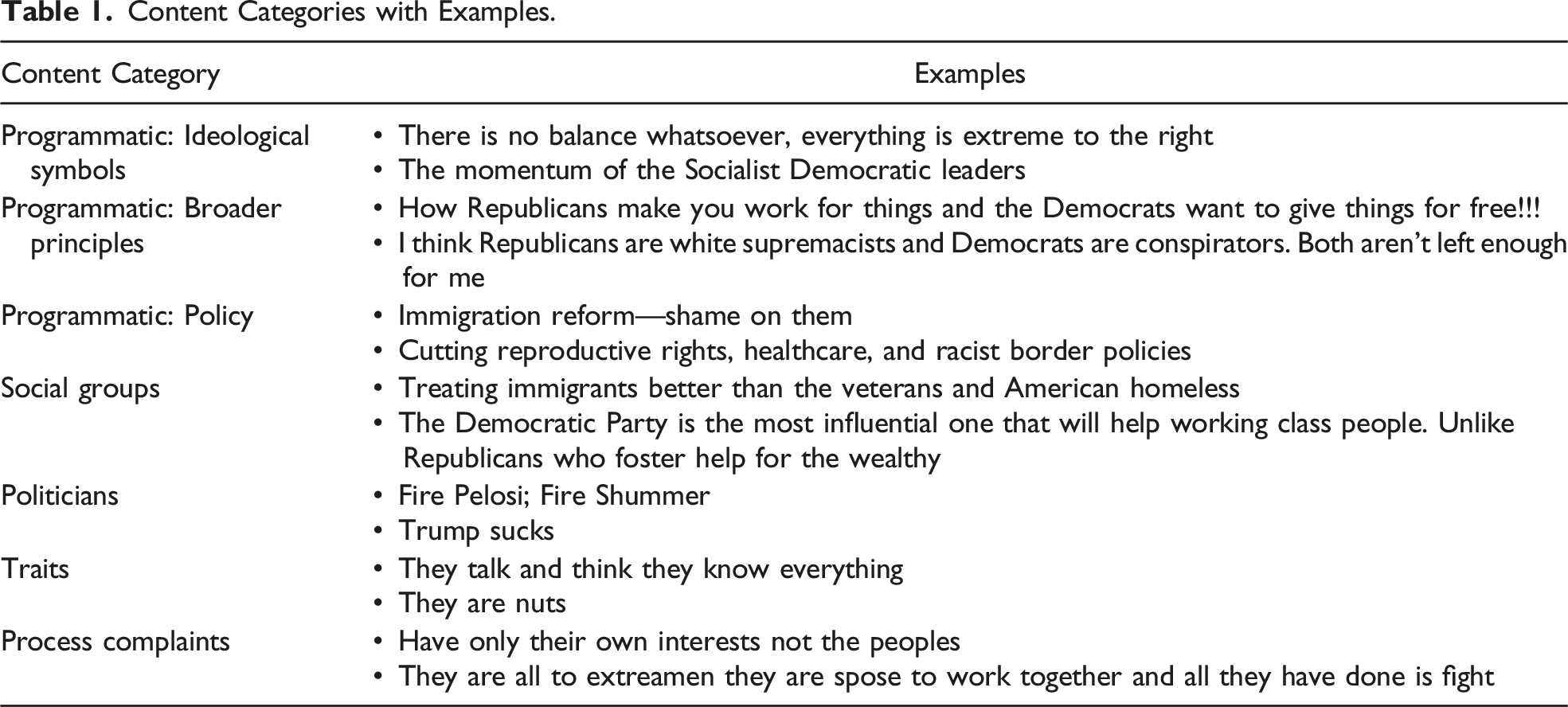
Figure 6 plots the proportion of entries where a given category was coded as present. Panels A and B keep the three programmatic categories separate, while Panels C and D combine them (i.e., a response was coded as “programmatic” if it used at least one of these categories).
13
Programmatic concerns are clearly quite salient in Panels A and B, and dominant in Panels C and D, albeit with a key difference between the parties. While references to specific policies were highly salient in both cases, references to ideological symbols were far more frequent when the target was the Democratic Party. However, while programmatic considerations were perhaps the most salient ones for respondents, they were nevertheless present in only approximately 1/3 of extremity responses. Extremity perceptions were instead multifaceted in nature drawing on a variety of complaints regarding the party in question. Category salience by target party.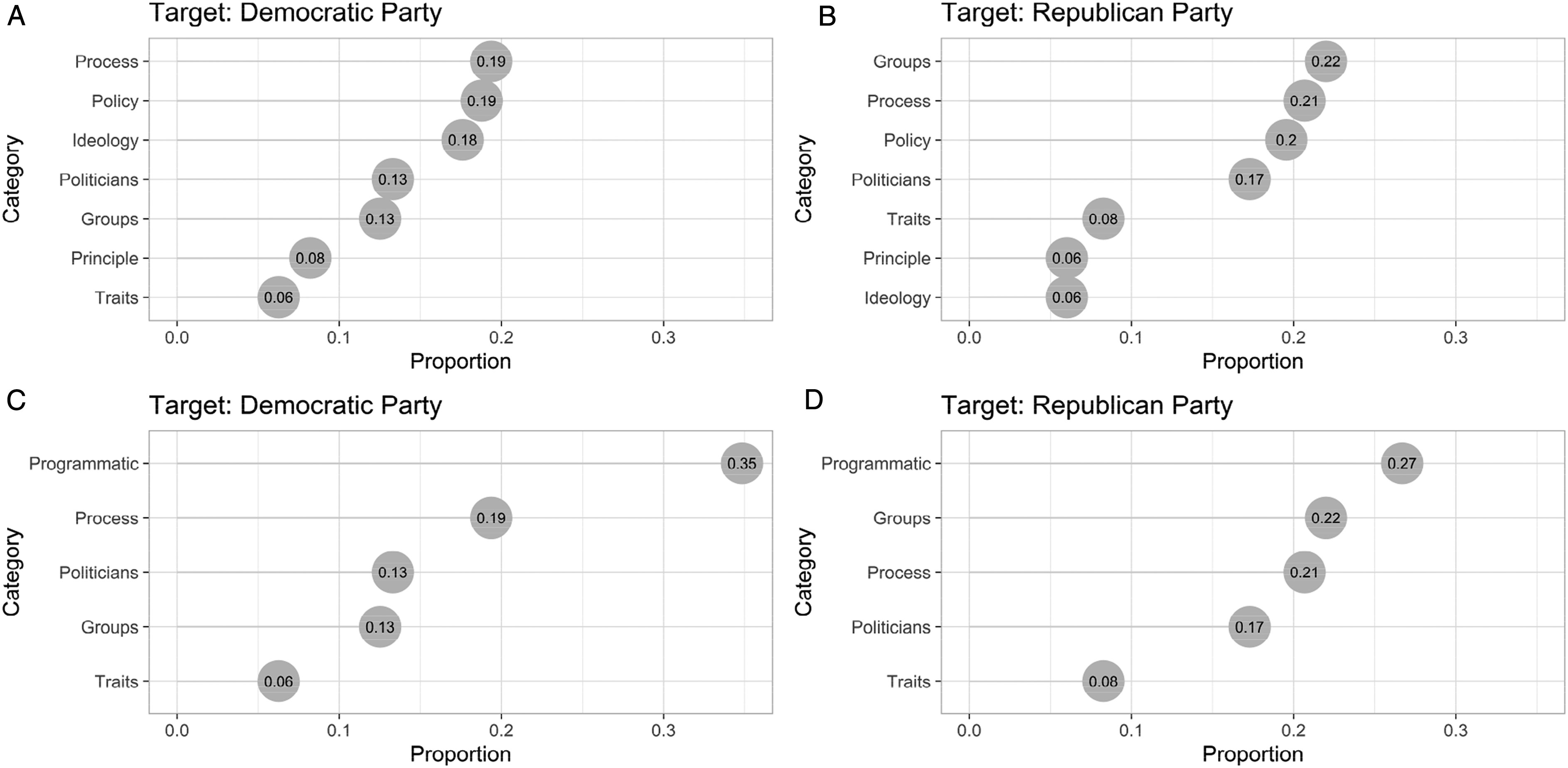
Perhaps the most consistently salient consideration outside of programmatic considerations was complaints about the procedural failings of the parties. Process complaints were one of the top three categories for both parties, with their specific ranking depending on how one treats the three programmatic categories. I further coded these “process” entries into additional sub-categories to further probe what types of procedural issues were salient for respondents. 14 Many of these entries referenced the self-interested motivations of the party (28% of Democratic and 38% of Republican Party process entries) or its failure to represent the views of constituents or the broader public (21% and 22% of process entries, respectively). These latter entries, it should be noted, focused on the general failure of the party to represent the public; none of the Republican entries with this code also mentioned a specific policy, while only three (out of 20) Democratic entries did. Another central theme was the failure of one (or both) parties to compromise or work with the other party (44% of Democratic Party and 25% of Republican Party process entries) and/or the highly conflictual nature of partisan politics (23% of Democratic and 6% of Republican Party entries). Donald Trump loomed large in these latter discussions although in a different manner depending on the target party. 15 References to Donald Trump when the target was the Democratic Party typically focused on the party’s obstructionist and conflictual stance toward the President, while mentions involving the Republican Party either focused solely on the President or instead focused on how the party was failing to hold him accountable and was putting party loyalty before other ends such as representation or accountability. The intertwined prominence of these considerations points to a more personalistic vision of extremity that may be only superficially related to programmatic considerations.
I end with a discussion of the predictors of the use of these categories. I argued in Hypothesis 5 that political knowledge should be positively related to the use of programmatic considerations. I test this hypothesis by stacking the dataset such that each row represents a respondent/party dyad. I then ran a series of logit models predicting whether a given category was used (= 1) or not (= 0). I include as predictor variables political knowledge, ideological extremity and issue consistency, respondent partisanship (Democrat [base category], Republican, or Pure Independent), an indicator for which party is being referenced, opinionation, whether the respondent indicated that the other party was too extreme, and respondent demographics. 16 I further cluster standard errors at the respondent level given repeated observations when respondents indicate that both parties are too extreme.
Figure 7 plots the average predicted probability of a respondent using a given category by level of political knowledge; full model results are provided in Table OA10. Political knowledge has a positive and statistically significant relationship with using each of the programmatic categories (and, indeed, all categories save traits and politicians). The substantive influence of knowledge is sizable. The predicted probabilities for those at the minimum of knowledge are 0.1 and below for the four programmatic codes. Those with limited political knowledge are seldom able to connect their feelings about a party’s extremity with what the party stands for.
17
Individuals at the maximum of knowledge, meanwhile, are anywhere from 10 percentage points more likely (principles) to 35 percentage points more likely (programmatic) to do so. This is exactly what was expected in Hypothesis 5. Political knowledge and category use.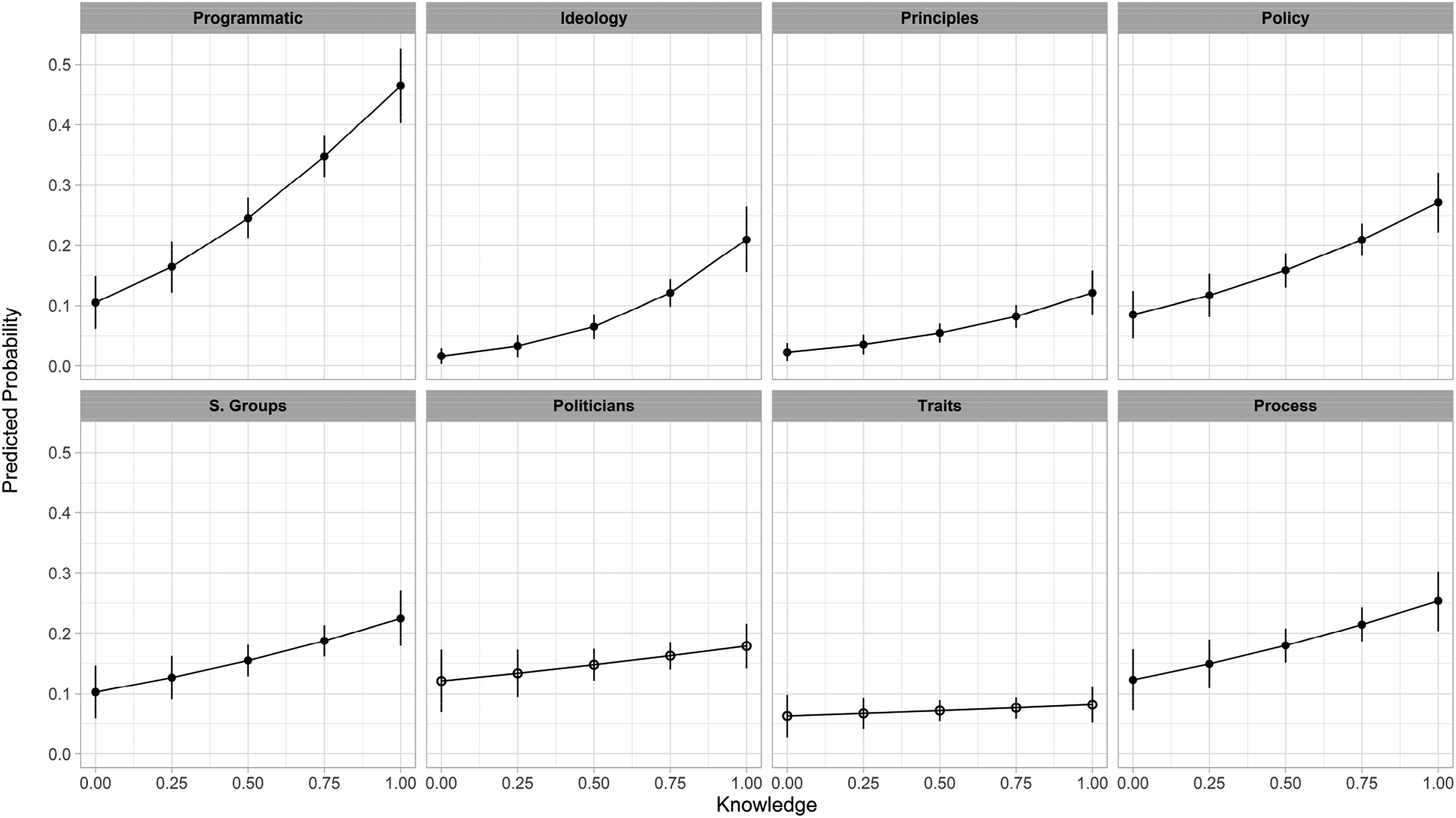
Conclusion
The Democratic and Republican parties have ideologically polarized since the 1960s, while most evidence suggests that the mass public has done so to a much lesser extent (Hill and Tausanovitch 2015; Lelkes 2016; McCarty et al. 2016). I provide a novel analysis of the American mass public’s reactions to party competition by leveraging repeated measurements of the public’s perceptions regarding whether the Republican and Democratic parties are “too extreme” or not. Three key results emerged. First, a growing proportion of Americans believe that both political parties are too extreme, but this belief remains in the decided minority. Second, ideological and partisan factors interact to shape beliefs about the parties. Ideological moderates, on average, are more likely to believe that both parties are too extreme than are extremists, but this is conditional on the presence of partisan motivations to say that only one party is too extreme instead. Finally, I show that declarations of party extremity are indeed predicated upon programmatic considerations for many Americans, but far from all. Instead, the public has a multifaceted conceptualization of extremity that is frequently tied to the procedural failures of the parties, that is, a surfeit of conflict, lack of compromise, and perceptions of self-interested behavior.
One limitation of the current study is the use of cross-sectional data. I have argued that stronger partisans will tend to report that only one party (the out-party) is too extreme even when they hold ideological predispositions that might better promote the belief that both parties are (i.e., a moderate ideology). This pattern does emerge in the foregoing analyses (Figure 4) and is consistent with a broader literature which shows partisanship shaping political perceptions (Barber and Pope 2019; Bisgaard and Slothuus 2018; Dancey and Sheagley 2018; Simas 2018). However, cross-sectional data cannot establish that partisan identification is indeed causing these extremity perceptions. Perhaps, for instance, some individuals come to believe that a given party is “too extreme” on a particular dimension they care about and thereafter update their partisan identities as a result (see, e.g., Carsey and Layman 2006; Lupu 2012). It is plausible that this process describes the behavior of some individuals, but the current evidence cannot detail the extent of this type of response. Future work could address this issue either via panel data, which is typically superior for advancing causal claims such as this (Carsey and Layman 2006; Lenz 2012), or via experimental methods in which beliefs about party extremity are targeted via randomly assigned manipulations.
The patterns shown above have important implications for party strategy and competition. Growing elite polarization combined with mass centrism attracts attention not just because it seems to endanger important outcomes such as democratic representation (Bafumi and Herron 2010; but see Ahler and Broockman 2018) but also because it poses a seeming puzzle: why haven’t parties come back to the middle? There are obviously myriad reasons why parties do not converge on the median position in the mass public (Grofman 2004; Harbridge and Malhotra 2011; Layman et al. 2010). My results suggest that the parties simply have little reason to do so as elite positions are only imperfectly translated into perceptions of extremity. While moderates on average may see both parties as too extreme, and increasingly so over time, this remains a minority view even within this subgroup of Americans. Moreover, partisan motivations augment whether moderates view the party system as too extreme. Relatively few people, drawn primarily from the most highly knowledgeable subset of Americans, explicitly connect their beliefs about party extremity to programmatic considerations. This implies that elite partisans could continue to grow more extreme without fear of stimulating a majority belief that the party system is too extreme as most in the public are unlikely to get the message (see, also: Adams et al. 2011).
This study also has implications for the broader examination of extremity in politics. Extremity is a relevant concept not just in the study of partisan polarization but also in additional literatures concerning voter behavior, candidate strategy, and legislative politics. A central question in these literatures concerns whether extremist parties and candidates suffer electoral penalties with most research suggesting that they do to some extent (Adams and Somer-Topcu 2009; Canes-Wrone et al. 2002; Hall 2015; Tausanovitch and Warshaw 2018). My results suggest that negative reactions to “extreme” candidates may not entirely be driven by their ideological reputations but instead may also be tied to perceptions about their legislative style (e.g., procedural reputations). Future work should investigate how variations in the various elements of extremity salient to individuals impacts subsequent evaluations.
Supplemental Material
Supplemental Material - Is a Polarized Party System a Too Extreme Party System? Understanding Perceptions of Party Extremity in the United States
Supplemental Material for Is a Polarized Party System a Too Extreme Party System? Understanding Perceptions of Party Extremity in the United States by Joshua Robison in Political Research Quarterly
Footnotes
Acknowledgments
I thank Martin Bisgaard, Diana Dávila Gordillo, Michael Meffert, Rachel Moskowitz, Wouter Schakel, Jonah Schulhofer-Wohl, Rasmus Skytte, and Nikoleta Yordanova for their feedback on earlier versions of this manuscript. All errors remain my own.
Declaration of Conflicting Interests
The author(s) declared no potential conflicts of interest with respect to the research, authorship, and/or publication of this article.
Funding
The author(s) disclosed receipt of the following financial support for the research, authorship, and/or publication of this article: This work was supported by the Danish Council of Independent Research (610900073A).

Supplemental Material
Supplemental material for this article is available online.
Notes
References
Supplementary Material
Please find the following supplemental material available below.
For Open Access articles published under a Creative Commons License, all supplemental material carries the same license as the article it is associated with.
For non-Open Access articles published, all supplemental material carries a non-exclusive license, and permission requests for re-use of supplemental material or any part of supplemental material shall be sent directly to the copyright owner as specified in the copyright notice associated with the article.
