




Abstract
In the literature on nuclear proliferation, some argue that further proliferation decreases interstate conflict, some say that it increases interstate conflict, and others indicate a non-linear relationship between these two factors. However, there has been no systematic empirical investigation on the relationship between nuclear proliferation and a propensity for conflict at the interstate–systemic level. To fill this gap, the current paper uses the machine learning method Random Forests, which can investigate complex non-linear relationships between dependent and independent variables, and which can identify important regressors from a group of all potential regressors in explaining the relationship between nuclear proliferation and the propensity for conflict. The results indicate that, on average, a larger number of nuclear states decrease the systemic propensity for interstate conflict, while the emergence of new nuclear states does not have an important effect. This paper also notes, however, that scholars should investigate other risks of proliferation to assess whether nuclear proliferation is better or worse for international peace and security in general.
Introduction
Does nuclear proliferation decrease or increase interstate conflict? The existing theories provide different, and often conflicting, explanations. Quantitative research has assessed the empirical validity of various explanations, but has only utilized a dyadic-level or crisis-level of analysis (Asal and Beardsley, 2007; Bell and Miller, 2015; Gartzke and Jo, 2009; Geller, 1990; Narang, 2013; Rauchhaus, 2009; Sobek et al., 2012). This is surprising, because nuclear proliferation is principally a systemic phenomenon, since it increases the number of nuclear states in the interstate system. Thus, it remains unclear how nuclear proliferation is empirically associated with a propensity for interstate conflict at the interstate–systemic level. A systemic propensity for conflict may not be understood simply as an aggregate of lower levels of phenomena. For example, even if nuclear weapons had a significant effect on conflict at the dyadic level, this effect might be negligible as an aggregate at the systemic level. This is a reasonable concern, because the majority of states in the system are non-nuclear states.
Given these issues, this paper contributes to the existing literature by empirically examining how a change in the number of nuclear states influences a propensity for conflict at the interstate–systemic level. Because the literature lacks a rigorous empirical answer to the theoretical debate, like Rauchhaus (2009) this paper tests existing theories rather than proposing a new theory.
To this end, it utilizes the machine learning method Random Forests (Breiman, 2001; for an R package, see Liaw and Wiener, 2002), one of the best-performing supervised learning models currently available (Caruana and Niculescu-Mizil, 2006). Random Forests can address theoretical and methodological problems to analyze the relationship between nuclear proliferation and a systemic propensity for interstate conflict, as this paper discusses in greater detail.
The paper first reviews the scholarly debate on nuclear proliferation and interstate conflict. Second, it empirically examines the relationship between nuclear proliferation and a systemic propensity for interstate conflict, using a Random Forests model to analyze interstate–systemic year data from 1950 to2009. Finally, it presents implications for the literature and policy making.
Theories
Nuclear-proliferation optimists argue that nuclear weapons reduce conflict because of the intolerable cost of nuclear war (Mearsheimer, 1984/1985: 21; Waltz, 2003: 6–9). Therefore, “more may be better” (Waltz, 2003: 3). Nuclear symmetry (a dyad of nuclear states) should deter states from resorting to war, because war could result in the use of nuclear weapons (Powell, 1985). Rauchhaus (2009: 263) notes that the nuclear deterrence literature is “virtually silent” on the effect of nuclear asymmetry (a nuclear state versus a non-nuclear state), but Waltz (2003: 17) argues, “Far from lowering the expected cost of aggression, a nuclear offense, even against a non-nuclear state, raises the possible costs of aggression to incalculable heights because the aggressor cannot be sure of the reaction of other states”. Non-nuclear states should also be deterred from engaging in war with nuclear states, because non-nuclear states fear nuclear retaliation. If nuclear weapons prevent war, they should also decrease conflict short of war, because states would hesitate to initiate conflict which could escalate to war. Optimists admit that nuclear weapons do not necessarily prevent all types of interstate conflict (see Hagerty, 2009: 109–110; Waltz, 2003: 17), but they do not argue that nuclear weapons increase conflict either.
Waltz (2003: 9–26) also suggests that new nuclear states are not more prone to conflict than old nuclear states, because the logic and assumptions of nuclear deterrence can be applied not only to old nuclear major powers but to any kind of states (minor powers, domestically unstable states, autocratic states, or states engaged in rivalry). In short, optimist logic expects that nuclear proliferation reduces a systemic propensity for interstate conflict through deterrent effects.
Nuclear-proliferation pessimists suggest that nuclear proliferation sometimes increases conflict; in discussions of nuclear symmetry, pessimists point out the problem of the stability–instability paradox, whereby “nuclear deterrence at the strategic level allows for greater flexibility and aggression at lower levels” (Saideman, 2005: 219; see also Snyder, 1965). Analyzing why Pakistan resorted to unconventional warfare against India even after both states became nuclear-armed, Bajpai (2009: 170) argues that the “existence [of nuclear weapons] created the conditions under which one side, Pakistan, felt that the fear of nuclear war allowed it to prosecute an insurgency/terror war against India”. Thus, nuclear symmetry can provoke limited war and conflict, if not full-scale war. As for nuclear asymmetry, Geller (1990: 307) points out that “the possession of nuclear weapons has no evident inhibitory effect on the escalation propensities of the non-nuclear opponent” for the following two reasons: first, the non-nuclear state may doubt that the nuclear opponent will actually use nuclear weapons due to “its lack of military significance” or “political and ethical inhibitions”; and second, the non-nuclear state may have greater interests in the conflict than the nuclear opponent. Hence, Geller concludes that, in nuclear asymmetry, “war is a distinct possibility, with aggressive escalation by the non-nuclear power probable” (Geller 1990: 307).
As for the age of nuclear states, Sagan (2003: 53–72) suggests that new nuclear states are more prone to conflict than old ones, because the assumptions of nuclear deterrence cannot be applied to the former. Other states may be motivated to initiate preventive war to destroy new nuclear states’ nuclear programs in their early stages, while new nuclear states may lack second-strike capabilities for effective deterrence. The implication of this argument is twofold: first, if new nuclear states do not have as much deterrence credibility as do old nuclear states, they are likely to motivate other states to initiate conflict. Other states are faced with a closing window of opportunities to secure their interest vis-à-vis new nuclear states. With time, their nuclear capabilities will develop, making it more difficult for other states to change the status quo by military means. Second, because they fear that other states will initiate conflict earlier rather than later, new nuclear states may initiate conflict as a costly signal to increase their deterrence credibility. Therefore, according to pessimist logic, new nuclear states are more likely to experience conflict (either as a target or an initiator) than old nuclear states or non-nuclear states. In summary, pessimist logic says that nuclear proliferation occasionally increases a systemic propensity for interstate conflict, particularly after a new nuclear state appears in the system.
Bueno de Mesquita and Riker (1982) and Intriligator and Brito (1981) suggest middle-ground views. While their model primarily focuses on the relationship between nuclear proliferation and the probability of nuclear war, it can be inferred that if the number of nuclear states changes the probability of nuclear war, it should also change the probability of interstate conflict which could escalate to such war. Bueno de Mesquita and Riker’s (1982) formal model shows that nuclear proliferation increases the probability of conflict until the number of nuclear states reaches five, and then the probability keeps decreasing along with further proliferation. Intriligator and Brito’s (1981) model indicates that nuclear proliferation causes the probability of conflict to increase until the second nuclear state obtains sufficient nuclear capabilities, and then further proliferation either decreases or increases the probability depending on the potentiality of accidental or irrational war. In short, these two models expect a non-linear relationship between nuclear proliferation and a systemic propensity for interstate conflict.
Finally, nuclear proliferation could mitigate conflict through two ‘indirect’ mechanisms: first, extended nuclear deterrence decreases the likelihood of a non-nuclear protégé being a target of conflict (Fuhrmann and Sechser, 2014; see also Huth, 1990 and Weede, 1983), and ceteris paribus, nuclear proliferation should result in a larger number of extended nuclear deterrence measures, thereby reducing a systemic propensity for conflict; and second, since nuclear weapons expand states’ foreign interests (Bell and Miller, 2015), the emergence of nuclear states might discourage non-nuclear dyads, particularly those in the same region, from engaging in conflict for fear of intervention by these nuclear states.
Given these conflict-reducing/provoking effects of nuclear proliferation, what overall effect would nuclear proliferation have on a systemic propensity for conflict? This is difficult to answer, not only due to the controversy over whether nuclear states are more or less prone to conflict, but also because the existing theories do not explain whether those conflict-reducing/provoking effects are large enough to influence a systemic propensity for interstate conflict, given the ratio of nuclear states to non-nuclear states in the system. This challenge motivates the empirical examination of the relationship between nuclear proliferation and a systemic propensity for conflict.
Empirical investigation by Random Forests
The interstate–systemic year data are used here to investigate the relationship between nuclear proliferation and a systemic propensity for interstate conflict. The dependent variable is the number of militarized interstate dispute onsets (Palmer et al., 2015; version 4.01 is used) per systemic-year, standardized as the ratio to the number of states in the interstate system (Correlates of War Project, 2011) – hereafter, the ‘dispute–state ratio’. Observations one year ahead (t+1) are used to make sure that causal effects precede a variation in the dispute–state ratio. 2
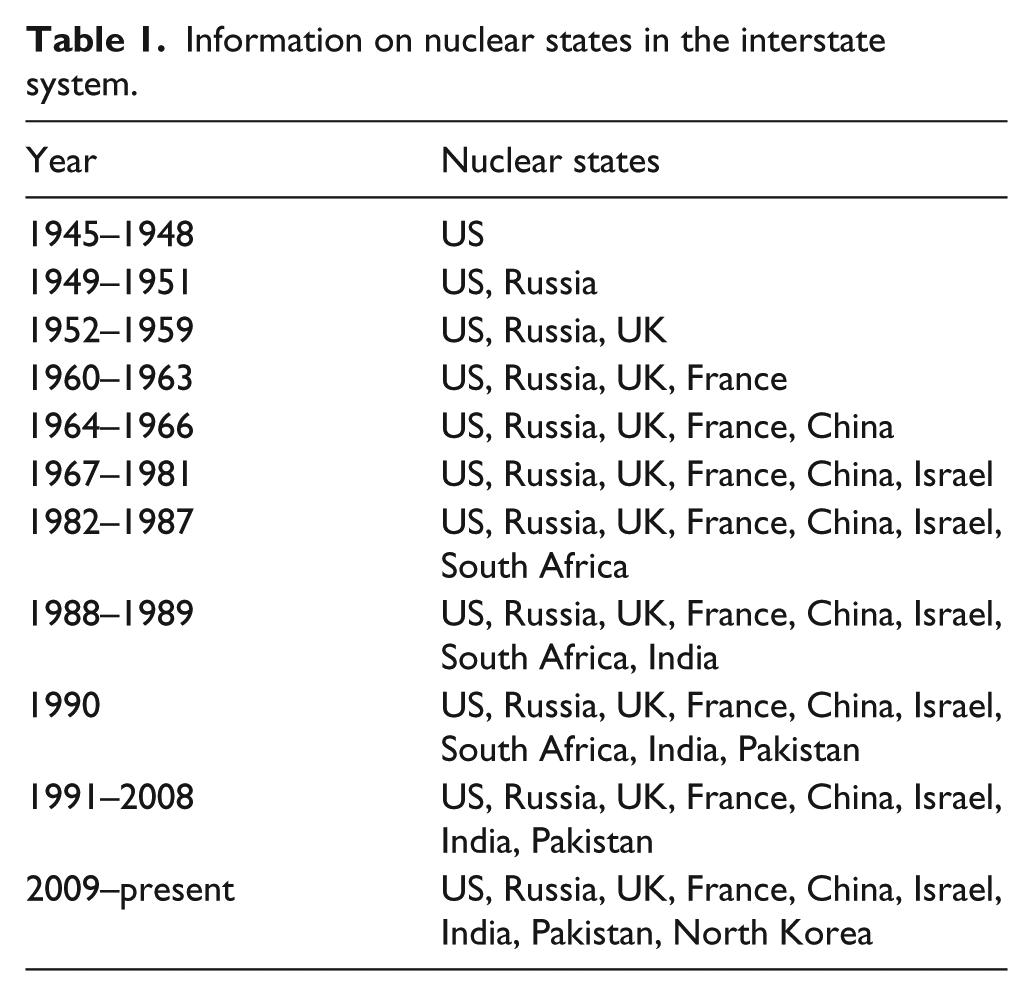
Two regressors are used to examine the effect of nuclear proliferation: the number of nuclear states in the interstate system; and a count of the years since the number of nuclear states changes (hereafter ‘nuclear year counter’), measuring the effect of new nuclear states (Horowitz, 2009). The data about nuclear states are from Gartzke and Kroenig (2009); additionally, the current paper codes North Korea as a nuclear state since 2009 (Table 1). 3
Information on nuclear states in the interstate system.
The model also includes the number of democratic states (Polity2 score ⩾ 6 in Marshall, 2013) in the interstate system, the gross world product (Earth Policy Institute, 2012), and the binary variable of unipolarity (coded zero until 1989 and one from 1990; see Monteiro, 2011/2012); these three variables control for democratic peace (Russett and Oneal, 2001), capitalist peace (Gartzke, 2007), and polarity (Monteiro, 2011/2012) respectively. The number of nuclear states and these control variables suffer from multicollinearity (see Table A-9 in the online appendix), and this paer later explains how to resolve this problem. A lagged dependent variable is also included to address the temporal dependence of time-series data. The temporal scope is 1950–2009 (i.e. N=59) due to the data availability and the use of the dependent variable at t+1. The descriptive statistics of all variables are displayed in Table 2. 4
Descriptive statistics.

As mentioned in the introduction, this paper uses the machine learning, non-parametric method Random Forests for the empirical investigation. 5 Although it is unfamiliar to most political science and international relations analysts, Random Forests has been widely used in numerous scientific studies (Strobl et al., 2009: 324; Strobl et al., 2008). The popularity of the method is also apparent from the fact that Breiman’s (2001) original paper has been cited 12,721 times in the literature. 6
Random Forests generates two useful analytics: first, ‘conditional variable importance’ measures how ‘important’ each regressor is, conditional on the remaining regressors (Hothorn et al., 2006; Strobl et al., 2007, 2008). This is analogous to statistical significance in conventional regression models. The significance threshold proposed by Strobl et al. (2009: 343) is whether the importance score of a regressor is negative, zero, or lower than the absolute value of the lowest negative score. If none applies, the regressor is considered as important; and the second relevant analytic is a partial dependence plot (Friedman, 2001). This estimates the marginal effect of each regressor on the dependent variable while taking the remaining regressors into consideration.
Random Forests has three attractive and distinctive characteristics for the purposes of this paper: first, the estimation of conditional variable importance and partial dependence plots enable conventional applied researchers to interpret non-parametric analysis in an intuitive way; second, Random Forests can examine non-linearity (Strobl et al., 2009: 339–341), which is desirable because, as already noted, some theories expect non-linearity between nuclear proliferation and a systemic propensity for conflict; and finally, it can cope with potential interactions and multicollinearity between regressors (Strobl et al., 2009: 339–341; Strobl et al., 2008). As noted before, most of the regressors here are highly correlated, and also it is plausible to anticipate some interaction effect between them (e.g. the number of democratic states and the gross world product). The specific capabilities of Random Forests are therefore essential.
The estimation of conditional variable importance shows that the nuclear year counter has a negative importance score. 7 Thus, the nuclear year counter is not important in explaining the dispute–state ratio. This suggests that the optimist theory is supported. The remaining regressors have an importance score higher than the absolute value of the importance score of the nuclear year counter, meaning that they are all important. Controlling for democratic peace, capitalist peace, and polarity, the number of nuclear states is still a significant predictor in explaining a systemic propensity for interstate conflict.
Figure 1 presents the partial dependence plots of the model. 8 First, on average, a larger number of nuclear states is associated with a lower dispute–state ratio, although the changes from two nuclear states to three and from six to seven increase the ratio instead. Thus, the relationship is empirically non-linear, as Bueno de Mesquita and Riker (1982) and Intriligator and Brito (1981) expected in part. Overall, however, the optimist theory is supported, and the change from two nuclear states to nine nuclear states decreases the dispute–state ratio approximately from 0.228 to 0.18. This means that, if there are 194 states in the system (as there were in 2009), the number of militarized interstate dispute onsets per system-year decreases approximately from 44 to 35. This is a substantively significant decline.
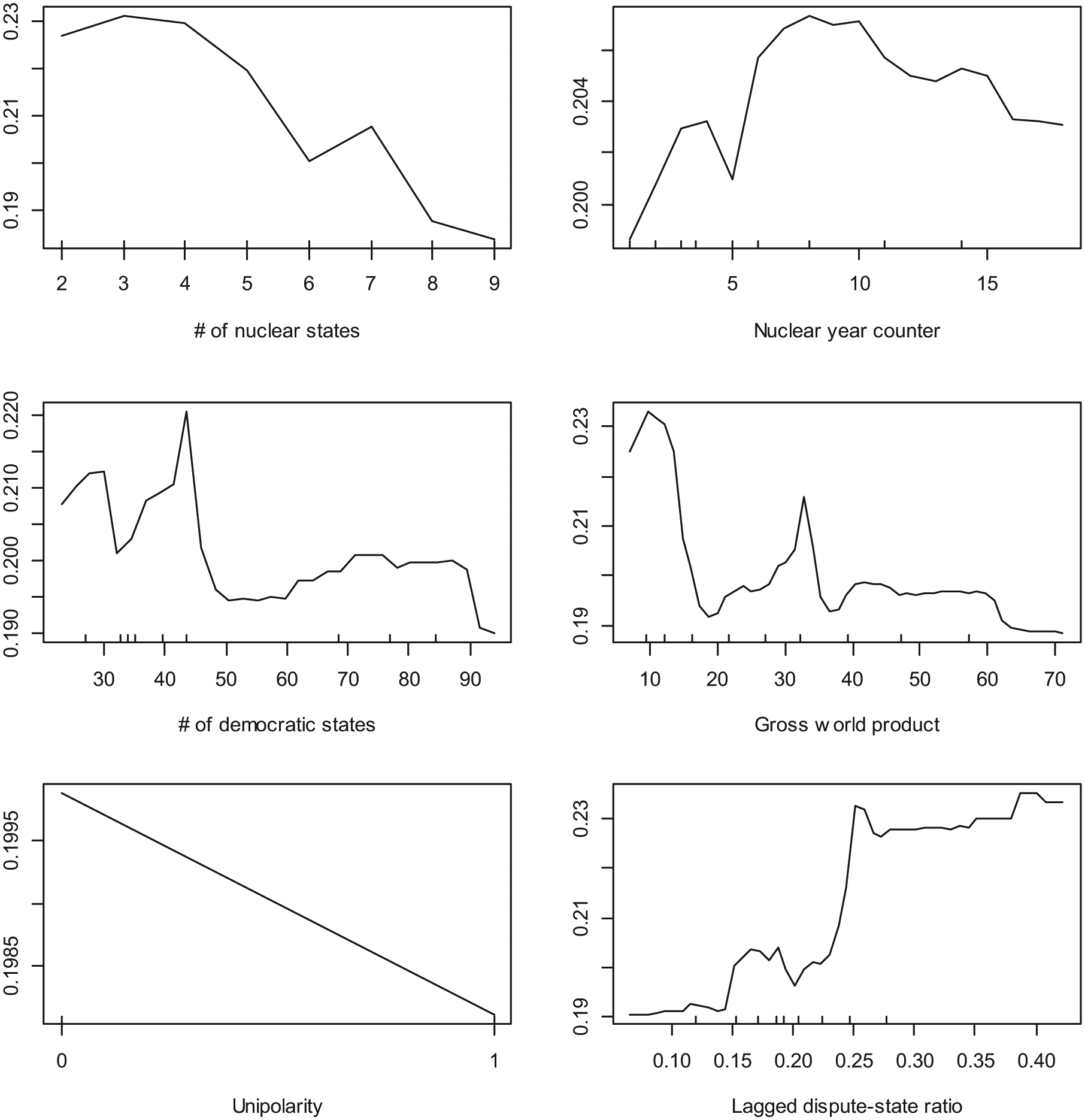
Partial dependence plots on the dispute–state ratio.
Second, the nuclear year counter shows a concave relationship with the dispute–state ratio, suggesting that new nuclear states are less prone to conflict than middle-aged nuclear states. Thus, the pessimist theory finds no support from either the variable importance estimation or the partial dependence plot.
Finally, as for the control variables, the number of democratic states and the gross world product have a complex non-linear relationship with the dispute–state ratio, but if the number of democratic states and the gross world product are sufficiently large, they tend to decrease the dispute–state ratio. Their substantive effects are also significant, though not as much as the number of nuclear states. When comparing the effect of their lowest and highest values (23 and 94 in the number of democratic states and 7 and 71.2 in the gross world product), the number of democratic states decreases the number of militarized interstate dispute onsets per system-year approximately from 40 to 37, and the gross world product from 44 to 37. Unipolarity is also associated with a decline in the dispute–state ratio, suggesting that unipolarity is better than bipolarity in terms of a systemic propensity for interstate conflict; however, its effect is negligible, as it reduces the number of militarized interstate dispute onsets per system-year from 39 to 38. One caveat is, as explained in the online appendix, that the results of the number of democratic states and unipolarity are significantly sensitive to a parameter setting. Thus, these predictors are less robust, and the aforementioned points about them should be treated with caution.
Discussion and concluding remarks
The main findings reveal that the optimist expectation of the relationship between nuclear proliferation and interstate conflict is empirically supported: 9 first, a larger number of nuclear states on average decreases the systemic propensity for interstate conflict; and second, there is no clear evidence that the emergence of new nuclear states increases the systemic propensity for interstate conflict. Gartzke and Jo (2009) argue that nuclear weapons themselves have no exogenous effect on the probability of conflict, because when a state is engaged in or expects to engage in conflict, it may develop nuclear weapons to keep fighting, or to prepare for, that conflict. If this selection effect existed, the analysis should overestimate the conflict-provoking effect of nuclear proliferation in the above model. Still, the results indicate that a larger number of nuclear states are associated with fewer disputes in the system.
This conclusion, however, raises questions about how to reconcile this study’s findings with those of a recent quantitative dyadic-level study (Bell and Miller, 2015). The current paper finds that nuclear proliferation decreases the systemic propensity for interstate conflict, while Bell and Miller (2015) find that nuclear symmetry has no significant effect on dyadic conflict, but that nuclear asymmetry is associated with a higher probability of dyadic conflict. It is possible that nuclear proliferation decreases conflict through the conflict-mitigating effects of extended nuclear deterrence and/or fear of nuclear states’ intervention, to the extent that these effects overwhelm the conflict-provoking effect of nuclear–asymmetrical dyads. Thus, dyadic-level empirics cannot solely be relied on to infer causal links between nuclear proliferation and a systemic propensity for conflict. The systemic-level empirics deserve attention.
The findings of this paper also have significant policy implications. The international community is sensitive to nuclear proliferation, and with Iran well on the way to developing full nuclear capabilities, it is crucial to understand the implications of nuclear proliferation for international security. This paper suggests that, at least in terms of a systemic propensity for interstate conflict, nuclear proliferation might be welcomed – although, given that nuclear asymmetry can provoke dyadic conflict, reducing this side effect of nuclear proliferation by some other measure will be desirable. Finally, this paper should not be seen as decisive evidence that nuclear proliferation contributes to international security in general. Nuclear proliferation may increase risks of nuclear weapons being leaked to terrorist groups (Bueno de Mesquita and Riker, 1982: 304) or used accidentally (Intriligator and Brito, 1981). It is untenable to assess the merits and demerits of nuclear proliferation only in terms of a systemic propensity for conflict. Additional research should examine these risks. Nonetheless, this paper makes a significant contribution to the literature by adding new empirics for a more comprehensive assessment of the relationship between nuclear proliferation and interstate conflict.
Footnotes
Acknowledgements
I would like to thank Ken McDonagh, Alex Baturo, Jos Elkink, Jason Douglas, and the editors and anonymous reviewers for their helpful comments. Elizabeth Thompson, James Moulder, Dana Cocargeanu, and Patrick Cadwell helped with proofreading.
Declaration of Conflicting Interest
The author declares that there is no conflict of interest.
Funding
This research received no specific grant from any funding agency in the public, commercial, or not-for-profit sectors.
