




Abstract
The nature and frequency of voter fraud figure prominently in many ongoing policy debates about election laws in the United States. Policy makers frequently cite allegations of voter fraud reported in the press during these debates. While recent studies find that voter fraud is a rare event, a substantial segment of the public believes that voter fraud is a rampant problem in the United States. It stands to reason that public beliefs are shaped by news coverage of voter fraud. However, there is very little extant academic research on how the news media, at any level, covers allegations or documented cases of voter fraud. This paper examines local newspaper attention to voter fraud in each of the 50 states during the 2008 and 2012 US elections. The results show that local coverage of voter fraud during the 2012 elections was greatest in presidential swing states and states that passed restrictive voting laws prior to the 2012 election. No evidence that newspaper attention is related to the rate of actual voter fraud cases in each state was found. The findings are consistent with other studies indicating that parties and campaigns sought to place voter fraud on the political agenda in strategically important states to motivate their voting base ahead of the election.
Keywords
Introduction
The nature and frequency of voter fraud figure prominently in ongoing debates about election laws in the United States. Over the past decade many states have passed restrictive voting laws, such as photo- identification or proof of citizenship requirements, based on public fears of voter fraud. While recent studies find that voter fraud is a rare event, a substantial segment of the public believes that voter fraud is a rampant problem in the United States. It is contended here that these public beliefs are partly shaped by news coverage of voter fraud. However, there is little extant research on how the news media, at any level, cover allegations or documented cases of voter fraud.
This study examines local newspaper coverage of voter fraud in each state during the 2008 and 2012 US general elections. The findings reflect the rise in prominence of vote fraud concerns on the policy agenda. The number of news articles mentioning voter fraud increased sharply from 2008 to 2012. In 2008, none of the theoretically-derived predictors had a statistically significant effect on coverage. However, in 2012, the volume of coverage devoted to voter fraud was larger in battleground states and in states that recently adopted restrictive voting laws. This is consistent with other evidence indicating that parties and campaigns sought to place voter fraud on the issue agenda before the election in strategically important states. These findings begin the process of uncovering the media’s role in how the public understands voter fraud in contemporary American elections.
What is known about voter fraud
While cases of election fraud are a colourful and ignominious part of American history going back to the earliest days of the nation (Bensel, 2004; Campbell, 2006; Kousser, 1974), despite heightened detection efforts during the past decade incidents of voter fraud are rare in contemporary American elections. One study found 31 instances of voter impersonation out of one billion votes cast (Levitt, 2014). Another study estimates one instance of voter fraud for every 15 million prospective voters (Kahn and Carson, 2012). Election fraud cases comprise less than one-tenth of one per cent of federal criminal prosecutions, despite efforts by the George W. Bush administration to devote substantially more resources to voter fraud investigations (Minnite 2010: 48). State level evidence also indicates that the vast majority of voter fraud investigations reveal no criminal violations (Minnite 2010: Chapter 4). Two other recent studies find little to no evidence of voter fraud in the United States (Ahlquist et al. 2014; Christensen and Schultz, 2014).
Nevertheless, a coterie of conservative interest groups and politicians continue to argue in favour of voting restrictions as a way to prevent voter fraud. For example, in advance of the 2012 elections Republican (GOP – ‘Grand Old Party’) election officials in some states alleged that thousands of non-citizens were illegally registered to vote and possibly casting ballots in American elections. In each of these states, subsequent investigations unearthed few cases of illegally registered non-citizens, and produced few voter fraud convictions. While the allegations were made before the election, the results of the investigations often did not come out until after the election (see, for example, Coolidge, 2013; Des Moines Register, 2013).
More importantly, a sizeable number of American adults believe that voter fraud remains a common occurrence (Ansolabehere and Persily, 2008; Dreier and Martin, 2010: 761; Wilson and Brewer, 2013). In a 2012 Washington Post poll, 48% of respondents answered that voter fraud was a major problem and 33% answered it was a minor problem. Interestingly, public beliefs about voter fraud appear to be unrelated to the frequency of actual fraud cases in their own state, and public concerns about voter fraud do not recede after the adoption of photo-identification requirements (Ansolabehere and Persily, 2008). This suggests that some people may have a penchant for believing in voter fraud, as is the case with other conspiratorial beliefs (Uscinski and Parent, 2014). Thus, attitudes about voter fraud tend to be better explained by partisanship and racial attitudes than by the actual frequency of voter fraud (Udani and Kimball, 2014; Wilson and Brewer, 2013). While Republicans express more support for photo ID laws than Democrats, pluralities in both parties are willing to believe in electoral fraud as an explanation if their preferred candidate loses a presidential election (Uscinski and Parent, 2014: 91–92).
Given the disconnection between public opinion about voter fraud and actual cases of voter fraud, it is important to examine the sources of public beliefs more carefully. With abundant evidence of the agenda-setting impact of the news media (e.g. Kinder and Iyengar, 1989; McCombs and Shaw, 1972) it is believed that the press is one source of public beliefs about voter fraud. Despite falling circulation and viewership, the news media remain an important source of public information about politics. Furthermore, there is evidence that news coverage and elite rhetoric are correlated with public expressions of government conspiracies, including election fraud (Uscinski and Parent, 2014: Chapter 5). Most Americans have no direct experience of voter fraud. Thus, what people believe about voter fraud is likely to come from other sources, particularly the news media. However, there has been little scholarly examination of news coverage of voter fraud (for an exception, see Dreier and Martin, 2010).
This short paper examines local newspaper attention to voter fraud. It focuses on local newspapers because that is where voter fraud allegations tend to be reported first. Furthermore, local newspaper reporters are in close proximity to state and local election officials and are thus well situated to independently check claims of voter irregularities.
This paper considers several theories about what drives media attention to voter fraud. One is that news coverage simply reflects actual cases of voter fraud (official investigations, indictments, and convictions or guilty pleas). A second, based on Bennett’s (1990) ‘indexing’ hypothesis, is that news coverage is influenced by government elites who frequently serve as news sources (Sigal, 1973). It is hypothesized that elites are most likely to debate voter fraud in states with heavy presidential campaigning, in states that pass restrictive election laws, and in states with a strong interest group presence devoted to the issue. A final theory is that there is likely to be a higher demand for reporting on voter fraud in certain states or markets. Measures to test each of these theories are described below.
Expectations and data for press attention to voter fraud
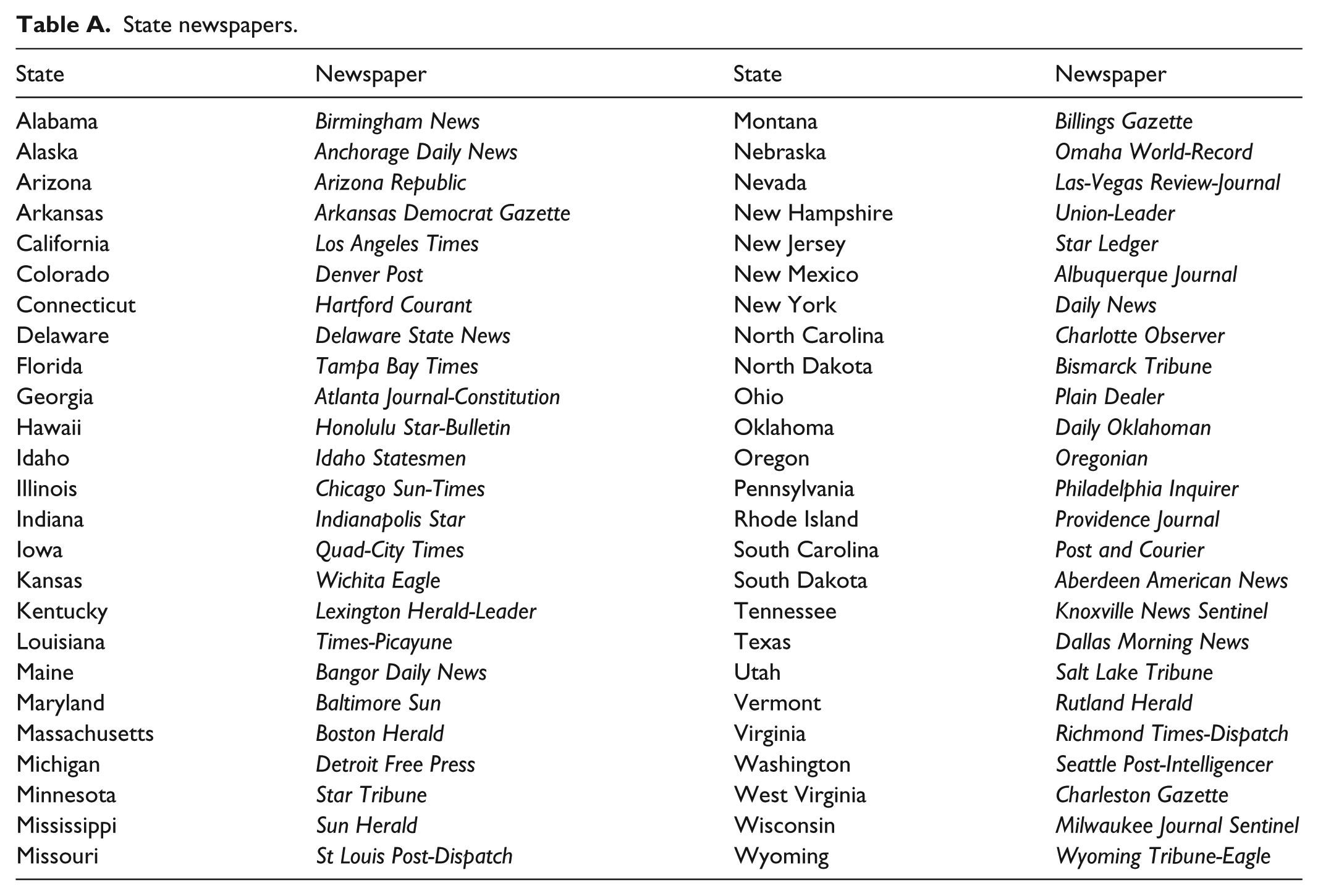
This analysis examines press attention to voter fraud in the largest and/or a significant newspaper in each of the 50 states from 1 August 2008 to 31 January 2009 and 1 August 2012 through to 31 January 2013. 1 This time frame incorporates the heart of the traditional campaign season and allows examination of coverage not just before the election, but also after the election when actual vote fraud challenges are likely to occur. Using Lexis-Nexis and Newsbank, the search term ‘voter fraud’ was employed, and all relevant stories, including editorials and readers’ letters were collected. 2 Across the 50 states, a total of 437 news articles pertaining to voter fraud during the 2008 elections were found, with 85% of articles coming before Election Day. For 2012, a total of 680 articles were found, with 74% of coverage coming before Election Day. This concurs with scholars who argue that voter fraud and voter suppression allegations are made by party and campaign elites to mobilize key voting constituencies in each party to participate in major elections (Hasen, 2012; Levitt, 2007). Consistent with this hypothesis, the vast majority of news coverage of voter fraud in this sample came before Election Day, even though the most common types of election fraud – committed by election or campaign officials, or involving absentee ballots (Kahn and Carson, 2012) – are typically discovered and reported after an election. For 2008, the median number of articles per paper was 7 articles, with 8 newspapers having 0 articles and the highest number drawn from the Atlanta Journal-Constitution with 46 articles. 3 For 2012, the median number of articles per paper was 11 articles, with the lowest number from the Wyoming Tribune-Eagle with 0 articles, and the highest number from the Tampa Bay Tribune with 48 articles (see Appendix: Table A).
A number of predictor variables to explain the volume of coverage on voter fraud are considered. The variables are grouped into supply-side and demand-side influences on whether or not the state and local media cover voter fraud. Supply-side influences reflect the supply of newsworthy opportunities to cover voter fraud based on the frequency of official investigations or elite debates about the issue. On the supply-side, whether a state is considered a battleground state for the 2008 or 2012 presidential elections, whether a state passed a restrictive voter law in 2008 or 2012, the number of alleged voter fraud cases in 2008 or 2012, and the percentage of state legislators per state who are members of the American Legislative Exchange Council (ALEC) are included. 4 Demand-side influences reflect characteristics of consumers who may demand more press attention to voter fraud. On the demand-side, political partisanship and race characteristics of each paper’s media market are considered; 5 newspaper circulation as a control for newspapers’ resources is also included.
Battleground states in presidential elections are important because they receive enormous attention, money, resources, and effort from campaigns, parties, and interest groups. With so much at stake, individuals and groups alleging voter fraud are likely to target these states in an attempt to mobilize their base (Hasen, 2012). State and local-level journalists are surely deluged by the supply of information alleging and responding to allegations of voter fraud. Therefore, it should be easier for these journalists to report on voter fraud if they so choose. Conversely, not only do non-battleground states lack the influx of resources and attention found in battleground states, the winner of the presidential contest in those states is a foregone conclusion. When the outcome of an election is already decided, the media have little incentive to report on voter fraud and the potential impact on the election (Fogarty, 2013; Zaller, 1999). It is therefore expected that newspapers in battleground states will cover voter fraud more than non-battleground states. A dummy variable for a battleground state (1 = battleground state) is included here. Following Politico, CNN, and the New York Times, 11 battleground states in the 2008 election and 8 battleground states in the 2012 election are identified.
Several state legislatures have passed restrictive voter laws over the past decade (Brennan Center for Justice, 2013). The pace of these laws has been pushed by outside groups such as ALEC and True the Vote. For media covering state politics, state legislatures passing restrictive voter laws supply information and events that make it easier for journalists to cover these issues. Therefore, it is expected that newspapers in states where restrictive voting laws were passed during the same year will have higher coverage of voter fraud. According to the Brennan Center for Justice, 4 states passed restrictive voting laws in 2008 and 19 states passed restrictive voting laws in 2012. A dummy variable for these states (1 = passed a law) is included here.
Another supply-side variable is whether any alleged voter fraud cases existed during the election year. It is expected that with more evidence of voter fraud, the press would have more material to report. Using data from News21 (Kahn and Carson, 2012), a variable measuring the number of alleged voter fraud cases in each state during 2008 and 2012 is included. 6 In 2008, 20 states had 0 cases, while the highest number of alleged cases were reported in Georgia (45 cases), Kansas (57 cases), and Washington (90 cases). A majority of the states had 0 cases during 2012, with the most activity in Wisconsin (6 cases) and New Mexico (9 cases).
The American Legislative Exchange Council (ALEC), mentioned above, is a non-profit organization that advances limited government, state rights and powers, and free-market capitalism. The central mechanism that ALEC utilizes is holding meetings where state legislators and business leaders can meet and decide on policy (ALEC website: http://www.alec.org/; Pilkington and Goldenberg, 2013). Besides this direct co-production of policy, ALEC provides ‘model bills’ that state legislators can simply introduce to their legislatures that advance ALEC’s and its members’ interests (Pilkington and Goldenberg, 2013). Although ALEC reportedly disbanded their voter fraud task force in late spring of 2012 (Lichtblau, 2012), many of the restrictive laws recently passed in the states, particularly voter identification laws, came from ALEC’s model bills (Brennan Center for Justice, 2013; Center for Media and Democracy, 2013). Included here is the percentage of state legislators per state who are members of ALEC (Center for Media and Democracy, 2013) as a measure of outside influence on states regarding voter fraud. The median was 15.5% of state legislators in ALEC per state, with a minimum of 1.4% of New York state legislators in ALEC and a maximum of 37.8% of Arizona state legislators in ALEC; 7 it is expected that states with higher percentages of state legislators in ALEC will have increased coverage of voter fraud.
Besides the supply-side of news creation, the media also must consider demand-side factors or, more specifically, the audience. Simply put, the audience wants news that is of interest and importance to them (Zaller, 1999). They will ignore issues that have no bearing on their ordinary lives. Thus demographics and the political interests of an audience should help dictate the issues covered and the content therein.
The first demand-side variable included in this analysis is the presidential vote percentage difference in each media market for 2004; 8 as conservative elites have driven much of the discussion and legislation surrounding voter fraud (Wilson and Brewer, 2013), it is expected that media markets which voted more Republican will have increased news attention on voter fraud.
This paper also considers the percentage of black and Hispanic residents per media market (Nielsen Company, 2014a, b). Some scholars claim that voter fraud charges and restrictive voting laws are intended to discourage voter participation by racial and ethnic minorities, as well as other disadvantaged groups (Schultz, 2008; Wang, 2012). Voters who are the most directly affected by new voting laws should be interested in news on the issue. However, it is also the case that many individuals are unaware of changes in voting laws (Wilson and Brewer, 2013). This is where perhaps journalists may switch from what the ‘audience wants to know’ to ‘what the audience should know’; namely, pursuing the civic and democratic ideal of informing the citizenry of pressing issues (Bennett and Serrin, 2005; Patterson and Seib, 2005). With these two considerations, it is expected that newspapers in media markets with higher percentages of black and Hispanic residents will have higher coverage of voter fraud. 9
Analysis
We examine one dependent variable for the 2008 and 2012 elections: total newspaper articles on voter fraud. Employing the covariates outlined above we use a negative binomial model for 2008 and 2012 10 in Table 1.
Press attention to voter fraud in the 2008 and 2012 elections.
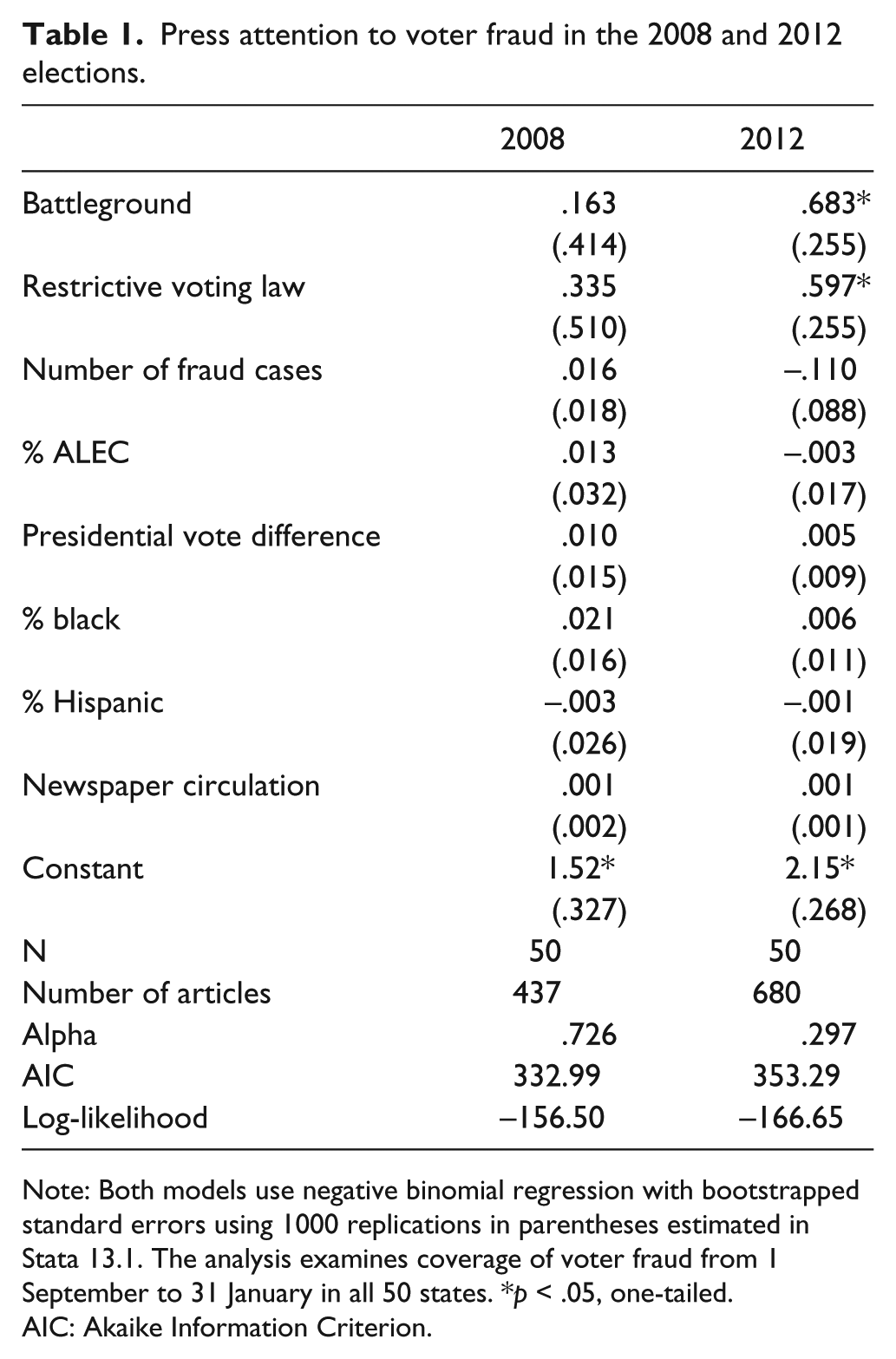
Note: Both models use negative binomial regression with bootstrapped standard errors using 1000 replications in parentheses estimated in Stata 13.1. The analysis examines coverage of voter fraud from 1 September to 31 January in all 50 states. *p < .05, one-tailed. AIC: Akaike Information Criterion.
For 2008, none of this study’s predictors are statistically significant. During the 2008 elections, the issue of voter fraud was only beginning to gain steam in conservative and Republican discussion and debate before cresting in the 2012 elections. Therefore, it is possible that voter fraud coverage did not systematically vary between media markets and states during the 2008 elections.
For 2012, it is found that whether a state was a battleground in the presidential election and whether the state passed a restrictive voting law are statistically significant predictors of the total coverage of voter fraud in newspapers. These are two of the four variables considered to be supply-side factors in understanding news coverage of voter fraud. Meanwhile, the demand-side variables fail to achieve statistical significance. Of note, many media markets with a high percentage of black residents also tend to be non-battleground states during presidential elections (i.e. the Deep South). Therefore, the battleground state effect may supplant potential audience effects during election season.
Both battleground states and states that passed restrictive voting laws in 2012 are found to have higher expected coverage of voter fraud than other states. 11 Specifically, battleground states are predicted to have 17.2 articles versus 8.7 predicted articles in non-battleground states. States that passed restrictive voting laws in 2012 are predicted to have 15.8 articles on voter fraud compared to 8.7 articles in states that did not pass these laws in 2012; 12 as previously mentioned, battleground states in presidential elections receive a surge of resources from the campaigns and other groups. Thus the amount of material available to journalists at state and local newspapers is likely vast. If individuals, parties, and interest groups in these states are debating voter fraud, it is more likely that the media will discuss the issue. Laws establishing restrictions on voting are often newsworthy on their own merits, as they put voter fraud on both the election law and public opinion agenda beyond what accusations accomplish. Further, new voting laws may convince reluctant editors and journalists that the issue is immediately important to readers, thus providing an impetus to increase coverage on voter fraud.
This paper also estimates a difference-in-difference model for a more rigorous test of whether the increase in voter fraud news coverage in 2012 was unique to battleground states and states that recently passed restrictive voting laws. The data from both years are pooled and a dummy variable for the 2012 election with the battleground and restrictive law measures is interacted. The analysis is divided into two parts in Table 2 – model 1 for the battleground state treatment and model 2 for the restrictive law treatment. 13
Press attention to voter fraud: difference estimation.

Note: Both models use negative binomial regression with standard error clustering by state and bootstrapped standard errors using 1000 replications in parentheses estimated in Stata 13.1. The analysis examines coverage of voter fraud from 1 September to 31 January in all 50 states. Model 1 includes an interaction for battleground states and 2012 and model 2 includes an interaction for restrictive law states and 2012 as difference-in-difference framework. *p < .10, one-tailed; **p < .05, one-tailed. AIC: Akaike Information Criterion.
The estimates in Table 2 indicate that news coverage of voter fraud increased across the board in 2012. Furthermore, as in Table 1, battleground states and states that passed restrictive voting laws saw more voter fraud news coverage than other states in 2012. Even though the coefficient on the interaction term is marginally statistically significant, referencing battleground states and restrictive laws, the impact of the variable in 2012 is statistically significant at p<.05. 14 Based upon the linear combination of estimators (the main coefficient plus the interaction term coefficient), twice as many fraud stories in battleground states compared to non-battleground states in 2012 (p=.01) are observed. Further, when evaluating the change in the expected number of voter fraud stories in battleground states in 2012, it is found that battleground states had roughly 8.5 more fraud stories than non-battleground states.
For the difference-in-difference analysis of restrictive laws, reported in the second model of Table 2, no statistically significant interaction between restrictive laws and the 2012-year dummy variable is found. Nevertheless, as in Table 1, in states that adopted restrictive voting laws prior to 2012 the expected number of fraud stories is 66% higher than in states that did not adopt those laws. This result is a statistically significant difference (p=.02). In states that adopted restrictive laws prior to 2012, the expected number of fraud articles increases by 6 stories compared to states that did not pass restrictive laws. In summary, battleground status and state lawmaking are potent predictors of voter fraud news coverage in 2012.
Conclusion
The controversy over voter fraud remains on the American political agenda. Although liberal groups have begun to counter the arguments of conservative groups such as ALEC, public concerns about voter fraud continue to sustain restrictive voting laws at the state level. Understanding the voter fraud information environment is important, given the apparent disconnection between the amount of voter fraud in American elections and the rhetoric surrounding the issue. Voters who believe voter fraud needs to be corrected may push for more restrictive voting laws, despite there being a lack of evidence of fraud. The negative implications of such laws could, in turn, lead to increased voter suppression among specific, often minority, groups. Such potentially affected groups tend to vote Democratic in presidential elections, so the persistence of public concerns about voter fraud could shape the outcome of future American elections.
This paper has examined how the press covers voter fraud. Numerous polls show that a majority of Americans believe that voter fraud is common and is a serious threat to the integrity of American elections. While this belief is stronger among conservatives and Republicans, this general notion crosses the political spectrum. While some Americans may be predisposed to voter fraud beliefs, it is believed, given the agenda-setting function of the press, that media coverage of voter fraud may influence public opinion on the issue. This paper seeks to assess the role of the media in Americans’ beliefs about voter fraud.
This paper has presented a first attempt at answering this question, and its findings indicate heavier news coverage of voter fraud in battleground states and in states that have recently enacted restrictive election laws. These findings indicate that supply-side factors affect the creation of voter fraud news, and are consistent with a theory positing that media coverage responds to elite debates. Furthermore, no demand-side audience effects on voter fraud coverage have been found. Instead, this study’s findings suggest parties and campaigns sought to place voter fraud on the political agenda through the media in strategically important states to motivate their voting base ahead of the election. This situation may change as more Americans become informed about voter fraud and demand news about the issue.
Footnotes
Appendix:
State newspapers.
| State | Newspaper | State | Newspaper |
|---|---|---|---|
| Alabama | Birmingham News | Montana | Billings Gazette |
| Alaska | Anchorage Daily News | Nebraska | Omaha World-Record |
| Arizona | Arizona Republic | Nevada | Las-Vegas Review-Journal |
| Arkansas | Arkansas Democrat Gazette | New Hampshire | Union-Leader |
| California | Los Angeles Times | New Jersey | Star Ledger |
| Colorado | Denver Post | New Mexico | Albuquerque Journal |
| Connecticut | Hartford Courant | New York | Daily News |
| Delaware | Delaware State News | North Carolina | Charlotte Observer |
| Florida | Tampa Bay Times | North Dakota | Bismarck Tribune |
| Georgia | Atlanta Journal-Constitution | Ohio | Plain Dealer |
| Hawaii | Honolulu Star-Bulletin | Oklahoma | Daily Oklahoman |
| Idaho | Idaho Statesmen | Oregon | Oregonian |
| Illinois | Chicago Sun-Times | Pennsylvania | Philadelphia Inquirer |
| Indiana | Indianapolis Star | Rhode Island | Providence Journal |
| Iowa | Quad-City Times | South Carolina | Post and Courier |
| Kansas | Wichita Eagle | South Dakota | Aberdeen American News |
| Kentucky | Lexington Herald-Leader | Tennessee | Knoxville News Sentinel |
| Louisiana | Times-Picayune | Texas | Dallas Morning News |
| Maine | Bangor Daily News | Utah | Salt Lake Tribune |
| Maryland | Baltimore Sun | Vermont | Rutland Herald |
| Massachusetts | Boston Herald | Virginia | Richmond Times-Dispatch |
| Michigan | Detroit Free Press | Washington | Seattle Post-Intelligencer |
| Minnesota | Star Tribune | West Virginia | Charleston Gazette |
| Mississippi | Sun Herald | Wisconsin | Milwaukee Journal Sentinel |
| Missouri | St Louis Post-Dispatch | Wyoming | Wyoming Tribune-Eagle |
Declaration of Conflicting Interest
The authors declare that there is no conflict of interest.
Funding
This research received no specific grant from any funding agency in the public, commercial, or not-for-profit sectors.
