




Abstract
The enactment and implementation of European Union Directives on antidiscrimination have received substantial scholarly attention. However, there is little knowledge about whether and how antidiscrimination measures influence citizens’ experiences and perceptions of discrimination. This study investigates the relationship between antidiscrimination policies, citizens’ knowledge in this policy area, and their handling of discrimination. Using data from a standardized policy indicator and repeated cross-sectional survey waves of EU countries, I first examine the relationship between antidiscrimination policy and societal levels of knowledge about victims’ rights. Subsequently, multilevel models test how differences in policy and knowledge levels predict individuals’ reported levels of experienced and perceived discrimination. The results show that people who live in countries with effective antidiscrimination laws know more about their rights to equal treatment than those from countries with less effective policies. For the most part, policy differences across countries are unsystematically related to discrimination-related outcomes. However, an increase in knowledge levels over time is associated with higher reports about witnessed discrimination, lower sociotropic perceptions of discrimination, and less individual self-identification with a discriminated group. The findings suggest that, to the extent that antidiscrimination policies foster knowledge of the law, they contribute to citizens’ awareness and empowerment against discrimination.
Introduction
Antidiscrimination policies aim to reduce practices of unequal treatment based on group characteristics, including gender, race and ethnic origin, religion and belief, disability, age, and sexual orientation. The European Union has launched several directives that focus on the enactment, application, and effective implementation of antidiscrimination measures in all of its member states. These directives began in 1975, when the European Council adopted a directive on implementing laws to ensure equal pay for men and women within member states of the European Economic Community, the precursor of the European Union. The most important subsequent acts related to equal treatment and antidiscrimination are the Racial Equality Directive (2000/43/EC) and the Employment Equality Directive (2000/78/EC), as well as Directive 2004/113/EC and Directive 2006/54/EC, both concerning gender equality. 1 The most recent directive, proposed in 2008, aims to tackle discriminatory practices in the fields of social security, education, and public services, which goes beyond present protection centered on discrimination in the workplace. However, the final passage of the directive is pending. While the processes of policy development and implementation have received substantial scholarly attention (e.g. Amiraux and Guiraudon, 2010; Givens and Evans Case, 2014; Lieberman, 2005), there is hardly any research that investigates how antidiscrimination policy is related to citizens’ experience and perception of discrimination.
This study examines the societal implications of antidiscrimination measures in a comparative European perspective, focusing on the relationship between antidiscrimination policy, citizens’ knowledge about their rights under current discrimination policy, and their experiences and perceptions of discrimination. From a policy-design perspective, antidiscrimination policies implement laws to sanction discriminatory practices, which increase the costs of unequal treatment. They also provide measures and services to assist victims and people at-risk for opposing discrimination. In this study I focus on the latter mechanism and argue that effective antidiscrimination policies increase citizens’ knowledge about their rights related to equal treatment and discrimination. In turn, higher knowledge of rights is expected to facilitate citizens’ awareness and their ability to take action against discrimination. The next section outlines the argument in detail and derives expectations about likely outcomes in terms of discrimination.
Linking policy, citizens’ knowledge, and discrimination
Drawing from the literature on public policy and mass politics (Mettler and Soss, 2004; Zaller, 1992) and policy feedback (Kumlin and Stadelmann-Steffen, 2014; Pierson, 1993), policy influences public opinion and behavior through structural effects (e.g., rules, administrative and organizational structures, and the distribution of resources) and normative effects (e.g., social norms, symbolic cues, frames and discourses). For antidiscrimination policy, the primary structural outcome is the implementation of laws that sanction discriminatory practices and thus increase the costs for perpetrators. There is also reason to assume that legal restrictions inform social norms, which yield effects by framing discrimination as no longer normatively acceptable (Blinder et al., 2013). 2 In this way, effective antidiscrimination policies are expected to ultimately reduce the amount of discrimination within a society.
On the side of recipients, implemented antidiscrimination measures assist victims in opposing discrimination. It seems pivotal that people know their rights in order to effectively utilize legal means and services provided by specialized agencies. This rationale is also reflected in the fact that it has been a central goal of the EU directives and complementary initiatives to improve citizens’ knowledge about their rights related to equal treatment and discrimination (e.g., Directive 2000/43/EC, Art. 10; Directive 2000/78/EC, Art. 12; European Commission, 2014; EU information campaign “For Diversity. Against Discrimination”). From this perspective, knowledge of rights operates as a key intermediate factor linking policy and discrimination outcomes in the population. More specifically, effective antidiscrimination policies are expected to foster citizens’ knowledge in this policy area. In turn, high levels of knowledge of rights constitute favorable informational environments (Kuklinski et al., 2001) that provide citizens with relevant knowledge, increase their awareness about discriminatory practices, and help them identify courses of action. 3 Acquiring relevant knowledge, i.e., knowing what to do, is related to building competence, i.e., knowing how to do something, and self-efficacy, i.e., the individual’s beliefs in his or her abilities, factors that are crucial for taking action against oppression (Cattaneo and Chapman, 2010). Informed and self-efficacious citizens are expected to make more effective use of the antidiscrimination measures that are in place. This increases the anticipated costs of discrimination for perpetrators, which should result in fewer discriminatory acts. Hence, I expect people who live in high knowledge contexts to experience and perceive less discrimination than those who live in contexts with low knowledge levels.
Beyond these hypothesized mechanisms, which center on the intended effects of policy design, scholarship has shown that policy implications are not always unidirectional and may yield unexpected or unintended effects (Kumlin and Rothstein, 2005; Soss, 1999). Policies frame the meaning and public salience of societal problems by defining political issues, target populations, actions, and potential solutions (Mettler and Soss, 2004: 62). For antidiscrimination policy, this means that the implementation of effective measures may evoke citizens’ awareness about discrimination as an individual or social problem and thus first increase their perceptions about discrimination. Similarly, higher levels of knowledge may lead to higher reports about discrimination, since greater awareness enables individuals to reveal forms of hidden or subtle discrimination (Essed, 1991).
Research design
Data and variables 4
Data on discrimination-related outcomes come from multiple waves of the Eurobarometer study (EB) and the European Social Survey (ESS). The Eurobarometer studies cover general topics on European integration and modules on specific topics of social, economic, and political relevance. Four Eurobarometer survey waves conducted in the years 2006 (EB 65.4), 2008 (EB 69.1), 2009 (EB 71.2), and 2012 (EB 77.4) include modules on discrimination and cover the EU-27 member states. The ESS is a biennially conducted survey, which currently consists of six waves and covers most EU countries. For the purpose of this study, I rely on the four most recent waves conducted in 2006, 2008, 2010, and 2012. The considered countries per wave range between 19 and 23, and are listed in the notes below the regression tables in the online appendix. Altogether, the obtained outcome variables are (1) “personal experience of discrimination” (EB-data), (2) “witnessed or heard about discrimination” (EB-data), (3) “sociotropic perceptions of discrimination,” which refers to the perceived distribution of discrimination in the respondent’s country (EB-data), and (4) “self-identification with a discriminated group” (ESS data). The outcome variables were surveyed based on specific grounds of discrimination, including gender, age, ethnic origin, religion or beliefs, disability, and sexual orientation. I also include aggregated variables that indicate average responses ((3) sociotropic perceptions) or whether any of the surveyed grounds was mentioned ((1) personal experience, (2) witnessed discrimination, and (4) self-identification).
Data on antidiscrimination policy come from a sub-index of the Migrant Integration Policy Index (MIPEX; Niessen et al., 2007). The country-specific antidiscrimination scores are based on country-expert ratings of national antidiscrimination laws and measures. More specifically, the ratings refer to the categories “definition and concepts” (e.g., number of grounds covered by law, indirect discrimination covered), “fields of application” (e.g., employment, social services, housing), “enforcement mechanisms” (e.g., the range of legal sanctions covered, assistance and protection of victims), and “equality policies” (e.g., implementation of specialized agencies or positive action measures). The index ranges from 0 to 100 (higher values indicate effective policy) and is available for more than 30 countries at two time points (2007 and 2010). Across the EU-27 countries, antidiscrimination policies measured by the MIPEX indicator vary substantially, with scores between 24.9 (Latvia) and 87.7 (Sweden) in 2010. The specific country figures appear in the online appendix in Table A1. Changes in the index score between 2007 and 2010 occur in 13 of 25 European countries (EU-27 minus Bulgaria and Romania, for which only one time point is available). Figure A1 in the online appendix depicts the country-specific variations, which are exclusively positive in direction and limited in magnitude. Because the policy indicator is measured at two occasions and exhibits only limited over-time variance, I treat it in the subsequent analysis as time-constant (see the online appendix for alternative specifications).
Knowledge of rights as intermediate variable consists of sampling weighted country proportions of respondents who affirmed the following survey question: “Do you know your right if you are the victim of discrimination or harassment?” The corresponding item is included in the Eurobarometer surveys and is available for all four survey waves. This “knowledge of rights” indicator is further disaggregated into a specific cross-sectional and longitudinal component. As this strategy is intertwined with the analytical approach, it is described in the following section on methods.
Figure 1 depicts the temporal availability, levels, and over-time variability of the key variables.
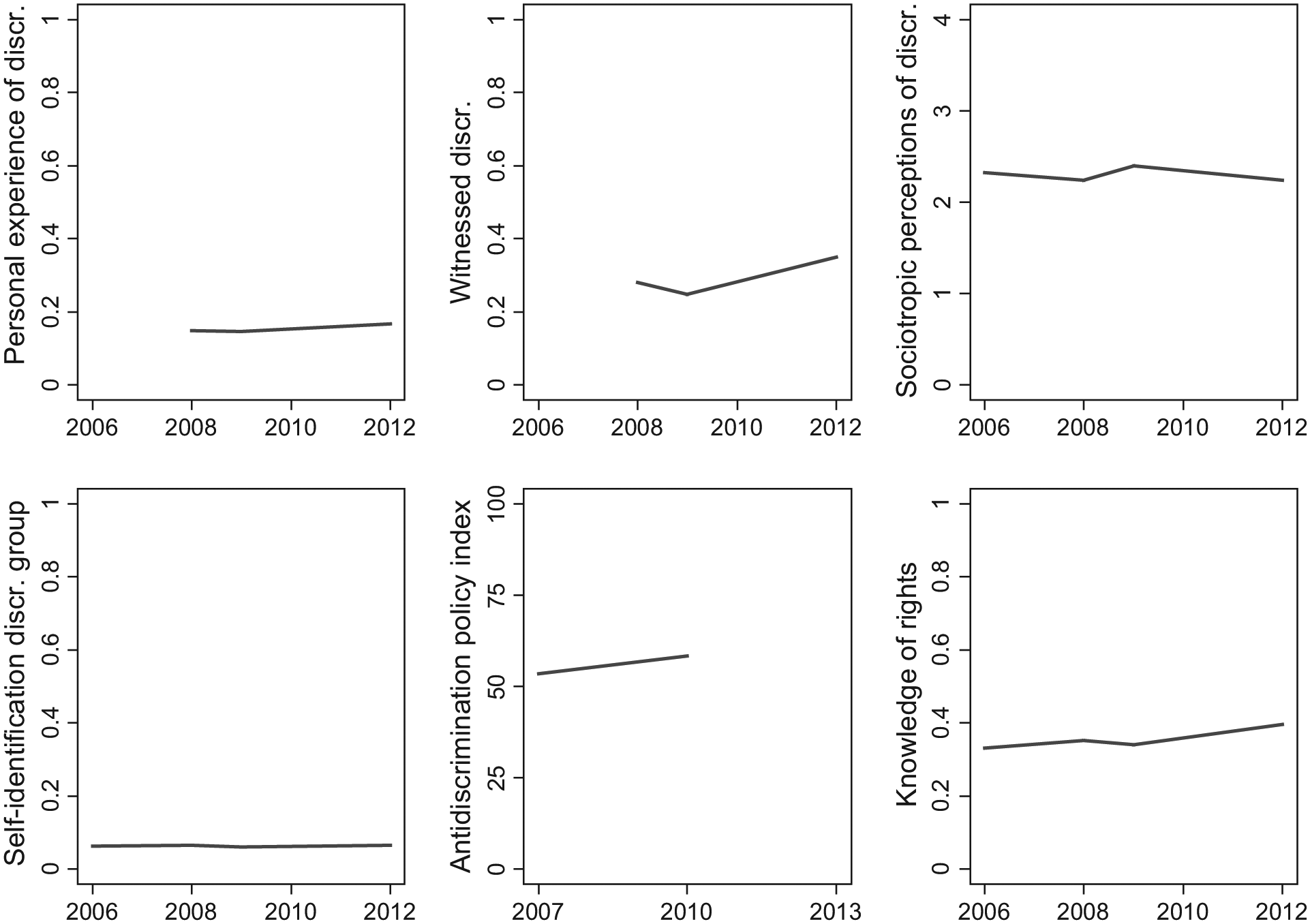
Over-time growth of key variables.
In order to control for the possibility that the results are confounded by compositional differences from relevant individual-level variables, the following control variables are included: migration status of the respondent, gender, age in years, education, and degree of urbanization. I expect that having a migration background, being female, older, less educated, unemployed, and from urban areas increase the likelihood of experiencing or perceiving discrimination. Additional country-level control variables include GDP per capita, unemployment rates, and proportions of foreign-born immigrants, which were obtained from the Eurostat online database, as well as country-level proportions of people who reported having experienced discrimination within the last 12 months (Eurobarometer).
Methods
In the first step, I analyze the relationship between antidiscrimination policy and knowledge of rights. Subsequent to a bivariate examination, the relationship is further determined by employing lagged dependent variable models (Angrist and Pischke, 2008). Here, knowledge of rights in 2012 is regressed (ordinary least squares) on antidiscrimination policy (2010) and knowledge of rights of a prior time point. This specification indicates the extent to which differences in antidiscrimination policy in 2010 explain differences in knowledge of rights in 2012, above levels of knowledge in prior years. In this sense, the lagged dependent variable accounts for unobserved country characteristics that led to current differences in the dependent variable.
Second, the relationship between antidiscrimination policy and citizens’ experience and perception of discrimination is examined by means of multilevel regression modeling (Snijders and Bosker, 2012). The models consist of two levels, with reports about discrimination as outcome and individual-level controls located at Level 1, and antidiscrimination policy and country-level controls at Level 2. For some outcome variables, reported discrimination is a rather rare event. To avoid empty cells, and to thus increase the reliability of the results, I pool the latest three survey waves (EB 2008, 2009, and 2012; ESS 2008, 2010, and 2012). 5 In addition to the 2010 MIPEX policy indicator, I include GDP per capita (2010), unemployment rates (2010), proportions of foreign-born immigrants (2011), and country proportions of people who reported experiencing discrimination (EB 2009) as control variables. The aggregated indicator of discrimination experience is omitted in the models with discrimination experience as an outcome. Moreover, all models include time dummies for the survey waves. All key results are robust to an omission or alternative specification of individual and/or country-level control variables.
Third, the relationships between aggregated knowledge of rights and discrimination outcomes are analyzed employing multilevel hybrid models (Allison, 2009). For this type of model, explanatory variables are disaggregated into a between (or cross-sectional) and within (or longitudinal) component. Both components are then estimated in a single empirical model. To do so, I draw on multilevel strategies for repeated cross-sectional survey data (Fairbrother, 2014). The models consist of three levels, with survey respondents (Level 1) nested in country-years (Level 2), which are located in countries (Level 3).
Explanatory variables are usually disaggregated using group-mean centering. Here, the mean reflects the cross-sectional and the demeaned values the longitudinal component. However, the disaggregation in this study is accomplished using intercepts and residuals from case-wise regressions (Curran and Bauer, 2011: 605–607). This procedure corrects for time dependency of the explanatory variable, while it produces identical results to group-mean centering in case of stationarity. Moreover, the models include knowledge of rights at the respondent level for all models based on EB-data, 6 antidiscrimination policy scores as cross-sectional macro-level control variable, and a trend variable to account for time dependency of the outcome variables. Key results are robust to omission of the control variables or to the additional inclusion of further macro-level controls (e.g., economic variables or proportions of reported discrimination). Further information on additional model specifications can be obtained from the online appendix.
Empirical results
Figure 2 depicts the bivariate relationship of antidiscrimination policy and aggregated levels of knowledge of rights. Policy scores of 2010 are used to predict knowledge levels in 2012, based on the assumption that policy influences public opinion with some temporal delay. The plot and correlation coefficient indicate a substantive positive relationship between both indicators. This means that, on average, respondents from countries with effective antidiscrimination policies are more aware about their rights than respondents from countries with less effective policies.
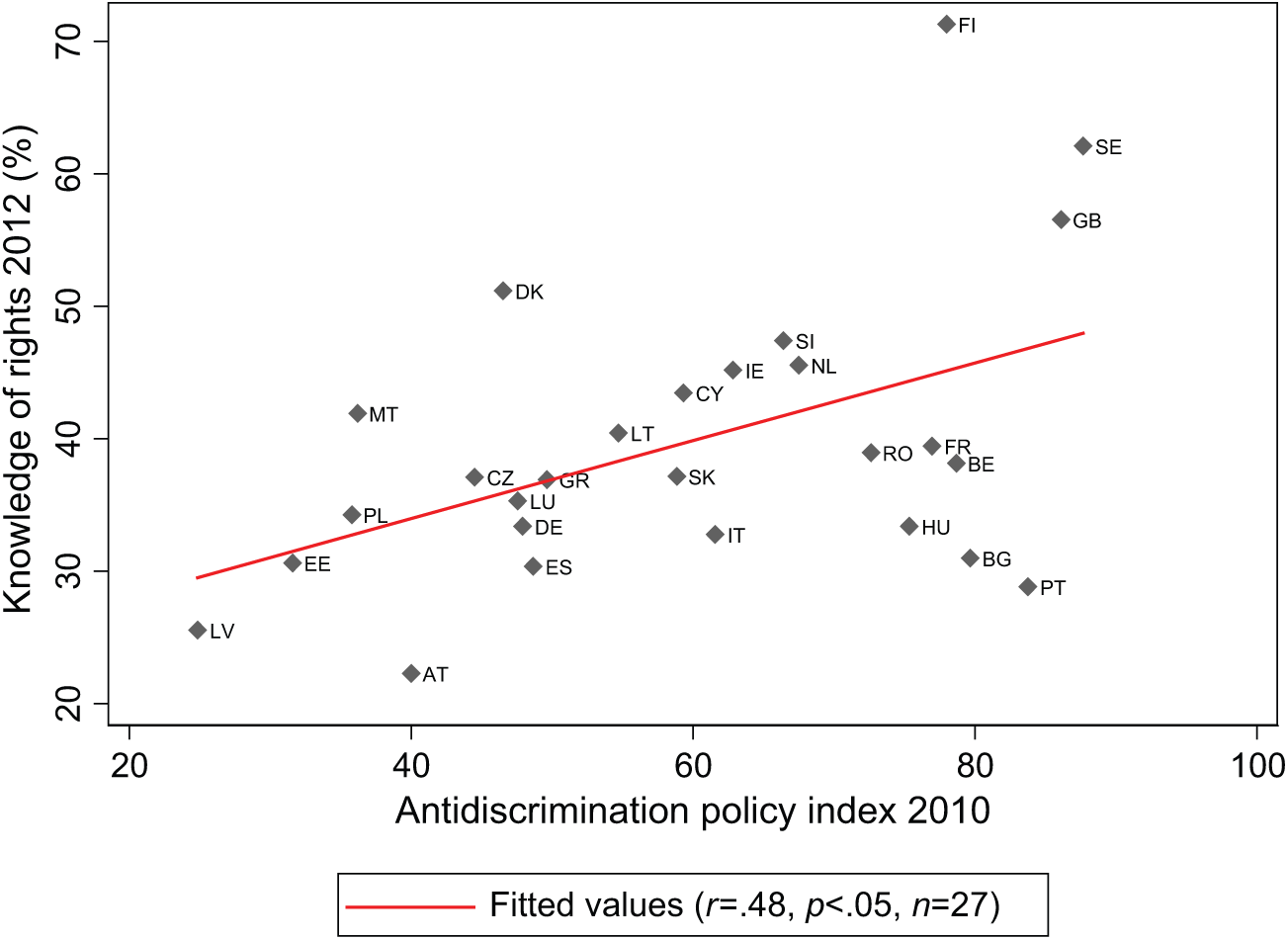
Bivariate relationship between antidiscrimination policy and knowledge of rights.
Table 1 presents the results of the lagged dependent variable models. The coefficient estimates show that antidiscrimination policies significantly predict people’s knowledge of rights even when controlling for prior levels of knowledge. The relationship is robust under alternative specifications of the time lag, while the coefficient estimate of the policy indicator for the lag closest to the outcome is only marginally significant. In substantive terms, an increase in the policy score by one is related to an increase in knowledge level by .18 percentage points (Model 1a). Moving from the lowest to the highest policy score (Δ = 62.8), this difference is associated with an 11 percentage points change in country-level knowledge. This is equivalent to one standard deviation of the 2012 mean of knowledge scores.
Lagged dependent variable regression models with knowledge of rights 2012 as outcome.

p < 0.1, * p < 0.05, ** p < 0.01, *** p < 0.001 (two-sided).
Note: Antidiscrimination policy indicator was linearly transformed (original score divided by 100).
MIPEX: Migrant and Integration Policy Index
Figure 3 presents the coefficient estimates and confidence intervals for the antidiscrimination policy indicator from the multilevel regression models. Detailed regression tables appear in the online appendix. The first set of models incorporates experience of discrimination based on different grounds as outcome variables. The coefficient estimates are positive for all grounds, although they are small in magnitude, and confidence intervals include zero for all models. In contrast to the theoretical prediction, the results provide no empirical evidence that, across countries, effective antidiscrimination policies are systematically associated with lower reports of experienced discrimination.

Multilevel models – antidiscrimination policy index as predictor.
Results for different forms of third-party discrimination are displayed in the upper right-hand box of the figure. The coefficient estimates of antidiscrimination policy are ambiguous in direction and non-significant, which means that the amount of witnessed discrimination does not systematically differ according to the policy context.
The results for sociotropic perceptions of discrimination show that policy is positively related to perceived discrimination on all six grounds and the average indicator (i.e., respondents’ average responses over all six grounds). Significant effect estimates occur for discrimination based on disability, sexual orientation (p < .10), and the average response over all grounds. People who live in countries with effective antidiscrimination policies are more inclined to consider discrimination as a societal issue when compared to those from countries with less effective policies.
The estimates for the models using self-identification with a discriminated group as outcome show no systematic results. The coefficients are ambiguous in direction, small in magnitude, and mostly non-significant. The lone exception is ethnic origin: effective antidiscrimination policies significantly predict higher reports of self-identification based on ethnic origin.
Figure 4 presents the results of the models using knowledge of rights as an explanatory variable. The between (or cross-sectional) estimates indicate the extent to which levels of knowledge are associated with levels of self-reported discrimination. The within (or longitudinal) components indicate how a change in knowledge levels over time is associated with a change in discrimination. Estimates based on within variance are considered to be comparatively accurate, since they are free from confounding by unobserved time-constant factors, such as long-term differences between countries (Allison, 2009).
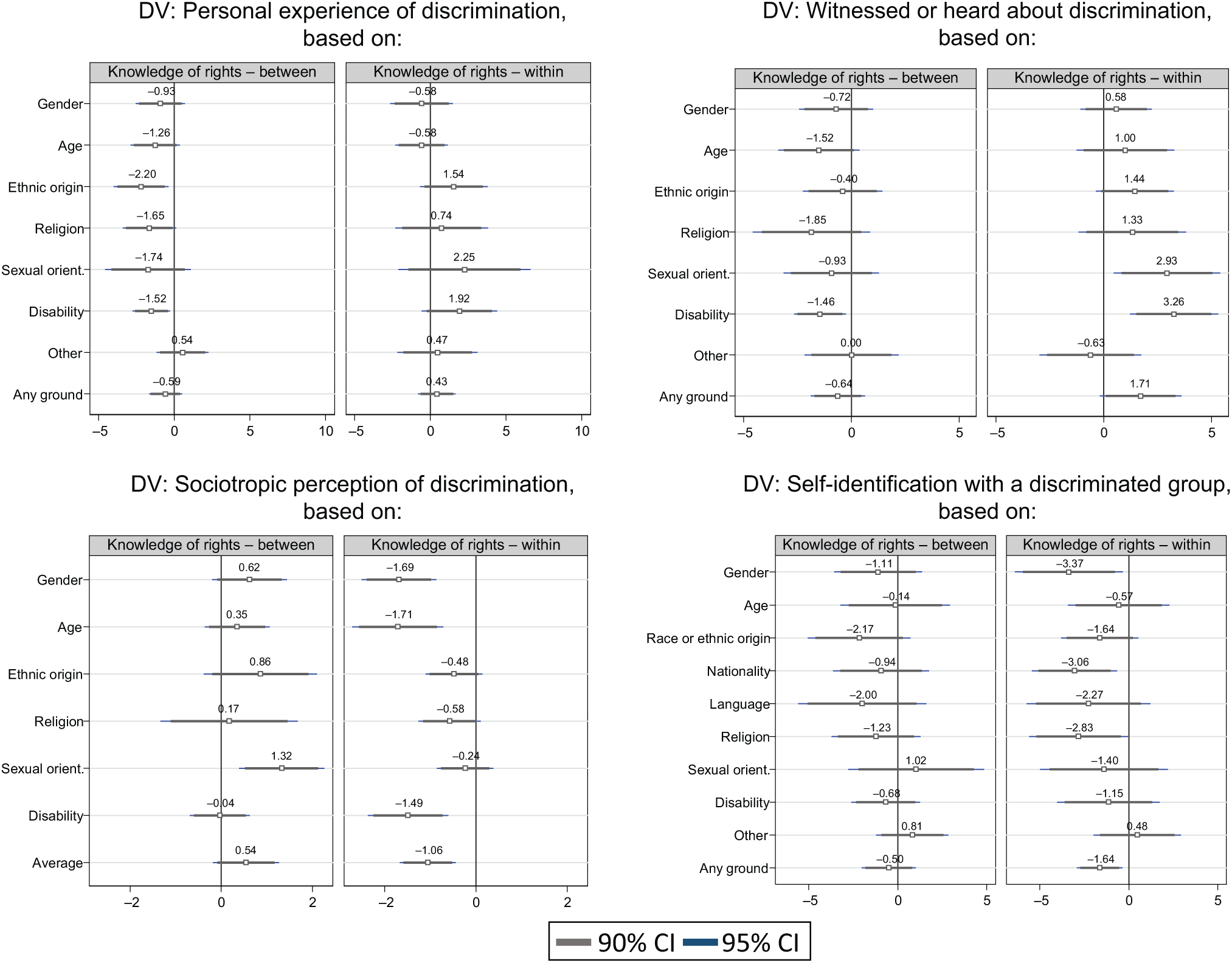
Multilevel hybrid models – level of knowledge of rights as predictor.
The between estimates show that levels of knowledge of rights are mostly negatively related to reports about experienced discrimination (significantly for ethnic origin, religion, and disability) and witnessed discrimination (significantly for disability), which is in line with the theoretical expectations derived from a policy-design perspective. By contrast, the longitudinal estimates suggest that an increase in knowledge of rights over time is related to higher reports about experienced and witnessed discrimination. Significant estimates occur for witnessed discrimination based on sexual orientation, disability, and the composite indicator “any ground” (p < .10). From this perspective, an increase in knowledge of rights over time seems to foster citizens’ awareness about discrimination, especially within their immediate social environment. The size of the effects can be illustrated by multiplying the marginal effect at the mean of an estimate with the full range of observed values for this variable. For “any ground” as an outcome variable, the maximum effect of within (longitudinal) knowledge is .18. This means that the average citizen who lives in the country with the highest knowledge level is about 18% more likely to witness discrimination in their personal environment than one from the country with the lowest knowledge level.
Regarding sociotropic perceptions (lower left-hand box in Figure 4), the between (cross-sectional) estimates are positive for most surveyed grounds, and are significant for discrimination based on sexual orientation. Much like the results from the policy indicator, higher levels of knowledge tend to be related to higher ratings about discrimination as a societal issue. By contrast, the within (longitudinal) estimates indicate that an increase in knowledge of rights over time is associated with a decrease in sociotropic perceptions of discrimination. The estimates are significant for perceptions related to discrimination based on gender, age, disability, and the average indicator. Using the indicator for average responses over all grounds as outcome, the maximum effect size of within knowledge is –.58, which is equivalent to a decrease of about four-fifths of a standard deviation of the “average perception” variable (SD = .73).
The cross-sectional relationships between knowledge levels and different forms of respondents’ self-identification with a discriminated group are systematic neither in the direction nor the significance of their effect. In longitudinal perspective, however, increasing knowledge levels are associated with a decrease in self-identification with a discriminated group. The results are statistically significant for discrimination based on gender, nationality, religion, and the global indicator “any ground.” In terms of effect size, people from the context with the highest knowledge are about 5% less likely to identify themselves with a discriminated group (based on any of the surveyed grounds) than those from the context with the lowest knowledge.
Conclusion
This study has investigated the relationship between antidiscrimination policy and citizens’ handling of discrimination, emphasizing knowledge of victims’ rights as an intermediate variable. The results reveal that people from countries with effective antidiscrimination measures tend to have greater knowledge about their rights related to equal treatment and discrimination. Multilevel models examining the direct links between policy and discrimination outcomes find a positive association between antidiscrimination measures and sociotropic perceptions of discrimination. There is, however, little evidence for further systematic associations between policy and reports about discrimination.
The results of the multilevel hybrid models demonstrate that societal levels of knowledge of rights are substantively related to different forms of discrimination. Here, the longitudinal findings are of particular interest, as they provide robust empirical evidence by relying solely on within-country variations from repeated measurements over time. This tackles the risk of omitted variables bias from unobserved time-constant country characteristics, such as different historical trajectories or institutional set-ups. The results suggest that, to the extent that antidiscrimination policies increase societal levels of knowledge of rights, they contribute to an enhanced social awareness by which people are more likely to sense discrimination in their immediate personal surroundings. At the same time, people who live in contexts characterized by an increase in knowledge of rights perceive less discrimination at the societal level. This association might be driven by more accurate and specific views about which practices can be considered as discrimination and which not. Another explanation is that, as people become more confident about their rights and how to use them, they project their self-efficacy to the societal level and tend to perceive discrimination as less of a diffuse and widespread issue.
The findings further demonstrate that an increase in knowledge levels is related to a decrease in self-identification with a discriminated group. This provides additional support for the argument that a favorable informational environment strengthens people’s self-efficacy toward discrimination. This finding is particularly important since individually perceived discrimination has been connected to a number of undesirable outcomes, including lower individual health and well-being, social isolation, and less civic and political engagement (e.g., Schildkraut, 2005; Schmitt and Branscombe, 2002). In this way, higher knowledge levels (and indirectly effective antidiscrimination policies) are associated with a number of important societal outcomes beyond the direct goal of reducing discriminatory practices.
At several points in the empirical analysis, the coefficients of the cross-sectional estimates were in the opposite direction to the longitudinal estimates. Whether this reflects a long-term effect of knowledge of rights on discrimination or the influence of additional confounding country characteristics is not easy to determine. Potentially confounding unobserved variables include forms of institutional or structural discrimination, policy differences, social norms, or mass media effects. Future research may provide evidence from experimental designs regarding additional mediating and conditioning mechanisms through which antidiscrimination policy is linked to attitudes and behavior. A key avenue for further examination is whether and under which circumstances specific at-risk groups, such as immigrants or ethnic minorities, profit more or less from antidiscrimination measures.
This study provides comparative empirical evidence on how antidiscrimination policies are related to societal outcomes. This in turn yields practical implications for policymakers and adds insight to the existing literature on policy effects on public opinion and behavior, a research area that has received increasingly systematic attention (Kumlin and Stadelmann-Steffen, 2014). Finally, the results presented here highlight the importance of identifying intermediate mechanisms and testing relationships beyond cross-sectional research designs in future research on policy effects on public outcomes.
Footnotes
Declaration of conflicting interest
The author declares that there is no conflict of interest.
Funding
This research received no specific grant from any funding agency in the public, commercial, or not-for-profit sectors.

Notes
References
Supplementary Material
Please find the following supplemental material available below.
For Open Access articles published under a Creative Commons License, all supplemental material carries the same license as the article it is associated with.
For non-Open Access articles published, all supplemental material carries a non-exclusive license, and permission requests for re-use of supplemental material or any part of supplemental material shall be sent directly to the copyright owner as specified in the copyright notice associated with the article.
