




Abstract
The personalization of politics is a popular thesis but often challenged when it comes to media personalization. While previous research compared the prominence of different types of political actors across national political contexts, this article situates its research in the context of European Union (EU) politics and, thereby, studies similar reference points across countries. Its focus lies on the European Commission and its members. Personalization is conceptualized as individualization and presidentialization, respectively. The article proposes that the EU integration process provides journalists with the opportunity to report more often about individual politicians, while political developments should further incentivize journalists to personalize their news from Brussels. To test this argument, the article investigates personalization patterns in seven broadsheets from Ireland, Britain, France, the Netherlands, Denmark, Italy, and Poland. In total, 119,070 articles are analyzed by automated content analysis over a period of twenty-five years. The article finds no pan-European trend toward greater personalization of politics with respect to news coverage of EU executive politics. The findings nonetheless provide important implications for future research. The article particularly discusses the universal applicability of the phenomenon, the time frame for analysis, and journalistic styles in covering European politics.
Keywords
Introduction
The personalization of politics is a long-observed phenomenon in modern democracies that has attracted considerable interest among political scientists and scholars of political communication (e.g., Karvonen 2010; Kriesi 2012; Langer 2007; Rahat and Sheafer 2007). The concept is generally defined as a trend toward an amplified focus on individual politicians in political processes, voting behavior, or media reportage at the expenses of political parties or institutions (e.g., Adam and Maier 2010; Rahat and Sheafer 2007; Van Aelst et al. 2012). However, we know little about personalization in the context of European Union (EU) politics, albeit the emerging research in the field of electoral behavior in European elections (e.g., Gattermann and De Vreese 2017; Schmitt et al. 2015). To address this lacuna, the purpose of this article is, first, to assess the extent to which personalization of EU politics in newspaper coverage occurs over time and across Europe, and, second, to examine the role political factors play for longitudinal and cross-sectional variation. Its focus lies on the European Commission and its members as the central and supranational executive body of the EU.
Thereby, the article contributes to the extant literature on the personalization of politics in four important ways. The first contribution is in terms of focus because mediated personalization has thus far been studied almost exclusively as a phenomenon of national politics. Although previous research has studied the news visibility of European actors at times of EU elections (e.g., Boomgaarden and De Vreese 2016; Schuck et al. 2011), or the visibility of individual Members of the European Parliament during routine periods (Gattermann and Vasilopoulou 2015), these studies have offered only limited insights into personalization as an overtime process.
Second, given this lack of focus thus far, we also require a theoretical framework for understanding possible personalization trends in EU politics, which this article advances. Few scholars have argued that political factors play a role for varying degrees in mediated personalization (e.g., Boumans et al. 2013; Langer and Sagarzazu 2018; Rahat and Sheafer 2007; Šimunjak 2017). Rather, proponents of the personalization thesis contend that mediated personalization can in part be linked to mediatization processes (e.g., Vliegenthart et al. 2011; Zeh and Hopmann 2013). Mediatization entails that, among other things, media content is increasingly influenced by media logic (Strömbäck 2008: 234). Personalizing news content is one characteristic of media logic, alongside the use of conflict and negativity in journalistic reportage (e.g., Mazzoleni 1987; Strömbäck 2008). Nonetheless, the extant literature provides inconclusive evidence for any universal trend toward mediated personalization (e.g., Kriesi 2012; Langer 2007; Rahat and Sheafer 2007; Šimunjak 2017), although some of this variation may be attributed to the different types of operationalization of the concept (Van Aelst et al. 2012).
This article provides an additional test by situating this study in the context of EU politics. Studying similar reference points across countries as opposed to differing domestic politics allows testing whether constitutional and political factors can explain mediated personalization trends in EU politics. Journalists are likely to have similar incentives to personalize their news coverage from Brussels as they would with their reporting of domestic politics. After all, they are the same media that cater for the same national audiences, if we disregard the few specialized pan-European outlets that exist. Personalizing news is likely to be even more appealing for journalists covering EU affairs compared with domestic politics as they are challenged to make news about complex and lengthy processes at the EU level comprehendible for their audiences (Gattermann 2011; Gleissner and De Vreese 2005). The EU integration process has led to the creation and strengthening of individual political offices and therewith responsibilities at the EU level, which provides journalists with an opportunity to report more often about individual politicians. Moreover, there is increasingly more at stake, and EU politics have become more politicized, which might further incentivize journalists to personalize their news from Brussels.
The third and empirical contribution concerns the research design. Many studies that examine mediated personalization of politics have focused on election periods; the inclusion of routine periods is rare (Vliegenthart et al. 2011: 98). This article considers the full course of twenty-five years from 1992 to 2016. Furthermore, personalization research has been dominated by single-country studies, but “comparative efforts are simply indispensable” (Karvonen 2010: 21) to understand the phenomenon. This article builds on the growing cross-country comparative research (e.g., Balmas and Sheafer 2013; Holtz-Bacha et al. 2014; Kriesi 2012; Šimunjak 2017; Vliegenthart et al. 2011) and examines the mediated personalization of the European Commission in broadsheets of seven countries, namely, Ireland, the United Kingdom, France, the Netherlands, Denmark, Italy, and Poland.
Fourth, the article’s conceptual contribution is that it applies and modifies key definitions of personalization and adapts them to the study of the European Commission. The prominent definition by Van Aelst et al. (2012: 206–208) distinguishes between an increase in the “general visibility” of individuals compared with parties or institutions and a rising “concentrated visibility” with shifts onto political leaders. The latter is also referred to as presidentialization in the literature, but the conceptualizations vary with either comparing leaders to other politicians (e.g., Boumans et al. 2013; Vliegenthart et al. 2011) or defining the visibility of leaders as relative to collective actors such as parties, cabinets, or countries (e.g., Balmas and Sheafer 2013; Holtz-Bacha et al. 2014; Kriesi 2012; Langer 2007; Šimunjak 2017). In this article, the visibility of Commissioners is compared with the visibility of the institution because party affiliations play a subordinate role in the College of Commissioners, and, given that EU politics are perceived as rather abstract and removed from domestic politics, it is sensible to conceptualize nonpersonalized news as a focus on the institution. Consequently, individualization is conceptualized as an increasing focus on individual Commissioners at the expense of the institution, and presidentialization is defined as growing attention for the Commission President vis-à-vis the Commission.
The article finds no pan-European trend toward greater mediated personalization of politics with respect to EU executive politics. The findings nonetheless provide important implications for research on the mediated personalization of politics, which the Discussion section of the article discusses. Particular attention is devoted to the universal applicability of the phenomenon, the time frame for analysis, and journalistic styles in covering European politics.
EU Integration and Media Personalization of Executive EU Politics
In their seminal work, Rahat and Sheafer (2007) rely on the politics-media-politics principle developed by Wolfsfeld (2004: 31), whereby “politics almost always comes first,” and argue that in the case of Israel, media personalization is a response to changes in political institutions, particularly the personalization of selection procedures of candidates by political parties. Applying the politic-media-politics principle to EU politics, we may distinguish between constitutional or institutional developments that have a procedural impact on EU politics on one hand, and actual EU politics and political developments on the other.
Regarding the former, the accelerating European integration process provides an opportunity structure for journalists to personalize their news content. It has led to an expansion of policy-making competences over the years, such as in the field of the Single European Market, which was established in 1993, monetary policies following the introduction of the Euro in 1999, or international trade policies. Put differently, there is increasingly more at stake in terms of policy issues. At the same time, treaty changes have created and strengthened individual political offices and therewith individual responsibilities at the EU level, such as the High Representative for Foreign Affairs. Put differently, as policy competences increase in scope and across policy areas, political sources diversify for journalists. For instance, with respect to Foreign Affairs and Security policies, journalists may now consult the High Representative; on questions related to the Single Market or immigration, journalists may access the respective Commissioners for information. Thus, if we followed the argumentation of Rahat and Sheafer (2007), we would expect that the media also pay more attention to individual politicians.
Procedurally, we may also expect an increase of journalistic attention on a short-term basis when a new Commission takes office, assuming that newspapers introduce the new Commissioners to their readers (see also Boumans et al. 2013: 204).
The Commission President is the central figure of the European Commission. Some of the extant literature argues that mediated politics have become more centralized with an increasing focus on leaders or heads of governments (e.g., Boumans et al. 2013; Langer 2007). Particularly, Balmas and Sheafer (2013) find that news coverage of international affairs increasingly focuses on heads of government rather than countries as such. While EU news represents a hybrid between domestic and international news, for most audiences, Brussels is geographically far away. Journalists are, therefore, likely inclined to personalize the EU in their news reportage by paying more attention over time to one of its central leaders at the expense of the institution itself. This should again be driven by political opportunity structures, namely, treaty changes, which have also enhanced the powers of the Commission President over his cabinet and vis-à-vis the member states (Kassim et al. 2013: 158) and have therewith provided more opportunities for the media to hold him personally accountable.
Short-term procedural variation in mediated presidentialization of EU politics is likely to be driven by European Council summits. These summits are rather personalized by their very nature because they focus on the national heads of state. The President of the Commission also takes part in these intergovernmental meetings on behalf of the whole College adding a supranational component to the summits. Following the above rationale, we should, therefore, expect:
However, some political scientists argue that the Commission President’s role in the EU is not solely influenced by the treaties but is also dependent on his political leadership (e.g., Kassim et al. 2013; Müller 2016). Some Presidents have stood out in the past, such as Delors, who is renowned for his transformative political leadership (Tömmel 2013), or Barroso, whose leadership style was considered rather presidential (Kassim et al. 2013). Thus, degrees of media presidentialization are likely to be conditional on a President’s personality (see Amsalem et al. 2018). Measuring such traits systematically lies outside the scope of this article. However, we may derive that degrees of presidentialization differ for each President included in this study.
This last hypothesis brings us to the political dimension of EU politics. As a consequence of new constitutional and procedural provisions, the EU has gained significant political authority over time. And De Wilde and Zürn (2012: 139) argue “that increasing EU authority leads to politicization.” This increase in politicization has generally been observed since the coming-into force of the Maastricht Treaty (Hooghe and Marks 2009). Hutter and Grande (2014: 1003) conceptualize politicization as an increase of the scope of conflict in EU politics that is manifest in an increase in issue salience alongside expansion to nongovernmental actors and actor polarization. Increasing issue salience provides journalists with substantive reasons to report more frequently about European affairs, and media coverage has indeed become more comprehensive (e.g., Boomgaarden and De Vreese 2016; Schuck et al. 2011). Politicization is heightened in times of crisis, which may also provide journalists with additional incentives to personalize their news from Brussels because demand for political leadership is particularly high. Although the Euro does not fall into the exclusive competences of the European Commission—the Eurogroup and its President oversee the Eurozone—the European Commission has also been concerned with solving the crisis and is also a member of the so-called Troika alongside the European Central Bank and the International Monetary Fund (IMF), which supervise bailout schemes in several EU countries. We may, therefore, expect that:
Thus far, I have argued that the mechanisms that are expected to be at play vary over time but not across country. However, politicization of EU integration primarily takes place in the domestic context (Kriesi 2016: 32). Research on the visibility of the European Parliament and its members argues that journalists’ domestic considerations play a crucial role for cross-country variation in the attention paid to news from Strasbourg (Gattermann 2011; Gattermann and Vasilopoulou 2015). Therefore, if politicization increases the likelihood of media personalization, then also national newspapers are likely to vary in their degree of presidentialization depending on degrees of EU politicization at home. This is most likely to be manifest with respect to some of the core policy areas of the EU concerning economic and monetary policies. Inside the Eurozone, politicization is likely to be more pronounced because the respective member states have transferred additional authority to the EU (see also De Wilde and Zürn 2012: 138).
Last, in the short to medium term, politicization is likely to be higher when the domestic economy is doing badly for which two indicators are central: rising unemployment and economic recession.
Data and Method
Sample
The chosen time period for this article spans from 1992 to 2016, which represents twenty-five years in the recent history of European integration. It begins before the Maastricht Treaty, which established the EU, came into force in November 1993, and ends in the year in which the British voted to leave the EU. In 1992, the European Community comprised twelve countries, which have subsequently been joined by other countries in 1995, 2004, 2007, and 2013. Ultimately, the EU comprised twenty-eight member states after 2013. Eight different compositions of the European Commission are subject to the time period of investigation, namely, the second and third Commission of Jacques Delors (1989–1993; 1993–1995); the Commission under Jacques Santer (1995–1999) followed by the brief interim Commission led by Manuel Marin in 1999 due to Santer’s resignation; Romano Prodi’s Commission (1999–2004); two Commissions led by José Manuel Durão Barroso (2004–2010; 2010–2014); and Jean-Claude Juncker’s Commission, which took office in 2014. Following the different enlargements of the EU, the size of the Commission has also been growing from seventeen to twenty-eight Commissioners, amounting to 184 individual offices during the eight Commission periods. 1
This study considers seven countries. Three of them are founding members of the EU: France, the Netherlands, and Italy. Ireland, Denmark, and the United Kingdom have joined the European Community with the first round of enlargement in 1973, and Poland is a more recent member having joined the EU in 2004. The country selection exhibits variation across types of traditional media systems (Hallin and Mancini 2004): the liberal media system can be found in Ireland and the United Kingdom, the Netherlands and Denmark can be characterized by the democratic-corporatist media system, the media systems of France and Italy belong to the polarized-pluralist system, and Poland has been described as “a hybrid of the Polarized Pluralist and Liberal models, with a few elements of the Democratic Corporatist model and the country’s postcommunist legacy” (Dobek-Ostrowska 2012: 49).
Newspapers provide the media content for this study because they allow studying personalization trends over long periods of time (e.g., Boumans et al. 2013; Langer 2007; Rahat and Sheafer 2007). Online and social media have only recently become (more) relevant. In addition, social media, such as Twitter, are “personalized per definition” (Kruikemeier 2014: 132). Last, television “automatically focuses on persons and personalities” (Karvonen 2010: 4), which makes it difficult to identify any trends over time. Furthermore, research on intermedia agenda-setting has found that newspapers can influence other media, including television (e.g., Vliegenthart and Walgrave 2008), but also social media (e.g., Conway et al. 2015; Kruikemeier et al. 2018).
The newspapers comprise The Irish Times, The Guardian (U.K.), the French Le Monde, the Dutch De Volkskrant, the Danish Politiken, the Italian La Stampa, and the Polish Gazeta Wyborcza. It goes without saying that one newspaper may not necessarily be representative of all newspapers in a given country. However, given the scarce availability of a comprehensive set of newspapers in all counties, the current sample has been carefully chosen to meet criteria of consistency and comparability. First, analyzing one newspaper over the whole course of investigation—as opposed to adding or removing additional newspapers along the way—ensures that the results are consistent within country. Second, each chosen newspaper is a major, politically left-leaning broadsheet in their country of distribution, which allows comparing the results across country. 2
The articles were collected via LexisNexis, an online database for international newspapers, through an extensive keyword search (see the online appendix) and saved as text files. The Irish, French, British, and Italian newspapers were available for the whole period of investigation, although the period of the former begins five months later on June 1, 1992. The study period for the Dutch and Danish newspapers starts in 1995 and 1997, respectively, and that of Gazeta Wyborcza in May 2004, when Poland joined the EU. The original sample comprises 626,569 articles (see the online appendix).
Procedure
The automated content analysis was initially conducted in Python. The Python codes have been adapted from a code that was originally designed for a different research purpose. 3 The codes included main article characteristics (date, word count, title, and article text) and instructions to discard articles that comprised more than ten thousand words. Moreover, following the methodological advice of Jonkman et al. (2016: 7), articles that consisted of more than 16 percent of numbers were removed as these are most likely “non-articles.” In addition, text files comprising Commissioner names and various ways of referring to the European Commission using regular expressions were inserted in the code, so that Python read these, counted the number of references in each article, and produced a csv-dataset for each newspaper sample. After that, another Python code 4 was developed to exclude duplicates based on a cosine distance of at least 0.7 (see Boumans 2016). Further omissions include a handful of articles for which no publication date could be identified and several online articles that were part of The Guardian’s original sample. The sample subsequently comprised 544,898 newspaper articles in total (see the online appendix). No distinction was made regarding the type of article (e.g., news, letters, obituaries, editorials, interviews).
Next, the data analysis continued in Stata and SPSS. All variables were recoded based on the condition that each Commissioner was at least mentioned once with his or her first name in the article. Importantly, each Commissioner was only coded for those days on which he or she was actually in office. Similarly, references to the “Commission” were counted only if the article text at least once referred to the “European Commission” or any equivalent in each language. This procedure ensures that the right person/institution is coded and has been consistently applied across and within newspaper samples.
Last, after all references to individual Commissioners and to the institution had been identified, all those articles that refer to different subjects were excluded. Ultimately, this leaves a final sample of 119,070 newspaper articles (see the online appendix). Figure 1 below provides a yearly overview of the amount of articles per newspaper. The figure shows considerable overtime fluctuation; only the coverage of De Volkskrant remains relatively stable. The coverage of La Stampa was high under Italian Commission President Prodi between 1999 and 2004. Moreover, the coverage of the Irish Times peaked in 2010, when Ireland had to agree to a bailout from the EU and the IMF given its sovereign debt crisis. The Guardian had the most comprehensive coverage in 2016, when the British voted to leave the EU. The reportage of Politiken and Le Monde vary considerably over time; it was highest in 1998 and 2003, respectively. The coverage of Gazeta Wyborcza peaks in 2007 and then decreases abruptly thereafter. Since 2013, there were fewer than three hundred articles per year. A comparison with the coverage of national politics shows similar patterns (see the online appendix), which suggests that there are missing data for Gazeta Wyborcza in the LexisNexis database. The newspaper’s coverage has, thus, to be examined with caution, and robustness checks include removing the Polish sample (see Online Appendix Section C).
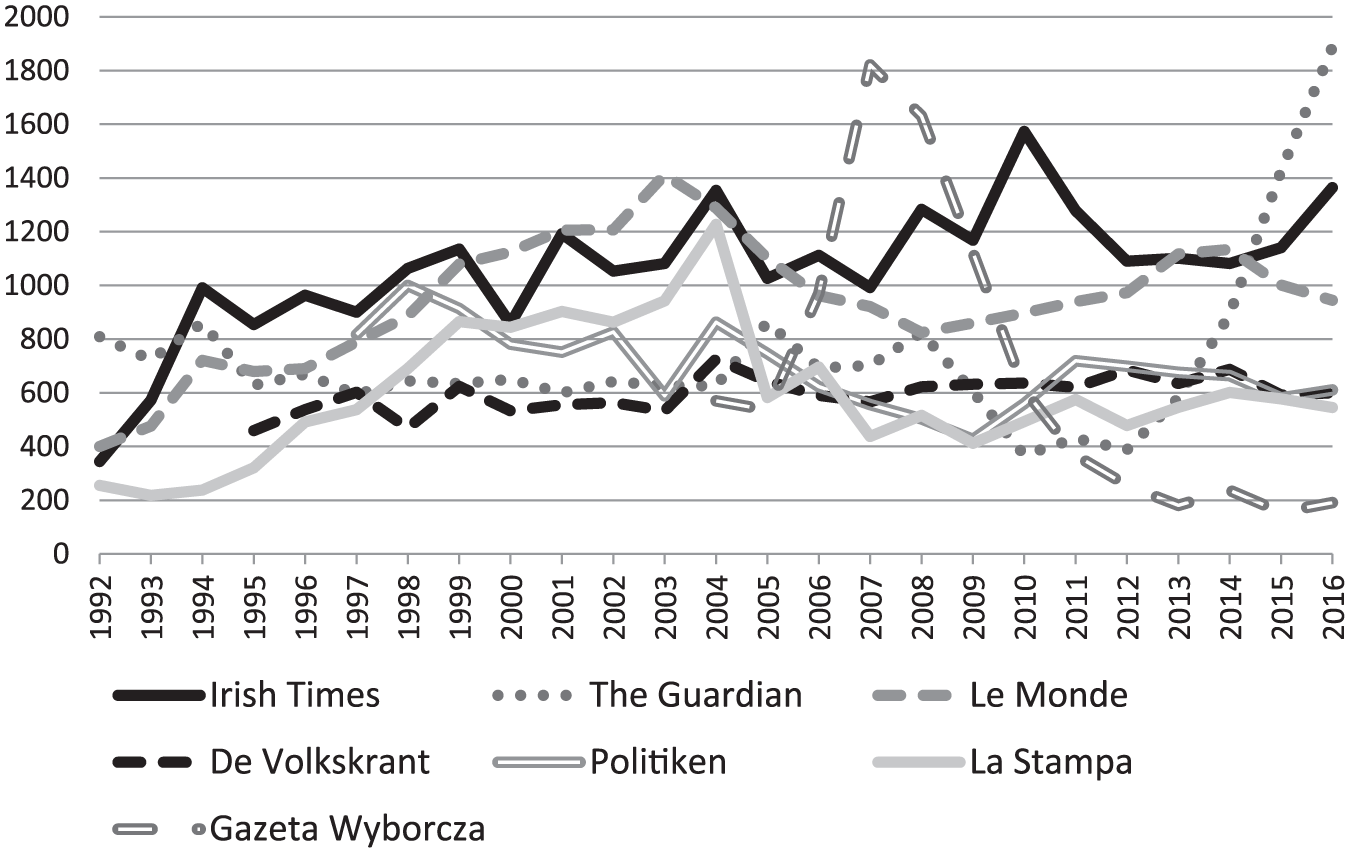
Data overview, total number of articles referring to the European Commission or Commissioners per year, and newspaper.
Operationalization
Following recent recommendations (e.g., Boumans et al. 2013; Holtz-Bacha et al. 2014; Van Aelst et al. 2012), this article applies relative measures of personalization. Furthermore, building on research that has accounted for the prominence of actors and institutions within articles (e.g., Holtz-Bacha et al. 2014; Rahat and Sheafer 2007), a distinction has been made between references to Commissioners/the Commission in the article text and in the title: references in the title count twice, while references in the article body count only once (see also Vliegenthart et al. 2011). The initial unit of analysis constitutes each individual article. Individualization is operationalized as the proportion of the sum of references to any individual Commissioner, including the President, out of the total number of references per article that refer to both Commissioners and the Commission as institution. This variable is almost normally distributed (M = 0.34, SD = 0.14, Figure A2). Presidentialization is measured as the proportion of the sum of references to the Commission President, out of the total number of references per article that refer to both the President and the Commission as institution. This variable’s distribution is right-skewed (M = 0.11, SD = 0.11, Figure A3).
Ultimately, both variables have been aggregated to a monthly level by taking the mean of the respective proportions. Importantly, to account for possible problems related to data availability discussed above, for those months in which the total number of articles is lower than twenty, the dependent variables have been set to missing values. The final N for further analysis is hence 1,754 months for both dependent variables (see the online appendix).
Analysis
The data have a panel structure with months being nested in newspaper samples, though it is unbalanced given the missing values for some newspapers. Because the dependent variables represent proportions, a fractional response model has been chosen (Papke and Wooldridge 1996). Although Papke and Wooldridge (2008: 127) themselves acknowledge that such nonlinear models would be “difficult to extend to unbalanced panel data,” to the author’s knowledge, this issue has not yet been fully resolved by means of Stata commands and for nonbinary response variables, respectively (see Wooldridge 2011). Following Wooldridge (2011), Stata’s ivprobit command has been probed to address possible issues of endogeneity, but the program states that endogenous variables are absent. Instead, Wald tests reveal that heteroscedasticity is present in all models with either dependent variable. Thus, for the analysis below, the average marginal effects (AMEs) of heteroskedastic fractional response models with robust standard errors are reported. AMEs additionally allow to compare effect sizes within models. All models include newspaper fixed effects.
Concerning the main independent variables at a pan-European level, a categorical variable indicates the respective Treaty period (H1a and H2a), distinguishing between pre-Maastricht, Maastricht (from November 1993), Amsterdam (from May 1999), Nice (from February 2003), and Lisbon (from December 2009). The dummy variable New Commission indicates the month in which a new Commission period begins (H1b). The continuous variable EU summits (H2b) ranges from 0 to 3 and counts the number of official and unofficial Council summits that have taken place in a respective month. It also includes Euro summits and extraordinary summits. To test H2c, the six Commission Presidents are distinguished by a categorical variable. The dummy Financial crisis is 1 for the period from September 2008 when Lehman Brothers announced their bankruptcy (H2d). At the domestic level, the Eurozone countries (H2e) include Ireland, France, the Netherlands, and Italy from 1999. Finally, figures for the annual unemployment rate (percentage of total labor force, H2f) and the annual percentage of GDP growth (H2g) were collected from the Worldbank. 5 The latter has been calculated as a dummy variable indicating growth. Given some longitudinal and cross-sectional overlap in the rather limited sample, the respective models for presidentialization are estimated separately to include the treaty periods, Commission Presidents, financial crisis, and Eurozone measures.
Several controls are added to the models. First, given the way the Commission periods are coded, the dummy variable Post-Election Period indicates the period between the month after the last European elections have been held until the new Commission has taken office to account for a potential cooling-off period of the outgoing Commission. The continuous variable Commission size measures the number of Commissioners, including the President, that each Commission comprised, ranging from seventeen to thirty. 6 Moreover, when a country holds the Council Presidency, the respective newspaper is likely to show higher levels of individualization and presidentialization. Last, the dummy variables National general election 7 and EU election indicate that a respective election has taken place in a given month and potentially have negative effects. The descriptive statistics of all variables can be found in the online appendix.
Results
Figure 2 provides an overview of individualization and presidentialization patterns that are aggregated across newspapers per year. Despite this rather crude aggregation, the figure shows that none of them linearly increases over time. Rather, both trends are particularly high between 1992 and 1994, which seems to be driven by then Commission President Delors as the high figures for presidentialization suggest. After 1995, the proportions of individualization remain within the range of 0.27 (1998) and 0.38 (2016). The highest value for presidentialization after 1995 is observed in 2003 with 0.15. This already provides some descriptive evidence for H2c, which stipulated that presidentialization is likely to vary across Presidents: the newspaper coverage of the Delors II and III Commissions was exceptionally personalized. However, this period also coincides with the coming-into-force of the Maastricht Treaty in November 1993.
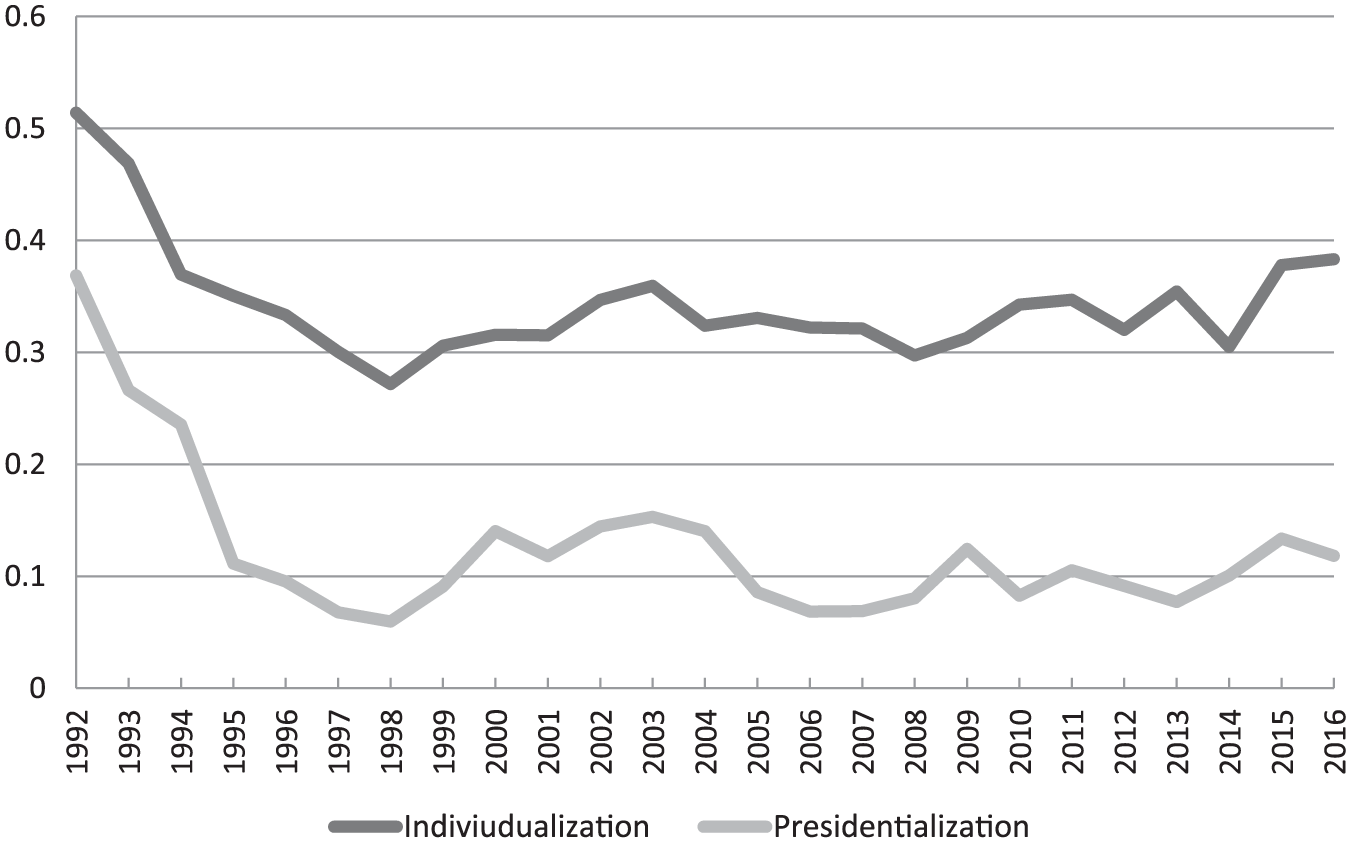
Yearly distribution of individualization and presidentialization, aggregated across newspapers.
Figure 3 depicts the aggregated values of individualization, which captures all individual Commissioners including the President, by Commission period for each newspaper. It demonstrates that individualization in the Irish, British, French, and Italian newspapers was on aggregate higher during Delors II compared with Delors III, which took office in January 1993. Interestingly, the scores in La Stampa are higher during Delors II than during the Prodi Commission. However, there seem to be fewer differences between Barroso I and II. The Italian, Danish, and Polish newspapers feature higher individualization scores for the latter compared with the former Commission, whereas this trend seems to be reverse for the remaining newspapers. Generally, individualization scores are highest for La Stampa, except during the Juncker Commission, when the Guardian is taking the lead, and lowest for De Volkskrant and Gazeta Wyborcza. Individualization appears to be increasing in the Danish and British newspapers between the Prodi and the Juncker Commissions.
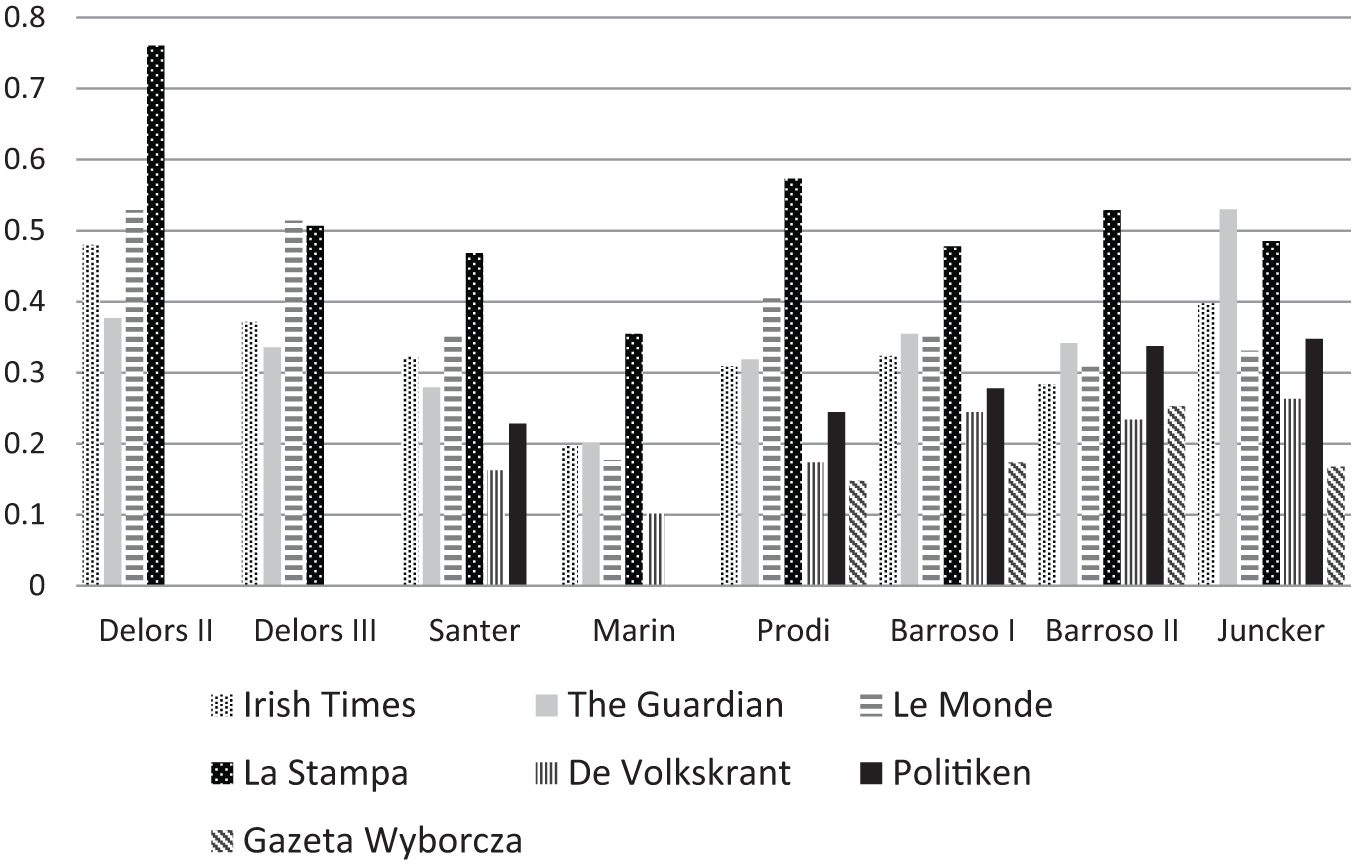
Comparing means of individualization over different Commission periods, per newspaper.
To systematically examine these trends, the article proceeds to test the hypotheses. The figures that follow report the AMEs; the full tables can be found in the online appendix. Figure 4 shows the AMEs on individualization. H1a stipulated that individualization is likely to increase with every new phase of formal EU integration, but the AMEs are not significant, and the hypothesis has to be rejected. There is no systematic overtime increase in individualization related to formal EU integration. Likewise, individualization is not driven on a short-term basis when a new Commission takes office; H1b is also rejected. Nonetheless, two control variables indicate significant and plausible effects. Individualization is lower in periods after European elections have been held and before a new Commission is inaugurated, and the size of the college is positively associated with more individualization. Although the latter effect is no longer significant when the Polish sample is removed (see online appendix), it refers to the theoretical argument presented above: as political sources diversify for journalists, they are likely to give more attention to individual Commissioners. Much of the variation, however, can be explained by the different newspapers, which all yield statistically significant effects. Compared with the Irish Times, individualization is significantly lower in De Volkskrant, Politiken, and Gazeta Wyborcza. Individualization scores in the Guardian are slightly higher, while La Stampa features significantly more individualized coverage from the European Commission, followed by Le Monde. This suggests that there is no long-term universal trend toward greater mediated individualization of executive EU politics. Rather, differing degrees of individualization are driven by cross-sectional variation.
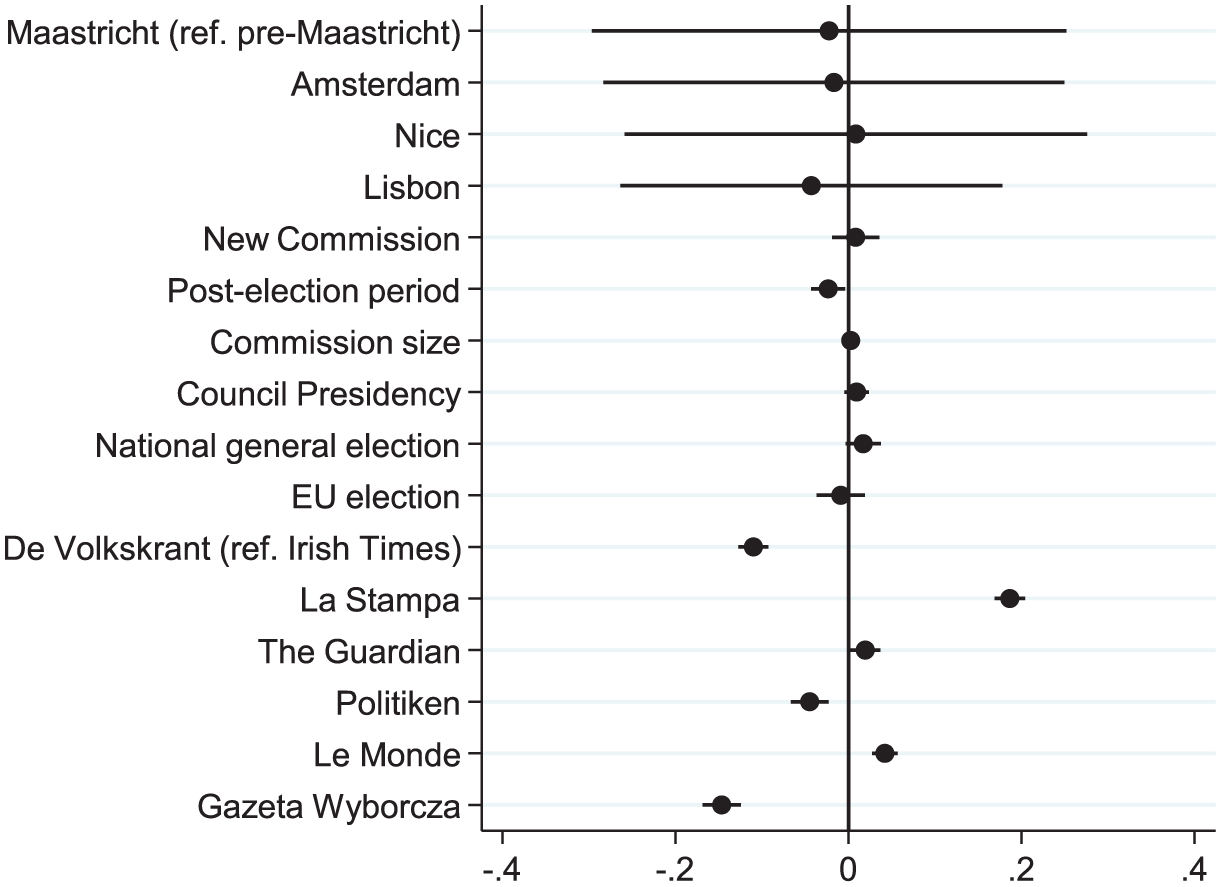
Average marginal effects on individualization.
This cross-sectional variation is also present with respect to different degrees of presidentialization. Figures 5 and 6 show similar patterns; although the differences between the Irish Times and Politiken and Gazeta Wyborcza, respectively, are not robust across models. Turning to our second set of hypotheses concerning presidentialization, Figure 5 (Model 1) shows that similarly to individualization, presidentialization does not increase with accelerating formal EU integration: the scores are significantly higher during the pre-Maastricht phase compared with the subsequent periods. Among the latter, presidentialization was also significantly higher when the Treaty of Amsterdam was in force compared with the remaining treaties. H2a is, thus, also rejected.
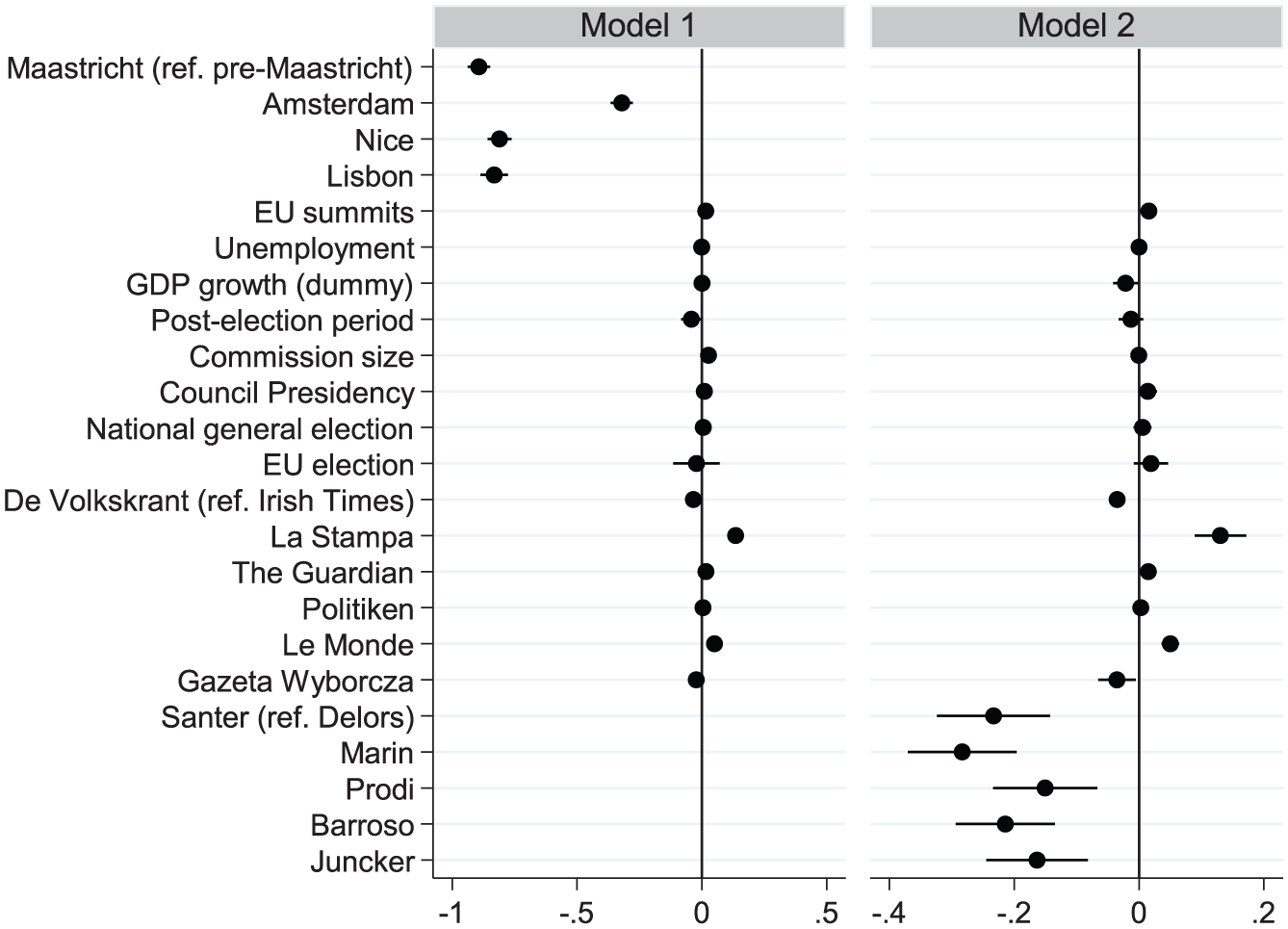
Average marginal effects on presidentialization.
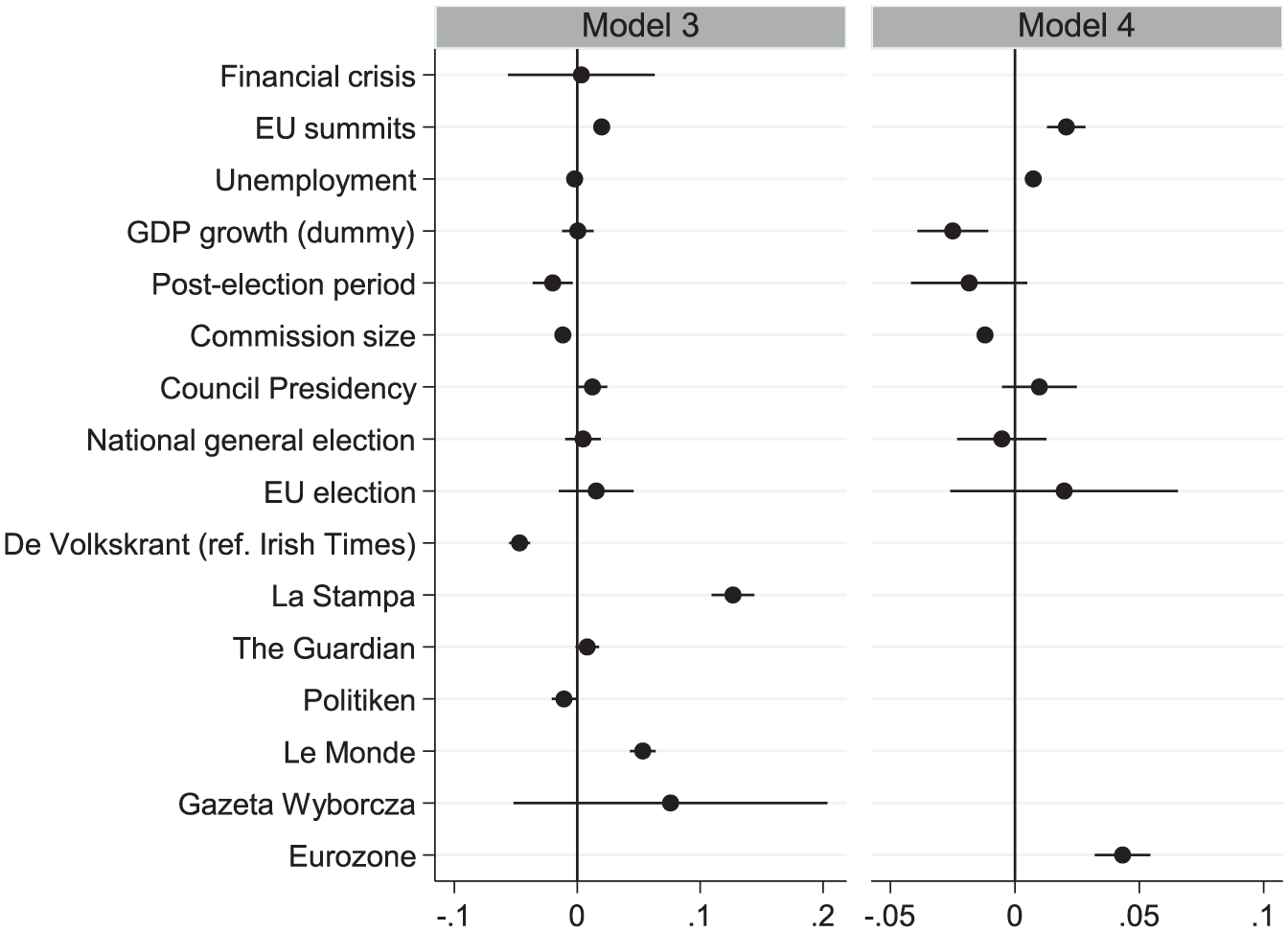
Average marginal effects on presidentialization.
However, there is some support for H2b. EU summits have a small but positive effect on mediated presidentialization. These effects hold in all four models presented in Figures 5 and 6 (and when removing the Polish sample). Moreover, H2c stipulated that mediated presidentialization of EU politics is likely to vary for different Commission Presidents. Figure 5 (Model 2) shows that presidentialization in European newspapers was indeed much higher under Delors compared with all remaining Presidents. Yet, as presidentialization scores do not significantly differ from each other among the other Presidents, this provides only partial support for H2c.
Turning to the remaining hypotheses that are related to the politicization of EU affairs, Figure 6 (Model 3) shows that presidentialization scores are not higher after the outbreak of the global financial crisis compared with before. H2d is rejected. To test H2e, Figure 6 (Model 4) includes the AMEs of the Eurozone membership of four countries after 1999. Because this operationalization correlates with the newspaper dummies, the latter have been removed from the model, which admittedly makes it less robust, especially since Italian and French newspapers are responsible for high presidentialization scores. Nonetheless, it shows that, on aggregate, presidentialization scores are higher in the Eurozone countries after 1999. This provides some tentative support for H2e. To explore this finding further, the sample has been split into Eurozone and non-Eurozone countries for Model 3 presented above (see Online Appendix Figures A4 and A5). The results show that presidentialization is higher after Lehman Brothers announced their bankruptcy in September 2008 in Eurozone countries, but not among the remaining countries, Britain, Denmark, and Poland. Last, the expected positive effect of higher unemployment rates (H2f) and negative effect of GDP growth (H2g) hold in the less stringent Model 4 (Figure 6). The respective effects are negative or not significant in the other models presented in Figures 5 and 6, with the exception of the negative effect of GDP growth in Model 2, which does, however, not hold without Gazeta Wyborcza. The AME of unemployment is negative in Model 3 (and also in the Eurozone sample). H2f has, thus, to be rejected; H2g receives some support, but the AMEs are not robust across models. Regarding the remaining controls, national or European elections taking place in the same month have no significant effects. Yet during a country’s Council Presidency, the respective newspaper exhibits slightly higher presidentialization scores in its coverage of the European Commission.
Discussion
The personalization of politics is a popular thesis but often challenged when it comes to media personalization. Research has thus far been unable to confirm any uniform trend toward greater personalization in political news coverage. While previous research compared the prominence of different types of political actors across national political contexts (e.g., Boumans et al. 2013; Holtz-Bacha et al. 2014; Kriesi 2012), this article situated its research in the context of EU politics. Importantly, the subject—that is, the European Commission and its members—is the same for all newspapers that allowed testing whether factors pertaining to the EU integration process and the politicization of EU affairs can explain varying patterns of mediated personalization.
Although the results of this study by and large reflect the existing lack of evidence regarding longitudinal trends (e.g., Kriesi 2012; Šimunjak 2017), they have important implications for research on the mediated personalization of politics. The, perhaps most important, take-away is that neither individualization nor presidentialization increase in European broadsheets over the twenty-five-year period under study. The subsequent treaty periods do not have positive effects on either personalization dimension, nor does the global financial crisis provide reason to increasingly personalize news stories about the European Commission at a pan-European level. Furthermore, we have to be cautious about the positive effect of the Eurozone after 1999 since it captures the highly personalized coverage of the French and Italian newspapers. Until we include more newspapers and countries, we are unable to confirm whether Eurozone membership indeed matters for the mediated personalization of EU politics.
The article found that the European Commission’s news coverage was highly personalized at the beginning of the study period, which coincides with the presidency of Delors. He is known as transformer because during his leadership, the single market was completed, and the Maastricht Treaty was adopted (Tömmel 2013: 796). The Maastricht Treaty represents an important milestone in European history, having stimulated EU integration to a considerable degree. Thus, the higher presidentialization patterns in the respective period leading up to the coming-into force of the treaty may not be down to Delors alone. Moreover, Santer and Prodi are considered rather weak Presidents, while Barroso has been able to follow Delors’ footsteps of a strong leader (Kassim et al. 2013). However, these observations are not present in the mediated presidentialization patterns. Despite the open question about which long-term mechanism is at play here, the findings have important implications for deciding on time frames in personalization research. Had we begun the analysis with the inauguration of the Santer Commission in 1995, we would have likely concluded that there is some evidence for an overtime increase in personalization. Thus, personalization patterns are always relative to prior developments, which future research should bear in mind.
Nonetheless, some short-term procedural developments, including the occurrence of EU summits, positively affect presidentialization trends. This suggests that the politics-media-politics principle (Wolfsfeld 2004: 31) to some extent applies in the day-to-day coverage of European Commission. Yet these effects are minor compared with the rather sizable newspaper effects. The latter also appear to absorb the other country-specific politicization effects that were operationalized by unemployment and GDP growth. Remarkably, the newspaper differences appear to align with Hallin and Mancini’s (2004) classic account of media systems: individualization scores are highest in the French and Italian newspapers, similarly high for the Irish Times and the Guardian, and comparatively lower in both the Danish and Dutch broadsheets, and even lower in Gazeta Wyborcza. Although only one newspaper has been considered in each country, the fact that they have been studied in the same EU political context allows us to derive tentative evidence that journalistic cultures matter for the varying degrees of mediated personalization of the European Commission. Put differently, high personalization scores may partially be explained by high levels of political parallelism combined with low professionalism of the press, as in Italy and France. Likewise, comparative research also finds that journalists working in the liberal media systems (here, Ireland and Britain) are more likely to personalize their political news compared with journalists in democratic-corporatist systems, such as the Danish and the Dutch, given higher degrees of commercialization in the former type of system (see Holtz-Bacha et al. 2014; Vliegenthart et al. 2011). Finally, this cross-sectional variation also demonstrates that expectations for media personalization as an overtime trend should account for the degree to which media coverage is already personalized. Whereas individualization appears to be increasing in the Danish and British newspapers, for others, such as La Stampa, there is little scope for further increase as its news coverage of the European Commission is generally highly personalized.
The study sought to provide a first account of mediated personalization trends in the EU, but it does not argue that the list of explanatory factors is exhaustive. For instance, one explanation for the decrease in personalized news content may also be of structural nature. Large countries, including Britain, France, and Italy, were represented by two Commissioners until 2004. If media individualization of the European Commission is also driven by nationality, this might explain why some of the respective newspapers ceased to increasingly personalize their news from Brussels. Moreover, it remains to be seen whether certain portfolios within the European Commission, such as that of the High Representative for Foreign Affairs, receive more attention than others. Likewise, Commissioners probably compete for media attention with other European politicians, including the heads of state in the Council; members of the European Parliament; the President of the European Council, who was installed with the Lisbon Treaty; or the President of the Eurogroup, whose office was created in 2005.
Regardless of the implications for future research, one question still requires an answer. If, as argued at the outset of this article, journalists are assumed to be incentivized to personalize news about the European Commission to make them more accessible to their readers, why do journalists not make use of the opportunity structure provided by the institutions and political environment at the EU level and increasingly personalize their news content? In light of the EU’s alleged accountability deficit, which partially derives from lack of information for European citizens about responsibilities in EU politics (Hobolt and Tilley 2014), scholars embrace the idea that personalization may provide citizens with information short-cuts to comprehend EU politics (see Adam and Maier 2010: 239; Gattermann and De Vreese 2017; Schmitt et al. 2015). Meyer (1999: 633) even argues that “without the personalization of political debate and decisions, political accountability remains invisible and unattributable” in the EU. Put differently, this article’s findings imply that the news coverage of the European Commission may not contribute to solving the EU’s accountability deficit given the little focus on individual Commissioners.
However, our normative expectations are perhaps too wishful. From a rational perspective, journalists may interpret information short-cuts differently. Interviews with Brussels correspondents reveal that some find it difficult to introduce less-well-known foreign politicians to their audience (Gattermann 2011: 171). One plausible explanation for the absence of increasing personalization in news about the European Commission may, therefore, precisely be connected to further EU integration and heightened politicization. As additional political actors gain responsibilities at the EU level, EU politics also become more complex to disentangle. Whereas in international affairs, heads of state may serve as information short-cuts for countries to compensate for the lack of political context (see Balmas and Sheafer 2013: 457), this may work in the opposite way with respect to news about the European Commission. Put differently, the institution may actually serve as information short-cut, especially seeing that Commissioners’ party affiliations, which usually provide additional heuristics in European politics, are less important. The European Commission may, therefore, not lend itself to personalization as a journalistic style. However, this does not mean that journalists are also unlikely to personalize their stories about other European actors, such as the European Parliament or the European Council. Individualization trends in particular might look different when it comes to the European Parliament. Its members are directly elected and, hence, incentivized to gain media attention, and journalists have greater responsibilities to hold them accountable. Future research should, hence, continue to investigate mediated personalization patterns at the European level and provide a more comprehensive account of the phenomenon.
Supplemental Material
Online_Appendix_rev – Supplemental material for Mediated Personalization of Executive European Union Politics: Examining Patterns in the Broadsheet Coverage of the European Commission, 1992–2016
Supplemental material, Online_Appendix_rev for Mediated Personalization of Executive European Union Politics: Examining Patterns in the Broadsheet Coverage of the European Commission, 1992–2016 by Katjana Gattermann in The International Journal of Press/Politics
Footnotes
Acknowledgements
I would like to thank Manon Metz for her research assistance as well as Damian Trilling and Kohei Watanabe for valuable advice on Python. I would also like to acknowledge the helpful comments on previous versions of this manuscript by two IJPP reviewers, Manuele Citi, Benjamin Egerod, Arjen van Dalen, Simon Hug, Mads Dagnis Jensen, Helene Helboe Pedersen, Rens Vliegenthart and Thomas Zittel as well as participants of the 2017 ECREA Journalism Conference, the 2017 ‘Personalization of Politics’ Workshop in Aarhus, and seminar participants at the University of Roskilde and the University of Copenhagen. The usual disclaimer applies.
Declaration of Conflicting Interests
The author declared no potential conflicts of interest with respect to the research, authorship, and/or publication of this article.
Funding
The author disclosed receipt of the following financial support for the research, authorship and/or publication of this article: The research is supported by a personal Veni Grant from the Netherlands Organisation for Scientific Research (NWO, project no. 451-15-003).
Supplementary Material
Supplementary material for this article is available online.
Notes
Author Biography
References
Supplementary Material
Please find the following supplemental material available below.
For Open Access articles published under a Creative Commons License, all supplemental material carries the same license as the article it is associated with.
For non-Open Access articles published, all supplemental material carries a non-exclusive license, and permission requests for re-use of supplemental material or any part of supplemental material shall be sent directly to the copyright owner as specified in the copyright notice associated with the article.
