




Abstract
Ballot order effects are well documented in established democracies, but less so in newly democratizing countries. In this research note we analyze ballot order effects in the 2010 parliamentary election in Afghanistan. The election provides a first look at ballot order effects in a high stakes, post-conflict election. In this setting, we argue that limited cognitive skills and information are more likely explanations of potential ballot order effects than mechanisms of lacking effort or ambivalence of choice. However, we find no clear evidence of a positive effect on the vote share of a higher ballot position. This raises the broader question of how applicable anomalies found in political behavior are to post-conflict democracies.
Introduction
Ballot order effects in democratic elections are well documented across a number of different countries and election settings (Kim et al., 2014; Koppell and Steen, 2004; Krosnick et al., 2004; Miller and Krosnick, 1998). Ballot order effects entail that candidates placed higher on the ballot receive more votes solely due to their ballot position. Here we test for the presence of ballot order effects in the 2010 parliamentary election in Afghanistan. The election provides a first look at ballot order effects in a high stakes, post-conflict setting.
Voters could expect to incur substantial risk by turning out for this election since the period surrounding the presidential election in the previous year had seen the highest number of civilian casualties since the fall of the Taliban in 2002 (AIHRC-UNAMA, 2009). On Election Day in 2010, news agencies reported that at least 14 people had been killed (BBC Online, 2010). Partly as a consequence of the increased threat level, only 3.9 million of the 10 million eligible voters turned out.
What might be the underlying mechanism of ballot order effects in the case of Afghanistan? Kim et al. (2014) find that ballot order effects are stronger for voters who 1) have little information about the candidates, 2) feel ambivalence about candidates, 3) have limited cognitive skills, and 4) allocate little effort to candidate evaluation. We argue that some of these factors are more likely to explain potential ballot order effects in the Afghan setting. On the one hand we can expect the high illiteracy of the Afghan electorate and the lack of experience with democratic elections to leave the voters with limited candidate information and cognitive skills to deploy for candidate selection. For instance, 82.4 percent of all Afghan women are estimated to be illiterate (World Bank, 2011). This should translate into substantial ballot order effects.
On the other hand we can expect the post-conflict setting of Afghanistan to provide strong incentives for picking the right candidate. This argument is in line with Ho and Imai (2008) who find that ballot order effects are much weaker in high-stakes US elections. We may view Afghanistan as an extreme case of a high-stakes election. Perhaps more importantly, the potential life-threatening act of voting should work to filter out the least dedicated voters by raising the expected costs of turning out. On balance, we therefore have mechanisms at work which should both increase and reduce ballot order effects in the case of Afghanistan. If we find ballot order effects in Afghanistan, limited information and cognitive skills are more likely explanations than lacking effort and ambivalence.
Data and design
On September 18th, 2010, Afghan parliamentary election were held. The elections determined who were to be members of the Wolesi Jirga (the House of the People). Our data consist of ballot information and election results from each of the 34 provinces for this election. We have obtained the total number of votes received for each candidate in every province along with their ballot position (IEC, 2013). In the smallest district the ballot contained 12 candidates while the largest district of Kabul had 664 (Median = 47). As we exclude the country-wide Kuchi constituency, our full sample consists of 2427 candidates.
Afghanistan is a particular well-suited case to study ballot order effects due to its single non-transferable voting system (SNTV). Each voter casts one vote for a candidate on a list with a potentially unlimited number of candidates. The candidates receiving the most votes then fill the predefined number of seats allocated to each electoral district. SNTV impedes the development of political parties as votes cannot be transferred among candidates (Goodhand and Sedra, 2007; Tadjbakhsh and Schoiswohl, 2008). Therefore, elections to the Wolesi Jirga involve large numbers of independent candidates. This leads to very long ballots and to voters being tempted to employ heuristic shortcuts such as the order of the candidates in their choice.
Each candidate on the Afghan ballot is distinguished by name, “party affiliation” (all of the elected candidates were independents), profile picture, and a unique black and white symbol (such as a motorcycle, three candles, or two books). The latter identifies them to illiterate voters.
Ballot order in Afghanistan is determined by a random lottery which allows the data generating process to be treated as a randomized experiment. Specifically, 35 separate lotteries where held which correspond to a lottery for each of Afghanistan’s 34 provinces and one for the Kuchi constituency (IEC, 2010). However, if strong ballot order effects exist and if these are known there will be equally strong incentives to manipulate the ballot order by political or administrative elites (Meredith and Salant, 2013). This poses a particularly serious problem in a highly corrupt state such as Afghanistan. 1 Any manipulation of the order would invalidate the natural experimental setting by inducing unobservable factors affecting both order an election outcomes. One way of testing for manipulation is to investigate whether candidate order is uncorrelated with candidate background characteristics.
We conduct two such tests. First, we look for irregularities in the distribution of women on each ballot. In Afghanistan’s highly patriarchal society we would expect that manipulation of the ballot order should result in lower average ballot position for women. However, the data show that female candidates are on average placed less than one position lower than men, and this difference is not significant (d = 0.7, p = 0.913). 2 Second, we observed whether or not the elected candidates were incumbents. If manipulation of ballot order had occurred we would expect elected incumbents to have a higher ballot position than elected non-incumbents as the former would have been able to leverage their position. Again the data do not suggest that this is the case as incumbents are in fact placed somewhat lower than non-incumbents (d = 21.5, p = 0.288, n = 225). In summary, we find it plausible to assume that candidate order was not manipulated and was therefore exogenous to any candidate attributes which could affect their vote share. We proceed to estimate the following model:

Where Vote Share is the percentage of votes received by candidate i in province j, Ballot Position (pct.) is the relative ballot position of candidate i on the ballot of province j, and ϵ represents unobserved determinants of Vote Share. The results presented come from estimations using OLS, but the same conclusions obtain with Tobit.
Empirical findings
The main findings are presented in Figure 1. Here the candidates’ relative ballot position is plotted against each candidate’s vote share. For the full sample we see no significant effect of ballot position on a candidate’s vote share (b = 0.001, p = 0.409). This null result is robust to the exclusion of the Kabul district, which has a much longer ballot than the others (b = 0.002, p = 0.409, n = 1778). Furthermore, the results hold when using logged ballot position and controlling for logged ballot length (b = 0.015, p = 0.740). If we restrict the model to districts with ballot length below the median of 46, we estimate a small and barely significant positive coefficient (b = 0.01, p = 0.086, n = 489). This corresponds to a 0.01 percentage point increase in vote share for each percentage point moved down the list.
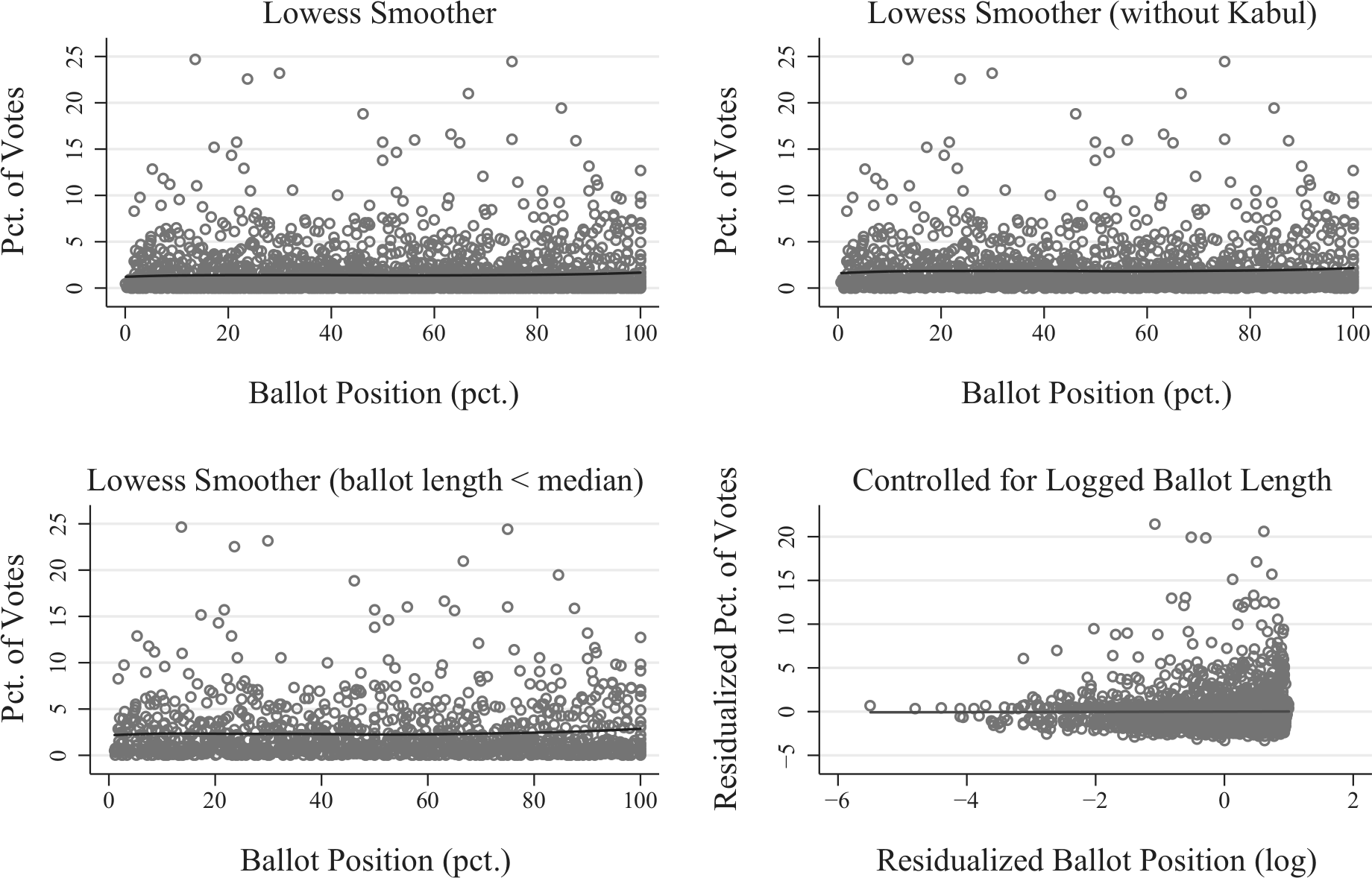
Ballot position and vote shares.
In a model with logged vote share and province fixed effects we find a marginally significant, but very small, negative effect (b = -0.002, p = 0.095). For candidates with the median vote share of 0.5 percent, for instance, the effect translates into an estimated decrease in vote share from being moved from first to last on the list of only 0.11 percentage points. Estimating an interaction between ballot order and logged ballot length results in both the main and the interaction term being insignificant (b = 0.015, p = 0.156, b = -0.003, p = 0.151). Finally, we include dummies for each decile of relative ballot position. None of these dummies turn out to be significant.
Another way of measuring ballot order effects is to compare vote shares of those at the very top of the ballot with everybody else (Meredith and Salant, 2013). Here we continue to control for logged ballot length to account for the fact that smaller lists come with larger expected vote shares for each candidate and thus increase the probability of a given candidate being at the top of the list.
On average the first candidate on the ballot got a somewhat larger vote share than everybody else but the difference is highly insignificant (d = 0.141, p = 0.776). The difference from the rest is marginally significant for the top ten (d = 0.461, p = 0.045), but not for the top five (d = 0.148, p = 0.525). However, the top ten-effect is driven entirely by two observations. If these are removed the effect disappears (d = 0.342, p = 0.131, n = 2425). On balance we do not find any clear support for the idea of ballot order effects in Afghanistan’s 2010 election.
Conclusion
The findings presented here show no or very marginal support for ballot order effects in Afghanistan’s 2010 election. The absence of ballot order effects in the chaotic post-conflict setting of Afghanistan points to the limits of the phenomenon, which has previously been identified for elections of varying importance in stable democracies.
We have argued that the high stakes, clear conflict lines, and especially the selection effect induced by extreme levels of electoral violence in Afghanistan should lead to a high level of effort and a low level of ambivalence for the average voter selecting into turnout. At the same time the high Afghan illiteracy rate and lack of experience with democratic elections should imply that the electorate has somewhat limited levels of information and cognitive skills to apply. The analysis indicates that these were not sufficient conditions for the electorate to employ candidate order as a shortcut.
An important limitation of the study is, however, that we are unable to determine if ballot order effects exist for subsets of the ballot. For instance, voters may conduct a first search based on ethnic or clan-based cues and then afterwards select according to ballot position. Nevertheless, the findings raise the broader question of how generalizable anomalies found in political behavior in the developed world are to post-conflict democracies.
Footnotes
Acknowledgements
The authors thank Jacob Gerner Hariri, Michael Cohen, Anders Wivel, and two anonymous reviewers for their helpful comments. All errors are our own.
Declaration of conflicting interest
The author declares that there is no conflict of interest.
Funding
This research received no specific grant from any funding agency in the public, commercial, or not-for-profit sectors.
