




Abstract
How did Syria’s conflict interact with the broader wave of regional protest known as the Arab Spring? This article uses a unique, complete Twitter dataset of tweets including the word “Syria” in English or Arabic to empirically test how Syria’s conflict was discussed online. The analysis shows a high level of interaction between Syria and other Arab countries through 2011. Other Arab countries experiencing popular protests (“Arab Spring countries”) were referenced far more often in 2011 than were Syria’s immediate neighbors, while keyword analysis shows the framing of the conflict in terms of Syria’s “regime” aligned the conflict with other Arab uprisings. In 2012–2013 this changed sharply, with significantly fewer mentions of other Arab countries, particularly Arab Spring countries, more fundraising and political appeals across the Gulf, and growing Islamization. These findings offer one of the first empirical demonstrations of the integration and disintegration of a unified Arab discourse from 2011 to 2013, with significant implications for theories of the diffusion of protest and ideas.
“The Syrian flag has two stars, one expresses Syria and the other Egypt” – Tweet by Egyptian activist, Wael Ghoneim, 25 March 2011.
Between December 2010 and March 2011 a local Tunisian protest against an aging dictator spread to Egypt and then to Libya, Yemen, Bahrain, and Syria and at a lower intensity to several other countries (Lynch, 2012). These protests involved a remarkable number of commonalities in slogans, timing, and methods, and self-conscious framing of events as a common “Arab” narrative. Yemeni protestors, for instance, quickly adopted Egyptian slogans or took heart from Libyan opposition advances. This Arab uprising represents a critical case for theories of the international diffusion of protest movements and regime change (Bunce and Wolchik 2011; Hale, 2013; Solingen, 2012; Zhukov and Stewart, 2013).
The early Syrian uprising modeled itself after counterparts across the region, employing similar rhetorical frames, attempting to seize public places without arms, presenting a civic, non-sectarian and non-Islamist face at home and abroad, and in some cases hoping to attract a NATO intervention like Libya’s. Many likely expected Bashar al-Asad’s regime to succumb to a similar fate as those of Egypt’s Hosni Mubarak and Tunisia’s Zine el-Abedine Ben Ali (Anden-Papadopolous and Pantti, 2013; Leenders, 2012; Leenders and Heydemann, 2012). As Syria’s conflict evolved towards a mixture of protest and civil war, while uprisings in Arab Spring leaders such as Tunisia, Egypt, and Yemen themselves struggled, Syria became far more of a polarizing issue with a higher degree of sectarian rather than pan-Arab identity narratives.
How did Syria’s popular uprising of 2011 fit within the broader regional wave of Arab uprisings in early 2011, commonly termed the “Arab Spring”? Existing theories of protest diffusion and regime change cascades emphasize the importance of geographic proximity. The pattern of uprisings in Arab countries in early 2011 only partially fits these models, however. While Tunisia, Egypt, and Libya may be physically connected, they are far from Yemen, Bahrain, and Syria. The regional nature of the Arab uprisings has been explained in part by the unusually intense degree of transnational linkages and a highly unified Arab public sphere, which facilitated diffusion of ideas, methods, and actions from one country to the next (Lynch, 2011, 2012). That shared space facilitated the spread of expectations of the possibility of victory, the sharing of repertoires of contention such as the tactic of seizing and holding a central square, and the replication of slogans such as “the people demand the downfall of the regime.”
Current theories of international diffusion have not fully considered the differences between the Arab uprisings and previous regional waves of protest, while most accounts of the Arab uprisings have simply assumed Syria’s place within this broadly integrated, intensely interconnected Arab public sphere. This article uses a unique Twitter dataset of all tweets over 2 months that include the word “Syria” in Arabic or English, to present new empirical evidence both for theories of international diffusion and for prevalent explanations of Syria’s conflict and the broader Arab uprising.
The findings suggest that Syria was deeply embedded within a relatively integrated Arab public sphere during most of 2011. For the first six months of the conflict, 35–45% of the tweets that mention Syria also mention at least one other Arab country and 10–15% mention more than one. What is more, attention in these early days reflected shared experience of protest far more than it did geographic proximity. Countries undergoing their own protest movements were far more likely to be mentioned in this early phase than were countries close to Syria or regionally powerful countries such as Saudi Arabia and Qatar. In 2012, this changed dramatically, online and on the ground. Far fewer Syria tweets mentioned other Arab countries, with those that did more likely to mention neighbors immediately affected by the fighting. As peaceful protest gave way to insurgency and civil war, Syria became less “Arab springy” and more of a sectarian, transnational civil war with primary impact on its geographical neighbors.
This evidence challenges and expands upon recent arguments about the socially constructed nature of “diffusion” (Mekouar, 2014; Solingen, 2012; Zhukov and Stewart, 2013). Where earlier literature highlights the importance of geographic proximity in regime change cascades and protest diffusion, Arab Spring cases such as Tunisia, Libya, Egypt, Yemen, and Bahrain were physically distant from Syria (Bunce and Wolchick, 2011; Saideman 2012). The Arab countries which occupied the same discursive space as Syria in 2011, and from which Syrian activists borrowed protest slogans and methods, were neither its neighbors nor traditional allies or rivals, but rather other Arab countries experiencing large-scale protest. Geographical proximity still matters, of course, but so do socially-constructed identities framed within distinctive public sphere networks.
Diffusion and identity framing
The high degree of regional media and social media integration arguably helped to create the conditions for the international diffusion of revolutionary protest, culminating in a regime change cascade (Hale, 2013; Hussain and Howard, 2013; Patel et al., 2014; Weyland, 2012). The key mechanism explored here is scale shift, the linking together of disparate local struggles into a single master frame which allows protest forms to become “modular” (Beissinger 2007; Hale, 2013) that is, applied similarly in otherwise different contexts. We address the prior question: to what extent was there such a common media and publicly articulated shared identity in the first place?
Evidence that Syria’s protestors paid close attention to physically distant Arab uprisings has implications for theories of diffusion beyond the Middle East. A tightly interlinked media environment would help to explain the particular potency of demonstration effects in the early Arab uprisings. The articulation of a shared identity within that media is also important, however, as individuals will more likely be inspired by protests in a foreign land if they have bought in to the notion that protestors there were “just like me” and engaged in a shared struggle (Lohmann, 1994). As Beissinger puts it, “modular phenomena are made possible by a sense of interconnectedness across cases produced by common institutional characteristics, histories, cultural affinities, or modes of domination, allowing agents to make analogies across cases and to read relevance into developments in other contexts” (Beissinger, 2007: 263). The linking together of multiple countries in a tweet is a concrete manifestation of this construction of a shared identity and shifting of scale. When individuals tweet “injustice is injustice whether in Bahrain or Libya or Syria” (@salmaeldaly, March 2011) or “#daraa of #syria is #sidibouzid of #tunisia and #suez of #egypt” (@drsonnet, March 2011), they are explicitly constructing such a sense of shared struggle and shared fate.
The construction of identity in terms of a shared popular uprising rather than physical proximity or political similarity points to the importance of problematizing the definition of “proximity” for the purposes of studying diffusion (Bunce and Wolchik, 2011; Zhukov and Stewart, 2013). In the early Arab Spring, Egypt and Tunisia were “closer” to Syria than were its immediate neighbors because of the shared experience of a popular uprising. In 2012 Kuwait became “closer” to Syria through the mobilization of public support in Kuwaiti civil society, and in 2013 Iraq became “closer” not because the physical distance between the two countries had changed but because its insurgency fused with parts of the Syrian insurgency. Our analysis of tweets offers one empirically observable manifestation of these changes.
Methodology
Social media has been used increasingly as a source of data for examining questions such as these (Bruns et al., 2013; Lotan et al., 2011; Lynch et al., 2014; Hussain and Howard, 2013; McGarty et al., 2013; Starbird and Pale, 2012; Tufekci, 2014). The high volume of real time sharing of information and expression of personal opinions creates an unprecedented public archive. The Syrian conflict has been perhaps the most socially-mediated civil war in history, with little direct journalistic access to the battlefield and an extraordinary amount of user-generated content shared across social media platforms such as Facebook and Twitter (Lynch et al., 2014). These tweets do many things simultaneously: they share information and frame it within a particular narrative context through self-selected networks, they can be used to condemn or praise, to express solidarity, and to argue and disrupt ongoing conversations (Tufekci, 2014). In this paper we are primarily interested in using large-scale analysis of these tweets as a window into public discourse.
Our analysis is based on a complete dataset of every tweet including the word “Syria” in Arabic or English between March 2011 and July 2013. The dataset, which we purchased from the certified Twitter data vendor, Topsy, includes all public tweets posted in those months – totaling over 5 million tweets and almost 7 million unique users. We avoided using hashtags or selecting key users in constructing this dataset in order to avoid the inevitable distortions of selecting on a dependent variable (Tufekci, 2014). It is worth noting that the use of “Syria” likely means that tweets from inside Syria itself are underrepresented (i.e. in a long debate about a protest in Aleppo, the word Syria might not be used).
Our analysis includes all tweets that were re-tweeted at least five times, in order to focus on tweets which passed a minimum threshold of attention. We further focused the analysis by drawing tweets from a subset of the dataset’s largest densely-connected network communities. We did this to increase the possibility that the tweets we examined would come from, and be raised to prominence by, individuals with a vested interest in Syria and its affairs. This produced a dataset of 608,026 unique tweets re-tweeted 12,509,706 times (which makes up 22% of the total dataset) and 120,968 unique users.
We then extracted every mention in Arabic and English of 14 different Arab countries which appeared in a tweet containing Syria. We calculated how many tweets each month contained one, two, three, four, or more other Arab countries, and how frequently those tweets were re-tweeted. This gives us an index of “Arab Springness” which tells us the extent to which tweets on Syria were linked to countries outside its borders. We posit that higher numbers of tweets containing one or more other Arab countries in addition to Syria represent higher degrees of regional interconnection and shared identification, which in turn are conducive to scale shift and diffusion across borders.
Which countries were mentioned alongside Syria matters as much as does the volume of co-mentions. We therefore grouped the 14 Arab countries into baskets of similar states. First, we created a basket of the five “Arab Spring” states in which a major protest movement took place between January and March 2011: Bahrain, Egypt, Libya, Tunisia, and Yemen. None of these countries have particularly close economic, political, or cultural relations with Syria, and none directly neighbor it. They are in physically different parts of the Middle East, have different levels of wealth, different political systems, and different sectarian compositions. The only thing which unites these five countries is that they experienced a major uprising in this time frame which overthrew or came close to overthrowing an entrenched autocratic regime.
We also broke out a group of Syria’s neighbors. Conveniently for the purposes of analysis, none of these neighbors (Iraq, Jordan, Lebanon) experienced a major protest movement, but each had close political, demographic, and cultural interactions with Syria. The dataset also includes Morocco, a distant Arab country which did not have a major “Arab Spring” uprising, and Oman, a Gulf state which did not play a major role in Syria. Neither receives any appreciable level of attention, which provides a useful validity check on the assumed significance of the Twitter mentions. Finally, we included Palestine, which did not have major mobilization and was only marginally affected by the war during the time period covered here, but which traditionally occupies a central place in Arab political discourse and would – all else equal – be expected to figure prominently in any regional discussion.
We coded the incidence of several key words in English and Arabic within the top 5,000 most re-tweeted tweets each month as a proxy for the prevalence of particular identity frames (Petchler and Gonzalez-Bailon, 2014). We employed a simple lexicon approach, searching in English and Arabic for the terms “regime” (a term often used by those sympathetic with the Syrian opposition, which resonates well with the discourse of the other Arab uprising cases), “donate/donation” (a term which we determined inductively captures a wide swathe of the public fundraising efforts on behalf of the Syrian opposition), and “jihad” (a term which captures at least some of the Islamist framing of the conflict).
Findings
The data demonstrate clearly a high degree of “Arab Springness” during the six months following the outbreak of Syria’s uprising in March 2011, and the sharp decline of that integration in the following 18 months.
During 2011, roughly 30% of “Syria” unique tweets included at least one other Arab country (and 32% of all re-tweets), while 8% of unique tweets and of all re-tweets named two or more (see Figure 1). In August 2011, when the overall number of tweets containing the word “Syria” in English or Arabic nearly quadrupled from the previous month, this shot up to 37% naming at least one other Arab country and 12% naming at least two. This “Arab Springness” reached a peak of 41.5% naming one country and 15.5% naming two in November 2011. And the countries named were not randomly selected. Figure 2 shows that the five “Arab Spring” countries dominated the mentions during 2011, with Arab spring countries appearing in no fewer than 20% of all tweets in any month. That exceeded 30% in each month between August and November 2011. By contrast, Syria’s immediate neighbors did not appear in more than 5% of tweets in any month in this time period except for September, when the proportion reached 10%.
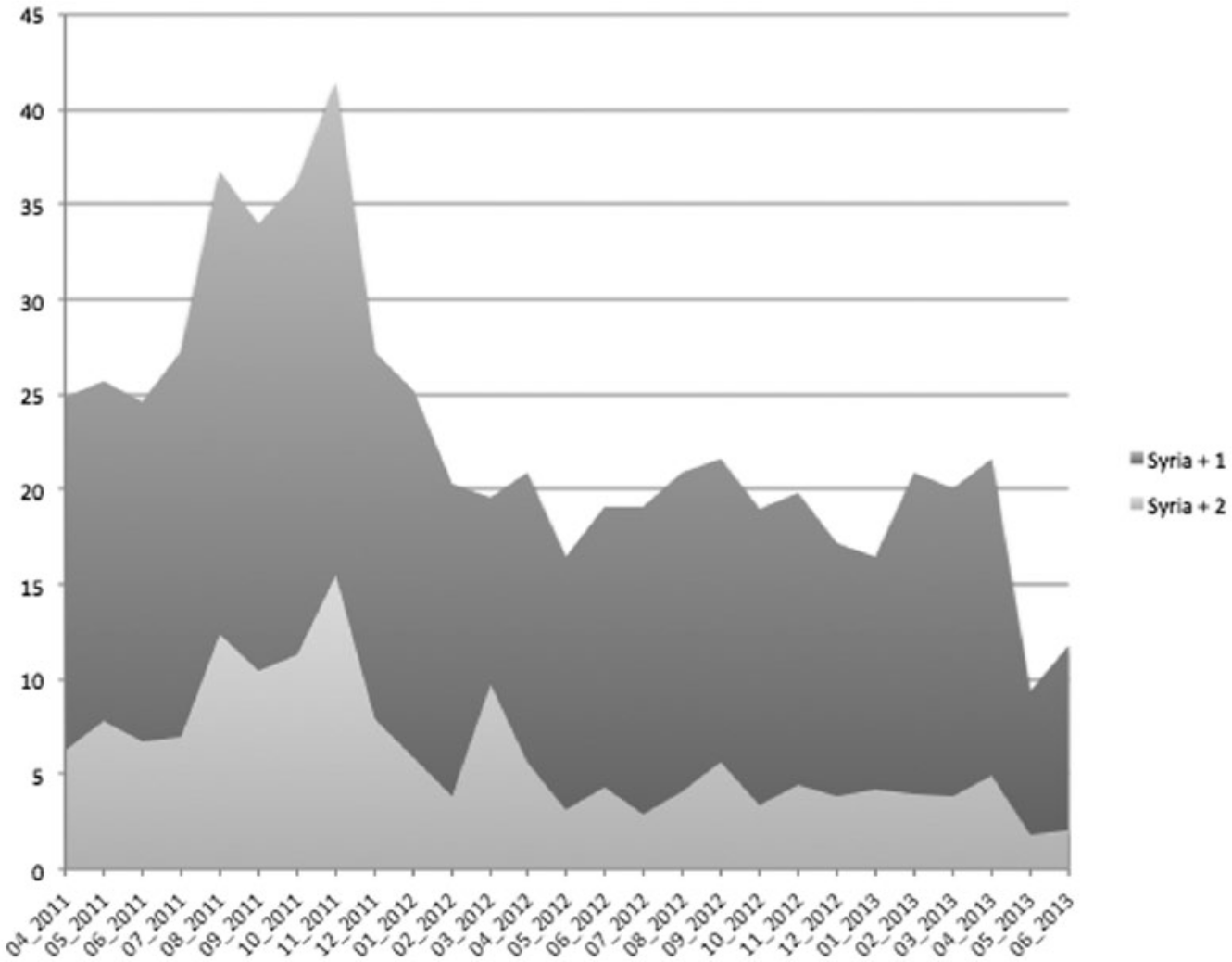
Total percentage of tweets with one or two other Arab countries.

Mentions of all “Arab Spring” countries as percentage of all tweets.
Our analysis of keywords also matches this pattern. As Figure 3 demonstrates, the tweets in this period sharply focused on the “regime.” The “regime” frame consciously mirrors the communicative strategy and framing of oppositions across the Arab world. “The people want to overthrow the regime” was the definitive slogan of the early Arab uprisings, shouted from Tunis to Cairo to Sanaa. Tweets such as “these leaders in libya, syria and yemen didn’t learn the lesson: if your people’s blood has flown your end is near!” by Egyptian businessman @naguibsawiris (April 2011, in English) or “Libya, Yemen, Syria … all deserve justice and security together … and all the Muslim lands” by Saudi media figure @ahmadalshugairi (April 2011, in Arabic) were common. Opposition activists tried to keep a tight focus on the depredations and illegitimacy of the regime while sustaining the momentum towards an inevitable denouement of regime change. “Jihad” barely appears at all during 2011, in line with the framing of the struggle as a civic uprising against an autocratic regime.
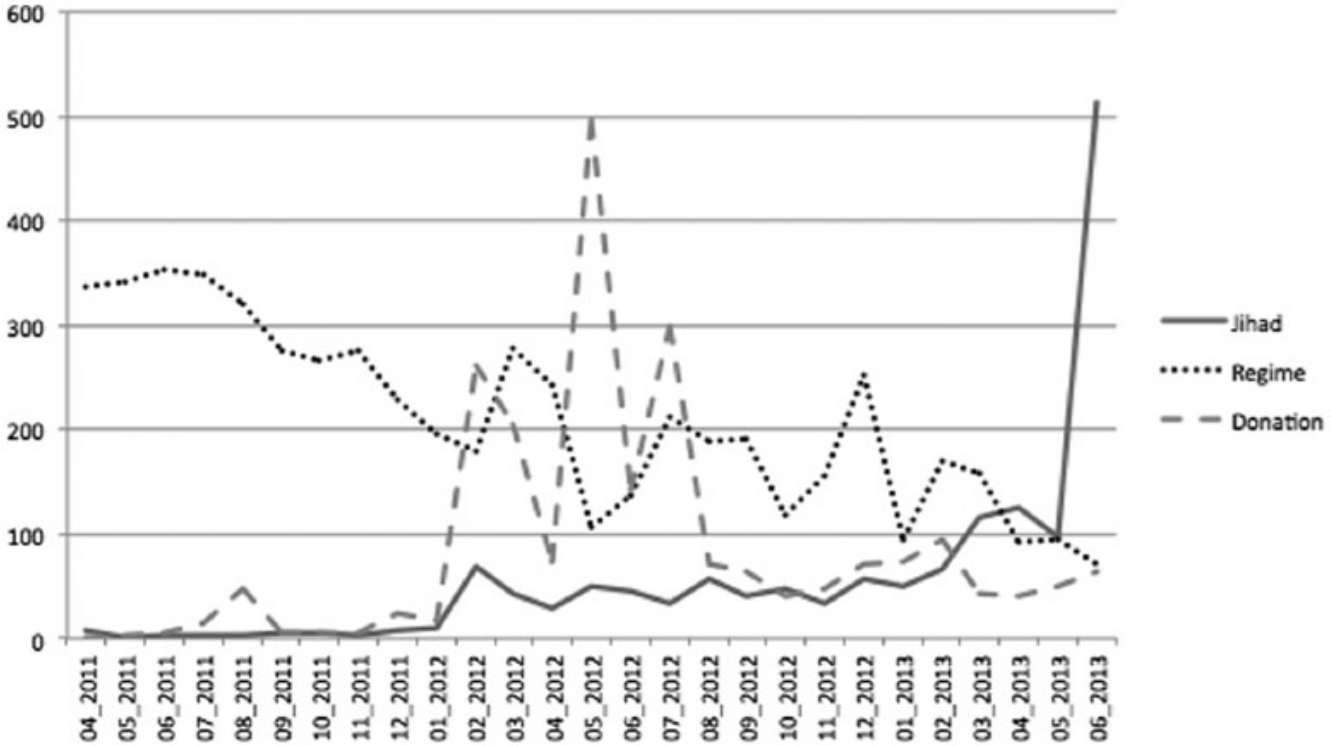
Keywords: “Regime,” “Jihad,” and “Donation”.
Syria’s “Arab Springness” did not last, however. Figures 1, 2, and 3 collectively show how “Arab Springness” declined as the Syrian struggle evolved from a civic uprising into civil war and insurgency.
After 2011, “more than two” never exceeds 10% again. “One” hovers around 20% of all tweets, still a respectable figure which suggests a continuing high level of bilateral engagement with Syria. The switch from “Arab Spring” countries to “Neighbors” (Figure 2) further reveals this shift. After January 2012, “Arab Spring” never breaks 10%, while “Neighbors” does so multiple times. The decline in “Arab Springness” coincides with the sharp increase in violence in the country and the growing shift towards armed resistance. The “regime” framing preferred by the mainstream Syrian opposition did not disappear, but it did fall in salience compared to sectarian and religious identity framing.
The tweets in the first eight months of 2012 reveal a major spike in the mention of “donations,” the keyword we chose as a proxy for the massive public fundraising and political support campaigns which gained steam across the Gulf in this period. The shift towards “donations” reflects the shift in focus by outside communities, and their growing role in funding and supporting armed groups rather than simply sharing information and expressing support. Tweets by prominent religious personalities such as @nabilalawadhy, @tareqsuwaidan, and @salman_odah bemoaning the fate of fellow Muslims and offering details on phone numbers, locations, and times for charitable campaigns commonly received thousands of re-tweets. These campaigns were often tied to specific Syrian factions and fighting groups, creating organic links between geographically distant parts of the Middle East. This was a very different type of identity construction, however: instead of identifying with the process of uprising and non-violent regime change, online strategies now identified with sectarian identities and particular groups within the complex insurgency.
By 2013, “jihad” grew rapidly in prevalence, reflecting the increasingly Islamized and radicalized nature of the Syria discourse. The dramatic spike over the summer of 2013 in Figure 3 matches the overall shift in tenor in regional discourse on the conflict. The rise of powerful groups such as Jubhat al-Nusra and the Islamic State of Iraq and al-Sham (ISIS) depended heavily on funding and fighters from outside of Syria. Tweets including appeals for Muslims to join the jihad, videos of their accomplishments, and intra-jihadist arguments increased significantly. More broadly, discussion of Syria took on a palpably more sectarian and radical tone.
Several individual countries are worth highlighting. Kuwait emerged as perhaps the most heavily invested country in the Syria debate. Kuwait hosted by far the largest concentration of fundraising and consciousness- raising campaigns, both online and offline. Parliamentarians such as Hajjaj al-Ajmi, Shafi Al-Ajmi, and Walid al-Tabtabie, and religious entrepreneurs such as Nabil al-Awadhy, gained enormous popularity for their exploits on behalf of the Syrian rebels, while raising enormous sums of money. The word “Kuwait” did not appear as often as might be expected given this reality on the ground. We speculate that this is because the fundraising campaigns were presented as pan-Arab and Sunni rather than as national, and consciously sought contributions from other Gulf states with tighter controls over charities and finances (Dickinson, 2013).
Bahrain’s unusual identity politics, with a Shi’a majority repressed by a Sunni monarch, gave its Syria discourse a very different quality. In the early Arab Spring, Bahrain’s protests were broadly seen through the frame of an Arab uprising, a mobilized Arab population challenging an autocratic regime. The Bahraini regime and its regional backers, particularly in Saudi Arabia, instead defined the struggle as one between a legitimate Sunni king and an Iranian-backed Shi’ite subversion campaign. As that discourse took hold, and as the Syria conflict became increasingly sectarianized, Bahrain “flipped” discursively, with its Shi’a citizens now cast as equivalent to the Syrian Alawi community and Hezbollah. The nature of Bahrain/Syria tweets therefore varies significantly from what is seen in the Sunni-majority Gulf states such as Kuwait, Qatar, and Saudi Arabia. Bahrain’s mentions plummeted from 10.3% in 2011, to 5.9% in January–September 2012, to 2.1% in October 2012–July 2013. This shows how a protest which had once been part of the “Arab Spring” came to be seen as “not like us” due to its Shi’ite majority, and thus phased out of the identity-shaped discourse. As one angry Bahraini tweeted: “Syria: popular mobilization/Libya: popular mobilization/Egypt: popular mobilization/Tunisia: popular mobilization/Yemen: popular mobilization/Bahrain and Qatif? Foreign Intervention” (@m_abdali, October 2011, translated from Arabic).
What about “Palestine,” traditionally that central issue of Arab political discourse? Interestingly, during 2011, peak Arab Spring, Palestine appeared in only 1.2% of all Syria tweets – far fewer than Bahrain (10.3%), and fewer even than Tunisia (2%). Palestine was not a primary reference point on Syria, compared to other Arab Spring countries. One of the most popular tweets mentioning Palestine referred to the failure of the outside world to help: “Syria shouted, where are the Arabs? And Palestine laughed.” In certain key months, however, Palestine did surge into the Syria debate; only Kuwait and Bahrain were mentioned more frequently in May 2012 (when Palestine was mentioned in 3% of tweets), no other country was mentioned more frequently in November 2012 (7%), and only Iraq was mentioned more often in July 2013 (3.7%). This suggested the enduring, if latent, salience of the Palestine issue for mobilization at key moments, as became strikingly clear in July 2014 when it quickly came to dominate online Arab political discourse war broke out between Israel and Hamas.
Implications
This analysis offers strong support for the rise and fall of the Arab Spring frame for the Syrian uprising. The findings show clearly the intense identification and interaction which underlay the diffusion of protest across borders for most of 2011. “Arab Spring” countries, not more obvious candidates such as geographical neighbors or the Palestinian conflict, were the primary point of reference for these online discussions. This intense interconnectedness lasted less than a year, however, and then sharply plummeted. The “Arab Spring” lens was replaced by both a regional sectarian and Islamist narrative, and by a focus on the immediate neighbors most affected by the conflict. The Gulf states became a particularly intense site of online discussion about Syria.
These findings document empirically the interconnected Arab Spring online. These findings matter for our thinking about the diffusion of protests and ideas, the social construction of proximity, and the life-cycle of protest waves. The evidence that expectations, ideas, and protest movements traveled between fellow “Arab Spring” countries even when not physically proximate suggests the need to include identity within theories of international diffusion. Much more needs to be done with the sprawling wealth of online data relevant to the Arab public sphere, including rigorous analysis of network clustering and the transmission of information. Our index of joint mentions is only one potential indicator of identification and attention, and could be supplemented with more intensive content analysis. More needs to be done to identify the specific mechanisms by which these changes took place, including potentially exogenous factors. Egyptians, Libyans, or Tunisians might, for instance, have become preoccupied with their own struggles at home and dropped out of the Syria conversation. The online data might also be supplemented with comparative evidence in the broadcast media. Taken together, this analysis should significantly advance the empirical basis for evaluating theories of international diffusion.
Footnotes
Declaration of Conflicting Interest
The authors declare that there is no conflict of interest.
Funding
This research was supported by the United States Institute for Peace, Grant Number IOP-12-222.