




Abstract
Groundwater supplies are dwindling worldwide as the Anthropocene deepens and human-water systems become more tightly coupled. Key actors are searching for ways to augment water supplies, including by large-scale transport. In this context, the role of human culture – values, beliefs, norms, symbols, language – is becoming even more important as a driver of socio-ecological change. We explore the role of culture in coupled, human-water systems through a case study of an emergent outcome in a groundwater-dependent system: the Kansas Aqueduct Project (KAP) – a large, yet-to-be-constructed infrastructure project that would divert water from the Missouri River 300 miles uphill, at exceptional cost to replenish groundwater supplies in the High Plains/Ogallala Aquifer, which has been depleted by irrigated agriculture. First proposed in the 1980s, the KAP has re-emerged as a socio-technical ‘solution’ to the unsustainable use of groundwater in Western Kansas. Given the significant barriers to its construction, why and how has the KAP survived as an idea? We employ the concept of a sociotechnical imaginary to understand the re-emergence of the KAP in this context. We show that the KAP is a re-assertion of an anthropocentric, specifically Euro-American cultural vision of progress and order, one that is based in environmental law, centers humans, naturalizes the region’s post-war history, and sees agriculture as the foundation of society. It is this order that is actually more imperiled by groundwater decline than the water itself.
Keywords
Introduction
Groundwater supplies are dwindling worldwide, with dramatic consequences at multiple scales. Exhausting aquifers makes many regions of the world even more vulnerable to droughts while at the same time contributing to the drivers of planetary environmental change (Jasechko and Perrone, 2021). The global pumping of underground water might soon reach a scale making groundwater the greatest terrestrial contributor to sea level rise, equaling the current contributions of glaciers and ice caps (Wada et al., 2016). Already, global groundwater extraction has displaced so much water to the surface that it has shifted the Earth’s tilt, or rotational pole, by 80 cm (31.5 inches) between 1993 and 2010 (Seo et al., 2023). On a regional level, the effects of depletion are especially pronounced in irrigated agricultural regions (Famiglietti and Ferguson, 2021). Some of the most exposed frontline communities of groundwater depletion are in the Great Plains region of the U.S., where the High Plains/Ogallala Aquifer has supported one of the most productive agricultural regions in the world for nearly 75 years (Opie et al., 2018). Labeled by the Euro-American expeditions of the 19th century as part of the “Great American Desert,” discovery and subsequent exploitation of the aquifer transformed this region into one of the world’s breadbaskets (Sanderson and Frey, 2014).
At the inflection point of the Great Acceleration (McNeill and Engelke, 2016), human industrial activity became so pronounced and global that it is now considered to mark the beginning of a human-geological epoch, the Anthropocene (Head et al., 2022; Rosol et al., 2023). In this new epoch, the semi-arid landscape of the High Plains Ogallala Aquifer region was transformed into an exceptionally productive agricultural region of the global, agro-industrial food system through advances in water technology, including deep well pump turbines and center pivot irrigation systems (McGuire, 2011; Schäfer, 2023).
Groundwater-dependent agricultural regions are examples of tightly-coupled human-water systems (Sanderson and Hughes, 2019). In such anthropocentric systems, social systems and water systems interact dialectically, co-producing each other in an ongoing process that can lead to unexpected, emergent outcomes (Sivapalan et al., 2012). The tighter coupling between human systems and water systems in the Anthropocene means that human culture – the values, beliefs, norms, languages, symbols humans use to represent the world and act in it – is becoming more important as a driver of (socio)-ecological change (Wittfogel, 1957; Worster, 1985).
We explore the role of culture in coupled, human-water systems through a case study of a (re-)emergent outcome in a groundwater-dependent system: the re-emergence of the Kansas Aqueduct Project (KAP) – a large, yet-to-be-constructed infrastructure project that would divert water from the Missouri River 300 miles uphill, at exceptional financial and environmental costs, to replenish groundwater supplies in the High Plains/Ogallala Aquifer, which has been depleted by irrigated agriculture. First proposed in the early-1980s, the KAP has re-emerged as a socio- technical ‘solution’ to the unsustainable use of groundwater in Western Kansas. Given the barriers to its construction, why and how has the KAP survived as an idea for so long? We employ the concept of a sociotechnical imaginary (Jasanoff and Kim, 2015) to understand the re-emergence of the KAP in this context. We argue that the KAP is a re-assertion of an anthropocentric cultural vision of progress and order that is imperiled by declining groundwater supplies. Our premise for the argument is that a richer understanding of how humans and water co-evolve over time can be uncovered through an investigation into the historical-legal relations and cultural discourses linking hydrology and culture in this context. To begin, we place the KAP against the broader background of water diversion projects elsewhere, and then sketch a historical-legal context to situate the lineages of the KAP as a sociotechnical imaginary in this context. Then, we trace the re-emergence of this imaginary as it transitions from the origin to embedding phases of its development (Jasanoff and Kim, 2015).
Background
The control and use of water have long been intimately connected to how political power is established, exerted, and projected within society. The Roman aqueducts of Spain and southern France, the elaborate Inca terraces of the Andes, and the canals of the Hohakam people in what is now southern Arizona are monuments to these ancient connections (Mithen, 2012; Solomon, 2010). The oldest court of justice in Europe is a water court, resolving disputes over the use of irrigation canals around Valencia. From the missions of California to the acequias of the Rio Grande, irrigation was central to Spain’s colonial ambitions for New Spain, long before the English managed to secure New England. The Industrial Revolution of the 18th and early 19th centuries relied substantially upon mills for water power and canals for commercial transport. The successful hydrological transformation of India was also key for the British to colonize India (Meyer, 1996; Worster, 1994). During the 19th century, the irresistible potential of developing hydropower by damming streams and rivers—first for mechanical hydropower, and later for hydroelectricity—forced a transformation in American property law away from its static, agrarian origins and toward an emphasis on the commercial imperative to exploit the economic potential of land (Getzler, 2004; Horwitz, 1977; Rose, 1990). In the 20th century, the connection between the physical control of water to reduce floods, irrigate arid lands, and generate electricity, and the political power conferred by such control, reached new levels. The construction of large hydroelectric dams across the major river systems of the United States was crucial for its geopolitical rise to a world power, as it was for the nations of South Asia (Amrith, 2018; Worster, 1985). The construction of large dams is one of the key socio-economic indicators of the trajectories of the Anthropocene (Holmes et al., 2021; Steffen et al., 2015).
The connection between the control of water and power is especially clear in the U.S. West (Merk, 1978; Worster, 1985). The Mexican War (1846–1848) brought most of the region under the dominion and control of the United States. Shortly thereafter, the Civil War generated the primary mechanisms that would dispense these newly-gained lands to the public – the Homestead Act of 1862, the General Mining Law of 1872, and the Desert Land Act of 1877, not to mention the acts that exchanged the public domain for transcontinental railroads, whose builders then sold off most of the land (White, 2011: 161, 209–211). But west of the 98th meridian, the underlying techno-scientific implications of the Lockean, Jeffersonian theory of using labor to turn mere land into fruitful property (Schäfer, 2018) became apparent: without hydrological improvements, homesteading would be difficult to put into practice (Mead, 1903; Powell, 1878; Flood Control Act of 1944, 33 U.S.C. § 701-1(b)). Mining and farming required the diversion and delivery of water from higher and wetter places, such as the Sierra Nevada and the Rocky Mountains, to the mines, farms, and towns lower down. Water law adapted to this ‘imperative necessity’, allowing water rights to be severed from the lands from which the water originated (Coffin v. Left Hand Ditch Co., 1882). In certain spots – Anaheim and Pasadena in California, Salt Lake City, Utah, Boulder or Greeley in Colorado – private irrigation projects succeeded and even prospered (Crifasi, 2015; Hobbs and Welsh, 2020).
Across the wider West, however, most homesteaders were caught in a difficult situation. They needed water to farm dependably, but they often could not afford the capital costs of dependable irrigation. Similarly, their homestead grants were too large for irrigated farms, but too small for dryland farming or grazing (Mead, 1903; Pisani, 1992). By the 1890s, it had become clear that the federal government was the only entity that could deliver water with sufficient scale and security to allow small farms to survive over the long term (Pisani, 1992). Congress passed the Reclamation Act in 1902, (Reclamation Act, 1902), and thereafter, western farms would draw much of their irrigation water from large, federally-owned reservoirs and projects, financed by the national public. The Reclamation Act was a national response to western farmers’ demands for federal financial support for irrigation projects, provided the federal government did not intrude too much into the sovereign authority of the states over their water supplies. The act largely accommodated this demand: it funded federal irrigation projects, provided generous credit terms that eventually became permanent, and largely deferred to state water law (Gregg, 2015; Reisner, 1993; Pisani, 1992; Worster, 1994: 40).
For the next seven decades, the U.S. Bureau of Reclamation dammed and replumbed the West’s rivers, famous and obscure alike, from the Columbia and the Colorado to Prairie Dog Creek in Kansas and West Otter Creek in Oklahoma. Federal water supply for irrigation, hydroelectric power, and urban use made much of the western public possible (Holmes, 1972, 1979; O’Neill, 2006). From the desert southwest to the upper Missouri River, the West comprehends a multitude of coupled, human-water systems. These systems are not only forceful demonstrations of what is attainable through the sociotechnical alliance of political interests, science, and engineering. They are also fraught with issues of how federal and state governments allocate political power through the development of infrastructure – and how society confers value and legitimacy on the use of water.
These systems are made possible and maintained by sociotechnical imaginaries: ‘collectively held, institutionally stabilized, and publicly performed visions of desirable futures, animated by shared understandings of the form of social life and social order attainable through, and supportive of, advances in science and technology’ (Jasanoff, 2015a: 4). The emergence and re-emergence of the KAP is illustrative of the processes that co-produce and maintain the sociotechnical imaginaries around hydrology and development in the West and translate them into new contexts.
Prelude to the KAP: Law and technology in the making of a sociotechnical imaginary
Multiple imaginaries can coexist within a society in tension or in a productive dialectical relationship. It often falls to legislators, courts, the media, or other institutions of power to elevate some imagined futures above others, according them a dominant position for policy purposes. (Jasanoff 2015a: 4)
In the construction and maintenance of the dominant sociotechnical imaginary of the U.S. West, law in all of its varieties – natural law, property law, constitutional law, and environmental and regulatory law – plays a necessary and crucial role. The legal order confers legitimacy on such socio-cultural visions and often determines whether they can be made manifest on the landscape (Dunbar, 1983; Kinney, 1912; Schorr, 2012; Wiel, 1911). A reconstruction of this legal history will trace the emergence of this sociotechnical imaginary, revealing how American water law and policy contributed to ‘creating the conditions that drive the Anthropocene’ (Kotzé, 2020: 3).
The regional forces behind the Kansas Aqueduct date back to the founding era of western statehood during the 19th century. In the Kansas-Nebraska Act of 1854, Congress established the Kansas Territory, which ran from its present boundaries west to the Front Range of the Rocky Mountains, in what is now Colorado; the Nebraska Territory extended through what are now large parts of Montana, Wyoming, Colorado, and the Dakotas (10 Stat. 277-90, 1854). In 1861, Kansas gave up its western half to the newly formed Colorado Territory and became a state (Socolofsky and Self, 1988: 25). In the decades after the end of the Civil War, Congress drew up the simple and crude boundaries of Nebraska (1873), Colorado (1876), North Dakota, South Dakota, Montana (1889), and Wyoming (1890). In so doing, Congress was motivated by partisan issues of congressional representation, and generally defaulted to geometrical preferences redolent of the Jeffersonian grid pattern. However, Congress made no real attempt to account for the physical and climatic diversity of the Great Plains region (Diener and Hagen, 2012: 54–55; Siegert, 2015: 114). State boundaries, for example, almost completely ignored interstate watersheds, and thus provoked opposition by some contemporaries. John Wesley Powell sought in vain to convince Congress to reorganize water management among the Western states according to their respective watersheds, to improve the governance of interstate river basins (Worster, 2003). Instead, Congress ‘followed rivers for convenience, then struck out in a straight line, bisecting mountain ranges, cutting watersheds in half. Boxing out landscapes, sneering at natural reality, they were wholly arbitrary and, therefore, stupid’ (Reisner, 1993: 47).
As a consequence of this 19th-century architecture, Kansas includes two different yet connected, socio-hydrological systems within one state (Rice and Rice, 1918). Eastern Kansas is relatively rainy, humid, and boasts many surface streams. Western Kansas enjoys an arid climate but suffers from a shortage of streams and rivers. Largely because of this divide, Kansas followed two different sets of water law between statehood and 1945. Eastern Kansas followed the riparian doctrine, the water law of the Eastern United States, by which landowners are entitled to use a ‘reasonable amount’ of the water that flows across or beneath their property. In times of water shortage, the riparian doctrine has equitable mechanisms for allocating water use among competing owners (Shamleffer v. Peerless Mill Co., 1877; City of Emporia v. Soden, 1881; Getzler, 2004: 271–279). Western Kansas, on the other hand, adopted the prior appropriation doctrine, the water law of the Western states (Kan. L., 1886: Ch. 115). Under this doctrine, a water right is a right to use water, connected to but severable from the land (Kan. Stat. Ann. 82a-701(g)). When water supplies run low in the West, prior appropriation dictates that ‘first in time is first in right’: senior water rights enjoy their full, quantified entitlements before junior rights can (Kan. Stat. Ann. 82a-707(c)).
For 7 decades, these two legal systems coexisted more or less without much controversy. Mill owners and other riparian users in eastern Kansas held riparian rights to stream flows, while irrigators on the Arkansas River in southwestern Kansas held prior appropriation rights for their irrigation canals. Tellingly, no riparian owner in western Kansas ever challenged an irrigator’s right to divert water (Buzick et al., 1944: 44). Given this workable comity, Kansas courts consistently declined requests to adopt the prior appropriation system statewide (Clark v. Allaman, 1905; Feldhut v. Brummitt, 1915; Frizell v. Bindley, 1936; Smith v. Miller, 1938).
In the 1930s and 1940s, however, two developments broke Kansas’s dual system. The New Deal brought the Bureau of Reclamation to the Great Plains, to design and build interstate, basin-wide reservoirs, and irrigation projects for Dust Bowl-parched farmers – ‘a massive program to provide federal financing, construction, and operation of water storage and distribution projects to reclaim the arid lands in many Western States’. (Orff. v. United States, 2005). But before it could do so, the Bureau of Reclamation needed to know how much water each state claimed – and Kansas’s riparian doctrine could not quantify that claim. As a lawyer for the Bureau of Reclamation stated, ‘we are rather at a loss to determine. . . whether or not there is water in excess of vested riparian rights for any reclamation project’ (Transcript of Governor’s Conference, 1944). Next, the Kansas Supreme Court, in 1944, held that the dual system was ineffectual in establishing state administrative control over groundwater – thus putting surface water users in peril of losing their rights to groundwater pumpers (State, ex rel., v. Board of Agriculture, 1944). Shocked into action, the Kansas governor appointed a commission to study the problem, and in a matter of months, the commission drafted a thorough reworking of Kansas water law (Buzick et al., 1944). The Kansas legislature enacted a comprehensive water code in 1945, the Kansas Water Appropriation Act (Duncan, 1986; Griggs, 2014; Kan. Stat. Ann. 82a-701 et seq.; Peck, 1995). Somewhat simplified, the code accomplished two things. First, it adopted the prior appropriation doctrine statewide, repudiating the riparian doctrine (Kan. Stat. Ann. 82a-702, 82a-706, 82-721). Second, it puts all of the water resources of the state – both surface and groundwater – under the jurisdiction of the state water engineer of the Division of Water Resources (DWR), who grants and protects water rights in an administrative system (Kan. Stat. Ann. 82a-706). By 1945, one legal and administrative system spanned the state’s strikingly different regions and water supplies.
A new and even more serious water conflict emerged almost immediately. For over 50 years, Kansans had known about the groundwater supplies of the High-Plains Ogallala Aquifer (see Figure 1), a vast interstate aquifer consisting mostly of water supplies deposited during the end of the last ice age, about 12,000 years ago (Haworth, 1897: 37–42: 48–56). However, technological limitations had prevented large-scale withdrawals from the aquifer (Buzick et al., 1944: 13–14). The technological advancements of World War II produced high-capacity, centrifugal water pumps, and more powerful motors needed to extract water on a larger scale. Combined with rural electrification, High Plains farmers gained the ability to pump groundwater cheaply and in high volumes. Moreover, the aquifer was located across much of western Kansas – the driest part of the state, but one blessed with some of its richest soils. Starting in the 1950s, farmers across western Kansas obtained thousands of prior appropriation water rights to the Ogallala (Peck, 2006). To encourage the development of the enormous but largely unreplenishable supplies of the Ogallala, the Kansas legislature made its water supplies even easier to grant in 1957 by softening the standards for granting new water rights (1957 Kan. Session Laws 1075, 1080). The state water engineer readily approved applications for new rights, because, under the prior appropriation doctrine, it was essentially his duty to put water to beneficial use provided that water was available (Kan. Stat. Ann. 82a-711, 82a-711a). Groundwater was now open for development. The state water engineer opined that ‘water rights were like belly buttons: everyone ought to have one’ (Griggs, 2017: 31). But, less than 20 years later, the groundwater revolution had produced an intractable problem: there were more water rights than there was water to supply them all, a condition known as over-appropriation (Griggs, 2014). As a consequence, groundwater levels began to decline across the non-rechargeable regions of the Ogallala (Konikow, 2013: 4–5, 22).
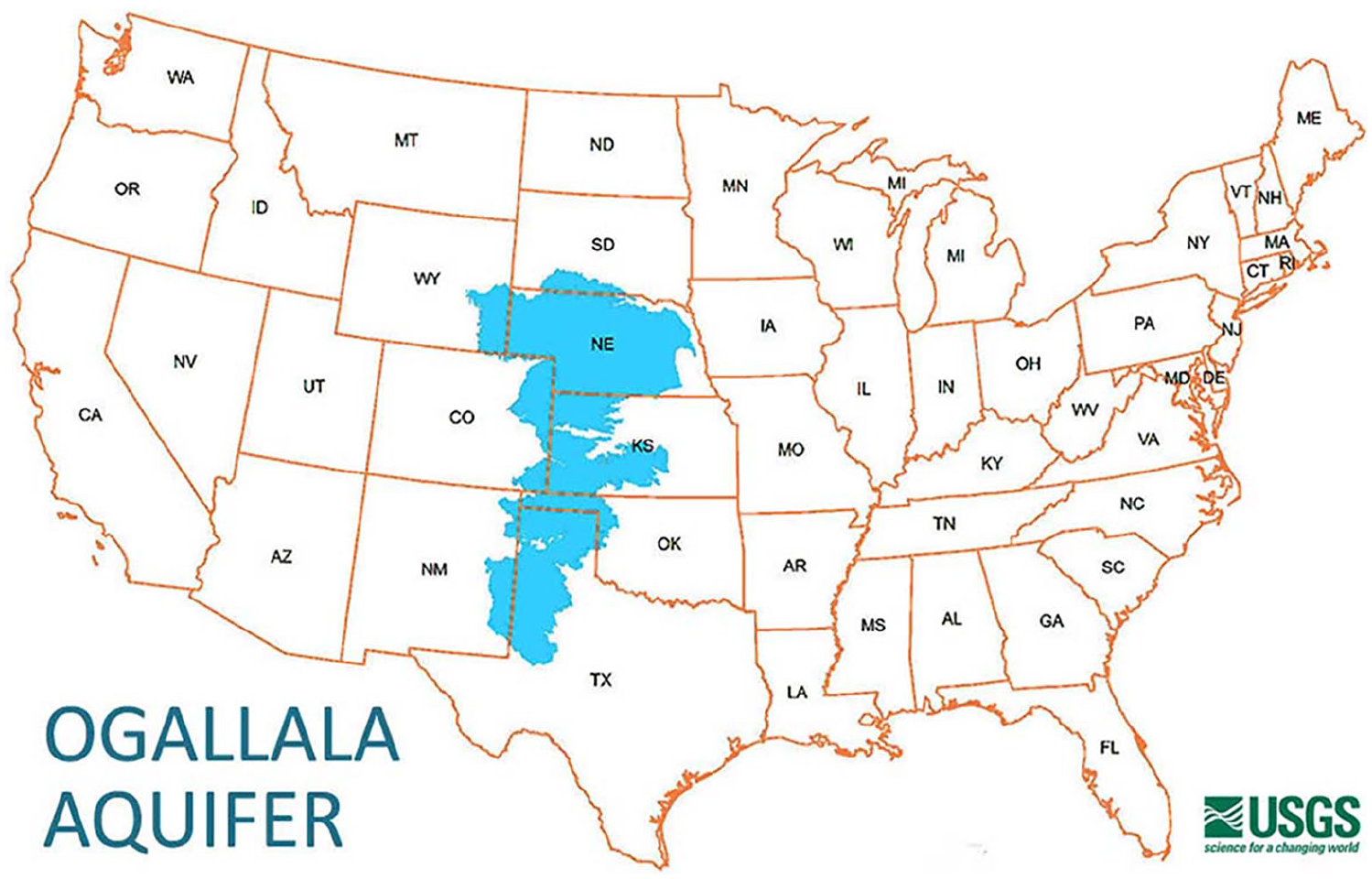
Map by the United States Geological Survey of the contiguous United States, highlighting the location of the Ogallala/High Plains Aquifer in blue. This aquifer system spans eight U.S. states: South Dakota, Wyoming, Nebraska, Colorado, Kansas, New Mexico, Oklahoma, and Texas. © United States Geological Survey.
The groundwater revolution placed the hydrological and legal systems of western water under new stress starting in the 1970s. As interstate relations and internal groundwater policies broke down, these crises largely repeated those of the 1930s and 1940s. Across the High Plains, upstream states over-pumped groundwater, starving interstate rivers and downstream states of the supplies to which they were entitled under interstate water compacts. In 1974, Texas sued New Mexico for over-pumping groundwater in the Pecos River Basin, in violation of the Pecos River Compact (Texas v. New Mexico, 1975, 1983). In 1985, Kansas sued Colorado for similar violations of the Arkansas River Compact (Kansas v. Colorado, 2004). Three years later, it sued Nebraska for over-pumping groundwater in violation of the Republican River Compact (Kansas v. Nebraska, 1999). The United States refrained from intervening in these groundwater disputes. In line with the Reclamation Act’s general deference to state water law, the Bureau of Reclamation did not act to protect its reservoirs and irrigation projects from the deleterious effects of excessive groundwater pumping; this decision was partly informed by the fact that the United States rarely has jurisdiction over groundwater supplies (Griggs, 2018: 171–174).
Meanwhile, Kansas also wrestled with groundwater over-pumping within its own boundaries. Kansas irrigators were pumping within the legal limits of their individual water rights, but collectively, that legal activity was permanently depleting the Ogallala. The legal problem of over-appropriation raised a related political challenge: while surface water supplies such as creeks and rivers flow across county and state boundaries, the groundwaters of the Ogallala are practically stationary. How, then, should the state conceive of these supplies? In 1972, Kansas enacted the Groundwater Management District Act, which struck a compromise between state jurisdiction and regulatory authority over groundwater on one hand and local involvement in groundwater management decisions on the other (Griggs, 2014: 1289–1290; Kan. Stat. Ann. 82a-1020 et seq.). Pursuant to the legislation, five groundwater management districts (GMDs) were formed across the Ogallala portions of western Kansas. Endowed with the power to raise taxes and develop management policies, the GMDs have become the most powerful political bodies in Kansas water politics. Yet the problems of over-appropriation and groundwater depletion have only intensified. Subsequent statutory innovations enacted in 1978 and 2012 allow for GMDs and DWR to impose limits on groundwater pumping, but these provisions have not gained much traction outside of northwest Kansas – and not at all in southwest Kansas, within the boundaries of the Southwest Kansas GMD 3 (Griggs, 2014: 1291–1292). And while the KWAA endows holders of senior water rights with the full protections afforded by the prior appropriation doctrine—shutting off junior pumpers in times of shortage – most irrigators have not deployed these tools (Griggs, 2014). Instead, there are renewed efforts to increase the supply of water through construction of the KAP, whose primary institutional supporter is GMD 3.
The Kansas aqueduct project
The KAP is among the last of the great interstate water diversion proposals from the ‘Big Dam Era’ – an era spanning the six decades between the Boulder Canyon Project Act of 1928 (which authorized Hoover Dam on the Colorado River) to the Environmental Protection Agency’s veto of the Two Forks Dam in Colorado in 1990. The era’s hydrological projects are the ‘ultimate expression of Manifest Destiny’ (Lavigne, 2005: 451) and the West’s sociotechnical imaginary, aiming at a full remodeling of the socio-hydrological system of the West. Executed by an alliance of science, state, and engineering, hydrological megaprojects were to overcome the natural limitations of the West’s arid landscape to enable a national ideal of irrigated civilization beyond the 98th meridian. Similar ideals informed projects across British India during the 19th and early 12th centuries – and became even more important to Pakistan and India in the post-colonial era (Amrith, 2018). With the beginning of the Cold War, this sociotechnical imaginary was spread globally through the Marshall Plan and institutions such as the World Bank (Holmes et al., 2021). It is still very much alive, most prominently in China’s ‘South–North Water Transfer Project’ and the re-emergence of water transport system proposals all over the Western USA (NRDC, 2012).
Historically, water transportation plans to irrigate the Great Plains were developed as early as 1896, when the former immigration agent for the Santa Fe Railroad Eli Newsom proposed channeling the ‘underflow’ of the Great Plains to centralized surface outlets to overcome the deficiencies of contemporary pumps, which were then either too weak or faulty. The first plan to artificially recharge the Ogallala Aquifer appeared with the 1967 R.W. Beck plan and the 1968 Texas Water Plan, which emerged only a few years after large-scale groundwater irrigation had begun on the plains and the first signs of local aquifer depletion had already appeared. While Beck’s plan proposed reversing the course of northern Nebraska’s Niobrara River, the Texan plan aimed at diverting Mississippi River water to the High Plains through canals and pumping stations (Hornbeck and Keskin, 2014: 192; Opie et al., 2018: 304–305). Other plans involved the construction of a reservoir through a chain of artificial islands along the Texas Gulf Coast, pumping the water back to the Ogallala (Green, 1992: 42), or taking water from the rivers of the Canadian Rockies and diverting it south. The North American Water and Power Alliance (NAWAPA) plan also included water transportation to the High Plains (Opie et al., 2018: 305–309). However, none of these plans were pursued because of their economic, environmental, and political costs.
As such, the KAP is redolent of the Big Dam Era’s confidence, and of the U.S. Army Corps of Engineers and the Bureau of Reclamation at the peak of their political powers. The KAP was first initiated as a component of a six-state study of groundwater depletion in the High Plains/Ogallala Aquifer region (the ‘High Plains Study’) in 1982 (High Plains Associates, 1982), authorized by Congress through the Federal Water Resources Development Act of 1976 (Pub. L. 94-587, § 193, 90 Stat. 2917: 2943). In the High Plains Study, the U.S. Department of Commerce and the Corps examined the feasibility of water transfers, including interstate and interbasin water transfers, along four alternative routes. The Alternative Route B, or Kansas South Route, would divert up to 3.88 million acre-feet 1 of water from the Missouri River near St. Joseph, Missouri, store it in the yet-to-be-created White Cloud Reservoir, and transfer it via a canal or pipeline west to terminal storage in another yet-to-be-built reservoir in Utica, Kansas which would feed the water into the High Plains aquifer (see Figure 2). As originally conceived, the project was estimated to require 16 pumping stations and one power plant to lift the water 1745 vertical feet over 375 miles at a cost of $8.1 billion (1977) over 20 years of construction ($35.695 billion today).
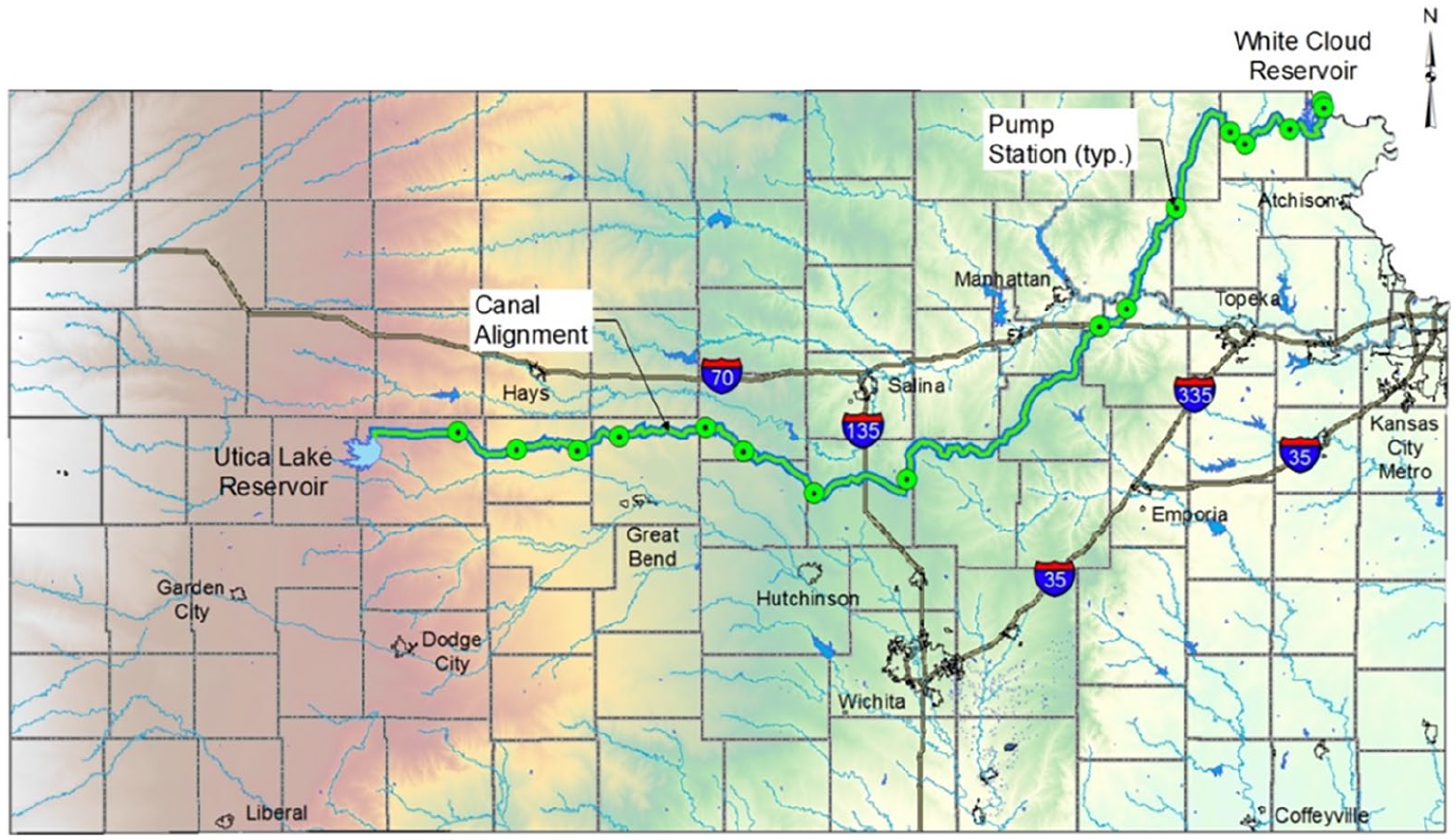
Map of Kansas showing the proposed aqueduct route in green. The aqueduct would begin at the northeastern border of the state, the Missouri River, diverting water from the river near St. Joseph, Missouri, into the yet-to-be-built White Cloud Reservoir in Kansas. From the reservoir, water would travel through 16 pumping stations (green dots) 375 miles (604 km) west via a canal or pipeline to terminal storage in another proposed reservoir in Utica, Kansas. From this second yet-to-be-built reservoir, the water is supposed to recharge the Ogallala/High Plains Aquifer. (Kansas Water Office and U.S. Army Corps of Engineers, 2015: iii).
Like many other ambitious inter-basin water supply projects, however, the High Plains Study fell into obscurity, largely as a consequence of massive political changes – most prominently the environmental law revolution of the 1970s. Federal environmental laws such as the Clean Water Act, the National Environmental Policy Act (NEPA) and, most powerfully, the Endangered Species Act (ESA) placed substantial restrictions on large federal water-supply projects. In an early case showing the ESA’s power, the Supreme Court halted construction of a nearly-finished federal dam to save an obscure small fish, the snail darter. In so doing, the Court declared that the ESA showed ‘beyond doubt that Congress intended endangered species to be afforded the highest priorities’ (Tennessee Valley Authority v. Hill, 1978).
The ESA and other federal environmental laws raised significant challenges to ambitious federal water projects, often killing them off altogether, as at Two Forks Dam in Colorado. However, in Kansas, Governor Sam Brownback supported a revival of the study as part of his ‘Water Vision for the State of Kansas’ in 2013, under the pressure of the extreme 2010–2015 drought, which surpassed even Dust Bowl drought conditions in some years (Anandhi and Knapp, 2016; Kansas Water Office, 2015). In 2015, the Kansas Water Office and the Corps of Engineers conducted an update of the High Plains Study, focusing on the feasibility of Alternative Route B, which has become known as the KAP. The study estimated the total cost of the KAP to be $28.276 billion (2014) over 20 years of construction, with annual operating costs (energy, maintenance, interest, etc.) of over $1 billion to deliver water at up to 10,000 cubic feet per second over the route. To put this volume of water in perspective, one cubic foot per second (cfs) is equivalent to 1.98 acre-feet per day. Thus, running at full 10,000 cfs capacity, the KAP could transport as much as 7.23 million acre-feet of water annually – approximately half of the water supplies allocated by the Colorado River Compact (Colo. Rev. Stat. § 36-61-101). The KAP would require a massive public investment, one that far exceeds even the $4.4 billion construction costs of the United States’ most expensive water transport system thus far (Richter et al., 2013: 346): the Central Arizona Project (CAP), which is referenced by KAP advocates as a role model (Kansas Aqueduct Coalition, 2016: minute 28). The KAP’s costs are enormous, even by the measures of the bygone Big Dam Era. To put this amount of money into context, the total budget for the state of Kansas was $34 billion in 2020 (State of Kansas, 2020). Construction of the KAP would require the equivalent of over 4 years of funding for all public, K-12 education in the state (currently $6.5 billion annually). Operating costs alone for the KAP would require 3% of the total state budget annually, placing it just below the amount spent to maintain all highways, roads, and bridges in the state. Moreover, a majority of the U.S.-built hydrological infrastructure is already well beyond its life expectancy and requires a $64 billion federal investment just to ensure the security of downstream communities and to maintain the dams’ function for water security (Perera et al., 2021), leaving very little fiscal leeway to invest into new projects. Finally, raising funds for a water transfer project of these proportions would be especially challenging in the context of climate change in the Anthropocene, considering the freshwater scarcity in neighboring states and the Mississippi watershed in particular, making inter-basin water transfer projects a zero-sum game, or a ‘rob Peter to pay Paul’ scenario between the freshwater supplies of different states (Zhuang, 2016: 12877).
By any estimate – economic, legal, political, and environmental – the KAP is an unrealistic proposition. Why and how, then, has the KAP continued to endure for more than a generation? The KAP was not revived, nor has it persisted, because it is a feasible project. On the contrary, as the following will show, the KAP survives because it re-articulates a powerful and effective sociotechnical imaginary, one that reflects a particular collective vision of a desirable socio-cultural order and future that is embedded and recurring in the history of the U.S. West and Kansas in particular. As ecological conditions deteriorate, and groundwater levels continue to decline in the region, that desirable order and future become ever more imperiled, rendering the KAP even more important over time as an imaginary. Stabilized as an idea by both federal and state government feasibility investigations, the KAP has been animated in the intervening years through a persistent discourse of this imaginary, which remains in the originating phase (Jasanoff, 2015a).
Below, we illuminate the re-emergence of this imaginary in the mid-2010s. Because the KAP remains a ‘pipe dream’ – it is an imaginary in every sense of the word – there are, as yet, no legal cases, opinions, or briefs to draw upon. Instead, to illustrate this imaginary, we parse what exists of the publicly available discourse on the KAP: the documentary film ‘Feast and Famine: Securing Kansas Water Needs’, produced by the agribusiness Garden City Co-op for the Kansas Aqueduct Coalition, an advocacy group created to promote the project (Kansas Aqueduct Coalition, 2016), featuring many of its members, especially board members of GMD 3. Other sources are the official Kansas state assessment of the 1982 High Plains Study (Kansas Water Office and U.S. Army Corps of Engineers, 2015), public comments by key proponents of the KAP made in newspapers and public presentations (Rude, 2013), and the management plans of GMD 3. Our case study gives insight into the unfolding of a sociotechnical imaginary as its proponents work to more thoroughly ‘re-embed’ the imaginary in the public consciousness against competing sociotechnical imaginaries and move beyond the origins phase of this imaginary.
Pipe dream: The re-emergence of a sociotechnical imaginary
The KAP is the manifestation of a sociotechnical imaginary grounded in a positive portrayal of social progress in Kansas, the High Plains region, and the U.S. more broadly. Within this imaginary, the affluence of water is central to its notion of civilization and consequently grounded in a decidedly anthropocentric view of the waterscape in the region. Water is seen as just being ‘misplaced’, in this view; that is, there is too much water in the eastern part of the state, where most of the population resides, and where flooding can occur, while water can be too scarce in the western part of the state, where agriculture prevails. Dr. Timothy James, a consultant who worked with the KAC, explains:
‘The fundamental issue in Kansas is that the water is not located in the right area, it tends to be in the east of the state’ (Kansas Aqueduct Coalition, 2016).
This is a chronic and archetypical problem in western water. From the Sierra Nevada in California to the Colorado Rockies, the largest water supplies tend to be distant from where the water is most needed. Because western rivers are often distant from good farmland, western water rights are severable from their native lands, which means that water supplies can be moved across valleys and basins to that they can be put to beneficial use elsewhere (Mead, 1903: 169). Here, water is merely a material resource for ‘servicing’ the needs and wants of humans in the region, namely the agricultural economy – by far the greatest user of western water. Because non-human nature merely put water in the ‘wrong place’, it is up to humans to bring water into the service of agriculture. Along with human desires, human capacities are also foregrounded in this vision. Brant Patterson, a local irrigator, explains:
‘We have the infrastructure, we have the know-how, we have the ability, we have everything in place. . .to continue to expand, except for water. That’s the one thing this area lacks’ (Kansas Aqueduct Coalition, 2016).
In this view, water does not necessarily have an intrinsic value. Rather, it is humans who actually create value for water by putting it to beneficial – that is, consumptive – use. This includes consumptive use for human-created and supported wildlife habitats. Robin Jennison, a prominent politician and former Director of the Kansas Department of Wildlife, Parks, and Tourism, the state agency responsible for managing wildlife and public lands, describes how by pumping groundwater to the surface for crops, irrigated agriculture stabilizes environmental fluctuations. Jennison emphasizes how such pumping creates more value from water by drawing in wildlife for hunting activities, but makes no mention about the contribution of irrigated mono-crops to biodiversity loss:
‘Agriculture has always been extremely important for wildlife in Kansas. You are going to have some impacts from dry, hot years regardless, but the one thing that you do see is some consistency around irrigation agriculture. This agency has made Kansas a tremendous waterfowl opportunity. We have people coming from Arkansas – the capital of duck hunting; People come up here to hunt geese, hunt sandhill cranes. . .’ (Kansas Aqueduct Coalition, 2016).
In this region where irrigated agriculture dominates, the lines between the categories ‘human’ and ‘natural’ are frequently difficult to discern. Often, human technological interventions are equated with natural, or non-human aspects of the waterscape. For example, Steve Irsik, a successful livestock farmer and former head of the Kansas Water Authority, draws a direct parallel between a human-made reservoir and the Ogallala Aquifer:
‘People in the eastern part of the state, they have their reservoirs, . . .the same thing is true out here in western Kansas, the Ogallala is our water resource. You take it away, it’s like taking away a reservoir’ (Kansas Aqueduct Coalition, 2016).
The KAP, in this sense, is simply the continuation, or the further extension of human capacities onto the landscape in this region. It is a socio-hydrological feature of the waterscape in every sense: a human-natural hybrid construct that eludes binary categorization of ‘human’ and ‘natural’. If the Columbia River, channeled and dammed to the point of environmental devastation, has become an ‘organic machine’ in the apt words of environmental historian Richard White, the KAP might be considered to be an even more contrived mechanism – one that somehow brings environmental benefits despite profoundly altering the natural hydrology of both the Great Plains and the Missouri River Basin (White, 1996).
Here, the concept of ‘adaptation’ is stretched to its most anthropocentric understanding, in striking contrast to understandings of the term which imply human adjustments to the non-human world, most prominently human adaptation to climate change-induced dynamics that are largely beyond direct human control, such as changes in rainfall, increasing floods, rising sea levels, and biodiversity declines. However, proponents of the KAP foreground agriculture in the vision, moving ecology to the background in a peculiar understanding of adaptation. Steve Irsik describes:
‘From a state perspective, and a national perspective, we need this concentrated animal agriculture here in the High Plains. This is where it’s adapted. . .low humidity, low rainfall, no surface water. No surface water, no water to pollute. It’s very well situated to this environment’ (Kansas Aqueduct Coalition, 2016).
Irsik identifies one of the most important, uncomfortable, and largely unintended consequences of the environmental law revolution of the 1970s. As the Clean Water Act increasingly regulated the waste discharges of large feedlots, dairy farms, and other ‘concentrated animal feeding operations’, or CAFOs, the meatpacking industry responded by relocating and expanding across the Southern High Plains. Thanks to the Ogallala, the region grew plentiful feed grains; and thanks to the relative lack of surface streams, the region had little surface water to pollute – and thus fewer water quality concerns and regulatory obstacles under the Clean Water Act.
Thus, rather than a focus on how agriculture can adapt to non-human, natural processes and dynamics in the region, natural processes are seen as ‘fitting into’ a human frame of reasoning. From this view, the focus is not on how concentrated agriculture adapts to the environment, but rather on how nature can support pre-established, concentrated agriculture. To paraphrase: Rather than describing how concentrated agriculture adapts in situ, Irsik is arguing that place is where concentrated agriculture works most effectively for humans.
This anthropogenic notion of adaption is symptomatic of the transformation of Western Kansas since the 1960s from a rural farming economy to a powerhouse of the nation’s agribusiness industry. Steve Irsik’s story is emblematic of the changing agricultural and political geography of the southern plains. Irsik was soon aware of the region’s structural change after it seemed to break the region’s climatic boom-and-bust cycle by tapping into the Ogallala’s resources, first by the introduction of center-pivot irrigation in the 1960s, then cattle feedlots in the 1980s and finally by industrial-scale hog facilities from the mid-1990s on. Keeping up with this change, Irsik transformed his family farm into a ‘plains empire’ (Opie et al., 2018: 153), first by vertically integrating cattle feedlots into his grains farming, then by expanding into the hog business as well. At one point, his family-farm-turned-agribusiness was among the biggest feedlot operations in the country, successfully competing with multinational corporations that have become more important to the southern plains’ economy in the meantime (Opie et al., 2018: 152–155).
Given the centrality of the anthropocentric view in this imaginary, natural processes that might otherwise be seen as fundamental limits to a way of life are instead portrayed more as temporary barriers, or challenges, to be overcome through human ingenuity. These barriers, however, are not interpreted in ecological terms but are instead translated into human terms, where they are understood mainly as economic limitations – as limitations to a way of life. Clay Scott, a local irrigator and board member of GMD 3, the KAP’s principal sponsor, describes:
‘You know, for generations out here, the economy was basically dependent upon the weather, and the boom and bust cycles of the droughts every 15–25 years, and your population would spike up and down, reflective of that, too, but one of the things that did change this area and brought permanent settlement was the irrigation and the ability to sustain yourselves through those dry periods of time and bring productivity to the lands where you could depend on a crop and raise your livestock’ (Kansas Aqueduct Coalition, 2016).
Natural limits such as drought are routinely mentioned by proponents of the KAP, but they are backgrounded in the narrative, and seen as temporary barriers to the ultimate enactment of human supremacy in the waterscape. In this view, humans have not only reduced their dependence on nature (weather), but they also have the capacity to enhance nature, or bring additional value to nature beyond what nature itself provides humans. Such rhetoric was central to the institutional mission of Reclamation during the ‘Big Dam’ era. As Floyd Dominy, former Commissioner of Reclamation proclaimed, ‘Nature changes the environment every day of our lives – why shouldn’t we change it? We’re part of nature’ (McPhee, 1971: 173). Similar rhetoric undergirded colonial settlement on the Great Plains from its very beginning in the mid-19th century. Every boom cycle and attempt to make the Great American desert bloom was driven by socio-technological plans that aimed at eventually transforming the arid climate. These included the pseudo-scientific postulates that ‘rain follows the plow’ regarding dryland farming, or that canals that would ‘redeem the desert’ of southwest Kansas (Bessire, 2021: 125; Worster, 2004).
Constructing threats and opportunities around a socio-technological imaginary
From within this imaginary, irrigation is just another solution to master the ecological vagaries of the region. Thus, for proponents, the most challenging barriers to the KAP are not ecological but social: they are within the human system, and they are framed in terms of shared harms that could be incurred if the KAP is not built. The threats are couched not in terms of harms to a particular farmer, or person, but as potential harms to generalized abstractions, including ‘agriculture’, ‘community’, ‘families’ and the ‘economy’. Brant Peterson, a local irrigator, describes the possibility of further population declines as one such threat:
If the water is not here for irrigation and we are just dryland farming, the amount of people that it will take will be cut, divided by 20 at least, and when you got 2200 people in your county, that doesn’t leave very many people left’ (Kansas Aqueduct Coalition, 2016).
Irsik explains threats to the broader agricultural economy:
“Will dryland techniques sustain the current economy we have here in western Kansas? I think the real short easy answer is ‘no, it will not. . .’ If you take the Ogallala away. . .I don’t think you’ll have these feedlots. I don’t think you have these dairies. You wouldn’t have all these grain elevators and equipment manufacturers, et cetera.” (Kansas Aqueduct Coalition, 2016)
There is the threat, then, that if the KAP is not constructed, the human population and economy will suffer. Mark Rude, Executive Director of GMD 3, translates the threat as a ‘crisis’, stating that the decline of the Ogallala Aquifer is the ‘largest single water-management concern in the U.S.’, and that delaying the project ‘assures an inevitable devastation of Kansas communities and an exodus of families and investment capital’ (Rude, 2013). Inherent in this perceived threat, however, is a distorted, temporally compressed view of Kansas’s water past. Western Kansas was dryland wheat country from the time of its settlement in the 1880s and 1890s through the 1950s. Groundwater irrigation did not become widespread in western Kansas until the 1950s; it peaked in 1982 and has been in permanent decline ever since. Similarly, the feedlot industry – what proponents call ‘animal agriculture’ – is a similarly recent phenomenon, driven by global meat demand and regulatory pressures such as the Clean Water Act. What Irsik views as the natural-historical condition of western Kansas is, in fact, a relatively recent, aberrant, highly fragile condition that is being naturalized and historized within the imaginary.
The imaginary also includes a perceived threat from several generalized ‘others’ – those people who are not from western Kansas, or who do not depend upon animal agriculture. One means of accomplishing this ‘othering’ is by normalizing unsustainable irrigation patterns. Even individuals such as Steve Irsik, who have contributed to aquifer depletion through their business and holding key water governance positions, can reframe opposition to the KAP as opposition to western Kansas. In this framing, opposition is a threat of some generalized other, a foreigner even, ‘tak[ing] the Ogallala away’. Another means of establishing a generalised ‘other’ is based on the premise that if the KAP is not constructed, some other group – another community, or another state – will build something akin to the KAP and transfer water away from western Kansas. Proponents often lament the loss of ‘usable’ water supplies to other actors: the ‘largest renewable surface water supplies are routinely passed downstream’ (Rude, 2013). And, the imaginary renders neighboring states as threats to Kansans’ rightful claims to the water, which are contended to be at risk in future legal agreements, or compacts. ‘No Compact exists, but compact proceedings with sister states could occur without warning, setting Kansas’s future portion (of the water) near zero’ (Rude, 2013). Brant Patterson further elaborates on the perceived threat of other actors’ claims on water:
“My fear is that if we don’t get proactive as a state and say ‘We are going to work on this and develop this because this is the future of the state and the country’, it will happen to us. There will be aqueducts built to move water. Either you are a part of it and you benefit from it or you get 10 cents on the dollar and watch it go right on out the state line. It’s going to happen.” (Kansas Aqueduct Coalition, 2016)
It is important to note how false these statements are. They reveal the disconnect between the KAP as an imaginary and the historical and legal realities of western water. First, it would not be possible under the well-settled law of interstate water allocation to hold such legal proceedings without Kansas’s involvement. Second, this discourse harkens back to the ‘race to water’ among upstream states in the Colorado River Basin in the 1910s and 1920s, when there was concern about prior rights downstream in California potentially blocking Colorado, Wyoming, New Mexico, and Utah from developing their own water supplies into water rights. Taken together, these comments are redolent of a chauvinistic approach to interstate water supplies that has long been discredited.
Nevertheless, there is a juxtaposition of threat and opportunity, which exists as an inherent tension in the KAP as a socio-technical imaginary. There is an implicit strain in the imaginary as proponents navigate between an optimistic, water infrastructure-enabled future and a more pessimistic scenario in which the KAP is not constructed. The KAP thus operates as a sociotechnical imaginary with an interplay ‘between utopia and dystopia’ (Jasanoff and Kim, 2015: 5).
KAP proponents draw from a long history of perceived threats to Kansas water supplies. In an earlier era, predecessors to KAP proponents in Kansas also sounded the alarm of other states seizing water supplies to which Kansas was justly entitled. Between the 1880s and the 1940s, irrigators on the Arkansas River in southwest Kansas repeatedly claimed, and with justification, that their Colorado neighbors were depriving the state of the full flows of the Arkansas River; the Supreme Court thought otherwise, but that did not detract from the political power of alleging water theft (Kansas v. Colorado, 1902, 1907; Colorado v. Kansas, 1943). The 1944 Report commissioned by Kansas Governor Schoeppel similarly evinced the concern that water not put to beneficial use in Kansas was water wasted, because it simply flowed downstream, out of state (Buzick et al., 1944). The proponents of the Kansas Aqueduct evince similar concerns that water not diverted into the Aqueduct is water ‘lost’ to the state forever – this time, to states such as Nebraska, Iowa and Missouri.
Nine years since the re-emergence of the KAP, proponents are entering the embedding phase of sociotechnical imaginary construction (Jasanoff, 2015a), which occurs through group remembering and recollection of shared pasts and expressions of desired futures. The most arduous challenges to the KAP are perceived to be social, and as a result, the proponents of this sociotechnical imaginary are shifting to assiduously construct a much broader ‘public’ for the imaginary. Infrastructure is central to this broadening public. Robin Jennison, KDWPT Secretary, makes explicit the challenge of building a public for further embedding this imaginary:
‘That’s the first uphill battle is creating an understanding of public infrastructure and how it plays a role in developing an economy. And I think we’re at a point in time in political thought that there’s not a great appreciation for that and I think that’s going to be the biggest challenge’ (Kansas Aqueduct Coalition, 2016).
The KAP imaginary includes two analytical moves here. First, there is an attempt to justify the KAP by drawing on the rhetoric of environmental stewardship prevalent in agricultural regions. This justification manifests as the argument that agriculture conserves resources, and in western Kansas, irrigators already use every available water use technology as efficiently as possible. Clay Scott, a local irrigator, describes:
‘As we look to extend and preserve the aquifer and maintain that economic viability, we continue to use new technologies and utilize the new [crop] genetics that are more drought efficient and a little more water efficient, and then we incorporate that with new farming practices. . .in doing so, we are seeing some really good yields and advancements in saving water. . .’ (Kansas Aqueduct Coalition, 2016).
Bran Peterson, a local irrigator, adds:
‘We were part of a pilot program to put up some of the first pivot monitors back in the 1990s. Using pivot monitors, we know exactly when the sprinkler shuts off and we can go out and correct the problem right then. We use variable-rate irrigation technology to speed the sprinkler up and slow the sprinkler down. I use moisture probes in the ground to monitor root development and moisture availability and moisture usage. (I) use satellite imagery to target (problem) areas. . . It’s a waste issue. . . so we do everything we can to mitigate those instances when something isn’t right. . .technology has allowed us to do better with less’ (Kansas Aqueduct Coalition, 2016).
Steve Irsik, a local dairy farmer, continues:
‘We use all the water in the dairy three times. The first trip for the water is we take the water and run it through the milk chiller. Then the second use of that water is we flush the parlor, and so all the urine, manure, just like a toilet goes into these holding ponds. Then, the third use is we take that water that is now nutrient-rich, and we pump it out on these fields to grow corn’ (Kansas Aqueduct Coalition, 2016).
The imaginary here centers on the role of technology in creating efficient, productive agriculture that builds on the value placed on the idea of agricultural stewardship in the region.
Upon this sociotechnical and cultural foundation, the KAP imaginary generously draws the boundaries of the community to extend well beyond irrigated agriculture, but also makes clear that this wide community depends on irrigated agriculture for its survival. Clay Scott, local irrigator, explains:
‘Here in the state of Kansas, agriculture is still the largest economic engine in the state. Whether it is land taxes on irrigated systems and production of the feedlots and dairies or the jobs that are created to service those industries, we see a gaining value that goes through the economy based on what starts with an irrigated field of corn or wheat and progresses through to tax rolls in town and in the state as well as jobs and homes and families’ (Kansas Aqueduct Coalition, 2016).
One central analytical strength of the sociotechnical imaginary framework is to uncover where ideas emerge, how they establish themselves, and especially what ‘social arrangements or rearrangements they help to sustain’ (Jasanoff, 2015b: 322). In this way, a key cultural element of the KAP as a sociotechnical imaginary can be revealed: the imaginary conceives of agriculture as the foundation of a desirable social order. While agriculture has been central to the Kansas economy and its culture, it no longer holds such a central role today, at least not economically in an increasingly urbanized state (Leatherman and Cader, 2004). Within the context of this socio-economic shift, the KAP, as an imaginary, is a ‘commitment to that [old] order’s coherence and continuity’ (Jasanoff, 2015a: 26), and in this sense, it is a deliberate attempt to conserve an agricultural legacy of the state in an era in which agriculture has become less important.
Taking a closer look at the agents lobbying for the KAP, the agrarian social order underlying the imaginary becomes even clearer. The key driver of the KAP is ‘large-scale agribusiness interests in western Kansas, most prominently [GMD 3]’ (GMD 3, 2020a: 33), the only GMD supporting the KAP and also the most vocal GMD opposing mandatory groundwater conservation measures, despite struggling with the steepest groundwater declines among all GMDs (Condos, 2023; Kansas Legislative Division of Post Audit, 2023: 17; Kite, 2023a). The central position of GMDs within Western Kansas’ human-hydrological system mirrors the agrarian-political order the imaginary aims to project onto the entire state of Kansas. GMDs are the most important regional institution to govern groundwater use, but they are nearly entirely restricted to agriculturists and businesses that own land and/or water rights and use groundwater extensively, limiting groundwater governance mostly to those who deplete it. Only landowners with 40 or more contiguous acres or who withdraw one acre-foot or more of groundwater per year qualify as eligible GMD voters (Kan. Stat. Ann. § 82a-1020 et seq.). This constitutes a conflict of interest since the top beneficiaries of groundwater use are in charge of conservation measures and would jeopardize their voting rights if they decide to stop irrigating (Bessire, 2021: 110, 149). This way, aquifers become effectively an agricultural commodity while unsustainable groundwater business practices are being institutionally cemented.
From the perspective of GMD 3’s ‘eligible voters’, ‘to allow the aquifer to be drained and then to replace it with a big-money pipeline’ (Bessire, 2021: 110) might be a beneficial conservation measure. But it might also be a means to enact the KAP over a long-term time horizon. For proponents, the strategy guarantees a continuation of business as usual – nearly unrestricted fossil groundwater extraction – in the short- and medium-term while depletion toward eventual exhaustion of the water could put pressure on the federal government to replace the aquifer’s fossil groundwater with imported water eventually. Ian Gray defines this dynamic as a ‘treadmill of protection’: ‘when the material conditions that support public financing of protective measures are linked to the root drivers requiring those measures to begin with. Protection treadmills exist where policymakers mitigate the negative effects of the Anthropocene without fundamentally trying to shift society’s status quo relationship to natural ecosystems’ (Gray, 2021: 197). In GMD 3, large agribusinesses are the major contributors to the region’s public revenue and are deeply entangled within the region’s water governance institutions. Protection measures funded by GMD 3’s management plan are not tailored to reduce groundwater depletion but to protect the district’s key industry – intensive groundwater irrigation. In this sense, the management plan maintains the GMD’s public funding base but delays effective conservation measures. Advocating for a massive infrastructure project that is only beneficial in the medium- to long-term, ‘essentially buys extra time for extraction, allowing incumbent economic actors to chase a final round of returns on existing investments, while delaying a deeper public reckoning with the social and environmental consequences of their activities [. . .] while also gambling that they will not be the last ones left holding worthless properties and other sunk assets’ (Gray, 2021: 209). Facing a hotter climate with exhausted aquifers in the coming decades, sunk assets are an existential threat to Western Kansas landowners since the value of agricultural real estate is directly linked to its availability of irrigation (Hendricks and Sampson, 2022; GMD 3, 2021: 25). The prospect of an aqueduct, available sometime in the second half of the 21st century, might help stabilize land values in the meantime, while further locking the region into the groundwater extraction system at the risk of offloading the region’s protection costs to the federal government and consumers (Gray, 2021: 203).
The KAP can be seen as a form of strategic denialism in public discourse, one that seeks to buy profitable time through the promise of a socio-technological fix, extending the unsustainable business practice of permanent groundwater depletion. However, it is not of crucial importance whether the KAP is economically, environmentally, or politically feasible in any way: ‘The real objective is to get the idea injected into general political discourse’ (Mirowski, 2013: 555). This also indicates why public performances have become so important to the strategy of KAP’s advocates. In December 2022, for instance, GMD 3 carried out their ‘Missouri River Floodwater Transportation POC’, a proof-of-concept (POC) project which is supposed to ‘verify key concepts of water transportation to bridge the gap between theory and reality’, one that “takes steps to act on the documentary ‘Feast and Famine: Securing Kansas Water Needs’” (GMD 3, 2020b: 1). The POC entailed trucking 6000 gallons of Missouri River floodwater from Kansas’s eastern border to western Kansas. However, the project did not deliver any valuable insights for large-scale water transfer projects such as the KAP. The trucking of water was rather a ‘political stunt’ according to Kansas Representative Lindsay Vaughn (Kite, 2023b). Nevertheless, this gesture was enough to feed the KAP into Kansas’s political discourse and even into the national news cycle (Najmabadi, 2023). This way, GMD 3’s performance of feasibility becomes an efficacious attempt to embed the KAP into public consciousness (Hendricks and Sampson, 2022; Jasanoff, 2015a: 9).
Another strategy to keep the sociotechnical imaginary alive is to expand the spatial scope of the KAP far beyond the boundaries of Kansas, to justify the project’s costs and increase the number of potential beneficiaries of the project. Proponents conceive of regional, national, and even global benefits from the KAP. Clay Scott, a local irrigator, describes:
‘The updated study (2015, state of Kansas) shows that we can partner with some of our neighbors to the west. The value of their water is extremely high. And if there is a way we can ladder water, or substitute water that is coming to the east and let them keep and maintain that water in their systems, we can work together to alleviate some of those costs’.
Colorado, Kansas’s century-long rival on the Arkansas River, has become a potential if unwitting ally in the business case of KAP proponents: for only Colorado’s booming cities and suburbs on the Front Range have the financial ability to pay for the actual economic cost of KAP water. As usual, proponents of the KAP do not mention the multiple legal and political obstacles to such interstate transportation of water supplies.
GMD 3 identifies an even greater community of beneficiaries, increasing the project’s scope both geographically as well as temporally, from the present and future generations of southwest Kansas to the entire state of Kansas and eventually to the entire world:
‘We can sustain the intensified irrigation where ag pollution runoff is not problematic and the destructive high flow waters [of the Missouri River] become sustainable blessings for many future generations of Kansans and world citizens’ (GMD 3, 2021: 25).
To match this maximally enlarged community’s performance needs of the KAP, advocates of the project embed the KAP into a far greater context as the water crisis of western Kansas. Here, the KAP is presented as the missing link within the US water system, not only satisfying the water needs of Kansas and its neighboring states but eventually connecting the watersheds of the United States’ humid East and arid West, finally bringing the geoengineering of the KAP to continental scale:
‘If Missouri is having torrential rains and floodings as imminent, Missouri could call up and say: we are in bad shape, please take out 200,000-acre feet as fast as you can to limit the damage that we’re gonna have [. . .] That could be Missouri’s water. Colorado could call up and say: hey, we want to buy that. [. . .] And our aqueduct would transport it to them. We would get to shipping it. Then they have to buy the product. Now you’ve got money that should be Missouri’s money to help them offset their flood damage. They’re not having to get as much federal relief, they’re not having to get as much relief from others, they’re generating their own relief fund’ (Kansas Aqueduct Coalition, 2016).
Presented this way, the KAP provides a libertarian market solution to the problem of public finance. The KAP does so by reviving both the idea of an interstate water system (Schulman and Schaefer, 2021) and a North American Water and Power Alliance, the Big Dam Era’s most radical proposals to reorganize North America’s hydrological systems. With this strategy, proponents of the KAP attempt to revive past national water strategies and re-embed them into the current discourse.
Embedding the KAP as a current sociotechnical imaginary
As the imaginary moves into the embedding phase, it works to broaden the political constituencies who can support it. Its proponents minimize the economic costs of the KAP, while promoting and emphasizing ideals that can putatively unite ‘Kansans’ and ‘Americans’. The 2015 update of the 1982 High Plains Study notably avoids any economic analysis, consisting of only a ‘legal review and preliminary political assessment’ (Kansas Water Office and U.S. Army Corps of Engineers, 2015). Steve Irsik, explains:
‘People are going to have to think into the future. All the big, nice, great industrial, economic things that have happened all over the state of Kansas, those were not done by non-doers. . .Sure cost is an issue, but to solve these things, you have to start on them, then we’ll find solutions. You can’t just set your feet in concrete and say we’re not going to do this. That’s not Kansas, that’s not America’ (Kansas Aqueduct Coalition, 2016).
Effectively embedding the KAP eventually depends on how successfully ‘translation agents’ (Jasanoff, 2015b: 329, 333) will be able to move this imaginary from its invented, more unencumbered form into the messier, socio-political context in Kansas. By selectively ‘remembering’ what has been achieved by the heroic ‘doers’ of the Big Dam Era, while systematically ignoring the social and ecological devastation it wrought, and by trying to define what it means to be a Kansan or American, KAP supporters are trying to re-embed the imaginary into the state’s and nation’s political culture (Jasanoff, 2015b: 335). Part of the embedding process will be to expand the boundaries of the community and the project’s scope even further by transcending present divides, real and imagined. The proponents of the KAP want this imaginary to inhabit broader socio-temporal landscapes than the here-and-now, in Kansas, today, and to transcend political divides and regional boundaries. Brant Patterson, a local irrigator, expresses the imaginary as especially inclusive:
‘We need to throw party lines away, we need to throw the east versus west away, we need to throw the urban vs rural away and we need to sit down and say what is going to be the best situation for Kansas going forward in the next decade and the next three decades, and the next century. . .because it is about Kansas, it is about America and for the future’ (Kansas Aqueduct Coalition, 2016).
Conclusion
Today, humans’ control over one-half of all surface water flows on Earth and long-distance water transport projects similar to the KAP are being proposed all over the world as a solution to the planetary water crisis (Cooley et al., 2021). Proceeding further into the Anthropocene, uncertainties in human-water systems are likely to only increase both in scope and scale. More of the uncertainties will be related, directly or indirectly, to the role of human culture in these systems – to the shared understanding of how to see and understand the world.
Our case study of the KAP – a sociotechnical imaginary – provides a qualitative approach that can produce further insights into the role of culture in coupled human-water systems. The KAP is an imaginary in every sense of the word: not yet constructed and never likely to be constructed, the KAP has nevertheless endured for nearly a generation as a means of expressing a particular cultural vision of progress and social order. This imaginary is both historically and spatially situated, requiring detailed understandings of the legal, cultural, and political aspects to gain traction on the questions of how and why it has persisted.
The KAP is an emergent outcome of the co-production of humans and water in the region. However, this sociotechnical imaginary - this cultural construct – is essential for understanding the dialectical relations linking humans and water in this region and likely for other systems in place and time.
Our analysis of the KAP reveals the enduring efficacy of human values, beliefs, and norms in coupled, human-water systems. Held to any rational economic standard, the KAP is patently indefensible; scrutinized according to state and federal law, it is almost certainly impermissible. Although it is unlikely to ever be constructed, the KAP endures as a sociotechnical imaginary. The KAP is a pipe dream, and a stubbornly recurring one.
But such objections miss the point – and the enduring appeal of the KAP as an imaginary. To its advocates and to outsiders alike, it presents an anthropocentric and desirable future for the High Plains region, one which intentionally obscures the social and environmental devastations wrought by the groundwater revolution. At a superficial, conceptual level, it comports with over 120 years of western water law and policy, which have long combined to move large volumes of water from rural regions to cities – from the Eastern Sierra Nevada to San Francisco and Los Angeles, from the western slope of the Colorado Rockies to the Denver metropolitan area, and from the Colorado River to Phoenix. This is a standard theme in western water history, and indeed all of water history, that of devising legal rules and deploying political power to re-plumb river basins according to imperial and economic demands (Worster, 1985).
Yet the KAP introduces perverse variations to this long-established theme. Instead of moving water from a rural area to a growing metropolis, the KAP proposes to move water from more densely populated eastern Kansas to some of the most rapidly depopulating regions of western Kansas. Instead of delivering water to a region that has never enjoyed large water supplies, the KAP proposes to compensate for the rapid and profligate overconsumption of such supplies – namely High Plains Aquifer groundwater. And instead of providing a water supply to support the civic and social goals of the Reclamation era – building nucleated farming and civic communities around irrigation systems which supplied small farms – the KAP proposes to maintain the large, diffused, and atomized large farm operations that characterize High Plains agriculture (Griggs, 2017; Pisani, 1992). The goal of the KAP is to perpetuate a way of irrigation that endured for barely a generation across western Kansas – the appropriation of nearly all of the region’s water supplies by a tiny fraction of its residents.
The proponents of the KAP are not eager to disclose these variations. At the conclusion of the documentary film produced by the Kansas Aqueduct Coalition, viewers see a modified version of the Kansas State flag (see Figure 2), which features agriculture and water prominently under the state’s Latin motto, ‘Ad astra per aspera’, ‘to the stars, through difficulties’. As a final expression of the KAP as a sociotechnical imaginary, the film leaves viewers with a reimagination of the state motto as: ‘Ad astra per aqua’ (sic): ‘To the stars, through water’ (See Figure 3). The KAP imaginary is founded on groundwater-dependent agriculture, despite the fact that groundwater cannot sustain agriculture in the region for much longer. But our description reveals that ultimately the KAP is not an attempt to restore or preserve groundwater. Rather, the KAP is an attempt to conserve a culture – one that did not establish itself in Kansas until the 1950s but has enshrined itself into the state’s environmental law and political institutions since then. As groundwater levels decline further, the KAP becomes more urgent, not to restore groundwater levels as they were in a prior era, but to sustain the myth of unyielding progress in a finite world. It is an impossible vision to realize. But that is beside the point. From within the sociotechnical imaginary, it is still possible to build the aqueduct, for there are no alternatives. And that makes it worth sustaining.
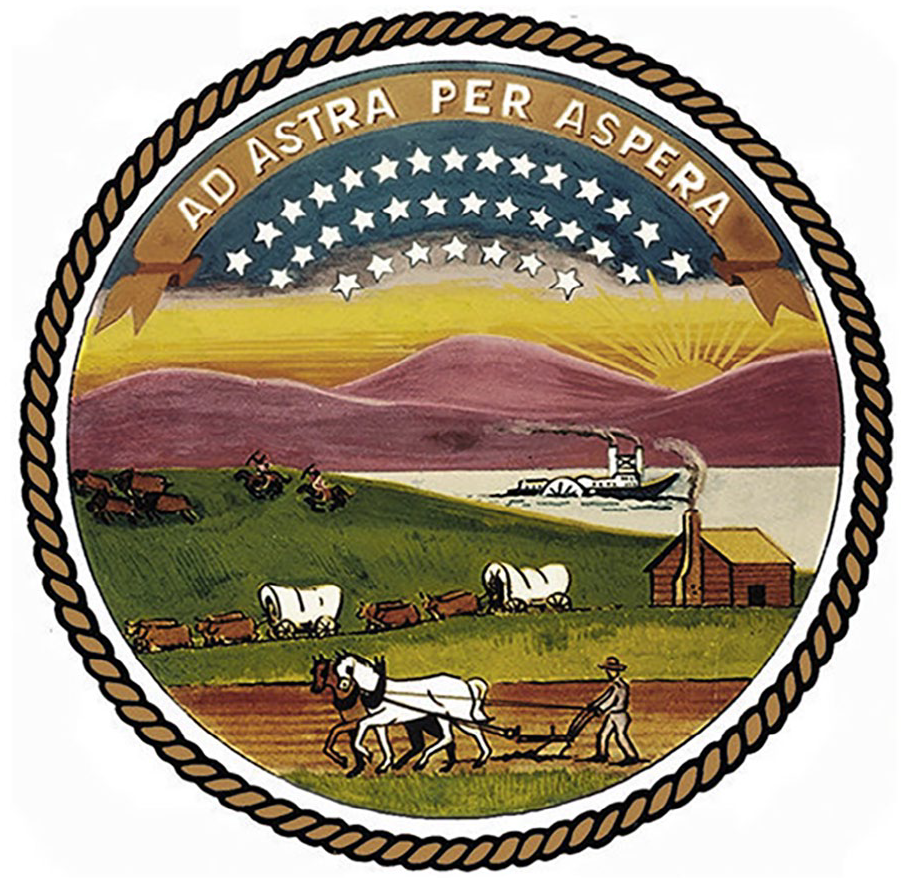
The “Great Seal of the State of Kansas,” featuring the state motto, Ad Astra Per Aspera. The seal illustrates the central role of agriculture in the state’s development, with a farmer plowing a field and a settler’s cabin in the foreground. A river steamboat approaching from the East symbolizes commerce, wagon trains represent westward expansion, and Native Americans hunting bison appear in the background (Kansas Historical Society, 2013).
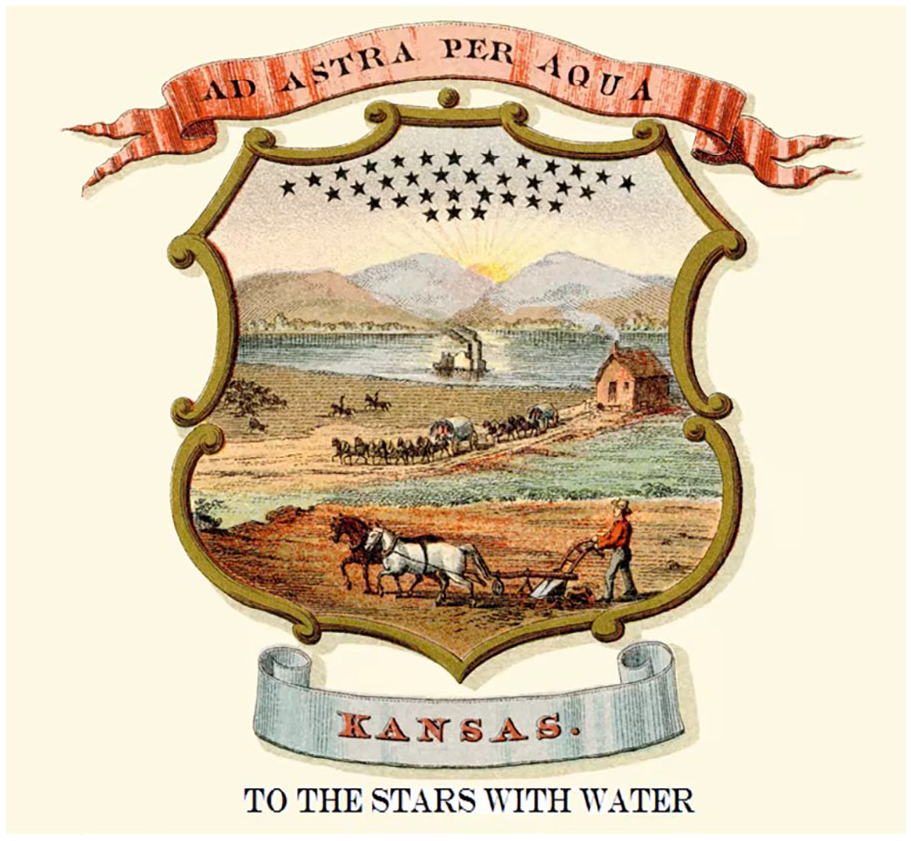
A modified version of Kansas’s historical coat of arms (Kansas Aqueduct Coalition, 2016: minute 41:23). While the original design remains unchanged, the state motto has been altered to “Ad Astra Per Aqua. To the stars through water” (sic).
Footnotes
Declaration of Conflicting Interests
The author declared no potential conflicts of interest with respect to the research, authorship, and/or publication of this article.
Funding
The author(s) received no financial support for the research, authorship, and/or publication of this article.
