



Abstract
We use a simulation model to explore the theoretical impact of technology, recycling, household propensity for material consumption, and nature conservation policies on economic growth and possible stabilization of the global economy within biophysical boundaries. The model dynamics, which arise from the autocatalytic loop between production and household sectors that deplete finite natural resources, qualitatively reproduce historically observed global GDP growth. The simulation results show that a sustainable but unstable steady-state can be reasonably reached only by the simultaneous application of policies that increase nature conservation and promote environmentally efficient technologies, a circular economy, and less-intensive material lifestyles. These policy measures, if realized, would reflect the anticipatory behavior of the human system to prevent future hazards by taking adequate actions in the present. The unstable steady-state suggests long-term sustainability would depend on continuous behavioral, institutional, and policy adjustments rooted in anticipatory behavior.
Keywords
Introduction
Global economic growth and development produced a broad spectrum of environmental and societal issues—from climate change (Lenton et al., 2019), mass extinction of species (Almond et al., 2020) to income and wealth inequality, which, altogether, constitute the crisis of capitalism (Jacobs and Mazzucato, 2016: 3–27).
Dealing with this crisis requires widespread, rapid, and fundamental environmental, economic, and social transformations. One of the preconditions to planning and implementing these transformations is “understanding the role of feedback processes in complex socio-ecological systems and especially the role of negative feedbacks, as a possible self-regulating feature in human civilizations” (Costanza et al., 2005: 37).
One way to approach the role of feedbacks in the growth and stabilization of economies is by looking at similar systems in nature, like ecosystems. Materially, the global capitalist economy is a complex living system where limited energy and natural resources support agents’ activity, similar to ecosystems. We base our theoretical perspective on “process ecology,” which emphasizes self-entailing configurations of processes that engender positive feedback or autocatalysis that imparts structure and regularity to ecosystems, as opposed to entropic tendencies toward disorganization and decay (Ulanowicz, 1997, 2006, 2009). The concept of autocatalysis offers a comprehensive framework for theorizing on economic growth and development. First, the autocatalytic dynamics operate with concepts like competition, selection, organization, and efficiency (Ulanowicz, 1997), which can straightforwardly apply to economic contexts (Matutinović, 2020). Second, it explicitly introduces specific negative feedbacks that are instrumental in stabilizing exponential growth resulting from the interplay of positive feedbacks, which is the central theme of this work.
Starting from the hypothesis that capitalist economies may be reaching a growth plateau in a way similar to other complex systems in nature (Matutinović et al., 2016), we use a simple quantitative model to explore the theoretical conditions and parameter values under which a transition from exponential growth to a steady-state might occur. A steady-state economy is a physically nongrowing economy where the production of new goods essentially matches the consumption and physical depreciation of existing goods, the population is constant, and the rate of resource throughput is no greater than the regenerative and waste assimilative capacities of the supporting ecosphere (Lawn, 2011).
Section (2) provides an outline of the autocatalytic process and negative feedbacks in the economic system; section (3) describes a quantitative model; section (4) presents model scenarios and simulations; section (5) discusses the model insights, and section (6) ends with conclusions.
Negative feedbacks in the autocatalytic process
An outline of autocatalytic process in economic system
Self-reinforcing or autocatalytic processes have long been recognized in heterodox economics (Arthur, 1988): increasing returns, virtuous circles, and circular and cumulative causation are concepts often found in theorizing about capitalist growth and development dynamics (Berger, 2009; Brenner and Cordes, 2004; Kapp, 1991; Matutinović et al., 2016; Meadows et al., 1972; Mitchell, 1927; Myrdal, 1984: 183–204; O’Hara, 2008; Raine et al., 2006; Zenghelis, 2016).
Generally, autocatalysis refers to any cyclical concatenation of processes in living systems wherein each member has the propensity to benefit or accelerate the activity of the succeeding link. For example, “an increase in A is likely to induce a corresponding increase in B, which in turn usually elicits an increase in C, and whence back to A” (Ulanowicz, 2006). Think about a semiconductor manufacturer that increases processing power in a microprocessor, enabling more computing power at a lower price for a desktop computer manufacturer and thus increasing its sales to the market. It simultaneously creates an opportunity to upgrade the operating system and enable new applications from software suppliers. This process of increased activity eventually feeds back to the semiconductor manufacturer as more demand for its products, thus completing the positive feedback loop that started at a particular link in a supply chain. At the level of the economic system, multiple positive feedback loops among variables, like market competition, technological innovation, productivity, labor share of income, and consumer demand, drive economic growth and development with characteristic structural changes (Matutinović et al., 2016).
The autocatalytic process engenders and stimulates the growth of its constituent members until some physical or spatial constraint has been reached. Then negative feedback stops the growth process (Ulanowicz and Hannon, 1987), allowing the system to settle into a meta-stable steady state. Autocatalytic growth is exponential, and, given its dependence on available resources and energy, it eventually reaches the asymptote producing the generalized logistic curve (Eigen and Winkler, 1993; Sterman, 2000; Thornley and France, 2007).
Negative feedbacks
We consider three types of negative feedback that act on global economic growth: physical scarcities of natural capital, anticipatory behavior, and spontaneous attenuation of positive feedbacks in the economic system. In the rest of this section we describe these negative feedbacks in more detail.
Physical scarcities of natural capital concern the availability of critical resources for sustaining complex socioeconomic systems. In the millennial expansion process, humanity modified more than 50% of land area (Hooke et al., 2012) and appropriated 38% of global net primary production (NPP) (Running, 2012). As a consequence of human expansion and population growth, fertile agricultural land, freshwater withdrawals, wood building materials, phosphate production, and wild fisheries harvest have a long-term per capita declining trend (Brown et al., 2014; Burger et al., 2012; Foley et al., 2005; Meadows et al., 2004: 67–72). According to estimates, only about 10% of global NPP is left for additional future use by humans (Running, 2012). Consequently, there is scarce space left for the further physical growth of the human system. Even though some recycling and substitution will often be possible, increasing quantities of energy and money will have to be expended to find, collect, and purify increasingly scarce minerals to meet ever-increasing demand, including that related to energy transition (Brown et al., 2014). The above-mentioned physical scarcities of natural capital inform the socioeconomic system via rising prices of resources, increased investments to extract a resource, and rising costs to deal with environmental stresses of various kinds - all of which act as negative feedback to economic growth (Meadows et al., 2004: 147–149). On the side of energy supply, depleting fossil fuels reserves and their substitution with renewable energy sources decreases the average energy return of investment (EROI) of the total primary energy supply, which is likely to represent a crucial constraint on future economic growth (Hall et al., 2014; Lambert et al., 2012; Murphy and Hall, 2010).
Anticipatory behavior refers to societal policy response to perceived biophysical hazards that arise from approaching or transgressing planetary biophysical boundaries 1 (Rockstrom et al., 2009; Steffen et al., 2015a, 2018). It has been estimated that the human system has already transgressed four of the nine planetary biophysical boundaries, including the two key ones of climate stability and biosphere integrity (Steffen and Morgan, 2021). In general, anticipatory systems contain internal predictive models of themselves and their environment and utilize the predictions of these models to control their present behavior (Rosen, 2012, vii). An anticipatory system can “use the information from its predictive model to change the present, so that a possibly different future from one that is originally predicted may result” (Louie, 2010). Societies use anticipatory behavior to respond to severe signs of stress that may arise from economic or natural systems. For example, national automatic stabilizers used in recessions to prevent expected major losses of GDP and employment, or the Montreal Protocol, agreed upon in the year 1987 as an international response to potential health damages resulting from thinning the ozone layer. In the present context, the very awareness at the societal level of approaching planetary biophysical boundaries may induce policy responses that would constrain resource exploitation before physical limits have been reached, thus effectively producing negative feedback. For example, we know that about one-third of oil reserves, half of the gas reserves, and over 80% of current coal reserves should remain unused from 2010 to 2050 to meet the target of 2°C global warming (McGlade and Ekins, 2015). This knowledge calls for self-imposed restrictions on fossil fuels extraction, far ahead of their physical scarcity. Some current instances of anticipatory responses are the Paris Agreement, where the parties agree to voluntarily reduce greenhouse emissions to keep global warming within the relatively safe 2°C increase, Global Methane Pledge, whereby over 100 countries committed to reduce their methane emissions by 30% by 2030 compared to 2020 levels, international agreements and conventions for protecting remaining rain forests and other natural habitats from exploitation to avert large-scale species extinction, and scaling down commercial fishing in oceans to prevent fisheries collapse. If applied consistently, these anticipatory responses to perceived natural stresses would most likely slow down global economic activity.
Novel significant stresses in this discourse are pandemics. Roadbuilding, mining and logging camps, expansion of urban centers and settlements, migration and war, and livestock and crop monocultures have led to increasing virus spillovers (Dobson et al., 2020), which, like Covid-19, can impact global economic activity, increase mortality, and impede the normal functioning of society. Land-use change is the most prominent driver (Loh et al., 2015), and thus there is a direct link between pandemics and pressure on planetary biophysical boundaries. Scientists estimate that there exist 1.67 million unknown viruses in mammal and bird hosts, out of which between 631,000 and 827,000 likely can infect people (Carroll et al., 2018). Therefore, it is not unlikely that pandemics may increase in the future, especially under unconstrained land-use change, biodiversity loss, and global warming. The Covid-19 pandemic, for example, has simultaneously disrupted both demand and supply in the global economy, producing a 5.2% contraction in the gross domestic product and having an adverse impact on poverty alleviation efforts (Asare and Barfi, 2021).
Spontaneous attenuation of positive feedbacks includes a host of frictional phenomena that unintentionally arise in a mature stage of capitalist development and impact negatively on economic growth (Matutinović, 2020; Matutinović et al., 2016). For example, declining rates of labor productivity growth (Antolin-Diaz et al., 2014; Chancel et al., 2013; Jackson, 2019; Schmelzer, 2015), declining wage share in national income (Karabarbounis and Neiman, 2014; Stockhammer, 2013), and growing income inequality (Alvaredo et al., 2018) weaken consumer demand and increase social tensions. The decline in the competition due to industry concentration at the national level (Banerjee and Duflo, 2019: 177–178) and the weakening of North-South trade flows (Matutinović, 2020), erode global economic growth. All these phenomena attenuate the effects of various positive feedback loops between technological innovation, productivity growth, increasing labor share of income, consumer demand, and market competition, which have been driving global economic growth, especially after World War II (Matutinović et al., 2016). We will subsume them under the parameter “b” in the quantitative model.
Theoretically, negative feedbacks may stabilize the global capitalist economy at a level of matter and energy throughput compatible with the earth’s biophysical boundaries. Such stabilization usually does not occur smoothly but more precipitously after an overshoot (Matutinović et al., 2016). We conjecture that anticipatory behavior is the primary societal tool in reaching and dynamically maintaining a steady-state economy. However, anticipatory behavior enables but does not guarantee such an outcome. If the overshoot size and duration happen outside the resilience capacity of the natural system, the global economic subsystem is likely to collapse (Meadows et al., 2004: 158). 2
Model description
Modeling coupled ecological economic systems covers a variety of purposes, methods and scales (Costanza et al., 1993). The literature review covering mathematical simulation models points at themes like long-run growth (Day and Walter, 1989; Garrett, 2014, 2015; King, 2020, 2022), conditions for growth under steady-state (Rodrigues et al., 2005), and the impact of social inequality on sustainability of societies (Motesharrei et al., 2014). None of these models addressed the theoretical impact of land conservation, circular economy, or household material consumption capacity on global biophysical sustainability.
Our stylized model belongs to the class of high-generality conceptual models, which provide a general understanding of system behavior (Costanza et al., 1993). It is grounded in a theory of capitalist economic growth and development (Matutinović et al., 2016). The capitalist economy is driven by several entwined self-reinforcing loops, which produce physical growth and structural change. During most of the immature stage of capitalist development, the economic material throughput grows exponentially. There are no socially recognized limits to growth, and negative feedbacks are still absent or too weak to have a lasting impact on growth dynamics. In the late phase of the immature economic development stage, negative feedbacks become visible and intense, thus slowing down material growth. At the same time, the consciousness of planetary biophysical boundaries triggers anticipatory behavior, which translates into long-term policies and institutional changes.
We explore how changes in technology, household material consumption capacity, internal socioeconomic frictions, and nature conservation policies affect material economic growth and depletion of natural resources and energy. We assume that natural resources and energy are depleted proportionally to the growth of material economic output, which corresponds closely to reality (see, e.g. Brown et al., 2011; Burger et al., 2012) The model does not explicitly address climate change, but the very process of instituting a circular economy, reducing material consumption, and preserving the natural system, directly contributes to slowing down global warming. According to Dinerstein et al. (2019), restoring vast areas of Earth’s surface to a natural state is the only way to safeguard biodiversity and the cheapest and most expeditious option for addressing climate change. Similarly, reducing global production and consumption and especially high-consuming lifestyles is one of the prerequisites for bringing down GHG emissions (Alfredsson et al., 2018).
Despite natural resource depletion and the closeness of planetary biophysical boundaries, the world economy still perseveres in its exponential trajectory of material growth, and its adverse impacts on climate, ecosystem health, and biodiversity persist. A negative feedback mechanism, like price signaling via free markets, which in theory may partially regulate human material consumption and respond to material scarcities or ecological and climate impacts, cannot stop unsustainable economic growth alone. Markets and technologies operate only on imperfect information and with delay and serve the goals of the most powerful segments of society: if the primary goal is growth, they produce growth as far as they can (Meadows et al., 2004: 222–234). Empirical analysis shows that during the 20th century, commodities price and resource consumption dynamics were essentially uncorrelated: while real commodity prices, punctuated by boom/bust episodes, have been modestly on the rise (Jacks, 2019, 2021), global materials use increased eight fold during the same period (Krausmann et al., 2009). Therefore, negative feedback from resource and planetary biophysical boundaries do not directly affect the human system in our model. Instead, we assume that a scientific investigation of biophysical boundaries informs societal anticipatory behavior and prompts the introduction of policies like nature conservation or promoting a circular economy, which constitutes some of our model scenarios.
We use a stylized model to explore whether a combination of parameter values might stabilize economic material throughput to remain within the planetary biophysical boundaries.
Model definition and description of variables and parameters
Of the many positive feedbacks that drive economic growth and development, we focus on the autocatalytic loop between production and household sectors. This loop is crucial because productive activities are generally undertaken to fulfill human needs, regardless of whether these are genuine or socially constructed (Goodwin et al., 2008). On average, households consume 60% of total output in OECD countries (OECD, 2021). Their material consumption signature is significant: it is the strongest determinant of global impacts like CO2 emissions, raw materials and energy consumption, air pollution, biodiversity loss, nitrogen emissions, and freshwater use (Wiedmann et al., 2020). The self-reinforcing process of economic growth, whereby entrepreneurs discover and invent new needs to be satisfied with a myriad of new products and services for which the household sector is willing to pay, is the main driving force behind the diversification and expansion of markets under capitalism (Becattini, 2004: 85–88).
Markets are too short-sighted to respond timely and adequately to warnings coming from biophysical boundaries. Therefore, we interpolate the sociopolitical domain where scientific institutions decode the natural signs, and governments interpret them in their own way before enacting corrective policies (Matutinović, 2007). Anticipatory policymaking considers future hazards and impacts on the human system which arise from the transgression of planetary biophysical boundaries, and prompt decision-makers to institute corrective actions now to avert them in the future.
The system model in Figure 1 serves as a blueprint for a stylized model, which is given by a system of three first-order differential equations. The first inner circle represents an economic domain composed of production (Ψ) and household sector (αC) entwined in an autocatalytic loop. The second circle denotes the socio-political realm, which receives and interprets signs from the natural system and responds by imposing conservation policies (z) and promoting systemic recycling (r) in the economic domain. Both domains constitute the human system as embedded in the natural system (N) (shaded area). Technology (T) is mediating resource and energy extraction to the economic domain and is influenced by policymaking. Recycling intensity (r) controls how many resources are retained in the economic domain instead of ending up as waste in the natural system. Frictions (b) represent various negative feedbacks that attenuate the autocatalytic cycle between production and HH sectors.
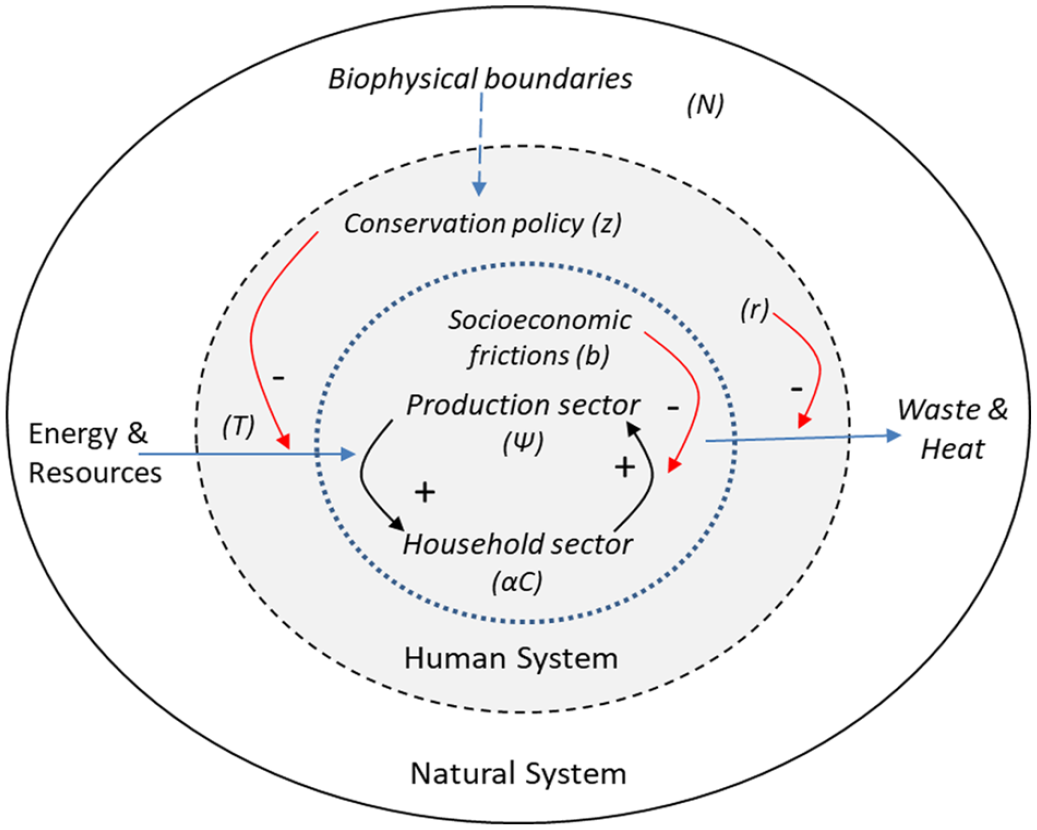
The system model.
The first equation of our model

describes the rate of change of the physical throughput of the global economy (Ψ), which depends on the magnitude of (Ψ) itself, planetary resources (N), technology (T), household sector consumption (αC), conservation policies (z), and the intensity of socioeconomic frictions (b).
The second equation

describes the rate of change of planetary resources (N) in terms of recycling intensity (r) and the rate of change of the physical-economic throughput (Ψ). This rate of change is proportional to the fraction of resources not being recycled and to the rate of change of (Ψ). The negative sign means that an increase in economic throughput results in decreased resources.
The third equation

describes the rate of change of household material consumption capacity (C) as a quotient of the rate of change of the physical-economic throughput (Ψ) divided by the size of (Ψ). In the following, we explain in detail all variables and parameters used:
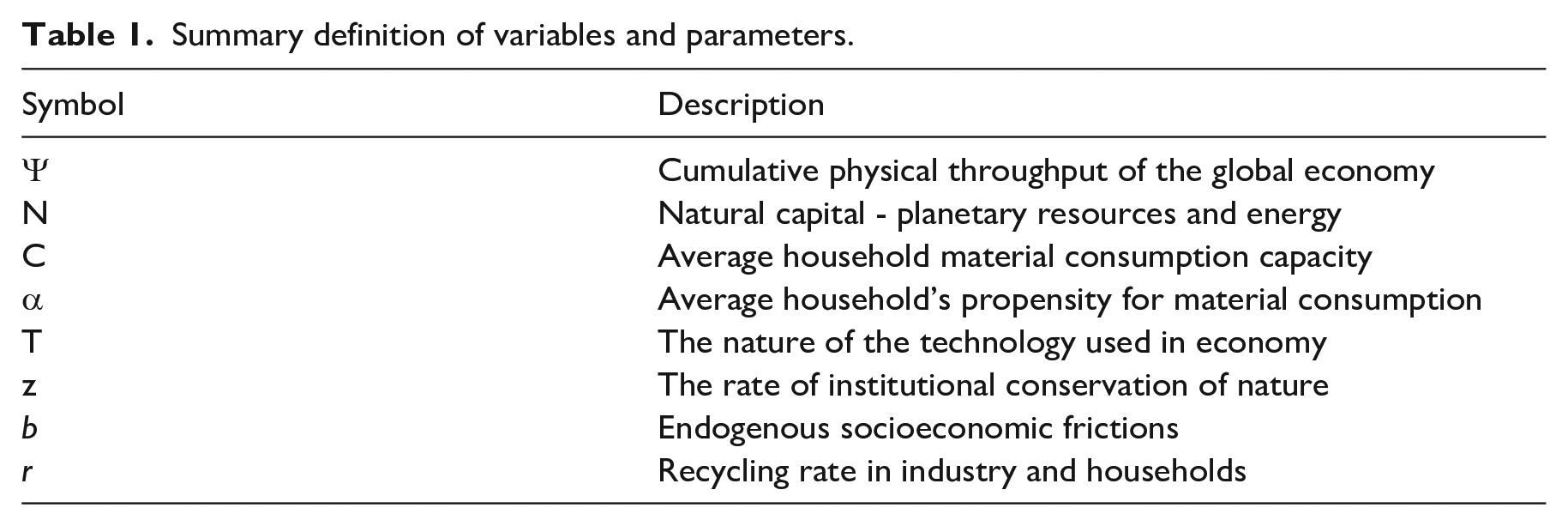
N = variable: refers to planetary resources and energy (renewable and no-renewable natural capital): tons of resources, gigajoules of energy or, alternatively, sq. km of land used to extract resources and energy, and to host the human system infrastructure. The relative size of the natural system at the initial condition is set as
C = variable: the average household material consumption capacity embodied in the material endowments (real estate, movables, durables) and disposable income. 5 Initial condition C0 = 1 is a dimensionless number that determines an arbitrary initial level of HH material consumption, say the one that corresponds to the material standard of living in the simulation year one. C changes along with Ψ. The rate of growth of C is proportional to the rate of growth of Ψ and inversely proportional to the current level of Ψ—this means it is harder to further increase material consumption by real estate, movables, and durables that already represent high levels of material throughput. 6
α = 1, households provide no incentive to decrease or increase the rate of growth of Ψ, which is proportional to the HH consumption capacity.
α > 1, households are increasing their propensity for material consumption—a sign for producers to increase the rate of material economic throughput faster.
α < 1, households are decreasing their propensity for material consumption—this is a sign for producers to slow down the increase of material throughput.
α~0 denotes paradigmatic changes in HH preferences—toward more leisure than material consumption, which arises spontaneously or, more likely, as the result of government policy measures, like reduced workweek. We assume that there is a trade-off between income and leisure, therefore a reduced workweek implies less income, which translates into lower alpha and, consequently, less material consumption.
T = positive parameter: denotes the prevailing nature of the technology used in the economic system: T = 1, resource-intensive technology that is neutral to material growth; T > 1 resource-intensive technology that has a positive impact on material throughput. T < 1, resource-efficient technology that slows down depletion of N and, consequently, reduces the rate of growth of Ψ 7 ;
z = nonnegative parameter that represents institutional conservation of nature like caps on the use of natural resources or increase of areas protected from exploitation. z = 0 stipulates no conservation policy/no land protected; z > 0 denotes the intensity of conservation policy that is imposed on the global scale.
b = nonnegative parameter: represents various socioeconomic frictions that decrease the growth rate of Ψ: b = 0, no frictions; b > 0, frictions of varying intensity.
r = parameter, 0≤r≤1: represents the proportion of waste recycling in industry and households so that fewer natural resources can be used for the same level of material throughput, leading, eventually, to a circular economy: r = 0, there is no recycling; r < 1, means that a fraction “r” of the increase in Ψ is not taken from N but comes from recycling; r = 1, an ideal situation where 100% recycling is taking place. We choose r = 0.11 as a starting parameter value based on the fact that, on average, only 11% of waste is recycled globally, ranging from 29% in high-income countries to 3.75% in low-income countries (Kaza et al., 2018). Another estimate shows that the global economy is only 8.6% circular (Haigh et al., 2021). These slight differences in the choice of initial parameter value do not impact on the qualitative nature of scenario results (Table 1).
Summary definition of variables and parameters.
If we assume that parameters are constant and do not depend on time, the system (1)–(3) is an autonomous system and has simple dynamics. Using tools from mathematical analysis and dynamical systems, it is easy to see that variable Ψ has only three possible equilibria when we let time t go to infinity. To further analyze these three cases, we should look at the sign of the right-hand side of equation (1), which depends only on the fixed-value parameters.
The first case is if the right-hand side of (1) is positive for time t =
Analogously, the second case is if the right-hand side of (1) is negative for time t =
Finally, the third special case occurs when the right-hand side of (1) is exactly equal to zero for time t =
To get a more realistic model, we want to let the parameters to depend on time t. For the sake of simplicity, we model parameters as piecewise linear functions of time t. First, we keep the parameters constant and set them to initial values until time
When solving our system of differential equations, we rescale time linearly for some parameter values so as to represent real years. The initial simulation time
For this more realistic model, system (1)–(3) becomes a non-autonomous system of differential equations. An analytical solution then becomes impossible, and any mathematical conclusion about system dynamics would be much more challenging than for an autonomous system. That is why we just solve our system numerically for a time period of 300 simulation years with several values of parameters and present simulation results.
Model scenarios and simulations
Scenario analysis can play a major role in addressing the challenges of sustainability science, especially the core question of how to scan the future in a structured, integrated and policy-relevant manner (Swart et al., 2004). Our model is theoretical, not predictive. We use simulation years to show the time dependence aspect of the model’s equations and provide an idea of the time needed for policy measures to show their effects. We start the simulation at t = 0 with baseline parameters and let it run for 200 simulation years at which time we assume the society becomes aware that the global economy has approached planetary biophysical boundaries so that appropriate policies are put in place to avoid a major catastrophe in the future. This is the moment when anticipatory behavior begins. Starting from the benchmark Business as usual scenario, we explore the impact of different policies regarding technology, recycling, land conservation, and household material consumption (Figure 2).
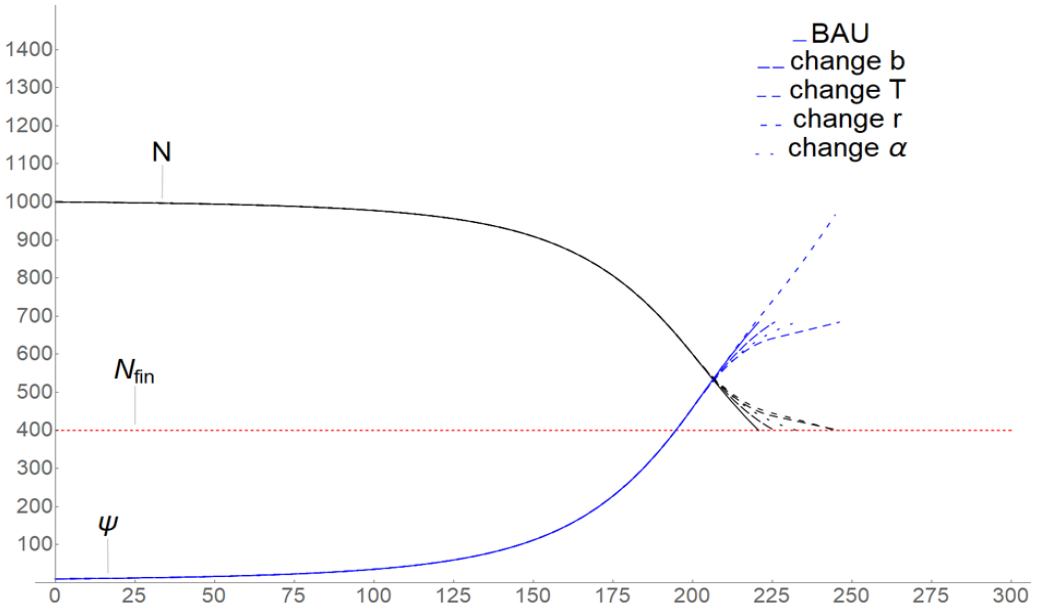
Simulation results: BAU, and separate changes in parameters b, T, r, α.
Business as usual
We let the system evolve undisturbed, which means we change no parameters except the parameter T, which changes from the value of 1.2 at t = 200–0.8 at t = 225, reflecting a modest transition to a resource-efficient technology. Parameter r stays fixed at 0.11, z at 0.1, b at 0.05, and
The impact of socioeconomic frictions
Everything stays the same as in BAU, but we change parameter b from 0.05 to 1.6, reflecting the intensification of socioeconomic frictions. This change leaves the depletion of natural resources dynamics essentially unchanged.
The impact of technology
Everything stays the same as in BAU, but we change parameter T from 1.2 to 0.2. to simulate a resource-efficient technology pushed by government regulation and incentives. We note slight inflections in the material economic output growth and depletion of natural resources while the socioeconomic system’s collapse starts 25 simulation years later.
The impact of recycling
Everything stays the same as in the BAU, but we change parameter r from 0.11 to 0.8, which is close to the ideal circular economy. The result is a continuing increase in the physical throughput, which reaches a higher value than in BAU, and a slowing down in the depletion of resources. Still, high-level recycling merely postpones entering the collapse zone by only 24 simulation years only, as unchanged household preferences for material consumption neutralize the resource use efficiencies. The average household material consumption capacity reaches its maximum value in this scenario (see Figure 3).
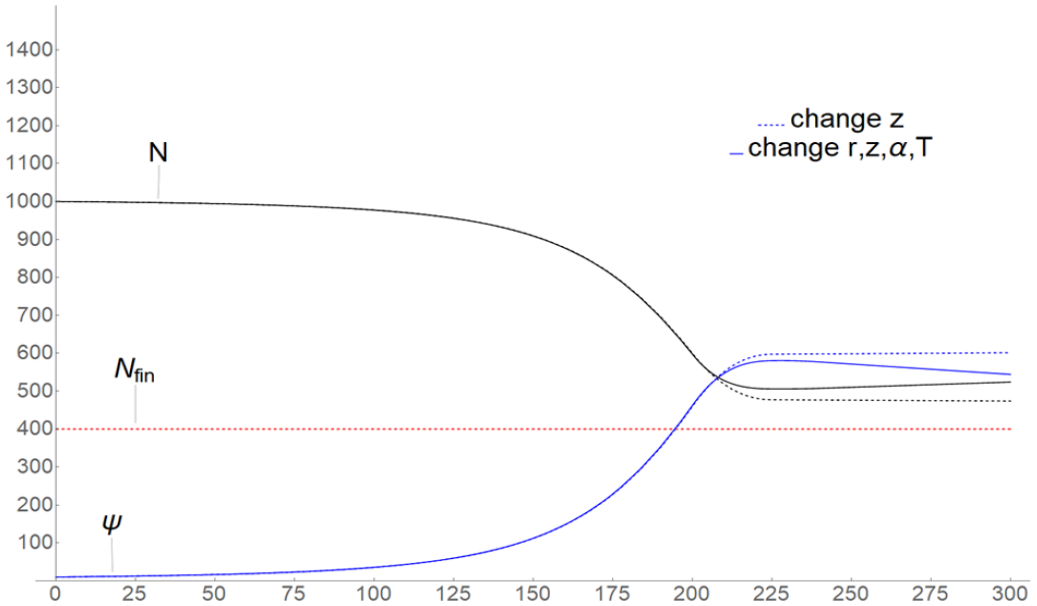
Simulation results: conservation policy alone and policy synergies.
The impact of the household propensity for material consumption and well-being
Everything stays the same as in BAU, but we change parameter α from 1 to 0.2 gradually, over 40 simulation years, starting at t = 200. We assume that changing α is harder and slower than changing other parameters. Consumption is a social process, and consumer society is based on widely shared materialistic values, beliefs, and symbols, making it a slow-changing variable. It is unlikely to expect a spontaneous restrain in personal consumption when income and goods are generally available. Therefore, government-imposed workweek reduction would be a major driver in the process, and it will take time to reach a target of, say, a 15-hour week, as Keynes (2010) proposed. 8 Substantially reducing the household preference for material consumption reduces the physical growth and depletion of the natural system, compared to the BAU scenario but still fails to stabilize the human-natural systems in the sustainable range of values. Shortening the transition time to 25 simulation years does not change the outcome qualitatively, although Ψ and N dynamics slow further down. Therefore, isolated from other measures, switching the household behavior toward more leisure 9 is not enough to avoid transgressing planetary biophysical boundaries.
The impact of conservation policies
Everything stays the same as in BAU, but we change parameter z from 0.1 to 5, reflecting the introduction of strong conservation and resource cap and trade policies. This large, 50-times increase in parameter value temporarily stabilizes resource depletion just above the human system collapse threshold. The significant change in parameter value and the proximity of the collapse threshold suggests that it may not be feasible to rely on conservation policies only to reach a steady-state economy.
The synergy of multiple parameters changes
Starting from initial BAU values, we increase recycling r from 0.11 to 0.5, set resource-efficient technology T = 0.2, and increase the intensity of conservation and resource cap policies (z) from 0.1 to 2. The z = 2 may be a metaphor for a requirement to restore at least 50% of the Earth’s land area as intact natural ecosystems by 2050, protecting and restoring 30% of the world’s freshwater ecoregions by 2030, and strongly protecting 37% of the ocean (Dinerstein et al., 2019). It would also call for extensive coverage of natural resources under cap and trade policies. The propensity for material consumption and well-being, α, drops to 0.2 like in the scenario 5. The parameter b is left unchanged. This combination of parameters produces an unstable steady-state economy. By keeping technology at T = 0.8, the result remains qualitatively unchanged, albeit N passes closer to the collapse threshold due to the global economy’s higher peak of material throughput. Note that in this scenario we needed a relatively large change in parameter values to stabilize economic material throughput within the biophysical boundaries. Translated into real-world terms, this metaphorically means that to move from the current unsustainable state to an unstable steady-state, the world will need bold and radical institutional changes and policy measures implemented over a relatively short period.
Increasing of socioeconomic frictions intensity
Starting from parameter values in the scenario 7, we increase bfigu to 1.6, simulating intense socioeconomic frictions, the physical output and household material consumption capacity dwindle significantly in the subsequent period. A real-world interpretation would see it as an uncontrollable material decline arising from economic and political turmoil which, if left to itself, ultimately leads to socioeconomic collapse. In this situation, the ecological dimension of sustainability would have been achieved but not the socioeconomic one (Figure 4).
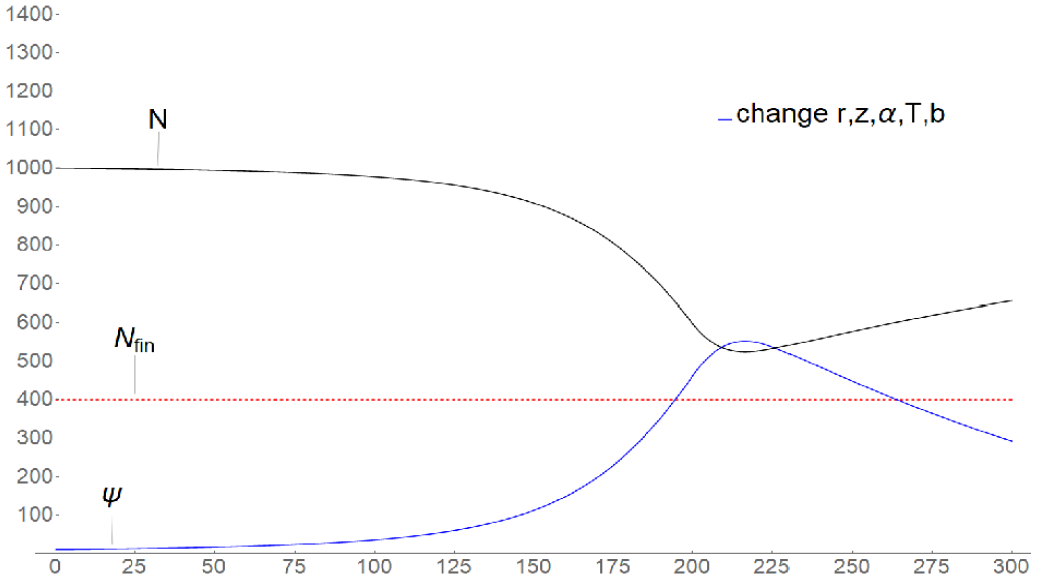
Simulation results: policy synergies and intense socioeconomic frictions.
The average household material consumption capacity
The average household material consumption capacity stabilizes only in two cases: by reducing the parameter alpha or under the synergy of parameter changes. The interpretation of the first case is straightforward: an increase in leisure time decreases disposable income, and the means for increasing further material consumption vanishes. Stabilization of C in the second case implies that durables and movables have a lengthy operating lifetime and producers entirely abandon planned obsolescence, products are repaired or reused instead of being replaced, and at the end of their life cycle, they are returned to the manufacturer for recycling (the contributing effects of T and r). When the synergy of multiple parameters changes combines with intense socioeconomic frictions, variable C tends to decrease significantly because households can no longer preserve their material well-being, like during economic depression or wars (Figure 5).
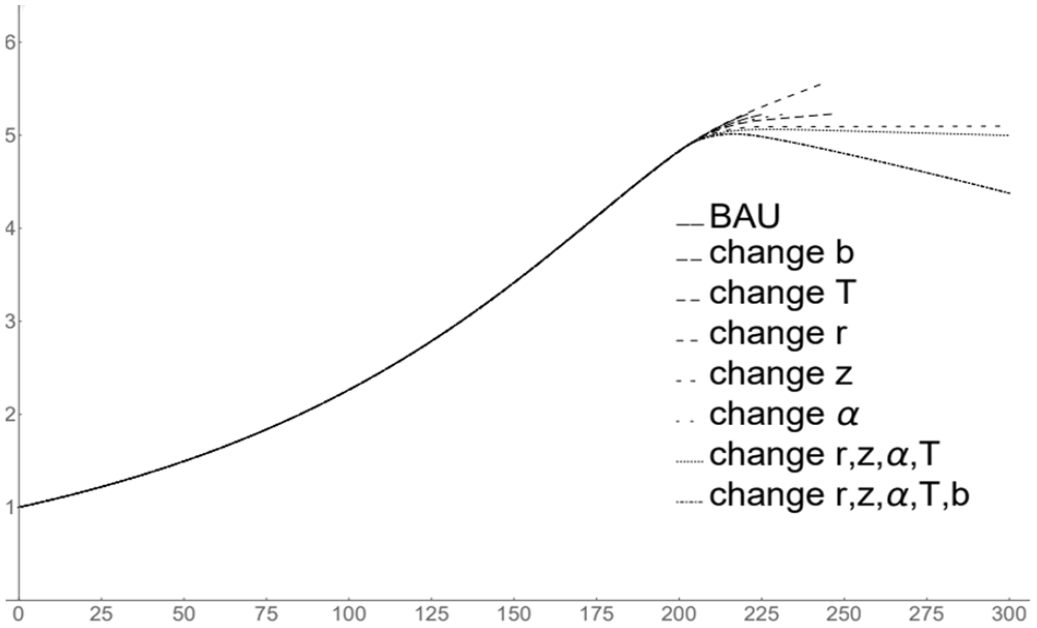
Household material consumption capacity.
Sensitivity analysis
We wish to explore the sensitivity of the solution regarding different end-values of parameters z, r, and α, which are in the focus of our interest. More precisely, we would like to see for which end-values of these parameters the value of variable N will not drop below an arbitrary threshold of N = 300, and would remain above desired long-term sustainability threshold, N = 500, at the t = 300. In this way, we simulate the possibility of a resilience window for the natural system after transgressing the critical threshold at N = 400.
Similarly, as in previous scenarios, we start our simulation with parameter values T = 1.2, b = 0.05, r = 0.11, z = 0.1, and
The contour diagram in Figure 6. shows, using shades of gray, the critical end-value of the parameter
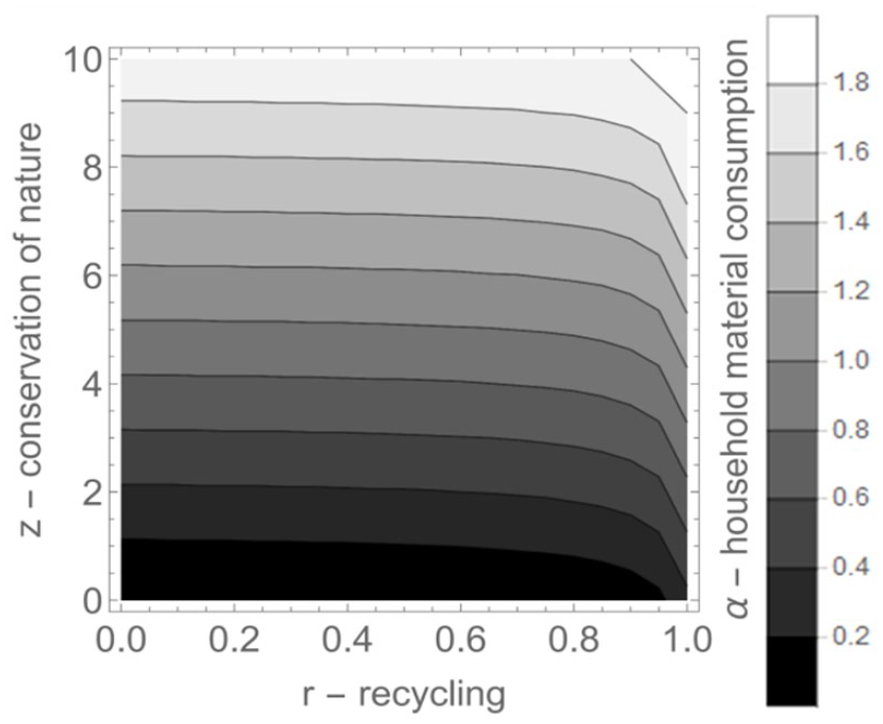
Sensitivity of
Discussion
The model produces exponential growth of the material economic throughput qualitatively similar to the observed historic growth of GDP in Western countries, their offshoots, and the global economy (Maddison Project Database [MPD], 2020). The growth arises from an autocatalytic loop between production and household sectors, supported by natural resources and energy and mediated by technology.
Left to itself (the BAU scenario) or following isolated policy measures, the world economy will likely transgress the boundaries imposed by the natural system and enter into the collapse phase. The only reasonable pathway to keep the economy within the safe, natural boundaries is through the simultaneous mix of bold conservation policies, directed technological change, a high-level circular economy, and changing household preferences—toward more leisure, less work, and less material consumption. No single policy would suffice to keep the economy within safe biophysical bounds. 10 A policy mixture allows for a certain trade-off between its elements, avoiding thus extreme measures, and incorporating synergetic effects to achieve the goals. This insight is not as straightforward as it may appear at first glance. For example, current large-scale, long-term policy programs like the European Green New Deal rely on circular economy (large r) and technological innovation (T<<1) as the main vehicles to reach sustainability and climate stability (European Commission, 2019). Our model indicates that without significant conservation policies and changing household preferences—toward more leisure, less work, and material consumption, efficiencies of use and technological fixes may not work.
Relying on technological fixes, for example, is not plausible. To stabilize the human-natural system in the sustainability region, the value of T would have to be close to zero—a condition that is a metaphor for technology that uses natural resources without ever depleting them. Recent research shows that despite technological progress in the past 60 years, extraction of most minerals has accelerated rather than stagnated, and some grew faster than GDP (Hannesson, 2021). As the empirical findings show, direct dematerialization due to technological progress will not occur because of the rebound effect (Magee and Devezas, 2017), human behavior, economic incentives, and global trade policies (Gutowski et al., 2017).
From the model perspective, system-wide recycling to create a (global) circular economy is effective only insofar as it happens in a nongrowing economy. Otherwise, it is either giving scope to increase household consumption in the short term or shifting the collapse further in the future by slowing down the use of natural resources.
Working time reduction is likely to be one of the key strategies to move away from universal consumption growth without increasing social tensions (Antal, 2018). However, our model suggests that changing household preferences as a sole condition for sustainability would require material consumption to drop near zero. The limited impact of the reduction of α on Ψ and N in the model derives from the high level that the average household material consumption capacity C had achieved by the time of parameter change. A peak level of C in the model refers to historically achieved material endowments, which require an adequate consumption of energy and resources for their usage and maintenance. The key insight is that once having reached a high level of household material well-being and income, like in rich Western countries, it is not easy to substantially reduce material consumption even if changing preferences toward more leisure. Therefore, only in synergy with conservation policy, resource-efficient technology, and high-level recycling can less work and more leisure be compatible with both ecological constraints and societal desire for material well-being. In the case of sudden reduction of C, as a consequence of wars or natural disasters, the reduction of α would produce a stronger effect on Ψ and N, but this certainly is not a desirable scenario.
The variable C refers to average material endowments, but our model is ignorant about the distributional equity of these endowments. It is generally recognized that the policy framework to achieve sustainable development is based on three pillars: sustainable rate of resource throughput, distributional equity, and allocative efficiency (Lawn, 2000; Purvis et al., 2019). In a sustainable steady-state economy, we would expect the value of C to reflect an equitable distribution in the material standard of living, within and among world societies, at least in the sense of sustainable development goals (Griggs et al., 2013). From the political aspect, a post-growth society is sustainable only if it is equitable and inclusive.
Given the huge inequality in global household income distribution (Lakner and Milanovic, 2016) and a large gap in per capita use of resources and energy between North and South (Diamond, 2019: 410), the major reductions in the parameter α can only be borne by developed countries by reducing their affluent overconsumption (Wiedmann et al., 2020). The policy aimed at reducing material consumption in upper-income countries is also necessary to accommodate population growth in low-income African and South-East Asian countries (Bongaarts, 2016; Vollset et al., 2020). According to Hickel (2019), achieving a good life for all within planetary boundaries will require rich countries to reduce their biophysical footprints by at least 40%–50% on average from current levels.
Socioeconomic frictions account only for a minor drag on physical-economic growth in our model. However, their importance is bound to increase in the future. For example, the growth of unemployment that is likely to arise from robotization and artificial intelligence (Manyika et al., 2017; Muro et al., 2019), and the increasing share of the precariat in the global labor force would contribute to income inequality and insecurity with a negative impact on growth. Increased income inequality, if left unaddressed by governments would likely erode the social fabric and destabilize societies, which may undermine the positive policy effects like in scenario 8.
We do not assume that technological change and household preferences would change spontaneously in the direction of sustainability within the observed time frame of 25 years. Likewise, with the conservation of nature and economy-wide recycling, they are the product of mission-oriented government policies (Mazzucato, 2018: 274–280; 2021), which, in our context, reflect the anticipatory behavior of the human system. The simulation scenario 8 suggests, metaphorically, that adequate social and welfare policies should complement bold policies aimed at stabilizing the global economy within safe planetary boundaries to avoid undesirable decreases in economic activity and material standard of living. The road to sustainability is necessarily a three-lane one: ecological, economic, and social. Although it is not oriented at achieving a steady-state economy, European Green New Deal is a good example of a comprehensive set of policies and financing aimed at producing measurable results in major areas like climate change and biodiversity while keeping sight of a just and inclusive transition for the citizens.
We believe that policies needed to direct the global economy toward a sustainable steady-state are viable within reformed capitalism (Banerjee and Duflo, 2019; Jackson, 2016; Jacobs and Mazzucato, 2016; Lawn, 2011; Mazzucato, 2021; Reich, 2016) but are incompatible even with only residuals of neoliberalism or growth fetishism, as has prevailed over the past 45 years.
Finally, the sustainable steady-state economy in our model is inherently unstable: behavioral and policy adjustments will always be necessary to keep the global socioeconomic system within ecologically and socially safe bounds. In the real world, this instability arises from the coevolution of two complex global systems—socioeconomic and ecological—where unintended and unpredictable consequences of human actions coupled with natural fluctuations in ecological systems create novel situations and challenges to the steady-state condition.
Conclusions
We use a simulation model to explore the theoretical impact of technology, recycling, household propensity for material consumption, nature conservation policy, and socioeconomic frictions on physical-economic growth and stabilization within biophysical planetary boundaries. The model dynamics arises from the autocatalytic loop between production and household sectors, and qualitatively reproduces historically observed growth of global GDP.
The model simulations produce several theoretical insights:
Technological change and circular economy are necessary systemic parts of a sustainable steady-state, but alone will not suffice to reach it.
The inertia of average household material endowments presents a constraint on switching to less intense material lifestyles, which will invariably be necessary but not sufficient conditions for sustainability.
A high-intensity global conservation policy, presumably in the range proposed by Dinerstein et al. (2019), can be the single most substantial leverage for achieving a sustainable steady-state economy as it simultaneously addresses unsustainable resource use, biodiversity loss, and climate change.
The sustainable steady-state can be reasonably reached only by the simultaneous application of policies that increase nature conservation and promote environmentally efficient and friendly technologies, circular economy, and less-intensive material lifestyles, especially in rich countries.
Moving from the current state of affairs to a steady-state economy will require radical institutional changes and policy measures implemented relatively quickly.
A steady-state economy may be inherently unstable, and its long-term sustainability would depend on continuous policy adjustment rooted in anticipatory behavior.
Anticipatory behavior, however, is not automatic. It requires political mediation and overcoming barriers that inhibit a transition to the post-growth economy (Strunz and Schindler, 2018). In that sense, the outcome - reaching a steady-state economy- although theoretically within reach, remains inherently uncertain.
Footnotes
Acknowledgements
We thank anonymous reviewers, for valuable comments that have helped improve this paper. Igor Matutinović thanks Aco Bjeliš for discussing the early version of the model.
Declaration of conflicting interests
The author(s) declared no potential conflicts of interest with respect to the research, authorship, and/or publication of this article.
Funding
The author(s) disclosed receipt of the following financial support for the research, authorship, and/or publication of this article: This research was partially supported by: Croatian Science Foundation (HRZZ) grant PZS-2019-02-3055 from “Research Cooperability” program funded by the European Social Fund.
