



Abstract
Together with research teams from around the world, the Anthropocene Working Group (AWG) has been meticulously quantifying and scrutinizing the global stratigraphic imprint of human activities, the results of which are gathered in this thematic collection of papers in The Anthropocene Review. How can such empirical research, which so impressively articulates the end of a relatively stable Earth System in the mid-20th century, inform our ways of understanding and responding to the planetary crisis that the geological samples quietly represent? In this afterword to the collection we report and reflect on the joint undertaking of the AWG, Haus der Kulturen der Welt and the Max Planck Institute for the History of Science to bring geoscientific evidence, cultural experimentation and historical contextualization together in a shared public framework.
Keywords
The concerted effort of the Anthropocene Working Group (AWG) to assess the stratigraphic evidence for the Anthropocene (Waters et al., 2023) has been closely accompanied and contextualized since 2012 by two Berlin-based partner organizations from far beyond the academic circles of geology: the Haus der Kulturen der Welt (HKW), a contemporary arts institution turned forum for critical debate and global discourse, and the Max Planck Institute for the History of Science (MPIWG), a humanities institute conducting basic research on the historical formation of knowledge in all its diversity. Berlin holds a special place in the history of the Anthropocene concept. It was at the German Reichstag where the standardization of stratigraphic divisions and the corresponding hierarchical nomenclature were significantly advanced during the Third International Geological Congress in 1885 (Puche-Riart et al., 2017; Walker et al., 2018). To that end, proposals of how to subdivide, name and color code also the most recent periods were submitted and discussed, along with the role of humans’ existence in recognising them (see Figure 1). Over a 100 years later, just after the turn of the millennium and Paul Crutzen’s famous (re-)invention of the term Anthropocene, it was again in Berlin where that human role, much elevated in the meantime, found particular interest and avid proponents. In two subsequent conferences of the Dahlem Workshop Series the Anthropocene hypothesis was readily taken up and already further developed by coining the term “Great Acceleration” (Steffen et al., 2015; Head et al., 2022; Luciano, 2022a).
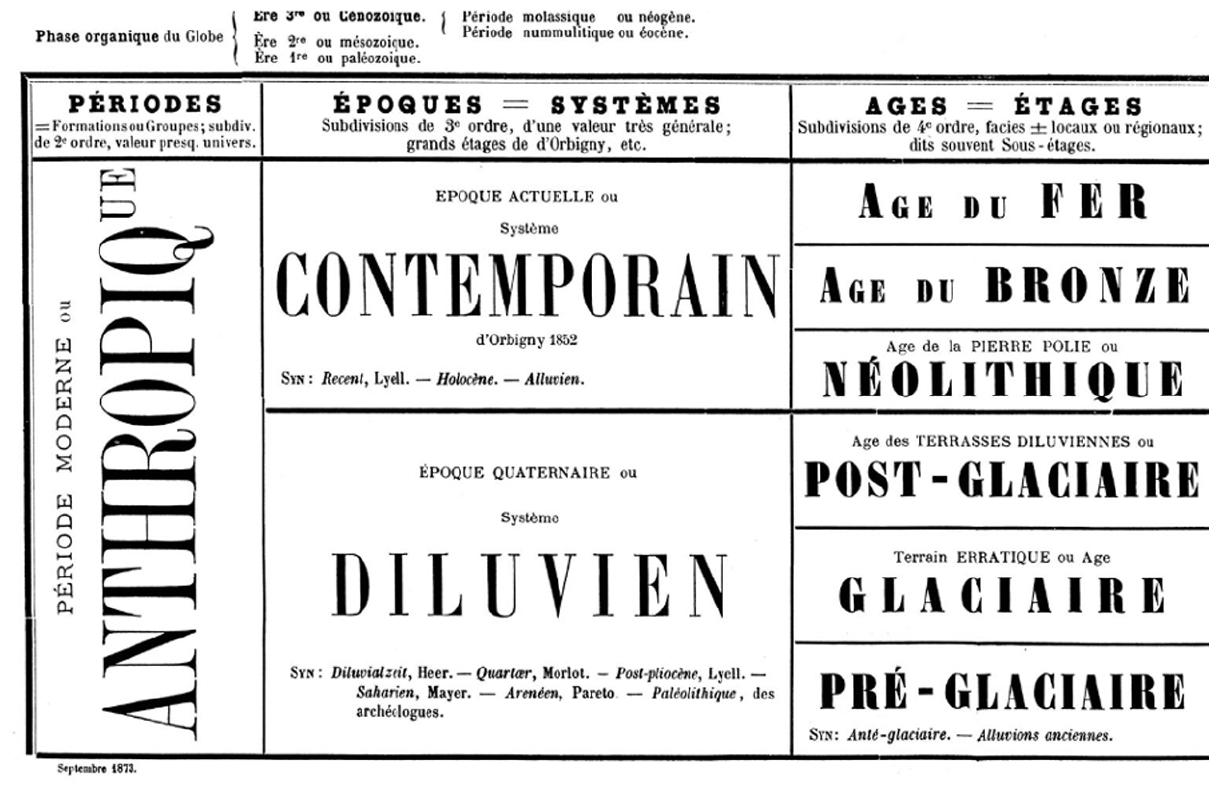
The first three columns of Eugène Renevier’s Tableau des Terrains Sedimentaires Représentant les Epoques de la Phase Organique, prepared in 1873. This is one of many attempts during the late 19th century to depict human history within geological timescales, a controversial topic during the 1885 Berlin conference. Renevier’s first Tableau lists the “Holocène” as a synonym for the contemporary geologic epoch and as part of an “Anthropique” period (Renevier, 1874), i.e. what would now extend to the Quaternary.
Whether it can be ascribed to historical coincidence or historical consequence, the start of the initial 2-year The Anthropocene Project at the HKW in 2013 was another momentous push to turn Berlin into a center for international and interdisciplinary Anthropocene debate. The interlacing of cultural reflection and scientific assessment of the Anthropocene was then brought to an entirely new level when in 2019 HKW’s director Bernd Scherer acquired financial support for a systematic assessment by the AWG of potential candidates for the Anthropocene’s Global boundary Stratotype Section and Point (GSSP, often referred to as the “golden spike”) by means of a special appropriation from the Bundestag, the German federal parliament, itself the institutional successor to the Reichstag (Scherer, 2022). This move decisively spurred the scientific process of examining potential candidates for a GSSP, and it seemed only natural that the AWG’s announcement of their final recommendation for the Anthropocene GSSP is now also set to take place in Berlin later this year, this time in the atrium of the Max Planck Society’s Berlin Office.
It is useful to quickly revisit the start of this unusual collaboration to understand its focus and pathway. The Anthropocene Project (2013–14) was a public forum on the theoretical and practical implications of the Anthropocene hypothesis for the sciences and arts that aimed to question the nature–culture divide as the central organizing principle for academia, cultural production, and public perception. Central to the extensive program of interdisciplinary workshops, performance events, and extensive exhibitions of this cultural project was the development of the Anthropocene Curriculum initiative by HKW and MPIWG: an international arts, research, and activism platform that has served as the umbrella framework for testing and facilitating new forms of collaborative knowledge production ever since (Rosol, 2021). However, similarly crucial for this start was the confidence of the AWG in taking part in these public and non-public events, joining conversations on stage, engaging with young researchers and artists in what became the Anthropocene Campus series, but also in making progress on their mandated task as a working group by holding their very first in-person meeting in October 2014 at the HKW, with several others to follow (AWG, 2015; see Figures 2 and 3). As part of that first meeting, a field trip took the participants to the Teufelsberg (Devil’s Mountain), a large hill made from the Second World War rubble of Berlin. This was not only a case study for anthropogenic ground, but is also a symbol of how the city was reborn physically, technologically, and societally at the inflection point of the Great Acceleration.
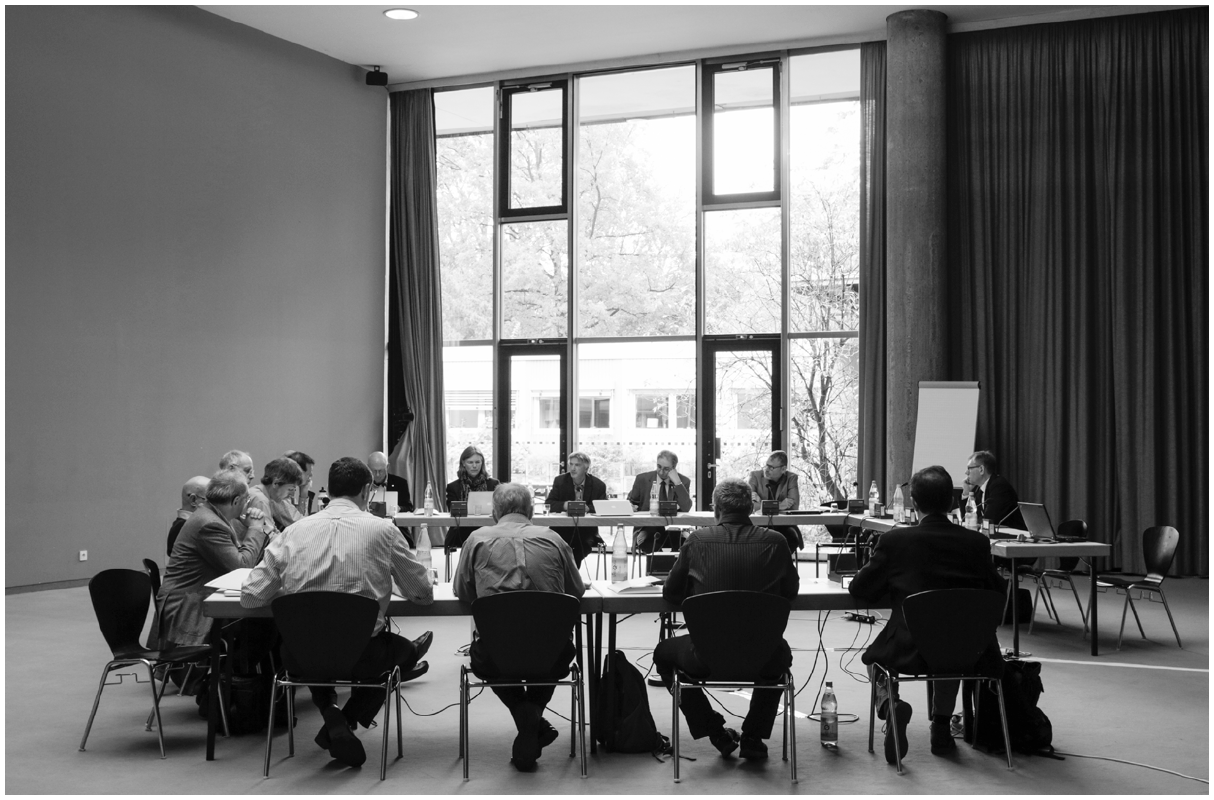
The first in-person meeting of the AWG, hosted by HKW in October 2014. Another four of these meetings were held in the framework of the joint cooperation between AWG, HKW, MPIWG (Berlin, Mainz, and New Orleans). Two further meetings took place in Cambridge and Oslo. © Giulia Bruno and Armin Linke.
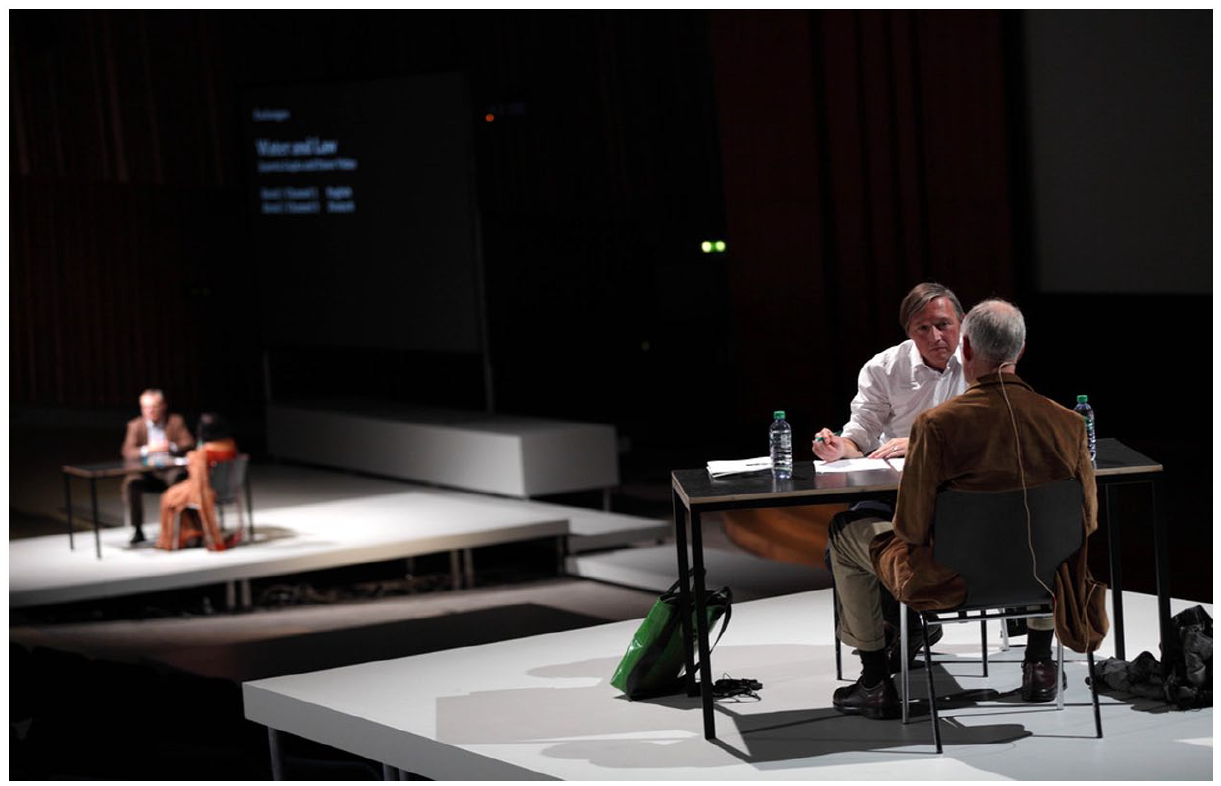
AWG members in public conversation with experts from other fields during A Matter Theater in October 2014 at HKW, following the AWG’s first meeting. From left to right: Davor Vidas, Joyeeta Gupta, Erich Hörl, and Peter K. Haff. © Sera Cakal for HKW. Reproduced in colour in online version.
The ongoing exchange between geoscience research group, cultural institution, and history-of-science institute that took place over the coming years deeply challenged and newly sutured not only the professional agendas and daily routines at three very different organizations, but also those of the numerous companions in science, art, and activism who have joined this endeavor along the way. It is in this framework that the search for evidence met the experiment: the cultivation of other kinds of knowledge production that enable a more adequate response to the planetary predicament which has found its watchword in the Anthropocene.
The 12 systematic and comprehensive studies gathered in this thematic set of The Anthropocene Review represent a clear and commendable aim: to present carefully documented evidence as the basis for a proposal to formalize the chronostratigraphic Anthropocene by means of a single prospective GSSP and several auxiliary stratotypes. There is, however, no previous example in the history of geology where a proposal of this kind has been achieved under such professional and public scrutiny. How could it be otherwise? The Anthropocene is not just any chronostratigraphic series or epoch. It sits at—if not decisively beyond—the uppermost edge of the conventional precincts of geochronology that, following tight protocols set by the International Commission on Stratigraphy (ICS), retrospectively subdivides 4.5 billion years of geological evolution into named intervals of time. The AWG is tasked with conducting a geological analysis of that which is still in the process of unfolding: an unheard-of “geology of the present.”
The evidence-based realization of the Anthropocene—not to mention its possible formalization—at the same time has immense consequences for the appraisal and recontextualization of the agency of humanity, or better, that of the industrial, technospheric behemoth it has created (see Pattberg and Davies-Venn, 2020). Defining the Anthropocene as a chronostratigraphic unit therefore means selecting a point within a geological reference section that crystallizes human and planetary history into a single representative moment in which Earth has figuratively left its “natural” (i.e. not anthropogenically dominated) state: a present that is preconditioning the deep future in ways that have no direct analog in the deep past. The members of the AWG and the candidate GSSP research teams have been faced with the “epoch-making” task of pinpointing a geochronological parting that represents the separation of the planetary epoch they live in (the Anthropocene) from that in which many of their own parents were born (the Holocene).
No wonder that such a crossing prompts a complementary discontinuity in comprehending and reacting to this epochal change. Through a close examination and wider contextualization of both the human and planetary markers of a potential Anthropocene starting date and the scientific practices and instrumentation that assemble its study, the three partner bodies have probed the nexus between the production of evidence, while also outlining the scope for social experiments that attend to this very evidence. How are consensus decisions being made within the sciences? How can scientific practices and existential struggles be related to one another? How do we tell planetary stories with multiple voices? Two comprehensive online publications, an extensive exhibition project, and two larger-scale events provided frameworks for joint engagements in the public space.
A first such output was the MPIWG-led publication project Anthropogenic Markers: Stratigraphy and Context, which curated an interdisciplinary conversation focusing on—and departing from—a selection of key stratigraphic markers for the Anthropocene including artificial radionuclides, combustion products, and technofossils (Rosol and Rispoli, 2022). In seven thematic dossiers more than 50 contributions (from the fields of geochemistry, paleobiology and climate science, history and science studies, artistic research, archeology, literary studies, and anthropology) presented a cyclorama of the historical details and political grain of the matters that mark the Anthropocene. Each dossier was prefaced with an introductory essay by AWG members with a special focus on scientific content and methods. Taken together this publication serves as a reminder that the existential rupture of the Anthropocene can only be grasped when context joins stratigraphy (see also Rosol et al., 2023).
A second online compilation provides a useful introduction to the scope and requirements of Anthropocene geology. The Geological Anthropocene presents a comprehensive, multimedia collection of the 12 diverse sites under investigation by the AWG, that is, the respective geological samples and their specific environmental archives, as well as the research teams behind their study [https://www.anthropocene-curriculum.org/the-geological-anthropocene]. The publication was developed by HKW together with the AWG and the GSSP research teams, and is a very useful companion to the in-depth datasets and their interpretations published in this special issue of The Anthropocene Review (see also Klingan et al., 2023).
An extensive visual registry of the scientific practices guiding the stratigraphic assessment of each sample set is further gathered in the exhibition Earth Indices, developed by the artists Giulia Bruno and Armin Linke [https://www.anthropocene-curriculum.org/contribution/earth-indices]. The central focus of the extensive installation spanning HKW’s large foyer (Figure 4) was on the spaces of social interaction in which the AWG’s stratigraphic research took place, shedding light on the specific procedures and scientific instrumentation involved in the production of geological evidence. As a consequence of the timing of this endeavor, paralleling the Covid pandemic, the installation also reflected a unique period of forced digital interaction and procedural adaptation. The result of this intensive learning and documentation process was an artistic index-card system which made the AWG’s research process readable through several layers of metadata, comments, and annotations, while at the same time probing a visual language of the Anthropocene (see Bruno and Linke, 2022).
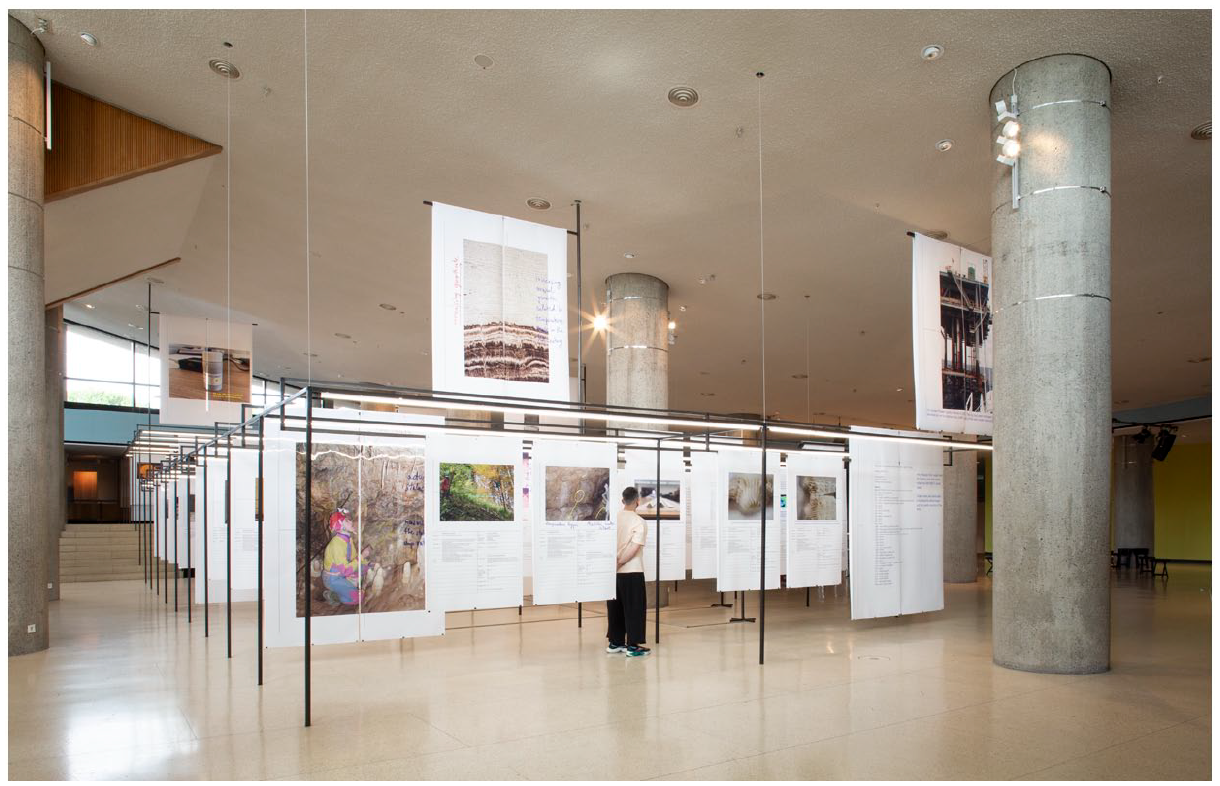
Installation view of Earth Indices at HKW from May to October 2022, a joint production by the artists Giulia Bruno and Armin Linke with HKW and scientists of the AWG. © Giulia Bruno and Armin Linke. Reproduced in colour in online version.
On the occasion of the opening of Earth Indices in May 2022 a multi-day discursive event took place at HKW that focused on the material evidence exhibited in the core samples themselves. Unearthing the Present extended another working meeting of the AWG into the public realm by inviting other scientists, humanists, artists, and activists to collective readings of the cores (Figure 5), to conduct joint workshops on Anthropocene markers and stratigraphic reasoning, and to debate the competing time horizons, latency effects, and accelerations inscribed in the cores that run counter to the temporal regimes of late-Holocene societies [https://www.anthropocene-curriculum.org/project/evidence-experiment/unearthing-the-present].
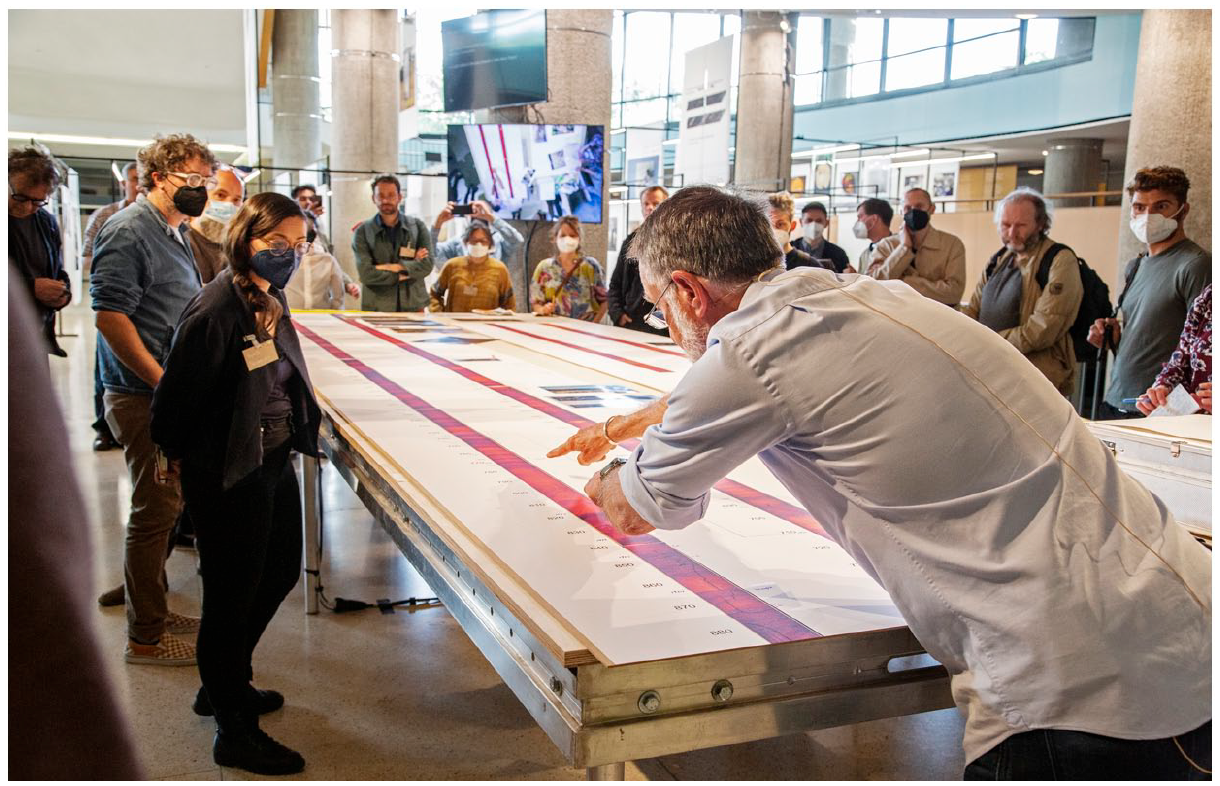
Anthony Barnosky, an investigator of the Searsville Lake GSSP candidate site, does a live reading of a printout of his team’s 12 m drill core during the Unearthing the Present event. © Katy Otto for HKW. Reproduced in colour in online version.
Based on this closer engagement with the scientific evidence and its production, a second event in October 2022 created a more experimental setting across the HKW auditorium over the course of 3 days [https://www.anthropocene-curriculum.org/project/evidence-experiment/where-is-the-planetary]. Here, contributors engaged in a series of collective practices that acted as a different kind of “multi-proxy” guided search, this time not for potential GSSPs but for potential models of living together (Figure 6). Where is the Planetary? was an informal experiment in devising a mutual understanding and common imagination of new, interdependent modes of cohabitation that operate within the ecological constraints and social values demanded by the Anthropocene crisis.
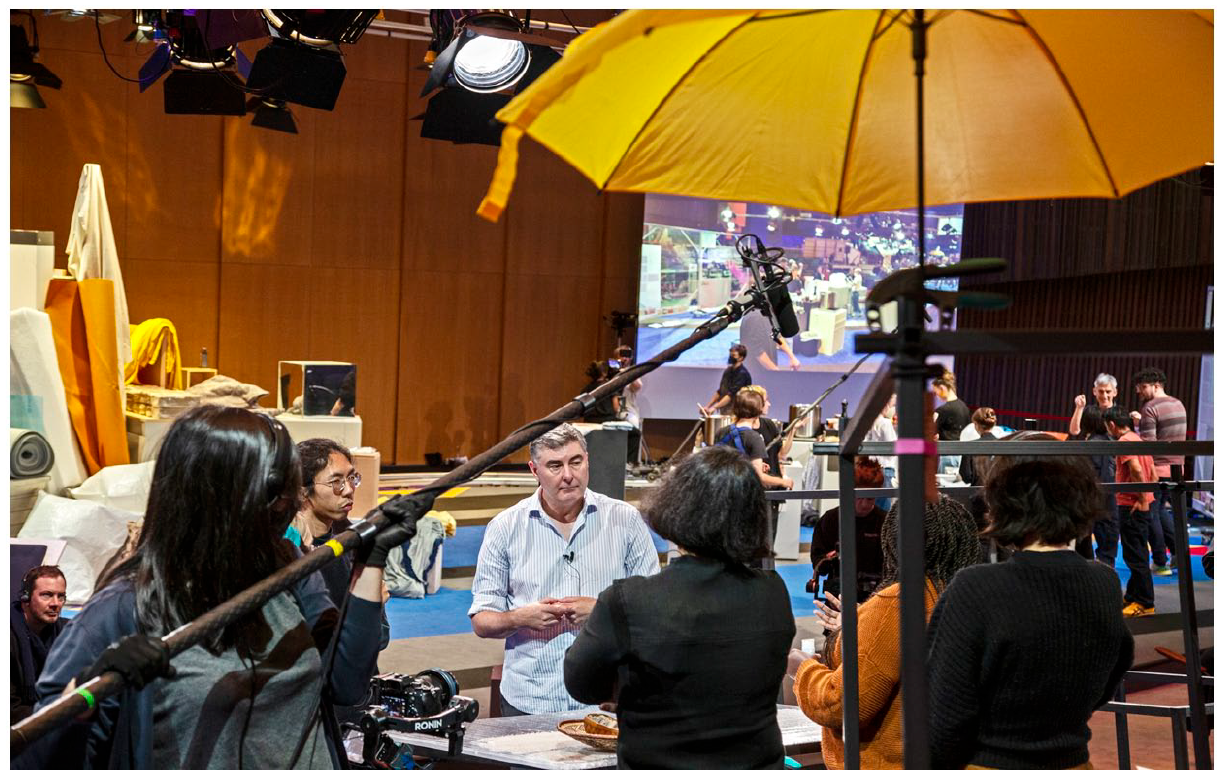
AWG member Mark Williams (center) discussing with Gary Zhexi Zhang, Larissa Lourie, Jahnavi Phalkey, Nikiwe Solomon, and Jenna Sutela the question “How can habitability be measured?” during Where is the Planetary? in October 2022. The event was designed in collaboration with the artist Koki Tanaka and recorded by the queer feminist film collective TINT. © Katy Otto for HKW. Reproduced in colour in online version.
Over the course of about 2 years, this joint program thus explored the uncharted space between the evident and the experimental, between the given and the collective search for its adequate response. What have we—scientists, curators, and scholars—learned from this encounter? How can the material testimonies of Anthropocene strata inform our ways of understanding and acting upon the temporal and political challenges of this new proposed epoch? And how can cultural experiments help in mapping out and expanding upon the various ways of tracing its evidence?
First, core samples, having been removed from their physical context, are neither natural, nor cultural, nor scientific objects alone but realize a composite arrangement that helps us to decipher—through highly technical translatory procedures—continuities and sudden discontinuities in the terrestrial metabolism: proxies that pattern planetary history. A “geology of the present” is informed not only about the evident connection between planet and society, but also about the deep implications of its own order of knowledge in specific economic and epistemological circumstances (Renn, 2020). It acknowledges that it participates in the production of its subject. It is attentive, for example, to the political currency linked to the choice of a start date—a question that has often overshadowed many of the inside and outside perspectives on the AWG’s work—as much as it acknowledges the disciplinary pragmatism by which a certain choice had to be made by the AWG. Moreover, understood as socio-natural-technical symptoms, the anthropogenic markers recorded in the geological samples remind us of the malaise that characterizes the systemic condition of the entire Earth System, and of the crisis this condition means for us humans. In this sense, such markers may be read as warning signals that we may use to reorient our actions in a more holistic way toward a resolution of the multiple crises of the Anthropocene.
Second, the production of scientific evidence of planetary change can be formed into arguments that counter many of the assumptions and values that produced the ecological and political disasters of the Anthropocene in the first place. As is well known, geology as a profession has been deeply complicit in the extraction business of the modern era, while at the same has helped to provide key insights and fundamental empirical data for the realization of the deep-time nature of the current planetary transformation. But there is more to such a reflexive stance. A genuinely planetary perspective is sensitive to a diversity of experiences and cosmologies: it undermines the anthropocentric worldview and develops an interdependent understanding of life on the planet (Clark and Szerszynski, 2020). A successful planetary praxis always means relationship-building, similar to the intricate biogeochemical relationships whose residues are recorded in the core samples of lake sediments, corals, speleothems, ice, or peat.
Third, new forms and forums of learning and knowing are needed. For humans to adapt to the Anthropocene’s rapid shifts and attend to the precarious realities of life in this new phase of planetary uncertainty, novel epistemic and esthetic strategies are essential in developing new modes of perception. They help us grasp the planet’s material flows, such as those inscribed in the core samples, and traverse multi-scalar complexities from local to global scale, from the molecular to the systemic. The reflexive embedding of the AWG’s endeavor into the long-term Anthropocene Curriculum project was an attempt to create and train a new cultural sensorium that can bridge scientific and artistic means, and forge transdisciplinary alliances of knowledge production, pedagogy, and action.
Fourth, fluent inter- and transdisciplinary conversation is not a given. It needs continuous efforts to cultivate a multi-perspective discourse and reciprocal understandings of key terms and concepts, not least what exactly “evidence” (and, similarly, “experiments”) mean to scientists, humanities scholars, or cultural curators (Luciano, 2022b; Will, 2021). Fostering a bridge-building discourse platform was, in many regards, at the heart of the curatorial work of this collaboration. What is even more important than what happens on a public stage, however, is to create a common working environment amongst the partnering institutions, ideally through the establishment of double-role positions that can act as constant go-betweens and unifiers of both vision and daily operations. Unlike almost any other framework, the Anthropocene is a very suitable “boundary object” for discussing common concerns and finding ways of understanding other points of theoretical and practical departure (Trischler, 2016). The cooperation has made attempts to fill the wide spectrum between a more narrow and technical definition of the chronostratigraphic Anthropocene and the excessively open and far-reaching debates around that term that take place within the humanities or the arts (Zalasiewicz et al., 2021). While shrinking this spectrum, or aligning thinking of the Anthropocene into a single frame of reference is probably not a good idea, a common focus on geological aspects has helped to reattach the Anthropocene term to its actual chronostratigraphic meaning.
Fifth, since the start of the cooperation in 2012, the world has already become quite a different place. The contours of the dawning Anthropocene are emerging ever more clearly from the background noise of the Earth’s natural fluctuations, changes that already contribute to rising societal conflicts and continuous efforts of crisis management. We still witness a serious discrepancy between the highly dynamic changes of the Earth system and the inert responses of traditional institutions, knowledge systems, and legal and political structures and tools. As Marcia Bjornerud has put it succinctly: “The economic and political sectors are now orthodox Lyellian gradualists while most geoscientists are neo-catastrophists” (Bjornerud, 2022). Indeed, the time corridors for avoiding irreversible damage to the well-being of the planet’s inhabitants are narrowing rapidly. Delays in responding to the imminent danger of planetary change—if not deliberate prevention of ambitious action—become questions of historical responsibility between generations born before and after the realization and geological recognition of the new epoch. Adding such “temporal” justice to efforts around social and ecological justice is one of the fundamental reconfigurations that the Anthropocene demands.
Lastly, and in connection with such a focus on the temporal, a sober assessment of the time that is left for putting such experiments in transdisciplinarity as ours to the test may be limited. The privilege of two reasonably well-funded (and Western) institutions to provide yet more funding for the collection of evidence, to freely pursue in-depth historical and cultural background research, and to curate delightful interdisciplinary gatherings might become increasingly out of reach with ever new waves of anthro-natural disasters and highly polarized societies operating in constant crisis mode. Is the pioneering AWG-HKW-MPIWG liaison really a model for a world in which not only public funding but entire social orders are under threat? The joint diagnosis of our times also reveals that these times are evidentially alarming and, in a much less pleasant way, daringly experimental in nature.
We would like to extend such questions to you, as readers of this afterword. Are we, as academic, social, human communities, structurally capable of weaving a precise network that will lead us from the evidence to not only the technological but also the social, political, and cultural innovations needed to help decelerate the planetary crisis? Do we sufficiently comprehend the legacy of the 20th century, and the human-induced changes of planet Earth so meticulously studied by the AWG, to halt this ominous development and to keep the crisis dynamics of the 21st century at bay? We believe that engagements across formerly separate domains of knowledge and routines at least encourage us to try. And that is the reason why we—together with other researchers and friends from the AWG, the MPIWG, and the new Max Planck Institute of Geoanthropology, at which Anthropocene research is now firmly anchored within the Max Planck Society, as well as the global Anthropocene Commons network that has resulted from the Anthropocene Curriculum initiative—are committed to continue this mission.
All of the content and projects mentioned can be found at www.anthropocene-curriculum.org, a public repository reflecting 10 years of explorative co-learning materials developed by HKW and the MPIWG. The website is now maintained by the MPIWG, while the global network continues under the new title
Footnotes
Declaration of conflicting interests
The author(s) declared no potential conflicts of interest with respect to the research, authorship, and/or publication of this article.
Funding
The author(s) received no financial support for the research, authorship, and/or publication of this article.
