




Abstract
Although a judicious use of solar radiation modification (SRM, or solar geoengineering) appears able to reduce climate change, SRM would create risks of its own. How results and conclusions are conveyed is important. This article describes nine cases in which scientific articles and their official press releases communicate results inaccurately: by inappropriately comparing SRM with a reference world of non-elevated greenhouse gas concentrations; focusing on the residual climatic anomalies that SRM would not entirely eliminate; generalizing a predictably harmful assumed implementation regime to all possible SRM; or reporting conclusions that the paper does not substantiate. Notably, each of these cases unduly amplifies SRM’s apparent risks and limitations. Collectively they may skew SRM communication and cause negative impacts on scientific assessments, news reporting, and policy discussions. The article suggests explanations for why SRM scientists and their official communicators sometimes inaccurately convey their results as well as how they and others should respond.
Introduction
Evidence indicates that a judicious use of solar radiation modification (SRM, or solar geoengineering) could reduce climate change and many of its environmental risks (IPCC, 2021; National Academies of Sciences, Engineering, and Medicine, 2021). 1 Specifically, the new report of the Intergovernmental Panel on Climate Change (IPCC) concludes “Modelling studies have consistently shown that SRM has the potential to offset some effect of increasing GHGs [greenhouse gases] on global and regional climate (high confidence), but there would be substantial residual or overcompensating climate change at the regional scale and seasonal timescale (high confidence)” (IPCC, 2021: 4–90, italics in original). The leading method would replicate volcanic eruptions’ natural cooling effect by injecting aerosols into the stratosphere. SRM is controversial for several reasons, among which is that it would also pose environmental risks of its own. Because of SRM’s potential to alter the nature, magnitude, and distribution of risks as well as its contestation, how scientists and authoritative communicators convey conclusions is salient. 2
Some critics portray SRM scientists as “boosters” (Baskin, 2019; Hamilton, 2015; Pierrehumbert, 2019), suggesting that they excessively emphasize SRM’s benefits while neglecting its risks, limitations, and other downsides. Others disagree. For example, one analysis concludes that proponents of SRM research are “displaying an unusual self-reflexivity, as they are well aware of and seriously consider all the technology’s risks” (Anshelm and Hansson, 2014: 135). This is consistent with SRM scientists saying, for example, “Only fools find joy in the prospect of climate engineering” (Caldeira, 2008).
Which vision is more accurate—“boosters” or self-reflexive—should be, to some degree, visible in public communications regarding SRM, that is, the SRM discourse. Most of the substantial scholarly literature on this considers sources other than scientific articles and official press releases; authoritative reports, news stories, social media, advocacy organizations’ statements, opinion essays, interviews, focus groups, events, and scholarship in other disciplines have been examined (e.g. Anshelm and Hansson, 2016; Horton, 2015; Huttunen et al., 2015; Nelson et al., 2021). Only a handful of scholarly publications have studied SRM’s scientific articles, and these have given their attention to frames and analytical approaches (Bellamy et al., 2012; Flegal and Gupta, 2018; Harnisch et al., 2015; Huttunen and Hildén, 2014; Matzner and Barben, 2020; McLaren, 2018), not accuracy.
Here, I ask a specific, substance-oriented question: Do official communications of SRM research convey their results and conclusions accurately? Or are there cases that do so inaccurately?
Method
This paper considers scientific articles and official press releases, as they are both official scientific communications that are (hopefully) written thoughtfully. Furthermore, press releases should have substantial input if not approval from the scientist-authors, although this might not always be so. The question is limited to internal accuracy: Do the article’s text, abstract, title, and any official press release accurately communicate its data and inferred conclusions? I do not consider the “upstream” scientific activities, such as questions the scientists chose to ask, which methods they selected to explore the questions, or which previous studies they did (not) cite. While important, these are the more subjective aspects of scientific research. Likewise, the analysis here excludes “downstream” activities, such as scientists’ opinion essays; their social media and quotations in the news, which may not be carefully crafted; collectively authored scientific reports, whose inaccuracies can have diverse causes; and others’ coverage of these studies, which are out of scientists’ hands.
Below I describe nine cases in which scientific articles and their official press releases are internally inaccurate. 3 The selection is not exhaustive or systematic. Other possible limitations to this approach are discussed in the concluding section, below. These scientific papers and press releases variously exhibit four forms, or categories, of internal inaccuracy, described in the following subsections. The distinctions among these categories are not perfectly sharp. The first three of these could, in principle, be helpful in understanding SRM if they are communicated accurately. However, they are not in the cases described.
Inappropriate reference world
A key challenge in reporting SRM’s expected effects is choosing a baseline and then describing these effects precisely. Most SRM studies have at least three groups of modeled data: (A) those from a preindustrial, current, or similar world; (B) those from a future world of elevated atmospheric GHG concentrations; and (C) those from a future world of elevated GHGs plus SRM. In this first category of internal inaccuracy, some scientists compare (C) with (A) and attribute the differences—presumably normatively bad ones caused by elevated GHG concentrations—to SRM and/or do not compare (C) with (B). This analysis is flawed because, despite its risks and limitations, SRM is being considered only as a response to climate change, and any decision-making regarding SRM will presumably focus on whether it reduces climate change impacts. In other words, SRM under elevated GHG concentrations may be a second best; comparing it with an unattainable first best is generally not helpful. Nevertheless, such a comparison could be useful, as humans are familiar with a world of preindustrial (or similarly low) GHG concentrations and might someday live with elevated atmospheric GHG concentrations plus SRM. Likewise, if one assumes that SRM’s consideration, development, and use would greatly undermine efforts to reduce GHG emissions, then this comparison could be logical. However, attributing differences between these two potential futures—especially those differences that are also present under climate change without SRM—conflates SRM and GHG-induced climate change.
This important distinction can be clarified by analogy. Despite its own risks and negative side effects, chemotherapy is sometimes used to treat cancer. A person with cancer who is undergoing chemotherapy could describe how he or she feels with reference to how he or she felt before the cancer’s onset. And if one believes that chemotherapy’s availability significantly increases behaviors that cause cancer, then an observer might also make such a comparison. But in all situations, including these, it would be wrong to attribute the difference to the chemotherapy without reference to the cancer, as doing so conflates the effects of cancer and those of the chemotherapy. Furthermore, if a person with cancer needed to decide whether to undergo chemotherapy, a comparison with conditions with neither cancer nor chemotherapy would not be helpful.
In an almost mirror-image variant of this inaccuracy, some scientists do compare (C) with (B) and describe SRM’s climatic effects as normatively bad, but they fail to compare with (A). Had they done so, these scientists would need to report that SRM brings the world closer to (A) and reduce net climatic anomalies, which would presumably be normatively good.
Focus on residuals
When the results suggest that a given scenario of SRM’s use would partially return a climatic metric to its preindustrial baseline, the scientists and science communicators may emphasize either what SRM could achieve, what it could not achieve, or both. There is a strong argument that the emphasis should be in proportion to how close the SRM could bring the variable back to its baseline. Yet some reports of research in which SRM would return the variable most of the way to its baseline selectively emphasize what SRM would not achieve. Not only does this second category of internal inaccuracy look at “a mostly full glass as partially empty,” but it also ignores the fact that a different magnitude of SRM might be able to return the metric more closely to its preindustrial value. Because the residual anomaly is sometimes attributed, usually implicitly, to SRM, this inaccuracy is distinct rhetorically, but not necessarily substantively, from using an inappropriate reference world. This focus on the residuals only applies to anthropogenic climatic anomalies that SRM could reduce, not to SRM’s other risks, such as those to stratospheric ozone.
Nevertheless, such a focus could be useful because, if those anomalies remain, humans might wish to reduce net GHG emissions or adapt more, or to reject SRM as too limited to justify its secondary effects and governance challenges. However, emphasizing the residuals is misdirection and attributing them to SRM—even implicitly so—conflates SRM and GHG-induced climate change.
Generalized assumed regime
In the third category of internal inaccuracy, scientists and science communicators sometimes generalize from an assumed SRM regime—including the magnitude of SRM, the rate at which it might cease, and the location and timing of stratospheric aerosol injections—to all SRM or stratospheric aerosol injection in general. Yet a different magnitude, SRM’s continued or phased-out use, or different location and timing of injections may not cause the risks at hand. Although the given study often does not consider these other deployment regimes of SRM, describing the expected effects of the assumed regime as inherent to SRM is inappropriate because the effects could be mitigated. This inaccuracy is distinct rhetorically, but not necessarily substantively, from focusing on the residuals.
By way of analogy, imagine a study that finds that driving a motorcycle at 150 km/hour for some length of time without a helmet has a 1% chance of a fatal accident. It would be inappropriate for a study to conclude simply that driving a motorcycle has a 1% chance of a fatal accident because motorcyclists could drive less fast or wear a helmet.
Nevertheless, such an assumption could be useful because SRM might be used consistent with the particular regime. However, claiming that SRM would necessarily have the impacts or risks under the assumed regime inappropriately overgeneralizes.
Unsubstantiated conclusion
The abstract, title, and press release sometimes report risks, limitations, and other conclusions that the scientific paper does not state and/or does not support. Such unsubstantiated conclusions are never useful.
Importantly, internal inaccuracies in this fourth category depend on neither a comparison of incommensurate risks (such as changes in temperature with changes in precipitation) nor subjective probabilities of future uncertain events (such as SRM’s sudden and sustained termination). On these matters, people of good will can disagree, at least within reasonable bounds.
Case 1: Asian and African monsoons
In one of the first empirical SRM studies, Robock et al. (2008) modeled a control without additional GHGs beyond those in 1999, a “business as usual” emissions scenario, that scenario plus a moderate amount of Arctic stratospheric sulfate aerosols, and the “business as usual” scenario plus a greater quantity of tropical stratospheric sulfate aerosols.
One of the most important metrics in climate projections is surface air temperature. Robock et al. show that the tropical SRM would cool the planet fairly evenly, albeit somewhat overcooling, especially in the northern lands. The authors conclude in the abstract, “Tropical SO2 injection would produce sustained cooling over most of the world, with more cooling over continents” (Robock et al., 2008: 1).
Changes in precipitation are also salient. Relative to 1999, almost all the world under “business as usual” emissions plus tropical SRM would see annual precipitation changes of less than 0.25 mm/day. In the model, most of the significant precipitation anomalies are above the ocean and would thus contribute little to risks to humans and ecosystems. An exception is drying in South Asia, where in some areas this reduction would, in this modeled scenario, be as great as 1–2 mm/day—as much as one-third of annual precipitation.
Robock et al. (2008) write in the abstract, “Both tropical and Arctic SO2 injection would disrupt the Asian and African summer monsoons, reducing precipitation to the food supply for billions of people” (p. 1). Yet for one thing, African summer precipitation increases under “business as usual” emissions scenario; SRM under both scenarios reduces it relative to that, bringing African summer precipitation closer to 1999 conditions. Specifically, tropical SO2 injection roughly eliminates GHG-induced African summer precipitation anomalies and the Arctic one overcorrects them. Saying that SRM would reduce precipitation and thus have negative consequences without the context that elevated GHG concentrations would increase precipitation is, at the very least, misleading. This is the “mirror-image variant” of the inappropriate reference world. For another thing, whether the assumed regime would reduce “precipitation to the food supply for billions of people” is not demonstrated in the article. This would require answering other questions: To what extent do farms in the potentially affected area of south Asia rely on summer precipitation versus that from other seasons? To what extent do farms rely on storage to compensate for intra-annual variability? Do more than 1 billion people rely on the food from that potentially affected area? This is an unsubstantiated conclusion.
The article’s main text appropriately concludes, “Whether we should use geoengineering as a temporary measure to avoid the most serious consequences of global warming requires a detailed evaluation of the benefits, costs, and dangers of different options. . . The work here helps to document some benefits of geoengineering (global cooling and preservation of Arctic sea ice), but also the possible side effects on regional climate” (Robock et al., 2008: 13). In contrast, the abstract states, “These regional climate anomalies are but one of many reasons that argue against the implementation of this kind of geoengineering” (Robock et al., 2008: 1). Whether the disruption of the Asian summer monsoon is enough to argue against SRM depends on other scientific questions (What would be the expected agricultural impacts? How would evaporation and water availability change? Could water storage and irrigation systems mitigate any negative impacts?) as well as normative and political ones (Would the reduction of other climate change impacts outweigh this regional precipitation one? Could other countries and regions compensate negatively affected areas?). The abstract’s prescriptive sentence arguably constitutes another unsubstantiated conclusion.
Case 2: Tropical atmospheric circulation
Ferraro et al. (2014) report on SRM’s expected impacts on tropical atmospheric circulation, which influences precipitation. They compared a control baseline, a world of quadruple preindustrial atmospheric carbon dioxide concentration (4xCO2, an extremely high, probably impossible level that is often used in SRM modeling to elicit a signal), 4xCO2 plus SRM by simply “turning down the Sun” (i.e. reducing the magnitude of incoming solar radiation in the model), and 4xCO2 plus SRM by sulfate stratospheric aerosols. In the latter two scenarios, the intervention’s magnitude was set to maintain preindustrial global mean surface temperature.
Like many other studies, Ferraro et al. find that climate change will warm the world and make it a bit wetter and that, for a given magnitude of intervention, SRM would compensate global mean precipitation changes more efficiently than temperature ones. The latter effect would cause overcorrection of precipitation anomalies if SRM were to fully compensate anthropogenic global warming. Furthermore, this study shows that simply “turning down the Sun” in a model underestimates SRM’s relatively greater correction of precipitation changes.
Regarding the authors’ central question, the modeling showed that stratospheric aerosol injection would not compensate the weakening of tropical circulation that is expected under anthropogenic climate change, yet modeling SRM by “turning down the Sun” fails to reveal this limitation. Ferraro et al. describe the environmental consequences of weakened tropical circulation: Such a weakening of the tropical circulation, in the absence of surface warming and humidity changes [i.e., as with climate change plus sulfate aerosols], would act to reduce precipitation in convective regions. . .. Such climatological precipitation changes are of considerable importance in regions vulnerable to droughts and floods, as well as being drivers of changes in agricultural production. (Ferraro et al., 2014: 1, 6)
In contrast to this measured language, the official press release makes bolder claims. It is worth quoting at length:
Plans to reverse the effects of global warming by mimicking big volcanic eruptions would have a catastrophic impact on some of the most fragile ecosystems on earth. . . University of Reading research suggests geo-engineering could cause massive changes to rainfall patterns around the equator, drying the tropical rainforests in South America and Asia and intensifying periods of drought in Africa. * Pumping sunlight-reflecting particles into the atmosphere would cut tropical rainfall by 30% * Reversing a 4°C temperature rise could benefit northern Europe but lead to drought in parts of South America, Asia and Africa The research also highlights how global geo-engineering could provide solutions for some regions while causing more problems in others, opening up the possibility of conflict between countries if they were to act unilaterally to alter the climate. In general, countries in northern Europe and parts of Asia would be most likely to benefit, at the expense of parts of Africa, North and South America and South-East Asia. . . [T]he researchers suggest that such stratospheric aerosol injection. . . would create significant, harmful side effects by weakening weather systems in the tropics. . . Dr Andrew Charlton-Perez, University of Reading, one of the co-authors of the research, said. . . “The risks from this kind of geo-engineering are huge. A reduction in tropical rainfall of 30% would, for example, quickly dry out Indonesia so much that even the wettest years after a man-made intervention would be equal to drought conditions now. The ecosystems of the tropics are among the most fragile on Earth. We would see changes happening so quickly that there would be little time for people to adapt.” (University of Reading, 2014)
Almost none of these strong claims are in or supported by the Ferraro et al. article. They are unsubstantiated conclusions. Moreover, the press release makes them categorically, with the verb “would” and without reference to the particular SRM regime. This press release thus generalized an assumed regime.
Case 3: Sea level rise
Sea level rise is a leading impact of concern of climate change. McCusker et al. (2015) investigate the extent to which SRM may be able to counteract sea level rise by comparing three modeled futures: extremely high GHG emissions, these high emissions plus a quantity of stratospheric aerosols to counterbalance the anthropogenic GHGs’ radiative forcing, and suddenly returning atmospheric GHG concentrations to their preindustrial levels—which is impossible but useful for comparison.
Sea level rise is caused by the expansion of the ocean and the melting of terrestrial ice. Regarding the former cause, McCusker et al. find that, by cooling the atmosphere and ocean waters, SRM could prevent and reduce ocean expansion about as effectively as hypothetically removing all anthropogenic GHGs.
The latter cause, terrestrial ice melting, is complicated to model and project. McCusker et al. focus on one fast-melting Antarctic glacier—the Pine Island Glacier—that hangs into the ocean like a shelf. In such places, water that is warmer and upwelling more strongly due to climate change can cause melting. Using a metric that combines the water’s warming and greater upward flows, the high GHG emissions scenario has positive values (peaking at about 0.2°C/year, i.e. melting ice) while the hypothetical future of preindustrial GHG concentrations has negative values of lesser magnitude (peaking at −0.1°C/year, i.e. potentially refreezing ice). Relative to high GHG emissions, in the model SRM reduces this metric to about one-third of the way to that of preindustrial GHG concentrations (peaking below 0.1°C/year, i.e. still likely melting but less so than in the high GHG emissions scenario). This would be a substantial yet imperfect improvement. Bearing in mind that “Ocean thermal expansion. . . and [melting in] Antarctica contribute 42%. . . and 8% to the global mean sea level” rise respectively (WCRP Global Sea Level Budget Group, 2018: 1551), SRM’s apparent ability to fully counter thermal expansion and to substantially slow the Antarctic ice shelf melting indicates great, but incomplete, potential efficacy.
But McCusker et al. emphasized what SRM could not do. They titled the paper “Inability of stratospheric sulfate aerosol injections to preserve the West Antarctic Ice Sheet,” and close with, “The inability to stabilize the West Antarctic ice sheet must be added to the list of weaknesses of stratospheric sulfate aerosol injections” (McCusker et al., 2015: 8). Through this, they focus on the residuals. Furthermore, the title solely and categorically describes SRM’s “inability,” even though a stronger or more localized atmospheric intervention may be able to fully stabilize the West Antarctic ice sheet. This generalizes the assumed regime.
Case 4: Hemispheric SRM and tropical cyclone frequency
Another concern about SRM is that only one or a few countries might implement it. If so, then it might be used unequally in the Northern and Southern Hemispheres. In part due to such concerns, Jones et al. (2017) modeled the effects of mono-hemispheric stratospheric aerosol injection on tropical cyclones. They modeled and compared historical data, moderately high future GHG emissions, and those emissions plus a fixed amount of stratospheric aerosols that are uniformly distributed over the globe, only in the Northern Hemisphere, and only in the Southern Hemisphere. Jones et al. conclude that global stratospheric aerosol injection could counter climate change, but if done in only a single hemisphere it could have negative impacts. For example, SRM in only the Northern Hemisphere could cause severe drying in the Southern one. In the paper’s and the abstract’s final sentences, Jones et al.—like many other observers—briefly state that their results “should motivate policymakers to regulate large-scale unilateral geoengineering deployment” (Jones et al., 2017: 1).
However, as with Ferraro et al., the press release was bolder:
Proposals to reduce the effects of global warming by imitating volcanic eruptions could have a devastating effect on global regions prone to either tumultuous storms or prolonged drought, new research has shown. . . In response, the team of researchers have called on policymakers worldwide to strictly regulate any large scale unilateral geoengineering programmes in the future to prevent inducing natural disasters in different parts of the world. (University of Exeter, 2017)
In this press release, the impacts of a particular, predictably harmful implementation spatial pattern of injections were generalized to all stratospheric aerosol injection, assuming the regime. 4 Moreover, a single, unelaborated, and unsupported remark about SRM governance in a scientific paper became a main message in the press release, amplified by the word “strictly.” In the latter form, this is an unsubstantiated conclusion.
Case 5: Biodiversity
One of the leading risks of climate change is potential negative impacts on biodiversity. If effective, SRM could prevent these but may also pose its own biodiversity risks. A commonly cited problem of SRM is that it might suddenly end, for some reason, without resumption, which would cause the previously pent-up warming to manifest rapidly. So Trisos et al. (2018) modeled and compared scenarios of future moderate GHG emissions and those of these emissions plus a specific amount of sulfate aerosols injected at the equator. This SRM begins and subsequently ends suddenly in the model. The authors conclude that sudden implementation of SRM would likely be a mix of harmful and beneficial effects for biodiversity; that ongoing SRM could, relative to the expected climate change impacts under moderate emissions, benefit biodiversity hotspots; and that sudden termination would be very harmful. This is not surprising, as the negative consequences of sudden and sustained SRM termination had been known for more than a decade (Matthews and Caldeira, 2007), and those of sudden implementation are predictable as well.
Nevertheless, Trisos et al. chose the title, “Potentially dangerous consequences for biodiversity of solar geoengineering implementation and termination.” This neglects the paper’s evidence of the efficacy of ongoing SRM in reducing climate risks to biodiversity hotspots.
The press release goes further:
[R]esearchers from the US say deliberately changing Earth’s climate is more dangerous to ecosystems than global warming is likely to be. . .. Once started, geoengineering is too dangerous to stop. (University of Maryland, 2018)
The press release miscommunicates the paper, as Trisos and colleagues concluded neither that SRM “is more dangerous to ecosystems than global warming is likely to be” nor that it “is too dangerous to stop.” These are unsubstantiated conclusions. The two claims rely on the assumptions that SRM would be used at a great intensity for a long time, then suddenly stopped, and not phased out. As such, they generalized the assumed regime.
Case 6: Extratropical storm tracks
A recent paper from Gertler et al. (2020) reports on modeling storm tracks (regions with heightened incidence of cyclones) in temperate and polar waters. Their primary modeled scenarios were continued preindustrial conditions, 4xCO2, and 4xCO2 plus “blocking the Sun” to maintain constant net radiative forcing.
As with other papers, their models indicated that SRM would largely—but imperfectly—compensate for climate change. Regarding their main research question, under 4xCO2, Gertler et al. find that storm tracks would weaken somewhat in the Northern Hemisphere and greatly strengthen in the Southern one. Under SRM-masked conditions, the Northern Hemisphere would, according to the model, see only a small weakening (i.e. still weakened relative to preindustrial conditions) whereas the Southern storm tracks would change from a great strengthening to a lesser net weakening of about one quarter of the magnitude (again relative to preindustrial conditions). In other words, 4xCO2 plus SRM would deviate from the preindustrial baseline, relative to 4xCO2, about the same in the Northern Hemisphere and much less in the Southern one.
One might wonder whether weakened storm tracks are worse than strengthened ones, even if the magnitude of change is less. The paper raises only the following concerns about weakened storm tracks: Weakening of the extratropical storm tracks would be expected to, for example, reduce wind extremes in midlatitudes but also possibly lead to less efficient ventilation of air pollution from the boundary layer. A weakening of the storm tracks may also contribute to the decrease in low cloud fraction over the storm track regions and weakened poleward energy transport. (Gertler et al., 2020: 8)
These negative effects of weakened storm tracks seem qualitatively less severe than the more frequent and intense cyclones that stronger ones would cause.
Yet the authors summarize their findings in their plain language summary’s final sentence: “reflecting incoming sunlight may not prevent changes in the strength of extratropical cyclones in the Northern Hemisphere and may overcorrect in the Southern Hemisphere” (Gertler et al., 2020: 1). That is, when SRM would slightly reduce the magnitude of change without changing the sign, they say that it “may not prevent changes.” And when it would dramatically reduce the magnitude of change with the sign reversed to a seemingly less impactful sign, Gertler et al. write that it “may overcorrect.” This is an inconsistent standard. Furthermore, although factually true, the latter interpretation neglected to say that the overcorrection is relatively small. The plain language summary thus focuses on the residuals.
As seen in some previous examples, the press release sends a stronger message:
. . . “A weakened storm track, in both hemispheres, would mean weaker winter storms but also lead to more stagnant weather, which could affect heat waves,” Gertler says. “Across all seasons, this could affect ventilation of air pollution. It also may contribute to a weakening of the hydrological cycle, with regional reductions in rainfall. These are not good changes, compared to a baseline climate that we are used to.” (Massachusetts Institute of Technology, 2020)
The press release’s subtitle misattributes the tropical storm track weakening in the Northern Hemisphere to SRM, while in the authors’ model it is actually be caused by elevated CO2 concentrations—using an inappropriate reference world. And because excess CO2 would strengthen Southern Hemispheric storm tracks, lesser SRM intensity could presumably return them close to preindustrial conditions—that is, assuming the regime. Moreover, the paper itself mentions neither a weakening of the hydrological cycle nor regional rainfall reductions, which are unsubstantiated conclusions. Finally, in the media release, the lead author emphasizes that these “are not good changes, compared to a baseline climate that we are used to”—that is, the one before further climate change and thus another use of an inappropriate reference world.
Case 7: Agriculture in India
Singh et al. (2020) examined the case study of a set of crops (deciduous fruits) in one region (India’s Himachal Pradesh state). They ran two models to yield several relevant climatic variables under conditions of moderate future GHG emissions and of these emissions plus enough stratospheric aerosols to keep the top-of-atmosphere energetic balance consistent. After 50 simulated years, the stratospheric aerosols were suddenly removed.
In the models, SRM brings the agriculturally relevant metrics of daily maximum temperature, daily mean temperature, daily minimum temperature, chill accumulation, and heat accumulation substantially closer to preindustrial conditions at the sub-regional scale. Singh et al. conclude, “Although geoengineering is found to reduce the impact of global warming on the effective suitable area for deciduous fruit cultivation, it does not completely nullify the effect” (Singh et al., 2020: 1340). The abstract says: “We found that although stratospheric geoengineering would be able to suppress the increase in temperature under an RCP4.5 [moderate emissions] scenario to some extent during both switch-on and switch-off periods, if the geoengineering was terminated, the rate of temperature increase would be higher than RCP4.5” (Singh et al., 2020: 1323).
This relative attention to the effects not of SRM but of its termination is stronger in the associated press release:
Geoengineering—spraying sulfur dioxide into the atmosphere to combat global warming—would only temporarily and partially benefit apple production in northern India. (Rutgers University, 2020)
In the paper, sudden and sustained termination is explicitly assumed near the temporal end of the model’s run. However, the press release’s first sentence describes SRM’s “benefit” as only temporary, which would be the case only with termination (as assumed) or other cessation, generalizing the assumed regime.
Case 8: Stratocumulus cloud cover
Schneider et al. (2020) examined the fate of stratocumulus clouds at very high atmospheric CO2 concentrations. This is a follow-up to a previous article (Schneider, Kaul and Pressel, 2019), which found that, above 1200 parts per million (ppm) atmospheric CO2 (a bit more than 4xCO2), stratocumulus clouds would break up. Because they naturally reflect incoming solar radiation, this dissipation triggers sudden dramatic warming of 8°C and almost 10°C in the subtropics.
In the more recent paper, Schneider et al. explore this phenomenon by similarly modeling very high atmospheric CO2 concentrations while “blocking the Sun” so that the planet’s radiative-energy balance at the top-of-atmosphere remains roughly constant. They found that, above 1700 ppm atmospheric CO2 (a bit more than six times its preindustrial concentration), stratocumulus clouds would break up and cause 5°C global warming and about 7°C in the subtropics.
Although Schneider et al. briefly mention their previous paper’s quantitative conclusions, they neither directly compare their previous and current results nor say that SRM appears able to delay and reduce the magnitude of possible extreme warming. Instead, the paper’s abstract concludes, “This effect is not mitigated by solar geoengineering,” and its laypersons’ summary says that SRM “does not mitigate risks to the climate system that arise from direct effects of greenhouse gases on cloud cover” (Schneider et al., 2020: 30179). These miscommunicate if not misrepresent the paper’s central finding and, as such, are unsubstantiated conclusions.
Likewise, the press release announcing the conclusions opens, “Seeding the atmosphere with aerosols would not prevent high atmospheric carbon dioxide concentrations from destabilizing low-lying clouds, opening the door to extreme warming” (California Institute of Technology, 2020). This focuses on the residuals. Furthermore, to the extent that the sentence implies that SRM—and not destabilized low-lying clouds—would “open[] the door to extreme warming,” this is an unsubstantiated conclusion based on an inappropriate reference world.
Case 9: El Niño–Southern Oscillation
Finally, Malik et al. (2020) investigated the El Niño–Southern Oscillation (ENSO), a complex irregular climatic variation in the central and eastern tropical Pacific Ocean. Models indicate that elevated GHG concentrations will alter ENSO frequency, amplitude, and more, but they disagree on what these changes would be. The authors used the same scenarios as Gertler et al.: preindustrial conditions, 4xCO2, and 4xCO2 plus SRM to fully counteract the radiative forcing from the CO2. For all but one reported climate metric, the anomaly under 4xCO2 had a greater magnitude than under 4xCO2 plus SRM, although some anomalies’ sign changed. In other words, in the model, SRM reduced these measurements of climate change but sometimes overcompensated modestly. These metrics (with their change under 4xCO2 and under 4xCO2 plus SRM, both relative to preindustrial, given in parentheses) include: tropical sea surface temperature (+3.9°C, −0.03°C), the zonal (−62%, −11%), and meridional (−111%, −9%) sea surface temperature gradients, the location of the South Pacific Convergence Zone and the Intertropical Convergence Zone, thermocline depth (−22%, +0.3%), ocean stratification (−33%, +6%), precipitation asymmetry between western and eastern Pacific (“effectively restored”), zonal wind stress (−31%, −10%), strengths of the westerly (−33%, +13%) and easterly (−28%, −7%) wind bursts, tropical vertical atmospheric velocity (range from −10 to +7 pa/s, −2 to +2 pa/s), El Niño (−47%, +9%) and La Niña (−64%, +1%) events’ amplitudes, warm El Niño (−57%, −4%) and cool La Niña (−36%, +20%) events’ amplitude, the eastern skewness of sea surface temperature (−190%, −65%), the number of El Niño (+213%, +12%) and La Niña (−75%, −0.3%) events, the number of extreme El Niño (+526%, +17%) and La Niña (−100%, +32%) events, the number of extreme El Niño corrected by detrending (+924%, +61%), and the “broad spatial patterns” of composite sea surface temperature, precipitation, and Pacific Walker Circulation for both El Niño and La Niña events (SRM is “very similar” to preindustrial). In all of the metrics for which values are given, the magnitude of change without SRM is greater than that with SRM. The one modest—and perhaps insignificant— exception is tropical precipitation (+0.21 mm/day, −0.23 mm/day).
Despite SRM’s forecast capacity to reduce the magnitude of these numerous climatic anomalies, most of the abstract describes these changes relative to only preindustrial conditions, without providing those relative to elevated CO2 concentrations. However, in this case the abstract is explicit about this comparison. For example, “Relative to preindustrial conditions. . . Notably, the frequency of extreme El Niño and La Niña events increases by ca. 60% and 30%, respectively, while the total number of El Niño events increases by around 10%” (Malik et al., 2020: 15461). Although this could be stated better, the abstract does not satisfy the criteria for focusing on the residuals.
In contrast, the press release is inaccurate in several ways:
the scientists also saw a significant increase in the number and intensity of a naturally occurring climate phenomenon called the El Niño Southern Oscillation. . . Dr Abdul Malik. . . said: “More intense La Niña events and frequent occurrence of extreme ENSO events can strongly impact temperature, precipitation, floods and drought patterns across the globe.” Emeritus Professor Joanna Haigh. . . said: “The results of this study indicate that solar geoengineering can in no sense be viewed as a sensible rescue plan due to the potential to severely impact on temperature, precipitation, floods and drought patterns across the globe.”. . . Furthermore, the most extreme La Niña events could become more intense in the geoengineered climate than in the preindustrial climate, and that these could more significantly impact the global climate system. (Ibbott, 2021)
This paper did not examine whether SRM is sensible, which would require normatively informed tradeoffs of many often-competing objectives. This is an unsubstantiated conclusion. Not only did it also not find that SRM would cause more problems than it solves, the study did not find any problems relative to a world of elevated GHG concentrations. The press release thus uses an inappropriate reference world. The number and intensity of ENSO events increased relative only to preindustrial conditions, not elevated GHG concentration. The increase in La Niña events’ intensity—the crux of the last three quoted paragraphs and the headline claim that SRM is not sensible—was by only 1% relative to preindustrial conditions. On this specific result, the paper’s text says “no statistically significant change is noticed in the central Pacific ENSO [i.e., La Niña] amplitude” (Malik et al., 2020: 15471). In contrast, the elevated CO2 concentrations would, according to the model, decrease La Niña events’ intensity by 64%. That is, in this model, SRM eliminated the change the La Niña events’ intensity to within the margin of error. In this way, the press release focuses on the residuals.
Discussion
Robust empirical evidence of SRM’s likely effects is essential in the near term for helping guide research priorities and in the longer term for informed decision-making about whether to use SRM and, if so, how. This article has described nine cases where scientists and/or their institutions’ media offices inaccurately communicated the given paper’s results (Table 1, attached). All these cases unduly overstate SRM’s apparent risks and/or limitations. Notably, these papers also found that, according to models, SRM would reduce climate change’s impacts, except when it was assumed to be used in a predictably harmful manner (i.e. implemented mono-hemispherically or suddenly ended without resumption). Such inaccuracies collectively skew communication in this domain. The fact that four of the nine cases were in 2020 and 2021 suggests that this tendency is not receding.
Summary of the cases and their internal inaccuracies.
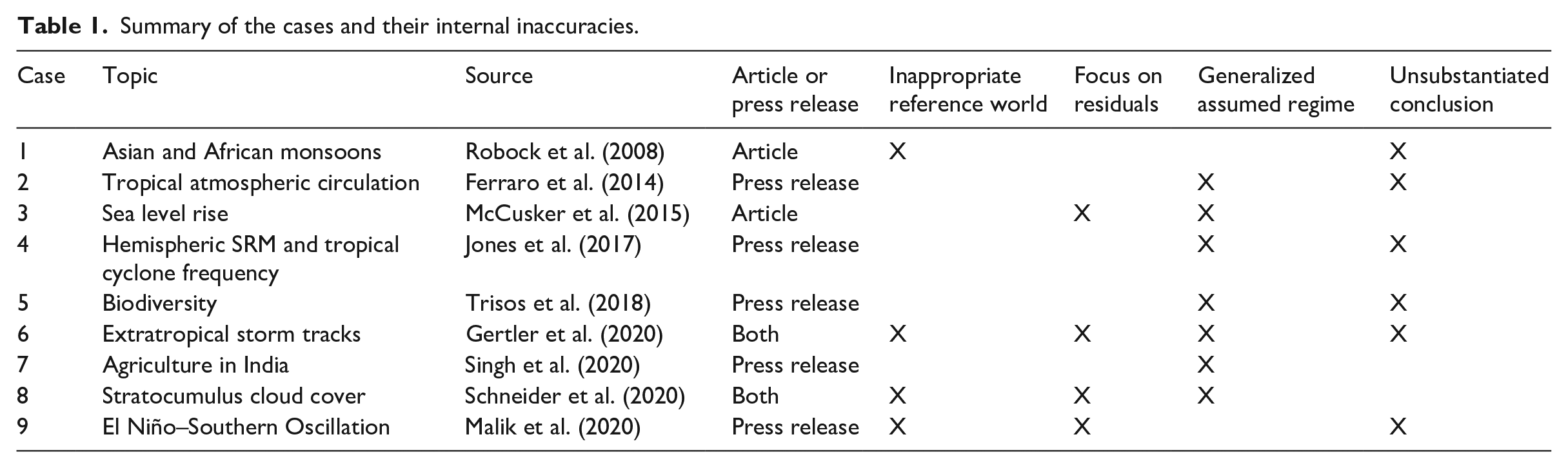
These cases nine constitute a small portion of the SRM scientific literature’s hundreds of articles, the vast majority of which present their results and conclusions in an appropriately balanced manner. Nevertheless, the influence of these cases is evident in associated assessments and news reporting (see also Reynolds, 2021). The most recent (at the time of writing) Assessment Report of the impacts, adaptation, and vulnerability working group of the IPCC states that models “find that global stratospheric SRM would. . . reduce summer monsoon rainfall relative to current climate in Asia and Africa (Robock et al., 2008)” (IPCC, 2014: 1066). This repeats Case 1’s inappropriate reference world, with respect to expected impacts in Africa, while also further generalizing the assumed the regime. Likewise, the only statement in the IPCC’s more recent Global Warming of 1.5°C regarding SRM’s potential effects on biodiversity is one of potential harm, citing Case 5 (IPCC, 2018: 347, 351). Yet this conclusion relies on that paper’s generalized assumed regime.
The inaccurate communications described here are often repeated or amplified by the news media. Headlines include “Scientists say blocking out the sun like volcanos do is not a great idea: The last-ditch plan to stop climate change might cause more problems than it solves” (reporting Case 4) (Thompson, 2017), “Geoengineering could cause more harm than climate change: US research finds policy and politics could turn a technological fix into a climate disaster” (reporting Case 5) (Fleischfresser, 2018), and “Solar geoengineering may cause more damage to the climate than good” (reporting Case 8) (Hannah, 2020). Moreover, Case 1’s unsubstantiated conclusion that SRM would “reduc[e] precipitation to the food supply for billions of people” has been repeated very widely by the news media and activists, often exaggerated to “endangering food and water sources for two billion people” (Ribeiro, 2018). The ultimate impact of SRM’s skewed scientific communication on assessments, news reporting, and—in turn—policy discussions would require more rigorous study.
To be clear, the conclusions presented here are, or may be, limited in several ways. First, this article is methodologically neither exhaustive nor systematic. Because I have not assessed every scientific paper and associated press release on SRM or randomly sampled a subset, selection bias is possible. However, I remain unable to identify any that communicate the conclusions in a way that unjustifiably downplays SRM’s apparent risks and limitations or amplifies SRM’s potential efficacy.
Second, I do not compare these results with other fields. Climate change more generally or any other empirical domain might have similar inaccuracies and skewedness. Of course, that would not excuse such miscommunication in SRM.
Third, the categories of inaccuracy might have hidden assumptions. My critiques of inappropriate reference world and focus on the residuals assert that SRM should be compared with a world of elevated GHG concentrations, not a preindustrial one. One could argue that this implicitly assumes that SRM’s consideration and development would not undermine efforts to reduce GHG emissions; perhaps this would happen. Nevertheless, a world of elevated GHG concentrations remains a more appropriate baseline than a preindustrial one because SRM is being considered as a means to reduce the unwanted impacts of elevated GHG concentrations. The decision-making context may thus be a tradeoff between a world of elevated GHG concentrations and one with elevated GHG concentrations plus SRM. Likewise, one could argue that my critique of the generalized assumed regime implicitly assumes that SRM would be used in a nearly optimal, globally coordinated manner. However, the papers in question generalize assumed regimes that would be in multiple actors’ interests and likely within their capabilities to prevent. If hemispheric SRM were occurring and dangerous, then any capable state would be motivated to counterbalance this in the other hemisphere. Sudden and sustained termination of SRM appears preventable through relatively simple policies and redundant equipment and knowledge (Parker and Irvine, 2018). Thus, the critique of a generalized assumed regime assumes merely the absence of such preventable regimes that are known to be harmful.
Fourth, the official press releases have more inaccuracies than the articles themselves (five cases of only the former, two of only the latter, and two of both). Yet at the very least, this does not mean that the inaccuracies and miscommunication do not exist. In fact, press releases can be interpreted as containing the messages that the authors wish to communicate most widely. Of course, the scientists might not have approved the press releases, even though doing so is the dominant practice.
Finally, a given study cannot be fully objective. At the same time, scientists and their associated communicators should interpret results and convey conclusions in an internally accurate, reasonably balanced manner. Doing so is admittedly relatively difficult in a contested, uncertain, and highly charged domain like that of SRM. In such a context, science cannot be pure, linear, and entirely value-free, and being an “honest broker” of alternative decisions is hard (Pielke, 2007). Despite the methodological and epistemological limitations, as well as the challenging environment, the skewed communication seems clear and has negative impacts on associated discourses.
This article asked: Which vision of SRM scientists is more accurate, “boosters” or self-reflexive? I believe that the latter is and that it even understates the situation. Not only do SRM scientists seem conscious of the risks, but some of them and their official public communicators inaccurately convey results in ways that individually unduly emphasize SRM’s apparent risks and limitations and that collectively may skew communication. If so, then the latter would be bias, that is, systematic error.
If these conclusions are correct, why do some scientists inaccurately convey their results in consistently negative ways? Importantly, these behaviors can be conscious or not. I can further only speculate based on more than a decade of conversations with SRM and other climate change researchers. They (including papers’ authors and peer reviewers) are weary veterans of battles with unscrupulous climate change deniers and worry that reporting positive evidence about SRM could lead to it being touted as a cheap alternative to cutting GHG emissions. Others are concerned about being publicly labeled as “SRM boosters” by the partisans who have resolved that it can only be harmful. By contrast, there are few (if any) pro-SRM ideologues. Instead, those who are most sanguine are reluctantly and self-reflexively so. Statements that report evidence of SRM’s potential efficacy and limited risks are often exposed to sharp criticism, whereas those that exaggerate its risks and limitations may be less likely to be scrutinized. For scientists worried about potentially undermining the necessary yet persistently insufficient emissions reductions or about their reputations in a community that is suspicious of SRM, it is safer and easier just to emphasize the negatives. Some scientists might go further, consciously opposing SRM and communicating their results in a way intended to further their policy preferences.
Meanwhile, universities’ press offices desire media coverage, which in turn is increasingly driven by attention-grabbing headlines. In this regard, imagery of mad scientists potentially destroying the Earth work well. But why don’t these press offices try to get attention through headlines that overpromise SRM as a “silver bullet” solution to climate change? One reason is that, to the extent that they only amplify papers’ conclusions, there are few, if any, scientific articles that unduly present SRM as an ideal response to climate change. Furthermore, most media releases are approved by the scientists, who—as described above—believe, perhaps rightly so, that activist opponents and academic skeptics of SRM would quickly criticize any such statements.
What is to be done? First, each of the categories of internal inaccuracies implies a rule for communicating results. Use an appropriate reference world, attributing to SRM only those projected differences between future worlds with GHG concentrations that have been held constant between them. Likewise, attribute the changes to anthropogenic climatic anomalies to SRM and any residuals of them to elevated GHG concentrations. Although modeling requires assuming an SRM regime, explicitly and clearly communicate this and note, as appropriate, that other regimes are possible and may even further reduce risk. Make only substantiated conclusions.
Second, experts in science communication should further investigate inaccuracies, skewing, and potential biases in SRM research. Exhaustive and systematic reviews of scientific papers and their official press releases should begin by asking the questions examined in this article: Do they accurately convey results? Ideally, this would go further and investigate the extent to which papers and press releases accurately describe the potential of judiciously used SRM to reduce climate change in ways that GHG emissions reduction, carbon dioxide removal, and adaptation cannot. Such reviews could be supplemented with interviews and collections of scientists’ opinion articles, quotations in the media, and social media.
Third, those who gather, interpret, summarize, and share primary literature—including other scientists, authors of prominent assessments such as those of the IPCC, and news reporters—should be vigilant of inaccuracies, skewing, and potential biases. Although this requires additional effort, it is incumbent upon these secondary communicators to read and scrutinize the reported papers and press releases one layer deeper.
Conclusion
SRM’s limitations, risks, and potential misuses are highly important and should receive substantial attention. In fact, I have argued for a red team/blue team approach in which “specialized clusters of scientists should aim to demonstrate either solar geoengineering’s effectiveness and safety or its ineffectiveness and risks” (Reynolds, 2019: 202). However, any “red team” should clearly and explicitly state its purposeful skepticism. Moreover, taking decision-making seriously necessitates balanced communication and rational consideration of all relevant expected and possible effects, positive and negative. I would be equally concerned if scientists and science communicators inaccurately conveyed results too positively. By way of analogy, suppose that a COVID-19 vaccine came with greater-than-typical limitations, risks, and potential for misuse. In such a situation, what should scientific articles and news releases emphasize? I suspect that most readers would hope for a fair depiction of the evidence for the vaccine’s expected efficacy and negative aspects, known and potential. The same should be true of the responses to climate change. SRM scientists and their official communicators have an obligation to convey the results of research in an accurate and balanced manner.
Footnotes
Acknowledgements
I thank for their comments the anonymous reviewers and the editors of The Anthropocene Review, as well as Holly Buck, Zhen Dai, Adrian Hindes, Pete Irvine, Ben Kravitz, Daniel Melling, Andy Parker, Chris Roberts, Alan Robock, and Gernot Wagner.
Author contributions
The author is the sole contributor.
Declaration of interests
The author declares no competing interests.
Funding
The author disclosed receipt of the following financial support for the research, authorship, and/or publication of this article: The author’s research fellowship is made possible through the kind support of the Open Philanthropy Project.
