




Abstract
In 2005 missiologist Rick Brown argued on the basis of Synoptic parallels that, in a few cases, Luke translates Son of God language with non-filial language, especially the term “Christ.” The argument supported the practice of using non-filial renderings of Son of God language in Bible translations made for Muslims, the stated intent being to convey the meaning of the text more clearly and to avoid offense and misunderstanding. This article tests Brown’s claim, mainly by considering the literary relationships between the Synoptic Gospels and by examining every Lukan parallel of Markan and/or Matthean Son of God language used with reference to Jesus. The results of the investigation contradict Brown’s thesis, showing that the relevant Lukan texts do not provide direct support for the rendering of Son of God language with non-filial language.
Years ago there was much discussion about how Christians should translate the New Testament phrase ὁ υἱός τοῦ θεοῦ “Son of God” in Bible translations produced for mainly Muslim populations. Since Muslims reportedly have a strong tendency to misinterpret divine sonship as referring to biological sonship, 1 and since Islam vehemently opposes the idea of anyone being God’s son, some argued that the phrase “Son of God” should be translated with non-filial phrases that were allegedly functional equivalents to the original phrase, such as messianic terms. 2 This proposition fit in broadly with the argumentation in favor of Muslim-idiom translations of the Bible, which use terminology familiar to Muslims. 3 Debate about the subject often focused on whether or not such translations were true to the original text. Proponents said that the phrase “Son of God” could indeed be faithfully represented in a target language without the use of any familial language, and critics argued that the familial element was essential and needed to be conveyed in the target language.
The conversation has largely cooled in the last decade or so, certainly due in part to the World Evangelical Alliance’s 2013 report on the issue (see Lowe 2018, 299); 4 nevertheless, the issue does not seem to be resolved, and one argument in particular seems worthy of attention years after its publication. In an article published in 2005 that spoke favorably of non-filial renderings of Son of God language, noted missiologist Rick Brown (2005b, 140–41) argued that Luke the evangelist uses the same translation strategy when handling Son of God language in his Gospel. 5 Non-filial renderings of “Son of God,” therefore, were not just acceptable but were divinely sanctioned. Brown’s case was ambitious and consequential. If he was correct, the superiority of his position on non-filial renderings would be almost incontrovertible. However, I believe Brown was wrong, and I intend, in revisiting Brown’s argument, to demonstrate exactly that: Luke does not seek to convey the meaning of “Son of God” by translating it, or even exchanging it, with non-filial language.
Brown’s argument
In his second 2005 article, Rick Brown claims that there are two instances in the Gospel of Luke where the evangelist “translates” the phrase “Son of God” with messianic language rather than sonship language. The first instance is in Luke 9.20, where Peter calls Jesus “God’s Messiah” (Brown 2005b, 140–41). 6 Matthew 16.16 has “the Messiah, the Son of the living God,” and Mark 8.29 has simply “the Messiah.” In light of the “Son” language in Matthew, Brown thinks that Matthew is creating a literal translation of the sonship language into Greek whereas Luke, writing for a gentile audience, translates it with messianic language. The second instance in the Gospel of Luke is similar. In the passion narrative, Luke records people mocking Jesus by saying, “Let him save himself if he is God’s Messiah, the Chosen One” (23.35). Matthew 27.40 has people say, “Come down from the cross, if you are the Son of God!” The parallel in Mark 15.32 includes the wording “this Messiah, this king of Israel.” Brown contends that in order to make the meaning of the phrase “Son of God” clear to his gentile readers, Luke uses the phrase “God’s Messiah.” Summarizing his interpretation of these differences between Luke and Matthew, Brown then says, “Luke did not ‘remove’ ‘son of God’; he simply translated the meaning of the original Hebrew phrase into Greek” (Brown 2005b, 140–41). (It is unclear why Brown refers to Hebrew rather than Aramaic here.)
Brown also argues that in one case Luke gives a non-filial rendering of “Son of God” that does not use messianic language. This case is 23.47, where the centurion says of the deceased Jesus, “Surely this was a righteous man.” Mark has the centurion say, “Surely this man was the Son of God!” (15.39). “Luke is simply translating the phrase,” Brown says, “into Greek in accord with its meaning in this context” (Brown 2005b, 141). He does not mention the witness of Matthew, but it is significant for the discussion, since it records the centurion saying, along with those guarding Jesus, “Surely he was the Son of God!” (Matt 27.54).
An article published in 2011 seems to indicate a change of opinion about using non-familial renderings of “Son of God.” Brown, along with co-authors Leith Gray and Andrea Gray, communicates a preference for retaining the familial element and also discourages translators from using messianic language (e.g., “Christ”) to translate sonship terms (e.g., υἱός “son”) (Brown, Gray, and Gray 2011, 116). This change of opinion may well entail a rejection of the argument about the parallel Gospel passages. However, the article does not explicitly address it, and Brown’s noteworthy observations from 2005 deserve to be taken seriously. Therefore, a careful evaluation of the argument is still in order, even after the 2011 statement.
An evaluation of the argument
In making his case, Rick Brown makes some interesting observations. However, the case is not as persuasive as it may seem at first glance. Its first major obstacle concerns the use of the phrase “Son of God” elsewhere in Luke. If Luke finds it important to substitute or translate “Son of God” with non-filial language for the sake of intelligibility, one would expect him to do so consistently. If Jewish use of “Son of God” requires special treatment for the sake of clarity in one chapter of Luke, the same would presumably be true in the next chapter. Yet, Luke does not avoid the title “Son of God” throughout the book; he repeatedly uses it without explanation (e.g., Luke 1.35; 4.3, 9, 41; 22.70). 7 Furthermore, it would be strange for Luke to choose messianic language as a substitute for or translation of filial language, since messianic language would be unfamiliar to most gentiles. Better terminology is available.
A more serious problem with Brown’s argument pertains to how it handles parallels in the Synoptic Gospels. The Synoptics share a huge amount of material, even in terms of wording, but also exhibit many small differences in these parallel passages. Nearly all biblical scholars agree that the commonality between the documents can be explained largely by literary dependence among the books; that is to say, where material in two Gospels is the same or very similar, one Gospel writer used another Gospel as a source, or both used a different source. 8 The specifics of the literary dependence between the three books are not perfectly clear, and scholars have posited many hypotheses. However, most scholars agree that Mark was written first—this belief is called Markan priority—and that Matthew and Luke both used Mark as a source. That is simple enough, but the problem becomes more complex when one recognizes that there is material that is common to Matthew and Luke but absent from Mark. Clearly Matthew and Luke did not get this material from Mark, so where did it come from? It is possible that it is original to Matthew—that is, “original” in the sense that wherever Matthew got the information from, he did not get it from another Synoptic Gospel—and that Luke got the material from Matthew (the Farrer hypothesis) (Porter and Dyer 2016, 21–22). The inverse may be true instead: the material is original to Luke, and Matthew used Luke (the Matthean-posteriority hypothesis) (MacEwen 2015, 2–3). The challenge to these theories, however, is that there is evidence to suggest that no literary dependence exists between Matthew and Luke. 9 Obviously, if that is the case, one writer did not get this material from the other’s book. With this in mind, scholars have theorized that Matthew and Luke must have got the material from some other source, which the scholarly community calls Q. This theory is called the two-source hypothesis because it argues that Matthew and Luke had two main literary sources: Mark and Q. The theory is disputed, but it remains the dominant explanation of the relationship between the Synoptic Gospels. The remainder of this article will consider the two-source hypothesis to be correct but will also consider any implications that would follow from the Farrer hypothesis or the Matthean-posteriority hypothesis being correct.
The two-source hypothesis does a fine job of explaining the similarities between the three books, but it does not explain the small differences within the parallel passages. A foundational principle is that the three writers choose and shape the material to suit their own purposes. 10 An aspect of a narrative that seems important to Mark might seem insignificant to Matthew, in which case Matthew may feel free to leave it out. Conversely, Matthew may add in or highlight details that he finds significant but Mark does not include. Authors may also give different summaries of dialogue based on what they think is important. Therefore, differences in content between parallel passages do not necessarily indicate that the authors had different information about what really happened, nor do such differences necessarily indicate different interpretations or translations of what was said. Those analyzing parallel passages should consider how the authors’ own interests and goals may influence their presentation of the material.
This understanding of the Synoptic parallels has important implications for the interpretation of the passages that Rick Brown uses in his argument. For the first text, that of Peter’s confession, the Synoptics each offer a different account of Peter’s words (see Table 1). Mark has “the Messiah” (8.29), Luke has “God’s Messiah” (9.20), and Matthew has “the Messiah, the Son of the living God” (16.16).
Synoptic comparison of Peter’s confession
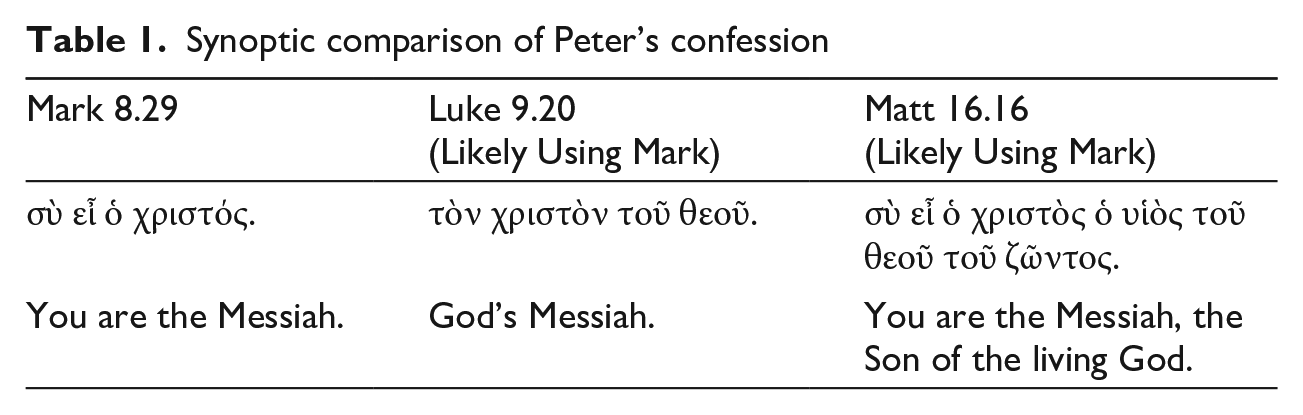
Brown speaks of Mark and Luke providing a translation in this case (Brown 2005b, 141). Whether he thinks Matthew, too, provided a translation is nowhere stated, but that seems likely. Brown says that Mark and Luke provided a translation that would be intelligible for gentiles, and there seems to be an implied contrast with Matthew’s translation for an audience including Greek-speaking Jews. So, two or all three of the Synoptic evangelists are providing their own translations of Peter’s confession. An obvious question is what source the authors are translating. No clarification is provided on this point, but it must be an earlier Hebrew or Aramaic source, either written or oral. What has already been said about the Synoptic relationships militates against such a notion. According to the majority opinion, Mark’s Gospel is the earliest, and Matthew and Luke are using Mark as a source. Mark might be translating into Greek from an Aramaic source of some kind, but Matthew and Luke are not translating anything; they are independently working with Mark’s Greek text.
Nevertheless, it is worthwhile, for argument’s sake, to accept Brown’s view on the relationships between the passages and see whether his reasoning holds up. So, it may be supposed that all three evangelists are translating from an earlier Hebrew or Aramaic source. 11 The question at this point is what the source says. Brown seems to think that it has Peter describe Jesus with a sonship title and not a messianic title. However, there is no reason to think that; all three Synoptic accounts have messianic titles, and Matthew has both kinds of title and is therefore not using a sonship title to translate the source’s messianic one. Further, R. T. France plausibly suggests that the phrase “son of God” is not exactly a synonym of a messianic title but, instead, adds more meaning by addressing, in a more direct way, the identity of Jesus (France 2007, 618–19). 12 So, if there is an earlier source, it very likely includes the messianic title. At this point Brown’s argument dissolves. Luke would be merely carrying over the messianic language from the source Gospel to his Greek-language Gospel. Brown’s idea about the translation of sonship language is therefore ruled out.
A possible counterargument here is that if the two-source hypothesis is wrong and the Farrer hypothesis is correct, then Luke did use Matthew and made a choice not to include the phase “Son of the living God.” This could potentially provide evidence for Brown’s argument. However, if that is the case, Luke still does not substitute “Son of God” with anything else; he merely retains Mark’s “Messiah,” which is also in Matthew, and follows Mark in ending the speech quotation at that point. So, he is clearly not translating sonship language with non-filial terms; he is not including that content at all. A further counterargument from the perspective of the Farrer hypothesis could be that Luke leaves out “Son of God” because he sees it as synonymous with “Messiah” and therefore superfluous in this instance (so Brown 2000, 47–48). But that is a speculative explanation that seems less likely than D. A. Carson’s suggestion that Luke leaves out “Son of God” because it is not needed for his purposes (Carson 2012, 80–81). 13 So, even if Luke is aware of Matthew, as posited by the Farrer hypothesis—and that is a tremendous “if”—this passage does not support the notion that Luke exchanges filial language for messianic language or sees “Son of God” as interchangeable with “Messiah.”
The second set of passages, that of the mockers, is even more problematic as a pillar of Brown’s argument. In this part of the passion narrative, people mock Jesus as he suffers on the cross. In Mark, a group comprised of chief priests and others says, “Let this Messiah, this king of Israel, come down now from the cross, that we may see and believe” (15.32). Luke has a similar insult, which he attributes to “the rulers”: “Let him save himself if he is God’s Messiah, the Chosen One.” Here Luke repeats the title “Messiah” from Mark but adds the phrase “the Chosen One.” The addition could be accounted for as an expansion of the meaning of “Messiah” that is meant to help the Gospel’s gentile readers. Such a concern for intelligibility could explain why Luke uses the word “rulers”; presumably he is referring to the chief priests and others in Mark but opts for a term that would be more intelligible to gentiles. 14 A different explanation, offered by Joel Green, is that Luke is borrowing from Isa 42.1 (Green 1997, 821). Matthew’s closest parallel to this insult differs from the other two: it does not have messianic language whatsoever. The group says, “Let him come down now from the cross, and we will believe in him” (27.42; see Table 2).
Synoptic comparison of the insult about Jesus saving himself from the cross
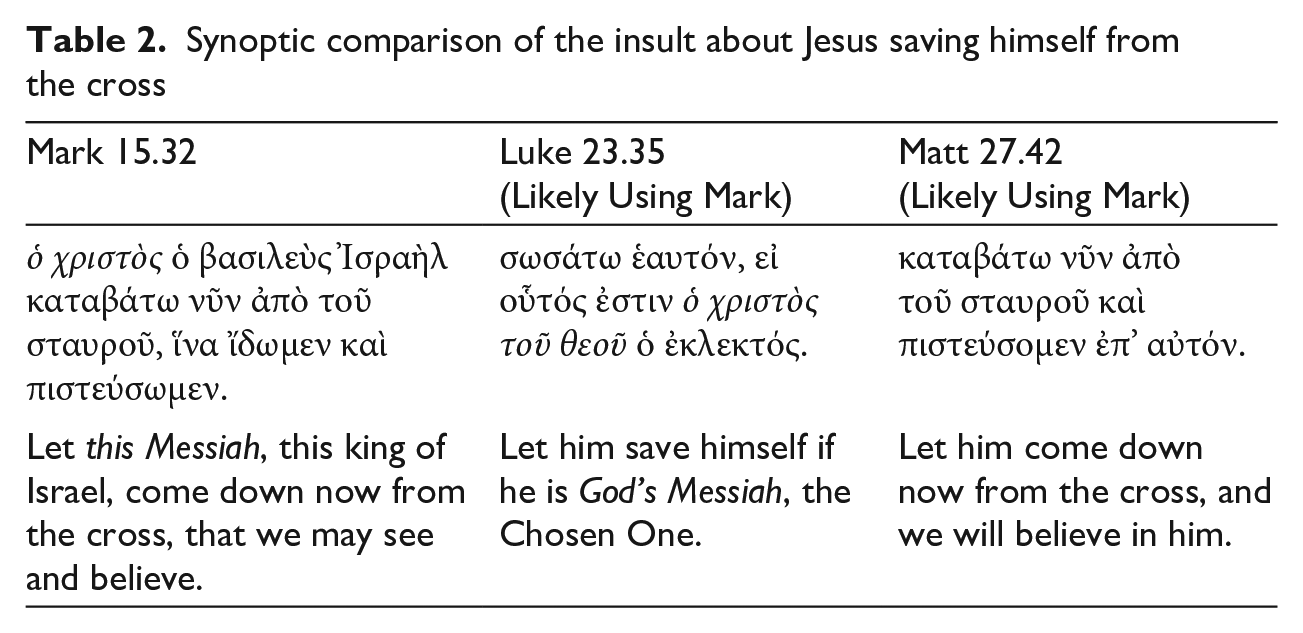
Brown says that Luke “simply translated the meaning of the original Hebrew phrase into Greek” (Brown 2005b, 141). It is unclear what Brown thinks Luke is translating. If he is thinking of a non-Synoptic source, there is very little evidence to support the notion that the source includes filial language. Mark and Luke do not include it at all. Matthew does have the phrase “Son of God” twice (Matt. 27.40, 43), but it does not appear in the insult that is the closest parallel to Luke 23.35 and Mark 15.32. Much more likely is the explanation offered by the two-source hypothesis, which is that Luke bases his account on the Markan text, which does not include filial language. In this case there is nothing significant whatsoever in the lack of filial language in the Lukan text. Luke’s account does differ noticeably from the wording of Mark, but seemingly because Luke is combining the Markan text with LXX Ps 21.8-9 (Wolter 2017, 2:526; Green 1997, 820).
The final set of texts, those recording the centurion’s exclamation, is different from the first two sets in that Luke does have an important difference from Mark. The latter has “Surely this man was the Son of God!” (15.39), and Matthew gives a very similar phrase, though he attributes it to the centurion and other people: “Surely he was the Son of God!” (27.54). Luke, by contrast, records the centurion as saying, “Surely this was a righteous man” (23.47; see Table 3).
Synoptic comparison of the centurion’s exclamation
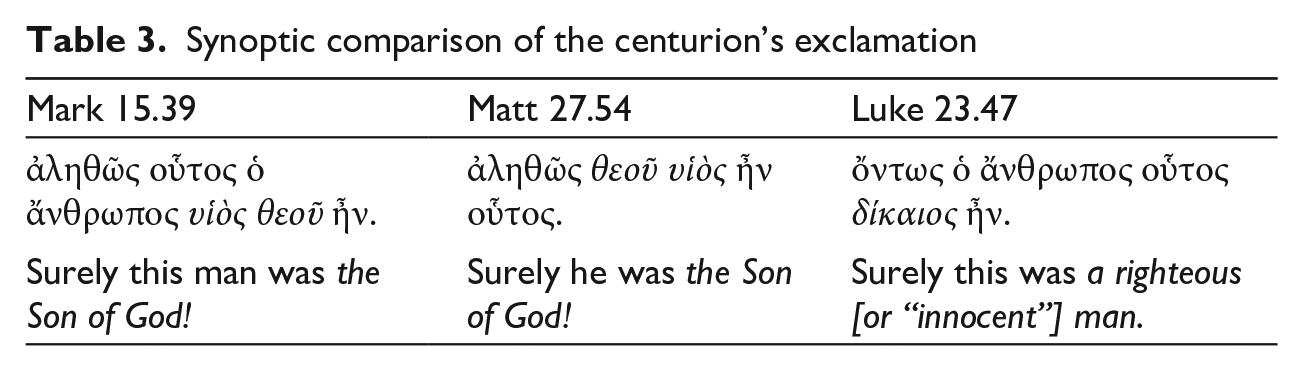
Here Luke does appear to omit the phrase “Son of God” deliberately, and he puts something different in its place: “a righteous man.” This difference deserves an explanation, and such an explanation can be gained only by venturing into the area of Gospel harmonization. Two initial observations are pertinent and help avoid excessive attention on harmonization. First, there is no strong reason to believe that any translation is happening in the Synoptic accounts of the centurion’s exclamation. It is most likely that the centurion spoke Greek, the lingua franca, which is also the language of the Synoptics. So, a notion of any evangelist, let alone Luke, offering a translation must be treated with skepticism. There is at least a small chance the centurion used Latin, 15 but in that case the term would be translated within the Greco-Roman culture, with its shared conceptual and terminological understandings. This point leads to the second observation, which is that Luke’s gentile readers would not need any help understanding what the gentile centurion really meant when he used the phrase “Son of God” (see Keener 1999, 688), which surely would have been intelligible in both Latin and Greek. So, Luke is almost certainly not avoiding the phrase “Son of God” in the interest of intelligibility.
These observations may add some clarity to the discussion, but they also further raise the question of why Luke differs from Mark. If there is no translation happening, and if Luke’s readers could understand perfectly well what the centurion meant by “Son of God,” then why would Luke put “righteous man” (23.47; or “innocent,” as in ESV) instead? An important observation is that the innocence of Jesus is a major theme in the Lukan crucifixion narrative: Pilate repeatedly says Jesus is innocent (23.4, 14-15, 22), as does the repentant criminal executed along with Jesus (23.40) (see Green 1997, 827; Bock 1996, 2:1863–64). Especially with this theme in mind, I see two possible explanations as being worth mentioning. The first is that Luke has other sources besides Mark and offers a different summary of the events, one that he thinks is more helpful or useful for his purposes. 16 Mark’s account of the remark or remarks is clearly selective rather than exhaustive, as evidenced by the fact that the Matthean parallel places “Son of God” not just on the lips of the centurion, as Mark does, but on the lips of other people as well. It is possible that Luke decides to give a different summary of what the centurion said, making his selection based on what fits best with his purposes.
A second explanation, and one that involves a less rigid harmonization of the Lukan and Markan texts, is that Luke does not have any other sources and simply alters the text in order to clarify not the meaning of the term “Son of God” itself but, rather, an important implication of the phrase as used in this specific moment: if he was the Son of God, then he was also an innocent man. Luke may well find that this implication suits his purposes better than the phrase “Son of God” (see Marshall 1978, 876).
A broader analysis
The passages that Brown cites in his 2005 article do not show Luke translating the title “Son of God” with non-filial language. However, Brown does not consider all the Lukan parallels of Markan and Matthean texts that use Son of God language of Jesus, and there is a possibility that his argument has missed something crucial. A more complete investigation of the question, therefore, should include a more extensive look at cases in Mark and Matthew in which Jesus is called the Son of God. 17
In the Gospel of Mark, Son of God language is used with reference to Jesus seven times (1.1, 11; 3.11; 5.7; 9.7; 14.61; 15.39). The exact phrase “Son of God” is not always used; for example, God calls Jesus “my Son” (1.11; 9.11). The meaning, of course, is the same. In 14.61 the title is used in a question in which the high priest asks Jesus if he is the “Son of the Blessed One,” but aside from that instance, the title is always used descriptively. Three of the Markan instances where Jesus is called God’s Son do not have a parallel in Luke: the Markan superscription (1.1) identifies Jesus as “the Son of God,” though some manuscripts do not have these words; the Markan but not Lukan account of the healings by the lake (Mark 3.11; Luke 6.17-19) mentions demons identifying Jesus as the Son of God; 18 and as discussed above, Luke has the centurion of the crucifixion narrative say “righteous man” (23.47) instead of “Son of God” (Mark 15.39). In all of the other cases (Mark 1.11//Luke 3.22; Mark 5.7//Luke 8.28; Mark 9.7//Luke 9.35; Mark 14.61//Luke 22.70), Luke repeats the “Son of God” phrase, or the variation of it, that appears in Mark. In no case does Luke substitute anything for a “Son of God” phrase.
The Gospel of Matthew has fourteen verses that use Son of God language with reference to Jesus (2.15; 3.17; 4.3, 6; 8.29; 11.27; 14.33; 16.16; 17.5; 26.63; 27.40, 43, 54; 28.19). 19 Four of them have already been discussed (16.16; 27.40, 43, and 54). Four have not been discussed in detail but are parallel to a Markan passage listed in the previous paragraph (Matt 3.17//Mark 1.1; Matt 8.29//Mark 5.7; Matt 17.5//Mark 9.7; Matt 26.63//Mark 14.61). Of the six remaining verses (2.15; 4.3, 6; 11.27; 14.33; 28.19), three do not have a Lukan parallel (2.15; 14.33; 28.19). The other three do have a Lukan parallel (Matt 4.3//Luke 4.3; Matt 4.6//Luke 4.9; Matt 11.27//Luke 10.22), and in all of these three cases, the Matthean Son of God language is present in the Lukan text. There are no instances, aside from the previously discussed centurion verse (Matt 27.54//Mark 15.39//Luke 23.47), in which Matthew has Son of God language and Luke has a parallel non-filial phrase or word. Therefore, this investigation of Synoptic parallels does not reveal any new information that could potentially support Brown’s argument.
Conclusion
This article has argued that there is no evidence to suggest that Luke ever translates Son of God language used of Jesus with a non-filial functional equivalent. It has also demonstrated that there is no case in which Luke simply exchanges such Son of God language used of Jesus for non-filial language. The closest Luke gets to such an exchange is found in 23.47, when the centurion calls Jesus “a righteous man” instead of “the Son of God” as in Mark 15.39 and Matt 27.54. In this case there is no clear reason to believe that Luke is trying to clarify the meaning of “Son of God.” It is more likely that he is giving a different summary of what was said or is giving an implication of the Son of God language. Therefore, it seems necessary to conclude that Brown’s claim about Luke translating Son of God language is false. As stated above, given the statement made in the 2011 article co-authored by Brown, it is entirely possible that he will already agree with this conclusion. This article should be taken not as a rebuttal of Brown but rather as a critical examination of an argument that, if persuasive, would have serious implications.
Brown’s article is an example of how engagement in the mission of God can drive practitioners and others to the text of Scripture with urgent questions, sometimes questions that are not settled or perhaps not even adequately explored. Such cases are an excellent opportunity for a mutually beneficial interaction between biblical studies and other disciplines and/or practices. Biblical studies can help provide an answer to the questions, and the questions can encourage new research and clearer articulations of established truths. This fact should provide additional incentive for biblical scholars and other serious students of Scripture to keep abreast of developments in the missiological realm, being ready and willing to bring the wealth of biblical studies to bear on important questions and issues while being aware of the limitations of their range of expertise. It should also provide additional incentive for missiologists, missions practitioners, and related professionals to keep abreast of developments in biblical studies, being ready and willing to apply new insights and, where necessary, to pose questions and challenges to biblical studies researchers, here too being sensitive to the limitations of their own range of expertise. And of course, those who have expertise in both spheres should be particularly motivated to bring about mutually enriching interactions between the spheres.
Footnotes
2.
For a summary of the debate, see Lowe 2018, 299–308. For arguments in favor of the practice, see esp. Brown 2000, 2005a, 2005b, 2007. For critiques of this practice, see esp. Horrell 2010; Carson 2012, 73–92; LeFebvre and Abdulfadi 2012. David Abernathy has written two long critiques: Abernathy 2010a, 2010b. However, see also the critique of Abernathy in  .
.
3.
Dennison (2012, 1n4) writes, “‘Muslim Idiom Translation’ has been defined by its proponents as translation that is specifically contextualized for Muslim people groups by using Arabic style names (e.g., Isa al-Masih vs. Jesus Christ), traditional Islamic honorifics for prophets and other respected characters, Allah as the name for God, ‘non-literal rendering’ of father-son language in reference to God, and natural syntax.” See also Brown, Penny, and Gray 2009.
6.
The word “translates” appears repeatedly throughout the discussion. All Scripture quotations in this article are from NIV.
9.
See, e.g., Allen 2000, 28–29; , 2. Since MacEwen’s book is an exploration of the Matthean-posteriority hypothesis, which posits literary dependence of Matthew upon Luke, a major theme of the book is the question of whether the evidence against literary dependence between the two Gospels is persuasive (see esp. 188–91).
10.
See Allen 2000, 75–80. For an example of this idea being applied, see , 79–82. The passages discussed here are also discussed in Brown’s argument and are analyzed below (Mark 8.29//Matt 16.16//Luke 9.20).
11.
12.
One likely reason that Matthew includes sonship language is that it is important for his purposes (Carson 2012, 79–82). , 665) writes of Matt 16.16, “This has an immediate link with the confession of Mt. 14:33 [where the disciples call Jesus ‘the Son of God’ after he walks on water]. … It will be important for Matthew that the confession of 16.16 not be on a lower level than the earlier one.”
16.
Cf. Carson’s assertion regarding the Petrine-confession passages discussed above (2012, 79–82).
17.
This investigation uses the Nestle–Aland Greek text, 28th ed., on Accordance Bible Software. Note as well that this investigation does not consider whether Luke ever puts Son of God language in the place of other Markan or perhaps Matthean language.
19.
It is entirely possible that “the Son” in Matt 24.36 is meant to be understood mainly as “Son of the Father,” since “the Father” appears very close by. However, Jesus repeatedly refers to himself as “the Son of Man” in the surrounding material, not only in the very next verse but also in vv. 27, 30, 39, and 44. For that reason it is not included in the tally here. In any case, there is no parallel to this sentence in Luke. (There is a parallel in Mark: 13.32. It, too, has “the Son.”)