



Abstract

In an ideal setting, all gastroenterology fellows and research teams will have a panel of senior experts in gastroenterology and hepatology poised to discuss medical conditions, clinical dilemmas and updates on recent scientific advancements. In this utopian scenario, this go-to panel of experts would also be available for private tutoring towards board exams, and preparation of presentations for staff meetings and journal clubs. While this may be the case in some departments, a possibly more common scenario is one in which the amount of time senior physicians can spend with the junior fellows is limited and is often used for guiding clinical management of challenging cases. International gastroenterology meetings, which provide information on the forefront of scientific advancements, often include post-graduate sessions to address this problem to some extent; however, not everyone can attend these meetings, and such a format clearly cannot be the answer to everyday needs during training. Furthermore, as these are ‘post-graduate’ courses, one may ponder if the ‘graduate’ training is not being overlooked.
This is the lacuna that might be filled by skillful use of United European Gastroenterology’s (UEG’s) E-learning resources
1
: A massive database, containing lectures, courses, posts and articles in gastroenterology and liver-related topics, which is readily available at www.ueg.eu/education. The basic principles for successfully utilizing the E-learning resources for professional advancement and personal development are as simple as ABC:
Accessing UEG’s E-learning
The E-learning website is a valuable tool for you to improve your training and expand your education. Accessing the website can be done directly at: www.ueg.eu/education, or by choosing the education tab from UEG’s homepage. A sign-in may be required, but opening an account is free of charge.
Within the website, users can look for content based on format (e.g. on-line course, lectures, live endoscopy sessions and more), publication year, conferences, or member societies (e.g. European Crohn's and Colitis Organization (ECCO) or European Society of Gastrointestinal Endoscopy (ESGE)). Special tabs can link directly to guidelines and recording from various UEG activities and courses. This way, you can attend UEG’s summer school, even during wintertime.
Break down your resource needs and expectations
Similar to a menu in a great restaurant, the first step before making your choice is knowing what you want. There are several parameters that can help you make your decision: What is your topic of interest? How much time to you have? Traditional ‘classic’ formats take between 20–60 minutes to complete, and provide a comprehensive view on each topic; however, understanding that for some users time may be a limiting factor, additional formats were developed, such as: blogs; “decide on the spot” challenges; and the “Mistake in” series, which addresses different topics in a more concise fashion. Why are you looking for material? If you are looking to get a broad perspective on a specific topic, you may prefer a state of the art lecture from a recent conference; while searching for abstracts of very focused studies in a particular topic may be more relevant after you have already consolidated your basic knowledge). Last but not least, if you are studying for a board exam, do consider that if a particular textbook was defined as the exam reference, the E-learning resource can only serve as an adjunct, but will not replace that specific textbook.
Choosing the right content
Now that you know what you are looking for, why and how much time you have to dedicate, you can choose the right content format (Figure 1).
The ABCs of utilizing UEG’s E-learning platform.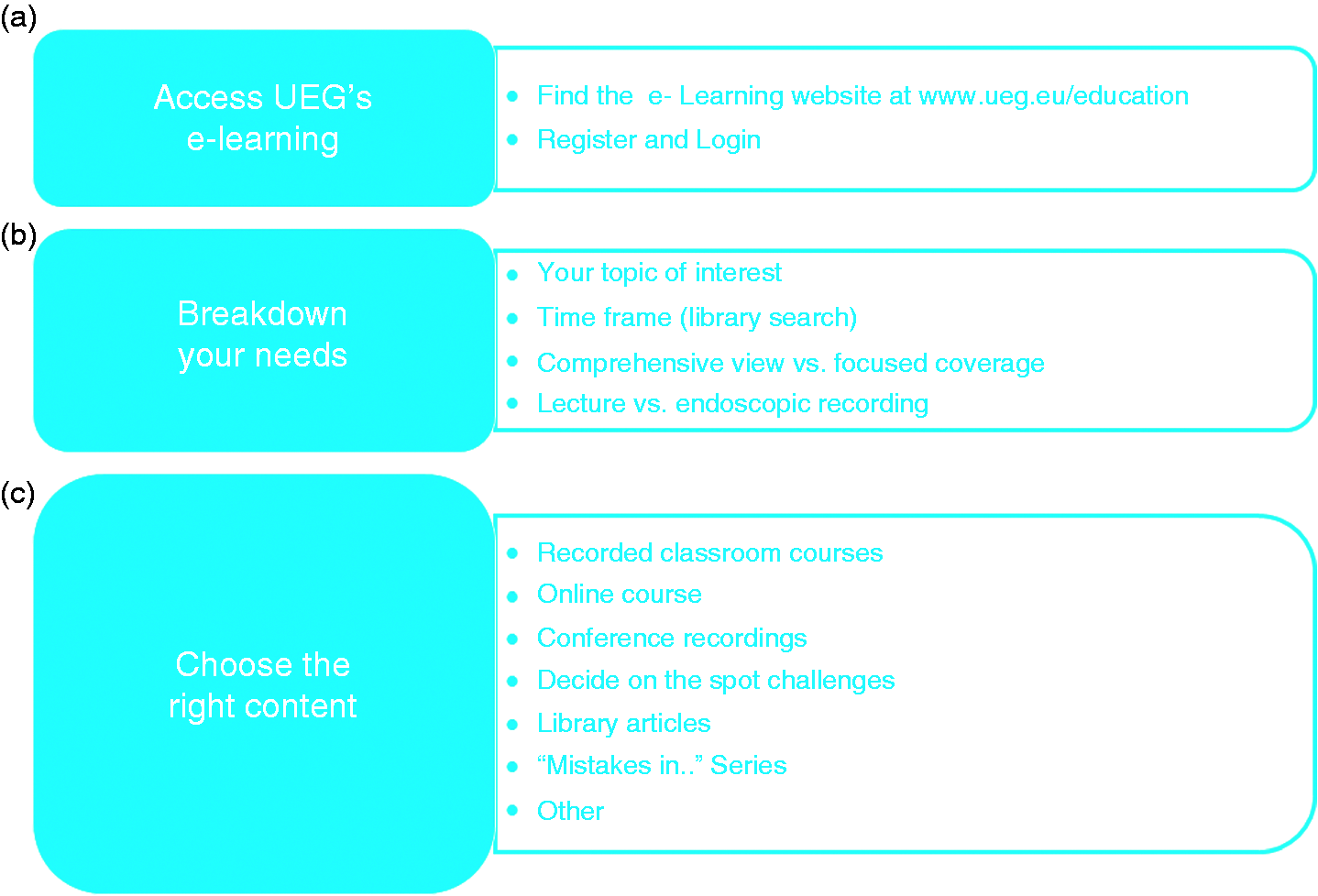
In case you have a presentation to give at the next staff meeting, and you want to hear a state-of-the-art lecture on that topic, you can look it up in the UEG Week 24/7 library, or look up a relevant on-line course. If you have already read the literature and want to receive more tips and insights from the experts in the field, the “Mistake in …” series may be more relevant. Topics can range from everyday clinical challenges, such as managing upper gastrointestinal bleeding, 2 or being more research oriented, such as finding the proper animal model to use for your next colitis experiment. 3 To watch specific endoscopic procedures, you can search the live endoscopy sessions.
Here we have completed the circle of utilizing UEG’s E-learning for your needs and development. We encourage young gastroenterologists and researchers to use these great available resources, and to share your experience with other fellows in your department, so they can make the most of it as well.