




Abstract
Circumcision is the most common operation with multiple complications. One of these complications is surgical such as urethrocutaneous fistula due to traumatic and ischemic injury during the operation. A 9-month infant with a history of swelling on the ventral aspect of the penile urethra during micturition was circumcised ritually in 3 months of birth and 6 months later was referred to Imam Reza Hospital with giant ventral fistula in the distal of the penis.
Introduction
Circumcision is the most common operation performed in the world. 1 The most common complication of circumcision is bleeding; however, surgical complications are important too and include the following, some of which may require reoperation: urethral injuries, glans injury, removal of excess skin, inadequate skin removal, epidermal inclusion cyst, abnormal scarring, resulting in adhesions, cicatrix, or penile curvature, and anesthetic complications.2,3 Although rare, injury to the urethra may occur. One such complication is an urethrocutaneous fistula located most commonly just below the coronal margin and also most frequently associated with hypospadias correction; it may occur as a complication of circumcision and the size is small generally. The assumed etiology of fistulas which occur due to circumcision is a crush, ischemia injury, or scalpel to the ventral urethra that was unequally pulled into a circumcision clamp. This injury may occur during application of the clamp when there is too much upward traction on the foreskin or the penile shaft skin is mistaken for the prepuce. 4 Fistula correction requires a second operation that is performed 6 months after the initial procedure. These repairs are generally cosmetically and functionally successful. 5 The congenital anterior urethral diverticulum is an uncommon occurrence in pediatrics and has congenital and acquired forms. Over the past 20 years, 260 cases have been reported. 6 Most children with this condition present with difficulty in initiating micturition, urine dribbling, weak urinary stream, or urinary tract infection. A careful history will reveal that these children never had a good urinary stream since birth, and the telltale sign which is a cystic swelling at the penile urethra will be observed in the majority of this cases. On compression, urine is seen dribbling out of the external meatus, and the swelling is seen to deflate. 7 To the knowledge we have, it has not been reported up to now, the giant urethral fistula following ritual circumcision in a patient with congenital anterior urethral diverticula.
Case presentation
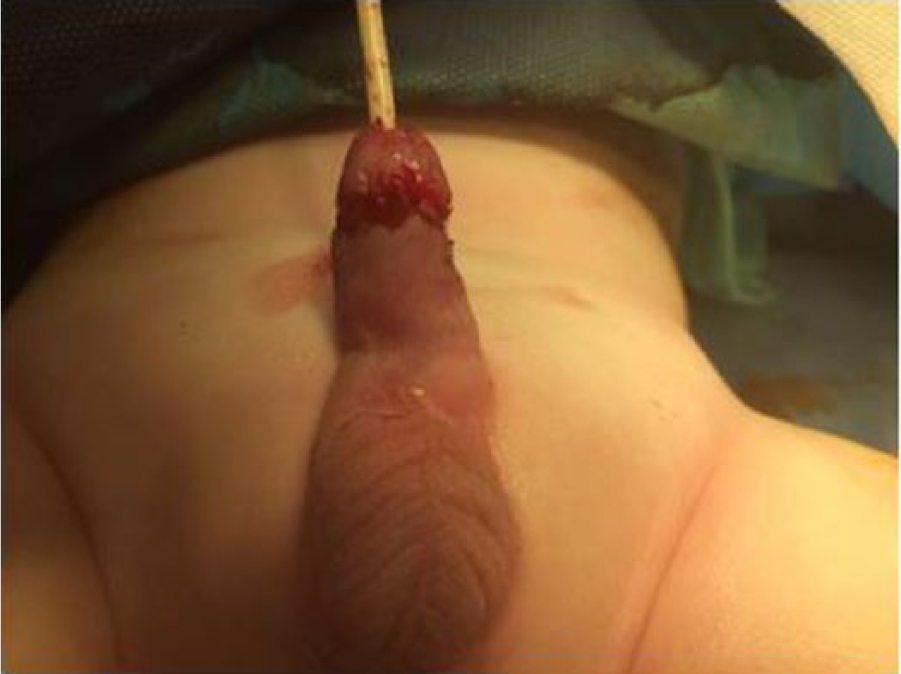
A 9-month-old male infant without any pre- and postnatal problems and normal growth indices was referred to our center. Parents described swelling on the ventral aspect of the penile urethra during micturition and urine dribbling had been seen out of the external meatus with parent’s manipulation. The swelling was deflated by compression. The infant had been circumcised ritually in 3 months. The ritual circumcision is a circumcision which is done by inexperienced rural individual unsanitary. It is done in some deprived part of Iran. Six months later, he was referred to Imam Reza Hospital with giant ventral fistula in the distal of the penis (Figure 1).

Giant urethrocutaneous fistula in the distal of the penis.
For repair of the urethra, first pre-operation cystoscopy was performed in order to be sure that anterior urethral valve was not present. The cystoscopy was fully normal, except for fistula. then an 8-Fr Foley catheter was inserted through the urethra and fixed, and subsequently remained edges of diverticula excised completely. The urethra was tabularized in two layers and then the neourethra covered by dartos layer and skin separately as we do in hypospadias repair surgery. Proper daily dressing was done for several days. Foley catheter was removed 10 days later eventually (Figure 2). The infant’s urethra 1 year after fistula repair is completely natural and parents are fully satisfied (Figure 3).
Repair of the giant urethrocutaneous fistula in the distal of the penis.

One year after fistula repair.
Discussion
Circumcision dates back more than 6000 years, with the oldest documented evidence thought to date to sixth dynasty tomb artwork in Egypt. Since that time, different religions, countries, and cultures have adopted various views on circumcision. 8 The risk of complications after circumcision is 0.2%–5%. Complications can occur immediately or months to years after a circumcision. The most common complication, which occurs so rarely and is more common in older children, is bleeding. 8 Circumcision in Iran is a religious and cultural issue that is done in the majority of cases during neonacy or infancy, and sometimes circumcision is performed ritually with inexpert persons, which accompanies complications. The result of this procedure can be complications such as urethrocutaneous fistula. Although the urethrocutaneous fistula following circumcision and also congenital anterior urethral diverticula are both separately rare, the formation of urethrocutaneous fistula following circumcision due to congenital anterior urethral diverticula is a new occurrence.
Conclusion
As more circumcisions are performed ritually and insanitary in developing countries, complications increase consequently and we encounter rare complications. This highlights circumcision should be done by experienced persons and consideration of sterility through surgery is indispensable. This report emphasizes the importance of parents’ awareness of sterile circumcision and the necessity of community education through social networks in developing countries so as to decrease the related complications.
Footnotes
Declaration of conflicting interests
The author(s) declared no potential conflicts of interest with respect to the research, authorship, and/or publication of this article.
Ethical approval
Our institution does not require ethical approval for reporting individual cases or case series.
Funding
The author(s) received no financial support for the research, authorship, and/or publication of this article.
Informed consent
Written informed consent was obtained from a legally authorized representative(s) for anonymized patient information to be published in this article.