




Abstract
Background:
In recent years, the interest in Qigong as an alternative therapy has grown following reports of its ability to regulate psychological factors in cancer patients. This is a case series to evaluate the outcome measures of Qigong when used as an adjunct to standard medical care to treat insomnia and stress in cancer patients.
Patients and methods:
The Qigong program was applied to four cancer patients with insomnia, stress, and anxiety. The program consisted of 30-min sessions involving exercise, patting of the 12 meridians, and spontaneous breathing exercises three times a week for a period of 4 weeks. The Pittsburgh Sleep Quality Index was measured as the primary outcome, while the Stress Scale, the State–Trait Anxiety Inventory, and the Functional Assessment Cancer Therapy–General determined the secondary outcomes. Insomnia, stress, and anxiety levels were examined weekly, while quality of life was examined on the first visit and the last visit.
Results:
The Pittsburgh Sleep Quality Index and Stress Scale scores were reduced after conduct of the Qigong program.
Conclusion:
This study could provide a better understanding of Qigong’s influence on insomnia and stress in cancer patients. However, a larger controlled trial should be conducted to confirm these findings.
Introduction
Due to advances in cancer diagnosis and therapy, death rates from 2004 to 2008 decreased by 1.8% annually in males, and by 1.6% annually in females. 1 Nonetheless, cancer remains one of the most feared illnesses. Furthermore, the arduous healing process and intractable symptoms are the most likely underlying causes for this fear. Most cancer patients suffer various psychological symptoms, including sleep disorders, fatigue, and depression, as well as physical symptoms such as pain, poor appetite, nausea, and vomiting.2,3
Insomnia, one of the sleep disorders associated with cancer, entails difficulties in sleep initiation and maintenance. Thus, patients suffering from insomnia do not get enough sleep, or feel fatigued even after sleep. Reportedly, 30%–75% of patients undergoing treatment for cancer experience insomnia, and the disorder is severe in 25%–75% of these patients.4,5 Insomnia induces symptoms of anxiety and fatigue, which can exacerbate sleep disorders, negatively affect cancer treatment, and consequently reduce quality of life (QOL). 6
Recently, the use of acupuncture and other forms of alternative medicine to alleviate many of the symptoms of cancer has become more prevalent. There have been reports that 40.0% of the US population, 35.9% of European inhabitants, and 44.6% of affected individuals in Japan were treated with alternative medicine in addition to routine cancer treatment.7,8
Adjunct to its impact on blood pressure,9,10 heart rate, 11 immune function, 12 and chronic pain, 13 Qigong has been studied for the management of cancer-related lymphedema, insomnia, pain, fatigue, vomiting, depression, anxiety, and QOL.14–21 However, in regard to evaluating the use of Qigong as an adjunct for the treatment of psychological symptoms such as sleep, distress, anxiety, and depression in cancer survivors, well-planned randomized controlled trials (RCTs) are lacking. 22
Accordingly, this case series was designed to obtain preliminary data on the impact of Qigong on sleep, stress, anxiety, and QOL in cancer patients, prior to the conduct of a larger RCT.
Methods
Study design
This study was a small case series designed to evaluate changes in sleep, anxiety, and QOL in cancer patients following Qigong treatment. The subjects included four cancer patients with insomnia, stress, and anxiety who were recruited at Daegu Haany University in Korea. The participants were screened from January 2013 to April 2013.The institutional review board of Daegu Haany University in Korea approved the study protocol. All four participants voluntarily signed informed consent forms.
Participants were included if they (1) were aged 20–70 years, diagnosed with cancer confirmed by histological and imaging methods; (2) experienced insomnia, anxiety, and stress for over 3 months despite proper palliative treatment; (3) exhibited an Eastern Cooperative Oncology Group (ECOG) Performance Scale score less than 3; (4) exhibited no difficulties in communicating or concentrating; and (5) were capable of participating in follow-up observations during the trial.
Participants were excluded if they (1) were unable to perform Qigong due to physical or psychological problems; (2) had underlying cardiovascular disease, or severe liver or renal diseases; (3) were pregnant, breast-feeding, or women of child-bearing age who had plans to become pregnant or refused to take appropriate contraceptives; (4) had a history of neurological or psychiatric disease; or (5) were otherwise deemed inappropriate by a physician.
Intervention
All participants performed Qigong three times per week, over the course of 4 weeks. A Qigong professor from a university administered the Qigong program according to the following program schedule: (1) exercise for 5 min, (2) patting of the 12 meridians for 5 min, and (3) spontaneous breathing exercise for 20 min. The Qigong instructor was a Korean medicine doctor who had trained in Qigong for more than 4 years.
Qigong is based on a traditional 3-beat rhythm with flexible motions that can easily be performed by any able-bodied person.23,24 Additionally, Qigong is a thorough form of exercise, in that every part of the body is involved in the performance of the motions. In the current study, the Qigong consisted of internal exercises, including patting the 12 meridians and spontaneous breathing. This program is usually performed to induce relaxation of the body, and to increase overall vitality and health, by facilitating the free flow of Qi in the body through body exercise, breathing, and meditation. Meridian patting stimulates the 12 meridians as Qi channels of the body, and consequently opens breakages, and releases stagnant energy throughout the whole body. Qigong is performed in a direction of the flow of the 12 meridians, of which three yin meridians of the hand go from the head to the hands along the inner arms (Table 1). In the sequence from yin to yang, starting from the Lung meridian, a bladder meridian is patted last. In this way, most meridians are patted with the exception of the part of that back that is beyond hands reach. Spontaneous breathing Qigong consists of Fangsong-gong followed by Taixi-fa. To achieve efficient breathing, the first maneuver is to follow Fangsong-gong, which refers to relaxing the entire body. Fangsong-gong, by which the practitioner achieves peace of the body and mind, is to stretch the body with making the spirit conscious of the part of body which instructor indicates. Under calm and quiet circumstances, patients focus their attention on the parts of the body they wish to relax when they inhale, and murmur silently the word “relax” when they exhale. Taixi-fa, a breathing practice to make the breath thinner and longer for relaxation, consists of closing the eyes while meditating, and gently watching the state of their mind and body to induce natural, long, narrow nasal breathing. Finally, once the breathing component has been completed, the arms are slowly out-stretched, the palms are rubbed together, and warmth is applied to the body sweeping from the head to the tip of the hands and feet.
Components of Qigong and flow of 12 meridians in the body.

Outcome measurements
To assess changes in sleep, anxiety, and patient QOL, the Pittsburgh Sleep Quality Index (PSQI), the State–Trait Anxiety Inventory (STAI), and the Functional Assessment Cancer Therapy–General (FACT-G) scores were recorded at the start of treatment, and every week over the course of 4 weeks.
Levels of sleep after Qigong treatment were measured using PSQI. 25 The index, developed by Buysse, is composed of 19 self-reporting questions in a total of seven categories (subjective sleep quality, sleep latency, sleep duration, habitual sleep efficiency, sleep disturbances, use of sleep medication, and daytime dysfunction). Each domain is assigned a score from 0 to 3 (with 3 reflecting the negative extreme), yielding a total ranging from 0 to 21, where poorer quality of sleep corresponds to an increasing score.
The Stress Scale suggested by Choi et al. 26 was used to measure the level of stress after Qigong. The index is composed of 30 questions of which 15 questions relate to physical parameters and 15 relate to psychological parameters. The stress level during the last week is scored from 0 (no stress at all) to 3 (constantly stressed), with the total score ranging from 0 to 45, where a higher stress level corresponds to a higher score.
Anxiety levels were measured by the index proposed by Kim and Shin, 27 which is adjusted appropriately to Korean characteristics using STAI. This index quantifies conditional anxiety levels and characteristic anxiety levels, with each component containing 20 questions scored from 0 to 4, and a total ranging from 20 to 80, where a higher score reflects a higher anxiety level.
FACT-G 28 for QOL consists of 28 questions, with seven questions in each category including physical, social/family, emotional, and functional state. Each question is scored from 0 to 4.
To assess the safety of Qigong, blood and urine tests were performed before and after the Qigong treatment, including complete blood count (CBC), aspartate aminotransferase (AST), alanine aminotransferase (ALT), serum blood urea nitrogen (BUN), creatinine, total-bilirubin, and albumin.
Results
All patients were females diagnosed with malignant cancer by pathology. Four patients completed this program. The subjects were diagnosed with thyroid (n = 2), breast (n = 1), or ovarian cancer (n = 1).
The seven criteria of the PSQI were assessed at baseline, and again at 1, 2, 3, and 4 weeks. Each answer was scored on a scale ranging from 0 to 3. The total PSQI score of the four patients exhibited a decreasing pattern after Qigong treatment. Total PSQI score initially ranged from 8 to 13, but decreased to 4 to 6 following 4 weeks of the Qigong program (Table 2).
PSQI score over time of the trial.

PSQI: Pittsburgh Sleep Quality Index.
After participation in the Qigong program, three subjects exhibited a decrease in Stress Scale scores in conjunction with improvement in clinical symptoms, particularly concerning the physical stress component of the index, and mean stress values. The mean STAI scores after Qigong treatment only decreased in one patient. The total score of each criteria, including physical, social/family, emotional, and functional state was calculated. Furthermore, the participants exhibited an increase in QOL after Qigong treatment (Table 3).
Stress Scale, STAI, and FACT-G over time of the trial.
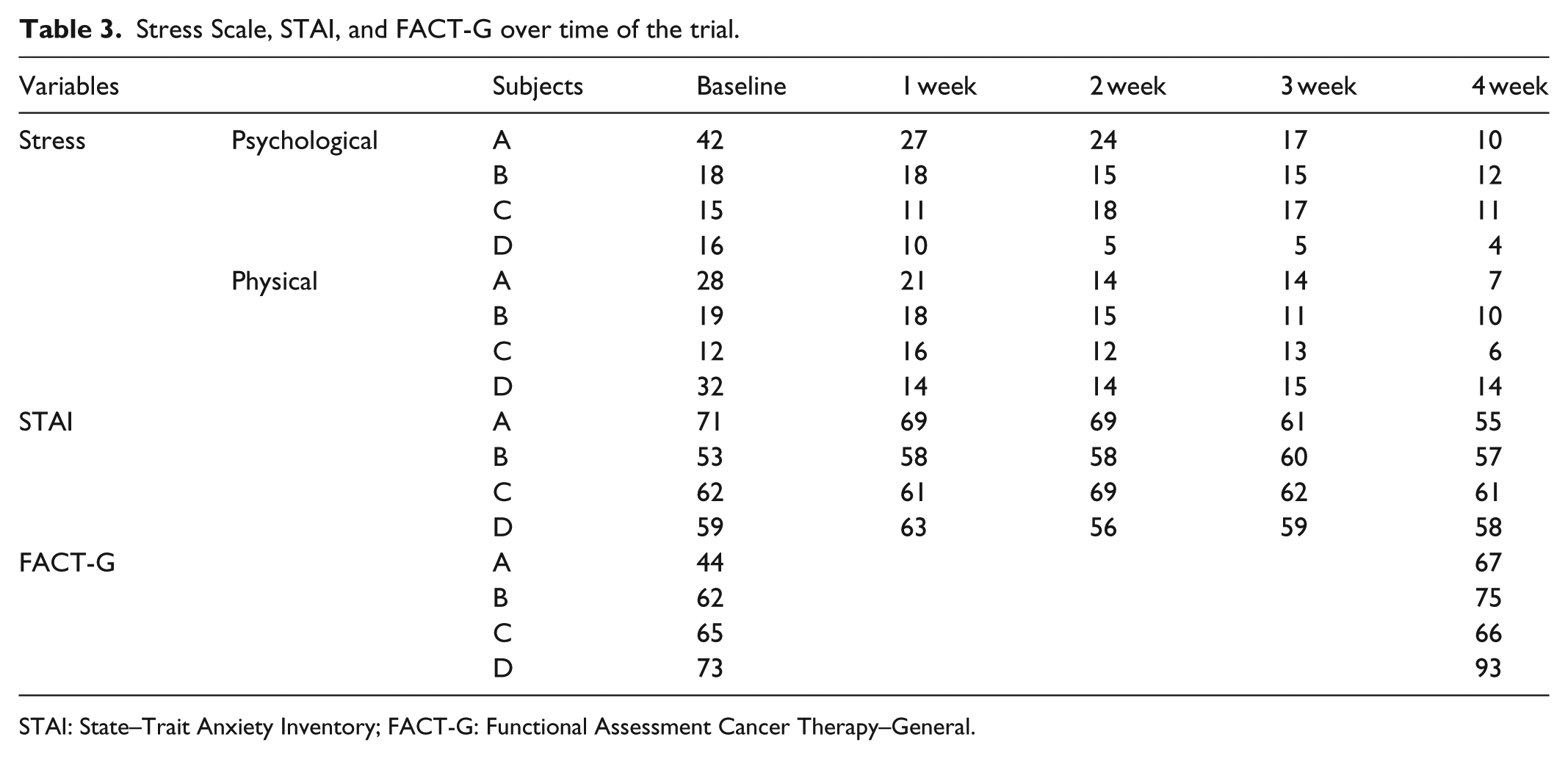
STAI: State–Trait Anxiety Inventory; FACT-G: Functional Assessment Cancer Therapy–General.
The total STAI score for measuring the severity of sleep appeared to improve overall in all of the patients over the course of program. Subject A no longer required medication for sleep after beginning the Qigong program. On the other hand, Subject C exhibited a slight increase at 2 weeks; however, she was nervous throughout program, and complained of noise from the upstairs during the daytime.
In regard to psychological and physical stress, all subjects exhibited a pattern of decreasing stress except for Subject C, whose stress level fluctuated during the program. Among the participants, Subject A exhibited the highest percentage of improvement in psychological and physical stress, at 73.8% and 82.1%, respectively. Her attendance and attitude regarding Qigong were very good, and she enjoyed the study.
The results of the evaluation of anxiety levels revealed a varied pattern. Except for Subject A, anxiety levels were maintained at levels similar to baseline during the study, but increased after the study. QOL was evaluated at baseline, and at 4 weeks. Subjects A, B, and D showed improvement (52.3%, 34.3%, and 27.4%, respectively), while Subject C showed no change.
During this study, CBC, AST, ALT, BUN, creatinine, total-bilirubin, and albumin remained within normal ranges. None of the results of the post-screening blood tests differed substantially from the corresponding pre-screening blood test results, and no side effects related to Qigong were reported during the study (data not shown).
Discussion
This study was observational and was designed to obtain preliminary data to serve as the basis for a future, large-scale controlled trial. The results of this study indicated an improvement in the psychological symptoms of sleep and stress associated with heterogeneous cancer.
In the current study, Qigong was selected because it has a number of potential advantages for the promotion of health among people with chronic illnesses, including cancer. After chemo- or radiation therapy, cancer patients experience various side effects such as pain, sleep disorders, nausea, vomiting, and fatigue, which decrease overall QOL. As an alternative therapy, Qigong has received increasing attention, because it has an established history of use for facilitating the mind and body. Furthermore, it represents a safe and easy-to-follow intervention with no reports of adverse events. The Qigong program in the current study consisted of physical postures, breathing, and meditation.
Several studies investigated the effects of Qigong on sleep, distress, anxiety, and depression in cancer patients, some of which demonstrated positive results (Table 4). However, previous studies included a variety of Qigong methods, including Guo-Lin, Chan-Chungm, Tai-chi chih, Daoist, and Buddhist, and likewise modified the form concerned with the characteristics of the patients. In addition, the prior studies involved differences in methodology in terms of length or intensity of Qigong. Therefore, there are limitations to making accurate comparisons regarding the efficacy of Qigong. To our knowledge, studies that investigated sleep and stress as primary outcomes are lacking.
Clinical research investigating the influence of qigong on sleep and psychological factors in cancer patients.

nr: not reported; QOL: quality of life.
Most of the prior Qigong studies have focused on the assessment of QOL or immune function. Thus far, there have only been a few reports of Qigong studies that used the PSQI to investigate sleep disorders in cancer patients. This case series provides preliminary data to support the use of the Qigong program in cancer patients who have experienced psychiatric side effects. However, because of the limited number of subjects involved, it is difficult to determine the full importance of the results. Nonetheless, the apparent positive impact on sleep and stress as well as QOL after Qigong treatment in cancer patients could provide a solid basis for a future controlled study involving a larger sample size.
Conclusion
This case series study provides potential evidence for the efficacy of Qigong in alleviating insomnia, stress, and anxiety in a non-invasive manner. As well, this study supports the safety of using a Qigong program as an adjunct to standard care in cancer patients. Nevertheless, a future randomized control trial with adequate sample size is required to determine the long-term effects of the Qigong program.
Footnotes
Acknowledgements
Jungchul Seo and Kyungsoon Kim contributed equally.
Declaration of Conflicting Interests
The authors declared no potential conflicts of interest with respect to the research, authorship, and/or publication of this article.
Funding
The author(s) disclosed receipt of the following financial support for the research, authorship, and/or publication of this article: This study was supported by a grant from the Ministry of Health & Welfare, Republic of Korea, 2012.