




Abstract
Objectives:
Conservative treatments for anterior cruciate ligament (ACL) tears may have just as good an outcome as invasive treatments. These include muscle strengthening and neuromuscular proprioceptive exercises to improve joint stability and restore motion to the knee. The Purpose of the current work presents was to examine the feasibility of a novel non-invasive biomechanical treatment to improve the rehabilitation process following an ACL tear. This is a single case report that presents the effect of this therapy in a patient with a complete ACL rupture who chose not to undergo reconstructive surgery.
Methods:
A 29-year old female athlete with an acute indirect injury to the knee who chose not to undergo surgery was monitored. Two days after injury the patient began AposTherapy. A unique biomechanical device was specially calibrated to the patient’s feet. The therapy program was initiated, which included carrying out her daily routine while wearing the device. The subject underwent a gait analysis at baseline and follow-up gait analyses at weeks 1, 2, 4, 8, 12 and 26.
Results:
A severe abnormal gait was seen immediately after injury, including a substantial decrease in gait velocity, step length and single limb support. In addition, limb symmetry was substantially compromised following the injury. After 4 weeks of treatment, patient had returned to normal gait values and limbs asymmetry reached the normal range.
Conclusions:
The results of this case report suggest that this conservative biomechanical therapy may have helped this patient in her rehabilitation process. Further research is needed in order to determine the effect of this therapy for patients post ACL injuries.
Introduction
Presently, the most common treatment for anterior cruciate ligament (ACL) injuries in young patients is focused on surgical repair with rehabilitation. There is, however, growing evidence that conservative treatments may have just as good an outcome as invasive treatments. A recently published study by Frobell et al. 1 showed that patients treated immediately with reconstructive surgery did not fare better than those that had rehabilitation treatment with delayed reconstruction or no reconstruction.
Guidelines for the conservative treatments for patients with ACL tears focus on muscle-strengthening and neuromuscular proprioceptive exercises to improve joint stability and restore motion to the knee. 2 AposTherapy is a relatively new noninvasive therapy currently used for a wide range of musculoskeletal disorders. This device allows for precise adjustment of the center of pressure (COP) of a patient’s foot during gait, thereby changing the forces acting on the body in general and on the knee joint.3,4 Studies have shown the ability of this device to increase/decrease activation of specific lower limb muscles. 5 The therapy also adds perturbation training that may increase the entire stability of the knee joint.2,6 Other studies have shown improved clinical symptoms such as pain and quality of life in several musculoskeletal disorders following treatment.7,8 The purpose of this work was to examine the feasibility of this therapy to improve the rehabilitation process following an ACL tear. This work is a case report that presents the effect of this therapy in a patient with a complete ACL rupture who chose not to undergo reconstructive surgery.
Case presentation
The patient was a 29-year-old female athlete (height = 170 cm; weight = 60 kg). Exercise intensity before the injury included 16 h/week of volleyball training and another 6 h/week of kite surfing (Tegner score 9). 9 Injury occurred during an indoor volleyball game, in which the patient landed poorly. The injury was an acute indirect injury to the knee (Video 1). The protocol was approved by the Institutional Helsinki Committee (Trial registration number NCT00767780). Written informed consent was obtained from the patient for publication of this case report and any accompanying images.
Immediately after injury, the patient experienced pain, swelling and difficulty bearing weight. She arrived at the emergency room after the injury, where the physician on staff noted pain, swelling and effusion of the knee. A radiograph ruled out a fracture. A joint aspiration suggested an acute ACL tear. The patient was discharged with instructions for physical therapy and a follow-up after a week. At follow-up, the patient underwent a magnetic resonance imaging (MRI) analysis, which showed a complete ACL rupture, lateral bone bruising and minor medial and lateral meniscal tears to her left knee. A total of 2 days after injury, the subject arrived at the AposTherapy center and underwent a gait analysis. Following the gait analysis, the all phases of step-cycle (Apos) system was calibrated. Treatment was then initiated, which included carrying out her daily routine with the biomechanical device. In all, 10 days post-injury, the patient started traditional physiotherapy in addition to AposTherapy for 6 months. The subject underwent follow-up gait analyses at weeks 1, 2, 4, 8, 12 and 26.
AposTherapy uses a biomechanical device (Figure 1) comprising four modular elements attached to foot-worn platforms (Apos system, Apos Medical and Sports Technologies Ltd., Herzliya, Israel). The modules are two convex-shaped biomechanical elements attached to each foot. One is located under the hindfoot region, and the other is located under the forefoot region. The elements are attached to the subject’s foot via a platform in the form of a shoe. The platform is equipped with a specially designed sole that consists of two mounting rails that enable flexible positioning of each element under each region. Each element can be individually calibrated to induce specific biomechanical challenges in multiple planes.3,4

The biomechanical device (a) biomechanical device comprising two individually calibrated elements and a foot-worn platform. The elements are attached to under the hindfoot and forefoot regions of the platform. (b) The biomechanical elements are available in different degrees of convexity and resilience. (c) The specially designed sole of the platform includes two mounting rails and a positioning matrix to enable flexible positioning of each biomechanical element.
Gait analysis was carried out using a computerized mat (GaitMat™ system; E.Q. Inc. Chalfont, PA, USA). During each gait analysis, the subject was required to walk barefoot at a self-selected speed for 3 m before and after the end of a walkway mat to allow sufficient acceleration and deceleration space outside the measurement area. Each gait test included four walks, and the average value of the four walks was calculated for each parameter. The following spatiotemporal parameters were evaluated in each gait test: velocity (cm/s), step length (SL) (cm), single limb support (SLS) (%gait cycle), base of support (BOS) (cm) and temporal distance (T-D) symmetry. T-D symmetry was calculated for SLS and SL (see Table 2). 10
At the end of the study, the patient was asked to fill out the Western Ontario and McMaster Universities Osteoarthritis Index (WOMAC) and the Short Form 36 (SF-36) to evaluate the severity of pain and the levels of function and quality of life.
A physical examination of the patient at 3 weeks post-injury showed that the knee was swollen with minimal to moderate effusion. A range of motion exam showed full extension and painful flexion to 100°. Anteroposterior (AP) stability was examined via the Lachman maneuver, anterior drawer test and pivot shift test. All tests were positive and confirmed the findings of the MRI exam of an ACL rupture. Over the rest of the study, the swelling and effusion reduced significantly. At 3 months post-injury, the subject first returned to beach volleyball, and by 6 months, she returned to her previous level of activity (Video 1).
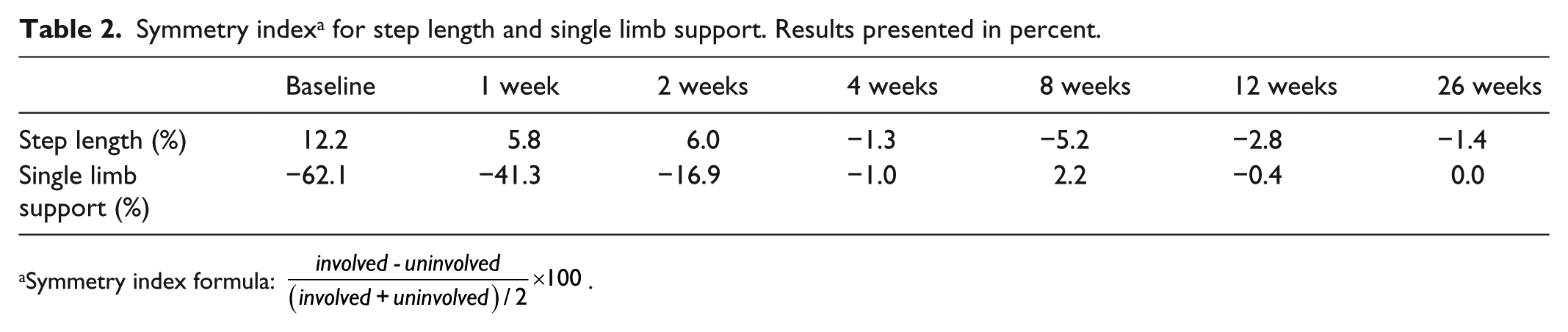
Gait measurements at baseline and at each follow-up are presented in Table 1. All gait parameters and T-D symmetry steadily improved from baseline to week 4, after which, they remained stable for the rest of the treatment period. Compared to baseline, velocity steadily increased by 244% of its original value (Figure 2); SL gradually increased by 66% and 90% in the involved and uninvolved limb, respectively (Figure 3); SLS increased by 43% for the involved limb and decreased by 24% for the uninvolved limb (Figure 4) and BOS decreased by 46% and 32% in the involved and uninvolved limb, respectively (Table 1). T-D symmetry for SL improved from a value of 12.2% at baseline to −1.4% at the end of the study period. T-D symmetry for SLS improved from a value of −62.1% at baseline to 0.0% at the end of the study period (Table 2).
Changes in spatiotemporal parameters following 6 months of AposTherapy.


Changes in gait velocity following 6 months of AposTherapy.
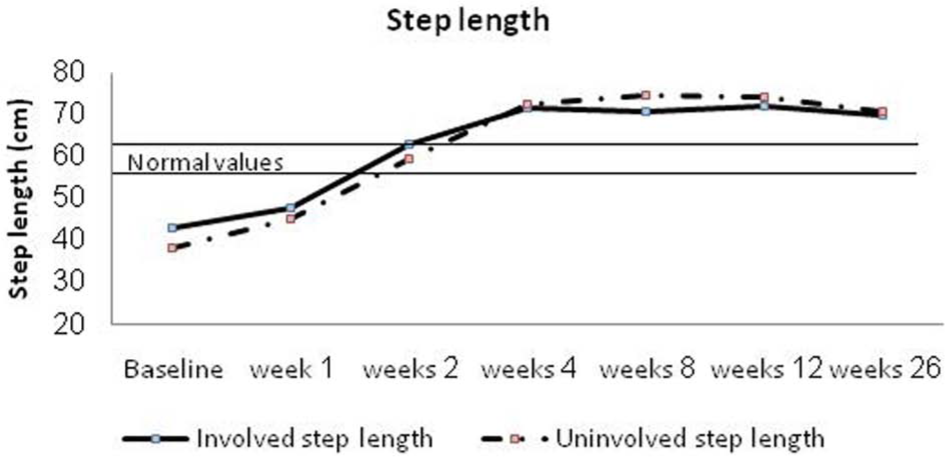
Changes in step length following 6 months of AposTherapy.

Changes in single limb support following 6 months of AposTherapy.
Symmetry index a for step length and single limb support. Results presented in percent.
Symmetry index formula:
Discussion
Recent evidence suggests that in ACL tear injuries, surgery and conservative treatments have similar outcomes with regard to pain, function and return to training intensity prior to injury.1,11,12 Noninvasive therapy may therefore be preferable, especially in coping patients, considering that surgery is costly, impairs quality of life and, in some studies, is associated with an increased incidence of knee osteoarthritis (OA).13,14 In this preliminary case report, we applied a unique therapy, which combines shifting of the COP in order to change the vector trajectory at the knee and reduce loads from the affected area, and apply perturbation training, to a patient after an acute ACL rupture.3,4 The purpose of this case report was to examine the feasibility of this therapy to help in the rehabilitation process post an ACL tear injury.
Results showed that the spatiotemporal gait parameters of velocity, SL, SLS and BOS were substantially compromised following injury. These parameters improved consistently during the first 4 weeks of treatment and remained stable thereafter. In order to determine the clinical importance of these results, we compared them to normal values, other therapies and the unaffected limb. By week 4, velocity, SL and BOS returned to normal ranges of the healthy population.15–17 In a study by Hartigan et al., 18 an improvement in velocity and SL was taken to indicate an increase in stability and less pain. In this case report, BOS value was substantially high at baseline, indicating that the patient needed a wider gait to balance during the acute phase of the injury. With recovery, however, a smaller BOS was noted over time, signifying increased stability with therapy.
Previous studies suggest that gait should be relatively symmetrical where a difference of 5% between limbs is considered normal.15,19 In this case report, there was a substantial asymmetry between limbs in SL and SLS at baseline. This asymmetry gradually improved over time and reached normal values. At baseline, SLS symmetry had a negative value, indicating that support was heavily skewed toward the uninvolved limb, thus relieving the afflicted limb. However, by week 4, SLS symmetry was substantially higher, indicating that both limbs spent equal time supporting weight. This is a key finding considering that limb symmetry is an important measure of most gait abnormalities. 20 Another important finding is that the patient reached symmetry via an improvement in her injured knee and not by a deterioration in her noninjured knee. This sort of phenomenon can often occur in other orthopedic disorders such as knee OA and after total knee replacements.21,22
The improvements in these gait parameters correspond with those found in several other studies of conservative therapies or reconstructive rehabilitation.17,19,23 However, the most compelling difference between previous works and this report is the time it takes to return to normal values. In this case report, the patient returned to normal parameters after 4 weeks of treatment, whereas in similar study designs, the duration to normal values was longer (Figure 5).17,19,23,24

Improvements in velocity over time in this case report compared to velocity changes after reconstructive surgery 19 or with other conservative therapies. 23 Baseline velocity was not published in the other studies. For graphical purposes, the baseline velocities were assumed to be equal to the baseline velocity in this study.
In addition to the gait analysis, the WOMAC and SF-36 questionnaires were added as additional outcome measures. After 6 months of therapy, the patient was asked to complete both questionnaires. Although the patient failed to fill out the forms at baseline, it was assumed that values at baseline would be in the lower ranges for both questionnaires. At the study endpoint, the surveys showed normal values of pain, function and quality of life (Table 3).
Pain, function and self-evaluation questionnaires at the end of the study period.

WOMAC: Western Ontario and McMaster Universities Osteoarthritis Index; SF-36: Short Form 36.
The weaknesses of this study lie mainly in the generalizability of the study. As a case report, it presents the results of a noninvasive therapy for acute ACL injury based on a single patient. Therefore, we cannot draw conclusions regarding the effect of this therapy. Nevertheless, this case report presents the feasibility of this therapy to help the rehabilitation process following an ACL injury, which should be further examined. We therefore recommend that future studies should investigate this therapy in a larger acute ACL tear population. Additionally, it would be interesting to determine the effect of the therapy on the patient after ACL tear that chose to undergo reconstructive surgery in order to determine if the therapy can expedite recovery time.25,26
Conclusion
This case report presented the feasibility of a biomechanical therapy applied to a patient after an acute ACL rupture to help the rehabilitation process. Gait patterns and limb symmetry improved and reached normal levels by 4 weeks and maintained this level over 26 weeks. We recommend future studies should investigate this therapy in a larger acute ACL tear population.
Footnotes
Appendix 1
Video 1.
Declaration of conflicting interests
Avi Elbaz, Amit Mor and Ronen Debi hold shares in Apos. Ganit Segal is a salaried employee of Apos. Marc Samuel Cohen, Eytan Magen Debbi, Udi Rath, Guy Morag and Yiftah Beer are co-researchers in a number of studies. They do not receive and are not entitled to any financial compensation from Apos.
Funding
This study was not funded in any way.