



Abstract
Objectives:
The objective of this study is to determine the distribution and attributes of licensed physical therapy practitioners in the Kingdom of Saudi Arabia.
Methods:
A cross-sectional research study was conducted. Data were retrieved from the database of the Saudi Commission for Health Specialties as of January 9, 2025. Data of all the licensed physical therapy practitioners were reviewed which included demographic characteristics, geographical distribution, educational institution, and workplace setting. Descriptive analysis was conducted using the Statistical Package for Social Sciences version 19.0.
Results:
A total of 5720 physical therapists are licensed in Saudi Arabia according to the database of the Saudi Commission for Health Specialties as of January 9, 2025. Mean age of the physical therapy practitioners is 36.26 ± 8.81 years. Over half (n = 2970, 51.9%) of the physical therapy practitioners are males, and 70.6% (n = 4038) of the workforce is ⩽40 years. The most frequently held academic qualification is bachelor’s degree (n = 3871, 67.7%), with 63.4% (n = 3624) and 10.8% (n = 617) professionals ranked as specialists and senior specialists, respectively. According to administrative regions, Riyadh has the most numbers of physical therapy practitioners (n = 1408, 24.6%), followed by Makkah (n = 1059, 18.5%) and Eastern province (n = 825, 14.4%). Physical therapy practitioners are almost equally employed in public (n = 2707, 47.3%) and private (n = 2555, 44.7%) settings in Saudi Arabia.
Conclusions:
Saudi Arabia has a fairly young physical therapy healthcare workforce with professionals equally balanced between male and females. However, there is a prominent geographical disparity of licensed physical therapy practitioners across administrative regions in the Saudi Arabia.
Introduction
According to the World Health Organization (WHO), “disability results from the interaction between individuals with a health condition, such as cerebral palsy, Down syndrome, and depression, with personal and environmental factors including negative attitudes, inaccessible transportation and public buildings, and limited social support.” 1 Globally, the prevalence of disability is around 16% which impacts an estimated 1.3 billion individuals. As per WHO statistics, individuals with disabilities die prematurely (around 20 years earlier) compared to those with no disabilities. 2 A snowballing number of aging population is linked with increased occurrence of chronic noncommunicable diseases. It has been reported that one in every five elderly individuals aged ⩾60 years and one in every two elderly individuals aged ⩾75 years are disabled. 3 Advancing age and multicomorbidity have independent associations with higher rates of disability. 4
In the Kingdom of Saudi Arabia, disability is a significant socioeconomic problem. As per the report of the General Authority for Statistics, 5 7.1% (n = 1,445,723) of the population in Saudi Arabia suffer from some form of disability, with 52.2% being males and 47.8% females. Physical or mobility associated disability is most frequently documented (2.53%, n = 833,136). 5 It is anticipated that these numbers might continue to rise owing to increase in established risk factors like obesity, physical inactivity, and road traffic accidents. 6 The burgeoning disability rates is a persistent challenge for healthcare system, demanding an all-encompassing approach to mitigate these risk factors and quality rehabilitation services in Saudi Arabia. 7 The latter has also been emphasized in Saudi Arabia’s Vision 2030 strategy to ensure accessibility to quality healthcare services, including rehabilitation. 6
The healthcare system in Saudi Arabia operates under a mixed model that combines both public and private sectors. The primary authority responsible for planning, regulation, and service delivery is the Ministry of Health, and public healthcare services are largely funded through the national government budget. Saudi Arabia provides a government-funded public healthcare system that offers free healthcare services to Saudi citizens through public hospitals and primary healthcare centers. Non-Saudi residents are covered under a mandatory health insurance system. Employers are legally required to provide health insurance coverage for their expatriate employees and, in many cases, their dependents.8 –11
Physical therapy practitioners are an integral part of rehabilitation services, providing care to individuals across a wide range of conditions, including acute and chronic diseases, musculoskeletal injuries, neurological disorders, and functional limitations, to improve mobility, restore function, and enhance overall quality of life. 12 In Saudi Arabia, the university physical therapy program follows a structured 5-year curriculum in which clinical education is progressively integrated, beginning with supervised clinical placements in affiliated hospitals and community settings during the third and fourth years, followed by a mandatory 12-month full-time clinical internship in the fifth year involving rotational, hands-on patient care across diverse practice settings. Upon graduation, professional classification and career progression in Saudi Commission for Health Specialties (SCFHS) are determined through a nationally regulated framework that considers academic qualifications, documented clinical experience, licensure examination, professional evaluation standards, and compliance with continuing professional education requirements, rather than academic degree alone. 13
A study by Al-Senani et al. investigated the supply of rehabilitation professionals in Saudi Arabia and reported scarcity of physical and occupational therapists for rehabilitation care for ischemic stroke patients. 14 Another recent study from Saudi Arabia by Wasfi et al. cited that the estimated ratio of physical therapists at the Ministry of Health is 0.69/10,000 population. In that study, no statistically significant association was observed between the supply of physical therapists and the regional demand for rehabilitation services. 7 To ensure efficient provision of rehabilitation services in Saudi Arabia, determining the adequate stream of rehabilitation workforce is crucial. However, there is a dearth of data relevant to the supply of rehabilitation healthcare professionals like physical therapy practitioners in Saudi Arabia. Hence, this study was aimed to determine the distribution and attributes of licensed physical therapy practitioners in the Kingdom of Saudi Arabia. We believe that mapping of the distribution of physical therapy workforce is essential as it will allow future studies to explore demand and supply discrepancy and possible gaps in access to quality rehabilitative services in Saudi Arabia.
Methods
Ethical considerations
Ethical approval and informed consent was not required for this study as no human subjects were directly involved. All data were obtained from the SCFHS database upon formal request. The study was conducted in accordance with the Declaration of Helsinki and its subsequent amendments.
Study design, setting, and participants
A cross-sectional research study was conducted to determine the distribution and attributes of licensed physical therapy practitioners in the Kingdom of Saudi Arabia. The data were retrieved from the database of the SCFHS as of January 9, 2025. The SCFHS is a national regulatory authority in Saudi Arabia that regulates and certifies healthcare professionals in Saudi Arabia.15,16 To actively practice in clinical setting in Saudi Arabia, it is mandatory for the professionals to get registered and certified with the SCFHS. Hence, the SCFHS is the ideal platform for valid sourcing of the data of physical therapy practitioners. Data of all the licensed physical therapy practitioners were reviewed.
Inclusion and exclusion criteria
The study included all individuals listed in the SCFHS registry as licensed physical therapy practitioners who held an active license as of January 9, 2025. Practitioners from all sectors, including the Ministry of Health, private institutions, and other governmental organizations, across all administrative regions of Saudi Arabia were considered eligible. Records of practitioners with expired, suspended, or revoked licenses, duplicate entries, or incomplete information (such as missing license number, specialty, or work location) were excluded. Additionally, practitioners not currently practicing in Saudi Arabia or whose primary work location could not be determined were also excluded from the analysis.
Data collection
The data were requested and retrieved directly from the SCFHS registry by the author of the study. All personal identifiers were removed during extraction to ensure de-identification, and only anonymized data were used for analysis. The de-identified dataset was stored securely on a password-protected computer accessible only to the author. For the purpose of analysis, following data were retrieved on request from the SCFHS: age, gender, academic qualification (high school degree/short course, technician course, certificate, diploma, training/internship, bachelor’s degree, master’s degree, doctoral degree, and unknown), career rank (health assistant, technician, specialist in training, specialist, senior specialist, and consultant), administrative regions of Saudi Arabia (Riyadh, Makkah, Eastern Province, Al-Madinah, Asir, Al-Qassim, Jizan, Tabuk, Al-Jawf, Hail, Najran, Northern Borders, Al-Bahah, Gulf Region, outside Saudi Arabia, and unknown), educational institution (government, private, non-Saudi, and unknown), workplace setting (public, private, and unemployed/unknown), and physical therapy specialty (no specific specialty, cardiovascular, musculoskeletal, neurological, pediatrics, sports medicine, vestibular, and women health).
Statistical analysis
Data were retrieved and managed in Microsoft® Excel 2017 before initiating the formal analysis. Descriptive statistical analysis was conducted using the Statistical Package for Social Sciences (SPSS) for Windows version 19.0 (SPSS, Inc., Chicago, IL, USA). For numerical data, mean ± standard deviation was reported, while frequencies and percentages were presented for categorical (nonnumeric) data. Besides demographic and geographical attributes of physical therapy practitioners, gender-based comparison of physical therapy practitioners by age category and administrative regions were also performed. Further analysis for distribution of physical therapy practitioners across different specialties and general practice was also conducted.
Results
According to the SCFHS database, a total of 5720 physical therapists are licensed in Saudi Arabia as of January 9, 2025. The mean age of the physical therapy practitioners was 36.26 ± 8.81 years, suggesting a fairly young cadre of active practitioners currently in Saudi Arabia. Over half (n = 2970, 51.9%) of the physical therapy practitioners were males, and 70.6% (n = 4038) of the workforce was ⩽40 years. Conversely, around 8% of the practitioners fell under the age group of >50 years. The most frequently held academic qualification was bachelor’s degree (n = 3871, 67.7%), with 63.4% (n = 3624) and 10.8% (n = 617) professionals ranked as specialists and senior specialists, respectively. Table 1 demonstrates the demographic characteristics of physical therapy practitioners in Saudi Arabia.
Demographic characteristics of physical therapy practitioners in Saudi Arabia (n = 5720).

SD: standard deviation.
Table 2 presents the geographical distribution, educational institution, and workplace setting of physical therapy practitioners. According to administrative regions, Riyadh has the most numbers of physical therapy practitioners (n = 1408, 24.6%), followed by Makkah (n = 1059, 18.5%), and Eastern province (n = 825, 14.4%). Most of the physical therapy practitioners are either trained from government (n = 2335, 40.8%) or foreign (n = 2588, 45.2%) educational institute. Physical therapy practitioners are almost equally employed in public (n = 2707, 47.3%) and private (n = 2555, 44.7%) setting in Saudi Arabia.
Geographical distribution, educational institution, and workplace setting of physical therapy practitioners (n = 5720).

Females are predominant in numbers compared to males in the younger age group (21–30 years) category (36.1% versus 25.8%). Conversely, male physical therapy practitioners are larger in numbers across age groups of 41–50 (24.0% versus 18.7%), 51–60 (9.1% versus 5.2%), and >60 (1.0% versus 0.4%) years. In addition, 40.1% of male and 39.5% of female physical therapy practitioners are between the ages of 31 and 40 years. Figure 1 displays a gender-based comparison of male and female physical therapy practitioners across diverse age groups.

Gender-based comparison of physical therapy practitioners by age category (n = 5720).
Gender distribution of physical therapy practitioners is fairly equal in following administrative regions of Saudi Arabia: Makkah, Asir, outside Saudi Arabia, Tabuk, and Northern Borders. However, relatively high distribution of female physical therapy practitioners is noted in Riyadh (26.0% versus 23.4%), Eastern province (15.2% versus 13.7%), Al-Qassim (6.0% versus 4.3%), and Al-Jawf (3.0% versus 2.9%). In contrast, Al-Madinah (8.3% versus 7.0%), Jizan (4.6% versus 3.0%), Hail (3.3% versus 2.4%), and Najran (3.8% versus 1.7%) regions have comparatively large numbers of male physical therapy practitioners. Figure 2 depicts the geographical distribution of male and female physical therapy practitioners.
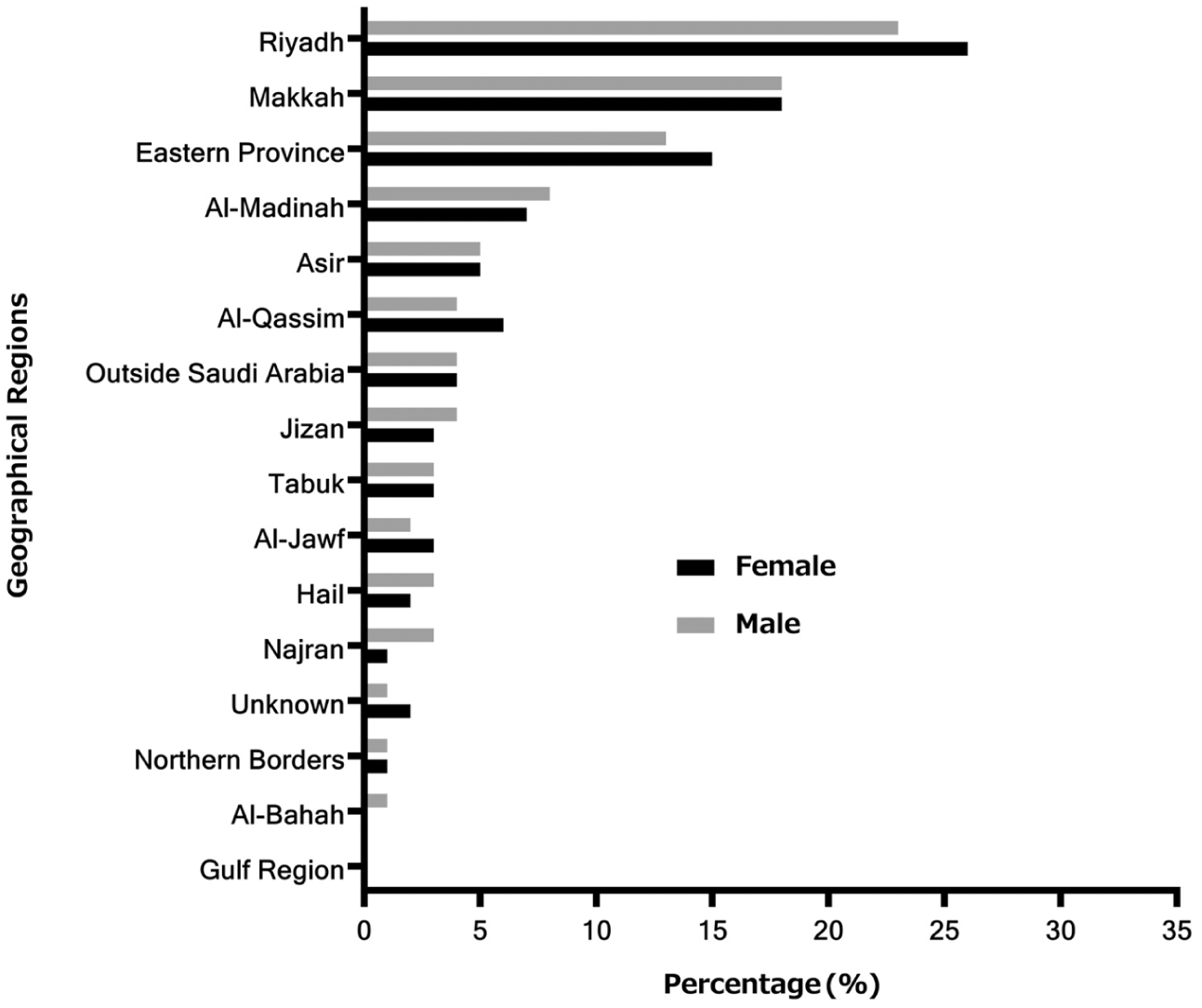
Distribution of physical therapy practitioners by gender across administrative regions of Saudi Arabia (n = 5720).
Overall, 5540 (96.9%) of the physical therapy workforce are general practitioners, while remaining 180 (3.1%) are working in specific specialty of physical therapy. Of these 180, 17 (9.4%) were in cardiovascular, 50 (27.8%) in musculoskeletal, 33 (18.3%) in neurological, 22 (12.2%) in pediatrics, 55 (30.6%) in sports medicine, 1 (0.6%) in vestibular, and 2 (1.1%) in women health specialty.
Supplementary Table 1 shows the demographic characteristics of physical therapy professionals practicing in specific specialty in Saudi Arabia. The mean age is 41.16 ± 7.17 years. Nearly two-third (n = 110, 61.1%) of the physical therapy practitioners are males. Distribution of physical therapy professionals across age groups of ⩽40 (n = 89, 49.4%) and >40 years (n = 91, 50.6%) is almost identical. The highest academic qualification is master’s degree (n = 111, 61.7%), with 68.3% (n = 123) ranked as senior specialists.
Supplementary Table 2 presents the geographical distribution, educational institution, and workplace setting of physical therapy professionals practicing in specific specialty in Saudi Arabia. As per administrative regions, Riyadh has the most numbers of physical therapy practitioners (n = 67, 37.2%), followed by Makkah (n = 38, 21.1%), and Eastern province (n = 35, 19.4%). A large pool of physical therapy practitioners in specialties are educated from foreign (n = 133, 73.9%) educational institutes, and employed majorly in public (n = 158, 87.8%) sector in Saudi Arabia.
Supplementary Figure 1 demonstrates a gender-based comparison of male and female physical therapy practitioners working in specific specialty across diverse age groups. Females are higher in number relative to males in the younger age group (21–30 years) category (5.7% versus 1.8%). Conversely, male physical therapy practitioners are predominant in numbers across age groups of 31–40 (49.1% versus 41.4%) and 51–60 (18.2% versus 5.7%) years. Besides, 47.1% of female and 30.0% of male physical therapy practitioners are between the ages of 31 and 40 years.
Supplementary Figure 2 presents the geographical distribution of male and female physical therapy practitioners working in specific specialty. A fairly high distribution of female physical therapy practitioners is noted in Riyadh (44.3% versus 32.7%), Eastern province (21.4% versus 18.2%), and Al-Madinah (5.7% versus 4.5%). In contrast, Makkah (21.8% versus 20.0%), Asir, (4.5% versus 0.0%), Jizan (4.5% versus 2.9%), and Hail (2.7% versus 0.0%) regions have comparatively large numbers of male physical therapy practitioners working in specific specialty.
Discussion
With increasing rates of disability and corresponding increase in demand of supply of rehabilitation services, 5 it is important to map the dynamics (distribution and attributes) of licensed physical therapy practitioners in Saudi Arabia. The current study was carried out to address the aforementioned issue. The findings of this cross-sectional investigation depicted that Saudi Arabia has a fairly young cadre of registered physical therapy professionals currently practicing, with the gender distribution appropriately balanced. Cumulatively, around 82% of the physical therapy practitioners hold either a bachelor’s or master’s degree as their highest academic qualification, of which nearly two-third (63%) of them are employed as specialists. Interestingly, according to the SCFHS database, ~58% of the physical therapy workforce is restricted to three administrative regions (Riyadh, Makkah, and Eastern province) in the Saudi Arabia. Besides, 86% of these practitioners are either trained in government or foreign institutes, with 92% employed in either public or private institutions.
In the present research study, we found that currently licensed physical therapy practitioners in Saudi Arabia are fairly young, with average age of 36 years. This may reflect the expansion of physical therapy programs and greater participation of younger individuals, which could influence the future workforce. According to the SCFHS database, over two-thirds of the licensed physical therapy practitioners fall under the age group of 21–40 years (70.6%). Our findings are in line with that of a recent study conducted in Saudi Arabia by Mohammed et al. which documented age bracket of 25–34 years as the most frequent, accounting for 70.6% of their physical therapy participants. 17 However, the comparison may not be suitable as the study had a relatively small sample size; nevertheless, the sample was extracted from the SCFHS database, and it does reflect the existing age demographic landscape of physical therapy practitioners in Saudi Arabia. Around 8% of the physical therapy practitioners in our study were ⩾50 years, indicating a minority of the workforce may have longer professional experience and expertise, while most practitioners are younger.
From the perspective of gender representation in physical therapy profession, it has conventionally been dominated by females since its foundation. 18 According to the American Physical Therapy Association census, 65%–68% of the physical therapists are females in United States in 2021. 19 Interestingly, we found physical therapy healthcare workforce to be uniformly balanced between males and females in Saudi Arabia. This observation may reflect increasing participation of both genders in the physical therapy profession over time. Such gender balance provides a more comprehensive view of workforce composition and can inform future workforce planning and policy discussions, without making assumptions about service adequacy or patient preferences. With increase in aging population, Saudi Arabia would need more healthcare workforce, including male professionals. At present, 11 healthcare personnel cater every 1000 population in Saudi Arabia. As per Saudi Vision 2030 to establish a sustaining healthcare system, 710,000 healthcare professionals would be required to accomplish this target. 20
Another finding in our study was that over half (57.5%) of the physical therapy practitioners in Saudi Arabia were located in three administrative regions; Riyadh, Makkah, and Eastern Province. The remaining >40% of the physical therapy practitioners are distributed across other administrative regions in Saudi Arabia, reflecting that a substantial portion of the workforce is located outside the principal cities. Our findings show that metropolitan cities such as Riyadh and Makkah have higher numbers of practitioners, which are consistent with the concentration of healthcare services and population density in these regions. 21 While factors such as educational and healthcare infrastructure, specialized hospitals and clinics, and population demands may contribute to this pattern, the current study does not directly assess these determinants, and the underlying reasons for regional distribution require further investigation.
The professional hierarchy classifies those with master’s degree as senior specialists and those with doctoral degree as consultants. 13 In the present study, we observed that around 11% and <5% of the physical therapy professionals are senior specialists and consultants, respectively. The reasons for this relatively low proportion of professionals in higher hierarchical positions were not directly examined in this study. Factors such as advanced academic qualifications, the availability of doctoral-level programs, duration of training, personal or family commitments, alignment between training programs and workforce needs, migration for professional opportunities, or cultural differences may contribute, but these require further investigation to confirm. Notably, only a handful of universities offer a doctoral-level program for physical therapy in Saudi Arabia. The number of physical therapy practitioners working in specialized fields (n = 180), such as cardiovascular, musculoskeletal, neurological, pediatrics, sports medicine, vestibular, and women health, remains relatively low.
As of January 9, 2025, 45.2% of the physical therapy professionals in the SCFHS database had degrees from foreign institutions. While foreign degrees may serve as a proxy for expatriate status, the actual nationality of these practitioners was not verified. One key aspect of Saudi Vision 2030 is the localization of the professionals, known as Saudization. Only one of the three healthcare professionals in Saudi Arabia are locals at the moment. Furthermore, turning the rate of Saudization from one-third to two-third would result in ~400,000 more healthcare jobs by 2030. 20
In the Saudi Arabia, according to a recent study by Wasfi et al., the ratio of physical therapist practitioners employed at the Ministry of Health is 0.69/10,000 population. 7 Overall, the average ratio of the rehabilitation workforce is 0.73/10,000 population in Saudi Arabia 7 which is well under the average of 15.7/10,000 population as cited by Jesus et al. in a cross-national ecological study on 35 high-income nations, which also included Saudi Arabia. 22 Wide regional fluctuations have also been reported for supply of rehabilitation workforce in the Saudi Arabia, that is, this was also under the average ratios documented from high-income nations. 7 Future studies must focus on dissecting the demand and supply, its discrepancy, and possible gaps in access to quality rehabilitative services in Saudi Arabia in the context of physical therapy.
The present study has several inherent limitations that need to be addressed and therefore readers are advised to interpret findings in the light of the following limitations. The study was designed and conducted as a cross-sectional research and data were extracted on request from SCFHS databases which mean that we were unable to determine the possible causes of geographic disparity in distribution of physical therapy practitioners. In addition, the data were retrieved as of January 9, 2025 and therefore the number of licensed physical therapy practitioners in database may have slightly changed as we publish. Furthermore, the data of SCFHS is not updated in real-time. Another key limitation of this study is that regional comparisons were based on absolute counts and percentages of licensed physical therapy practitioners only. Aligned region-specific population data for the registry year were not available, preventing calculation of population-adjusted workforce density (e.g. physical therapists per 10,000 population) and formal assessments of geographical disparity using inequality metrics such as Lorenz curves or Gini coefficients. Also, 45.2% of the physical therapy professionals had degrees from foreign institutions; foreign educational degrees were used as a proxy for expatriate status, which may not accurately reflect the actual nationality of licensed physical therapy practitioners; this assumption should be interpreted cautiously in workforce and policy discussions. Moreover, no formal sample size calculation was performed, as the analysis included the entire population of licensed physical therapy practitioners registered with the SCFHS. Finally, absence of data on physical therapy practitioners who do multiple jobs might have led to an overestimation of the workforce.
Conclusions
To conclude, Saudi Arabia has a fairly young physical therapy healthcare workforce with professionals equally balanced between male and females, suggesting the expansion of physical therapy programs. However, high rates of disability in Saudi Arabia mandate further efforts from stakeholders to encourage and expand the pool of physical therapy practitioners. Furthermore, there is a geographical disparity of licensed physical therapy practitioners across administrative regions in the Saudi Arabia. Notably, a high number (45.2%) of physical therapy professionals had degrees from foreign institutions, potentially reflecting their expatriate status. We believe that findings of the current study will assist readers in understanding the distribution of physical therapy workforce in Saudi Arabia and that future studies must accordingly explore the demand and supply discrepancy in workforce in rehabilitative services in Saudi Arabia.
Supplemental Material
sj-docx-1-smo-10.1177_20503121261434105 – Supplemental material for A cross-sectional research study of distribution and attributes of licensed physical therapy practitioners in the Kingdom of Saudi Arabia
Supplemental material, sj-docx-1-smo-10.1177_20503121261434105 for A cross-sectional research study of distribution and attributes of licensed physical therapy practitioners in the Kingdom of Saudi Arabia by Afnan M. Alkhateeb in SAGE Open Medicine
Footnotes
Acknowledgements
The author gratefully acknowledges the technical and financial support provided by the KAU Endowment (WAQF) and the Deanship of Scientific Research (DSR) at King Abdulaziz University, Jeddah, Saudi Arabia.

Ethical considerations
Ethical approval was not required for this study as no human subjects were directly involved. All data were obtained from the Saudi Commission for Health Specialties (SCFHS) database upon formal request.
Author contributions
Afnan M. Alkhateeb: conceptualization, methodology, software, data collection, data curation, formal analysis, investigation, supervision, writing—original draft, visualization, writing—final draft, reviewing and editing, and validation.
Funding
The authors received no financial support for the research, authorship, and/or publication of this article.
Declaration of conflicting interests
The authors declared no potential conflicts of interest with respect to the research, authorship, and/or publication of this article.
Data availability statement
The datasets used and analyzed during the current study are available from the corresponding author on reasonable request.
Supplemental material
Supplemental material for this article is available online.
References
Supplementary Material
Please find the following supplemental material available below.
For Open Access articles published under a Creative Commons License, all supplemental material carries the same license as the article it is associated with.
For non-Open Access articles published, all supplemental material carries a non-exclusive license, and permission requests for re-use of supplemental material or any part of supplemental material shall be sent directly to the copyright owner as specified in the copyright notice associated with the article.
