




Abstract
Background:
The practice of self-medication with antibiotics is expanding globally, particularly in developing countries. This practice is associated with increasing rates of health-related problems, including antibiotic resistance.
Objective:
A survey was conducted to investigate knowledge, attitudes, and practices regarding self-medication with antibiotics among senior undergraduate pharmacy students in Jordan.
Methods:
A cross-sectional study was performed by using a validated questionnaire for data collection. This questionnaire was randomly distributed online to senior undergraduate pharmacy students from a range of universities. Respondents’ knowledge of, attitudes towards, and practice of self-medication with antibiotics were thus assessed. Data analysis was performed using IBM SPSS version 24.0 (IBM Corp., Armonk, NY, USA).
Results:
Among the 250 respondents, who represented a response rate of 66.3%, 80.8% had self-medicated with antibiotics. The majority (85.6%) of antibiotics used for such self-medication were purchased from pharmacy drug stores. The most frequently used antibiotic for self-medication during the prior 6 months was amoxicillin (53.2%), ciprofloxacin (42.4%), and metronidazole (34.4%). Respiratory health issues were the most common reason for self-medication, with tonsilitis (90%) being major reason, then skin infections (34%). About 34% of students had changed their dose during treatment, while 30% kept some antibiotics for future use. Additionally, the majority of students (69.6%) recommended antibiotics to others without prescription, with 24% of students using antibiotics despite receiving advice that these were not required. The mean score for students’ attitudes was 4.06, which indicated a positive attitude towards antibiotics use. The undergraduate senior pharmacy students had good knowledge and positive attitudes yet demonstrated poor practice with regard to antibiotic use, as the prevalence of self-medication was alarmingly high.
Conclusion:
This malpractice highlights the importance of identifying effective and urgent interventions to be performed at different levels, including by educational and regulatory authorities, to mitigate the misuse of antibiotics.
Keywords
Introduction
Antibiotics played a crucial role in reducing mortality and morbidity associated with infectious diseases across diverse global populations. 1 However, numerous studies have shown that the widespread availability, misuse, and use without prescriptions or counselling of antibiotics have transformed their use from a medical success story into a growing and significant global health crisis, as represented by antimicrobial resistance (AMR). Thus, AMR references the various resistance mechanisms developed by microorganisms, especially bacteria, as they develop to resist the effects of antibiotics, which make standard treatments ineffective and lead to persistent infections, longer hospital stays, the need for increased doses, higher medical costs, and increased morbidity and mortality rates for infectious diseases.2–4
Overall, inappropriate use of antibiotics without a prescription by physicians and a lack of counselling by pharmacists have led to misuse of antibiotics becoming common. The increasingly widespread practice of self-medication, which often triggers ineffective and unsafe use of antibiotics, is also considered a key driver of AMR. 5 There has recently been an increased prevalence of self-medication with antibiotics in many countries worldwide: from a medical and legal standpoint, antibiotic use often requires a prescription; however, from a practical standpoint, they are often used without a prescription, whether by pharmacists or their patients. 6 Misuse of antibiotics is thus alarmingly prevalent in many countries, especially where antibiotics are available over-the-counter or are otherwise accessible through informal sources. 7
Self-medication with antibiotics often involves the use of incorrect dosages, inappropriate drug selections, and insufficient treatment durations, all of which may contribute significantly to the development and spread of resistant bacteria and thus to AMR. Unfortunately, the legal and ethical control of antibiotics dispensation in developing countries is often weak, which exacerbates the issue of pharmacists dispensing antibiotics without prescriptions or appropriate patient counselling.8,9 Antibiotic misuse thus remains a persistent challenge across a range of groups involving patients, general populations, and healthcare professionals including pharmacists. Therefore, pharmacy students represent a main role in promoting rational antibiotic use.
Pharmacy students are equipped with advanced clinical knowledge and have early access to pharmaceutical products. This positions them to play a central role in ensuring appropriate antibiotic use and in guiding patient education on medication adherence and safety. 10 Consequently, enhancing role of pharmacists in the efficacy and safety of antibiotics use. However, self-medication practices remain common among pharmacy students, revealing a gap between theoretical understanding and practical behaviour, despite their awareness of risks. 11 Also, cultural, socio-economic, and healthcare systemic factors may influence self-medication behaviours. Subsequently, self-medication behaviours of pharmacy students can be seen as an indirect measure of curriculum’s impact on instilling the principles of rational medication use.12,13
Consequently, this emphasizes the need to enhance university education for pharmacy students to effectively address the behavioural and ethical aspects of antibiotics use, and their safe and effective use. 14 Therefore, this study aimed to evaluate the prevalence and patterns of antibiotics self-administration among senior BSc Pharm and PharmD students to assess the underlying motivations for such behaviours, sources of antibiotics, and types of infections commonly self-treated, as well as the level of awareness of issues linked to the misuse of antibiotics and their contribution to AMR. This study focused on final-year students, as these hold the highest levels of professional knowledge and maturity within the undergraduate training context. This research was intended to shed light on critical gaps in pharmacy education.
Methodology
Study setting and design
This cross-sectional study was conducted across various universities’ Pharmacy faculties in Jordan from December 2024 to April 2025. Data collection was performed through online distribution of a link to a self-administered questionnaire among BSc Pharma and PharmD students. The Google Forms service on Microsoft Teams and appropriate social media platforms (Facebook, WhatsApp) were used to complete this process. The inclusion criteria ensured the recruitment of senior pharmacy and PharmD students (fifth and sixth year, respectively) and any students who are not in those fields and levels (senior students) were excluded. Senior pharmacy students in Jordanian education system refer to students who are in their final year, and they are at an advanced level of professional practice. This is because they extensively engage with practical training in community and hospital pharmacies.
Study instrument
Data were collected in English using a questionnaire prepared based on the previously performed literature review. 15 The face and content validity of the questionnaire were investigated by 3 professors from the Faculty of Pharmacy and 10 undergraduate pharmacy students. The authors then made required modifications to the questionnaire prior to its full distribution.
The questionnaire included 4 sections with 36 items each. The first such section covered socio-demographic data, such as age, gender, year of study, residence, accommodation status, monthly allowance, health insurance, and parental occupation. In the second section, the pharmacy students’ knowledge regarding antibiotics was assessed, while the third section assessed attitudes towards antibiotic use, measured using Likert-scale statements ranging from “strongly agree” to “strongly disagree”. A final section, featuring 14 questions, examined pharmacy students’ practices regarding antibiotics and their self-administration.
A pilot study was performed initially with 10 pharmacy students, and the reliability and internal consistency of the questionnaire were evaluated using Cronbach’s alpha test. The 10 participants from the initial pilot study were excluded from the final data analysis. The purpose of the pilot was solely to test the questionnaire’s clarity, flow, and technical functionality, and including these responses would have compromised the integrity of the final dataset.
Sample size and sampling technique
The sample size was calculated by using the Raosoft Sample Size Calculator (Sample Size Calculator by Raosoft, Inc., Seattle, USA). Which employs a standard formula for determining sample size for a proportion. As there were no prior studies on self-medication practices, specifically among senior pharmacy students in Jordan, the adopted conservative proportion made at 50% (0.5). The total population of fifth- and sixth-year pharmacy students in Jordan was estimated to be approximately 2000. Inputting these parameters (population = 2000, proportion = 0.5, confidence = 95%, error = 5%) yielded a required sample size of 323. This sample size increased conservatively to 377 to account for potential incomplete responses.
Data were collected over the period of December 2024 to April 2025, where the collected responses were 250 from BSc Pharm and PharmD students. Recruitment was conducted exclusively through online channels targeting senior pharmacy students. These include official and student-run social media groups on platforms including WhatsApp and Facebook, which are dedicated to the cohorts of fifth-year BSc Pharmacy and sixth-year PharmD students at several major Jordanian universities. The recruitment message included a clear description of the study, its objectives, eligibility criteria (being a senior pharmacy student), and the voluntary and anonymous nature of participation. No financial or academic incentives were offered, minimizing the risk of coercion A representative sample was randomly selected using a multi-stage convenience sampling method tailored for reaching a specific and dispersed population. In which, links to the questionnaire were shared with student-moderated groups on platforms, such as Facebook and WhatsApp, which are exclusive to students of specific faculties and academic years
Ethical approval
The study was performed according to the Declaration of Helsinki guidelines and regulations, with ethical approval obtained from the Deanship of Scientific Research and Graduate Studies at the Applied Science Private University (IRB no. 2024-PHA-41). All participating students were informed briefly about the aims of the study and the voluntary nature of their participation. All of the students were also asked to provide written consent before starting the study.
Statistical analysis
The responses collected were exported to Microsoft Excel and subsequently analysed using IBM SPSS Statistics, version 24.0 (IBM Corp., Armonk, NY, USA). Descriptive statistics were used to summarize the data: continuous variables were expressed as means and standard deviations, while categorical variables were presented as frequencies and percentages. The internal consistency of the questionnaire was assessed using Cronbach’s alpha, which yielded a value of 0.79, indicating acceptable reliability.
In addition to descriptive analysis, inferential statistical tests were performed to explore potential associations between participants’ demographic characteristics and their knowledge, attitude, and practice (KAP) scores. Independent-samples t-tests were used for two-group comparisons (e.g. gender), one-way ANOVA for comparisons involving more than two groups (e.g. university, year of study, or programme type), and chi-square tests for relationships between categorical variables such as self-medication behaviour and socio-demographic factors. The normality of continuous variables was evaluated using the Shapiro–Wilk test to determine the suitability of parametric testing. All statistical analyses were conducted at a significance level of p ⩽ 0.05.
Participants’ attitudes towards antibiotic use were measured using a set of statements rated on a 5-point Likert scale ranging from 1 = strongly disagree to 5 = strongly agree, where higher scores indicate more positive attitudes. An overall attitude score was computed in each case by averaging responses across all relevant items. For interpretability and consistency with previously published KAP research, the knowledge, attitude, and practice scores were categorized using modified Bloom’s criteria, which define levels of <60% as poor, 60%–79% as moderate, and ⩾80% as good knowledge or performance. This classification method has been widely adopted in studies assessing antibiotic use and AMR.15,16
Results
Socio-demographic characteristics:
Participant socio-demographic characteristics for the 250 individuals surveyed, based on a response rate of 66.3%, are presented in Table 1. Over half (58%) of participants were aged between 20 and 23 years old, while those aged 24–26 years old represented 37.6% of participants. The sample was 54% female, while males represented the remaining 46%. Overall, 70.4% of participants were in their fifth year, while 29.6% were in their sixth year. The central region was home to most of the participants (42.4%), and the majority of respondents (71.2%) lived with their families. Most participants reported monthly incomes or allowances between 200 and 400 JD (64.8%).
Socio-demographic characteristics of the study participants (n = 250).

The survey results indicated that 55.2% of participants had health insurance, while 44.8% remained uninsured. The largest group of participants identified their mothers as housewives (51.6%), while having mothers employed in non-health-related roles was also common (25.6%). While the majority of fathers worked in non-health-related fields (50.4%), with health-related jobs held by 29.2%, other occupations were claimed in 14.8% of cases, and just 5.6% were unemployed.
Participant knowledge about antibiotics
Figure 1 summarizes participants’ knowledge regarding antibiotic use. Nearly all respondents (98%) correctly identified antibiotics as medications, specifically targeting bacterial infections, rather than viruses (Figure 1(a)). The antibiotics most commonly recognized by the participants were amoxicillin–clavulanic acid (21.6%), metronidazole (19.6%), erythromycin (14%), and doxycycline (13.6%; Figure 1(b)). Participants predominantly acknowledged pneumonia (89.6%) and tuberculosis (60.8%) as illnesses appropriately treated with antibiotics, whereas fewer participants incorrectly associated antibiotics with conditions such as diarrhoea (18.8%), common cold (12%), dengue fever (8.4%), or general aches and pains (3.6%; Figure 1(c)). Moreover, most respondents (91.6%) demonstrated correct knowledge by stating that antibiotics should always be taken until the full prescribed course is completed, regardless of symptom relief (Figure 1(d)).

Participants’ knowledge regarding antibiotic use: (a) Correct identification of antibiotic targets, (b) recognition of commonly known antibiotics, (c) awareness of diseases treated with antibiotics, and (d) understanding of appropriate antibiotic usage duration.
Participants’ attitudes towards antibiotic use
Participants’ attitudes towards antibiotic usage were assessed using a 5-point Likert scale that ranged from 1 (strongly disagree) to 5 (strongly agree). Based on Bloom’s cut-off points, scores below 3 indicate a negative attitude, scores between 3 and 3.9 reflect a neutral attitude, and scores from 4 to 5 represent a positive attitude, as shown in Table 2.
Participants’ attitudes towards antibiotic use (n = 250). Data presented as frequency (%), mean scores, and standard deviations.

SD: standard deviation.
Attitude score was assessed using Likert scale with a maximum of 5 to a minimum of 1. Scores were categorized using Bloom’s cut-off points: <3 (<59.%) were considered negative attitude, 3–3.9 (60.0%–79.0%) as neutral and 4–5 (80.0%–100.0%) as a positive attitude antibiotics use.
The overall mean attitude score was 4.06 ± 0.69, suggesting that participants generally had positive attitudes towards responsible antibiotic use. The majority strongly disagreed or disagreed with the practices of using antibiotics without a prescription for perceived minor illnesses (88.8%, mean score 4.35 ± 0.99) and sharing antibiotics among family or friends with similar symptoms (90.4%, mean score 4.36 ± 0.86). Most participants were also opposed to keeping leftover antibiotics for future use (85.6%, mean score 4.10 ± 0.79).
However, there was greater variation in attitudes regarding the proper disposal of leftover antibiotics, with only 52.8% disagreeing that antibiotics could be disposed of with regular garbage or flushed down the toilet (mean score 3.48 ± 1.24). A substantial proportion (77.6%) of respondents disagreed with the idea that increasing antibiotic dosages without medical advice could accelerate recovery (mean score 3.99 ± 0.90).
Antibiotic use among study participants
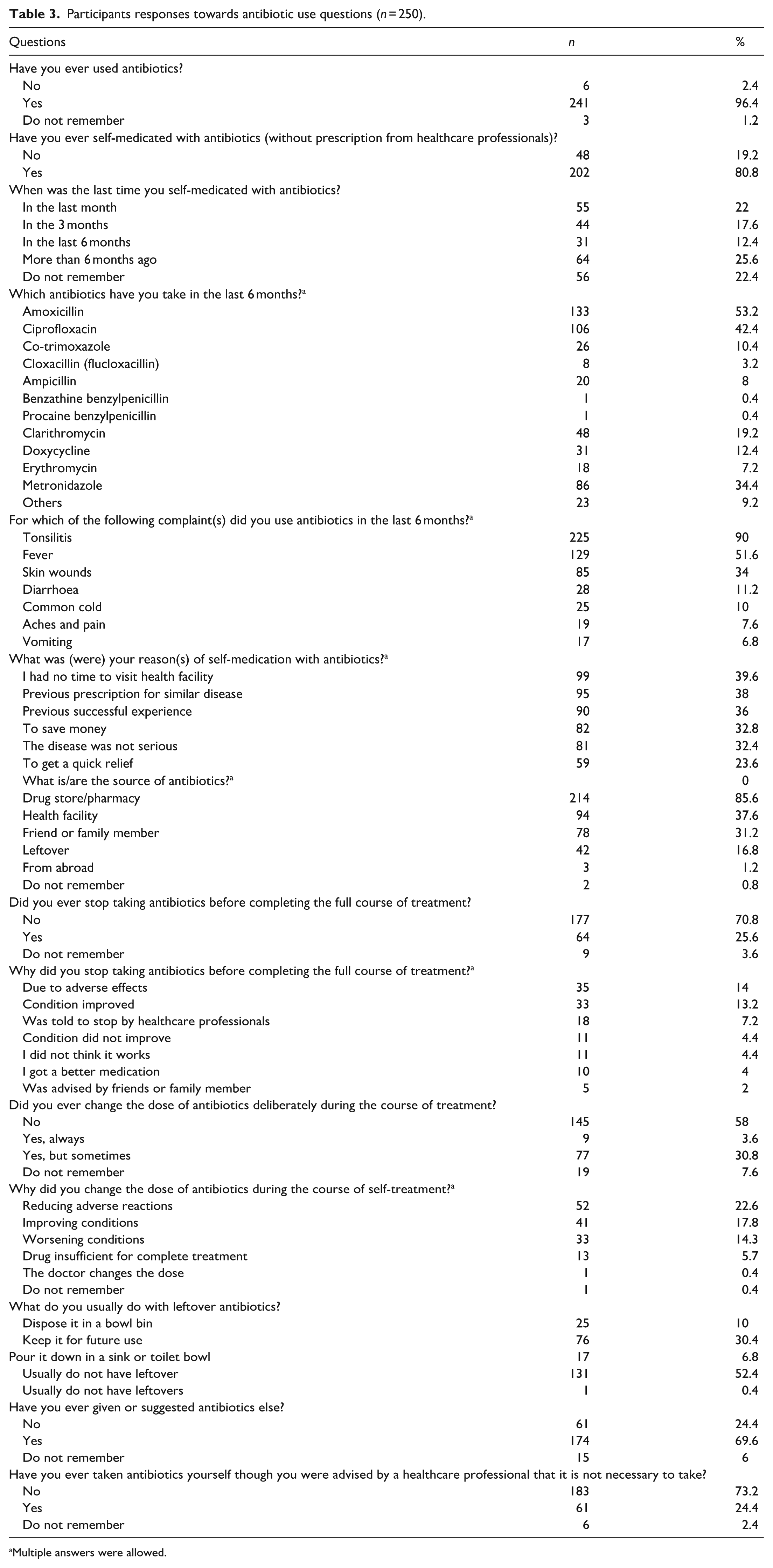
Regarding antibiotic use practices, nearly all participants (96.4%) had previously used antibiotics, and a significant proportion (80.8%) admitted to self-medicating without prescription, as shown in Table 3. Around a quarter (25.6%) had self-medicated more than 6 months ago, while about a fifth (22%) had done so in the past month. The most common self-prescribed antibiotics were amoxicillin (53.2%) and ciprofloxacin (42.4%), followed by metronidazole (34.4%), and clarithromycin (19.2%). Participants primarily used antibiotics to manage conditions such as tonsillitis (90%), fever (51.6%), and skin wounds (34%).
Participants responses towards antibiotic use questions (n = 250).
Multiple answers were allowed.
The top sources of antibiotics were drugstores, or pharmacies (85.6%), but many participants also obtained them from healthcare facilities (37.6%) or informal sources, such as family or friends (31.2%). Some used leftover medicine from previous treatments (16.8%). Worryingly, 25.6% of participants acknowledged stopping the antibiotic treatment before completing the full course, most commonly due to adverse effects (14%) or feeling better (13.2%). Dosing practices were also variable: 34.4% of respondents reported changing the prescribed dose during treatment, with reasons including seeking a reduction of side effects (22.6%), improvement in patient conditions (17.8%), or worsening symptoms (14.3%). With respect to handling leftover antibiotics, just over half (52.4%) stated they usually did not have leftovers, while almost a third (30.4%) reported keeping them for future use. Only 10% disposed of leftover medication properly. Furthermore, 69.6% of participants admitted they had recommended or given antibiotics to someone else without a prescription, and nearly a quarter (24.4%) reported taking antibiotics despite being advised by a healthcare professional that it was unnecessary.
Participants knowledge about antibiotic resistance
With respect to knowledge of antibiotic resistance, as shown in Table 4, a vast majority of participants (96.8%) reported having heard of the term, and nearly all (98.4%) were aware that some antibiotics are no longer effective due to such resistance. The most common sources for this information were pharmacies (33.6%) and campaigns or seminars (26.4%), followed by health facilities (14%) and schools (13.6%).
Knowledge of antibiotic resistance among participants (n = 250).

Most participants correctly recognised that antibiotic resistance could occur locally and was not limited to other countries (85.6%); only 8% believed it was not an issue in their own country, while 6.4% were unsure. A large majority (87.6%) understood that resistant bacteria can spread from person to person, and almost all respondents (94%) acknowledged that using antibiotics when not needed could contribute to resistance. More than 84.0% of participants were aware that proper hand hygiene before meals and after using the toilet can help reduce the spread of antibiotic-resistant bacteria. However, a small portion remained unaware of or uncertain about such preventive measures.
Inferential analysis
Inferential statistical tests were conducted to assess associations between demographic variables and KAP scores. The analyses revealed no statistically significant differences in knowledge or practice scores across gender, university, year of study, or residence region (p > 0.05). A slightly higher attitude score was observed among PharmD students compared with BSc students (p = 0.031). No significant associations were found between self-medication practice and either gender or health insurance status (p > 0.05). The detailed results of the inferential analysis are presented in Supplemental Table S1.
Discussion
Improper use of antibiotics, such as during self-medication, is seen as malpractice in both developing and developed countries. 17 Such phenomena have led to the emergence of many resistant bacteria, which may have in serious and life-threatening complications.17–19 In this study, knowledge around antibiotics and AMR among senior undergraduate pharmacy students in Jordan was investigated. Beside this, the practices of self-medication with antibiotics were also determined. This was the first study to evaluate the practice of self-medication with antibiotics among senior pharmacy students in Jordan. Participants demonstrated good knowledge of and a positive attitude towards antibiotic use yet exhibited poor practice in the use of antibiotics.
Nearly half of the respondents were female (54%) and aged between 20 and 23. Such reducing prevalence of female students observed in other studies among pharmacy cohorts (63.7% and 76.8% in Hu et al. (2018) and Nukaly et al. (2024), respectively).20,21 A significant majority of respondents (70.4%) were in their fifth year, though more than a quarter of participants were PharmD students in their sixth year. This small percentage of PharmD students as compared to Pharmacy students can be explained by the fact that of the 18 pharmacy schools in Jordan, only 2 public universities offer the PharmD programme. 22
Regarding participants knowledge, our findings revealed a good level of background knowledge about antibiotics among respondents. Almost all participants (98%) acknowledged that antibiotics target bacterial infections. In which they identified pneumonia (89%) and tuberculosis (60.8%) as bacterial infections that may be effectively treated with antibiotics. Similarly, the vast majority of students (91.6%) correctly answered that any antibiotics course should be completed regardless of the disappearance of symptoms. Such pattern is expected because senior pharmacy students are exposed to in-depth information about antibiotics throughout their study. These figures are consistent with other published studies that demonstrate good knowledge of antibiotics among medical students.23,24
With regard to attitude of participants, the overall attitude regarding correct antibiotic use among respondents was positive, with 88.8% disagreeing with the use of antibiotics without prescription. Similarly, most students were aware of, and agreed with, the fact that “leftover” antibiotics should not be stocked at home for future use. This attitude can be explained by the advanced level of knowledge of senior pharmacy students about risks of inappropriate antibiotics use and its negative impact on patient safety. These findings were similar to those of studies in Pakistan, which have demonstrated positive attitudes among final-year pharmacy students towards antibiotic use. 25
Practices of participants towards antibiotics use showed different pattern. For instance, despite study participants having sufficient medical knowledge and positive attitudes towards antibiotic use; this study revealed poor practices regarding actual antibiotic use. This was clearly obvious by the alarmingly high rate (80.8%) of self-medication with antibiotics among senior undergraduate pharmacy students. This high rate of self-administration should be taken seriously, however, as it indicates a significant gap between knowledge and practice. Moreover, this malpractice has several negative implications. These include increase AMR, side effects, misdiagnosis, and increase overall health expenses. The current study’s figure of self-medication was considerably higher than those produced by studies in Jordan (39.5% and 54.5% in Al-Tarawneh et al. 26 and Al-Azzam et al., 27 respectively). Since those studies were conducted on the general population. This higher rate among senior pharmacy students could be explained by their access to sufficient medical information about diseases and medicines during their studies. This may have given them a false sense of confidence with respect to self-management as compared to members of the general public. A similar trend has been found in another systematic review, 28 which also reported that rates of self-medication with antibiotics were higher among medical students than the general population. The findings also agreed with in multiple studies across the world, including studies in Yemen (87.1%), 29 Sudan (60.8%), 30 China (74%), 31 Pakistan (60%), 32 and several European countries such as Portugal (18.9%), Bulgaria (43%), Greece (44.6%), Denmark (4.5%), and Sweden (0.43%). 33 However, the self-medication rate in European countries remains lower than that seen in this study and in other countries. Such figure may be attributed to the strict regulations and policies implemented by the responsible authorities in European countries, which prohibit the dispensing of antibiotics without a prescription.
The majority of participating students (96.8%) demonstrated good understanding of the concept of AMR. They also showed theoretically good awareness of the fact that the misuse of antibiotics can contribute to AMR. This was probably due to the frequent use of this technical term across various subjects of study within their undergraduate courses. The findings in this study were thus in concordance with other published studies.17,18,34
Examining the results overall, it is critical to enhance awareness among undergraduate pharmacy students regarding the careful and appropriate use of antibiotics. This can be achieved by continuously improving and updating the pharmacy curriculum. For instance, providing courses on antimicrobial stewardship, improving the curriculum content of clinical microbiology, and managing issues related to rules governing the rational use of antibiotics. 35 Besides, emphasize on the serious consequences of antibiotic resistance. Finally, health boards and other government authorities should seek to implement stricter regulations on the prescribing and dispensing of antibiotics. Additionally, it is important to establish and disseminate national guidelines for treatment infectious diseases. Moreover, enhancing awareness about the risks of indiscriminate use of antibiotics among several sectors including healthcare providers and public. This can be achieved through organizing campaigns and workshops. 36
Study limitations
This study had several limitations; in particular, the sample size was not large enough to allow generalization of the results as we were only able to collect data from 250 respondents (response rate 66.3%). This was due to practical constraints encountered during the data collection period, including a finite window of time and notable survey fatigue among the student population, which are common challenges in online voluntary surveys. This shortfall potentially impacts the study’s statistical power and limits the precision of our prevalence estimates. However, the sample size achieved is still substantial enough to perform descriptive analysis and identify the significant trends reported, particularly the stark contrast between knowledge and practice. More studies with larger samples would thus facilitate validation of the findings from this study. The cross-sectional design of the study also restricted the ability to confirm the causality of various variable relationships. Nevertheless, the study provided new, up-to-date insights about knowledge, attitude regarding use of antibiotics, and self-administration practices among senior pharmacy students.
Conclusion
Self-administration of antibiotics is a serious health phenomenon that facilitates irresponsible use of antibiotics. Our results revealed good knowledge regarding antibiotics and antibiotic resistance information. Indeed, positive attitude towards responsible use of antibiotics; however, practices were poor as a remarkable percentage of students self-medicated with antibiotics. Accordingly, this shows a gap between knowledge and practice, whereby students possess good knowledge yet exhibit poor practice. This makes it crucial to tackle inappropriate practice regarding antibiotics by improving pharmacy education to include comprehensive knowledge of the discriminant use of antibiotics, as well as by strengthening rules and laws that prohibit non-prescription sales of antibiotics.
Supplemental Material
sj-docx-1-smo-10.1177_20503121251404848 – Supplemental material for Knowledge, attitude, and practices of self-medication with antibiotics among senior undergraduate pharmacy students: A cross-sectional study in Jordan
Supplemental material, sj-docx-1-smo-10.1177_20503121251404848 for Knowledge, attitude, and practices of self-medication with antibiotics among senior undergraduate pharmacy students: A cross-sectional study in Jordan by Reham Aljalamdeh, Muna Barakat, Rami Mosleh and Derar H. Abdel-Qader in SAGE Open Medicine
Supplemental Material
sj-docx-2-smo-10.1177_20503121251404848 – Supplemental material for Knowledge, attitude, and practices of self-medication with antibiotics among senior undergraduate pharmacy students: A cross-sectional study in Jordan
Supplemental material, sj-docx-2-smo-10.1177_20503121251404848 for Knowledge, attitude, and practices of self-medication with antibiotics among senior undergraduate pharmacy students: A cross-sectional study in Jordan by Reham Aljalamdeh, Muna Barakat, Rami Mosleh and Derar H. Abdel-Qader in SAGE Open Medicine
Footnotes
Acknowledgements
The authors would like to thank all the final year Pharmacy and PharmD students for their voluntary participation in the study

Ethical consideration
The study was performed according to the Declaration of Helsinki guidelines and regulations, where ethical approval was obtained from the Deanship of Scientific Research & Graduate Studies at Applied Science Private University (IRB no. 2024-PHA-41). Indeed, students were informed briefly about the aims of the study and the voluntary participation. All of the students enrolled in the study provided written consent before starting the study.
Author contributions
Conceptualization: R.A. and D.A., Data curation: R.A., M.B. and D.A., Formal analysis: M.B. Funding acquisition: Not applicable, Investigator: R.A., M.B., Methodology: R.A., M.B., R.M. and D.A., Project Management: R.A., R.M., Supervision: R.A., R.M. and D.A., Visualization: R.A., M.B. Writing, review, editing: R.A., M.B., R.M. and D.A.
Funding
The authors received no financial support for the research, authorship, and/or publication of this article.
Declaration of conflicting interests
The authors declared no potential conflicts of interest with respect to the research, authorship, and/or publication of this article.
Data availability statement
The datasets used and analysed during the current study are available from the corresponding author on reasonable request.
Supplemental material
Supplemental material for this article is available online.
References
Supplementary Material
Please find the following supplemental material available below.
For Open Access articles published under a Creative Commons License, all supplemental material carries the same license as the article it is associated with.
For non-Open Access articles published, all supplemental material carries a non-exclusive license, and permission requests for re-use of supplemental material or any part of supplemental material shall be sent directly to the copyright owner as specified in the copyright notice associated with the article.
