




Abstract
Introduction:
Tinnitus is a common medical condition that affects an individual’s quality of life. It affects 5%–43% of the global population. Only a few research studies have been conducted in Palestine, so knowledge of tinnitus prevalence and risk factors is limited. The purpose of this study was to determine tinnitus prevalence and risk factors among young university students in Palestine.
Methods:
A cross-sectional study of Palestinian university students was done utilizing an online self-administered questionnaire. The questionnaire for the study was developed using the European School for Interdisciplinary Tinnitus Research-Screening Questionnaire. A logistic regression analysis of the associations between tinnitus and influencing factors was performed to determine the effects of various clinically relevant variables on the likelihood of experiencing tinnitus.
Results:
A total of 728 participants responded to the questionnaire aged 20.0 ± 2.0. The overall prevalence of tinnitus was 31%. Having a relative with tinnitus, gastroesophageal reflux, depression and anxiety, hearing difficulties, vertigo, tympanic membrane perforation, chronic otitis, acoustic trauma, head and neck radiotherapy, dental surgery, ear surgery, ear pain, headache, neck pain, temporomandibular joint pain, balance disorders, and nasal septal deviation were significantly associated with tinnitus. The logistic regression analysis showed that suffering from frequent vertigo (at least once per year), from slight hearing difficulty, temporomandibular joint pain, performing ear surgery, and having depression and anxiety is associated with an increased risk of having tinnitus.
Conclusions:
The current study concluded that tinnitus is common among Palestinian university students. Furthermore, the study identified several major risk factors for tinnitus. It is critical to explore the possibly modifiable risk factors for tinnitus in order to have a better understanding of the condition and eventually minimize its prevalence.
Introduction
Tinnitus is one of the most common audiological symptoms. In recent years, tinnitus has been much more widely known. Tinnitus is described as the subjective sense of sound in the absence of external auditory stimuli. Tinnitus can be caused by virtually any insult to the auditory pathway. Several non-auditory conditions can also cause tinnitus. 1 Tinnitus is categorized as subjective or objective. The most prevalent type of tinnitus is subjective tinnitus, which is perceived exclusively by the patients. In contrast, objective tinnitus can be perceived by the patient as well as heard by the examiner. 2 Typical descriptions of the sensation include a hissing, sizzling, or ringing sound, though more complex sounds like voices or music have also been reported. Sometimes the sound of tinnitus is rhythmic or pulsating. 3 When pulsatile tinnitus coincides with the heartbeat, a vascular cause is suspected; when it does not, palatal muscles or myoclonus of the middle ear is more likely to be the cause. 4 Tinnitus often causes people to hear more than one ringing or buzzing noise at the same time. Some patients report an external source, while others claim it is centered in their head or limited to one or both ears. Tinnitus can appear suddenly, but it is more likely to develop gradually. Some people may notice an obvious exacerbation along with increased stress arousal, but this is subjective. The substantial variability of tinnitus experience has impeded studies in both fundamental science and treatment of the condition. 5
Tinnitus is a symptom caused by a range of disorders and has varying risk factors. Autological, neurological, psychological, cardiovascular, traumatic, rheumatological, immune-mediated, endocrine, metabolic, and ototoxic medications, all of these factors have been related to the development of tinnitus and its accompanying conditions. Previous head injuries, alcohol consumption, arthritis history, obesity, smoking, and hypertension have all been suggested as possible risk factors for the development of tinnitus. 6 Tinnitus that persists for more than 6 months is chronic; otherwise, it is acute or recent onset tinnitus. 7 Chronic tinnitus can be associated with other conditions such as depression, anxiety disorders, and insomnia.8,9 Tinnitus is a condition that varies in severity. It might be mild, aggravating, or severe, but it all has a substantial impact on a patient’s quality of life because it can induce sleep disturbances, anxiety, and desperation.10,7,11,12 Tinnitus has been connected in the industrialized world to excessive medical costs. A retrospective study by Goldstein et al., 11 reported that the annual cost of treating tinnitus per patient is approximately US$660 in the United States of America, while Maes et al. 13 estimated that the average annual cost of tinnitus-related healthcare per patient is €1544 in the Netherlands. In the United Kingdom, the incidence of annoying tinnitus presenting to the National Health Service (NHS) is growing along with observed increases in expenses. 3
In Palestine, the prevalence of tinnitus has been recently estimated to be 30.6% among adult Palestinians. 14 The majority of the studies that were discussed above were carried out with the purpose of determining the prevalence of tinnitus and the risk factors that are related with it in the general population. In order to circumvent this issue, we utilized a recently developed standardized evaluation technique known as the European School for Interdisciplinary Tinnitus Research Screening Questionnaire (ESIT-SQ) 15 that has been developed to screen for tinnitus as well as characterize it, and as a result, anyone, regardless of whether or not they have tinnitus, is able to respond to it. As a result of its ability to simultaneously combine clinical experience and the analysis of large datasets, it is able to identify the risk factors that are associated with tinnitus, so contributing to a more comprehensive understanding of the condition. 15 Tinnitus among young adults in Palestine has not been previously evaluated. However, tinnitus can significantly impair the quality of life, sleep, concentration, attention, emotional balance, and even social interaction and should be considered in the medical field as a debilitating factor in students’ quality of life. Therefore, the current study aimed to investigate the prevalence and risk factors of tinnitus among Palestinian university students.
Methods
Ethical consideration
The Institutional Review Board (IRB) of An-Najah University provided its approval for this study, which was conducted in accordance with ethical standards. (Reference: H.Sp. 2023/9). Prior to inclusion, all participants provided written informed consent to take part in the study. All participants provided informed consent before proceeding to the online questionnaire questions, and those who did not sign the consent form were not allowed to participate. The permission form explained the study’s goal and guaranteed voluntary and anonymous participation, with no consequences for nonparticipation.
Study design and sampling
An observational cross-sectional study of university students in Palestine was conducted from January to March 2023 to assess the prevalence of tinnitus among young people and to identify the supposed risk factors related with the emergence of tinnitus. A convenient sample size of 728 students was enrolled in the study. The sample size was calculated based on a single proportion formula, considering a sample proportion of 50% while using a cross-sectional study design wherein n = required sample size (n = Z (α/2) 2 pq/d2) and 95% CI with 5% margin of error where Z is the Z-value (1.96 for a 95% confidence interval), α is the significance level (0.05), p is the assumed proportion (0.50), q is 1 − p = (0.50), and d is the margin of error (0.05). Substituting these values, we obtain n = 384.16. Given the population size (N) of approximately 100,000 students, we applied the finite population correction (FPC) formula: ((N − n)/(N − 1))1/2. Substituting the values, the minimum required sample size, after applying the FPC, was calculated to be approximately 384 participants. To ensure robustness, we targeted a minimum sample size of 385 participants.
Inclusion criteria include being university student, who was aged 18 years old or older, could read the online consent form, and had signed the consent form. Students who had not signed the consent form and who were not able to read the online form were not allowed to participate. Ultimately, we received 728 responses, and 27 individuals declined to participate.
Study tools: The study’s questionnaire was based on the European School for Interdisciplinary Tinnitus Research-Screening Questionnaire (ESIT-SQ), a self-report tinnitus-relevant history questionnaire (Supplemental file). 15 Public health and speech disorders experts reviewed and modified the questionnaire before distribution. The questionnaire involved questions regarding the sociodemographic data, clinical characteristics of the participants, the characteristics of tinnitus, provoking factors, treatment strategies, and responses to therapy among the tinnitus-affected participants. The questionnaire was an Arabic translated version of ESIT-SQ, which was used as a study tool in a recent Palestinian study. 14 The questionnaire was created with Google Forms and distributed electronically through student websites, social media, student emails, and university e-teaching tools. The questionnaire has been distributed to student websites, but not to public.
Data analysis
The statistical analyses were carried out using IBM Corp.’s Statistical Package for the Social Sciences version 25 (SPSS 25) in Armonk, New York, USA. Data were analyzed descriptively, with categorical variables expressed as frequency and percentage. The categorical variables were compared using the Chi-square test. p-values < 0.05 were considered statistically significant. To identify predictors of tinnitus, a binary logistic regression was used to determine the variables with significant association with tinnitus.
Results
The study population
The survey included 728 university students, with 26.8% male and 73.2% female. The average age of the participants was 20.0 ± 2.0 years. Over half of the participants (56.3%) lived in villages, followed by towns (42.3%) and camps (1.4%). The majority of subjects had a normal BMI (65.7). 19.9% were overweight, 8.8% underweight, and 5.6% obese. 13.5% of individuals reported being current smokers, whereas 15.4% having a family history of tinnitus. Table 1 displays the participants’ characteristics.
Background characteristics of the study participants descriptive statistics of the sample characteristics (n = 728).

Clinical characteristics of the participants
Table 2 shows the clinical features of the study participants. 66.4% of the participants reported experiencing vertigo at least one episode per year. In addition, 15.2% of the subjects stated having depression and anxiety, and 26.9% mentioned being bothered by outside noise. Acoustic trauma is reported by 4.1% of research participants (caused by loud sounds). Only 2.9% of respondents reported having previous ear surgery, and 1.2% reported having previous neurosurgery. 38.2% of respondents reported having headaches. The survey also revealed that 10.6% of respondents suffered ear problems. Detailed descriptions of the clinical characteristics are presented in Table 2.
Clinical characteristics of the study participants (n = 728).

Prevalence of tinnitus and its characteristics
The overall prevalence of tinnitus in the study sample was 31% (n = 224). Among those affected with tinnitus, 15.2%, 15.6%, and 12.5% experienced tinnitus monthly, weekly, and daily, respectively. Tinnitus affects the majority of participants (31.5%) every few months, with 25% experiencing it once a year. 30.4% of those affected reported bilateral tinnitus. Tinnitus was constant in 69.2% of the affected participants and sounded like noise in 33.5% of them. The bulk of tinnitus cases (68.3%) had no rhythm. At least 5.4% of individuals reported objective tinnitus. The results are presented in Table 3.
Characteristics of tinnitus among the affected participants (n = 224).

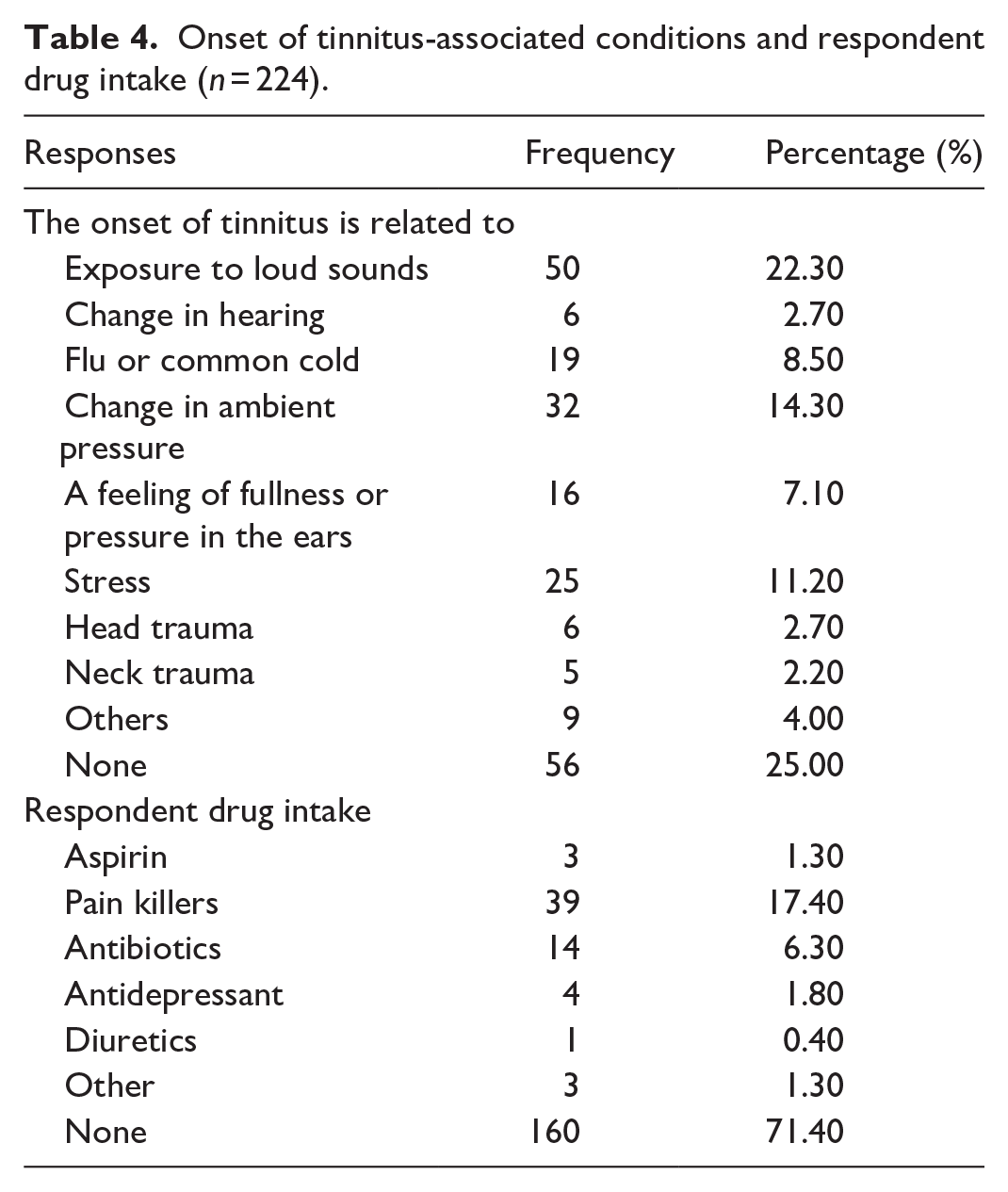
As presented in Table 4, 22.3% of the participants with tinnitus reported that loud noise exposure was associated with the onset of tinnitus. 17.4% of tinnitus sufferers reported using painkillers just before experiencing tinnitus symptoms. Only 2.6% of participants reported using drugs as a management option, and the majority of patients did not seek treatment for tinnitus. Results are shown in Table 5.
Onset of tinnitus-associated conditions and respondent drug intake (n = 224).
Management of tinnitus (n = 224).

Tinnitus-associated factors
Table 6 shows the potentially associated factors with tinnitus. Relative of tinnitus, gastroesophageal reflux, depression and anxiety, hearing difficulties, vertigo, tympanic membrane perforation, chronic otitis, acoustic trauma, head and neck radiotherapy, dental surgery, ear surgery, ear pain, headache, neck pain, temporomandibular (TM) joint pain, nasal septal deviation, and balance disorders were significantly associated with tinnitus.
Association between presence of tinnitus with sociodemographic and clinical characteristics.
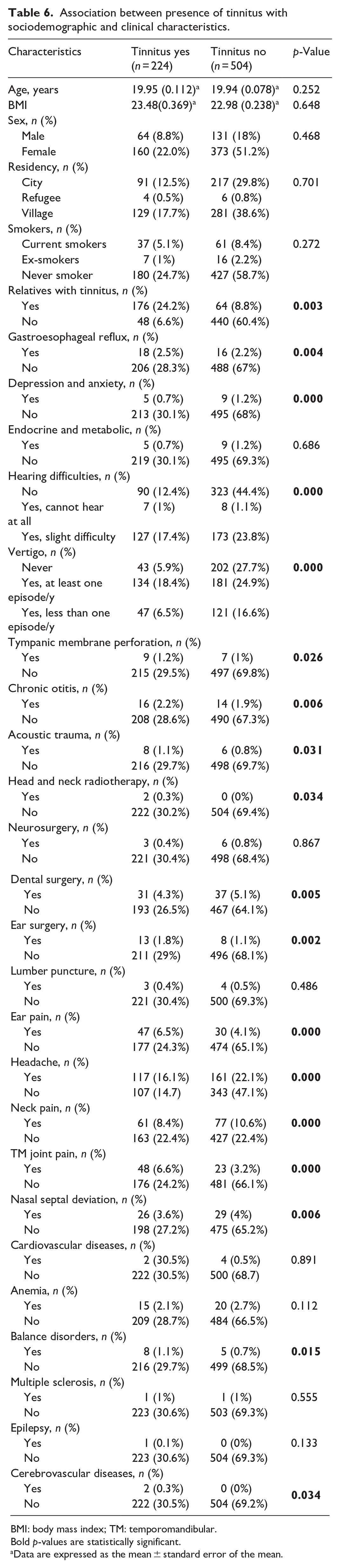
BMI: body mass index; TM: temporomandibular.
Bold p-values are statistically significant.
Data are expressed as the mean ± standard error of the mean.
Logistic regression analysis of the associations between tinnitus and influencing factors
Significant variables from the Chi-square were introduced into the binary logistic regression to determine the predictor variables of having tinnitus. Table 7 revealed that suffering from frequent vertigo (at least once per year) is significantly associated with an increased risk of tinnitus by more than two times (p-value =0.001, 95% CI: 1.377–3.44). Additionally, suffering from slight hearing difficulty is significantly associated with having tinnitus by 1.8 times compared with having no hearing difficulties (p-value = 0.001, 95% CI: 1.259–2.636). Moreover, suffering from TM joint pain is significantly associated with having tinnitus by 2.7 times (p-value = 0.001, 95% CI: 1.49–4.931), and performing ear surgery is significantly associated with having tinnitus by more than three times (p-value = 0.027, 95% CI: 1.141–8.864). Having depression and anxiety is associated with an increased risk of having tinnitus by nearly 2.5 times (p-value < 0.001, 95% CI: 1.545–3.997). Results are shown in Table 7.
Logistic regression analysis of the associations between tinnitus and influencing factors.

Bold p-values are statistically significant.
Discussion
Tinnitus is a widespread condition, affecting a significant proportion of the global population, with prevalence ranging from 5% to 43%. 16 However, there are several studies demonstrating the prevalence of tinnitus in Palestine and Middle Eastern countries in the general population, Palestine 30.6%, 14 Turkey 33%, 17 Egypt 5.2%, 18 and Iran 4.6%. 19 An interesting recent study among Saudi health sciences university students found that more than a quarter of students had tinnitus. Ear problems, or allergies, and being exposed to loud sounds was a significant predictor. 20 The variation could also be attributed to differences in study design and the absence of a uniform and established definition of tinnitus. This makes comparing different surveys difficult. Therefore, we used an existing standardized and validated evaluation approach, that is, ESIT-SQ. 15
Additionally, the prevalence of tinnitus among the general population in the United States of America is reported to be 14.3% in other countries. 9 The discrepancies in prevalence among countries can be attributed to a number of variables, including population characteristics, variances in investigative methods, and the absence of a broadly agreed and verified definition of tinnitus. Such differences make it impossible to directly compare survey data. While the aforementioned studies indicated the prevalence of tinnitus in the general population, there is a disparity in age stratification in terms of tinnitus prevalence and risk factors. In our current study, we sought to investigate the prevalence of tinnitus and its risk factors among young university students. Aside from defining tinnitus as a symptom, the prevalence of tinnitus in our study was 31% among young university students, which is in accordance with the general population of Palestine and higher than that of Saudi health sciences university students. 20 It is noteworthy that there was a female predominance in our sample, which reflects the high ratio of female students at the university. This might have affected the results concerning the gender.
According to the data, those affected experienced varying frequency of tinnitus. Participants had tinnitus on a monthly, weekly, and daily basis with 15.2%, 15.6%, and 12.5%, respectively, while a major proportion of participants experienced tinnitus every few months 31.7% and yearly 25%. Tinnitus frequency varies within affected persons, indicating that it is a symptom rather than a disease and that many etiologies may contribute to the development of tinnitus. The statistics show that a sizable proportion of individuals have tinnitus on a monthly, weekly, or daily basis. These data are consistent with the changing nature of tinnitus, stressing the need for a deeper comprehension of its influence on people’s lives. 21 The characteristics of tinnitus in our study population highlight the heterogeneity of this disorder. Tinnitus was described as constant in 69.2% of cases and intermittent in 30.8%. The most frequently reported tinnitus sounds were crickets (27.7%), noise (33.5%), and tonal sounds (28.6%). Additionally, there was variability in the tinnitus rhythm, the affected ear, and whether the tinnitus was subjective or objective. It is worth mentioning that tinnitus is experienced in both ears among our study population (about 48%); this could suggest a bilaterality that may be associated with systemic rather than a local disorder. Examples of such illnesses are Ménière’s disease, vestibular schwannoma, atmospheric inner ear barotrauma, vertebrobasilar ischemic stroke, and otosclerosis.22,23
Even though the exact pathophysiology of tinnitus is not clear, several risk factors have been documented. Several environmental and health-related factors were found to be associated with tinnitus. Older ages, being female, smoking history, sleeping problems, stress, noise exposure, and history of other clinical conditions such as arthritis, asthma, and thyroid disorders were found to be tinnitus risk factors.24,25 Furthermore, genetic factors associated with tinnitus had been previously reported in genome-based studies and twin studies. Identification of the genetic predisposition of tinnitus could be of great value in the pathogenesis and diagnosis of tinnitus.26,27
The association with tinnitus in individuals with a family history may indicate a genetic or familial predisposition to the condition. A previous investigation found a notable correlation between the presence of tinnitus in adolescents and a familial history of tinnitus, 28 a local study shows an insignificant association between tinnitus and a family history of tinnitus for the latter that may be due to the nature of the study population, which includes different age groups. 14 Our study shows a significant association between having tinnitus and relative with tinnitus, which may suggest that younger age group with tinnitus may be affected by familial inheritance of some etiological disorders that can lead to tinnitus, while environmental factors may play a more important role as a causative and risk factors in the old-aged group. Furthermore, our study suggests a significant association between tinnitus and various categorical factors. Gastroesophageal reflux and psychological factors, such as depression and anxiety, have been known to contribute to the perception and exacerbation of tinnitus. 29 The relationship between mental health and tinnitus is well-documented in the literature.30–33 Given that tinnitus is often related to auditory function, an association with hearing difficulties is not surprising. 34 Hearing impairment can contribute to or be a consequence of tinnitus. Tinnitus and vertigo may share common underlying causes, such as issues with the inner ear. Studies have shown a co-occurrence of these symptoms in various conditions affecting the vestibular system.35–38 Other categorical factors that showed a significant association with tinnitus, tympanic membrane perforation, chronic titis, 39 acoustic trauma, 40 head and neck radiotherapy, 41 dental surgery, 42 ear surgery, ear pain, headache, 43 neck pain, 44 and TM joint pain 45 were documented in the literature. The current study showed no significant correlation between sex, residency, smoking, and BMI. Despite several lines of evidence that suggest males are more affected by tinnitus than females15,46–49, it is possible that this observation indicates that men are more engaged than women in jobs and recreational activities that expose them to loud noise and the resulting hearing damage, 50 which is not the case in our study because our study population is still young university students.
The issue of tinnitus is not well documented in Palestine, and this is reflected in the way of management of this condition as the majority of patients (90%) did not have any treatment for tinnitus, 17.4% of tinnitus sufferers admitted to using painkillers just before their symptoms started, and only 2.6% of participants reported using drugs as a management option and about 79% have not seen a healthcare professional or doctor at a clinic or hospital about their tinnitus. Therefore, this study presents new insights into the tinnitus in Palestine, contributing to the development of our knowledge and comprehension of this condition. This study focused on the characteristics and possible risk factors of tinnitus in young Palestinian university students; it did not examine the disorder in adolescents or younger patients. Consequently, additional research is needed to determine the incidence of tinnitus in the Palestinian population as well as to look into the cause-and-effect relationship for common risk factors connected to tinnitus in our demographic. It is also necessary to conduct more studies on the features and risk factors of tinnitus among younger Palestinian age groups; perhaps, this will stop the development of tinnitus later in life.
Conclusion
To summarize, our study indicates that tinnitus is widespread among Palestinian university students. The study reveals that the overall occurrence rate of tinnitus was 31%. Tinnitus was significantly associated with a range of medical conditions, including gastroesophageal reflux, depression, anxiety, hearing difficulties, vertigo, tympanic membrane perforation, chronic otitis, acoustic trauma, head and neck radiotherapy, dental surgery, ear surgery, ear pain, headache, neck pain, TM joint pain, nasal septal deviation, and balance disorders. Given the absence of a recognized definitive solution for various types of tinnitus, it is essential to examine possibly modifiable risk factors and thereafter take measures to prevent tinnitus. Hence, additional longitudinal (repeated cross-sectional or prospective) research is necessary.
Limitations of the study
The ESIT-SQ questionnaire used in the current study is a considered general-purpose tool suitable for both screening for and profiling tinnitus that could be answered by those who have or do not have tinnitus. However, it has some limitations. It cannot be considered as reliable as clinical evaluation in the tinnitus diagnosis. Further questions regarding individual characteristics, such as history of noise exposure and personality traits, might be associated with tinnitus but are not included in the questionnaire. On the other hand, some variables might not be important in tinnitus profiling. The cross-sectional design of a study at a specific point of time limits the ability to establish causal relationships. The application of self-reported tools introduces potential information bias. The study included a large sample size of Palestinian university students, but these results cannot be generalized to the Palestinian population in general. Thus, further studies are needed to generalize these results on the whole Population in Palestine.
Supplemental Material
sj-docx-1-smo-10.1177_20503121241283344 – Supplemental material for Tinnitus prevalence and associated risk factors among university students: A cross-sectional study
Supplemental material, sj-docx-1-smo-10.1177_20503121241283344 for Tinnitus prevalence and associated risk factors among university students: A cross-sectional study by Malik Alqub, Narmeen Tourman, Juliana Mousa, Nada Humead, Asmaa Abd Alrazeq, Aya Khatatbh, Saja Nasassrh, Anas Hamdan, Mustafa Ghanim, Saad Allahham, Samar Alkhalidi, Maha Rabayaa and Majdi Dwikat in SAGE Open Medicine
Footnotes
Acknowledgements
We thank everyone who contributed their time to make this project a reality. Likewise, we are grateful to the faculty of medicine and health sciences of An-Najah National University for their affordable collaboration.
Authors’ contribution
MA and AH contributed to conceptualization, methodology, project administration, supervision, validation, writing original draft, review, and editing in addition to writing and finalization of the article. NT, JM, NH, AAA, AK, and SN conducted data collection, literature search, data analysis, and helped in writing, reviewing, and editing. MR, MG, MD, SAA-A and SAM-A provided critical review and helped in literature search, data analysis, writing original draft, reviewing, and editing. All authors consented to the submission of the article to the journal after revising and approving the final version.
Data availability
The data that support the findings of this study are available from the corresponding author upon reasonable request.
Declaration of conflicting interests
The author(s) declared no potential conflicts of interest with respect to the research, authorship, and/or publication of this article.
Funding
The author(s) received no financial support for the research, authorship, and/or publication of this article.
Ethics approval
Ethical approval for this study was obtained from Institutional Review Board (IRB) of An-Najah University (Reference: H.Sp. 2023/9).
Informed consent
Prior to inclusion, all participants provided written informed consent to take part in the study.
Consent for publication
The authors give the Publisher the Author’s permission to publish the work.
Trial registration
Not applicable.

Supplemental material
Supplemental material for this article is available online.
References
Supplementary Material
Please find the following supplemental material available below.
For Open Access articles published under a Creative Commons License, all supplemental material carries the same license as the article it is associated with.
For non-Open Access articles published, all supplemental material carries a non-exclusive license, and permission requests for re-use of supplemental material or any part of supplemental material shall be sent directly to the copyright owner as specified in the copyright notice associated with the article.
