




Abstract
Objectives:
Nowadays, there is a global trend towards an increase in the prevalence and incidence of diabetes mellitus, including among children, which is a significant health problem in many countries. The analysis of data on diabetes among children is important for training medical personnel and planning preventive measures. The aim is to determine the trends in the prevalence and incidence of diabetes mellitus, as well as the gender and age structure among the paediatric population of different regions of Ukraine over the last 20 years (2002–2021) of peacetime.
Methods:
The results of statistical evaluation and epidemiological analysis of the data of the Centre for Medical Statistics of the Ministry of Health of Ukraine on the prevalence and incidence of diabetes mellitus among children during 2002–2021 are presented. Statistical processing of the results was carried out using MS Excel (Microsoft Corporation, USA), XLSTAT-Pro (Addinsoft, USA).
Results:
According to the Ministry of Health of Ukraine, as of 2021, 11,193 children aged 0–17 years inclusive with diabetes mellitus were registered, which is 15.0 cases per 10 thousand of the relevant population. Compared to 2002, the prevalence and incidence rates increased by 93% and 80%, respectively; the fastest rates were among children aged 0–6 years, and the lowest among adolescents aged 15–17 years. In 2021, the highest incidence of diabetes among infants over the past 15 years was recorded (0.05 per 1000 of the relevant population).
Conclusions:
In Ukraine, over the past 20 years (2002–2021) of peacetime, there has been an annual gradual increase in the prevalence and incidence of diabetes mellitus among children in all age groups with gender balance, which generally corresponds to the global trend.
Introduction
The epidemic of diabetes mellitus (DM) is one of the major problems of public health worldwide. Type 1 diabetes is the most common type of diabetes in children and adolescents in most countries, but other types of diabetes, including type 2 diabetes and monogenic diabetes, are also common. Every year, the prevalence and incidence of DM among children in many countries of the world is increasing.1–8
In general, it is estimated that 1,211,900 children and adolescents between the ages of 0–19 years have type 1 diabetes worldwide. It is estimated that about 1,08,200 children and adolescents under the age of 15 are diagnosed each year. This number rises to 1,49,500 when the age range is extended to include those under 19 years of age. 3
Incidence rates are highest among people of Northern European descent, as well as in a growing number of countries in the Middle East and North Africa. Of the ten countries with the highest incidence rates, four are countries with non-European populations. 3
The incidence rates among children aged 0–14 years have no gender differences, but among adolescents, a predominance of boys was found Wandell and Carlsson 9 Also, Gale and Gillespie 10 and Warram et al. 11 report that the general sex ratio among diseased children is approximately the same until the age of 15. In contrast, in populations of European descent, males predominate at the age of 15–40 years.
Ramachandran et al. 12 reported that the peak age of diagnosis of diabetes is 11 years in girls, while in boys there are multiple peaks between 11 and 18 years. In addition, the maximum age of onset in urban patients is 11 years, and in rural patients – 18 years. A number of studies13–15 suggest that the predominance of the peak incidence of DM in puberty may be partly due to reduced insulin sensitivity at this time, which also explains why girls develop diabetes earlier, as they undergo pubertal development earlier than boys.
DM in infancy or neonatal diabetes mellitus is a rare genetic disease [1 per 90,000 live births] with variations in different ethnic groups. 16
Along with the global trend, significant changes in the prevalence and incidence of diabetes have occurred among the paediatric population of Ukraine. A retrospective analysis of data on diabetes statistics among children is important for training medical personnel and planning urgent preventive measures.
Research objective
To determine trends in the prevalence and incidence of DM, as well as gender and age structure among the paediatric population of different regions of Ukraine over the last 20 years (2002–2021) of peacetime.
Materials and methods
Data collection
The article presents the results of statistical assessment and epidemiological analysis of data from the Centre for Medical Statistics of the Ministry of Public Health of Ukraine 17 on the prevalence and incidence of DM among children in 2002–2021. The study complies with the main provisions of the Declaration of Helsinki on the Ethical Principles for Medical Research Involving Human Subjects, the Convention on Human Rights and Biomedicine developed by the Council of Europe, the recommendations of the Bioethics Committee at the Presidium of the National Academy of Science of Ukraine and the relevant meeting of the University Committee on Ethics.
In Ukraine, patients aged 18 years and older are considered adults. This article provides information about children aged 0–17 years. The Centre for Medical Statistics of Ukraine is the main institution that coordinates the activities of territorial information and analytical centres for health statistics and health care facilities in collecting, processing and analysing statistical information. All state and private hospitals subordinated to the Ministry of Health of Ukraine and have to fill in and submit special reporting forms on health status, provision of medical care to the population, healthcare resources and their use once a year. This applies to statistics on the prevalence and incidence of DM, among other diseases. The Centre for Medical Statistics collects, processes and analyses the information, ensuring the reliability, objectivity, efficiency and integrity of statistical data. This article contains data on the prevalence and incidence of DM among children of different age groups and different regions of Ukraine, published exclusively on the website of the Centre for Medical Statistics. The latter excludes risks of data being unreliable or incomplete. The local ethics committee of the Bogomolets National Medical University (Kyiv, Ukraine) gave its approval to the study (Protocol No 142). Written informed consent was obtained from the patients prior to study invitation.
Statistical analysis
Statistical analysis of the results was performed using MS Excel, XLSTAT-Pro. The data presented as means, absolute numbers, and, when appropriate, frequencies and percentages.
Results
According to the data of the Ministry of Health of Ukraine, in 2021, 11,193 children under the age of 0–17 years inclusive with DM were registered, which is 15.0 cases per 10 thousand of the relevant population.
For comparison, in 2002 there were 8010 children with diabetes, which amounted to 7.77 cases per 10 thousand of the relevant child population. The prevalence rate among the paediatric population in 2021 compared to 2002 gradually increased by 93% (from 7.77 to 15.0 per 10 thousand of the relevant population), that is by 1.93 times (Figure 1).
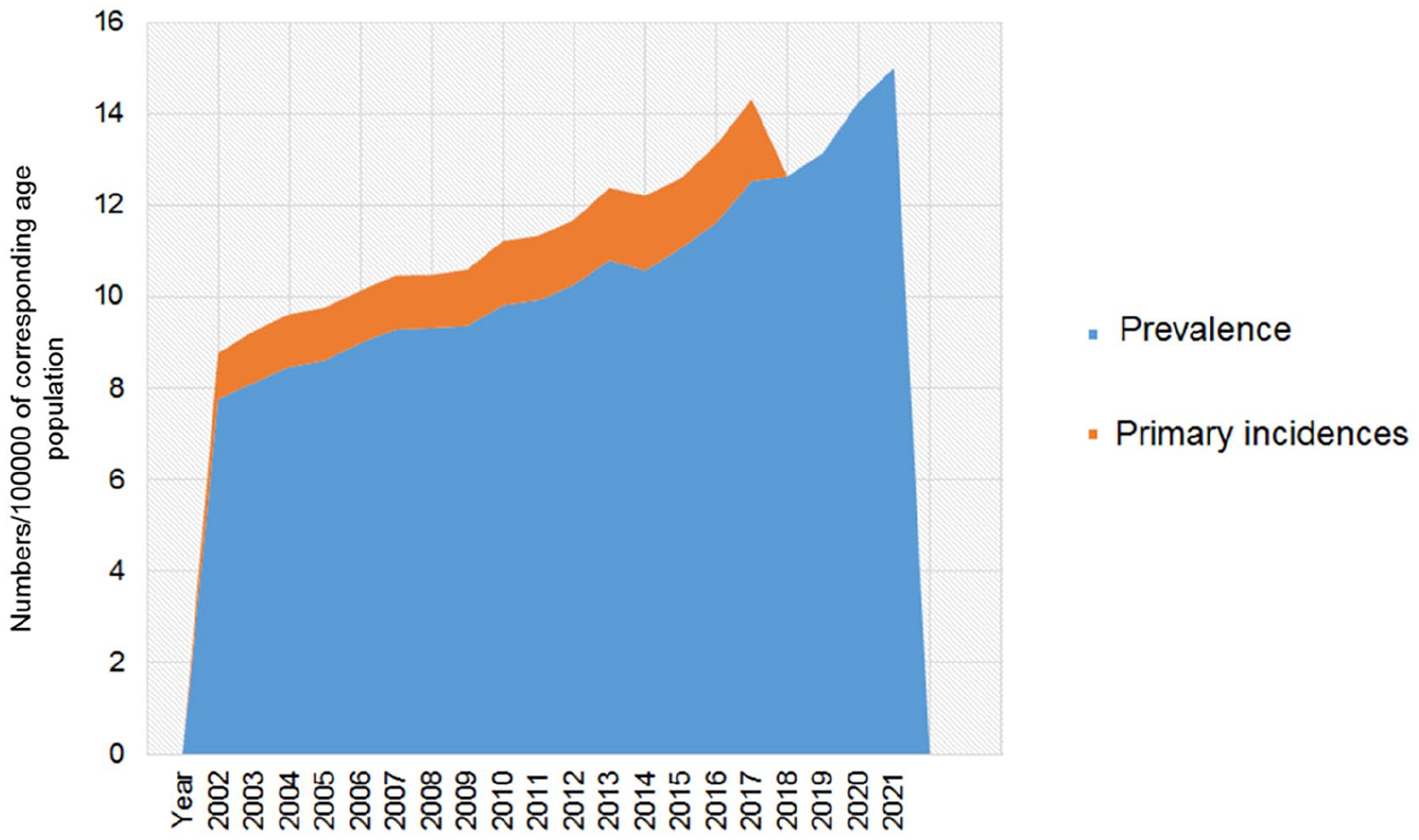
Comparative dynamics of prevalence and incidence of diabetes mellitus among children aged 0–17 years (per 10 thousand of the respective population) in 2002–2021.
Since 2017, statistical data on DM has not been collected centrally in Ukraine, as the main statistical form No. 12 ‘Report on Diseases Registered in Patients Residing in the Service Area of a Medical Institution’ was cancelled by the Order of the Ministry of Health of Ukraine No. 1802 dated 04 October, 2018. In addition, since 2014, the statistical data exclude the Autonomous Republic of Crimea and the non-government controlled territories of Donetsk and Luhansk regions.
In the structure of the prevalence and incidence of endocrine system diseases, metabolic diseases and eating disorders among children in 2017, the share of diabetes was 1.8% and 1.2%, respectively.
In 2017, there were 1368 newly diagnosed cases of DM (primary morbidity) among children under 0–17 years of age, which is 1.8 per 10 thousand of the relevant population. In 2002, this rate was 1 per 10 thousand of the relevant population, that is, it has increased by 80% or 1.8 times in 15 years (Figure 1).
In the structure of DM prevalence among different age groups, the lowest proportion is observed among children aged 0–6 years – 15% (in 2002 – 6%) (Figure 2). However, the prevalence and incidence of DM among this age group is growing the fastest. Thus, compared to 2002, the prevalence increased by 174% (from 1.68 to 4.60 per 10 thousand of the relevant population), and the incidence by 200% (from 0.48 to 1.44 per 10 thousand of the relevant population) (Figures 3 and 4).
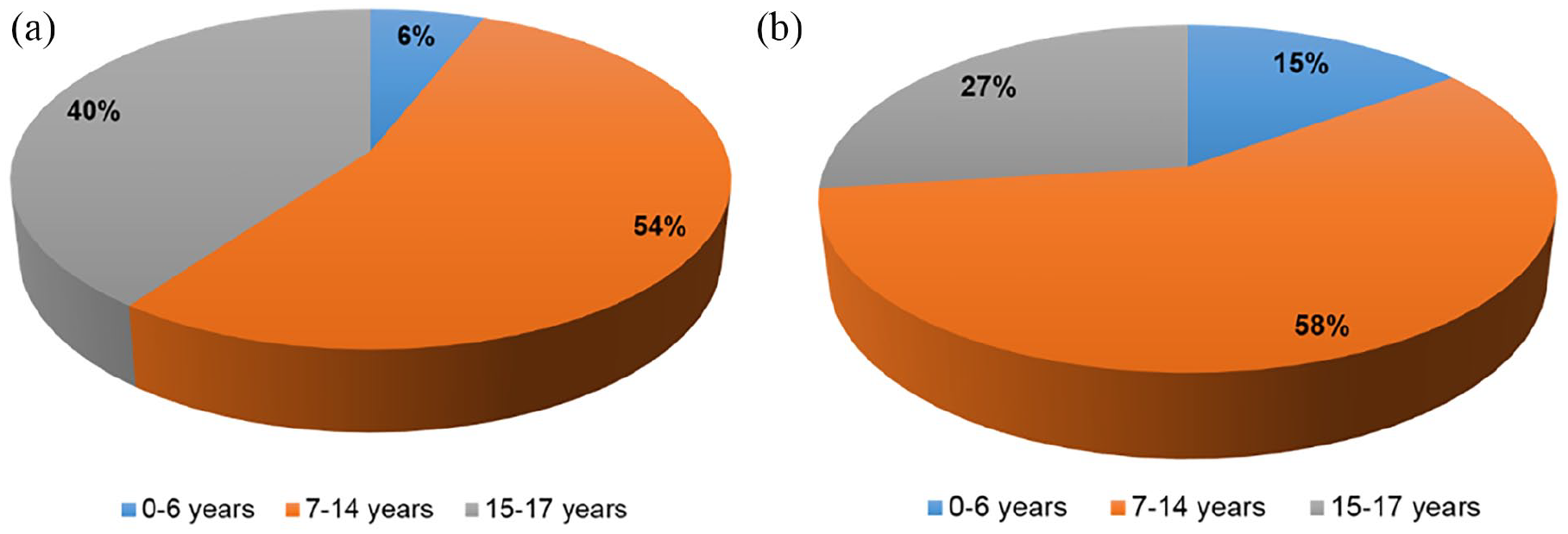
Age structure of diabetes mellitus prevalence among children in Ukraine in 2002 (a) and 2017 (b).

Comparative dynamics of diabetes mellitus prevalence among children aged 0–6 years, 7–14 years and 15–17 years in Ukraine in 2002–2017 (per 10 thousand of the relevant population).
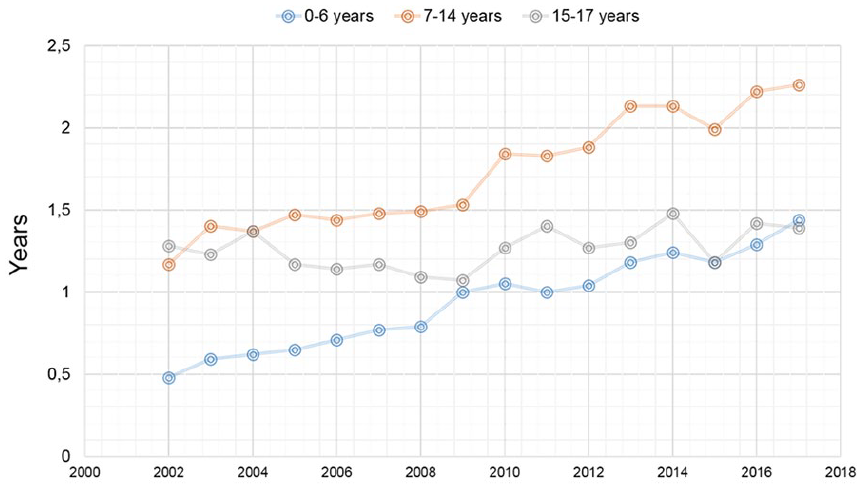
Comparative dynamics of diabetes mellitus incidence among children aged 0–6 years, 7–14 years and 15–17 years in Ukraine in 2002–2017 (absolute numbers).
As shown in Figure 2, in 2017, there was a decrease in the proportion of registered cases of diabetes in the total number of the oldest children (15–17 years) from 40% to 27% comparing to 2002. The prevalence and incidence rates in this age group are growing at the slowest pace. Thus, over 15 years, the prevalence of diabetes among adolescents increased by 74% (from 13.72 to 23.81 per 10 thousand of the relevant population), and the incidence by only 8.6% (from 1.28 to 1.39 per 10 thousand of the relevant population) (Figures 3 and 4).
The proportion of registered cases of diabetes in the total number of children aged 7–14 years changed slightly (from 54% to 58%) during 2002–2017 (Figure 2). The prevalence and incidence of diabetes in this age group increased by 92% (from 8.52 to 16.33 per 10 thousand of the relevant population) and 93% (from 1.17 to 2.26 per 10 thousand of the relevant population), respectively (Figures 3 and 4).
It should be noted that the dynamics of the absolute numbers of prevalence and incidence of diabetes among different age groups varies: along with an increase in the number of 0–6 years and 7–14 years, there is a decrease in adolescents aged 15–17 years (Figure 5).

Comparative dynamics of prevalence (a) and incidence (b) of diabetes mellitus among children aged 0–6 years, 7–14 years and 15–17 years in Ukraine in 2002 and 2017 (absolute numbers).
It should be noted that the dynamics of statistical data by age on the prevalence and incidence of diabetes may also be influenced by the decrease in the number of children in Ukraine during 2002–2021 from 10.30 million to 7.45 million, in particular in the group of children aged 0–6 years – from 2.92 million to 2.55 million, 7–14 years – from 5.02 million to 3.72 million, and adolescents aged 15–17 years – from 2.35 million to 1.17 million.
Thus, in Ukraine, there has been an annual stable trend of increasing prevalence and incidence of DM among children in all age groups over the past decades. This is similar to the global trend of increasing diabetes detection in children in most countries and leads to the need to address many social issues.
Depending on the region, in 2017, the highest prevalence and incidence of DM was observed in children in Kyiv and Kyiv, Kharkiv, Luhansk, Lviv, Ivano-Frankivsk, Donetsk, Dnipropetrovs’k, and Vinnytsia regions, and the lowest levels were observed in Volyn, Rivne, Zhytomyr, Zakarpattia, and Kirovohrad regions (Figure 6).
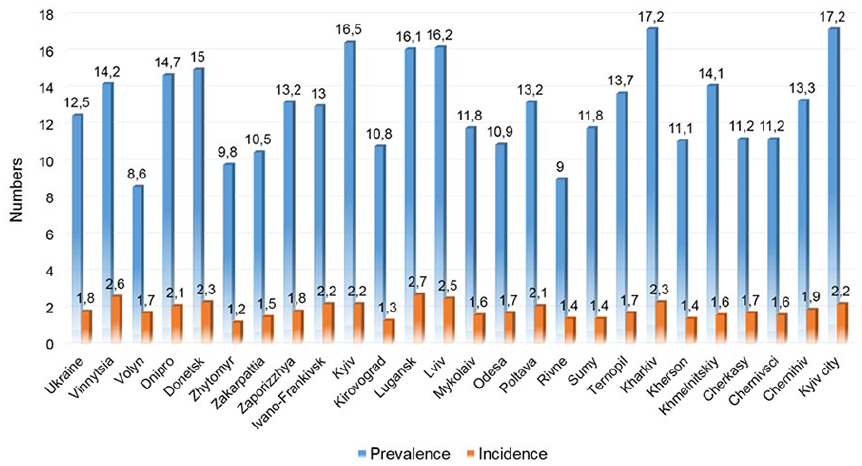
Prevalence and incidence of diabetes mellitus among children aged 0–17 years by regions in 2017 (per 10 thousand of the relevant population).
In the gender structure of DM prevalence among children aged 0–17 years, girls slightly prevailed in 2002–2005, and from 2006 to 2017 – boys (Figure 7), but this difference is not significant.
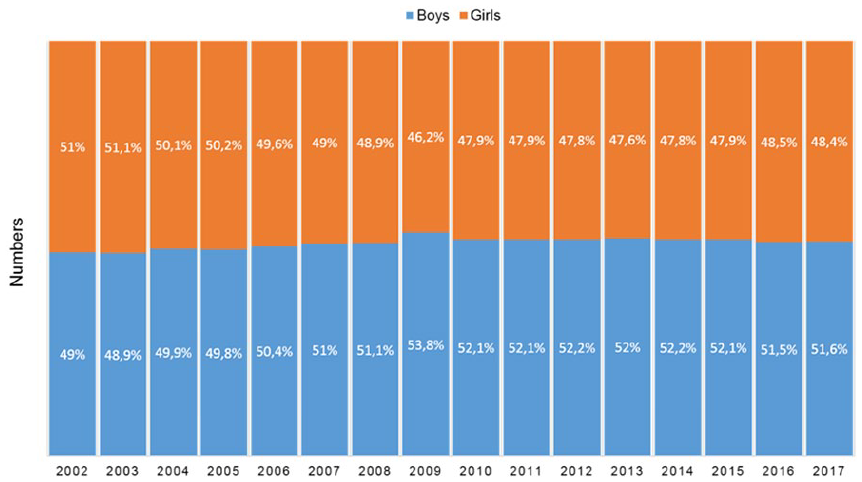
Prevalence of diabetes mellitus among children aged 0–17 years by gender in 2002–2017 (percentage).
Attention is also drawn to the peculiarities of the trend in the incidence of DM in children of the 1st year of life (Figure 8). Thus, from 2006, when epidemiological indicators in infants were separately recorded, until 2020, they remained stable, at an average of 0.02 per 1000 children.

Dynamics of diabetes mellitus incidence among children of the first year of life in 2006–2021.
However, as shown in Figure 8, in 2021, the highest incidence of DM among infants was recorded in the last 15 years. Thus, it was detected in 14 people, which is 0.05 cases per 1000 children of the corresponding age. Of these, three cases were registered in Donetsk and Ternopil regions, two cases in Ivano-Frankivsk and Cherkasy regions, one case in Zakarpattia, Kyiv, Odesa regions and the city of Kyiv, which may be due to an increase in the number of pregnant women with Covid-19, but requires further scientific observation and study.
Discussion
Our research demonstrates the trends in the prevalence and incidence of DM, as well as the gender and age structure among the paediatric population of different regions of Ukraine over the last 20 years (2002–2021) of peacetime.
The results of studies around the world indicate that the incidence and prevalence of diabetes among children and adolescents is increasing annually. This is generally in line with the trend we see among the paediatric population of Ukraine.1–5
According to one review study, which estimated the incidence of diabetes among the population from 0 to 19 years of age, an age difference was found. The lowest rates were found among children aged 0–4 and 15–19, while the rates among children 5–9 and 10–14 years old were the highest. 18 As for Ukraine, according to the results of our study, the highest rates of DM are observed among children aged 7–14 years, and the lowest among children aged 0–6 years. But, in the group of adolescents (15–17 years old), positive dynamics was recorded aimed at reducing the proportion of registered cases of diabetes in the total number of children and also at the slowest growth rates of prevalence and incidence of the disease. However, we found that among children aged 0–6 years, the incidence and prevalence rates are growing the fastest. This issue is very disturbing and requires further investigation.
With regard to the incidence of diabetes among children in neighbouring countries, the trend is similar to Ukraine. Although, in general, their incidence rates are higher than in Ukraine.19–26 According to one study, the incidence of diabetes among children in eastern and central Poland increased by 1.5 times between 2010 and 2014. However, the highest growth rates are observed in the group of children aged 10 to 14, and the lowest among 15 to 17-year-olds. 22 At the same time, in Ukraine, this data has increased by 1.1 times over this few years with the highest growth rates among children aged 0–6 years, and the lowest among children aged 7–14 and 15–17 years. Other studies also show an increase in the incidence rates of DM among children in Poland.23,24 Romania used to be one of the countries with a low prevalence of DM in children, but studies show an increase in the incidence rate and now Romania is a country with an intermediate incidence rate of childhood DM.25,26 If the growth rate of the incidence continues, this will lead to a doubling of the rate every 14 years. 26 Studies show that Romania’s neighbours, namely Germany and Hungary, have higher rates of diabetes among children and also have a tendency to increase.27,28
In 2019, the International Diabetes Federation noted that 98,200 children and adolescents aged 0–14 are diagnosed with DM every year worldwide. In addition, the report indicates that in the period from 1989 to 2013, the overall compound annual growth rate was 3.4%. 29
Gender plays a role in the onset of autoimmune diseases. According to statistics, women are more prone to developing autoimmune diseases. However, most of studies on type 1 diabetes do not show significant differences by gender. 27 In Ukraine, over the last 20 years (2002–2021), the rates of prevalence and incidence of DM among children in all age groups have gender balance, which generally corresponds to the global trend. However, there are some studies that indicate the predominance of male gender in the incidence of diabetes among the contingent over 15 years old9,28 and under 6 years old. 29
By 2021, there are differences in incidence and prevalence rates depending on the region of Ukraine. For example, the highest prevalence and incidence of diabetes were observed in children: Kyiv and its region, Kharkiv, Luhansk, Lviv, Ivano-Frankivsk, and Ternopil regions, while the lowest rates were observed in Zakarpattia, Rivne, and Kirovohrad regions. We did not examine the reasons for these differences, but this issue is worth further study.
Limitations of the study
There are several restrictions on this study that must be discussed. Potential limitation of this study is that it did not have a sample size calculation. It doesn’t include data from the temporary occupied in 2014 territories of Ukraine. Since 2017, statistical data on DM has not been collected centrally in Ukraine, as the main statistical form No. 12 ‘Report on Diseases Registered in Patients Residing in the Service Area of a Medical Institution’ was cancelled by the Order of the Ministry of Health of Ukraine No. 1802 dated 04 October 2018. In addition, since 2014, the statistical data exclude the Autonomous Republic of Crimea and the non-government controlled territories of Donetsk and Luhansk regions. Another limitation of the study is that we can’t add the subject inclusion and exclusion criteria due to fact that we worked with data dealing with incidence and prevalence of the DN. Data obtained from the Centre for Medical Statistics of Ukraine which is a final link in the chain collecting epidemiologic data all around the country. They collect information about the numbers of diabetic patients etc. from all hospitals around the Ukraine. We didn’t work with patients records etc. that is why information about the exclusion and inclusion criteria is not applicable in our case.
Conclusions
In Ukraine over the last 20 years (2002–2021) of peacetime there has been an annual gradual increase in the prevalence and incidence of DM among children in all age groups with gender balance which generally corresponds to the global trend. The highest registration of DM cases during 2002–2017 was observed in primary school children (7–14 years), and the prevalence and incidence in this age group increased. The slowest growth rates of prevalence and incidence of the DM documented during 2002–2017 in the group of adolescents (15–17 years old). A differences in prevalence and incidence of DM were observed in children living in different regions of Ukraine in 2021 before the war.
Footnotes
Acknowledgements
We acknowledge clinical paediatric hospitals which are clinical bases of our departments.
Author contributions
Authors equally contributed to the paper.
Author contributions
Mityuryayeva-Korniyko Inga O. idea, study design, paper writing; Volosovets Oleksandr P. idea, study design, paper writing; Kryvopustov Sergii P. idea, study design, paper writing; Burlaka Ievgeniia A. idea, study design, data analysis, paper writing, revision; Polukhina Maryna O. data analysis, literature analysis, paper writing; Shevchenko Tetiana A. data analysis, literature analysis; Nechayev Mykyta P. literature analysis; Kovalchuk Ihor V. literature analysis; Kryvonos Yurii M. literature analysis.
Declaration of conflicting interests
The author(s) declared no potential conflicts of interest with respect to the research, authorship, and/or publication of this article.
Funding
The author(s) received no financial support for the research, authorship, and/or publication of this article.
Ethics approval
The local ethics committee of the Bogomolets National Medical University (Kyiv, Ukraine) gave its approval to the study (Protocol No 142).
Informed consent
Written informed consent was obtained from the patients prior to study invitation.
Trial registration
Not applicable.
