




Abstract
Food adulteration is the intentional addition of foreign or inferior substances to original food products for a variety of reasons. It takes place in a variety of forms, like mixing, substitution, hiding poor quality in packaging material, putting decomposed food for sale, misbranding or giving false labels, and adding toxicants. Several analytical methods (such as chromatography, spectroscopy, electronic sensors) are used to detect the quality of foodstuffs. This review provides concise but detailed information to understand the scope and scale of food adulteration as a way to further detect, combat, and prevent future adulterations. The objective of this review was to provide a comprehensive overview of the causes, risks, and detection techniques associated with food adulteration. It also aimed to highlight the potential health risks posed by consuming adulterated food products and the importance of detecting and preventing such practices. During the review, books, regulatory guidelines, articles, and reports on food adulteration were analyzed critically. Furthermore, the review assessed key findings to present a well-rounded analysis of the challenges and opportunities associated with combating food adulteration. This review included different causes and health impacts of food adulteration. The analytical techniques for food adulteration detection have also been documented in brief. In addition, the review emphasized the urgency of addressing food adulteration through a combination of regulatory measures, technological advancements, and consumer awareness. In conclusion, food adulteration causes many diseases such as cancer, liver disease, cardiovascular disease, kidney disease, and nervous system-related diseases. So, ensuring food safety is the backbone of health and customer satisfaction. Strengthening regulations, taking legal enforcement action, enhancing testing, and quality control can prevent and mitigate the adulteration of food products. Moreover, proper law enforcement and regular inspection of food quality can bring about drastic changes.
Introduction
Food is one of the basic needs of all living organisms that are consumed for day-to-day activities. Food contains a variety of essential minerals and nutrients such as carbohydrates, water, lipids, and proteins that animals, including humans, can consume or drink for nutrition or pleasure. 1 The health and productivity of the population depend on the nature of the food they consume and its wholesomeness in terms of its nutritive value. Adequate nutrition is essential for health, but when food is adulterated, its beneficial effects are diminished. 2 Poor diet quality is associated with elevated risk for various morbidity and mortality such as cardiovascular disease, type II diabetes, and cancer. For instance, food containing glutton causes to increase the glucose level of the person. 3 In addition, adulterated food products are responsible for mild-to-severe health impacts as well as financial damage. Diarrhea, nausea, allergic reactions, diabetes, cancer, etc. are frequently observed illnesses upon consumption of adulterated food. 4 Some adulterated food may also affect our internal organs directly, leading to heart, kidney, liver, and many more organ disorders and failure. 5 The assurance and protection of food quality have always been important to man. Over many years, governments have attempted to ensure the safety and wholesomeness of food by legal provisions. Despite these provisions, adulteration of foods has increased and the detection of these adulterants has proved more difficult, essentially because of the sophisticated methods being used in the adulteration. 6
Economical food adulteration takes place in many forms, like mixing, substitution, hiding the observation of poor quality from packaging material, putting decomposed food for sale, misbranding or giving false labels, and the addition of toxicants. 2 Moreover, some examples of food adulterants are listed in Table 1. 7 Unbalance of consumer income and food price is a leading factor for food adulteration. For instance, when the cost of food production exceeds the consumer’s willingness to pay, the seller is forced to provide a lower-quality food product. Adulteration is one of the biggest and most challenging problems faced in the present time. Because the law is not implemented as drafted and also arresting the criminal is challenging due to the collaboration of criminals with government members. 8 In addition, food adulteration is an overall concern for consumers, the government, food processors, regulatory agencies, and industries.9–11
List of food, its adulterants, and purposes with its analytical techniques.
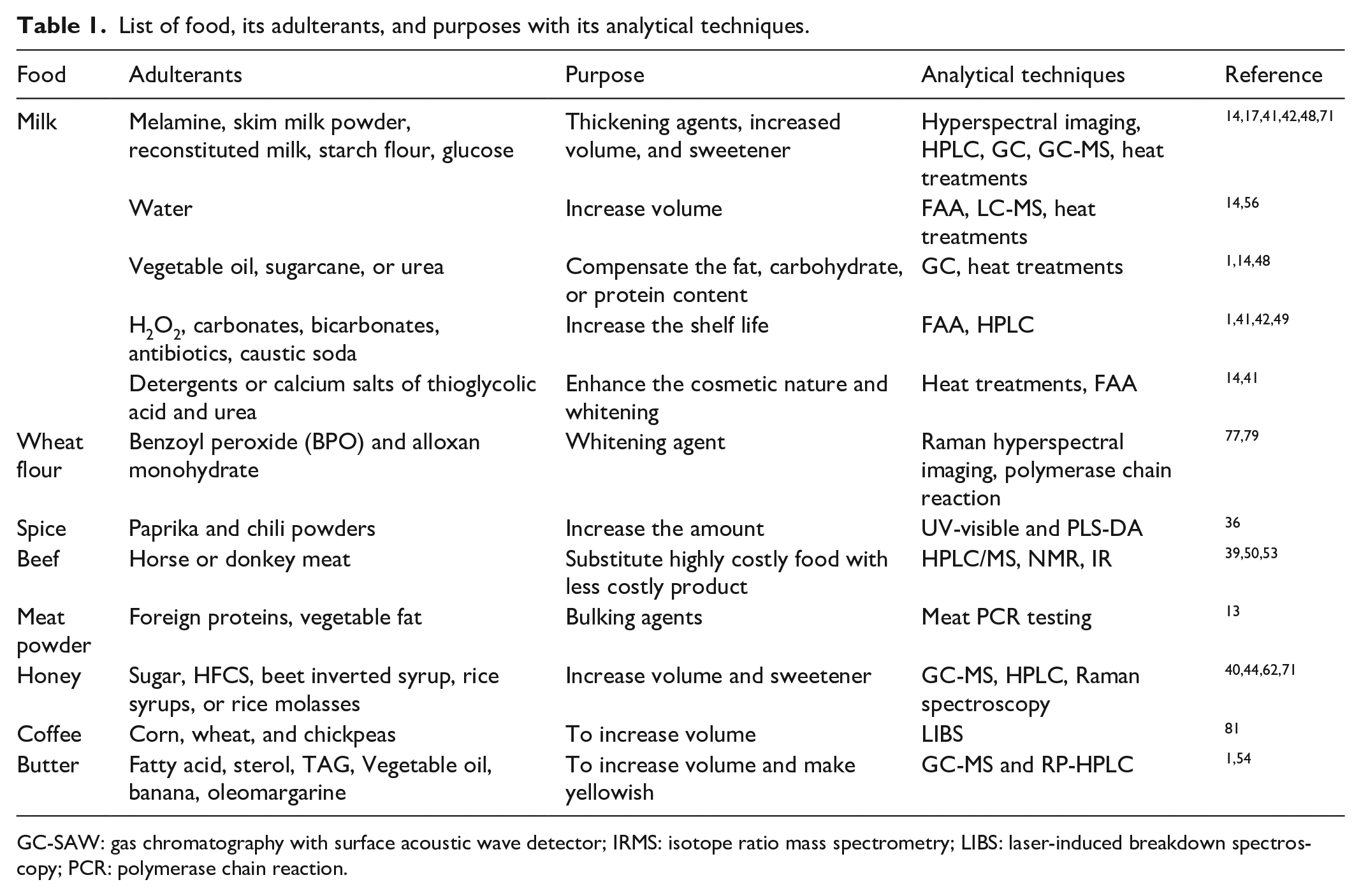
GC-SAW: gas chromatography with surface acoustic wave detector; IRMS: isotope ratio mass spectrometry; LIBS: laser-induced breakdown spectroscopy; PCR: polymerase chain reaction.
According to different articles, economic adulteration is a type of adulteration in which dishonest producers and traders deliberately reduce the number of essential nutrients in various food products to increase their profit margin by adding different chemicals and/or less costly foods. Furthermore, these dishonest producers and traders increase the volume of food by adding ingredients such as starch, flour, cane sugar, vegetable oils, water, skim milk, sand, chalk powder, molasses, stone, and brick powder to different foodstuffs. 1 Such practice is the most dangerous because the amounts of nutrients deducted and extraneous substances added to food items that are done by business-oriented people just forget the humanity behind of money-making mentality. 12 Recent food fraud crises have had a considerable impact, including the addition of illegal Sudan dyes to chili and paprika (2005), the indirect augmentation of protein content through the nitrogen-rich compound melamine in wheat gluten (2007), and the European horsemeat scandal (2013). The 2013 European scandal involving the widespread use of cheaper horse meat in place of beef, which expanded from the UK and Ireland to several other nations, highlights the vulnerability of processed meat. 13 According to different articles, milk is adulterated to increase its shelf life, viscosity, and volume. For instance, starch and other reconstituted milk powders are added to increase viscosity. Various chemicals, including hydrogen peroxide, carbonates, bicarbonates, antibiotics, caustic soda, and even the most lethal agent, formalin, are also used to extend the shelf life of milk. Urea-contaminated milk is quite harmful to girls since it speeds up puberty. 14
There were many challenges while we prepared this review. Since the review includes a variety of food adulteration-related topics and their findings, it took a long time to summarize the key findings. Articles published in languages other than English are not included. There was a lack of information in some studies that we found using search engines to conclude. Moreover, there is a lack of guidelines and legislation for governing food adulteration. Adulterated food is usually not identified until it shows a health hazard. In addition, many developing countries still lag in terms of food adulteration analysis techniques. The limitations of the previous studies are specific to a single topic, like the detection of food adulteration using a single analytical method. So, the previous study did not address different food adulterations and their detection techniques simultaneously. This review provides concise but detailed information to understand the scope and scale of food adulteration as a way to further detect, combat, and prevent future adulterations. It also provides an opportunity for the reader to see and even evaluate the assessments and research methods in food adulteration and its detection techniques. In addition, this review prevents the reader from duplicating the same information as others writing about food adulteration and its detection techniques. In general, the study aimed to assess the different causes, health impacts, and detection techniques of food adulteration.
Causes of food adulteration
There are different causes of food adulteration such as the dishonesty of traders to make quick and easy money.3,10,11 Powdered food products are the most vulnerable because of the complex supply chain and drift in nutritional and aesthetic quality over time. As a result, ground material with a texture and color similar to the original powder can be added to increase the amount, while other compounds can be added to maintain the quality. 15 Moreover, to keep the freshness of the food, some unethical activities are usually adapted to prevent financial losses due to the spoilage of food during its transportation and sale. For instance, the addition of adulterants to increase volume, thickening agents to counter the dilution and extend the solids content, compensate the fat, carbohydrate, or protein content, enhance the shelf life, enhance the cosmetic nature, and give it a genuine look. 16 Besides this, the use of dose-dependent starches and flours in the production of fresh cheese is approved as functionally necessary, according to the FAO study. However, the maximum concentration of starch or stabilizer/anti-caking agents present in fresh cheese is 5 g kg−1; when the amount is above this, the nutritional quality of cheese can be affected. 17
Some food producers/traders exaggeratedly advertise their products. It is very difficult for the consumer to select safe food items because of misleading/false advertisements. Based on these malpractices, the ultimate victim is a consumer, who innocently takes adulterated foods and suffers. As a result, the right media coverage of food adulteration has a great contribution to reducing crime and announcing to the consumer how adulterated food is bad for human health, but in some countries, the media existence in the country did not give attention. Media coverage creates awareness among consumers about food adulteration and saves their health from such related diseases. 18
Preventing food adulteration is a complex task that requires a multifaceted approach.19,20 The following measures can prevent and mitigate the adulteration of food products: strengthening regulations and enforcement, enhancing testing and quality control, promoting public awareness and consumer education, strengthening supply chain management, strengthening international cooperation, and encouraging responsible business practices; collaborative development of codes of conduct; implementation of best practice guidelines; monitoring and compliance mechanisms; capacity building and knowledge sharing; public–private partnerships and consumer engagement; and research and development.19–22 By implementing these measures, we can safeguard public health, protect consumers’ rights, and ensure the availability of safe and nutritious food. 22 There is a need for adequate precautions to be taken by the consumer at the time of purchasing adulterated food, which can make consumers alert to avoid procuring such food. 23 It is the collective responsibility of governments, regulatory bodies, industry stakeholders, and consumers to work together to combat food adulteration and establish a robust food safety ecosystem.24,25
Health impact of adulterated food
Food adulteration is a major source of health problems. 26 Adulterants of food products not only decrease the quality of food but if we eat these adulterated food products daily, then it affects our health very dangerously. For instance, adulteration causes many diseases such as cancer, lathyrism, liver disease, cardiac failure, kidney diseases, and nervous system-related diseases. 8 Furthermore, nearly 300,000 illnesses and six known infant deaths were reported in China in 2008. 7
Economically motivated adulteration is a root cause of public health food risks. 27 Although the motivations are economic, the adulteration may result in serious public health consequences when the adulterant is toxic or allergenic. 7 For instance, hydrogen peroxide affects antioxidants in the body disturbing the natural immunity hence increasing aging, chloride in the milk disturbs the acid–base balance in the body and also blood pH, and ammonia in milk develops regression, loss of acquired speech, and sensory disturbances. 16
Food safety
Food safety is the milestone for health, customer satisfaction, acceptance of the industry by consumers, and decreasing the deficit of food supply. Thus, proof of provenance is an important topic for food safety, food quality, and consumer protection, as well as compliance with national legislation, international standards, and guidelines. Provenance is the identification and verification of a product’s origin and, subsequently, the location in which it was manufactured. 28 Today, food safety is a big issue so many consumers are concerned about what they eat. In addition, the choice of one food product over another can reflect individuals’ lifestyles, religious beliefs, diets, and health concerns. As a result, proper labeling is essential in supporting consumers in making conscious choices. The elemental composition of food is a very important indicator to understand food quality, nutritional value, and authenticity of the food. Besides, it is fundamental to assess the presence of nutrients presented. Therefore, determining the elemental composition of a food product is vital, especially for certain consumer groups such as children, pregnant women, and people with allergies to specific elements. 29
While food security is a matter of equal importance to importing and exporting countries, several countries have inferior food safety standards and have not yet established adequate surveillance or reporting mechanisms to identify food adulteration. 30 Nowadays, food safety is a major concern for both the food industry and food safety organizations, due to an increase in the number of food adulteration cases over the past decade. 15 Most food products susceptible to fraud are high commercial cost products, often produced worldwide on a large scale. Therefore, the ability of the industry, governments, and standard-setting organizations to authenticate, control food constituents, and check for food fraud is increasingly important. 31 Food safety is a multidisciplinary subject regarding food processing, preparation, and storage in ways that prevent food adulteration. 32
Analytical methods
Determination of food authenticity is an important issue for both quality assurance (QA) and food safety. Authenticity testing is a quality criterion for food and food ingredients and is increasingly a result of the legislative protection of regional foods. Thus, there is a pressing need for accurate, standardized food authentication techniques. Over the last decade, several analytical procedures have been proposed for rapid screening or selective confirmation of the quality and authenticity of different food items such as liquid chromatography (LC) and gas chromatography (GC), especially coupled with mass spectrometry (MS). 33 In addition, chemometric methods with other analytical techniques are used for qualitative and quantitative analyses of food including milk 34 and edible extra virgin olive oils. 35 Principal component analysis (PCA) and neural networks (NN) are the two chemometric methods practiced for food analysis. PCA provides useful plots by representing the first principal components (PCs). 34
Multivariate qualitative methods also have increasingly been applied in food analysis. Qualitative analysis is used not only to identify compounds but also to classify and authenticate foodstuffs. Like all analytical methods, qualitative methods need to be validated by establishing their performance parameters. 36 The most commonly used techniques have been chromatography-based methods including HPLC, GC–MS, LC-MS/MS, 37 FTIR, and SERS. 38 Recent research focused on the determination of adulterants using different analytical techniques. Among these, Raman spectroscopy, 39 HPLC,40–43 GC–MS, 44 FTIR,45,46 GC,47,48 FAA, 49 HPLC-MS, IR, GLC, 43 and HPLC/MS 50 were successfully used as suitable techniques for the determination and quantification of different food adulterants.
Chromatography
Chromatography is an analytical method used to separate chemical compounds and food items based on their polarity or boiling point. This includes techniques that adsorb or partition analytes between a mobile and a stationary phase. They are usually classified according to the character of the stationary and mobile phases. The solid stationary phase is applied in a column and the mobile phase is pumped through the column. 51 A compound with the lowest affinity of the stationary phase, lowest boiling point, and lowest retention time will elute first and be detected by the detector. 52 Chromatographic methods may be capable of differentiating individual meat products, but they are less effective in detecting adulterated products in meat mixtures or cooked meat because of the increased complexity of the chromatographic patterns. Besides, expensive instruments and laborious sample preparation procedures are required, which has restricted their use for regulatory purposes. 53
The most common classifications of chromatography are GC and LC. Gas chromatography is one type of chromatography that has been applied to a wide range of foods for identification, authentication, or quality feature prediction. Liquid chromatography has also been applied to identify, classify, and assess the quality of several kinds of foods. Nowadays, HPLC fingerprints are used to evaluate the similarity of various food items. The similarity analysis is applied to calculate some correlation parameters like correlation coefficients. Furthermore, many classes of food solutions, both polar and non-polar solvents, can be analyzed directly and easily by LC without derivatization. 52 However, GC needs derivatization during sample preparation due to the high boiling point and compact nature of the product. For instance, derivatization is used to transfer the hydroxyl groups of tocopherols to trimethylsilyl (TMS) forms, resulting in lower boiling points. 54
To date, HPLC methods have been widely used in the analysis of tocopherols in food and nutrition areas. Using HPLC with either a UV or fluorescence detector, each form of tocopherol can be separated and quantified separately. Interferences are largely reduced after separation by HPLC. As a result, this method is more sensitive and specific than that of the colorimetric, or polarimetric, but less than GC methods. 54 Moreover, the LC systems currently shifting from standard HPLC to UHPLC, which can significantly increase resolution, sensitivity, and peak capacity due to the reduced particle size while significantly decreasing sample volumes and mobile phases. 52
HPLC coupled with PCA has differentiated bovine (collagen originates from a cow) and porcine (collagen originates from a pig) gelatins based on the results of individual amino acids. The amino acid analysis was performed using a reversed phase-high performance liquid chromatography (RP-HPLC). HPLC/MS method is also used for the identification of marker peptides in digested gelatins. 55 LC-MS was used to determine the adulteration of cow’s milk into the water, buffalo milk, and mozzarella. 56 In addition, HPLC, LC, and GC are widely used to assess the quality of honey. 57
Spectroscopy
A variety of spectroscopy has been researched for food safety and quality applications. It has a great role in the determination of food adulterants through subsurface inspection of packaging and evaluation of flesh quality under fruit skin. 58 The development of non-destructive rapid analysis methods is an area in which interest increased a few years ago. Several methods based on various chemical and physical principles have been presented to perform both qualitative and quantitative determinations in laboratories and process chains. The methods that have demonstrated high versatility and robustness are those based on the simultaneous analysis of a large number of wavelengths of electromagnetic spectra and in all their modes. Specifically, the study of IR has been used for a vast number of determinations from multiple food matrices and analytes. 9 It uses spectra in the NIR and MIR region, but in muscle food applications, visible wavelength ranges are often included due to the presence of pigments in the raw material. In the NIR region, vibration and combination overtones of the fundamental O–H, C–H, and N–H bonds are the main recordable phenomena. The MIR spectrum of a food sample reveals more about the molecules present, including many of the general stretchings, bendings, and wagging motions of functional groups like C–C, C–H, O–H, C=O, and N–H. UV-vis, NIR, and MIR spectroscopy coupled with chemometric techniques used for detecting bovine meat adulteration with turkey meat. 59
Fourier-transform infrared spectroscopy (FTIR) and Raman spectroscopy have come into use for fat-based methods in the recent decade. The capacity to provide information about the chemical structure of molecules without creating any changes and the use of only a small amount of the sample are the two key advantages of this technology. 39 NIRS, based on the absorption of various wavelengths, and Raman spectroscopy, based on the inelastic scattering of light, are becoming increasingly popular tools in the determination of food adulteration. Based on the identification of chemical adulterants in foods, different articles state that Raman spectroscopy has a great contribution to the determination of melamine in milk. Besides this, NIRS methods have also contributed to the determination of the adulteration of melamine in soya bean products. 60 Raman and IR spectroscopies have been extensively investigated to reveal food fraud issues based on their simple instrumentation, increased accessibility, and rapid and non-destructive features. 61 Raman spectroscopy was used to determine adulterants of honey such as high fructose corn syrup (HFCS) and maltose syrup. 62 Also, the adulteration of butter with margarine was determined using this analytical technique in combination with chemometric methods. 63 This has high potency for the evaluation of food quality systems during handling, processing, and storage. The combination of Raman spectroscopy with chemometric data analysis methods enables researchers to determine food adulteration more quickly. It is a new approach used to differentiate horse meat from beef. 39
To date, various types of research focus on the determination and quantification of the adulteration of minced lean beef with horse meat, textured soy protein, or the addition of fat beef trimmings using mid-FTIR spectroscopy with multivariate analysis. 53 Surface-enhanced Raman spectroscopy (SERS) has been widely investigated owing to its significant enhancement of faint Raman scattering signals. SERS gathers vibrational signals from a variety of functional groups in molecules. As a result, both targeted analytes and interferences derived from food matrices contribute to SERS spectra. 64
Nuclear magnetic resonance (NMR) is preferable in analytical and metabolomics studies due to its high robustness and reproducibility, so it is a preferable choice for the determination of adulteration of different food items. 65 Besides this, it has a better performance in identifying various chemicals because the minor difference in the electron cloud of nuclei can be accurately recorded by NMR spectra. Thus, the identification of chemicals sharing similar structures can be achieved. The intensity of NMR spectral signals is only influenced by the number of each type of nuclei present in the sample; thus, absolute quantification of several specific chemicals simultaneously can be achieved by applying only one reference chemical. Although NMR spectroscopy also lacks the sensitivity to determine the chemical(s) at low concentrations based on its principle, the sensitivity can be improved by simply increasing the number of scans during spectral collection without modifying any hardware. 61
In general, there are various types of analytical methods used to determine adulterants in foods, most of which are chromatography and spectroscopy-based including SERS, 64 NIR-PLSR, 66 immunological separation and SERS, 67 multiplexed planar waveguide fluorescence immunosensor, 68 near-infrared hyperspectral imaging and band ratio, 69 mid-infrared spectroscopy, 70 and others like silver nanoparticles, 38 Personal Glucose Meter, 71 and Chemical Sensors and Biosensors. 72 The analytical techniques that were employed to rate the qualities of a variety of food products are shown in Table 1. To determine and quantify the authentication of honey, different articles used various analytical methods including Vis-IR with chemometrics, 73 NIR, 74 Hyperspectral Imaging, 75 and other analytical techniques have been reported by different authors: differential scanning calorimetry to detect corn syrups, 76 high-performance liquid chromatography (HPLC) to detect starch syrups. 40 To determine the authentication of wheat flour, different articles used various analytical methods including Raman micro-spectroscopy combined chemometrics to detect L-cysteine, 77 laser-induced breakdown spectroscopy (LIBS) to determine calcium (Ca), 78 polymerase chain reaction assay to detect common wheat adulteration of durum wheat for pasta production. 79 NIR spectroscopy to detect Corn Adulteration in Brazilian Coffee (Coffee Arabica), 80 LIBS for determination of coffee adulteration with chickpea, corn, and wheat, 81 DNA-based method to detect and quantify adulterations in coffee (Arabica vs Robusta), 82 capillary electrophoresis-tandem mass spectrometry to determine adulteration of coffee with soybean and corn, 83 and NMR spectroscopy was used to verify the presence of Arabica and Robusta species in coffee. 84 In addition, a list of foods, their adulterants, and the methods employed for their analyses are shown in Table 1.
Electronic nose
An electronic sensor is an advanced analytical method used for the physical or chemical determination of food adulterants by imitating the human sense. Electronic noses are devices that imitate the sense of smell. These instruments generally consist of an array of sensors utilized to detect and distinguish odors in complex samples at a low cost. These characteristics make them very useful for different applications in many areas, including the food industry.85,86 Nowadays, electronic sensors are increasingly employed for food analysis. These are being utilized to analyze the aromatic profiles of samples without first separating the volatile fraction into distinct components. These devices are made up of a series of neon or partly selective gas sensors that are linked to a data processing and pattern recognition system that can recognize even the most complex aromatic profiles. This technique is a non-destructive analysis and is used as an alternative to relatively costly and time-consuming techniques.85,87 E-tongues, on the other hand, are analytical devices (sensor groups) used to identify and classify the tastes of a variety of chemical substances in beverages or liquid phase food samples, with their method of operation “imitating” the human sense of taste. It can be utilized to characterize multi-component mixtures for both qualitative and quantitative purposes, hence the increasing attention they are receiving in the field of food analysis. 86
Enzyme-linked immunosorbent assay
This analytical technique is a simple, specific, and sensitive analytical method used to determine the adulteration of meat speciation. Enzyme-linked immunosorbent assay (ELISA) does not need major scientific equipment, is easy to perform, uses a small number of immune reagents, and has the capacity for large-scale screening and field tests. However, the performance of ELISA depends on the nature, quality, and availability of the antibody used. 53 Many monoclonal antibody-based immunoassays have been commercialized for the detection of various food adulterants/contaminants to better comply with food regulations and decrease the economic loss to the food business. 88 ELISA test kits were used to find melamine, atrazine, and triazines. About 1500 g/ml melamine was needed for the test kit to detect triazines. The atrazine ELISA produced results with 23 g/ml melamine. The melamine ELISA also produced positive results, with all samples containing at least 9 ng/ml of melamine. 89 Through the use of monoclonal antibody-based ELISA test kits, the species of 100 different types of meat and meat products were determined. According to the findings of this examination, unknown species were detected in 11 of 28 fermented sausages (39.2%), 5 of 14 cooked salami (35.7%), 3 of 11 frankfurters (27.2%), 2 of 9 raw meat samples (22.2%), and 1 of 16 raw ground meat and meatball samples (6.2%). 90
Food quality control
Quality control is the standard that maintains the quality of food products according to the customer’s acceptability. Physical, chemical, microbiological, nutritional, and sensory properties are employed to preserve healthy food. These quality factors depend on specific attributes such as sensory properties, based on flavor, color, aroma, taste, texture, and quantitative properties, namely, percentage of sugar, protein, fiber, and so on as well as hidden attributes such as peroxides, free fatty acids, enzyme. 91 Over the past few decades, there has been a growing demand for safe and high-quality food. Rapid economic development and recent changes in the food supply chain have contributed to increased interest in the issue of quality in the food sector. The concept of a food product’s quality appears to be intimately linked to the perception of its safety in the minds of customers. A recent study looking at the relationship between food quality and food safety discovered that, in general, consumers are more likely to see a food product as safe if it is of good quality rather than the converse. 92
Conclusion
Authentic food is a basic need for a human being that plays a crucial role in maintaining a healthy lifestyle. However, unscrupulous dealers nowadays mix, substitute, and hide quality inspections from packing material, sell decomposed food, use forged labels, and mix low-quality, even dangerous chemicals with real food. Moreover, dishonest traders and producers practice food adulteration to boost their profit margins. Food adulteration is a serious public health problem that affects millions of people every year. As a result, it causes cancer, lathyrism, liver disease, heart failure, kidney disease, and nervous system disorders. The economic-oriented producers/traders adulterate foodstuffs in a sophisticated way from time to time. To overcome this sophisticated food adulteration, advanced analytical techniques were used. However, these techniques were not applied well in low- and middle-income countries and cannot assure food safety easily. That is why food adulteration is a big challenge for consumers and regulatory bodies. These mind-boggling problems will be solved by building an unwavering food regulatory system, giving training for personnel to detect adulterants easily, developing analytical methods for various adulterants, giving serious legal coverage, the law must be implemented as drafted, etc.
In modern times, the contribution of scientists and researchers to food adulteration detection and quantification technologies is highly appreciable. Even though different authors across the world have published their research on the area of food adulteration, more research is needed for the development of new onsite testing analytical methods for adulteration in different foodstuffs like milk, honey, injera, and others. That means more methods need to be developed, validated, and approved, especially those that are simple and easy to undertake. Different forms of food adulteration and their associated health impacts should be well documented and analyzed. Proper law enforcement and regular inspection of food quality can bring about drastic changes. Awareness creation for the community, food value chain stakeholders, and different organizations and agencies responsible for the health implications of adulteration and the like must be done. Build guidelines and legislation for governing food adulteration.
Footnotes
Acknowledgements
We would like to acknowledge all individuals who contributed to making the documents available for this review and the authors and references that we used.
Authors’ contributions
YKA designed the study and wrote the manuscript. YKA, WA, LWL, DTG, MCW, TAT, WS, and MLM collected scientific studies and assessed the quality of the study. YKA also prepared the manuscript for publication. All authors have read and approved the manuscript.
Availability of data and materials
This paper is a review of previously published data.
Declaration of conflicting interests
The author(s) declared no potential conflicts of interest with respect to the research, authorship, and/or publication of this article.
Funding
The author(s) received no financial support for the research, authorship, and/or publication of this article.
Ethical approval
Not applicable.
Informed consent
Not applicable.
Consent for publication
Not applicable.
