



Abstract
Objectives:
To assess the knowledge and attitudes among school principals towards childhood hearing loss and hearing services to support the implementation of inclusive education in Samoa. Educators are uniquely positioned to advocate for inclusive education in their classrooms, and may be among the first professionals to suspect hearing loss in their young students. Given the well-known impacts of childhood hearing loss on learning and development, educators therefore play a vital role in referring students for an ear and hearing health assessment.
Methods:
A cross-sectional convenience sampling design and bilingual questionnaire were used (English/Samoan). School principals attending the annual conference for educators of Samoa over 4 days in June 2022 were invited to anonymously complete a 23-item questionnaire on childhood hearing loss and hearing services. Participants were required to respond to each statement with either ‘yes’, ‘no’ or ‘unsure’. The questionnaire investigated general knowledge of healthy hearing and hearing loss, knowledge of causes and risk factors of hearing loss, knowledge of identification and intervention for hearing loss and the attitudes towards students with hearing loss.
Results:
95.4% of the 109 participants agreed that healthy hearing is important, and 97.2% felt that childhood hearing loss is an important problem in Samoa. Participants agreed that hearing loss adversely impacts the interaction with peers (95.4%), listening in the classroom (94.5%), speech and language development (93.6%), classroom behaviour (88.1%) and reading skills (85.3%). 97.2% of participants felt that students with hearing loss should have the same opportunities as their normal-hearing counterparts, and 92.7% would include students with hearing loss in their classroom. 94.5% were keen to learn more about childhood hearing loss. There were no significant differences in response proportions between variable subgroups.
Conclusion:
Overall, the results displayed high levels of knowledge and very positive attitudes among school principals in Samoa towards their students with hearing loss.
Introduction
The implementation of inclusive education is a major objective of the United Nations Sustainable Development Goal (SDG) Project. 1 While all 10 targets of SDG4 (Quality Education) are committed to achieving inclusive and equitable quality education for all, 2 targets focus specifically on students with disabilities, and aim to ‘Eliminate all discrimination in education’ and ‘Build and upgrade inclusive and safe schools’. 1 This offers a platform for hearing health advocates to improve support services for students who are Deaf or Hard of Hearing, that they may have equal access to lifelong quality education and employment opportunities. Advocacy should also extend to students with hearing difficulties secondary to ear disease who are likely to experience an unrecognised educationally disabling hearing loss. 2 The impacts of childhood hearing impairment on education are well-documented, and include delayed speech/language development, learning difficulties, and reduced social-emotional well-being. 3 Early childhood educators and primary school teachers are among the first professionals who may suspect hearing difficulties in their young students, and they are well-placed to initiate referrals to appropriate health and support services. They are also uniquely placed to positively influence, support and advocate for a child with hearing impairment in their classroom.
A review of the literature revealed a growing body of publications on the implementation of inclusive education (IE) in the Pacific Islands.4–19 The major themes emerging from these studies include the need for reconceptualising IE to develop culturally and contextually informed policies, the importance of school leadership for the successful implementation of IE and generally raising awareness and advocacy for people living with disabilities. In contrast, there is very little in the audiology literature from low- and middle-income countries (LMICs) on the knowledge and attitudes of key stakeholders towards IE for students with hearing impairment. Only four articles were found that examined knowledge and attitudes among educators. An early article suggested that teacher attitudes towards childhood hearing disability is generally negative, 20 however, a recent study from South Africa found positive attitudes towards the education of students with hearing impairment (81.5%), with the specification that attendance at special schools would be preferable at this time (67.5%). 21 A study from the Solomon Islands found that school leaders were positive about their ability to support IE, 22 and a study from Niue reported that their sample population, which included teachers, was positive and knowledgeable about hearing health. 23 There are no other studies of this kind from LMICs, including other Pacific Island nations. Neither are there studies evaluating the educational well-being of students with hearing impairments in the Pacific Islands.
The implementation of IE is currently underway in Samoa, a Polynesian country of the Pacific Islands (Figure 1). According to the most recent SDG report, Samoa is on track or maintaining the SDG target for literacy rates and lower secondary completion rates, but stagnating for net primary enrolment rates and participation in pre-primary organised learning rates. 24 The annual conference for educators in 2022 was the first time IE was featured in the programme, and addressing the needs of students with hearing impairment was one of the key areas under consideration. The Ministry of Education, Sports and Culture invited the Ear, Nose and Throat (ENT) Clinic of the national hospital to be a collaborating partner in this endeavour. From a medical and public health perspective, a significant proportion of young students in Samoa are likely to experience educationally disabling hearing difficulties due to ear disease.25,26 While other collaborating partners in Samoa support students with a significant permanent hearing disability that requires amplification or sign language communication, the role of the ENT Clinic for IE in Samoa is to focus on the prevention, and early detection and management of ear disease. One aspect is to improve the knowledge and awareness of educators regarding ear disease and hearing loss among young students, that they may identify and refer a child for ear and hearing health care, as well as implement holistic classroom strategies aimed at improving the listening ability and educational outcomes of all students.
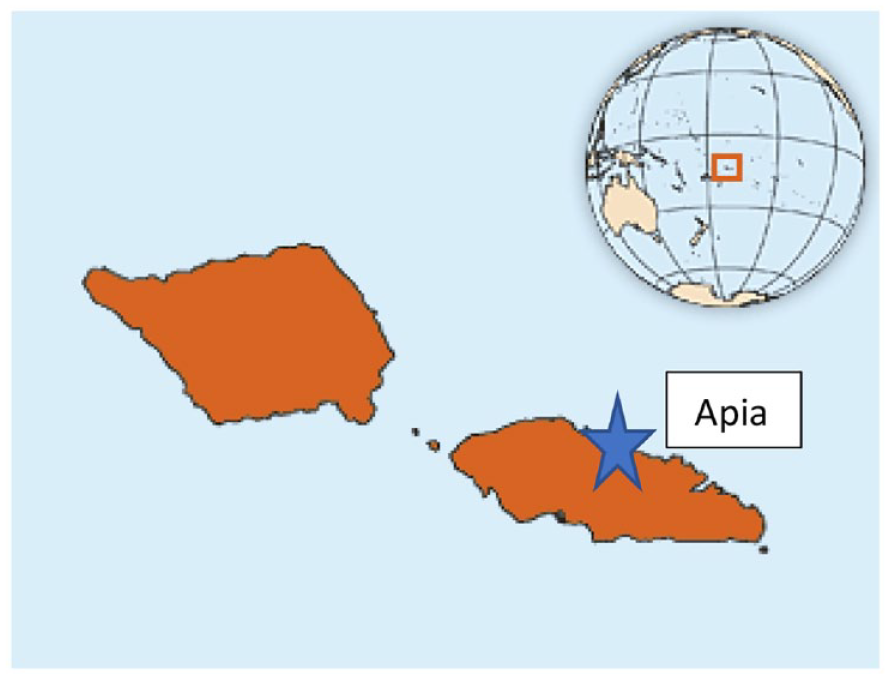
Map of Samoa.
The aim of the present study was to assess the current knowledge and attitudes of school principals in Samoa towards childhood hearing impairment. The results should guide health education and professional development activities, as well as contribute to the implementation of IE in Samoa. In turn, this should facilitate timely referral from schoolteachers to medical care for any hearing concerns regarding their students, thereby reducing the impact of educationally disabling hearing loss from ear disease among students in Samoa. Our findings may be translational to our Pacific Island neighbours in similar circumstances.
Methods
Ethical approval
This study was approved by the Government of Samoa Ministry of Health Ethical Research Committee and the University of Queensland Medical Ethics Research Committee (Approval No. 2020000255). Gatekeeper approval was obtained from the Ministry of Education, Sports and Culture (MESC) (Approval Reference NO.019/2021). This study upholds the principles of Pacific Data Sovereignty, and the data are owned by the Government of Samoa Ministry of Health. The data will be held for 7 years by the ENT Clinic of the Tupua Tamasese Meaole Hospital. Should access to the data be requested, access must be formally requested and approved by the Health Research Ethical Committee of the Government of Samoa Ministry of Health.
The present study is a modified version of the protocol published elsewhere. 27 The modifications were due to the impact of COVID-19 restrictions and are described below.
Participant recruitment
A cross-sectional convenience sampling design was used to recruit school principals attending the Training and Awareness of IE programme of the annual conference of the MESC over 4 days in June 2022. Although the conference is usually open to all educators (i.e. principals and classroom teachers of all levels), COVID-19 restrictions mandated a limited number of conference attendees. A decision was therefore made to deliver the Training and Awareness of IE programme to school principals only, who could then disseminate the information among staff members of their respective schools. The Training and Awareness of IE programme took place over four consecutive days, with a different group of school principals attending on each day. Inclusion criteria for the study were (1) attendance at the Training and Awareness of IE programme, (2) minimum 18 years of age and (3) currently employed as a school principal in Samoa. Exclusion criteria were (1) unwillingness to participate or (2) did not sign the consent form.
An announcement was made about the study on each day of the Training and Awareness of IE programme by the conference facilitators, and all attendees were invited to take part in the study. Participation was voluntary, and all attendees who were willing to complete the study questionnaire were required to sign a consent form.
Administration of the study questionnaire
Following the announcement about the study, the questionnaire was distributed to willing participants by the facilitators of Training and Awareness of IE programme. Participants were given time to complete the questionnaire independently and anonymously. The completed questionnaires were then collected by the programme facilitators and given to the chief investigator (AK).
Permission was obtained to use the study questionnaire from the previously mentioned study from South Africa. 21 In the absence of any validated questionnaire that satisfactorily addressed our research aims, it was decided that, given our time and resource limitations, using the present questionnaire was preferable to developing our own. Furthermore, the present questionnaire aligned with our outcome goals of formulating health education and professional development activities to support the implementation of IE in Samoa by addressing educationally disabling hearing loss associated with ear disease.
Participants were first invited to provide demographic and current employment information: gender (male/female), age (years), school location (Urban-Apia, Rural-Upolu and Remote-Savai’i), school level (early childhood, primary school, secondary school), and type of school (government, private, mission, special). The study questionnaire consisted of 23 statements: 4 statements regarding general knowledge of healthy hearing and hearing loss (Questions 1–4), 5 statements regarding knowledge of causes and risk factors of hearing loss (Questions 5–9), 10 statements regarding knowledge of identification and intervention for hearing loss (Questions 10–19) and 4 statements regarding attitudes towards students with hearing loss (Questions 20–23). Each statement required a Yes/No/Unsure response from participants. A bilingual version of the questionnaire was developed for the study in collaboration with the MESC (Appendix 1). Bloom’s cutoff criteria were used to assess knowledge as high (80%–100%), moderate (60%–79%) or low (<60%), and attitudes as positive (80%–100%), neutral (60%–79%) or negative (<60%).
Statistical analysis
All data handling and analysis were done by the chief investigator (AK) in collaboration with the Hearing Research Unit for Children at the University of Queensland (Brisbane, Australia) (CD). The completed questionnaires were placed in a secure folder at the time of data collection which remained closed until data entry was performed by the chief investigator at the ENT Clinic. All information was entered into a purposefully designed Statistical Package for the Social Sciences software spreadsheet. Participant demographic and employment information was summarised using descriptive statistics, and the responses to each questionnaire statement were tallied. Chi-squared association tests of significance were performed as appropriate to assess for any significant differences between age, gender, school location, school level and school type variables.
Results
An overview of the study participants’ demographic information (n = 109) is summarised in Table 1. The age range was 25 to 66 years, with a mean of 43.8 years (SD = 10.3 years) and a median of 44.5 years. The majority of participants were female, and employed at government primary schools in the capital city Apia.
Overview of study participants’ demographics (N = 109).

An overview of the study results is summarized in Table 2. Chi-squared association tests of significance were performed, and no significant differences in response proportions were measured for any item between age, gender, school location, school level and school type variables.
Overview of knowledge and attitudes of educators to childhood hearing loss and hearing services in Samoa (N = 109).

There were 43.1% of participants who reported that they had previously worked with a child with hearing loss, and 39.4% reported that there was a child with hearing loss currently at their school. There was a high level of basic knowledge of healthy hearing and hearing loss, with 95.4% of participants agreeing that healthy hearing is important, 97.2% of participants feeling that hearing loss is an important problem in Samoa and 83.5% of participants noting that hearing loss affects some children more than others. In contrast, only 55% of participants agreed that hearing loss is common in young children.
There was a high level of knowledge regarding causes of childhood hearing loss, with 87.2% and 84.4% of participants aware that ear infections and certain illnesses cause hearing loss, respectively. There were 69.7% of participants who agreed that a child may be born with hearing loss.
There were also high levels of awareness of the impact of childhood hearing loss: participants agreed that hearing loss adversely impacts on interaction with peers (95.4%), listening in the classroom (94.5%), speech and language development (93.6%), classroom behaviour (88.1%) and reading skills (85.3%).
Statements regarding identification and intervention for hearing loss found that 71.6% of participants agreed that hearing loss can be identified at any age, 73.4% knew that children aged 3–6 years can be accurately diagnosed with hearing loss, and 73.4% agreed that hearing loss can be treated.
There were high levels of positive attitudes towards students with hearing loss, with 97.2% of participants responding that students with hearing loss should have the same opportunities as their normal-hearing counterparts. Furthermore, 92.7% of participants affirmed that they would include a student with hearing loss in their classroom. There were 63.3% of participants who also responded that children with hearing loss should be referred to special schools.
High positive attitudes were also expressed towards ENT Clinical services, with 97.2% of participants keen for students to have hearing tests, and 94.5% willing to learn more about childhood hearing loss.
Discussion
Overall, the results displayed high levels of knowledge and very positive attitudes among school principals in Samoa towards hearing loss and hearing services for their young students. Similar to the study from South Africa, 21 there was high awareness among Samoan school principals of the importance of healthy hearing, as well as the fact that hearing loss is a major issue among children. This is an encouraging result, given that school principals are ideally placed to advocate for health programmes and health policy development in the school environment. Based on forum discussions during the training programme when the present study was conducted, it is not a lack of knowledge or willingness to address the needs of students with disabilities in schools in Samoa, but rather a lack of adequate training and resources. For example, participants highlighted the urgent need for qualified teacher aides in the classroom to support students with disabilities.
A striking difference between the Samoan and South African results was that knowledge was significantly higher for congenital hearing loss among the South African (84.1%) than the Samoan study populations (69.7%). Given that previous research in the Pacific Islands found that parental awareness of congenital hearing loss is low, 8.7% in Samoa and 28% in the Solomon Islands,28,29 the present finding among Samoan educators suggests that this information is probably gained through their professional training and/or experience. Anecdotally, it is generally believed that babies are born perfect, and that any developmental or sensory impairment is due to a causal event(s) in the postnatal period.
Another striking result between the Samoan and South African findings is that the Samoan population had significantly higher awareness scores for all questionnaire items relating to the adverse effects of hearing loss on a child. The Samoan population had higher knowledge than their South African counterparts of the impact of childhood hearing loss on classroom listening (94.5% vs 67.5%), speech and language development (93.6% vs 58.8%), reading skills (85.3% vs 54.5%), behaviour (88.1% vs 63.6%) and interaction with peers (95.4% vs 73.7%). The Samoan population results were also noticeably higher for knowledge of illnesses that cause hearing loss (84.4% vs 69.5%), the fact that hearing loss can affect some children more than others (83.5% vs 61.3%), and that children aged 3–6 years old can accurately be diagnosed with hearing loss (73.4% vs 37%). There also appeared to be a greater willingness to include a student with hearing loss in the classroom among the Samoan population (92.7%) than among South African respondents (61%).
There were also some noteworthy similarities between the Samoan and South African study results. In both cases, approximately half of the respondents agreed that hearing loss is common in young children. For our Samoan context, this suggests that greater awareness needs to be created about the prevalence of hearing loss associated with middle ear disease among young students. Another similarity was that a similar number of participants felt that children with hearing loss should attend special schools (63.3% in Samoa and 67.5% in South Africa). From the Samoan perspective, this may be explained by research in the Pacific Islands that suggests that while parents may be supportive of IE philosophy, there is a preference for special school education for students with severe disabilities to avoid bullying from mainstream school students.13,14
Based on the responses described above, an important point to note is that it is worth questioning what our Samoan participants understood by the phrase ‘child with hearing loss’. Did they understand it to mean a student with a congenital or early-onset profound hearing loss who uses sign language as their primary means of communication? Did they understand it to mean a student with some hearing difficulties secondary to ear disease? Or both? Or the whole spectrum of different hearing levels? While qualitative focus group or individual interview studies may be helpful to clarify these questions, it does not change the fact that positive attitudes were expressed by our participants, no matter their understanding of the phrase ‘child with hearing loss’. It is also important to note that the questionnaire was completed before the chief investigator gave her presentation during the Training and Awareness programme and, as a representative of the ENT Clinic, the focus of her presentation was on the prevalence of avoidable hearing loss among students secondary to upper respiratory tract infections and middle ear disease, and how classroom teachers may positively contribute to preventing and managing this type of childhood hearing loss (N.B. The needs of Deaf students were addressed by the representative from the support service for students with disabilities in Samoa).
Similarly, what did the Samoan participants understand by the phrase ‘hearing loss can be treated’? Does it mean medical management of middle ear disease, which is something all caregivers in Samoa should be familiar with? Could it refer to hearing aid devices or even cochlear implantation? Given the large Samoan diaspora in New Zealand, it is possible that our study cohort is familiar with these options in a high-income country context. It is also possible that ‘treatment of hearing loss’ may include non-biomedical dimensions: 40% of Samoan female caregivers agreed that curses may cause childhood hearing loss. 29 Again, the fact that 73.4% of educators responded positively to the statement that hearing loss can be treated suggests that, no matter their understanding of this phrase, a significant proportion of school principals would seek healthcare advice regarding hearing health concerns.
Overall, the results of the present study provide valuable support for the development of further workshops for school-based professionals to promote the prevention and timely medical management of educationally disabling hearing loss that is associated with ear disease. Preparations are also underway to formulate a national health policy for school-based hearing and vision screening, which should further contribute to the successful implementation of IE in Samoa and achieving SDG4 Quality Education. 30
Limitations
Due to COVID-19 restrictions, our study sample was limited to school principals which likely favoured participants with greater professional experience (i.e. therefore higher knowledge levels), as well as participants who actively engage with initiatives aimed at improving the education of their students (i.e. therefore positive attitudes). Repeating the study with classroom teachers equally representing all levels of education (i.e. pre-school/primary/secondary) would be beneficial, as it would provide insight into the knowledge and attitudes of those educators on the frontline. Similar to a previous study from Niue in the Pacific Islands, 23 a qualitative focus group or individual interview study design may even be preferable to gain insight into the classroom realities and practical suggestions for implementation of IE for students with hearing loss. This may even be preferable for the strong oral traditions of Pacific Island culture.
There was a relatively high proportion of missing data for demographic information of participants, and this may have affected the data analysis and tests of significance between the various demographic categories. Demographic information may have been omitted due to fears that questionnaire responses could be traced back to the respondents among this close-knit community, despite the fact that questionnaires were completed anonymously, and reassurance was given that data handling would be performed by the chief investigator only (AK).
Following MESC procedure, the study questionnaire was translated from English to Samoan by the MESC personnel, and participants were given a bilingual questionnaire to complete. Given the points raised above regarding the meaning of certain statements, it may be preferable to follow good practice translation guidelines for future evaluations of this kind. 31
A major limitation was that the study questionnaire was not validated or pilot-tested for the study population. This may have addressed some of the concerns regarding the translation, as well as any concerns regarding bias in the questionnaire design for a ‘yes’ response.
Future studies of this kind should include formal calculation of a minimum sample size. While our sample size was limited by a convenience sampling design and COVID-19 restrictions, our number of participants also reflects the relatively small body of education professionals in Samoa. This generally fosters close working relationships, but may have potentially influenced questionnaire results for the socially desirable ‘yes’ response.
Conclusions
Overall, the results displayed high levels of knowledge and positive attitudes among school principals in Samoa towards their young students with hearing loss. There was keen interest for further training and workshops to assist students with hearing loss in the classroom.
Footnotes
Acknowledgements
Thank you to Professor De Wet Swanepoel and colleagues for granting permission of the use of their questionnaire in our study. Thank you to all Ministry of Education, Sports and Culture, Inclusive Education Unit and Service Providers who assisted with the facilitation of the present study.
Declaration of conflicting interests
The author(s) declared no potential conflicts of interest with respect to the research, authorship, and/or publication of this article.
Funding
The author(s) received no financial support for the research, authorship, and/or publication of this article.
Ethics approval
Ethical approval for this study was obtained from the Government of Samoa Ministry of Health Ethical Research Committee and the University of Queensland Medical Ethics Research Committee (Approval No. 2020000255). Gatekeeper approval was obtained from the MESC (Approval Reference NO.019/2021).
Informed consent
Written informed consent was obtained from all subjects before the study.
Trial registration
Not applicable.
