




Abstract
Introduction and Objective:
Nursing is a professional career that requires patient-specialized care. To this end, it requires a high academic performance during undergraduate studies. However, some factors that can influence the academic performance of nursing students have been noticed during the internship. We aimed to determine the hospital and community-academic performance of nurse interns who work.
Materials and Methods:
We designed a 3-year mixed study carried out with students of the Universidad Norbert Wiener. We interviewed 15 students about their academic performance, the consequences of studying while working, internship, family, and academic activities. Using the quantitative approach, we analyzed the evaluations of 321 students between 2016 and 2018.
Results:
The qualitative approach showed that students had certain difficulties in their clinical internship because they worked and studied simultaneously. Despite this, their academic performance was remarkable in both internship programs, and 10% of students had an outstanding performance. This performance is subject to personal, economic, and family factors that affect students in their last year of undergraduate studies.
Conclusions:
Working nursing interns had a remarkable academic performance during community and hospital internships. This performance is influenced by personal, financial, and family factors that affect students in their final year of undergraduate study.
Introduction
Health majors are different from others due to the hard work they have on human beings either as mediators of health or as those in charge of alleviating illnesses. Nursing, to fulfill its noble objectives, daily exercises its function in regard to patient care and is a health profession that has direct and continuous contact. However, it is sometimes not completely recognized and usually underestimated. 1
To enhance its standing and achieve its goals effectively, the university must impart comprehensive education to nursing professionals, ensuring they possess a deep grasp of pathology and clinical terminology to excel in patient care. Consequently, educational methodologies assume a pivotal role, as they can disproportionately enhance certain competencies, notably theoretical ones, over others like clinical or community-oriented skills. Thus, comprehending the potential influence of educational advancements during university training is paramount in shaping the development of prospective nursing practitioners. 2
Nursing training is examined worldwide taking into account a set of characteristics that allow the different measurements of its objectives. For example, in nursing students from Ethiopia, it has been reported that recent educational programs do not prepare their students for practical and efficient performance, and most nurses finish their studies as “beginners.” 3 Another study in Australia on nursing students showed that students with higher results in secondary education obtained a higher level of academic performance in comparison with international students or students with a previous nursing diploma who obtained a lower level of clinical performance. 4
There exist different factors that are detrimental to nursing students’ academic performance, such as family burdens and work-related activities.5,6 It has been reported that 57% of American university students are engaged in some type of external work while studying 7 and that students work mainly because of economic reasons 8 or to pay for their daily life needs. 9 On the other hand, nursing students’ workload increase can affect their academic performance. A recent study has shown that those students who worked more than 16 or 20 h a week during six academic semesters reduced their cumulative grade point average.6,10
In Peru, there are public and private undergraduate programs that accept working students or those who already have nursing technical studies or from other health areas (Figure 1) in the same educational program. Including new students and staff who already work in the area results in unequal academic development, which could impact academic grades and nursing training, as has been seen in other health areas. 11 Before implementing strategies such as academic advising for students who work and study simultaneously, it is necessary to understand how much academic performance may be affected and what academic dimensions are involved (i.e., practical skills, knowledge, and attitudes).
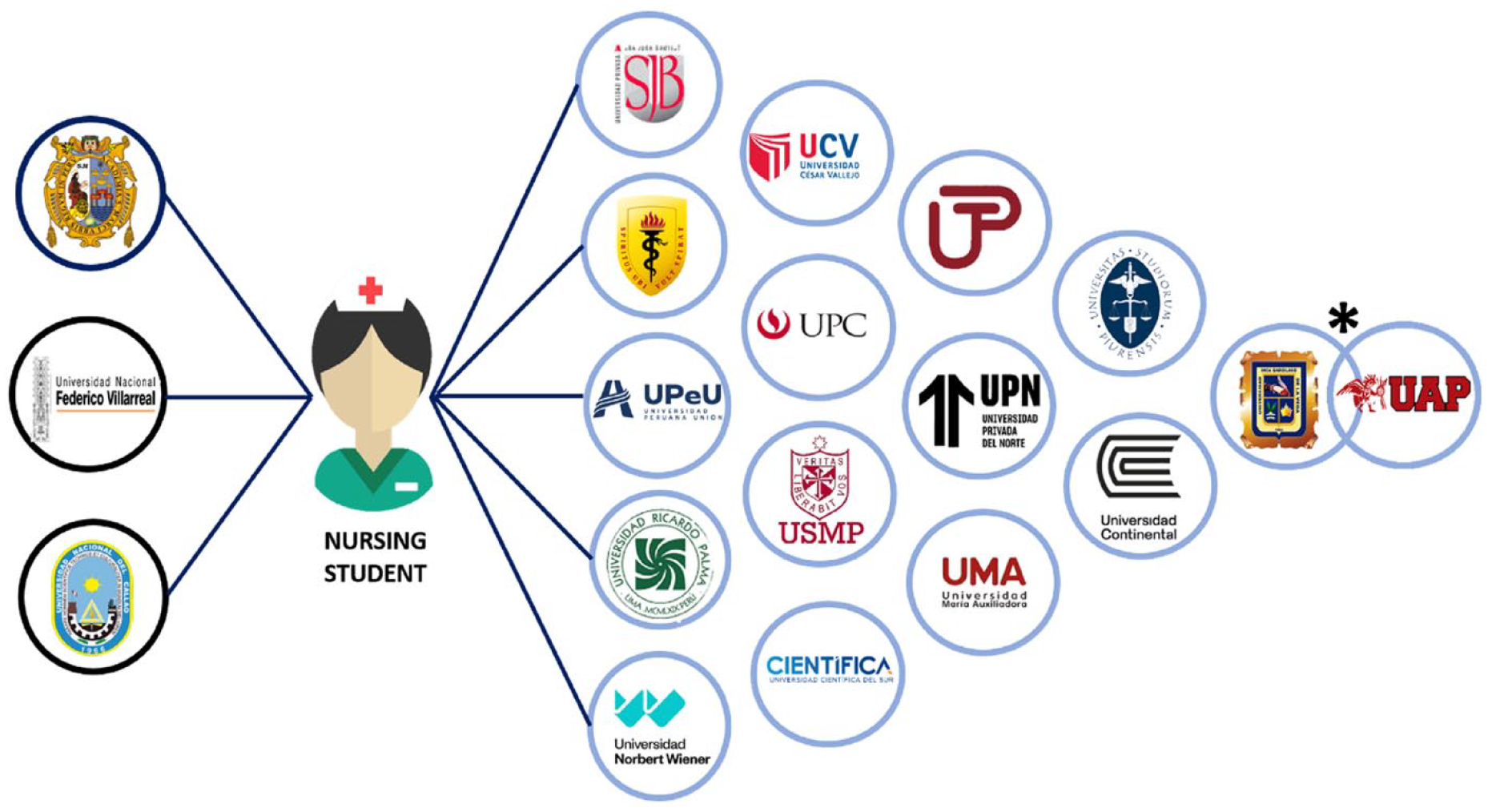
Peruvian universities that have nursing schools in Lima, Peru. On the left, we can see the three public universities that offer nursing as a major, while on the left, we can see private universities that have this major (n =16).
Although there exist some studies on Peruvian nursing students,12–14 these have not analyzed the academic performance of working nurse interns (WNIs) using a multidimensional approach during their last year of undergraduate studies. Currently, there exists a dearth of comprehensive information regarding the impact of WNIs on academic performance in comparison to non-working peers. Certain studies advocate for the positive influence of student employment, asserting that it enhances their caregiving abilities. 15 However, these factors have not been evaluated, requiring a holistic approach to understand and grasp the experience of simultaneous work and nursing internship studies, and to identify noteworthy distinctions in the academic achievements across their undergraduate courses.
Hence, the objective of this study was to determine the hospital and community-academic performance of WNI during the undergraduate clinical practices in Peru.
Methods
Study design, settings, and population
We used a mixed observational study in nursing students who were in their last year of studies at the School of Nursing of the Universidad Norbert Wiener (UNW). This university has a 5-year educational program based on theoretical and practical education, with about 1550 nursing students. Community and hospital internship practices are developed in the last year of the program.
Qualitative approach
The qualitative approach used was that of grounded theory. This methodology enabled us to engage in individualized in-depth interviews with 15 willing students who were concurrently employed while pursuing their university studies. The selected participants were females aged 18 years or older. Invitations for study participation were extended to all students via email. Initially, 30 participants expressed their interest, but ultimately five were excluded as they were solely engaged in their studies or concurrently pursuing a different academic discipline. The interviews were carried out with each participant’s consent, following prior provision of study details and the signing of informed consent documents. The semi-structured interviews, lasting approximately 20 min each, encompassed three main themes explored through open-ended questions: the impact of simultaneous work and studies on academic performance, experiences within hospital and community settings, and the juggling of academic and family commitments.
The questions of the study and the interview topics were revised by experts of UNW based on recommendations of the Consolidated Criteria for Reporting Qualitative Research (COREQ) for qualitative studies. 16 The validation of the interview guide was carried out by experts following the recommendations of Bonganciso 17 and, in addition, the suggestions made by the Research Ethics Committee of UNW were accepted. The saturation of themes was deemed adequate with the incorporation of all participants, given the relative homogeneity of the study population and the clearly outlined objectives. 18 The interviews were conducted in Spanish during November 2018 and were audio-recorded.
Quantitative approach
For the analysis of academic performance, we analyzed the evaluations of 321 undergraduate students distributed in different academic semesters between 2016 and 2018. The school of nursing approved access to the academic records through direct downloading from the university’s student management data storage system (RUNACHAY v2.2). We verified that all the records had complete grades without amendments or second-chance exam grades (obtained to replace a previous failing grade), and dropped students were also excluded, which gave us a sample of 320 records (Table 1).
Study population by nursing internship. Data in N.

For each phase, we estimated the assessment grade units (GU); an academic semester has four GU, and each GU has three categories of evaluation: knowledge (K), practices (P), and attitudes (A). With the average of the two GU, we could obtain a permanent evaluation average (PEA); an academic semester has two PEAs, one per each phase of evaluation. To obtain the first phase grade, we obtained the average of the PEA and the grade obtained in the mid-term theoretical exam; and for the final grade, the average of the PEA2 and the final theoretical exam was obtained (Figure 2). Thus, a final average (FA1) is obtained in the first phase; and an FA2, in the second phase. The overall performance was obtained with the following formula:

Evaluation protocol of nursing students. The grades of the study units are shown with their three variables (purple box). The sum of the two study units (GU) is the average of the permanent assessment (PEA1), which is equal to 70% of the grade of each evaluation phase (gray box). The PEA result is added to the theoretical exam (green box), which allows us to obtain the final average (FA) of each unit. The sum of the two FA is the overall academic performance (black box).
Overall academic performance (OAP) = FA1 + FA1
For each evaluation phase, we considered the following:
First phase (40% of the overall grade) corresponds to the permanent assessment (70%) with the PEA and the mid-term theoretical exam (30%).
Second phase (60% of the overall grade) corresponds to the permanent assessment (70%) with the PEA and the final theoretical exam (30%).
The overall academic performance was interpreted following the OAP score: 0–10 (failed), 11–14 (passed), 15–17 (remarkable), and 18–20 (outstanding).
Data gathering and analysis
The interviews were recorded and transcribed by two authors (JM-S and RQ-P). All data were coded and entered into NVivo 12 (QSR International, Melbourne, Australia) for pooled analysis and we analyzed each interview, following Braun and Clarke’s 19 techniques for qualitative studies. The data on academic performance were obtained directly from the RUNACHAY v2.2 system to a data collection form.
The quantitative analysis of the data was performed using MS Excel and IBM SPSS (Amork, USA V24.0 for Windows). First, the grades of each student were obtained; we estimated the PEAs and FAs for each course and each year of study (2016–2018), using descriptive statistics to measure the frequencies, the average, and the standard deviation. Then, data normality was determined with the Kolmogorov–Smirnov test, and the paired-T test was used to demonstrate differences in the averages of each course and each category. In addition, we used one-way ANOVA to find differences between the years of study and considered a significance threshold of p < 0.05 and a confidence interval at 95%.
Ethical aspect
This study has followed the guidelines of the Helsinki Declaration (WMA, 2013), 20 and it was approved by the Research Ethics Committee of the Universidad de Ciencias y Humanidades (Acta CEI N°058).
Results
Qualitative approach
Nursing students expressed their discomfort because they study and work at the same time; this is why participant 1 (P1) said “[. . .] I am late for my clinical practices because I’m on call from work.” Thus, among the interviews we could evidence work exhaustion; in addition to this, students lose some clinical hours, which are essential for their academic performance. On the other hand, with respect to feelings about studying while working, participants have expressed the following: “I’m stressed about the assignments given by tutors. We have to present about clinical cases in a week, SOAPIE (problem-oriented documentation system parallel to the nursing process), educational talks, in addition to comply with care activities of each hospital” (P2). Thus, most of the students who work have to face academic assignments in addition to the load they have at work.
This challenge has been seen in all the interviews; however, this situation gets worse when they do not feel prepared for some clinical activities. The third participant could let us understand better this issue, “I’m afraid of canalization; I did not have the chance to perform the procedure in previous classes (. . .), several times because of not being on time to class” (P3). This concerning situation is because they were not on time for classes, which means that they lost practical or theoretical activities of various topics that are essential during internships in hospitals. In all the participants, we have noticed the disadvantage of being late to classes to perform procedures of interest in their professional careers. In addition, they have to face academic assignments that are given by their advisors, and the on-call shifts are detrimental to their performance as well since students after overnight shifts do not have the same concentration capacity as a student who has slept appropriately.
On the other hand, more factors that influenced their academic performance were found. One of them was the personal conflicts that they may have, as mentioned below: “My son is hospitalized. He has been admitted on an emergency basis. I came from the hospital sleepy, trying to learn something” (P4). Being a mother, working or studying can be a factor that affects greatly academic performance. In addition, the hospital location turned out to be another factor, since, generally, students do not live close to the hospitals in Lima, but in far districts, a couple of hours away, traveling by bus. One of the students said, “The hospital is located in a dangerous area. There’s a lot of delinquency around that place. I can’t bring my laptop to do my group work, because we leave the hospital late” (P5).
In addition to family and workload, crime around the hospitals creates a hostile environment. Many of the students take materials (i.e., stethoscopes, laptops) that can be useful in their clinical rotation; however, they cannot work on their assignments at the hospital due to the danger of being robbed. Moreover, when at home, they have other activities and functions that do not let them comply with their academic work. “It is, many times, frustrating to bring scarily my laptop to the hospital and not be able to use it because when I leave, I have to go to work, and then go home to see my family without even opening it for a minute” (P7).
Finally, another important aspect that can impact academic performance is the economic factor. This can even force students to drop their studies, “My parents don’t want to continue supporting my studies (. . .); I have to work and study, I don’t have a choice, as only in this way I could complete my internship regardless of my final grade” (P6). All the interviewed students mentioned, at a certain point, an economic issue that made it difficult to continue their studies. Our participants had diverse factors that could alter their academic performance, which could be noticed during their hospital and community internships.
Academic performance
We found that 46 (13.1%) students had an outstanding performance; 237 (67.7%) had a remarkable performance; and 37 (10.6%) had a passing grade (p > 0.05). In regard to outstanding performance during community internship, 0.3%, 2.5%, and 0.6% of students had it during 2016, 2017, and 2018, respectively. In addition, 1.8% of students in 2016, 3.7% in 2017, and 2.2% of students in 2018 had a passing grade in their hospital internship, while the percentage of passing grades for 2016, 2017, and 2018 was 0.9%, 0.3%, and 2.5%, respectively (Figure 3(a)).

The overall academic performance (a), final grade average (b), and performance average (c) according to the internship type of working nursing interns.
The final hospital internship average was 15 in all the years of study, while the community internship grade increased by one point in 2017. The FA grades of hospital internship students were 15.3, 15.7, and 15.5 in 2016, 2017, and 2018, respectively. The final grade of community internship students varied from 16.3 in 2016, 17 in 2017, and to 16.2 in 2018 (Figure 3(b)).
The academic performance of nursing students was predominantly remarkable in both internships and for each dimension (knowledge, procedural, and attitudes). Moreover, the distribution of the overall averages of the three dimensions of nursing student’s performance in the hospital and community internships evidenced an increase in the grades for 2017 (Figure 4). The overall average grade of the knowledge dimension was 15.9 in 2016, 16.6 in 2017, and 15.9 in 2018. The overall average grade of the procedural dimension was 16 in 2016, 16.5 in 2017, and 15.9 in 2018. Finally, the overall average grade of the attitude dimension was 15.9 in 2016, 16.5 in 2017, and 15.9 in 2018.

Distribution of the score of the academic performance per year of study in nurse interns.
The FA grade of the knowledge dimension was 15.3 in 2016, 16.1 in 2017, and 15.7 in 2018. The FA grade of hospital internship students for the procedural dimension was 15.3 in 2016, 16 in 2017, and 15.8 in 2018. Finally, the FA grade of the students of hospital internship in regard to the attitudinal dimension was 15.6 in 2016, 16 in 2017, and 15.7 in 2018. The average in 2018 was the same for the knowledge and attitudinal dimensions. In 2016, all the students had a performance average of 15 for all three dimensions.
The FA grade of community internship students in regard to the knowledge dimension was 16.4 in 2016, 16.7 in 2017, and 16.1 in 2018. The FA grade in regard to the procedural dimension was 16.7 in 2016, 17 in 2017, and 16 in 2018. Finally, the FA grade of the students of community internship for the attitude dimension was 16.1 in 2016, 17 in 2017, and 16 in 2018. We found differences in the academic performance between community and hospital internships in 2016 and 2017 (both p < 0.001).
According to PEA, in regard to hospital internship students, in 2016, 20 (6.2%) students had a remarkable performance, and 14 (4.4%) had a passing performance. In 2017, 60 (18.7%) students had a remarkable performance, and 18 (5.6%) had a passing performance. In both years, students with outstanding performance were not reported. Finally, in 2018, only 0.3% of students had an outstanding performance, and 22 (6.8%) had a remarkable performance during hospital internships. PEA results in regard to community internships, however, indicated different proportions. In 2016, 2 (0.2%) students were reported as having an outstanding performance, and 32 (10%) had a remarkable performance. In 2017, there were 12 (%) students with an outstanding performance, followed by 62 (19.4%) students with a remarkable performance. In addition, in 2018, 7 (2.2%) students with an outstanding performance were reported, followed by 43 (13.4%) with a remarkable performance (Table 2).
Annual academic performance according to dimension and nursing internship.

SD: standard deviation; 95% CI: 95% confidence interval.
Finally, the results of the overall academic performance of PEA showed that both internship programs had the same grades during the 3 years of evaluation. The performance average during the hospital internship was 15.5 in 2016, 15.6 in 2017, and 15.6 in 2018. On the other hand, the performance average during the community internship was 15.3 in 2016, 16.9 in 2017, and 16.2 in 2018 (Figure 3(c)). In addition, the overall academic performance in 2016 was 15.8; in 2017, it was 16.3; and in 2018, it was 16, where we found differences between the years 2016 and 2018 (p < 0.001).
Discussion
This study demonstrated that WNI had certain difficulties during their internship in performing their clinical practices due to studying and working simultaneously. Despite this, their academic performance was remarkable in both internship programs, and 10% of students had an outstanding performance. The triangulation analysis highlights the complex interplay between students’ work and study commitments, as well as the potential impact on their academic performance. While the qualitative approach provided insight into the challenges and experiences faced by nursing students, the academic performance data shed light on the outcomes of their efforts. The findings from both qualitative and quantitative aspects contribute to a comprehensive understanding of the factors influencing nursing students’ academic performance and the need for further investigation into this complex relationship.
Strengths
This study had different strengths. First, we developed, to the best of our knowledge, the first 3-year study of academic performance in Peruvian nursing students. Although there are previous studies, all of them have performed evaluations of 1 year.14,21,22 Another strength is that we included WNI of the community and hospital internships, which is a novelty compared to other previous Latin American studies. 11
Main findings
Several Peruvian studies coincide with our results, which showed a remarkable performance. Barrientos and Escalante 21 demonstrated that internships with nursing students of the Hospital Regional de Ayacucho have generated an acceptable performance, while the study conducted by Pino and Quispe 22 showed a high proportion of nursing students from Huancavelica with a remarkable performance. Both studies assessed population from the Andes of Peru and, although the populations are different, the syllabi used seemed to be similar as they were regulated and standardized by the National Superintendence of Higher Education. 23
On the other hand, in our study, nursing students did not show failing averages during the 3-year evaluation, which is not consistent with the following studies. The first study was carried out in Northern Peru (n = 50 students) and found that half of the nurse interns had a deficient performance. 9 The second study was conducted on 35 nurse interns of the Hospital Regional de Ayacucho and showed that 28.8% of interns had an unfavorable performance. 14 In addition, a study on 101 students from Barcelona has demonstrated that 39% of students had a reduced academic performance in the dimensions of skills, knowledge, and attitudes, 24 which clearly differs from our results. The variations observed in comparison to prior studies can be attributed to a range of factors. These factors include the availability of clinical and technological resources, the extent to which tasks and academic obligations are facilitated by the institution, as well as the effectiveness of student support through tutoring. 25 These elements collectively influence students’ performance in clinical practice, potentially accounting for the disparities noted in relation to earlier research.
Our findings demonstrated that students obtained higher grades in the community internship compared with the hospital internship. These results are supported by the study by Troncos 26 in which the authors found that 57.1% of students of the community internship had a good perception of the program, which demonstrated a better performance quality in this. This can be due to better clinical and social interaction during the community practices, which should be experienced since the first years of study so students can be familiarized, demonstrate their potential, and avoid finishing their studies as beginners, without clinical or experiential knowledge. 1
When we excluded the theoretical exam grade, all the students had a remarkable performance without outstanding grades. This finding is important because it describes how theory grades can contribute to a higher grading of practical activities (with PEA) already performed in each hospital and community site. During the internship, students interact with patients and get confident that they can take care of them. Something that is important to highlight is the assessment format, as well as who the evaluators of the practical activities are, since the practical academic performance is going to be affected by these factors and the grades should be multidimensional and cross-sectional, including practical assessment categories (i.e., attitudes) as it has been previously reported. 9
Another important aspect is that our students are parents; in addition, they have a not specified previous profession, which could influence their academic performance. This is why new strategies should be implemented, with programs for students living in these situations (including an interactive study plan, with flexible and asynchronous schedules, and mentoring for small groups). Our study does not detail the socioeconomic level of each student; however, most of them manifested the discomfort that is caused by having problems to perform practices during the hospital and community internship due to their economic problems. These factors should constitute a pending agenda to continue improving the studies program of nursing.
Limitations
This study had limitations. First, as we assessed WNI, it is likely that academic performance varies with students who do not work. Second, academic performance evaluations were performed following the OAP, but other instruments were not used, which could have given us other scopes. 27 Third, the evaluations of hospital and community PEA can vary according to the perception and criteria of each nurse supervisor in each health center. Moreover, although evaluation criteria are standardized, there can be differences in the attitudinal grades of students. Fourth, the community internship is developed in different primary healthcare centers in urban and rural areas, for which the activities can vary.
Conclusion
We found a remarkable academic performance in WNI during the community and hospital internships, which is subject to personal, economic, and family factors that affect students during the last year of their undergraduate studies. The implementation of strategies to improve training in nursing internships is crucial. This should involve the enhancement of the performance evaluation, using a multifactor approach to assess educational variables such as practices, cognition, and procedures. 6
Supplemental Material
sj-docx-1-smo-10.1177_20503121231208643 – Supplemental material for Community and hospital academic performance of working nurse interns: A mixed-methods study in Peru
Supplemental material, sj-docx-1-smo-10.1177_20503121231208643 for Community and hospital academic performance of working nurse interns: A mixed-methods study in Peru by Jeel Moya-Salazar, Roxana Quispe-Pariona, Betsy Cañari, Belén Moya-Salazar and Eliane A Goicochea-Palomino in SAGE Open Medicine
Footnotes
Acknowledgements
Not applicable.
Declaration of conflicting interests
The author(s) declared no potential conflicts of interest with respect to the research, authorship, and/or publication of this article.
Ethics approval
Ethical approval for this study was obtained from the Research Ethics Committee of the Universidad de Ciencias y Humanidades (ACTA CEI N 058-19).
Funding
The author(s) received no financial support for the research, authorship, and/or publication of this article.
Informed consent
Written informed consent was obtained from all subjects before the study.
Trial registration
Not applicable.

Supplemental material
Supplemental material for this article is available online.
References
Supplementary Material
Please find the following supplemental material available below.
For Open Access articles published under a Creative Commons License, all supplemental material carries the same license as the article it is associated with.
For non-Open Access articles published, all supplemental material carries a non-exclusive license, and permission requests for re-use of supplemental material or any part of supplemental material shall be sent directly to the copyright owner as specified in the copyright notice associated with the article.
