




Abstract
Aims:
Both developing and developed countries are facing difficulties in finding regular donors. In areas that are exposed to frequent conflicts and wars, such as the Gaza Strip, there is a need for a continuous blood supply. This study aims to determine the level of knowledge, attitudes, and practices toward blood donation in the Gaza Strip, Palestine.
Methods:
A cross-sectional study was conducted in 2022, in which 1506 participants were randomly selected from different governorates in the Gaza Strip. A structured and valid questionnaire was employed to assess the level of knowledge, attitudes, and practices toward blood donation. All statistical analyses were performed using SPSS version 28. The chi-square test was used to measure the significance of associations.
Results:
A total of 1506 individuals living in the Gaza Strip participated. The total mean score of the overall knowledge and positive attitudes toward blood donation was 55.1% and 67.1%, respectively. Furthermore, 1236 (82.1%) of the study participants never donated blood. Of them, 260 (21.0%) demonstrated that they do not have information on when, where, and how to donate; 228 (18.4%) thought that they were not fit to donate; 187 (15.1%) demonstrated that they did not have time to donate; 143 (11.6%) feared health problems, and 132 (10.7%) feared anemia. On the contrary, 99 (36.7%) donated blood when a friend or relative needed blood, and 171 (63.3%) were voluntary donations. Statistically, a significant association was found between knowledge, attitudes, practices, and sociodemographic variables (p < 0.05 for all).
Discussion:
The study findings indicated poor donation habits despite positive attitudes toward blood donation in the Gaza Strip, Palestine. This research emphasizes the need to recognize and correct the knowledge gap that results in unfavorable behaviors against blood donation.
Introduction
Over the past few decades, there has been a rapid increase in demand for safe blood due to an aging and growing population. 1 In 2018, 118.5 million blood donations were made in 171 countries. The World Health Organization and World Bank income groups correlated data, showing varying levels of blood availability for transfusion. In all, 43 countries in the African Region collected 6.1 million blood donations, accounting for only 5% of global donations. European Region received 26% of global donations, while high-income countries collected 40%. Low-income and lower-middle-income countries received 2% and 24% of global donations, respectively. 2
In areas that are exposed to frequent conflicts and wars, such as the Gaza Strip, Palestine, there is a need for continuous blood supply. Therefore, a better understanding of the knowledge, attitudes, and practices (KAP) of the general Palestinian population regarding blood donation will help improve intervention to promote safe, voluntary, non-remunerated donors since recruiting safe, low-risk volunteer donors is a challenge in the Gaza Strip, Palestine. The willingness of an individual to donate blood is influenced by sociodemographic, organizational, physiological, and psychological aspects, according to research looking at the elements that might affect blood donor recruitment and retention.3 –5 In addition, many nations with voluntary donation systems provide incentives to attract donors, such as free medical testing, time off work, small tokens, refreshments, reimbursement of direct travel expenses, free entry to social events, and free lottery or raffle tickets, all of which are acceptable forms of voluntary, non-remunerated giving but do not involve receiving an actual cash payment.3,4 Each hospital in the Gaza Strip, Palestine, has established its blood bank center, where replacement donors rather than volunteer donors make up the majority of donations. The hospitals provide incentives such as time off from work and medals. Geographic and sociodemographic characteristics have an impact on attitudes toward blood donation. 6 Similar findings indicated that convenience and satisfaction related to the time and location of blood donation were significant motivators. 3 A person will be more likely to donate blood and have a favorable attitude toward being a volunteer donor on a regular basis if they are aware of the motives a blood donor has and the misunderstandings about donation are recognized and corrected. Moreover, blood donation has evolved into a requirement that every community must take into account. 7 Finding consistent donors, though, is a challenge for both poor and developed nations. 8
In addition, frequent conflicts and wars in the Gaza Strip, Palestine, increase the need for continuous blood supply. Although the Gaza Strip’s healthcare system provides highly specialized services, a lack of understanding and bad attitudes regarding blood donation will ultimately result in a restricted amount of blood being donated. Finding a secure, low-risk donor is difficult in Gaza, Palestine. A deeper understanding of the information and knowledge around blood donation, however, will enable better intervention to encourage secure, willing, voluntary non-remunerated donors. Therefore, the current study was conducted to determine the level of KAP toward blood donation in the Gaza Strip, Palestine.
Materials and methods
Study context and the organization of blood donation services
The Gaza Strip, located in the Mediterranean, is a narrow strip in the northeast of the Sinai Peninsula. With 2,166,269.9 Palestinians, it is divided into five governorates. The population is divided into five smaller governorates, with a 6-per-family size. The strip has high unemployment and extreme poverty rates, with an average density of 5138 individuals per km2. In addition, the Gaza Strip is known to be an educated community. According to the Palestinian Central Bureau of Statistics, the illiteracy rate decreased from 13.7% in 1997 to 1.8% in 2022 in the Gaza Strip. 9
Access to screened blood is crucial for safe surgical care in the Gaza Strip. However, war and border closures have strained health response, putting extra pressure on blood banks. In all, 13 hospitals organize mobile campaigns to collect blood from various neighborhoods during emergencies. 10
Study design, setting, and period
A community-based cross-sectional study was conducted between July 2022 and November 2022 among the Palestinian population in the Gaza Strip, using a well-structured and validated self-administered questionnaire to assess the level of KAP toward blood donation.
Study participants, sample size calculation, and sampling technique
The Palestinian population in the Gaza Strip was estimated at 2 million. 11 Accordingly, the representative sample size in the current study was calculated using the Charan and Biswas formula. 12 The study included 1506 healthy participants living in the Gaza Strip, aged ⩾18 years, and both genders. Participants with a history of blood-borne diseases were excluded. A list of households was taken from the municipal office in each governorate. Every 10 households were screened for eligibility criteria. The household that did not meet the eligibility criteria was excluded, and the next household was selected. The sample was proportionally selected from the households at homes of the five governorates of the Gaza Strip, using a cluster random sampling method and based on the population density in each of them as follows: 56 from North Gaza, 396 from Gaza City, 402 from Middle Area, 407 from Khan Younis, and 245 from Rafah governorate. In addition, participation in this survey was entirely optional; all participants received a briefing on the purpose of the research and assurances of the privacy of the data collected. Moreover, before completing the survey, the participants gave their approval.
Data collection
Self-administered questionnaire
A structured and valid self-administered questionnaire was employed in the current study. The questionnaire consisted of four sections: (1) sociodemographic characteristics included six questions that covered the necessary participant information, including age (years), gender, marital status, educational level, monthly income, and occupation; (2) knowledge of blood donation included 14 questions; (3) attitudes toward blood donations included 12 questions; and (4) practices toward blood donations included four questions. All questions about the KAP toward blood questions were validated and published in previous studies.13 –15
A scoring method was utilized to determine the overall level of knowledge; a maximum of 14 points were available, and 1 point was awarded for each correct response and zero for each erroneous response (scores of 7 or greater indicating good knowledge). In addition, a scoring system was utilized to determine the overall attitude level. A maximum of 12 points were available, with 1 point awarded for each accurate response and zero for each erroneous response (scores of 6 or more indicating positive attitudes).
Lownik et al., 16 in a previous study about KAP surveys of blood donation in developing countries, concluded that despite considerable differences in the culture and demographics of the included countries, several common themes emerged from different KAP survey tools. In the current study, the cross-cultural guideline process was employed in the translation of the questionnaire. 17 Final Arabic draft questionnaire validated by five experts in public health, epidemiology, and biostatistics, with face and content validity index assessing relevance. 18 Minor language and construction changes were made.
Pilot study
A pilot study with 45 participants was done prior to data collection to confirm the acceptability and consistency of the survey. Following that, small adjustments were made in light of the findings of the pilot study. The results of the pilot study showed a good overall Cronbach’s alphas of 0.84.
Ethical approval
The Palestinian Ethics Committee approved the study protocol (PHRC/HC/507/22). In addition, participants gave their informed agreement to participate in the study before the commencement of the survey. There were no monetary incentives for completing the survey. Written informed consent was obtained from each participant. Furthermore, for the illiterate/uneducated subjects, written informed consent and questionnaires were collected with the assistance of their relatives.
Statistical analysis
The Statistical Package for Social Science (IBM SPSS) version 28 (SPSS Inc, Chicago, IL, USA) was used for data analysis. Data are expressed as a percentage for categorical variables. The overall scores for knowledge and attitudes were transformed into mean percentage scores by dividing the sum scores obtained by the respondents by the number of items. The prevalence of several categorical variables was compared using the chi-square test. The p value of less than 0.05 was considered statistically significant.
Results
Sociodemographic characteristics of the study participants
A total of 1506 individuals living in the Gaza Strip, Palestine, participated in the current study. Of them, 221 (14.7%) were male, and 1285 (85.3%) were female. The sociodemographic information of the participants indicated that the majority, 953 (63.3%) of participants, were between 20 and 29 years old, all from different areas of the Gaza Strip, and the majority were singletons 1063 (70.6%). More than half of the participants, that is, 869 (57.7%) had a university degree, and 1145 (76.1%) were unemployed. In addition, 1389 (92.2%) participants were in the low-income bracket of less than 2000 New Israeli Shekels (NIS) (Table 1).
Sociodemographic characteristics of the study participants.

Data are expressed as percentages for categorical variables.
Knowledge of blood donation
Furthermore, Table 2 shows the study participant’s knowledge of blood donation. The findings showed that 1313 (87.2%) of the study participants correctly responded to how often eligible individuals can donate blood, 1269 (84.3%) to the best blood donor type, 1134 (75.3%) to the place of blood donation, and 1121 (74.4%) to the importance of blood donation. While 1314 (87.3%) of the study participants incorrectly responded to the minimum weight eligible for blood donation, 1221 (81.1%) to the maximum volume of blood being donated once, and 928 (61.6%) to “Can smokers donate blood.” In addition, as shown in Table 2, the results revealed that the total mean score of the overall knowledge of blood donation for the study participants was 55.1%.
The study participant’s knowledge of blood donation.
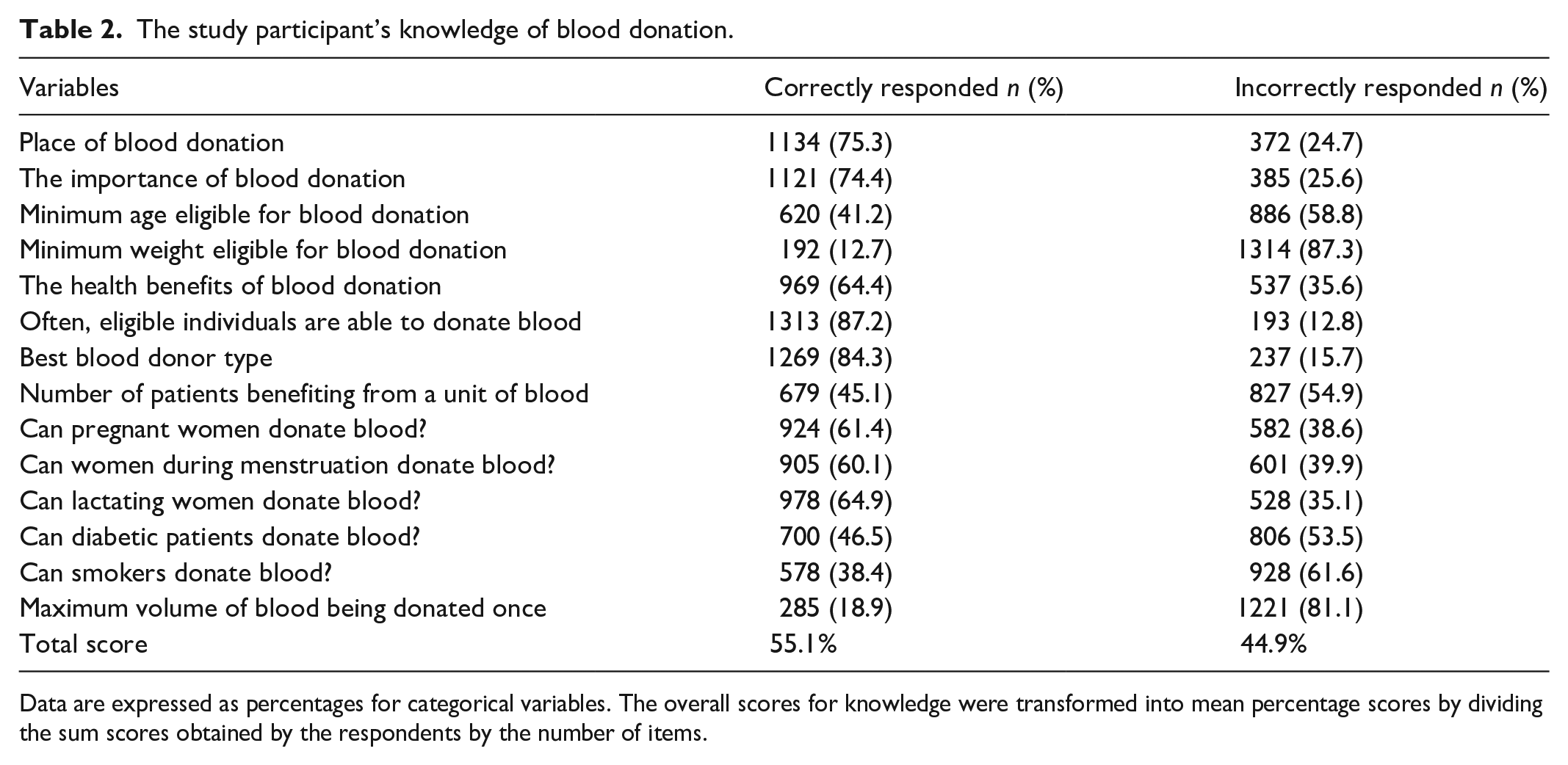
Data are expressed as percentages for categorical variables. The overall scores for knowledge were transformed into mean percentage scores by dividing the sum scores obtained by the respondents by the number of items.
Attitudes toward blood donation
Concerning the study participants’ attitudes toward blood donation, Table 3 shows that 1271 (84.4%) of the study participants had positive attitudes toward “What do you think about blood donation,” 1204 (79.9%) to “Will you ask for a monetary compensation for blood donation,” and 1066 (70.8%) to “will you donate blood to an unknown person if you were asked.” On the contrary, 821 (54.5%) of the study participants had negative attitudes toward “Do you think donation is a moral duty,” 758 (50.3%) to “Do you have the plan to donate voluntarily within the coming 6 months,” and 550 (36.5%) to “do you think donation is harmful to donors.” In addition, the total mean score of the overall positive attitudes of the study participants toward blood donation was 67.1% (Table 3).
The study participant’s attitudes toward blood donation.

In the case of categorical variables, data are expressed as percentages. By dividing the respondents’ total scores by the total number of items, the mean percentage scores for attitudes were calculated.
Practices toward blood donation
Moreover, Table 4 shows the study participant’s practices toward blood donation. The findings demonstrated that 270 (17.9%) of the study participants ever donated blood, while the majority of 1236 (82.1%) of them never donated blood. In addition, 102 (6.8%) of the study participants donated blood one time, and 168 (11.1%) two to five times. Regarding the reason for donation, the results showed that 99 (36.7%) of the study participants donated when a friend or relative needed blood, and 171 (63.3%) were voluntary donations.
The study participant’s practices toward blood donation.

Data are expressed as percentages for categorical variables.
Concerning the main reasons for not donating, 260 (21.0%) of the study participants demonstrated that they do not have information on when, where, and how to donate; 228 (18.4%) thought that they were not fit to donate; 187 (15.1%) demonstrated that they did not have time to donate; 143 (11.6%) feared health problems, and 132 (10.7%) feared anemia.
KAP toward blood donation and their association with sociodemographic variables
In addition, Table 5 shows the KAP of the study participants toward blood donation and their association with sociodemographic characteristics. As shown in Table 5, 73 (64.0%) of participants aged 40 or more years; 718 (55.9%) female participants; 225 (55.1%) married participants; 498 (57.3%) participants with university degrees; 74 (63.2%) of high income; and 121 (60.2%) of student participants had adequate knowledge toward blood donation. A significant statistical association was found between the level of knowledge about blood donation and age, educational level, and monthly income (p < 0.05 for all).
KAP of the study participants toward blood donation and their association with sociodemographic characteristics.

Data are displayed as a percentage for categorical variables. The chi-square test was used to compare how commonplace various category variables were. As a statistical significance, a p value of 0.05 or below was considered acceptable.
In addition, 86 (75.4%) of the participants were aged 40 or more years; 872 (67.9%) of the female participants; 294 (71.9%) the married; 608 (70.0%) participants with a university degree; 937 (67.5%) of low income; and 758 (66.2%) of unemployed participants had positive attitudes toward blood donation. Significant statistical associations were found between the level of attitudes toward blood donation and age, marital status, and educational level (p < 0.05 for all).
Moreover, Table 5 shows that 94 (82.4%) of participants aged 40 or more years; 1064 (82.8%) the female participants; 883 (83.1%) single; 703 (80.9%) participants with a university degree; 1160 (83.5%) of low income; and 131 (81.9%) of employed participants had never donated blood. A significant statistical association was found between practices toward blood donation and gender, marital status, and monthly income (p value < 0.05 for all).
Discussion
It has become difficult to maintain an acceptable number of voluntary, voluntary non-remunerated blood donors in the Gaza Strip, Palestine, especially given the ongoing increase in blood demand. The main results of the current study indicated that the total mean score of the overall knowledge of blood donation for the study participants was 55.1%. In addition, statistically significant associations were found between the level of knowledge about blood donation and age, educational level, and monthly income. In the current study, 64.0% of participants aged 40 or more years, 57.3% of participants with a university degree, and 63.2% of high-income participants had adequate knowledge of blood donation. Chauhan et al. 19 showed that the mean knowledge score of participants toward blood donation was 74.4% among medical students of a medical college in North India, and they found significant associations between knowledge level, age, and educational level. Enawgaw et al. 20 showed that 35.4% of the study participants had adequate knowledge of blood donation at the North Gondar district blood bank, Northwest Ethiopia, and the author found a statistically significant association between monthly income and knowledge level. In addition, Alsalmi et al. 21 showed that the majority of respondents 60.2% had sufficient knowledge regarding blood donation among health professions students in Saudi Arabia; and they found a significant association between knowledge level and academic level. The results of the current study support these findings. Different study volunteers may have different levels of understanding about blood donation, which could explain the disparity. Students studying medicine and health sciences, as well as healthcare professionals, are included in the aforementioned studies. As a result, it is anticipated that members of this group will be quite knowledgeable about blood donation.
Regarding positive attitudes toward blood donation, 67.1% of the study participants had a good attitude toward blood donation. The findings were compared to the previous reports from Gondar, 22 Bahir Dar, 23 and Wolita Sodo. 24 The difference in the level of attitudes toward blood donation might be due to variations in study methods and subjects since the current study was a community-based study. On the other hand, statistically significant associations were found between the level of attitudes toward blood donation and age, marital status, and educational level. Several previous studies support these findings.21,25
Furthermore, the results of the current study demonstrated that 17.9% of the study participants ever donated blood, while the majority of 82.1% of them never donated blood. In addition, 6.8% of the study participants donated blood one time and 11.1% two to five times. Chauhan et al. 19 showed that the prevalence of blood donors was 22.9%. Studies by Kumari and Raina 25 (13.81%) and Desai and Satapara 26 (21.3%) reported findings that were comparable. In the current study, the main reasons for not donating among the study participants were lack of information on when, where, and how to donate, the belief that they were not fit to donate, did not have time to donate, fear of health problems, and fear from anemia. On the contrary, they donated blood when a friend or relative needed blood, and a large percentage of the study participants were voluntary donations. In the current study, the voluntary donors were not given a credit to claim blood in the future, but they were voluntary non-remunerated blood donors. According to a study by Kumari and Raina, 25 fear of needles, the sight of blood, worries about side effects, family disapproval, and never being asked for blood are the top reported reasons for not giving. Similar concerns have been expressed by respondents in various other studies.27,28 Further future studies are recommended to confirm these findings.
The key strengths of our study were that it was one of the first to indicate the KAP levels for blood donation in the Gaza Strip, Palestine and that it had a sizable sample size. This study’s primary limitation is its cross-sectional methodology, which restricts the generalizability of our findings because the causal relationship could not be established.
Conclusion
The study findings of the current study indicated poor donation habits despite positive attitudes toward blood donation in the Gaza Strip, Palestine. This research emphasizes the need to recognize and correct the knowledge gap that results in unfavorable behaviors against blood donation.
Recommendations
Our research suggests that the intervention might be accomplished by creating appropriate teaching materials and communication tactics to initially recruit first-time contributors and then persuade them to give again in the future. This will enable the development of a secure blood supply in blood banks across the governorates.
Footnotes
Acknowledgements
The authors wish to thank and appreciate the study participants for their significant participation in the study.
Declaration of conflicting interests
The author(s) declared no potential conflicts of interest with respect to the research, authorship, and/or publication of this article.
Ethics approval
The study protocol was approved by the Palestinian Health Research Council (Helsinki Ethical Committee) (Code: PHRC/HC/507/22).
Funding
The author(s) received no financial support for the research, authorship, and/or publication of this article.
Informed consent
All participants gave their informed agreement to participate in the study before the commencement of the survey. There were no monetary incentives for completing the survey. Written informed consent was obtained from each participant. In addition, participation in the study is voluntary; the confidentiality and anonymity of the information was confirmed. Furthermore, for the illiterate/uneducated subjects, written informed consent and questionnaires were collected with the assistance of their relatives.
Trial registration
Not applicable.
