



Abstract
Objectives:
Around the world, accidents and injuries are the leading causes of death among children. Because mothers and family members commonly administer first aid at home and at preschools, it’s critical to learn what parents and the public think about children’s mishaps. Our objective was to assess parents’ knowledge and attitude toward pediatric first aid in the Aseer region of Saudi Arabia.
Methods:
A cross-sectional study was conducted in the Aseer region of Saudi Arabia to assess the parents’ level of knowledge and attitude about pediatric first aid and trauma with an electronic- and paper-based multiple-choice self-administered questionnaire covering different medical emergencies. The Arabic and English versions of the questionnaire were made from the information obtained from the first aid educational content of the Saudi Ministry of Health.
Results:
When the participants were asked about their knowledge of pediatric first aid, arranged in descending order from most answers, 37% (n = 135) answered it was good, 30% (n = 111) answered that it was very good, 20% (n = 74) answered that it was not enough, and 13% (n = 47) answered that it was excellent. Results of the multiple linear regression analysis showed the knowledge score to be significantly higher among participants who had higher education levels (t = 2.039, p < 0.001), who had received first aid training before (t = 2.786, p = 0.0001), those who were already healthcare providers (t = 4.336, p < 0.001), those who were from rural districts (t = 2.5, p = 0.355), and younger personnel (t = 0.821, p = 0.345) The difference was not statistically significant.
Conclusion:
Although this study shows that the level of first aid knowledge among personnel who care for children was low, it also shows that they are interested in obtaining proper training.
Introduction
Around the world, accidents and injuries are the leading causes of death among children. 1 Children are more prone to unintended mishaps 2 and are at a higher risk of injury because their bodies are still developing, and they have not yet learned to be conscious of themselves and countless environmental dangers. Children’s crises, such as the worsening of pre-existing medical conditions or accidental physical injuries, are more likely to occur in home facilities because children spend so much of their time there. 3 Unintentional injuries, such as falls, bruising, and bumps, can occur in homes and play schools. In schools and playgrounds, the most common injury is a fall (40.4%), while bites account for around 39% of reported injuries in child-care settings. 4 Injuries to children range from 0.7 to 5.1 per 1000 children in the United States. 5 Injuries account for more than half of all deaths in children below the age of 6 years in the United States.6,7 Pediatric trauma is a severe concern in the Aseer region, according to a recent study on the pattern of accidents in children below the age of 14 years in Abha City, Kingdom of Saudi Arabia. 8 Most preschool injuries just require first aid treatment. Preschools are critical venues for focusing on the prevention of injuries and infections in children since situations requiring first aid are common. All patients with acute burn injuries who came to a children’s hospital were given first aid, and the clinical results were documented by Leila et al.9,10 In children with contact injuries, proper first aid was connected to a substantially shorter period of re-epithelialization and some positive clinical results. This emphasizes the importance of raising public understanding of proper first aid methods. Providing good and fast first aid to patients after an accident is crucial and can potentially save lives.11,12 Because mothers and family members commonly administer first aid at home and in preschools, it’s critical to learn what parents and the public think about children’s mishaps. 13 Because mothers were the primary caregivers in 94% of cases, mothers need to be educated on preventive measures to limit the number of cases, especially those containing foreign bodies. 8 In the event of an accident or other child disease or trauma, the immediate care providers are parents. A survey of the public and parents in the Aseer region and throughout the kingdom is urgently needed. This poll will be used to lay the framework for continuous medical education (CME) and public programs targeted at instilling fundamental first aid skills and knowledge in parents and the broader public. The primary goals of this study are to analyze parents’ knowledge and attitudes regarding pediatric first aid and trauma in the Saudi Arabian Aseer region and to determine the need for basic first aid knowledge and skills among parents and the public.
Material and methods
A cross-sectional study was conducted in the Aseer region of Saudi Arabia to assess the parents’ level of knowledge and attitude about pediatric first aid and trauma with an electronic- and paper-based multiple-choice self-administered questionnaire covering different medical emergencies (see Supplemental Material). The Arabic and English versions of the questionnaire were made from the information obtained from the first aid educational content of the Saudi Ministry of Health (MOH).
Subjects
This study was done on parents and volunteers from the Aseer region’s general population from November 2020 to December 2021. At Aseer General Hospital, we carried out the stratified sampling procedure according to age, attendance at pediatric clinics, and educational level made as inclusion criteria, and after initial pre-testing of questionnaires, participants who opted out were excluded from the data. Around 500 participants were interviewed, pre-tested, and explained the purpose of the study and chose to participate in the survey, which mainly consisted of patients in the outpatient department (OPD) and their attendants. Finally, 367 out of 500 volunteers agreed to take part in the study, with a response rate of participation of 73.40%. Using a self-completed questionnaire, a cross-sectional survey was undertaken to assess individuals for the first aid management of ill or injured children. No reference materials were allowed to be checked by the participants. All the participants signed a written informed consent form. The Institutional Review Board of King Khalid University approved this study under the ethical clearance number (HA-06-B-001) and the research was carried out in compliance with the Helsinki Declaration.
Procedure
The information was gathered via a questionnaire that was separated into three parts. The participants’ demographic information was the focus of Section A. Section B consisted of 37 multiple-choice questions that tested your knowledge of how to treat typical children’s emergencies. The questions were developed using a PedFACTs textbook 14 and an American Academy of Pediatrics 14 instructor’s reference material. Participants were given four options from which to choose the best response. Section C focused on first aid attitudes, with three questions each on attitudes toward learning and giving first aid. Participants were asked to react on a five-point scale that ranged from complete disagreement to complete agreement (1 = Completely Disagree, 2 = Partly Disagree, 3 = Neutral, 4 = Partly Agree, and 5 = Completely Agree). These questions were adapted from a previous study on first aid training. 15
Statistical analysis
For statistical analysis, all the data were entered into the Statistical Package for the Social Sciences for Windows (Version 11.0, Chicago, IL, United States). The questionnaire’s responses were calculated in percentages and expressed as frequency distributions. A multiple linear regression analysis was performed to assess the independent contributions of factors associated with the knowledge scores: age, district (urban/rural), type of school (public/other), the highest level of education (high school and below/college and above), staff category (healthcare providers/teachers), and previous first aid training (received/not). A p-value of less than 0.05 was statistically significant.
Results
A total of 367 cases were analyzed; 337 females (91.8%) and 30 males (8.1%) representing a female-to-male ratio (12.2: 1.0) answer that only less than 5 of the sample answered were eliminated (Figures 1–6).

Ages, it ranged from 10 to 73 years with a mean of 37.17 years.

Illustrates the educational level of the sample participants as follows: arranged in descending order from most answered—higher education 82%, high school level 16%, and middle school 1.36% of the sample.
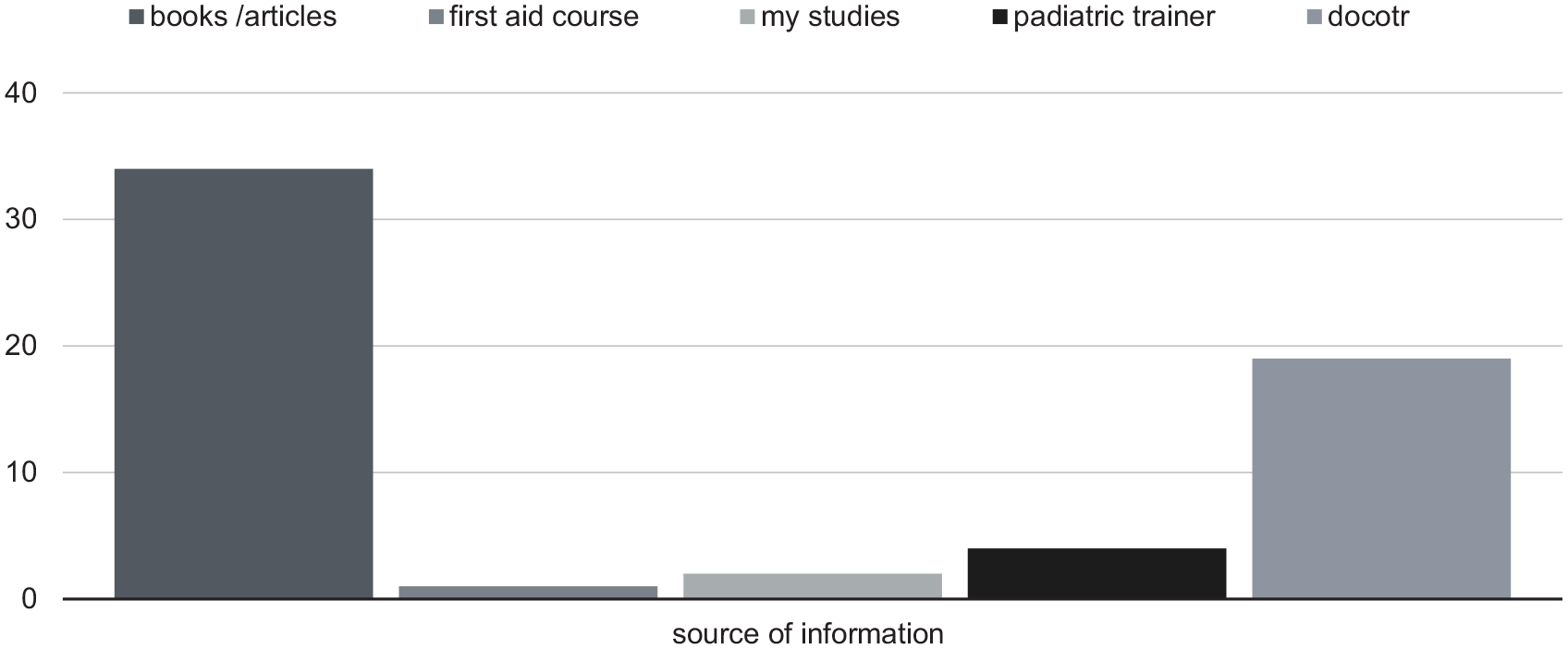
Shows participants’ sources of information.

Shows the result when the sample was asked about their knowledge about pediatrics first aid arranged in descending order from most answered—37% answered it was good, 30% answered that it was very good, 20% answered that it was not enough, and 13% answered that it was excellent.

The participants were asked if they had a first aid kit in any of the following places: their bag, house, or car—56% answered with Yes and 44% answered No.
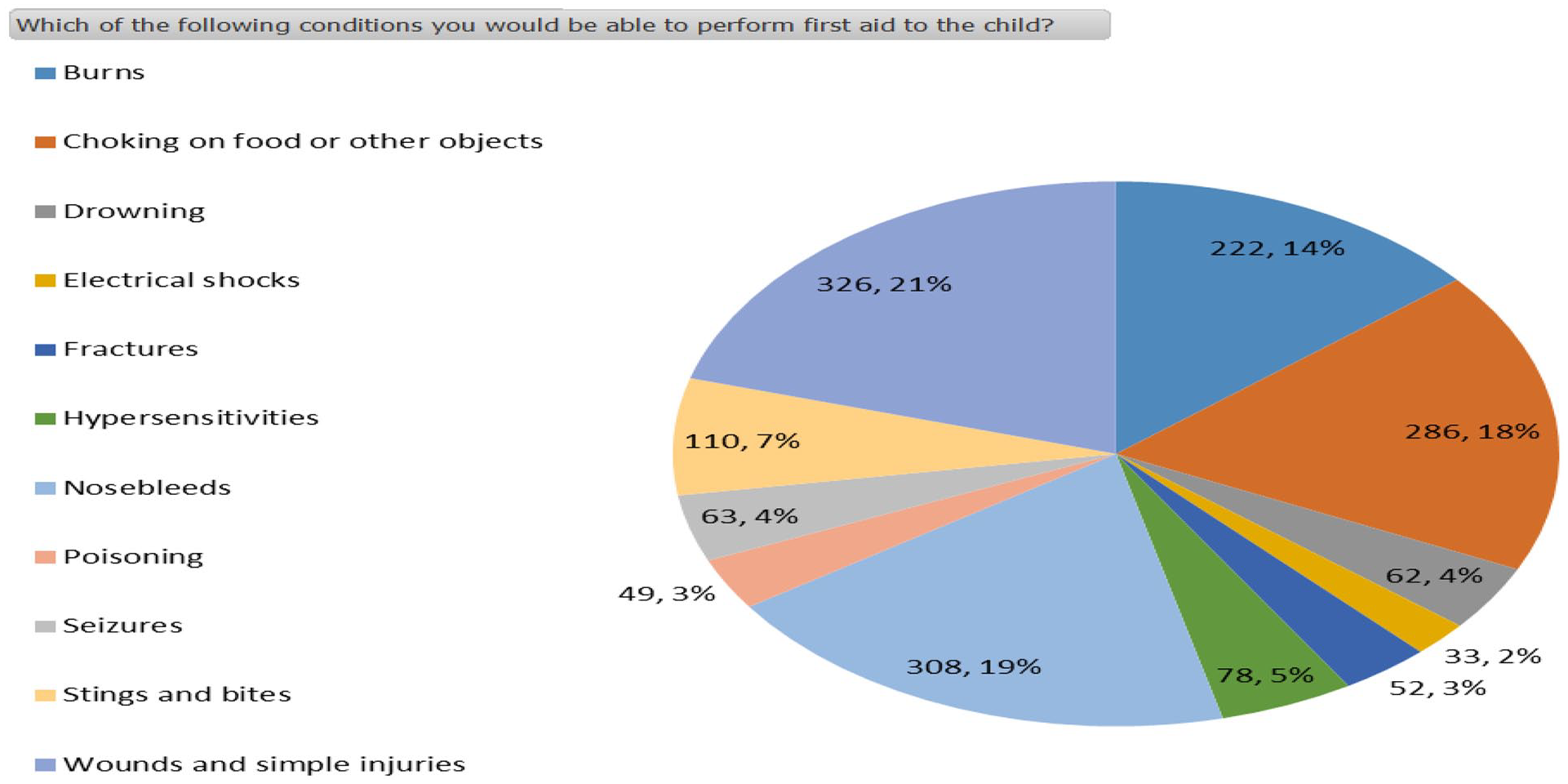
Shows conditions where participants were able to perform first aid.
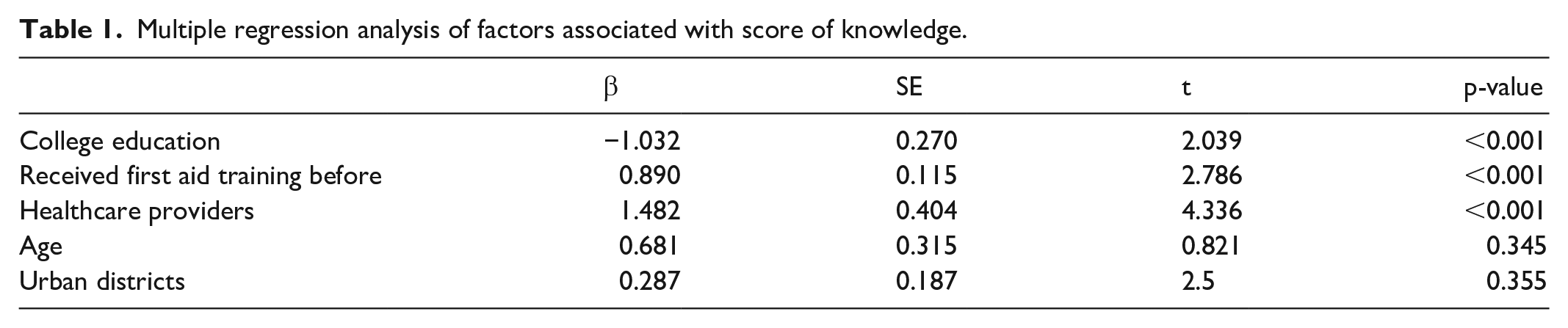
Results of the multiple linear regression analysis showed the knowledge score to be significantly higher among participants who had higher education levels (t = 2.039, p < 0.001), who had received first aid training before (t = 2.786, p < 0.0001), those who were already healthcare providers (t = 4.336, p < 0.001), those who were from rural districts (t = 2.5, p = 0.355), and younger personnel (t = 0.821, p = 0.345); the difference was not statistically significant (Table 1).
Multiple regression analysis of factors associated with score of knowledge.
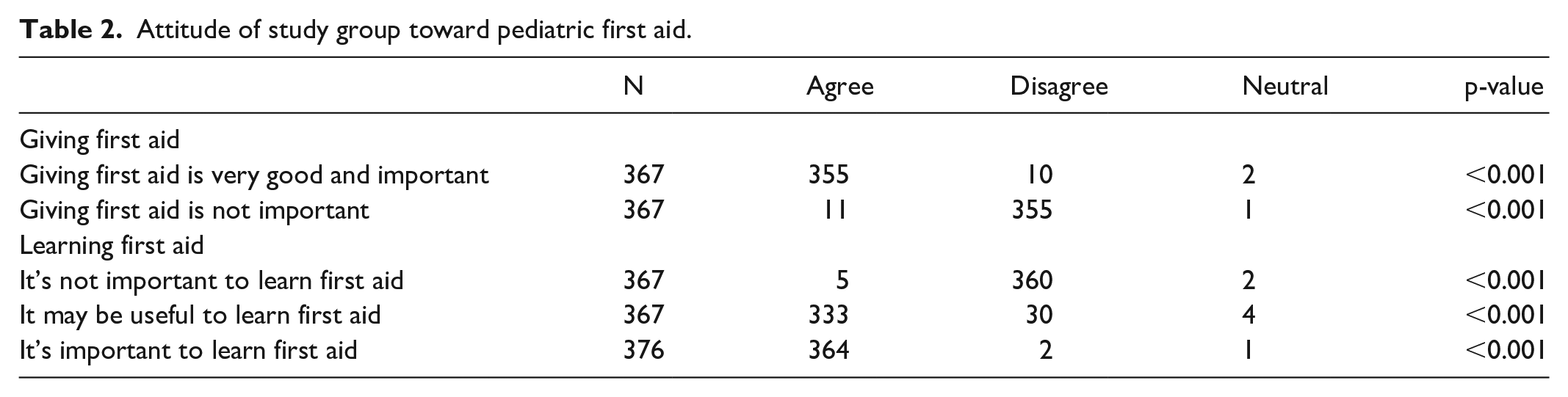
For attitudes toward the administering first aid, the majority felt positive toward providing first aid. Regarding attitudes toward learning first aid, the vast majority felt that it was an important and useful skill for them to learn.
Table 2 shows the attitude toward administering and learning first aid.
Attitude of study group toward pediatric first aid.
Discussion
Our data reveal that overall parental and community first aid knowledge is lacking, as seen by the low but noticeable frequency of incorrect responses to common illnesses and injuries. Caregivers who have completed pediatric first aid training have an 80% pass rate, according to the American Academy of Pediatrics. Only 2.8% of those polled met that condition, indicating that they lacked adequate first aid expertise. 16 Injuries to children are a leading cause of morbidity and mortality. Treatment that is delivered swiftly and effectively can help to reduce morbidity and mortality. Because they spend most of their day with their children, parents should be proficient in basic first aid skills. Only 1% of the participants in our study had undergone prior first aid training; however, they had only been taught cardiac resuscitation and not how to treat typical children’s injuries. Qureshi et al. 17 discovered that two-thirds of questioned teachers had no specific training in first aid and 40% had never been schooled in cardiopulmonary resuscitation (CPR) 18 in a study on the degree of training and emergency care knowledge of public school teachers. 19 This is in line with a previous study, which found that 30% of teachers had no formal first aid training and 40% had never been given CPR. 19 Medical emergencies, such as significant bleeding, unresponsiveness, poisoning, shock, heart or circulation failure, seizures, head trauma, anaphylaxis, or allergic reactions, are not explicitly written procedures in half of all child-care centers in the United States. 3 Because many emergencies can be managed with these lifesaving skills, parents and the public should be given greater opportunities to learn first aid and CPR. Our findings demonstrate that in the Aseer region and throughout Saudi Arabia, there are major deficiencies in the provision of first aid for children by parents and the public. One possible reason for these results is a lack of formal and adequate basic emergency care training in general preparedness programs, and a lack of basic emergency care training in general preparedness programs and a lack of ongoing education requirements. 14 A comprehensive campaign for Saudi Arabia, particularly the Aseer region, should be designed based on the findings of this study. The current findings show that healthcare providers and people who had taken a first aid course did well on the questionnaire and had basic first aid knowledge, which is likely because healthcare providers, by definition, had prior medical experience. For delivering appropriate first aid, knowledge is important but not sufficient. While attitudes about administering first aid are thought to have a direct impact on first aid performance, attitudes toward learning first aid may have a higher, albeit indirect, impact. 16 Most parents and volunteers have a favorable attitude toward delivering or studying first aid, but they still need to enhance their actual first aid knowledge and skills, according to our poll. Parents should be taught how to do pediatric evaluations and CPR on their children by pediatricians. Parents can learn about the hazards of various illnesses by teaching first aid to their children. Efforts to identify and reduce risks, and first aid training, may help to reduce the overall rate of child injury.
There were limitations to our study. It was based in the southern region of Saudi Arabia and does not necessarily represent the whole population, so more studies are needed in the kingdom. For some reason, no power calculations were performed to estimate the sample size. Our research was also constrained in that it did not assess parents’ ability to administer first aid. This was because most of our participants lacked practical skills, and first aid education alone does not guarantee good behavior in an emergency.
Conclusion
Although our study reveals that the study population has a low degree of first aid knowledge, it also reveals that they are interested in receiving sufficient training. Parents must be educated about first aid procedures and the risk factors associated with various injuries. We believe that pediatric first aid training should be made more accessible to parents and the entire public. A pan-Kingdom examination of parents’ and the general public’s knowledge and first aid abilities is recommended. To transfer knowledge to the public, more CMEs and public awareness programs are needed. For various pediatric emergencies, a visual presentation of first aid and emergency basic skills will be performed.
Supplemental Material
sj-docx-1-smo-10.1177_20503121221126762 – Supplemental material for Pediatric first aid, trauma knowledge, and attitude among parents and general population in Aseer region, Southern Saudi Arabia
Supplemental material, sj-docx-1-smo-10.1177_20503121221126762 for Pediatric first aid, trauma knowledge, and attitude among parents and general population in Aseer region, Southern Saudi Arabia by Javed Iqbal Wani, Nouf Omar Almushayt, Wejdan Fuad Abbag, Lama Ali Buhran and Mir Nadeem in SAGE Open Medicine
Footnotes
Declaration of conflicting interests
The author(s) declared no potential conflicts of interest with respect to the research, authorship, and/or publication of this article.
Ethical approval
Ethical approval was obtained from ethical committee of King Khalid University under Approval No. HA-06-B-001.
Funding
The author(s) received no financial support for the research, authorship, and/or publication of this article.
Informed consent
Written informed consent was obtained from all the participants.

Supplemental material
Supplemental material for this article is available online.
References
Supplementary Material
Please find the following supplemental material available below.
For Open Access articles published under a Creative Commons License, all supplemental material carries the same license as the article it is associated with.
For non-Open Access articles published, all supplemental material carries a non-exclusive license, and permission requests for re-use of supplemental material or any part of supplemental material shall be sent directly to the copyright owner as specified in the copyright notice associated with the article.
